Pathologic Outcomes during the Learning Curve for
Robotic-Assisted Laparoscopic Radical Prostatectomy
Amul Shah, Onisuru T. Okotie, Lee Zhao, Michael R. Pins, Vishal Bhalani, Daniel P. Dalton
Department of Urology (AS, OTO, LZ, VB, DPD) and Department of Pathology (MRP), Northwestern
University, Feinberg School of Medicine, Chicago, Illinois, USA
ABSTRACT
Objective: We report our initial experience with 62 patients undergoing robotic-assisted laparoscopic prostatectomy (RALP), focusing on the primary parameter of positive surgical margins. The authors demonstrate that excellent oncologic outcomes can be attained with a less steep learning curve than previously hypothesized.
Materials and Methods: The irst 62 patients undergoing RALP by a single physician (DPD) at our institution between
November 2005 and August 2007 were retrospectively assessed. Surgical pathology records were reviewed for Gleason score, pathologic tumor stage, nodal status, location of prostate cancer within the specimen, extracapsular extension, surgi-cal margin status, presence of perineural invasion, tumor volume, and weight of the surgisurgi-cal specimen. Margin status was determined using surgical specimens only, and not intraoperative frozen sections. All cases in this series were completed using the four-arm da Vinci Robotic System (Intuitive Surgical, Sunnyvale, California).
Results: Sixty-one patients had prostate cancer on their inal surgical pathology specimens. Pathologic stage T2 and stage
T3 patients were 88.7% and 9.7% of all cases, respectively. The pathologic Gleason score was 7 or greater in 62.3%. Our overall positive surgical margin rate was 3.3%. Patients with pathologic T2 and T3 disease had a positive surgical margin rate of 1.8% and 16.7%, respectively.
Conclusions: Our study suggests that RALP can have equal if not better pathologic outcomes compared to open radical prostatectomy even during the initial series of cases. We argue that the learning curve for RALP is shorter than previously thought with respect to oncologic outcomes, and concerns asserting that lack of tactile feedback leads to poor oncologic outcomes are unfounded.
Key words: prostate cancer; prostatectomy; laparoscopy; robotic-assisted; outcomes
Int Braz J Urol. 2008; 34: 159-63
INTRODUCTION
Robotic-assisted laparoscopic prostatectomy (RALP) is becoming increasingly prevalent as the desire for less-invasive procedures continues to grow and the surgery itself becomes more reined. Robotic surgery irst appeared in urology in 2000 (1). Since its debut, reinements and the relative increase in ease of the surgery have allowed an increasing number
MATERIAL AND METHODS
We retrospectively reviewed surgical pathol-ogy data for the irst 62 consecutive RALPs performed at our institution by a single surgeon (DPD) between November 2005 and August 2007. Although not fellowship-trained in laparoscopy, the surgeon had extensive experience with open radical prostatectomy and laparoscopic renal surgery. Surgical pathology records were reviewed for Gleason score, pathologic tumor stage, nodal status, locations of prostate cancer within the specimen, extracapsular extension, surgi-cal margin status, presence of perineural invasion, tumor volume, and weight of the surgical specimen. One patient had Stage pT0 disease and was excluded from our analysis.
All cases in this series were completed us-ing the four-arm da Vinci Robotic System (Intuitive Surgical, Sunnyvale, California). A transperitoneal approach was used for all cases with 4 robotic arm ports and 2 assistant ports. Pelvic lymphadenectomy was performed if clinically indicated (Gleason score
≥ 7, PSA > 10). We routinely attempt to spare the bladder neck, as it is our subjective impression this improves early return of continence. Nerve sparing is performed by identifying the plane between the prostatic capsule and neurovascular bundle at the base of the prostate and carrying it distally to the prostatic apex while staying as close to the prostatic capsule as possible. No attempt at a primary lateral release of the neurovascular bundle is made. Posterior dissection consists of dividing Denonvilliers’ fascia and dissec -tion along the capsule distally to the prostatic apex. Apical dissection is always performed with apical capsule in view. If a previously placed dorsal vein ligature is obstructing visualization of the apex during dissection, it is removed so the natural planes of dis-section are not altered. A second ligature is then placed after apical dissection is complete. A urinary catheter and abdominal drain was placed in all patients. One patient in our series required a blood transfusion.
RESULTS
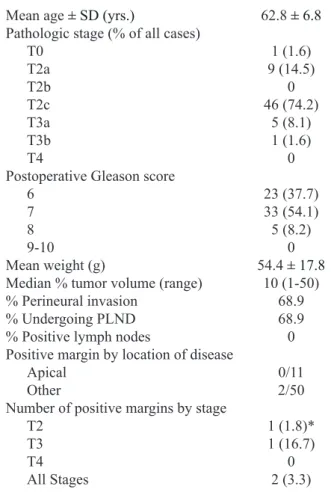
Patient and pathologic variables are summa-rized in Table-1. There was one open conversion for
moderate bleeding in a Jehovah’s Witness (patient 23). This patient had the sole T2 positive margin. Three additional patients whose procedures were converted (one failure to maintain pneumoperi-toneum, two failures to progress) had negative margins. Pathologic stage T2 and stage T3 patients were 88.7% and 9.7% of all cases, respectively. The pathologic Gleason score was 7 or greater in 62.3%. Mean prostate weight was 54.4g and median tumor volume was 10%. Perineural invasion was present in 68.9% of patients.
Our overall positive surgical margin rate was 3.3%. Patients with pathologic T2 and T3 disease had a positive surgical margin rate of 1.8% and 16.7%, respectively. Of the 11 patients in our series who had apical disease, none had a positive surgical margin. Pelvic lymph node dissection (PLND) was completed in 68.9% of patients. No patient had lymphatic me-tastasis identiied.
COMMENTS
RALP has the obvious benefit of being minimally invasive; however, in order to become universally adopted, surgeons must be confident that oncologic and functional outcomes are at least equivalent to open surgery. Ahlering et al. concluded that RALP offers the beneits of minimally invasive surgery without compromising clinical or pathologic outcomes (6). Our study conirms that superior patho -logic outcomes can be attained even during the initial set of RALP cases performed.
To put into perspective what is an acceptable positive surgical margin rate for RALP, one can refer to the literature for radical retropubic prostatectomy. In a consecutive series of 1,000 cases between 1994 and 2000, Lepor et al. demonstrated a positive surgical margin rate of 19.9% (7). In a large series of 9,035 cases, Han et al. showed an overall positive margin rate of 14.7% (8).
al. reported rates of 16% and 13%, respectively (3,10). Finally, a large series of 2,652 patients demonstrated a positive surgical margin rate of 13% (11). When broken down by pathological stage, our data showed positive margin rates of 1.8% and 16.7% for stage T2 and T3 disease, respectively.
Multiple studies show that positive margins following radical prostatectomy are more likely to result from cancers in the apical region than from other regions (12,13). Among our 61 patients, 11 had apical disease, but none had positive margins. In contrast, Mikhail et al. reported positive apical margins in 4 of their 100 patients (10).
A literature review article by Hegarty & Kaouk showed that positive surgical margin rates were comparable between radical retropubic prostatectomy, laparoscopic radical prostatectomy, and RALP (14). Others have suggested the positive margin rate is related to experience with RALP (15). These studies suggest the margin rate is less a function of the procedure than the experience of the surgeon. It is our belief, however, that the enhanced visualization of important anatomic landmarks provided by RALP results in lower positive margin rates. Anecdotally, it has been the experience of one of the authors (MRP) that prostatectomies by a surgeon who has performed a large number of RALPs generally have intact, non-fragmented capsular tissue making the microscopic assessment of the surgical margins easier.
Our series allows us to draw conclusions that may possibly affect the view regarding usage of RALP in the ield of urology. We were able to demonstrate not only that a superior positive surgical margin rate is attainable via RALP, but it is possible without as steep a learning curve as previously hy-pothesized. To our knowledge, our positive margin rate was lower than any previous RALP series, and we have the added study characteristic that all of the surgeries were done by a single physician. Of course, we recognize that our low positive margin rate would not be possible were it not for the surgeons who pioneered RALP; their work in ine-tuning the surgi -cal technique was essential in attaining our results. Our results indicate that the lack of tactile feedback with RALP has absolutely no impact on oncologic outcomes.
CONCLUSION
The pathologic outcomes of our study cohort indicate that excellent, perhaps superior, oncologic outcomes can be obtained during the learning curve for RALP. Fear of exposing one’s patients to an in -ferior result should not dissuade the urologist from learning this excellent technique. Furthermore, the lack of tactile feedback with RALP appears to have absolutely no negative effect on surgical margin rates.
Table 1 – Patient and pathology characteristics (N = 62).
Mean age �� SD (yrs.) 62.8 �� 6.8
Pathologic stage (% of all cases)
T0 1 (1.6)
T2a 9 (14.5)
T2b 0
T2c 46 (74.2)
T3a 5 (8.1)
T3b 1 (1.6)
T4 0
Postoperative Gleason score
6 23 (37.7)
7 33 (54.1)
8 5 (8.2)
9-10 0
Mean weight (g) 54.4 �� 17.8
Median % tumor volume (range) 10 (1-50)
% Perineural invasion 68.9
% Undergoing PLND 68.9
% Positive lymph nodes 0
Positive margin by location of disease
Apical 0/11
Other 2/50
Number of positive margins by stage
T2 1 (1.8)*
T3 1 (16.7)
T4 0
All Stages 2 (3.3)
CONFLICT OF INTEREST
None declared.
REFERENCES
1. Binder J, Bräutigam R, Jonas D, Bentas W: Robotic surgery in urology: fact or fantasy? BJU Int. 2004; 94:
1183-7.
2. Schuessler WW, Schulam PG, Clayman RV, Kavoussi
LR: Laparoscopic radical prostatectomy: initial short-term experience. Urology. 1997; 50: 854-7.
3. Patel VR, Tully AS, Holmes R, Lindsay J: Robotic
radical prostatectomy in the community setting--the
learning curve and beyond: initial 200 cases. J Urol. 2005; 174: 269-72.
4. Herrell SD, Smith JA Jr: Robotic-assisted laparoscopic prostatectomy: what is the learning curve? Urology. 2005; 66 (5 Suppl): 105-7.
5. Ficarra V, Cavalleri S, Novara G, Aragona M, Artibani
W: Evidence from robot-assisted laparoscopic radical prostatectomy: a systematic review. Eur Urol. 2007; 51: 45-55; discussion 56.
6. Ahlering TE, Woo D, Eichel L, Lee DI, Edwards R, Skarecky DW: Robot-assisted versus open radical prostatectomy: a comparison of one surgeon’s out
-comes. Urology. 2004; 63: 819-22.
7. Lepor H, Nieder AM, Ferrandino MN: Intraoperative
and postoperative complications of radical retropubic prostatectomy in a consecutive series of 1,000 cases.
J Urol. 2001; 166: 1729-33.
8. Han M, Partin AW, Chan DY, Walsh PC: An evalua -tion of the decreasing incidence of positive surgical margins in a large retropubic prostatectomy series. J
Urol. 2004; 171: 23-6.
9. Rozet F, Jaffe J, Braud G, Harmon J, Cathelineau X,
Barret E, et al.: A direct comparison of robotic assisted versus pure laparoscopic radical prostatectomy: a single institution experience. J Urol. 2007; 178: 478-82.
10. Mikhail AA, Orvieto MA, Billatos ES, Zorn KC, Gong
EM, Brendler CB, et al.: Robotic-assisted laparoscopic prostatectomy: irst 100 patients with one year of fol
-low-up. Urology. 2006; 68: 1275-9.
11. Menon M, Shrivastava A, Kaul S, Badani KK, Fumo
M, Bhandari M, et al.: Vattikuti Institute prostatec
-tomy: contemporary technique and analysis of results. Eur Urol. 2007; 51: 648-57; discussion 657-8. 12. Dahl DM, He W, Lazarus R, McDougal WS, Wu CL:
Pathologic outcome of laparoscopic and open radical
prostatectomy. Urology. 2006; 68: 1253-6.
13. Ahlering TE, Eichel L, Edwards RA, Lee DI, Skarecky DW: Robotic radical prostatectomy: a technique to reduce pT2 positive margins. Urology. 2004; 64: 1224-8. 14. Hegarty NJ, Kaouk JH: Radical prostatectomy: a
comparison of open, laparoscopic and robot-assisted laparoscopic techniques. Can J Urol. 2006; 13 (1
Suppl): 56-61.
15. Atug F, Castle EP, Srivastav SK, Burgess SV, Thomas
R, Davis R: Positive surgical margins in robotic-as
-sisted radical prostatectomy: impact of learning curve on oncologic outcomes. Eur Urol. 2006; 49: 866-71;
discussion 871-2.
Accepted after revision: March 5, 2008
Correspondence address: Dr. Daniel P. Dalton
Northwestern Memorial Hospital 201 E. Huron, Suite 10-200 Chicago, IL, 60611, USA
Fax: + 1 312-926-3585
EDITORIAL COMMENT
This initial experience of authors with ro-botic-assisted laparoscopic radical prostatectomy was very enthusiastic, specially considering that the surgeon had never done pure laparoscopic prostatec-tomy but had renal laparoscopic skills.
I am very impressive with the very low rate of positive margins in his initial robotic experience, maybe one of the lowest of the literature, even con-sidering surgeons with much more surgeries done. I am intrigued with this and I might consider the possibility that the surgeon had been not so closed to prostatic capsule as he stated. I am curious about
the functional results even considering the short fol-low-up. The space between prostatic capsule and the nerves is very restricted. In order to obtain the best oncologic result one could compromise the functional results and vice-versa. It is well established that suc-cessful treatment of prostatic cancer considers three aspects: PSA free, full return of continence and full return of sexual function.
Anyway, this paper encourages those no laparoscopist surgeons to start in robotic assisted laparoscopic prostatectomy.