256 Jornal de Pediatria - Vol. 86, No. 4, 2010 2009 impact factor - Procianoy RS
Correspondence: Renato S. Procianoy Rua Silva Jardim, 1155/701
CEP 90450-071 - Porto Alegre, RS - Brazil E-mail: [email protected]
References
1. Garield E. The history and meaning of the journal impact factor. JAMA. 2006;295:90-3.
2. Procianoy RS. The journal impact factor today. J Pediatr (Rio J). 2007;83:487.
3. Piccoli N, Procianoy RS. Brazilian scientiic journals: an overview. Eur Sci Edit 2007;33:73-4.
4. Parizoto GM, Parada CM, Venâncio SI, Carvalhaes MA. Trends and patterns of exclusive breastfeeding for under-6-month-old children. J Pediatr (Rio J). 2009;85:201-8.
5. Passoni CR, Coelho CA. Ascorbic acid supplementation has a cytoprotective effect on secondary biliary cirrhosis: experimental study in young rats. J Pediatr (Rio J). 2008;84:522-8.
6. Almeida MF, Guinsburg R, Martinez FE, Procianoy RS, Leone CR, Marba ST, et al. Perinatal factors associated with early deaths of preterm infants born in Brazilian Network on Neonatal Research centers. J Pediatr (Rio J). 2008;84:300-7.
7. Moraes MA, Bonatto RC, Carpi MF, Ricchetti SM, Padovani CR, Fioretto JR. Comparison between intermittent mandatory ventilation and synchronized intermittent mandatory ventilation with pressure support in children. J Pediatr (Rio J). 2009;85:15-20.
8. Procianoy RS. Commitment to quality. J Pediatr (Rio J). 2002;78:83.
Toward high quality medical care for sickle cell disease:
are we there yet?
Jane Hankins*
S
ickle cell disease (SCD), one of the most common single gene disorders in the world, affects approximately 280,000 live births per year worldwide; SCD and thalassemiasyndromes together account for 3.4% of all deaths of children younger than 5 years.1 Infants with SCD are particularly at
risk of premature mortality from SCD because of the early loss of the iltrative function of the spleen.2,3 This places
these vulnerable infants at a high risk of invasive infection
by encapsulated organisms, especially pneumococcus. In
addition, splenic sequestration is an important SCD-related
complication that, if not recognized and treated early in its course, can lead to circulatory collapse and death.4
Despite the increased risk of fatal complications in early life, mortality rates of patients with SCD have signiicantly
* MD, MS. Assistant member, Department of Hematology, St. Jude Children’s Research Hospital, Memphis, TN, USA. No conflicts of interest declared concerning the publication of this editorial.
Suggested citation: Hankins J. Toward high quality medical care for sickle cell disease: are we there yet? J Pediatr (Rio J). 2010;86(4):256-258. doi:10.2223/JPED.2021
One of the reasons for the success of Jornal de Pediatria is the diversity of the articles published. The topics addressed in our articles range from primary care issues,
such as breastfeeding, to translational research, as well as
observational studies and clinical randomized trials.4-7 Our
only commitment is to guarantee the scientiic quality of
the manuscripts accepted for publication. We have achieved
the objective set out when I was nominated as
editor-in-chief of Jornal de Pediatria, in March 2002. At that time,
we decided that Jornal de Pediatria should bridge the gap between basic research and clinical practice in pediatrics, always contributing to spread new knowledge and trying to keep our readers updated about the most recent scientiic indings in the ield.8
Such excellent result is a consequence of the hard work
and effort of many people: the associate and executives
editors, who have actively participated in the project over the years; the Editorial Board, which has always replied to our
requests promptly; the presidents of the Brazilian Society of
Pediatrics, Lincoln Marcelo Silveira Freire, Dioclécio Campos Jr., and Eduardo da Silva Vaz, who have always supported
our decisions; the board of the Brazilian Society of Pediatrics,
which has provided the necessary support for the journal’s development; the independent reviewers, who were always
ready to collaborate; and, in particular, the investigators,
who submitted excellent articles for publication.
In sum, I hope that this is just the beginning of the
journey for the scientiic growth and international recognition
Jornal de Pediatria - Vol. 86, No. 4, 2010 257 Medical care for sickle cell disease - Hankins J
Under Main Number of Duration of
5-year Disease Period cause of patients observation
Region survival (%) genotype of analysis death evaluated (person-years)
Minas Gerais, Brazil11 89.4 HbSS and HbSβ0-thal 1998-2005 Sepsis 764 2,493
Kingston, Jamaica16 91 HbSS 1979-1994 ACS 105 Not available
Los Angeles, United States17 ~ 93 HbSS 1975-2003 Sepsis 172 Not available
Cooperative Study of
Sickle Cell Disease*18 95 HbSS 1978-1988 Sepsis 427 1,781
Dallas, United States8 99.2 HbSS and HbSβ0-thal 2000-2007 ACS 180† 663.6
London, England19 100 HbSS 1982-2005 N/A 180 1,542
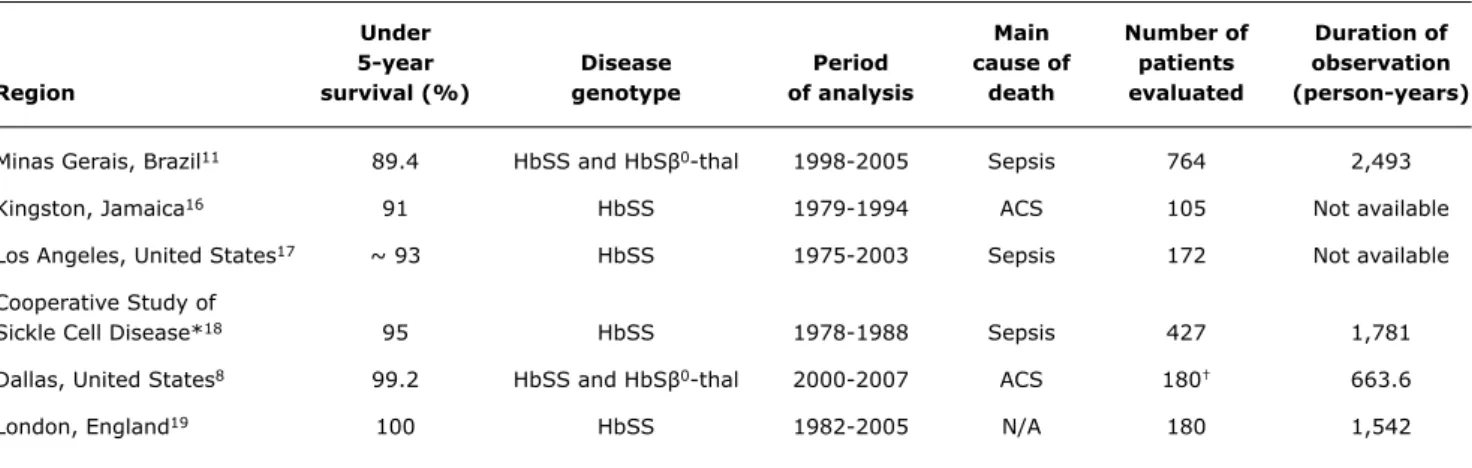
Table 1 - Comparison of survival rates of children with sickle cell anemia younger than 5 years from different regions of the world where newborn screening for hemoglobinopathies is available
ACS = acute chest syndrome; N/A = not applicable.
* Nineteen clinical sickle cell disease centers in the United States.
† These 180 patients represent a subset of the Dallas Newborn Cohort that has a total of 940 patients with a total of 8,857 patient-years of follow-up.
See related article on page 279 declined over the past 4 decades. The most signiicant
decrease has occurred in the irst 5 years of life, with a continued shift toward mortality later in life.5 This important
trend of increased survival among children can be attributed
to simple measures such as early diagnosis, followed by prophylactic therapy and anticipatory guidance. The irst
and most fundamental of these steps is the implementation
of screening programs for newborns. Identiication of an at-risk young population has allowed targeted use
of prophylactic penicillin and special
immunization with Streptococcus
pneumoniae, Haemophilus inluenzae,
and Meningococcus meningitidis
vaccinations. These basic public health strategies have positively impacted the overall outcome of pediatric patients
with SCD not only in the USA but also worldwide.6,7
Recent statistics from a pediatric cohort from Dallas, TX, USA, shows that the chances of children with SCD dying
before 5 years of age are less than 1%.8 This represents a
major shift from the 1960s and 1970s, when many children with SCD were not expected to live into adulthood and their risk of sepsis was 20 to 30 times higher than that of the
general population.9,10 In this issue of Jornal de Pediatria, Dr.
Fernandes and her colleagues have elegantly demonstrated that implementation of an organized, centralized, and
well-designed newborn screening program, followed by
diligent employment of basic clinical standards, is able to
yet again impact and modify the natural course of SCD
among young children. Survival rates of children from
Minas Gerais, Brazil, who have SCD and are younger than 5 years, are comparable with those from North America,
Europe, and the Caribbean, despite the relatively brief
existence of Brazil’s hemoglobinopathy newborn screening
program (Table 1).11
In the future, further improvements are expected in
the Brazilian SCD program. Dr. Fernandes’s study found
that the rate of special immunization (pneumococcal
and meningococcal vaccinations) was very low among fatal cases (only 40% of the children who died were
immunized), and 31% of patients succumbed to acute splenic sequestration. This underlines the need for a greater effort
toward global immunization against
encapsulated organisms. In addition, further investment in educating family members about the complications of
SCD could have prevented fatal cases
of splenic sequestration. A greater emphasis on educating health care providers from primary health care
units about SCD is likely to improve the outcome of many more children with SCD. Considering that 58% of the families who lost a child with SCD in Minas
Gerais had a monthly income of less than US$ 50.00, the
relative low death rate observed in Dr. Fernandes’s work shows that adequate diagnosis and medical care can prevent
mortality even in the setting of extreme poverty.
Another potential disease modiier that could impact the natural history of SCD and reduce early mortality is hydroxyurea therapy. Hydroxyurea appeared to have prevented deaths among adults with SCD in the United
States and Greece.12,13 Given its ease of administration and
low cost, hydroxyurea therapy could be adopted and used
in developing nations. The feasibility of its use, including
258 Jornal de Pediatria - Vol. 86, No. 4, 2010
Correspondence: Jane S. Hankins
St. Jude Children’s Research Hospital 262 Danny Thomas St., Mail Stop 800 Memphis, TN 38105 - USA
E-mail: [email protected] References
1. Modell B, Darlison M. Global epidemiology of haemoglobin disorders and derived service indicators. Bull World Health Organ. 2008;86:480-7.
2. Pearson HA, Spencer RP, Cornelius EA. Functional asplenia in sickle-cell anemia. N Engl J Med. 1969;281:923-6.
3. Brown AK, Sleeper LA, Miller ST, Pegelow CH, Gill FM, Waclawiw MA. Reference values and hematologic changes from birth to 5 years in patients with sickle cell disease. Cooperative Study of Sickle Cell Disease. Arch Pediatr Adolesc Med. 1994;148:796-804.
4. Kinney TR, Ware RE, Schultz WH, Filston HC. Long-term management of splenic sequestration in children with sickle cell disease. J Pediatr. 1990;117:194-9.
5. Hassell KL. Population estimates of sickle cell disease in the U.S. Am J Prev Med. 2010;38:S512-21.
6. King L, Fraser R, Forbes M, Grindley M, Ali S, Reid M. Newborn sickle cell disease screening: the Jamaican experience (1995-2006). J Med Screen. 2007;14:117-22.
7. Rahimy MC, Gangbo A, Ahouignan G, Alihonou E. Newborn screening for sickle cell disease in the Republic of Benin. J Clin Pathol. 2009;62:46-8.
8. Quinn CT, Rogers ZR, McCavit TL, Buchanan GR. Improved survival of children and adolescents with sickle cell disease. Blood. 2010;115:3447-52.
9. Kabins SA, Lerner C. Fulminant pneumococcemia and sickle cell anemia. JAMA. 1970;211:467-71.
10. Robinson MG, Watson RJ. Pneumococcal meningitis in sickle-cell anemia. N Engl J Med. 1966;274:1006-8.
11. Fernandes AP, Januário JN, Cangussu CB, de Macedo DL, Viana MB. Mortality of children with sickle cell disease: a population study. J Pediatr (Rio J). 2010;86:279-84.
12. Steinberg MH, Barton F, Castro O, Pegelow CH, Ballas SK, Kutlar A, et al. Effect of hydroxyurea on mortality and morbidity in adult sickle cell anemia: risks and beneits up to 9 years of treatment. JAMA. 2003;289:1645-51.
13. Voskaridou E, Christoulas D, Bilalis A, Plata E, Varvagiannis K, Stamatopoulos G, et al. The effect of prolonged administration of hydroxyurea on morbidity and mortality in adult patients with sickle cell syndromes: results of a 17-year, single-center trial (LaSHS). Blood. 2010;115:2354-63.
14. Charache S, Terrin ML, Moore RD, Dover GJ, Barton FB, Eckert SV, et al. Effect of hydroxyurea on the frequency of painful crises in sickle cell anemia. Investigators of the Multicenter Study of Hydroxyurea in Sickle Cell Anemia. N Engl J Med. 1995;332:1317-22. 15. Hankins JS, Helton KJ, McCarville MB, Li CS, Wang WC, Ware RE.
Preservation of spleen and brain function in children with sickle cell anemia treated with hydroxyurea. Pediatr Blood Cancer. 2008;50:293-7.
16. Lee A, Thomas P, Cupidore L, Serjeant B, Serjeant G. Improved survival in homozygous sickle cell disease: lessons from a cohort study. BMJ. 1995;311:1600-2.
17. Powars DR, Chan LS, Hiti A, Ramicone E, Johnson C. Outcome of sickle cell anemia: a 4-decade observational study of 1056 patients. Medicine (Baltimore). 2005;84:363-76.
18. Gill FM, Sleeper LA, Weiner SJ, Brown AK, Bellevue R, Grover R, et al. Clinical events in the irst decade in a cohort of infants with sickle cell disease. Cooperative Study of Sickle Cell Disease. Blood. 1995;86:776-83.
19. Telfer P, Coen P, Chakravorty S, Wilkey O, Evans J, Newell H, et al. Clinical outcomes in children with sickle cell disease living in England: a neonatal cohort in East London. Haematologica. 2007;92:905-12.
Medical care for sickle cell disease - Hankins J
basic infrastructure in place, it is doable. Hydroxyurea
therapy has the potential to reduce mortality rates of
young children with SCD because of its possible role in
organ protection and proven effect in reducing acute vaso-occlusive episodes.14,15
Finally, it is important to note that the creation of an
enterprise that will be responsible for successfully diagnosing and treating SCD in the context of an emerging economy
requires substantial efforts from its organizers and sustained
government support. Despite the natural obstacles to establishing such a medical infrastructure, as well as the substantial low socioeconomic status of most patients, deaths can be prevented and outcomes improved with such an undertaking. The experience in Brazil can serve as an example to many other nations with similar socioeconomic circumstances. As caregivers of SCD, we have come a long way, and although we have not yet achieved the goal of excellence in medical care for all patients with SCD, the
road ahead may be successfully traveled.
Acknowledgements
The author is indebted to Dr. Charles Quinn, MD,
for providing additional information about survival from
the Dallas Newborn Cohort, and Drs. Winfred Wang, MD and Vani Shanker, PhD for helpful comments on the