Abstract
Objective: To evaluate the causes of disposal of donated human milk and the impact of the measures taken to reduce the amount of milk unsuitable for consumption.
Methods: A quasi-experimental, observational, comparative study was conducted with different populations of external donors in 2006 and 2008. In 2006, a simple form was used to record the criteria for disposal of the donated milk. We also interviewed the donors to ind the reason of changes in the milk. In 2008, a checklist containing comprehensive guidance for milk collection and pre-storage was handed out to the donors. Next, we continued to survey the disposal criteria after the intervention using the same form administered in 2006. A case was deined as all bottles of milk of the same donor discarded per day. Data were analyzed by calculations based on comparison of proportions for 2006 and 2008.
Results: Twenty-four percent of the milk collected was discarded in 2006, while in 2008 only 10.5% of the milk was discarded. There was signiicant reduction in the disposal of milk for the items: cigarette odor; forgetting the milk outside the refrigerator, inside it or on its door; problems with the freezer; frequent opening of the refrigerator and freezer; expiration date; and unidentiied cases. However, there was a signiicant increase in milk disposal for irst milk collection without guidance; use of inappropriate bottle; milk transportation from work to home; and indirect guidance.
Conclusions: The use of the step-by-step checklist had a positive impact on the reduction of the volume of donated milk discarded and changed the frequency of the causes of disposal, eliminating some of these causes.
J Pediatr (Rio J). 2010;86(4):290-294: Human milk, selection, donor, analysis.
O
RiginAlA
RtiCleCopyright © 2010 by Sociedade Brasileira de Pediatria
290
introduction
A major concern of human milk banks (HMB) is to have suficient milk supplies to meet the demand. A manner to achieve this goal is by decreasing the volume discarded after the analysis of raw milk in the early stages of processing, that is, during screening upon milk delivery, after thawing
based on the appearance and odor, and inally according to the titration of milk acidity. During these stages, the disposal of the milk collected from external donors at home is related to environmental contaminants because of failures in the collection technique, pre-storage, cold
Disposal of human milk donated to a human milk bank
before and after measures to reduce the amount
of milk unsuitable for consumption
Ana l. grazziotin,1 Maria C. B. grazziotin,2 luiz A. J. letti3
1. Mestranda, Biologia Celular e Molecular, Universidade Federal do Paraná (UFPR), Curitiba, PR, Brazil.
2. Consultora Internacional em Lactação, International Board of Lactation Consultant Examiners. Coordenadora, Banco de Leite Humano, Hospital de Clínicas, UFPR, Curitiba, PR, Brazil. Professora, Saúde da Mulher e da Criança, Banco de Leite Humano, Hospital de Clínicas, UFPR, Curitiba, PR, Brazil.
3. Professor assistente I, Curso de Engenharia de Bioprocessos e Biotecnologia, UFPR, Curitiba, PR, Brazil.
Study conducted at the Human Milk Bank, Hospital de Clínicas, Universidade Federal do Paraná (UFPR), Curitiba, PR, Brazil.
Financial support: Hospital de Clínicas, Universidade Federal do Paraná (UFPR), Curitiba, PR, Brazil.
No conflicts of interest declared concerning the publication of this article.
Suggested citation: Grazziotin AL, Grazziotin MC, Letti LA. Disposal of human milk donated to a human milk bank before and after measures to reduce the amount of milk unsuitable for consumption. J Pediatr (Rio J). 2010;86(4):290-294.
Manuscript received Dec 17 2009, accepted for publication Apr 30 2010.
chain maintenance, management of the collection bottle, causing changes in the properties of milk and making it unit for consumption.
Human milk has no physical barrier that prevents the presence of microorganism1 and it behaves like a semi-plastic
luid that can undergo changes at the molecular level.2 It
is not sterile (has saprophytic lora) and may be affected by primary contamination (blood source) and secondary contamination (skin and environment) with microorganisms that penetrate the breast1-3 and, although it has effective bacteriostatic and bactericidal factors to protect it from its lora, it is not always as effective against external contaminants.1,2,4 Quality control starts before removing the irst drop from the breast, starting with the guidelines provided to the donor and the cold chain maintenance, and continuing throughout all stages of milk processing until it is offered to newborns and preterm infants.2,3,5,6 High quality of human milk is essential for these babies’ survival and to protect them against infections in general.7
At the HMB, after receipt of raw expressed human milk (REHM), the irst stage of processing is the registration and screening of the milk, followed by storage, thawing, rescreening (presence of impurities, color, off lavor and Dornic acidity), rebottling, pasteurization, cooling, microbiological analysis, and inal freezing.1,4,8 At each stage, milk is assessed, and those bottles approved in the previous stage go on to the next stage.
Considering the relevance of the topic, the objective of the present study was to evaluate the causes of disposal of donated human milk and the impact of the measures taken to decrease the amount of milk unsuitable for consumption.
Methods
We conducted a retrospective observational study using a comparative quasi-experimental design at the HMB of Hospital de Clínicas (HC), Universidade Federal do Paraná (UFPR), Curitiba, state of Paraná, Brazil. We surveyed and analyzed data about the milk discarded from all the 1,926 donors visited in 2006 and from all the 1,798 donors in 2008 after taking measures for focused assessment and guidance.
In January 2006, the investigation on milk disposal was initiated. We deined as a “case” all bottles of milk discarded per day from the same donor. To manage the data collect in 2006, a questionnaire named “Identiication and measures taken in cases of non-compliant human milk,” which included the name of the donor, total volume of milk, and the number of discarded bottles, was used to record the non-compliance criteria of the milk received (acidity, off lavor, packaging, impurities, color) and to
enable traceability. At each subsequent home visit, milk disposal was reported to donors and we interviewed them to identify the possible failure in the process that involves
the whole collection procedure, from sanitation to pre-storage (temporary condition in which the product is kept until being delivered to the BMB).
Based on the fact that in 2007 the causes of disposal were still present, we decided to use a new form beginning in January 2008. This checklist (Figure 1) included the step-by-step procedure regarding collection technique, careful measures related to the collection bottle, washing hands and breasts, right place, devices used, pre-storage, among other items. During weekly home visits, the form was handed out to each donor along with an educational booklet. We informed the donors about each case of discarded milk during the subsequent home visit in order to get the checklistreviewed with the purpose of diagnosing a possible failure in the procedure and to record such failure on the form “Identiication and measures taken in cases of non-compliant human milk.” Data were analyzed by calculations based on comparison of proportions for 2006 and 2008.
This study was approved by the Research Ethics Committee of HC-UFPR under the number 2115.010/2010-01 and by the Certiicate of Presentation Ethical Evaluation (CAAE) under the number 0313.0.208.000-10.
Results
In 2006, 898 cases of disposal were detected among 741 donors. In 2008, 501 cases of disposal were detected among 392 donors. The cause of disposal was identiied in 596 (66.36%) and 415 (82.83%) cases for 2006 and 2008, respectively. In terms of total volume collected, of the 2,340 L in 2006, 24% were discarded; in 2008, of the 2,029 L collected, 10.5% were discarded.
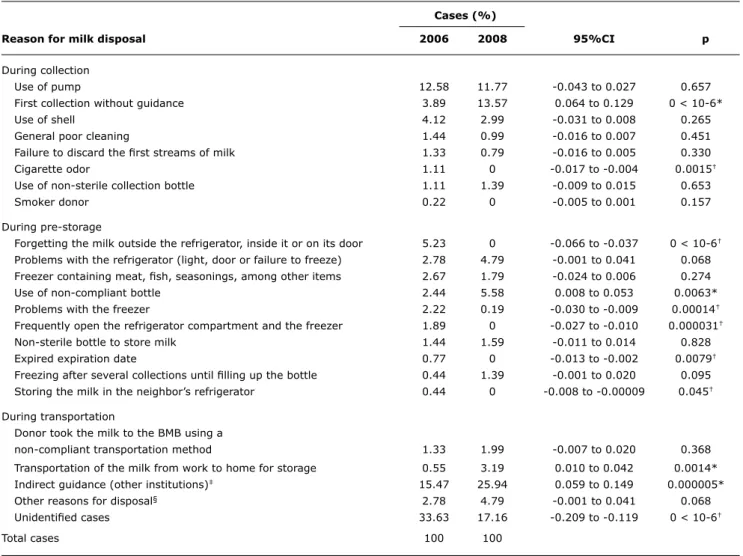
The causes of disposal were grouped according to the process stage, since milk expression until its delivery to the HMB in situations related to the collection, pre-storage, transportation, indirect guidance, other reasons for disposal, and unidentiied cases. The data are shown in Table 1.
Based on the comparative analysis of the proportions of 2006 and 2008, we found a signiicant reduction (p < 0.05) in the disposal of milk for the items cigarette odor, forgetting the milk outside the refrigerator, inside it or on its door, problems with the freezer, frequently open the refrigerator compartment and the freezer, donation after the expiration date, and unidentiied cases. The items irst milk collection without guidance; use of inappropriate bottle; milk transportation from work to home; and indirect guidance showed signiicant increases (p < 0.05) in milk disposal.
Discussion
Figure 1 - Checklist of standard guidance for human milk donors
could not ind reports investigating the causes leading to changes in the properties of milk that render it unit for consumption.
Among the reasons for discarding milk grouped into the item collection, the reason irst collection without guidance increased signiicantly in 2008. There was an increase in the number of advertising campaigns to attract donors, but the information provided was supericial and non-technical. Furthermore, there were cases in which the donors received guidance from other institutions or from laypeople, and when the home visit was requested to the HMB, the milk supply had already been delivered for donation.
Regarding to cigarette odor, lactose is able to absorb substances that vaporize to the environment and change the natural odor of human milk.2,9 These odor alterations
are determined by off lavor, which is a safe method to ind out if there are physical and chemical changes that make the milk unit for consumption.10 In 2006, donors reported they were nonsmokers, but there were people smoking in the place where they expressed the milk. After receiving additional guidance about this aspect, there was a signiicant reduction in 2008, and none case was found for this item.
Cases (%)
Reason for milk disposal 2006 2008 95%Ci p
During collection
Use of pump 12.58 11.77 -0.043 to 0.027 0.657
First collection without guidance 3.89 13.57 0.064 to 0.129 0 < 10-6*
Use of shell 4.12 2.99 -0.031 to 0.008 0.265
General poor cleaning 1.44 0.99 -0.016 to 0.007 0.451
Failure to discard the irst streams of milk 1.33 0.79 -0.016 to 0.005 0.330
Cigarette odor 1.11 0 -0.017 to -0.004 0.0015†
Use of non-sterile collection bottle 1.11 1.39 -0.009 to 0.015 0.653
Smoker donor 0.22 0 -0.005 to 0.001 0.157
During pre-storage
Forgetting the milk outside the refrigerator, inside it or on its door 5.23 0 -0.066 to -0.037 0 < 10-6†
Problems with the refrigerator (light, door or failure to freeze) 2.78 4.79 -0.001 to 0.041 0.068
Freezer containing meat, ish, seasonings, among other items 2.67 1.79 -0.024 to 0.006 0.274
Use of non-compliant bottle 2.44 5.58 0.008 to 0.053 0.0063*
Problems with the freezer 2.22 0.19 -0.030 to -0.009 0.00014†
Frequently open the refrigerator compartment and the freezer 1.89 0 -0.027 to -0.010 0.000031†
Non-sterile bottle to store milk 1.44 1.59 -0.011 to 0.014 0.828
Expired expiration date 0.77 0 -0.013 to -0.002 0.0079†
Freezing after several collections until illing up the bottle 0.44 1.39 -0.001 to 0.020 0.095
Storing the milk in the neighbor’s refrigerator 0.44 0 -0.008 to -0.00009 0.045†
During transportation
Donor took the milk to the BMB using a
non-compliant transportation method 1.33 1.99 -0.007 to 0.020 0.368
Transportation of the milk from work to home for storage 0.55 3.19 0.010 to 0.042 0.0014*
Indirect guidance (other institutions)‡ 15.47 25.94 0.059 to 0.149 0.000005*
Other reasons for disposal§ 2.78 4.79 -0.001 to 0.041 0.068
Unidentiied cases 33.63 17.16 -0.209 to -0.119 0 < 10-6†
Total cases 100 100
table 1 - Impact of the causes found for the disposal of raw expressed human milk donated by external donors in 2006 and 2008 based on the calculation of comparison of proportions
95%CI = 95% confidence interval.
* Situations that showed a significant increase of cases.
† Situations that showed a significant decrease of cases.
‡ Institutions just receive human milk from donors and then delivery it to the human milk bank.
§ Kerosene odor, broken bottles, milk spill, presence of pets at the milk collection time, insufficient milk volume (less than 50 mL).
situations. However, for the item use of non-compliant bottle, there was an increase in cases regardless of the guidance received, because in many situations there was increased volume of milk expressed during the week by the donor, exceeding the number of sterile bottles provided by the HMB for storage.
In terms of transportation, some donors worked in areas that were not covered by the route of home visits and, therefore, they took the expressed milk from work to their homes, located in regions where there was home visit. This was the only reason explaining disposal during transportation. REHM must be transported under cold chain conditions, inside isothermal packages made of smooth, durable, waterproof material that can be easily cleaned and used solely for that purpose, and for frozen
milk transportation, the maximum temperature may not exceed -1 °C.1,4,8,9
References
1. BRASIL. Ministério da Saúde. Normas e Manuais Técnicos, N117. Recomendações técnicas para o funcionamento de Bancos de Leite Humano. 4a Ed. Brasília: Ministério da Saúde. Reimpressão junho de 2001.
2. Almeida JA. Amamentação: um híbrido natureza-cultura. Rio de Janeiro: FIOCRUZ; 1999.
3. Mattar MJ, Kuzuhara JS, Gomes AM. Banco de Leite Humano. In: Neto CM, editor. FEBRASGO - Manual de orientação de aleitamento materno. São Paulo: Ponto; 2006. p.130-8.
4. BRASIL. Ministério da Saúde. Programa Nacional de Qualidade em Bancos de Leite Humano: curso de implantação. Brasília; 2003.
5. Almeida JA. Qualidade do leite humano coletado e processado em bancos de leite [dissertação]. Viçosa (MG): Universidade Federal de Viçosa; 1986.
6. Cavalcante JL, Telles FJ. Aspectos físicos-químicos do leite humano ordenhado cru e congelado. In: Buss PM, Almeida JA, Novak FR, editores. Teses. III Congresso Brasileiro de Bancos de Leite Humano. Rio de Janeiro: FIOCRUZ; 2002. p. 43.
7. Victora CG. Infection and disease: the impact of early weaning. Food Nutr Bull. 1996;17:390-6.
8. BRASIL. Agência Nacional de Vigilância Sanitária. Resolução RDC nº171, de 4 de setembro de 2006. Dispõe sobre o regulamento técnico para funcionamento de BLH. Diário Oicial da União. Brasília, DF. 5/09/2006.
9. Brasil. Agência Nacional de Vigilância Sanitária. Banco de leite humano: funcionamento, prevenção e controle de riscos/Agência Nacional de Vigilância Sanitária. Brasília: Anvisa; 2008. 160p. 10. Novak FR, Junqueira AR, Dias Mde S, Almeida JA. Sensorial analysis
of expressed human milk and its microbial load. J Pediatr (Rio J). 2008;84:181-4.
11. Vinagre RD, Diniz EM. O leite humano e sua importância na nutrição do recém-nascido prematuro. São Paulo: Atheneu; 2002.
Correspondence:
Maria Celestina Bonzanini Grazziotin Banco de Leite Humano, Hospital de Clínicas Universidade Federal do Paraná
Rua General Carneiro, 181 - Centro CEP 80060-900 - Curitiba, PR - Brazil Tel.: +55 (41) 3360.1867
E-mail: [email protected] The unidentiied cases represent the lack of diagnosis
of the cause of disposal after a review by the HMB staff during a home visit. In 2006, the review was conducted through informal conversation between the professional and the donor. In 2008, there was a change in the strategy of review, which was combined with a step-by-step checklist. We believe that the use of the checklist is the reason for the signiicant decrease in the number of unidentiied cases.
We also believe that the use of the checklist during the procedures of home visit led to a behavioral change in the donors, possibly because the checklist introduction allowed a closest relationship between professionals and donors. In 2006, only informal talks with the donors whose milk was discarded were performed. Donor embarrassment due to the received information and also professional embarrassment due to information given was observed in some cases. However, with the introduction of the checklist in 2008, and the step-by-step explanation provided by the professional, there was improvement in the dialogue between professionals and donors, as well as in the interest shown by the donors on the use of their milk. We noticed that the checklist was adopted as a document of commitment by the donors, ensuring the quality of their milk.
Maternal milk is the irst choice in terms of quality for all infants, and the milk of the HMB is the second best option, because even after processing the milk keeps the nutritional, metabolic, protective, and anti-infectious properties,2,7,11 especially for preterm infants who need to adapt their metabolism to the extrauterine environment to which they were exposed earlier than expected. To achieve a development as close as possible to the uterine environment, it is necessary to ensure the overall quality of the milk of the HMB. This should be the major concern of professionals and donors. Although pasteurization is a process that ensures the elimination of 99% of the saprophytic lora and 100% of the pathogenic lora,1,2,4,8,9
it is absolutely necessary to protect the milk from prior contamination in order to preserve its components until being offered to the hospitalized newborns. The fact that the HMB receives high quality milk is directly related to the care taken during collection and the awareness about the importance of providing human milk to newborns by the donors.
There are several studies on the quality of human milk in the literature; however, all of them aimed to ind the causes of milk disposal in the internal control of the HMB, only through routine methods adopted in the REHM milk