48
CASE REPORTGiant retroperitoneal myelolipoma:
case report and literature review
Mielolipoma gigante em retroperitônio: relato de caso e revisão da literatura
Gunter Gerson1; Maria P. F. G. Bêco1; Carlos Gustavo Hirth1; Maria do Perpétuo Socorro S. Cunha1;
Francisca Estefânia M. M. Lima1; Francisco Victor C. Parente1; River A. B. Coêlho2
1. Hospital Haroldo Juaçaba/Instituto do Câncer do Ceará (HHJ/ICC). 2. Universidade Federal do Ceará (UFC).
First submission on 07/10/14; last submission on 08/01/15; accepted for publication on 09/01/15; published on 20/02/15
ABSTRACT
Adrenal myelolipomas are unusual benign tumors with an average age of 60 years at onset, often associated with adrenal gland. A 63-year-old female presenting with abdominal discomfort and a large expanding mass in retroperitoneum occupying the right hemi-abdomen, with extrinsic compression of adjacent organs, underwent tumor resection. Macroscopic examination of the surgical specimen showed a large yellowish homogeneous lesion with areas of hemorrhage, covered by a thin ibrous capsule. Microscopic analysis revealed a neoplasm composed of mature adipocytes permeated by hematopoietic tissue. There was residual adrenal cortex around the lesion.
Key words: myelolipoma; retroperitoneum; tumor; adrenal.
J Bras Patol Med Lab, v. 51, n. 1, p. 48-51, February 2015
INTRODUCTION
Myelolipomas are rare benign tumors, often associated with the adrenal gland, with an average age of 60 years at onset(1).
Such tumors used to be incidental indings in autopsies; however, with the advent of imaging exams, such as ultrasonography, computed tomography (CT), and magnetic resonance imaging (MRI), the detection rates of these lesions have increased. Their estimated incidence in autopsies is 0.003%-0.4%(2, 3), and they
represent 7%-15% of adrenal incidentalomas(4). The lesion is
generally single, unilateral, and smaller than 5 cm of diameter, presenting slow growth. Yet, giant bilateral tumors have been reported(5, 6). Although the most common affected site is the zona
fasciculata of the adrenal cortex, the disease may rarely involve extra-adrenal sites(7).
CASE REPORT
A 62-year-old female presented with abdominal pain and nausea, and was referred to the oncologic surgery service of
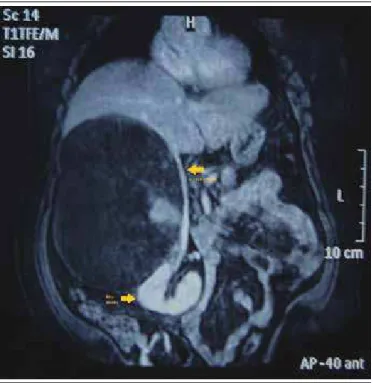
Hospital Haroldo Juaçaba/Instituto do Câncer do Ceará (HHJ/ICC), after clinical investigation and abdomen MRI. The imaging exam revealed a bulky well-deined expanding solid cystic lesion (Figure 1), occupying the right adrenal space and exerting signiicant mass effect on the right hepatic lobe, homolateral kidney and inferior vena cava (Figure 2). Due to the lesion size and its location in the retroperitoneum, the preoperative assessment could not exclude malignancy: the surgical approach was indicated for complete resection of the lesion. Grossly, the surgical specimen was a voluminous solid lesion of 21 × 18 × 9 cm and 2,468 g, covered by a ine translucent capsule. The sections showed a yellow compact homogeneous surface with hemorrhage foci, besides an orange yellow tissue suggestive of residual adrenal tissue around the lesion. Microscopic examination revealed a neoplasm constituted by typical mature adipocytes permeated by hematopoietic tissue containing the erythroid, myeloid and megakaryocytic lineages, with remnants of normal adrenal gland cortex at the periphery of the lesion (Figures 3, 4 and 5). The morphologic indings conirmed the diagnosis of giant myelolipoma of the adrenal gland. The patient was discharged on regular outpatient follow-up every six months, with no evidence of recurrence on abdominal CT scan so far.
49
FIGURE 1 − Axial slice of abdomen MRI showing a large well-defined expanding solid cystic lesion, with areas of both hyper- and hypo-intense signal on T1 with contrast enhancementMRI: magnetic resonance imaging; T1: spin-lattice relaxation time.
FIGURE 3 − Myelolipoma composed of mature adipose tissue and hematopoietic elements, with the presence of fibrous pseudocapsule and rim of adrenal cortex around the lesion (4× magnification)
FIGURE 4 − Presence of zona fasciculata of the adrenal cortex of ordinary aspect around the lesion and fibrous pseudocapsule (20× magnification)
FIGURE 5 − Neoplasm formed by adipocytes and elements of the three hematopoietic lineages (erythroid, myeloid and megakaryocytic). On the left side of the image, a mature megakaryocyte stands out (40× magnification)
FIGURE 2 − Coronal contrast-enhanced T1-weighted abdominal MRI slice showing that the lesion occupies the adrenal area and exerts significant mass effect on the right hepatic lobe and the homolateral kidney (lower arrow), revealing hyper-intense signal in this phase. One may also notice the inferior vena cava partially compressed by the lesion (upper arrow)
MRI: magnetic resonance imaging; T1: spin-lattice relaxation time.
50
DISCUSSION
Myelolipomas are unusual benign tumors constituted by mature adipose tissue and hematopoietic tissue(8). In 1957,
Dyckman and Freedman reported the irst operated case of myelolipoma(2); in 1985, Blois and May published the irst case
diagnosed by CT scan and ine-needle aspiration (FNA)(9).
These tumors used to be incidental indings in autopsy exams; however, with the advent of imaging exams, such as ultrasonography, CT and MRI, the detection rates of these lesions have increased. The incidence estimated in autopsies is 0.003%-0.4%(2, 3), and they account for 7%-15% of adrenal incidentalomas(4).
Less than 100 cases were described in the literature, where their incidence is estimated in 0.08%-0.25%(10, 11). The mean age at onset
is 62 years, and the tumor affects men and women equally(1).
The lesions are normally unilateral and asymptomatic(12),
measuring around 5 cm of diameter. However, they may reach larger sizes(5), as in the described case. The largest adrenal myelolipoma
reported in the literature weighed approximately 6 kg(6). They
generally occur in zona fasciculata of the adrenal cortex, but extra-adrenal myelolipomas were found in several sites, including the presacral region, skull, mediastinum, thoracic spine, liver, stomach, spleen, mesentery, lymph nodes, retroperitoneum, testes and pelvis(7).
Their etiopathogenesis is still uncertain, but different theories have been proposed, such as the development from stem cells rests, embolism of bone marrow cells, and extramedullary hematopoiesis. The most widely accepted theory is that by Meaglia and Schmidt, in 1992, which afirms that myelolipomas arise due to metaplasia of reticulo-endothelial cells of blood capillaries in the adrenal gland in response to stimuli, such as chronic stress, infection, necrosis, or inlammation(1, 3). Frequent association with obesity, type 2 diabetes
mellitus, and arterial hypertension was observed(13).
The most common symptom is abdominal pain, which may be attributed to intratumor hemorrhage, tumor necrosis, or compression of adjacent organs. Complications as rupture and
retroperitoneal hemorrhage are rare and occur in large tumors(1, 3).
Tumors larger than 10 cm are four times more likely to bleed, thus surgical excision is necessary(14). Adrenal myelolipomas
are characteristically non-functioning and asymptomatic, but may be associated with endocrine disorders, as Addison’s disease and hyperaldosteronism(3), or may coexist with hyperplasia or
hormone-producing adrenal gland tumors(11, 12). Apparently,
congenital adrenal hyperplasia and Cohen syndrome are the most commonly associated endocrine diseases(1).
The radiologic diagnosis cannot exclude malignancy. CT shows an encapsulated mass with tissue density equivalent to that of the fat tissue; therefore, the differential diagnosis between liposarcoma and myelolipoma must be established by histopathological analysis(2, 8). Some authors recommend
the conduction of CT-guided FNA to conirm the diagnosis of myelolipoma(2, 3, 10). The aspirate is usually cellular, consisting of
mature adipose tissue with many hematopoietic cells of the three hematopoietic lineages in a hemorrhagic background.
The macroscopic analysis shows, in the sections, adipose yellow tissue with rare areas of hemorrhage and residual adrenal tissue(15).
Myelolipomas are generally surrounded by a ine ibrous capsule and displace adjacent structures(4, 9, 16). The microscopic exam
reveals mature adipose tissue along with islands of elements of the three hematopoietic lineages with no maturation abnormalities(16).
In this case report, the macroscopic and microscopic indings were characteristic of myelolipoma. Lipoblasts, atypical adipocytes, mitotic activity, cellular pleomorphism, and necrosis were not observed. The residual adrenal tissue at the periphery of the lesion was composed of typical and uniform adrenal cortical cells. The frozen section procedure may also be useful to assess surgical margins, when considering the initial diagnostic possibility of malignancy at a preoperative exam.
Asymptomatic lesions smaller than 5 cm, showing no growth, could be followed-up in intervals of 1-2 years, with imaging controls. However, symptomatic lesions, those larger than 5 cm, or showing evident growth should be surgically excised(6).
RESUMO
Mielolipomas são tumores benignos pouco comuns, com média de incidência de 60 anos, frequentemente associados à glândula adrenal. Relata-se caso de paciente do sexo feminino de 63 anos que apresentava quadro clínico de desconforto abdominal e volumosa formação expansiva em retroperitônio, ocupando hemiabdômen direito com compressão extrínseca de órgãos adjacentes, sendo submetida à ressecção tumoral. A análise macroscópica da peça cirúrgica mostrou volumosa lesão homogênea amarelada com áreas de hemorragia, recoberta por fina cápsula fibrosa. A análise microscópica revelou neoplasia constituída por adipócitos maduros permeados por tecido hematopoiético, notando-se cortical da suprarrenal residual na periferia da lesão.
Unitermos: mielolipoma; retroperitônio; tumor; adrenal.
51
Gunter Gerson; Maria P. F. G. Bêco; Carlos Gustavo Hirth; Maria do Perpétuo Socorro S. Cunha; Francisca Estefânia M. M. Lima; Francisco Victor C. Parente; River A. B. Coêlho
REFERENCES
1. Lam KY, Lo CY. Adrenal lipomatous tumors: a 30-year clinicopathological experience at single institution. J Clin Pathol. 2001; 54(9): 707-12.
2. Akamatsu H, Koseki M, Nakaba H, et al. Giant adrenal myelolipoma:
report of a case. Surg Today. 2004; 34(3): 283-5.
3. Wrightson WR, Hahm TX, Hutchinson JR, et al. Bilateral giant adrenal myelolipomas: a case report. Am Surg. 2002; 68(6): 588-9.
4. Chen KC, Chiang HS, Lin YH. Adrenal myelolipoma: a case report with
literature review. J Urol. 2000; 11(4): 185-9.
5. Sakaki M, Izaki H, Fukumori T, et al. Mielolipoma gigante bilateral da glândula adrenal. J Bras Patol Med Lab. 2007; 43(4): 265-8.
6. Tyritzis SI, Adamakis I, Migdalis V, et al. Giant adrenal myelolipoma, a rare urological issue with increasing incidence: a case report. Cases J. 2009; 2: 8863.
7. Akhtar F, Ishtiaq S, Ali Z, Hassan U. Adrenal myelolipoma. Ann Pak Inst Med Sci. 2009; 5(4): 266-8.
8. Ares Valdes J. Adrenal myelolipoma: case report and bibliographic review. Arch Esp Urol. 2006; 59(1): 71-3.
MAILING ADDRESS
Gunter Gerson
Rua Joaquim Lima, 516, casa; Papicu; CEP: 60175-005; Fortaleza-CE, Brazil; e-mail: [email protected].
9. Dell’Avanzato R, Castaldi F, Giovannini C, et al. Giant symptomatic myelolipoma of the right adrenal gland: a case report. Chir Ital. 2009; 61(2): 231-6.
10. Kalafatis P. Bilateral giant adrenal myelolipoma and polycystic ovarian disease. Urol Int. 1999; 63(2): 139-43.
11. Kalidindi RS. Bilateral giant adrenal myelolipomas. Abdom Imaging. 2006; 31(1): 125-7.
12. Patel VG, Babalola OA, Fortson JK, et al. Adrenal myelolipoma: report of a case and review of the literature. Am Surg. 2006; 72(7): 649-54.
13. Soliman HE, Zein TA, Milad MF, et al. Myelolipoma of the adrenal
gland diagnosis and management. Saudi Med J.2001; 22(5): 457-9. 14. McDonnell WV. Myelolipoma of adrenal. AMA Arch Pathol. 1956; 61(5): 416-9.
15. Lin PC, Yang FS. Bilateral giant adrenal myelolipomas a case report and literature review. Chin J Radiol. 2008; 33: 261-4.