ORIGINAL
RES
EAR
CH
Correspondence to: Patrícia Paludette Dorneles – Universidade Federal de Santa Maria – Centro de Educação Física e Desportos – Faixa de Camobi, km 9 – Avenida Roraima, 1000 – CEP: 97105-900 – Santa Maria (RS), Brasil – E-mail: [email protected]
Presentation: Aug. 2012 – Accepted for publication: Jul. 2013 – Financing source: none – Conflict of interests: nothing to declare – Presentation at a scientific event: I Congresso de Iniciação Científica de Pós-Graduação – Approval at the Ethics Committee n. 0083.0.243.000-09.
Comparison of postural balance
between female and male adolescents
Comparação do equilíbrio postural entre adolescentes do sexo feminino e masculino
Comparación del equilibrio postural entre adolescentes del sexo femenino y masculino
Patrícia Paludette Dorneles1, Gabriel Ivan Pranke1, Carlos Bolli Mota2
Study conducted at the Biomechanics Laboratory of Universidade Federal de Santa Maria(UFSM) – Santa Maria (RS), Brazil. 1Universidade Federal do Rio Grande do Sul (UFRS) – Porto Alegre (RS), Brazil.
2UFSM – Santa Maria (RS), Brazil.
ABSTRACT | Adolescence phase comprises between 10 and 19 years old. This stage is characterized by a fast individual growth and development. However, these changes do not occur at the same rate for both genders, and can lead to differences in postural balance. The pur-pose of this study was to compare the postural balance between male and female adolescents. To this, 11 female and 19 male adolescents were assessed. The center of gravity height was obtained by a reaction board, and postural balance was evaluated with a force platform from Advanced Mechanical Technologies, Inc. model OR6-6. The variables analyzed were calculated from the center of pressure (COP): COP anteroposterior range of displacement (COPap), COP mediolateral range of dis-placement (COPml); and COP mean disdis-placement veloc-ity (COPvel). Female adolescents showed a significantly lower COPap (p=0.011) and COPml (p=0.003) ranges of displacement with open eyes when compared to male adolescents. With closed eyes, females had lower COPap (p=0.001), COPml (p=0.001) and COPvel (p=0.004). It sug-gests a lower postural sway for these female adolescents. It is believed that the results came from differences in an-thropometric characteristics between genders. We con-clude that female adolescents in this study had a better postural balance when compared to male adolescents.
Keywords | adolescent; postural balance; biomechanics.
RESUMO | A adolescência compreende a fase entre os 10 e 19 anos de idade, a qual se caracteriza por uma aceleração no crescimento e desenvolvimento dos indivíduos. No en-tanto, essas mudanças não ocorrem no mesmo ritmo para ambos os sexos, o que pode trazer diferenças no equilíbrio postural. Este estudo tem como objetivo comparar o equilí-brio postural entre adolescentes dos sexos masculino e femi-nino. O grupo de estudo foi composto por 11 adolescentes do
sexo feminino e 19 do sexo masculino. A análise da altura do centro de gravidade foi obtida com o uso de uma prancha de reação, e o equilíbrio postural por meio de uma platafor-ma de força Advanced Mechanical Technologies, Inc. mode-lo OR6-6. As variáveis avaliadas foram calculadas a partir do Centro de Pressão (COP): amplitude de deslocamento ânte-ro-posterior do COP (COPap), amplitude de deslocamento médio-lateral do COP (COPml) e velocidade média de des-locamento do COP (COPvel). Os adolescentes do sexo femi-nino apresentaram amplitude de deslocamento do COPap (p=0,011) e COPml (p=0,003) significativamente menor na condição de olhos abertos que o sexo masculino, e na con-dição de olhos fechados nas três variáveis avaliadas, COPap (p=0,001), COPml (p=0,001) e COPvel p=0,004, sugerindo menor oscilação postural para as adolescentes deste estudo. Acredita-se que os resultados encontrados podem ser advin-dos das diferenças nas características antropométricas entre os sexos. Conclui-se que os adolescentes do sexo feminino apresentaram melhor equilíbrio postural quando compara-dos aos do sexo masculino.
Descritores | adolescente; equilíbrio postural; biomecânica.
INTRODUCTION
According to the World Health Organization1,
adoles-cence is the period comprised between the ages of 10 and 19 years old, which is marked by accelerated growth and development of individuals. During childhood, preceding adolescence, the weight of boys and girls in-creases proportionally to height2. At the early stage of
transition to adolescence, lean body mass increases rap-idly among boys due to the action of testosterone, with more bone and muscle growth, however, among girls it is possible to observe the increase of fat tissue, due to the action of estrogen2.
In adolescence, the increment of female and male individuals does not keep the same rhythm, which can bring diferences in postural balance among genders. Studies concerning postural balance with this popula-tion are still scarce in literature, since most scientiic papers are conducted with adults, elderly and/or par-ticipants with pathologies3-6.
According to Horak and Macpherson7, balance is
basic for all types of movements and is under the in-luence of visual, somatosensory and vestibular stimuli. It can be deined as the maintenance of a speciic pos-ture with minimum oscillation (static balance) or dur-ing the performance of a motor skill that tends to dis-turb body orientation (dynamic balance)8.
According to Smith et al.9, the level of stability of
a body depends on four distinct factors: body weight, center of gravity height, size of the support base and location of the gravity line within this support base. he stability of the individual is inversely proportional to the center of gravity height, and directly proportional to the support base, and these variables are related with postural balance9,10.
Postural balance can be assessed by means of the Center of Pressure (COP) dislocation, which, for Duarte and Freitas11, is the point of ground reaction
force over the support surface. Oliveira et al.12 describe
that variables such as dislocation velocity and COP area are related with anthropometric data of individuals, es-pecially height.
Due to possible diferences between genders dur-ing adolescence as to the development of some an-thropometric variables, which are directly related with postural balance, it is suggested that female and male adolescents present diferent postural control. So, this study aimed to compare postural balance between male and female adolescents.
METHODOLOGY
Study group
his is a cross-sectional, ex post facto study. he study group was comprised of 11 female adolescents (age: 15.45±0.52 years old; height: 1.62±0.05 m; mass: 58.07±7.31 kg) and 19 male adolescents (age: 14.89±0.80 years old; height: 1.71±0.07 m, mass: 65.69±10.88 kg).
he selection of individuals was made with verbal invitations to all of the students enrolled in the junior and sophomore years of high school, from an institution close to the Biomechanics Laboratory, where the col-lection was performed. One hundred and twenty people were invited to participate in the research. Out of these, only 60 people returned the informed consent form, and 20 itted the exclusion criteria of the study, thus accounting for 30 students who were interested to vol-untarily participate in the study.
Exclusion factors were: not being within the age range of 14 to 16 years old, not participating in physi-cal education classes, regularly practicing any other sport modality outside school, being physically and/ or mentally disabled, having hypertension or diabe-tes or spinal pain.
Advanced Mechanical Technologies, Inc. modelo OR6-6. Las variables evaluadas fueron calculadas a partir del Centro de Presión (COP): amplitud de desplazamiento antero-posterior del COP (COPap), amplitud de desplazamiento medio-lateral del COP (COPml) y velocidad media de desplazamiento del COP (COPvel). Los adolescentes del sexo femenino presentaron amplitud de desplazamiento del COPap (p=0,011) y COPml (p=0,003) significativamente menor en la condición de ojos abiertos que el sexo masculino, y en la condición de ojos
cerrados en las tres variables evaluadas, COPap (p=0,001), COPml (p=0,001) y COPvel p=0,004, sugiriendo menor osci-lación postural para las adolescentes de este estudio. Se cree que los resultados encontrados pueden ser resultado de las diferencias en las características antropométricas entre los sexos. Se concluye que los adolescentes del sexo femenino presentaron mejor equilibrio postural cuando fueron compa-rados a los del sexo masculino.
he study was developed in accordance with ethi-cal aspects, according to the principles of Resolution 196/96, of the National Health Council, being approved by the Ethics Committee of Universidade Federal de Santa Maria, Protocol n. 0083.0.243.000-09.
Instruments
he analysis of the center of gravity (CG) height was obtained by a reaction board, consisting of a Kratos scale, 0.1 kg resolution and a wooden apparatus with two supports (one over the scale and another one on the ground), 1.80 m apart. he equation to calculate CG height is:
hCG=(R2–R1).d Ps
In which:
CGh = CG height;
R2 = force measurement given by the scale with the person standing on the apparatus (kgf );
R1 = force measurement given by the scale without the person standing on the apparatus (kgf );
d = distance between supports (m); Ps = individual’s weight (kgf ).
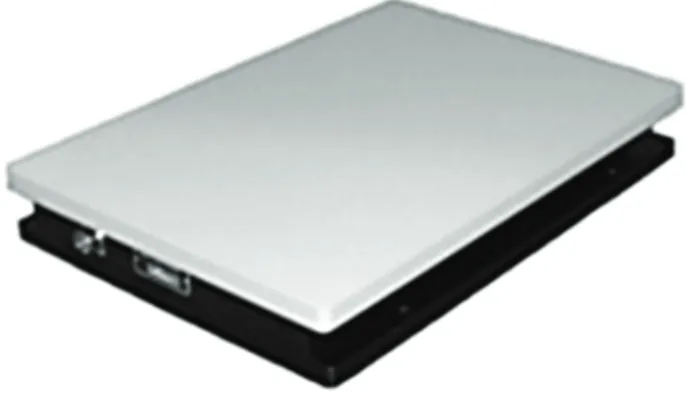
For the acquisition of data concerning postural balance, a force platform from Advanced Mechanical Technologies, inc. (AMTI), model OR6-6 was used (Figure 1).
Raw data were iltered with the 4th order low-pass
ilter, with 10 Hz cut-of frequency. he variables ac-quired by the force platform are related to COP, calcu-lated by the following equations:
COPx=(My–h.Fx)/Fz COPy=(Mx–h.Fy)/Fz
In which:
COPx = coordinate of the center of pressure at the an-teroposterior direction;
COPy = coordinate of the center of pressure at the me-diolateral direction;
Mx = moment around the anteroposterior axis; My = moment around the mediolateral axis;
Fx = anteroposterior component of ground reaction force;
Fy = mediolateral component of ground reaction force; Fz = vertical component of ground reaction force;
h = distance from the surface to the geometric center of the force platform.
he assessed variables were the COP anteroposte-rior range of displacement (COPap), COP mediolateral range of displacement (COPml) and COP mean dis-placement velocity (COPvel).
Procedures for data collection
Collections took place in the Biomechanics Laboratory of Universidade Federal de Santa Maria. Individuals were welcomed by one of the people in charge of the research and were briely enlightened as to the collection procedure. Afterwards, they were referred to another room, where all of the tests were performed, with barefoot participants. Measurements of height and body mass, CG height and postural balance were assessed. For the acquisition of CG height, the individual was told to stay in the dor-sal decubitus position on top of the apparatus with stretched lower limbs, trunk and upper limbs and feet against the base of the apparatus. Afterwards, they were told to stay on top of the force platform in orthostatic position and with their feet apart, at the width of the hip. During the test, the individual should remain standing, with their heads faced for-ward under two conditions: open eyes (OE), staring at a target at a distance of approximately 2 m, and arms along the body; closed eyes (CE), with arms along the body. here were three attempts for each condition (OE and CE), accounting for six attempts for each individual, and their mean was used for sta-tistical analyses. he position of the feet was marked in a millimeter paper, in order to consider the same position. he sample rate of the platform was 100 Hz, and acquisition time was 30 seconds.
Statistical analysis
Data were submitted to descriptive statistics. he nor-mality in data distribution was veriied by the Shapiro-Wilk test. Afterwards, the Mann-Whitney test was used to compare the variables of postural balance between the female and male groups. Signiicance level was 5%.
RESULTS
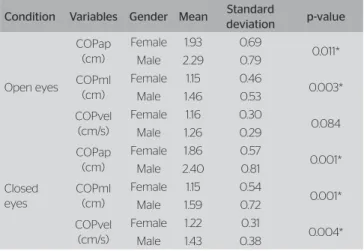
Female adolescents presented lower and signiicant COP anteroposterior and mediolateral range of dis-placement under the OE and CE conditions when compared to male adolescents he COP displace-ment velocity was signiicantly lower for the female gender only with CE. Results are summarized in Tables 1 and 2.
DISCUSSION
his study aimed to compare postural balance between male and female adolescentes. Results point to less and signiicant postural oscillation for the group of female adolescents under both conditions, and to lower COP mean displacement velocity with their eyes closed.
Colli13, when analyzing 6,765 adolescents aged from
10 to 19 years old, showed that sexual maturation gen-erally begins 1 year earlier among female adolescents in relation to male adolescents. Siervogel et al.14 show
that there are also diferences between genders due to anthropometric changes and alterations in body com-position during pubescence — a girl of any age usually has higher maturation level when compared to a boy at the same chronological age15.
During development, girls and boys with the same chronological age present very diferent characteristics for being in diferent stages of maturation16.
Certain anthropometric characteristics may in-terfere in postural balance, such as height and CG height. he boys in this study presented higher mean in the mentioned items than girls, thus suggesting that the higher and the more distant from the ground the CG of the individual, the more he oscillates, consider-ing the model of simpliication of the human body in inverted pendulum for balance studies, as described by other authors11,17,18.
Lemos19 performed a study comparing the
pos-tural balance of children aged from four to ten years old with a group of adults, and veriied that, with their eyes open, the group from nine to ten years old reached adult postural balance patterns. In this study, statistical diferences were found in all of the postural balance variables in the adult group when comparing genders, both with their eyes open and closed. Such results corroborate with those of this study, because the assessed adolescents were aged between 14 and 16 years old, and had supposedly reached the adult postural balance pattern. So, the adolescents in this study, as well as the female participants in the re-search by Lemos19, presented better postural balance
when compared to male individuals.
Narciso et al.20 state that anthropometric and body
segment variations lead to changes in CG placement, which will be lower among women, for presenting larger hips, and higher among men, due to the width of their shoulders. According to Weineck21, the length
of the trunk of a woman is similar to 38% of her body, and this value gets to 36% for men, thus leading to lower CG displacement in women, around 0.08 cm lower than in men.
Table 2. Comparison bewteen groups under the conditions of open eyes and closed eyes
Condition Variables Gender Mean Standard
deviation p-value
Open eyes
COPap (cm)
Female 1.93 0.69
0.011* Male 2.29 0.79
COPml (cm)
Female 1.15 0.46
0.003* Male 1.46 0.53
COPvel (cm/s)
Female 1.16 0.30
0.084 Male 1.26 0.29
Closed eyes
COPap (cm)
Female 1.86 0.57
0.001* Male 2.40 0.81
COPml (cm)
Female 1.15 0.54
0.001* Male 1.59 0.72
COPvel (cm/s)
Female 1.22 0.31
0.004* Male 1.43 0.38
*Representing statistically significant diferences
COPap: center of pressure anteroposterior range of displacement; COPml: center of pressure medio-lateral range of displacement; COPvel: center of pressure mean displacement velocity (COPvel)
Table 1. Comparison between groups for anthropometric variables
Variables Gender Mean Standard deviation p-value
Height (m) Female 1.62 0.05 0.001*
Male 1.71 0.07
CG (m) Female 0.91 0.03 0.003*
Male 0.97 0.05
BMI (kg) Female 22.05 2.12 0.722 Male 22.40 3.19
According to Rivas and Andries Jr.22 and Lemos
et al.23, the knee joint in relation to body height of
fe-male individuals is larger than fe-male individuals, thus generating more instability in relation to body size and, consequently, better postural balance. hese authors state that the mass distribution is diferent in female bodies due to morphological factors, thus lowering their CG in relation to male individuals with the same height, also decreasing postural oscillation values.
It is believed that the female adolescents in this study presented better postural balance than male individu-als due to the diferent anthropometric characteristics. Another hypothesis would be the rhythm of maturation development, which usually occurs earlier for females. However, maturation level was not assessed, which is a major limitation for this study. As limitations we could also mention the small sample and the diferent number of individuals in each group.
he indings in this study lead to important clinical implications concerning postural balance for rehabilita-tion, because the deicit found in the balance of male adolescents may lead to changes in other motor skills, which depend on postural control, such as gait, and also make the process of musculoskeletal rehabilitation more diicult in case of possible lesions.
CONCLUSION
he female adolescents in this study presented better postural balance when compared to male adolescents.
REFERENCES
1. World Health Organization. Physical status: the use and interpretation of anthropometry, report of a WHO expert committee. Geneva: WHO; 1995.
2. Duarte MFS. Maturação física: uma revisão na literatura, com especial atenção à criança brasileira. Cad Saúde Pública. 1993;9(Suppl 1):71-84.
3. Fabunmi AA, Gbiri CA. Relationship between balance performance in the elderly and some anthropometric variables. Afr J Med Med Sci. 2008;37(4):321-6.
4. Jamet M, Deviterne D, Gauchard GC, Vançon G, Perrin PP. Higher visual dependency increases balance control perturbation during cognitive task fulfilment in elderly people. Neurosci Lett. 2004;359(1-2):61-4.
5. Mann L, Kleinpaula JF, Teixeira CS, Rossi AG, Lopes LFD, Mota CB. Investigação do equilíbrio corporal em idosos. Rev Bras Geriatr Gerontol. 2008;11(2):155-65.
6. Sacco ICN, Bacarin TA, Watari R, Suda EY, Canettieri MG, Souza LC, et al. Envelhecimento, atividade física, massa corporal e arco plantar longitudinal influenciam no equilíbrio funcional de idosos? Rev Bras Educ Fis Esp. 2008;22(3):183-91.
7. Horak FB, Macpherson JM. Postural orientation and equilibrium. In: Sehaprd J, Rohwell L (eds). Handbook of physiology. New York: Univesity Press; 1995
8. Silveira CRA, Menuchi MRP, Simões CS, Caetano MJD, Gobbi LTB. Validade de construção em testes de equilíbrio: ordenação cronológica na apresentação das tarefas. Rev Bras Cineantropom Desempenho Hum. 2006;8(3):66-72.
9. Smith LK, Weiss EL, Lehmkuhl LD. Cinesiologia clínica de Brunnstrom. São Paulo: Manole; 1997.
10. Hayes KC. Biomechanics of postural control. Exerc Sport Sci Rev. 1982;10:363-91.
11. Duarte M, Freitas SMSF. Revisão sobre posturografia baseada em plataforma de força para avaliação do equilíbrio. Rev Bras Fisioter. 2010;14(3):183-92.
12. Oliveira LF, Imbiriba LA, Garcia MAC. Índice de estabilidade para avaliação do equilíbrio postural. Brazil J Biomech. 2000;1(1):33-8. 13. Colli AS. Crescimento e desenvolvimento pubertário em crianças
e adolescentes Brasileiros. VI: Maturação sexual. São Paulo: Editora Brasileira de Ciências; 1988. p. 19-32.
14. Siervogel RM, Maynard LM, Wisemandle WA, Roche AF, Guo SS, Chumlea WC, et al. Annual changes in total body fat (TBF) and fat free mass (FFM) in children from 8 to 18 years in relation to changes in body mass index (BMI). The fels longitudinal study. Ann NY Acad Sci. 2000;904:420-3.
15. Malina RM, Bouchard C. Atividade física do atleta jovem: do crescimento à maturação. São Paulo: Roca; 2002.
16. Rivas RC, Andries Junior O. O dimorfismo sexual e suas implicações no rendimento e planejamento do esporte feminino. Mov Percep. 2007;7(10):126-48.
17. Caron O, Faure B, Brenière Y. Estimating the centre of gravity of the body on the basis of the centre of pressure in standing posture. J Biomech. 1997;30(11-12):1169-71.
18. Paixão Júnior CM, Heckman MF. Distúrbios da postura, marcha e quedas. In:Freitas EV, Py L, Cançado FAX (eds). Tratado de geriatria e gerontologia. Rio de Janeiro: Guanabara Koogan; 2006.19. Lemos LFC. Desenvolvimento do equilíbrio postural e desempenho motor de crianças de 4 aos 10 anos de idade [Dissertação]. Brasília: Universidade de Brasília; 2010.
20. Narciso FV, Santos SS, Ferreira F, Lemos VS, Barauna MA, Cheik NC, et al. Altura percentual do centro de gravidade e número de quedas em idosos ativos e sedentários. Rev Bras Cineantropom Desempenho Hum. 2010;12(4):302-7.
21. Weineck J. Treinamento ideal. 9. ed. São Paulo: Manole; 2003. 740 p.
22. Rivas RC, Andries Júnior O. O dimorfismo sexual e suas implicações no rendimento e planejamento do esporte feminino. Mov Percep. 2007;7(10):126-48.