Contents lists available atScienceDirect
Veterinary Immunology and Immunopathology
j o u r n a l h o m e p a g e :w w w . e l s e v i e r . c o m / l o c a t e / v e t i m m
Short communication
Increased type 1 chemokine expression in experimental Chagas
disease correlates with cardiac pathology in Beagle dogs
Paulo M.M. Guedes
a,∗, Vanja M. Veloso
b, André Talvani
b, Livia F. Diniz
b, Ivo S. Caldas
b,
Maria A. Do-Valle-Matta
c, Juliana Santiago-Silva
a, Egler Chiari
d, Lucia M.C. Galvão
d,e,
João S. Silva
a, Maria T. Bahia
baDepartamento de Bioquímica e Imunologia, Escola de Medicina de Ribeirão Preto/USP, Ribeirão Preto, São Paulo, Brazil bDepartamento de Ciências Biológicas/NUPEB, Universidade Federal de Ouro Preto, Ouro Preto, Minas Gerais, Brazil cLaboratório de Ultraestrutura celular, Instituto Oswaldo Cruz/FIOCRUZ, Rio de Janeiro, Brazil
dDepartamento de Parasitologia, Instituto de Ciências Biológicas, Universidade Federal de Minas Gerais, Belo Horizonte, Minas Gerais, Brazil eUniversidade Federal do Rio Grande do Norte Federal, Natal, Rio Grande do Norte, Brazil
a r t i c l e
i n f o
Article history:
Received 21 August 2009
Received in revised form 4 June 2010 Accepted 11 June 2010
Keywords:
Chemokines Dog model
Trypanosoma cruzi
Chagas cardiopathy Inflammation
a b s t r a c t
Chemokines and chemokine receptors interaction have presented important role in leuko-cyte migration to specific immune reaction sites. Recently, it has been reported that chemokine receptors CXC (CXCR3) and CC (CCR5) were preferentially expressed on Th1 cells while CCR3 and CCR4 were preferentially expressed on Th2 cells. This study evaluated the mRNA expression of type 1 and type 2 chemokine and chemokine receptors in the cardiac tissue of Beagle dogs infected with distinct genetic groups ofTrypanosoma cruzi(Y, Berenice-78 and ABC strains) during acute and chronic phases. To analyze the correlation between chemokine and chemokine receptors expression and the development of heart pathology, the chronic infected animals were divided into groups, according to the parasite strain and based on the degree of heart damage: cardiac and indeterminate form of Chagas disease. Our results indicated that cardiac type1/2 chemokines and their receptors were partially dependent on the genetic diversity of parasites as well as the polarization of clinical forms. Also, dogs presenting cardiac form showed lower heart tissue mRNA expression of CCL24 (type 2) and higher expression of CCL5, CCL4 and CXCR3 (type 1) when compared with those with indeterminate form of disease. Together, these data reinforce a close-relation between T. cruzigenetic population and the host specific type 1 immune response and, for the first time, we show the distribution of type 1/2 chemokines associated with the development of cardiac pathology using dogs, a well similar model to study human Chagas disease.
© 2010 Elsevier B.V. All rights reserved.
∗ Corresponding author at: Departamento de Bioquímica e Imunolo-gia, Faculdade de Medicina de Ribeirão Preto, Av. dos Bandeirantes 3900, Monte Alegre, 14049-900, Ribeirão Preto, SP, Brazil. Tel.: +55 16 3602 3234; fax: +55 16 3602 4590.
E-mail addresses:[email protected],[email protected] (P.M.M. Guedes).
1. Introduction
Chagas disease is a neglected illness caused by the intra-cellular parasiteTrypanosoma cruzi, which is transmitted by hematophagous reduviid vectors. Although it has been described 100 years ago by Carlos Chagas, this disease still represents an important health problem, being broadly dispersed in 18 developing countries in South and Cen-tral Americas. Its main clinical manifestations are cardiac and/or digestive disturbances, with an overall prevalence of
about 12–14 million cases, been considered a major cause of cardiac infection disease in endemic areas (WHO, 2005). It is estimated that 10–30% ofT. cruzi-infected individu-als will progress to chronic irreversible cardiac pathology, causing considerable morbidity and mortality. Chagas car-diopathy (CC) is characterized by myocarditis, in which an important lymphomononuclear infiltrate is accompa-nied by interstitial fibrosis and cardiomyocyte hypertrophy that can lead to dilated cardiomyopathy, end-stage heart failure, and death. Inflammatory infiltrates are composed primarily of CD8+T cells but also contain CD4+T cells and
macrophages (Higuchi, 1997).
Although it is widely accepted that inflammatory infil-trate is the ultimate effector of myocardial damage, the exact mechanism through which only a subset of infected individuals develop CC remains poorly under-stood (Higuchi, 1997). The cytokine profile has been pointed as essential key to orchestrate the immune response againstT. cruziand define immunopathological mechanisms involved in CC. It was previously described, for instead, that individuals with CC are high produc-ers of IFN-gamma, TNF-␣ and IL-6, and less producers of IL-4 and IL-10 evaluated in peripheral blood lym-phocytes and heart tissue mononuclear cells, when compared to those asymptomatic (Abel et al., 2001; Gomes et al., 2003). Proinflammatory cytokines (e.g. IFN-gamma) appear to mediate, directly and indirectly, the synthesis or expression of chemokines, essential ele-ments to the inflammatory and immune-mediated Chagas disease process in the cardiac tissue (Talvani et al., 2000).
Chemokines and their cognate receptors drive leuko-cytes and monoleuko-cytes recruitment from the bloodstream into inflamed tissues and are important immunological markers of profiles Th1 (CCL2, CCL3, CCL4, CCL5, CXCL9, CXCL10, CXCL11, CCR5 and CXCR3), Th2 (CCL1, CCL11, CCL17, CCL22, CCL24, CCL26, CCR3, CCR4 and CCR8), Th17 (CCL17, CCL20, CCL22, CCR4 and CCR6), and regulatory T cells (CCL1, CCL17, CCL22, CCR4 and CCR8) (Bromley et al., 2008). However, several disease and parasite mod-els showed different pattern of chemokine expression in the Th1, Th2, Th17 and regulatory T cell (Bromley et al., 2008). In the context of human Chagas disease, soluble chemokines were previously associated with high serum TNF-␣and correlated with worst prognosis in individu-als with CC (Talvani et al., 2004). In parallel, peripheral mononuclear cells from CC individuals showed higher co-expression of CCR5 or CXCR3 and IFN-␥ than patients presenting the indeterminate form of disease, suggesting that chemokines and their receptors are strongly involved in the development of the early forms of CC (Gomes et al., 2005; Talvani et al., 2004).
Another aspect emerged in the last decade concern-ing pathogenesis of Chagas disease was the participation of genetic diversity ofT. cruziin coordinate host immune response and define cardiac clinical disturbances. We have recently contributed to this understand showing that dif-ferent strains of the parasite present distinct patterns of virulence, immune response and the pathogenesis during experimental Chagas disease (Guedes et al., 2008,Santos et al., 2009).
A major stumbling block for research efforts striving to elucidate the mechanisms of pathogenesis of human chronic Chagas disease are the lack of a suitable animal model. Our group has shown that dogs develop diffuse chronic myocarditis with alterations in immune, patho-logical, electro- and echocardiography similar to those described in humans (Lana and Chiari, 1986; Guedes et al., 2007, 2008). In fact, we have previously showed, in the same animals used in this study, that those with inde-terminate clinical form were associated with high IL-10 production during the acute phase of the disease, while those with cardiac form were associated with high IFN-␥, TNF-␣and low or nil IL-10 production (Guedes et al., 2009). The propose of this study is investigate the expression of Th1, Th2, Th17 profiles of chemokines and their receptors in heart tissue from Beagle dogs and verify whether differ-ent populations ofT. cruzi(Berenice-78, Y and ABC strains) can interfere in this chemokine background and in the car-diac pathology during acute and chronic phases of Chagas disease.
2. Materials and methods
2.1. Trypanosoma cruzi stocks
Three distinct strains ofT. cruziII stocks were used in this proposal according their virulence pattern and capacity to induce pathogenesis in dog model: Y, Berenice-78 and ABC strains of the parasite, as previously described byGuedes et al. (2007).
2.2. Experimental animals and infection
Four-month old Beagle dogs (n= 32) from the kennels at the Universidade Federal de Ouro Preto (UFOP) were used in this study. All procedures and experimental pro-tocols were conducted in accordance with the procedures issued by the Brazilian College of Animal Experimenta-tion (COBEA) and approved by the Ethics Committee in Animal Research at UFOP. Animals were fed with com-mercial dog food and waterad libitum. Prior to the study, pups were dewormed and vaccinated with Vanguard®
HTLP 5/CV-L (Pfizer). Twenty-four Beagle dogs were inoc-ulated with 4.0×10³bloodstream trypomastigotes per kg
of body weight of the Y, Berenice-78 (Be-78) and ABC T.cruzistrains and euthanised 4 (acute phase) and 100 (chronic phase) weeks after infection. Eight age-matched non-infected dogs were used as controls. Latter, to ana-lyze the correlation between chemokine and chemokine receptors expression and the development of heart pathol-ogy, dogs were divided into groups, during chronic phase, according to the degree of heart damage: (i) cardiac form – defined by the presence of cardiomegaly, inflammation and fibrosis in the heart tissue; (ii) indeterminate form – defined by the absence of pathological signals.
2.3. Total RNA isolation and cDNA synthesis from the canine heart tissue
(Invitrogen) and SV Total RNA Isolation System (Promega, Madson, WI) according to manufacturer instructions. The RNA yield and the ratio of absorbance at 260–280 nm (A260/A280ratio) were measured using the NanoVue PLus
Spectrophotometer (GE Healthcare, UK). Samples contain-ing <10 ng/L of RNA were excluded from the study. The cDNA was synthesized using 1g of tRNA through a reverse transcription reaction (ImProm-IITMReverse Transcriptase,
Promega). The cDNA-actin copy number/RNA-actin copy number ratio was calculated as a measure of the efficiency of the cDNA synthesis; this ratio was used to normalize the reference gene copy numbers as assessed by quantitative real-time PCR.
2.4. Development of real-time PCR assays for canine chemokine and chemokine receptors
For all chemokine and chemokine receptors genes, a standard curve from serial dilutions of a known concen-tration of purified DNA was achieved. This quantified DNA consisted of the target PCR product prepared by conven-tional PCR from cDNA positive for the corresponding target mRNA. Threefold measurement for each standard dilution point over the whole standard curve range was produced to generate a reliable standard curve.
Then, real-time PCR quantitative mRNA analyses were performed in an ABI Prism 7000 SDS (Applied Biosys-tems) using the Platinum® SYBR® Green qPCR SuperMix
UDG with ROX reagent (Invitrogen) for quantification of amplicons. The standard PCR conditions were as follows: 50◦C (2 min), 95◦C (10 min); 40 cycles of 94◦C (30 s),
58◦C (30 s), and 72◦C (1 min); followed by the
stan-dard denaturation curve. The sequences of dog primers were designed using the Primer Express software (Applied Biosystems) using nucleotide sequences present in the GenBank database (Table 1). In each reaction the Platinum®
SYBR® Green qPCR SuperMix UDG with ROX reagent
(Invitrogen), 1g/L of each specific primer, and cDNA diluted 20 times were used. In all this study, data were normalized to -actin mRNA. Relative increase in chemokines and their receptors were plotted in com-parison to non-infected dogs control group (calibrator of the reaction) using 2−CT method, as previously
described (Livak and Schmittgen, 2001).
2.5. Statistical analysis
Data are expressed as the mean±standard error of the mean (SEM) and analyzed using one-way analysis of vari-ance. All analyses were performed using the PRISM 3.0 software 292 (GraphPad, San Diego, CA, USA) and the level of significance was accepted atp< 0.05.
3. Results and discussion
The results of this study show that dogs with cardiac form of Chagas disease presented lower mRNA expression of CCL24 (type 2) and higher expression of CCL5, CCL4 and CXCR3 (type 1) than those presenting indeterminate form of the disease. These findings suggest that the immuno-logical imbalance observed in the cardiac animals may
Table 1
The sequences of the primers were designed based on nucleotide sequences in the GenBank Database and were used were as follows.
Target Sense and antisense sequences
CCL1 ACTTTTCAGAGAAGAGGATCGC TGGAGCTGGTGTGTTTGTAACA CCL2 TAAAAGAGTCACCAGCAGCAA TTTAGGACGGTCTTGAAGATCA CCL3 CAAGCAGATTCCACGCAAGTT TAATACCGGGCTTGGAGCAT CCL4 TGACCGTCCTTTCTCTCCTT GATCTGAACCCATTGGTGCT CCL5 AAGGGCTGACTGATAAATGTGA AGCGAGAATTTTAATGGAAAGC CCL17 CCATCGTGTTTGTAACTGTCCA AATATCTGACCGCCTTCTTCAC CCL20 TATGGTTCCTCCCGGATCTATC TCATTGGCCAGCTGTTGTGT CCL24 CCTGCTGCATGTTCTTCATTTC TTCTGGTTCTTCTTGGTGGTGA CCL26 TCTTCATCCTGAGTGTCCATCG AGCAGAACTTGGCCACATCA CXCL9 CAGATGGTCCTTAAGCCACTTT CCTTTCCCTGTGAACCTCAA CXCL10 CACATGTTGAGATCATTGCCAC TTCAGACATCTTTTCTCCCCA CCR3 CTAGCAGCCTCCCCTGAATTTA TGTTCAGACTCCTTTTGGGACT CCR4 TTTGGACTAGGTCTCTGCAAGA AAAAGCCCACCAGGTACATC CCR5 TGTGTCTGCTTCAAAAGCCC TCACTTGTCACCACCCCAAA CCR6 AGCTGTTTGTGCCAATTGCTTA AAAATATTGCCCAGGAGGCC CCR8 TGATATCATCTCAAGCCCCTG AGCAACTTGCTGTCTCTTTGGA CXCR3 TTCTTTGCCATCCCAGATTTC ATGCATGGCATTTAGGCG -actin CCACTTTCCTGTCTTACCCAA AATTAACCACCCACGGTGTT
be correlated to deficient type 2 chemokine expression and consequently deficient in Th2 cells migration to the heart.
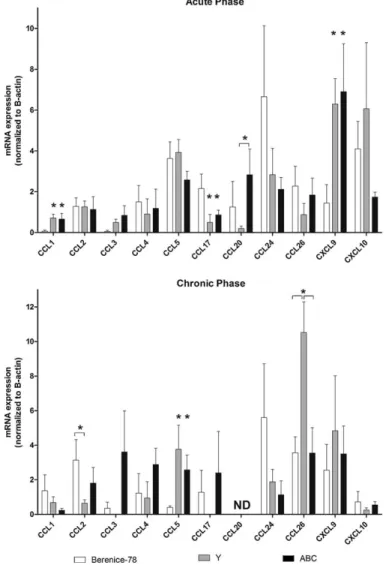
Fig. 1. Expression of type 1 and type 2 chemokines in heart from infected dogs, under influence of different populations ofTrypanosoma cruzi,during acute and chronic phases. Beagle dogs were infected with Berenice-78, Y and ABC strains ofT. cruziand mRNA expression of chemokines determined in heart tissue in the acute (A) and chronic (B) phases of the disease. After normalization to-actin mRNA, relative increase of type 1 and type 2 chemokines was plotted in comparison to non-infected animals (control group) and data presented using 2−CTmethod. Data (mean
±SEM) are representative of four dogs per group. *P< 0.05. ND: not detected.
of infection (Petray et al., 2002). In fact, our data with the canine model showed (i) Y and ABC strains inducing a more intense myocarditis and fibrosis as compared to Be-78-infected dogs (Guedes et al., 2009), and complementary, (ii) an increased mRNA level for CXCL9 during acute phase and CCL5 during chronic phase in heart tissue of animals infected with high pathogenic Y and ABC strains. In addi-tion, an important cellular migration to the heart tissue was observed with an overexpression of these chemokines and, accordingly, high tissue lesion.
The CCL20 expression during acute phase was higher in the heart of dogs infected with ABC than Y strain, and CCL2 mRNA expression was higher in Be-78-than Y-infected animals during the chronic phase (Fig. 1B). A defective expression of this last chemokine, named monocyte chemoattractant protein/MCP-1, leads to major phenotypes of a defective monocyte trafficking in mice
Fig. 2.Expression of type 1 and type 2 chemokine receptors in heart from infected dogs, under influence of different populations ofTrypanosoma cruzi,during acute and chronic phase. Beagle dogs were infected with Berenice-78, Y and ABC strains ofT. cruziand mRNA expression of chemokines determined in heart tissue during acute (A) and chronic (B) phases of the disease. After normalization toˇ-actin mRNA, relative increase of type 1 and type 2 chemokine receptors was plotted in comparison to non-infected animals (control group) and data presented using 2−CTmethod. Data (mean±SEM) are representative of four dogs per group. *P< 0.05. ND: not detected.
strains which can cause more severe (Y, ABC) or milder (Be-78) disease. This last strain bearing the character of a better prognosis, showed a significantly higher level of CCL2 chemokine in the chronic phase when compared to both strains with somber prognosis. Indeed, the unique infective strain, used in our comparative study, which allowed animals (50%) progress into the indeterminate form of the chronic phase of Chagas disease was Be-78 strain. This result suggests the existence of a role for CCL2 in alleviating the deleterious effects of cellular migration to heart tissue by reducing parasite burden consequent toT. cruziinvasion. The expression of CCR5, a chemokine receptor expressed in activated T cell, macrophage and NK cells, and important for the development of myocardi-tis during experimentalT. cruziinfection (Machado et al., 2005), was increased in the heart tissue of the acute phase
of Y and ABC-infected dogs when compared to Be-78-infected animals (Fig. 2A). Our previous works (Guedes et al., 2009, 2007) demonstrated that Y and ABC strains are more pathogenic for dogs than Be-78, which induced a less severe cardiac damage to the infected animals. Indeed, during the chronic phase of infection two cardiac fibrosis patterns were observed in the right atrial wall of dogs: animals infected with Y and ABC strains showed severe intra-fascicular collagen deposition, while dogs infected with the Be-78 strain presented discreet fibrosis (Guedes et al., 2009). Marino and colleagues (Marino et al., 2004) using C3H/HeJ model of infection, demonstrated that CD8+T cells
intracardiac CD4+ and CD8+ T cells influx, a diminished
deposition of fibronectin in heart tissues and an attenu-ated myocarditis. Latter, another group demonstrattenu-ated that CCR5 expression on CD8+T cells was positively modulated
during experimental Chagas disease (Machado et al., 2005). Accordingly, mRNA and protein for the CCR5 ligands CCL3, CCL4 and CCL5 were associated with CD4+and CD8+T cells
in the heart of infected mice. Furthermore, CCR5-deficient C57Bl/6 mice showed impairment in T cell migration to the heart, being susceptible to acute infection and con-firming an essential role for CCR5 and its ligands in the control of T cell influx in infected C57Bl/6 mice. Considering the bulk of information on the deleterious role of CCR5 on the heart Chagas disease, and looking at the comparative results concerning different populations ofT. cruzi, we may suggest a pivotal role to CCR5 acting on the enhancement of inflammatory cardiac remodeling in CC, according our
previously data with Y- and ABC-infected animals (Guedes et al., 2009).
The expression of CCR6, a chemokine receptor expressed in Th17 and regulatory T cells (Bromley et al., 2008), was markedly reduced in the heart tissue of Y and ABCT. cruzi-infected dogs during acute phase of infection (Fig. 2A). Interaction between CCL20 and CCR6 is responsible for chemoattraction of immature dendritic cells, effector and memory T cells, and B cells to inflam-matory sites (Bromley et al., 2008). These data support our theory about a poor CCR6 expression associated with ABC and Y strains during acute phase of infection (Fig. 2A) which could argue about the role of Th17 delineating the events of the chronic phase. In this delayed phase, the expression of CCR3, CCR4, CCR8 and CXCR3 in the heart was similar among groups of dogs infected with Y, ABC and Be-78 strain, while CCR3 mRNA expression was not
detected (Fig. 2B). Chemokines are well-described agents in the mechanism leading to myocarditis during experi-mentalT. cruziinfection (Talvani et al., 2000; Machado et al., 2005). In this study, the increase of CCR5 mRNA expres-sion may be correlated to high myocarditis while CCR6 expression with the balance of inflammatory response in those animals infected with Y and ABC strains during acute phase (Fig. 2A). In accordance with this hypothesis, we observed, in mice infected withT. cruzi,that IL-17 produc-tion was essential to controlT. cruzi-induced myocarditis at same time that modulated chemokines and IFN-gamma production (Guedes et al., 2010).
Here, dogs infected with Y and ABC strains, and 50% of those infected with the Be-78 strain presented CC, while 50% of the animals infected with the Be-78 presented indeterminate form (Guedes et al., 2009). The profile of chemokine receptor expression differed strongly between cardiac and indeterminate groups and reflected an imbal-ance toward a type 1 response in the cardiac group of dogs. The expression of CCL4, CCL5, CCL26 and CXCR3 mRNA in the heart was higher in animals presenting CC cardiac form of disease; on the other hand, animals categorized in indeterminate group showed higher expression of CCL24 than those with CC (Fig. 3A and B). CCL24/eotaxin-2 was highly expressed associated with chronic indeterminate form after infection with Be-78 strain ofT. cruzi. This finding reinforces the existence of a fine tuning among chemokine receptors which can mediate the selective recruitment of effectors type-1 or -2 cells into tissues depending on the pathogen and on the host immune response (Bromley et al., 2008). In general, kinetic for expression of type-1 chemokine/chemokine receptors mRNA was coincident to the intensity of myocarditis in the animals infected with T. cruzi. Of note, studies on the co-expression of chemokine receptors of type-1 (CCR5 and CXCR3) and type-2 (CCR3) on CD4+and CD8+T cells producing
type-1 or type-2 cytokines from chagasic patients revealed a high percentage of single positive cells co-expressing CCR5 and IFN-gamma, CCR3 and IFN-gamma, and TNF-alpha in patients with cardiopathy in comparison with indeterminate clinical form. By contrast, the proportions of CD4+ or CD8+ T cells co-expressing CCR3 plus IL-10
were lower in the indeterminate group (Gomes et al., 2005; Talvani et al., 2004). Noteworthy, our results in the canine model are consistent with those former reported with chagasic patients. Cardiac group registered high lev-els of CXCR3 receptor (Fig. 3A), IFN-gamma and TNF-alpha levels when compared to animals included in the inde-terminate group, whose predominant cytokine was IL-10 (Guedes et al., 2009). In this vein, the progressive destruc-tive process in cardiac group could, therefore, result from a pathogenic Th1 response which is down regulated by IL-10 (Gomes et al., 2005).
The findings here reported suggest that the develop-ment of the chronic cardiac form of the disease during experimentalT. cruziinfection in dogs is related to a strong chemokines induced-Th1 cells migration to the heart dur-ing the acute and chronic phase of the disease, while the development of the indeterminate form results from a blend of Th1, Th2, Th17 and regulatory T cells chemokines and chemokine receptors expression in the heart.
Col-lectively our data in the canine model shed light on the intricate web of cytokine–chemokine-mediated circuits in that they contribute to accumulate evidences on the involvement of specific cytokines in the effective progres-sion through a mild/severe Chagas disease prognosis.
References
Abel, L.C., Rizzo, L.V., Ianni, B., Albuquerque, F., Bacal, F., Carrara, D., Bocchi, E.A., Teixeira, H.C., Mady, C., Kalil, J., Cunha-Neto, E., 2001. Chronic Chagas’ disease cardiomyopathy patients display an increased IFN-gamma response to Trypanosoma cruzi infection. Journal of Autoimmunity 17, 99–107.
Aliberti, J.C., Machado, F.S., Souto, J.T., Campanelli, A.P., Teixeira, M.M., Gazzinelli, R.T., Silva, J.S., 1999. beta-Chemokines enhance parasite uptake and promote nitric oxide-dependent microbiostatic activity in murine inflammatory macrophages infected withTrypanosoma cruzi. Infection and Immunity 67, 4819–4826.
Bromley, S.K., Mempel, T.R., Luster, A.D., 2008. Orchestrating the orches-trators: chemokines in control of T cell traffic. Nature Immunology 9, 970–980.
Gomes, J.A., Bahia-Oliveira, L.M., Rocha, M.O., Busek, S.C., Teixeira, M.M., Silva, J.S., Correa-Oliveira, R., 2005. Type 1 chemokine receptor expres-sion in Chagas’ disease correlates with morbidity in cardiac patients. Infection and Immunity 73, 7960–7966.
Gomes, J.A., Bahia-Oliveira, L.M., Rocha, M.O., Martins-Filho, O.A., Gazzinelli, G., Correa-Oliveira, R., 2003. Evidence that develop-ment of severe cardiomyopathy in human Chagas’ disease is due to a Th1-specific immune response. Infection and Immunity 71, 1185–1193.
Guedes, P.M., Veloso, V.M., Afonso, L.C., Caliari, M.V., Carneiro, C.M., Diniz, L.F., Marques-da-Silva, E.A., Caldas, I.S., Do Valle Matta, M.A., Souza, S.M., Lana, M., Chiari, E., Galvao, L.M., Bahia, M.T., 2009. Development of chronic cardiomyopathy in canine Chagas disease correlates with high IFN-gamma, TNF-alpha, and low IL-10 produc-tion during the acute infecproduc-tion phase. Veterinary Immunology and Immunopathology 130, 43–52.
Guedes, P.M., Veloso, V.M., Caliari, M.V., Carneiro, C.M., Souza, S.M., de Lana, M., Chiari, E., Bahia, M.T., Galvao, L.M., 2007.Trypanosoma cruzi
high infectivity in vitro is related to cardiac lesions during long-term infection in Beagle dogs. Memorias do Instituto Oswaldo Cruz 102, 141–147.
Guedes, P.M., Veloso, V.M., Gollob, K.J., Afonso, L.C., Caldas, I.S., Vianna, P., de Lana, M., Chiari, E., Bahia, M.T., Galvao, L.M., 2008. IgG iso-type profile is correlated with cardiomegaly in Beagle dogs infected with distinctTrypanosoma cruzistrains. Veterinary Immunology and Immunopathology 124, 163–168.
Guedes, P.M., Gutierrez, F.R., Maia, F.L., Milanezi, C.M., Silva, G.K., Pavanelli, W.R., Silva, J.S., 2010. IL-17 produced duringTrypanosoma cruzi infec-tion plays a central role in regulating parasite-induced myocarditis. PloS Neglected Tropical Disease 4, e604.
Higuchi, M.L., 1997. Chronic chagasic cardiopathy: the product of a tur-bulent host-parasite relationship. Revista do Instituto de Medicina Tropical de Sao Paulo, 53–60.
Lana, M., Chiari, C.A., 1986. Comparative biological characterization of Berenice and Berenice-78 strains ofTrypanosoma cruziisolated from the same patient at different times. Memorias do Instituto Oswaldo Cruz, 247–253.
Livak, K.J., Schmittgen, T.D., 2001. Analysis of relative gene expression data using real-time quantitative PCR and the 2−CTmethod. Methods 25, 402–408.
Machado, F.S., Koyama, N.S., Carregaro, V., Ferreira, B.R., Milanezi, C.M., Teixeira, M.M., Rossi, M.A., Silva, J.S., 2005. The Journal of Infectious Diseases 191, 627–636.
Marino, A.P., da Silva, A., dos Santos, P., Pinto, L.M., Gazzinelli, R.T., Teixeira, M.M., Lannes-Vieira, J., 2004. Regulated on activation, normal T cell expressed and secreted (RANTES) antagonist (Met-RANTES) controls the early phase ofTrypanosoma cruzi-elicited myocarditis. Circulation 110, 1443–1449.
Murphy, A., Long, A., Volkov, Y., Kelleher, D., 2000. Cross-linking of LFA-1 induces secretion of macrophage inflammatory protein (MIP)-l alpha and MIP-1beta with consequent directed migration of activated lymphocytes. European Journal of Immunology 30, 3006–3011.
exper-imental infection with Trypanosoma cruzi. Acta Tropica 83, 205–211.
Santos, D.M., Talvani, A., Guedes, P.M., Machado-Coelho, G.L., de Lana, M., Bahia, M.T., 2009.Trypanosoma cruzi: genetic diversity influences the profile of immunoglobulins during experimental infection. Exper-imental Parasitology 121, 8–14.
Talvani, A., Ribeiro, C.S., Aliberti, J.C., Michailowsky, V., Santos, P.V., Murta, S.M., Romanha, A.J., Almeida, I.C., Farber, J., Lannes-Vieira, J., Silva, J.S., Gazzinelli, R.T., 2000. Kinetics of cytokine gene expression in experi-mental chagasic cardiomyopathy: tissue parasitism and endogenous IFN-gamma as important determinants of chemokine mRNA
expres-sion during infection withTrypanosoma cruzi. Microbes and Infection 2, 851–866.
Talvani, A., Rocha, M.O., Ribeiro, A.L., Correa-Oliveira, R., Teixeira, M.M., 2004. Chemokine receptor expression on the surface of peripheral blood mononuclear cells in Chagas disease. The Journal of Infectious Diseases 189, 214–220.