ORIGINAL
RES
EAR
CH
Correspondence to: Janaíne Cunha Polese – Avenida Antônio Carlos, 6627 – CEP: 31270-901 – Belo Horizonte (MG), Brazil – E-mail: [email protected]
ABSTRACT | The aim of this study was to characterize and an-alyze changes in the variables related to the motor function of chronic hemiparetic patients after a period of seven years. The demographic and clinical data of the participants, who were initially assessed in 2003, were collected by telephone. All indi-viduals were invited to participate in the reassessments, which included data related to respiratory strength, functional perfor-mance, physical ability, and physical activity levels. Descriptive statistics, Wilcoxon or paired t-tests were used for analyses. Out of the 101 hemiparetic partcipants, who were initially as-sessed in 2003, 65 subjects or their relatives were contacted by telephone; 35 (64.5±10.6 years) answered the questions by telephone, 8 passed away, and 22 (56.8±13.3 years) were physi-cally assessed. After a mean follow up of seven years, none of the physically assessed variables showed significant differ-ences between the two assessments (0.08<p<0.96), except for inspiratory strength (p<0.05), which increased. Although the decreasing motor and functional performances were ex-pected due to the aging process, their maintenance or even improvements were observed. These results highlighted the importance of physical activity for this population.
Keywords | stroke; follow-up studies; clinical evolution; motor activity.
RESUMO | Objetivou-se caracterizar e analisar mudanças nas variáveis relacionadas à função motora de hemiparéticos crônicos após um período médio de sete anos. Coletaram-se via telefone dados demográficos e clínicos de hemiparéticos avaliados em 2003. Todos foram convidados a participar da reavaliação, em que se coletaram medidas de força da mus-culatura respiratória, desempenho funcional, capacidade física e nível de atividade física. Estatísticas descritivas, testes
t pareado ou Wilcoxon foram utilizados para análise dos
da-dos. Dos 101 hemiparéticos avaliados presencialmente em 2003, contataram-se por telefone 65 deles ou seus familiares, sendo que 35 (64,6±10,6 anos) responderam às questões por
function of post-stroke individuals
Estudo de seguimento da função motora de indivíduos pós-acidente vascular encefálico
Estudio de seguimiento de la función motora de individuos post accidente cerebro vascular
Janaíne Cunha Polese1, Marina de Barros Pinheiro1, Marluce Lopes Basilio1, Verônica F. Parreira2,
Raquel Rodrigues Britto2, Luci Fuscaldi Teixeira-Salmela2
Study conducted at the the Physical Therapy Department of Universidade Federal de Minas Gerais (UFMG) – Belo Horizonte (MG), Brazil.
1Universidade Federal de Minas Gerais (UFMG) – Belo Horizonte (MG), Brazil. 2Physical Therapy Department of UFMG – Belo Horizonte (MG), Brazil.
telefone, 22 (56,8±13,3 anos) foram avaliados presencialmente e 8 faleceram. Após uma média de sete anos de seguimen-to, em relação às medidas realizadas presencialmente, ne-nhuma variável apresentou diferença significativa entre as avaliações (0,08<p<0,96), exceto a força da musculatura ins-piratória (p<0,05), que aumentou. Apesar de serem esperadas reduções nos valores das variáveis devido ao envelhecimento, evidenciou-se a sua manutenção ou aumento, ressaltando-se assim, a importância desta população manter-se ativa.
Descritores | acidente vascular cerebral; seguimentos; evolução clínica; atividade motora.
RESUMEN | Se buscó caracterizar y analizar cambios en las variables relacionadas a la función motora de hemiparé-ticos crónicos después de un período medio de siete años. Se colectaron por teléfono datos demográficos y clínicos de hemiparéticos evaluados en 2003. Todos fueron invitados a participar de reevaluación, donde se colectaron medidas de fuerza de la musculatura respiratoria, desempeño funcional, capacidad física y nivel de actividad física. Estadísticas des-criptivas, tests t pareados o Wilcoxon fueron utilizados para análisis de los datos. De los 101 hemiparéticos evaluados pre-sencialmente en 2003, se contactaron por teléfono 65 de ellos o sus familiares, siendo que 35 (64,6±10,6 años) respon-dieron las preguntas por teléfono, 22 (56,8±13,3 años) fueron evaluados presencialmente y 8 fallecieron. Después de una media de siete años de seguimiento, en relación a las me-didas realizadas presencialmente, ninguna variable presentó diferencia significativa entre las evaluaciones (0,08<p<0,96), excepto la fuerza de la musculatura inspiratoria (p<0,05), que aumentó. A pesar de ser esperadas reducciones en los valo-res de las variables debido al envejecimiento, se evidenció su manutención o aumento, resaltándose así, la importancia de que esa población se mantenga activa.
INTRODUCTION
he increasing life expectancy observed throughout the world in the past few years led to the higher number of individuals who survived chronic diseases, among them, stroke1. Saposnik and Del Brutto reported data on the incidence and prevalence of stroke in South America, where prevalence rates ranged from 1.74 to 6.51 per 1,000 inhabitants; incidence rates annually ranged from 0.35 to 1.83 per 1,000 inhabitants. With this increasing population, there are new demands re-lated to public health services, especially focusing on the improvement of quality of life. Studies report that expenses related to hospitalization, rehabilitation and other aspects of long term care with this population generate considerable costs for society3,4. It is estimat-ed that approximately 3 to 4% of the total expenses with health in western countries are addressed to the treatment of stroke5.
After the stroke, individuals usually present with contralateral hemiparesis to the lesion, besides other motor deicits. Hemiparetic patients generate major social and economic impact not only for health sys-tems, but also for their families and caretakers in terms of long term comorbidities and impairment6. Besides, one third of the chronic hemiparetic patients present remnant motor deicit7,8, thus making their community reinsertion more diicult.
Studies demonstrate that both non-modifiable (hypercholesterolemia and presence of heart dis-ease)9 and modifiable factors (such as muscle weak-ness and reduced cardiorespiratory conditioning) directly impact the morbidity and mortality of this population10. However, literature fails to mention how the variables related to modifiable factors, that is, those that can be manipulated with preventive strategies, impact or behave, with time, on hemipa-retic patients.
Facing the expectation of the increasing incidence and recurrence of stroke in Brazil11, there should be ef-forts to understand the observed deicits and the modi-iable varmodi-iables related to morbidity and mortality in order to provide its proper handling and prevention. herefore, the objective of this study was to character-ize and analyze variables related to the motor function in a population of chronic hemiparetic Brazilian pa-tients after a mean follow-up period of seven years. he hypothesis was that worsened motor function could be observed with time.
METHODOLOGY
A longitudinal study was conducted in the Laboratory of Evaluation and Research of Cardiorespiratory Performance at Universidade Federal de Minas Gerais
(UFMG). Hemiparetic patients from clinics, hospitals and rehabilitation centers from the city of Belo Horizonte, Minas Gerais, who were initially assessed from 2003 on, were recruited by telephone to compose the sample.
Inclusion criteria of the study for the physical assess-ment were: understanding and executing the commands identiied by the Mini-Mental State Examination with cutof points for the Brazilian population12,13; being able to ambulate and having no other neurological or or-thopedic disabilities. hose who could not understand/ execute the procedures were excluded. he study was approved by the Ethics Committee of UFMG and all of the participants signed the informed consent form.
All of the 101 participants who participated in the irst evaluation from 2003 on were contacted by tele-phone and, after this contact, demographic and clinical data, as well as information concerning time between evaluations, frequency of physical activity and hospi-talization, were collected in order to characterize the sample. All of the participants who could be reached were invited to participate in a physical reassessment.
According to the same procedures and standard-izations adopted at the time of the irst evaluation, all measures were retaken. Data concerning the level of physical activity (Human Activity Proile – HAP14), functional performance (habitual and maximum gait speed15), respiratory muscle strength (manuvacuometer: maximal inspiratory pressure – MIP and maximal ex-piratory pressure – MEP16,17) and physical ability (six minute walk test – 6MWT18,19).
he level of physical activity was obtained by the self-reported performance questionnaire HAP14, being clas-siied by the adjusted activity score (AAS), as follows: inactive (AAS<53), moderately active (53<AAS<74) and active (ASS>74)14. he maximal activity score (MAS) was also calculated.
Manuvacuometry was used to indirectly assess the respiratory muscle strength by means of MIP and MEP. he used manovacuometer, which had been pre-viously calibrated, presented operational interval of
±300 cmH2O (GeRar®, São Paulo, Brazil). he col-lection procedures were performed according to Neder et al.16 and Teixeira-Salmela et al.17.
Physical ability was assessed by the 6MWT. he procedures were performed according to the protocol described by Steele18, and standardizations were con-ducted in Brazilian Portuguese19. he individual was asked to walk as fast as possible, without running, on a lat corridor 34 meters long for six minutes. he dis-tance run during the test was registered and used for analysis.
Data Analysis
Descriptive statistics was used to characterize the sam-ple, with measures of central tendency and dispersion for quantitative variables and frequency measures for
categorical variables. In order to assess if there were sig-niicant diferences in the level of physical activity, gait speed, inspiratory and expiratory muscle strength and distance run in the 6MWT between the assessments, the paired t test or the Wilcoxon test were used. he statistical software Statistical Package for the Social Sciences (SPSS), version 17.0, was used, and the con-sidered signiicance level was 5%.
RESULTS
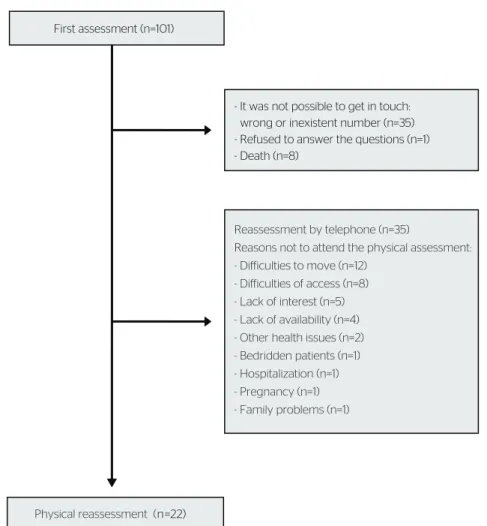
Out of the 101 assessed hemiparetic patients, it was possible to get in touch with 66 of them, and one re-fused to participate in the study. herefore, it was pos-sible to contact 65 participants or their relatives. Out of the 57 remaining individuals, 35 only answered the questions by phone and 22 were physically assessed. he recruiting process and reasons for not attending the re-assessment can be observed in Figure 1.
First assessment (n=101)
Reassessment by telephone (n=35)
Reasons not to attend the physical assessment: - Difficulties to move (n=12)
- Difficulties of access (n=8) - Lack of interest (n=5) - Lack of availability (n=4) - Other health issues (n=2) - Bedridden patients (n=1) - Hospitalization (n=1) - Pregnancy (n=1) - Family problems (n=1)
n=22)
- It was not possible to get in touch: wrong or inexistent number (n=35) - Refused to answer the questions (n=1) - Death (n=8)
Physical reassessment (
Table 1 reports data related to the 22 individuals who were physically reassessed and to the 35 partici-pants whose data were collected by telephone.
Table 2 presents the comparison between scores ob-tained in the reassessment in comparison to the irst evaluation of the 22 analyzed individuals. In the irst evaluation, six participants were classiied as inac-tive by the HAP, 12 as moderately acinac-tive and 4 as acinac-tive. In the second evaluation, 5 were classiied as active, 12
as moderately active and 5 as inactive. No statistically signiicant diferences were observed for the HAP vari-ables (AAS) (p=0.77) and HAP (MAS) (p=0.18), dem-onstrating that levels of physical activity were not dif-ferent between evaluations. None of the other variables presented statistically signiicant diferences between assessments (0.08<p<0.96), except for MIP (p<0.05) (Table 2). Individuals presented maximum gait of 1.40±0.6 m/s in the reassessment.
DISCUSSION
his is the irst Brazilian study that analyzed the behav-ior of variables related to the motor function of chron-ic hemiparetchron-ic patients after a long follow-up period. Interestingly, even though the stroke is considered as the worst problem in Brazilian public health, little at-tention has been addressed to the control of risk factors for new events and follow-up of post-lesion survivors20.
Even though André et al.1 pointed out the reduced post-stroke mortality throughout the years in Brazil, which was justiied, among other reasons, by the im-proved health conditions of the population, it was ob-served that after the average of seven years, 12% of the participants passed away. his value was higher than the one found in literature, which reports a mortality rate of approximately 5% for individuals aged between 55 and 64 years old21. Since it was not possible to obtain data concerning the severity of the lesion in individuals who passed away in this study, it is not possible to state that this discrepancy could be justiied by the severity of the observed lesion.
Also, a 14% recurrence rate was observed for stroke, which was inferior to that reported in literature, which points out that the individuals in a period of approxi-mately ive years after the lesion have a 25 to 40% chance of sufering a new episode22,23. However, this rate can be underestimated, since it is not possible to know if new episodes have occurred among the people who could not be reached.
Recently, Malmann et al.24 observed in a popula-tion of hemiparetic patients that physical inactivity was determinant for new stroke events. he results of this study corroborate this inding, because in the irst as-sessment, only 26.5% of the participants were classiied as inactive, which contributes with the low found recur-rence. Besides, the 22 individuals who were physically Table 1. Characteristics of the participants assessed physically and by
telephone
Variable
Physical (n=22) mean±SD
By telephone (n=35) mean±SD
Age (years)
(minimum–maximum)
56.8±13.3 (31–86)
64.6±10.6 (41–84) Male gender (%) 11 (50.0) 16 (47.1) Side of Hemiplegia, right (%) 17 (77.3) 12 (35.3) Post-stroke time (years)
(minimum–maximum)
10.8±3.3 (4.9–16.0)
12.4±5.6 (5.9–28.0) New stroke (%) 1 (4.5) 6 (17.6) Number of medications (number), mean±SD
and variation (minimum–maximum)
4.7±2.9 (0–9)
4.0±1.8 (0–7) Number of associated diseases
(minimum–maximum)
3.1±2.1 (0–6)
3.4±2.0 (0–9) Physical activity, yes (%) 5 (22.7) 5 (14.3) Rehabilitation, yes (%) 7 (31.8) 5 (14.3) Time of rehabilitation between
assessments (years) (minimum–maximum)
NA 1.7±2.2 (0–9) BMI (kg/m2)
(minimum–maximum)
26.5±5.4 (17.8–38.0)
NA
SD: standard deviation; NA: not assessed; BMI: body mass index
Table 2. Comparison of variables investigated bewteen the two assess-ments (n=22)
Variable Assessment Follow-up p-value
HAP (AAS) mean±SD
(minimum-maximum)
60,23±17,69 (20–86)
64,00±16,80 (15–94)
0,45
HAP (MAS) mean±SD
(minimum-maximum)
76,41±12,47 (43–94)
74,59±12,22 (33–94)
0,64
Gait speed (m/s) mean±SD
(minimum-maximum)
0,97±0,45 (0,13–1,95)
0,87±0,34 (0,08–1,32)
0,23
MIP (cmH2O) mean±SD
(minimum-maximum)
78,55±36,62 (20–150)
99,55±37,60 (40–180)
0,03
MEP (cmH2O) mean±SD
(minimum-maximum)
93,76±49,19 (20–200)
88,13±38,94 (40–170)
0,52
6MWT (m) mean±SD
(minimum-maximum)
360,48±139,93 (40–570)
317,1±135,25 (27–510)
0,08
reassessed maintained the activity levels and only one individual reported a new episode of stroke.
In relation to the functional level, no signiicant dif-ferences were observed between the assessments. Even though a tendency of reduced speed gait values was ob-served, participants kept appropriate values for commu-nity ambulation (>0.8 m/s)25. Once gait speed measures are recognized as indicators of functional performance, independence and social participation26, this fact points to the maintenance of the integration of the individu-als in the community. Besides, in reassessment it was observed that individuals were able to improve their speed in 62% (analyzed by the maximum gait speed), and this inding is relevant, since this ability is related to community activities that demand acceleration, such as crossing streets safely27.
In this study, an increased MIP was observed in reas-sessment. In this sense, it is very important to maintain the proper functioning of the post-stroke inspiratory muscles, once such weakness can lead to compromised respiratory function28, thus leading to recurrent hospi-talizations. Teixeira-Salmela et al.17 observed the de-creased strength of respiratory muscles in hemiparetic patients when compared to healthy individuals. he in-creased MIP observed in this study could be partially explained by the high functional level observed, which could probably be associated with the increased motor demands throughout the years (muscle strength, for in-stance), which were not assessed in this study. his hy-pothesis is s strengthened by studies that demonstrated the correlation between MIP and MEP and the periph-eral muscles in individuals aged 20 to 80 years old16, and exclusively among the elderly29.
Even though diferences have been found between the values of MIP between the evaluations, no difer-ences were observed between the distance run in the 6MWT, which is diferent from the result observed by Kelly et al.30, who reported a relation between the perfor-mance in the 6MWT of acute hemiparetic patients with cardiorespiratory performance. his counterpoint can be explained by the diferences between the samples in the studies, such as post-lesion time and functional levels.
In reassessment, only 20% stated to practice physi-cal activities. However, data related to physiphysi-cal activ-ity were not initially collected, so it was not possible to verify changes in this behavior. Studies show that all the variables investigated in this study present the tendency to decrease with time14,31-34. However, such tendency was not conirmed.
Some limitations can be observed in this study. Data were reported by the individuals themselves, which may have led to memory bias. Factors that may have inlu-enced the studied variables were not controlled between assessments, once the individuals were analyzed only twice. Besides, the episodes that occurred with people who could not be reached are not known. he data presented can only be generalized in populations with similar characteristics to the one analyzed here: chronic hemiparetic patients with high functional levels, since only these individuals had physical conditions to return to the reassessment location.
herefore, even though reductions were expected in the values of the variables analyzed with aging, this study showed their maintenance or increase in the cases of MIP. Such fact can be associated with the maintenance of physical activity levels of post-stroke individuals.
REFERENCES
1. André C, Curioni CC, Cunha CB, Veras R. Progressive Decline in stroke mortality in Brazil from 1980 to 1982, 1990 to 1992, and 2000 to 2002. Stroke. 2006;37(11):2784-9.
2. Saposnik G, Del Brutto OH. Stroke in South America: a systematic review of incidence, prevalence, and stroke subtypes. Stroke. 2003;34(9):2103-7.
3. Evers SMMA, Struijs JN, Ament AJH, van Genugten MLL, Jager JHC, van Den bos GAM. International comparison of stroke cost studies. Stroke. 2004;35(5):1209-15.
4. van Eeden M, van Heugten CM, Evers SMAA. The economic impact of stroke in The Netherlands: the €-Restore4Stroke study. BMC Public Health. 2012;12:122.
5. Struijs JN, van Genugten MLL, Evers SMAA, Ament AJH, Baan CA, van den Bos GAM. Future costs of stroke in the Netherlands: the impact of stroke services. Int J Technol Assess Health Care. 2006;22(4):518-24. 6. Caro JJ, Huybrechts KF, Duchesne I. Management patterns and
costs of acute ischemic stroke: an international study. Stroke. 2000;31(3):582-90.
7. Hankey GJ, Jamrozik H, Broadhurst RJ, Forbes S, Anderson CS. Long-term disability after first-ever stroke and related prognostic factors in the Perth Community Stroke Study, 1989-1990. Stroke. 2002;33(4):1034-40.
8. Rigby H, Gubitz G, Eskes G, Reidy Y, Christian C, GroverV, et al. Caring for stroke survivors: baseline and 1-year determinants of caregiver burden. Int J Stroke. 2009;4(3):152-8.
9. Kammersgaard LP, Jørgensen HS, Reith J, Nakayama H, Pedersen PM, Olsen TS. Short- and long-term prognosis for very old stroke patients. The Copenhagen Stroke Study. Age Ageing. 2004;33(2):149-54. 10. Diederichs C, Mühlenbruch K, Lincke HO, Heuschmann PU, Ritter
11. Christensen MC, Valiente R, Silva GS, Lee WC, Dutcher S, Rocha MSG, et al. Acute treatment costs of stroke in Brazil. Neuroepidemiology. 2009;32(2):142-9.
12. Brucki SMD, Nitrini R, Caramelli P, Bertolucci PHF, Okamoto IH. Sugestões para o uso do mini-exame do estado mental no Brasil. Arq Neuro-psiquiatr. 2003;61(3B):777-81.
13. Polese JC, Nascimento LR, Faria CDCM, Laurentino GEC, Rodrigues-de-Paula F, Ada L, et al. Percepção de hemiplégicos crônicos sobre o uso de dispositivos auxiliares na marcha. Rev Panam Salud Pública. 2011:30(3):204-8.
14. Souza AC, Magalhaes LC, Teixeira-Salmela LF. Adaptação transcultural e análise das propriedades psicométricas da versão brasileira do Perfil de Atividade Humana. Cad Saúde Pública. 2006;22(12):2623-36.
15. Teixeira-Salmela LF, Silva PC, Lima RCM, Augusto ACC, Souza AC, Goulart F. Musculação e condicionamento aeróbico na performance funcional de hemiplégicos crônicos. Acta Fisiátrica. 2003;10(2):54-60.
16. Neder JA, Andreoni S, Lerario MC, Nery LE. Reference values for lung function tests. II. maximal respiratory pressures and voluntary ventilation. Braz J Med Biol Res. 1999;32(6):719-27.
17. Teixeira-Salmela LF, Parreira VF, Britto RR, Brant TC, Inácio EP, Alcântara TO, et al. Respiratory pressures and thoracoabdominal motion in community-dwelling chronic stroke survivors. Arch Phys Med Rehabil. 2005;86(10):1974-8.
18. Steele B. Timed walking tests of exercise capacity in chronic cardiopulmonary illness. J Cardiopulm Rehabil. 1996;16(1):25-33. 19. Britto RR, Sousa LAP. Six Minute Walk Test – a Brazilian Standardization.
Fisioter Mov. 2006;19(4):49-54.
20. Lotufo PA. Stroke in Brazil: a neglected disease. Sao Paulo Med J. 2005;123(1):3-4.
21. Prencipe M, Culasso F, Rasura M, Anzini A, Beccia M, Cao M, et al. Long-term prognosis after a minor stroke: 10-year mortality and major stroke recurrence rates in a hospital-based cohort. Stroke. 1998;29(1):126-32.
22. Mohan KM, Wolfe CD, Rudd AG, Heuschmann PU, Kolominsky-Rabas PL, Grieve AP. Risk and cumulative risk of stroke recurrence: a systematic review and meta-analysis. Stroke. 2011;42(5):1489-94.
23. Rosamond W, Flegal K, Furie K, Go A, Greenlund K, Haase N, et al. Heart disease and stroke statistics – 2008 update: a report from the American Heart Association Statistics Committee and Stroke Statistics Subcommittee. Circulation. 2008;117(4):e25-146.
24. Mallmann AB, Fuchs SC, Gus M, Fuchs FD, Moreira LB. Population-attributable risks for ischemic stroke in a community in south brazil: a case-control study. PLoS One. 2012;7(4):e35680.
25. Perry J, Garrett M, Gronley JK, Mulroy SJ. Classification of walking handicap in the stroke population. Stroke. 1995;26(6):982-9.
26. Teixeira-Salmela LF, Lima RCM, Lima LAO, Morais SG, Goulart F. Assimetria e desempenho funcional em hemiplégicos crônicos antes e após programa de treinamento em academia. Rev Bras Fisioter. 2005;9(2):227-33.
27. Polese JC, Teixeira-Salmela LF, Nascimento LR, Faria CD, Kirkwood RN, Laurentino GC, et al. The efects of walking sticks on gait kinematics and kinetics with chronic stroke survivors. Clin Biomech. 2012;27(2):131-37.
28. Annoni JM, Ackermann D, Kesselring J. Respiratory function in chronic hemiplegia. Int Disabil Stud. 1990;12(2):78-80.
29. Simões LA, Dias JMD, Marinho KC, Pinto CLLR, Brito RR. Relação da função muscular respiratória e de membros inferiores de idosos comunitários com a capacidade funcional avaliada por teste de caminhada. Rev Bras Fisioter. 2010;14(1):24-30.
30. Kelly JO, Kilbreath SL, Davis GM, Zeman B, Raymond J. Cardiorespiratory fitness and walking ability in subacute stroke patients. Arch Phys Med Rehabil. 2003;84(12):1780-5.
31. Britto RR, Zampa CC, Oliveira TA, Prado LF, Parreira VF. Efects of the aging process on respiratory function. Gerontology. 2009;55(5):505-10.
32. Janssens JP, Pache JC, Nicod LP. Physiological changes in respiratory function associated with ageing. Eur Respir J. 1999;13(1):197-205. 33. Pires SR, Oliveira AC, Parreira VF, Britto RR. Teste de caminhada de
seis minutos em diferentes faixas etárias e índices de massa corporal. Rev Bras Fisioter. 2007;11(2):147-51.