EFFECT OF FLY ASH AND SILICA
FUME ON THE SORPTIVITY OF
CONCRETE
FOLAGBADE, SAMUEL OLUFEMI*
Department of Building, Faculty of Environmental Design and Management, Obafemi Awolowo University, Ile-Ife, 0220005, Nigeria.
*Research was carried out at the Department of Civil Engineering, University of Dundee, Dundee, United Kingdom as part of the Author’s PhD degree programme.
Abstract
Despite their ability to perform better than CEM I, available data have shown that cement combination concetes have been under-utilised in construction. To investigate the permeation resistance of cement combination concrete, this paper examined the sorptivity of CEM I and some binary and ternary cement concretes containing fly ash and silica fume at equal water/cement ratios and strengths. At equal water/cement ratio, fly ash binary cement concretes have higher sorptivity than CEM I and while their sorptivity increased with increasing content of fly ash, they decreased with curing age. Silica fume binary and ternary cement concretes have lower sorptivity than CEM I and fly ash binary cement concretes at both early and later ages and their sorptivity reduced with increasing content of silica fume. At equivalent strengths, cement combination concretes generally have lower sorptivity than CEM I and they reduced with increasing total content of the cement additions.
Keywords: Cement additions; cement combination concrete; permeation resistance; sorptivity.
1. Introduction
The use of cement additions has become an increasingly accepted practice in construction to improve concrete performance and contribute positively to the sustainability principle through the re-use of the supposed waste materials, reduced embodied carbon dioxide contents and improved environmental compatibility of their concrete. Silica fume, due to its fineness, would result in close packing of materials, reduced bleeding and reduced pore size[1] and generate more nucleation sites to accelerate hydration reactions[2]. Therefore, apart from filling up the voids existing between the coarser particles like the inert additives, it would chemically react in the pore water to produce materials which are capable of reducing the porosity within the resulting paste and at the interface transition zone between the paste and the aggregates[3]. Fly ash is cheaper and would improve the workability of concrete, but it would reduce hydration reactions at early ages. Fly ash and silica fume, complimenting each other, would react with Ca(OH)2 to form additional calcium silicate hydrates which would
increase density, refine the pore structure and reduce permeability to make concrete less susceptible to deterioration. The use of cement combinations is permitted by cement and concrete standards like BS EN 197- 1, BS 8500 and BS EN 206- 1.
slow-continue to refine the properties of the hardened concrete as it matures[5, 9, 17, 18, 19]. Also, their ternary
combination would result in reduced dosage of water reducing admixtures [20]. Sorptivity is a standard test for
measuring the rate of absorption of water by hydraulic cement concretes and it determines the susceptibility of an unsaturated concrete to water penetration by absorption when no head of water exist. Minimising sorptivity is important in order to reduce the ingress of chloride or sulphate into concrete[21]. Sorptivity would increase with
increasing content of fly ash[22]. Compared with CEM I and fly ash binary cement concretes, the addition of
silica fume as binary and ternary cement component would reduce sorptivity[23].
Cement combinations, by virtue of their delayed strength development at early ages, would be more suitable for mass concreting and concrete work in hot climate than CEM I. Due to their long-term pozzolanic reaction with curing age, cement combinations would also be good for under-water concrete structures. While BS EN 197- 1 permits the use of silica fume and fly ash of up to 10% and 55% respectively, data from the European Ready Mixed Concrete Organisation show that the cement addition content (majorly GGBS and fly ash) was less than 20% of the total cement consumption in ready-mixed concrete. At equivalent strengths, the use of cement combinations could result in better performance[24, 25]. However, while concrete in practice is prescribed on the basis of strength, most researches in literature were conducted at equal water/cement ratio. Hence this paper, within the standard limits, examined the effect of cement combinations on the sorptivity of concrete at equal water/cement ratios and strengths.
2. Experimental Materials and Mix Proportions
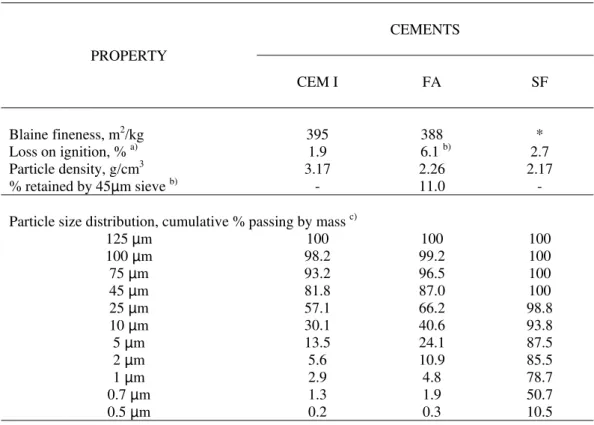
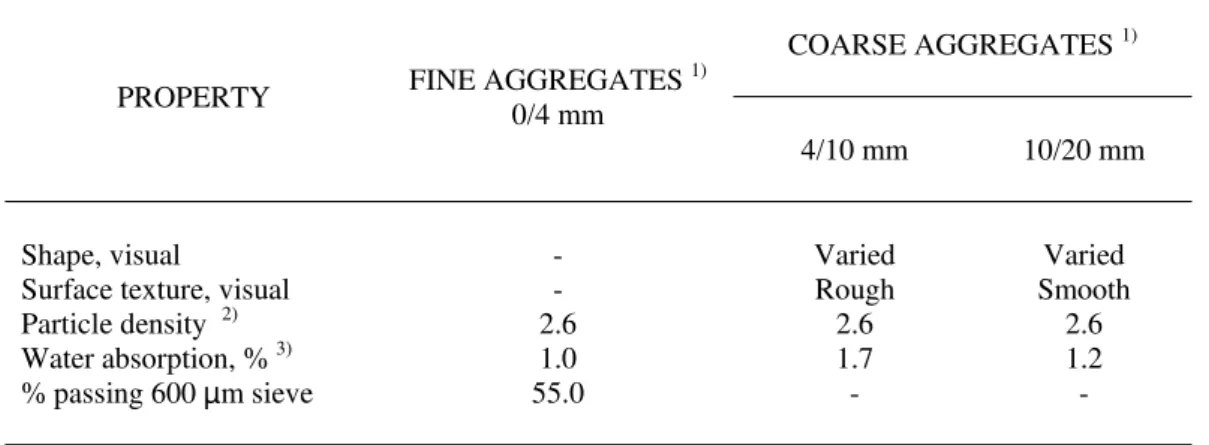
The cements used were Portland cement (CEM I, 42.5 type) conforming to BS EN 197- 1, siliceous or Class F fly ash (FA) conforming to BS EN 450- 1 and silica fume (SF) in a slurry form (50:50 solid/water ratio by weight) conforming to BS EN 13263- 1. The physical and chemical properties of the cements are presented in Table 1. The aggregates consisted of 0/4mm fine aggregates and 4/10mm and 10/20mm coarse aggregates. The coarse aggregates were uncrushed and they come in varied shapes. The 4/10mm aggregates have rough texture and the 10/20mm aggregates were smooth. The physical properties of the aggregates are presented in Table 2.
Table 1: Physical and chemical properties of cements
PROPERTY
CEMENTS
CEM I FA SF
Blaine fineness, m2/kg 395 388 *
Loss on ignition, % a) 1.9 6.1 b) 2.7
Particle density, g/cm3 3.17 2.26 2.17
% retained by 45µm sieve b) - 11.0 -
Particle size distribution, cumulative % passing by mass c)
125 µm 100 100 100
100 µm 98.2 99.2 100
75 µm 93.2 96.5 100
45 µm 81.8 87.0 100
25 µm 57.1 66.2 98.8
10 µm 30.1 40.6 93.8
5 µm 13.5 24.1 87.5
2 µm 5.6 10.9 85.5
1 µm 2.9 4.8 78.7
0.7 µm 1.3 1.9 50.7
0.5 µm 0.2 0.3 10.5
Table 2: Physical properties of fine and coarse aggregates
PROPERTY FINE AGGREGATES
1)
0/4 mm
COARSE AGGREGATES 1)
4/10 mm 10/20 mm
Shape, visual - Varied Varied
Surface texture, visual - Rough Smooth
Particle density 2) 2.6 2.6 2.6
Water absorption, % 3) 1.0 1.7 1.2
% passing 600 µm sieve 55.0 - -
1) Aggregates were obtained from Wormit Quarry. 2) In accordance with BS EN 1097- 6 3) In accordance with BS EN 1097- 6, Laboratory-dry condition
Potable water, conforming to BS EN 1008, was used for mixing, curing and testing the concrete specimens. In order to provide reasonably workable concretes and a uniform basis for comparing concrete performance at low water/cement ratios and a fixed water content, a superplasticiser based on carboxylic ether polymer conforming to EN 934-2 was applied during mixing to achieve a consistence level of S2 defined by a nominal slump of
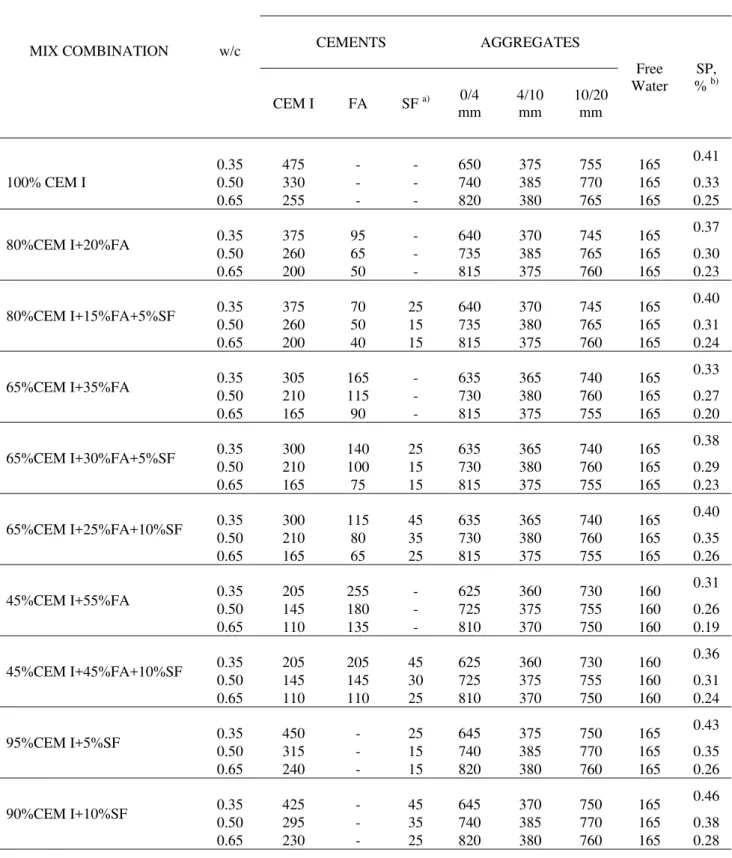
50-100mm in BS EN 206- 1. The yield corrected concrete mix proportions, to the nearest 5 kg/m3, based on the
BRE Design Guide[27], a free water content of 165 kg/m3 (to avoid an excessively sticky mix) and saturated
Table 3: Yield corrected mix proportions of concrete at a fixed free water content of 165 kg/m3
MIX COMBINATION w/c
MIX PROPORTION, kg/m3
CEMENTS AGGREGATES
Free Water
SP, % b)
CEM I FA SF a) 0/4
mm
4/10 mm
10/20 mm
100% CEM I
0.35 475 - - 650 375 755 165 0.41
0.50 330 - - 740 385 770 165 0.33
0.65 255 - - 820 380 765 165 0.25
80%CEM I+20%FA 0.35 375 95 - 640 370 745 165
0.37
0.50 260 65 - 735 385 765 165 0.30 0.65 200 50 - 815 375 760 165 0.23
80%CEM I+15%FA+5%SF 0.35 375 70 25 640 370 745 165
0.40
0.50 260 50 15 735 380 765 165 0.31 0.65 200 40 15 815 375 760 165 0.24
65%CEM I+35%FA 0.35 305 165 - 635 365 740 165
0.33
0.50 210 115 - 730 380 760 165 0.27 0.65 165 90 - 815 375 755 165 0.20
65%CEM I+30%FA+5%SF 0.35 300 140 25 635 365 740 165
0.38
0.50 210 100 15 730 380 760 165 0.29 0.65 165 75 15 815 375 755 165 0.23
65%CEM I+25%FA+10%SF 0.35 300 115 45 635 365 740 165
0.40
0.50 210 80 35 730 380 760 165 0.35 0.65 165 65 25 815 375 755 165 0.26
45%CEM I+55%FA 0.35 205 255 - 625 360 730 160
0.31
0.50 145 180 - 725 375 755 160 0.26 0.65 110 135 - 810 370 750 160 0.19
45%CEM I+45%FA+10%SF 0.35 205 205 45 625 360 730 160
0.36
0.50 145 145 30 725 375 755 160 0.31 0.65 110 110 25 810 370 750 160 0.24
95%CEM I+5%SF 0.35 450 - 25 645 375 750 165
0.43
0.50 315 - 15 740 385 770 165 0.35 0.65 240 - 15 820 380 760 165 0.26
90%CEM I+10%SF 0.35 425 - 45 645 370 750 165
0.46
0.50 295 - 35 740 385 770 165 0.38 0.65 230 - 25 820 380 760 165 0.28
a)Dry powder content.
3. Experimental Methods
Concrete was prepared to BS EN 12390- 2 and the specimens were cast, cured under a layer of damp hessian
covered with polythene for 20-24 hours, demoulded and cured in water tanks maintained at about 20oC until the
tests’ dates. Tests were carried out on hardened concrete specimens to determine their cube compressive strength and sorptivity at equal water/cement ratios. The cube compressive strengths were obtained in accordance with BS EN 12390- 3 using 100mm cubes at the curing age of 28 days at the water/cement ratios of 0.35, 0.50 and 0.65. Since absorption into concrete is a function of the drying temperature and immersion
duration[28], sorptivity was determined with specimens oven-dried to constant mass at 105±5oC to ensure a
uniform basis for the comparison and repeatability of the results. This is because it is generally believed that at this temperature the pozzolanic reactions of the cement additions would be stopped, the plastic shrinkage cracking associated with reduced bleeding that normally characterise the use of fine materials would be avoided and the microstructure of the test specimens would not be adversely affected to prevent the repeatability of the results.
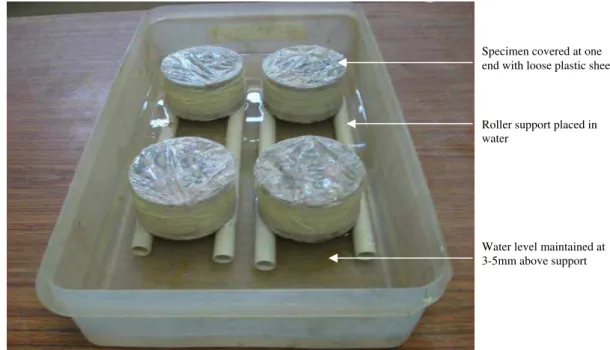
Sorptivity was carried out in accordance with ASTM C1585- 05 using concrete specimens 100mm in diameter and about 50mm thick. After being cooled to room temperature in a dessicator, the oven-dried specimens were waxed on the side and covered on one end with a loose plastic sheet attached with masking tape to allow the entrapped air to escape from the concrete pores while at the same time preventing water loss by evaporation. After obtaining the initial mass, the test surface (i.e. uncovered end) of each sample was placed on two lines of roller support placed in water maintained at 3-5mm level above the top of the support throughout the duration of the test (Figure 1).
Figure 1: A typical sorptivity test set-up
The sorptivity test was conducted over six hours and the cumulative change in mass at specific intervals was determined. For each mass determination, the test specimen was removed from water and the surface was cleaned with a dampened paper towel to remove water droplets. The mass of the sample was then measured and the sample was replaced to continue the test. The cumulative change in mass at one minute, five minutes, ten minutes, 20 minutes, 30 minutes, one hour, two hours, three hours, four hours, five hours and six hours were used to obtain the respective cumulative absorption values (i) expressed by
i =
A
m
(1)
where Δm = cumulative change in mass due to water absorption,
A = cross-sectional area of test specimen, mm2 and
Specimen covered at one end with loose plastic sheet
It has been shown by Hall [29] that there exists a relation of the form
i = St0.5 (Darcy’s Law) (2)
where S = sorptivity in mm/√min (1mm/√min = 1.29x10-0.4 m/√s) and t = time in minutes
Hence the cumulative absorption values were plotted against the square root of the times and sorptivity (the initial rate of water absorption) was obtained as the slope of the line that best fits the plot.
4. Analysis and Discussion of Results
Table 4 shows that the cube compressive strength of concrete reduced with increasing water/cement ratio and that while the addition of fly ash would reduce strength with increasing content, the addition of silica fume as binary and ternary cement component resulted in improved strength at 28 days. Also, the sorptivity of fly ash binary cement concretes which were slightly higher than that of CEM I concrete at 28 days reduced progressively such that at 180 days they became lower. This is because fly ash would require a higher level of
alkalinity which increased progressively with the release of Ca(OH)2 by the hydration reaction of CEM I to
improve the resistance of its concretes to sorption. Since the reductions at these ages increased with increasing content of fly ash, sorptivity would reduce at equal water/cement ratio with increasing content of fly ash. The Table also shows that the addition of silica fume as binary and ternary cement component reduced the sorptivity of concrete at the test ages. The resistance of the ternary cement concretes to sorptivity also increased with increase in the total content of the cement additions. The higher fineness of silica fume (Table 2) must have resulted in better packing between the cements and at the interface zones between the cement paste and the
aggregates. Also, more nucleation sites would be provided by the finer silica fume for Ca(OH)2 to improve the
pozzolanic reactions and reduce the sorptivity values of concrete.
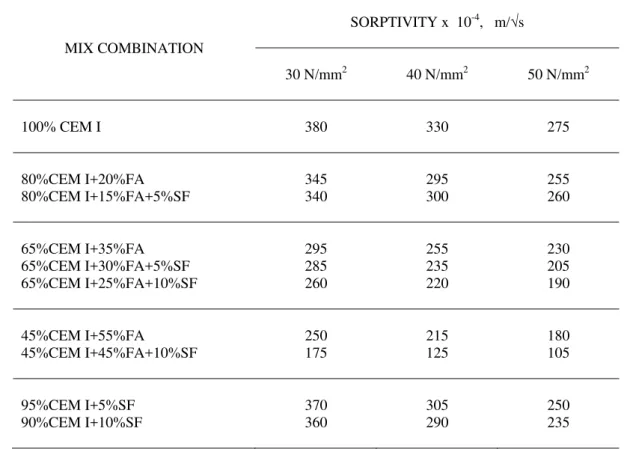
Table 4 shows that sorptivity of concrete reduced with increasing water/cement ratio and that equivalent sorptivity values of the concretes at equal water/cement ratio would be achieved at different ages and therefore at different compressive strengths. Concrete is specified in practice on the basis of strength and since at 28 days a substantial quantity of hydration would have taken place, the sorptivity of these concretes has been investigated at equivalent strength at 28 days. The cube compressive strength and sorptivity of the concrete at the curing age of 28 days at the water/cement ratios of 0.35, 0.50 and 0.65 (Table 4) were used, by interpolation, to obtain the sorptivity of the concretes at the equivalent strengths of 30, 40 and 50 N/mm2 at 28 days (Table 5) which happen to be the range of strengths that would commonly be used in practice. These strengths also satisfy most of the strength requirements in BS EN 206-1 and BS 8500.
Table 4: Cube compressive strength and sorptivity of concrete at equal water/cement ratios
MIX COMBINATION w/c
STRENGTH AT 28 DAYS,
N/mm2
SORPTIVITY x 10-4, m/√s
28 Days 90 Days 180 Days
100% CEM I
0.35 80.0 200 160 135
0.50 54.0 260 215 190
0.65 38.5 335 295 260
80%CEM I+20%FA 0.35 72.0 205 155 120
0.50 46.5 265 220 185
0.65 30.0 345 300 255
80%CEM I+15%FA+5%SF 0.35 83.0 190 150 125
0.50 55.0 245 200 165
0.65 36.0 315 260 220
65%CEM I+35%FA 0.35 60.0 210 155 120
0.50 35.0 270 220 180
0.65 20.0 360 295 250
65%CEM I+30%FA+5%SF 0.35 65.0 170 130 100
0.50 43.0 225 170 135
0.65 26.0 300 230 180
65%CEM I+25%FA+10%SF 0.35 77.0 150 120 95
0.50 49.5 190 155 125
0.65 32.0 255 205 165
45%CEM I+55%FA 0.35 42.0 210 150 110
0.50 24.0 275 210 155
0.65 12.0 375 295 250
45%CEM I+45%FA+10%SF 0.35 57.0 95 80 70
0.50 36.0 140 120 95
0.65 22.0 250 170 125
95%CEM I+5%SF 0.35 78.0 120 100 85
0.50 58.0 205 160 120
0.65 41.0 300 235 175
90%CEM I+10%SF 0.35 82.0 115 95 80
0.50 59.0 185 145 115
0.65 45.0 270 210 170
5. Conclusion
Table 5: Sorptivity of concrete at the equivalent strengths of 30, 40 and 50 N/mm2 at 28 days
MIX COMBINATION
SORPTIVITY x 10-4, m/√s
30 N/mm2 40 N/mm2 50 N/mm2
100% CEM I 380 330 275
80%CEM I+20%FA 345 295 255
80%CEM I+15%FA+5%SF 340 300 260
65%CEM I+35%FA 295 255 230
65%CEM I+30%FA+5%SF 285 235 205
65%CEM I+25%FA+10%SF 260 220 190
45%CEM I+55%FA 250 215 180
45%CEM I+45%FA+10%SF 175 125 105
95%CEM I+5%SF 370 305 250
90%CEM I+10%SF 360 290 235
References
[1] Mindess, S., Young, F. J. and Darwin, D., Concrete, Prentice-Hall, 2003, 644p.
[2] Mehta, P, K. and Aitcin P. C., Principles underlying production of high-performance concrete, Cement Concrete and Aggregates, 12, 1990, pp. 70-78.
[3] Korpa A., Kowald T. and Trettin R., Hydration behaviour, structure and morphology phases in advanced cement based systems containing micro and nanoscale pozzolanic additives, Cement and Concrete Research, 38 (7), 2008, pp. 955-962.
[4] Dhir R. K., McCarthy M. J. and Paine K. A., Use of fly ash to BS EN 450 in structural concrete, Thomas Telford, 2002, 878p. [5] Thomas M. D. A., Shehata M. H., Shashiprakash S. G., Hopkins D. S. and Cail K., Use of ternary cementitious systems containing
silica fume and fly ash in concrete, Cement and Concrete Research, 29 (8), 1999, pp. 1207-1214.
[6] Concrete Society, The use of GGBS and PFA in concrete, Technical Report No 40, The Concrete Society, London, 1991. [7] Helmuth, R., Fly ash in cement and concrete, Portland Cement Association, Skokie, Illinois, 1987, 203p.
[8] Hassan, K. E., Cabrera, J. G., Maliehe, R. S., The effect of mineral admixtures on the properties of high- performance concrete, Cement and Concrete Composites, 22 (4), 2000, pp 267-271.
[9] Lam L., Wong Y. L., Poon C. S., Effect of fly ash and silica fume on compressive and fracture behaviours of concrete, Cement and Concrete Research, 28 (2), 1998, pp 271-283.
[10] Naik T. R., Singh S., Ramme B., Mechanical properties and durability of concrete made with blended fly ash, ACI Material Journal, 95 (4), 1998, pp 454-462.
[11] Dhir R. K., Jones M. R., Development of chloride-resisting concrete using fly ash, Fuel 78 (2), 1999, pp 137-142.
[12] Antiohos S. and Tsimas S., Chloride resistance of concrete incorporating two types of fly ashes and their intermixtures: The effect of active silica content, Supplementary paper- Proceedings of the 6th CANMET/ACI International Conference on Durability of Concrete, Thessaloniki, Greece, 2003.
[13] Antiohos S. K., Papadakis V. G., Chaniotakis E., Tsimas S., Improving the performance of ternary blended cements by mixing different types of fly ashes, Cement and Concrete Research, 37 (6), 2007, pp 877-885.
[14] Jones M. R., Sear L. K. A., McCarthy M. J. and Dhir R. K., Changes in coal fired power station fly ash: Recent experiences and use in concrete, Proc. Ash Technology Conference, UK Quality Ash Association, 2006.
[15] Langan B. W., Weng K. and Ward M. A., Effect of silica fume and fly ash on heat of hydration of Portland cement, Cement and Concrete Research, 32 (7), 2002, pp 1045-1051.
[16] Bentz D. P., Stutzman P. E. and Garboczi E. J., Experimental and simulation studies of the interfacial zone in concrete, Cement and Concrete Research, 22 (5), 1992, pp 891-902.
[17] Mehta P. K. and Gjorv O. E.,Properties of Portland cement concrete containing fly ash and condensed silica fume, Cement and Concrete Research, 12 (5), 1982, pp 587-595.
[18] Khan M. I., Lynsdale C. J. and Waldron P., Porosity and strength of PFA/SF/OPC ternary blended paste, Cement and Concrete Research, 30 (8), 2000, pp 1225-1229.
[19] Khan M. I. and Lynsdale C. J., Strength, permeability and carbonation of high-performance concrete, Cement and Concrete Research, 32 (1), 2002, pp 123-131.
[21] McCarter W. J., Ezirim H., Emerson M., Absorption of water and chloride into concrete, Magazine of Concrete Research, 44 (158), 1992, pp 31-37.
[22] Bai J., Wild S. and Sabir B. B., Sorptivity and strength of air-cured PC-PFA-MK concrete and the influence of binder composition on carbonation depth, Cement and Concrete Research, 32 (11), 2002, pp 1813-1821.
[23] Gonen, T. and Yazicioglu, S., The influence of mineral admixtures on the short and long-term performance of concrete, Building and Environment, 42, 2007, pp 3080-3085.
[24] Dhir R. K. and Byars E. A., PFA Concrete: Near surface absorption properties. Magazine of Concrete Research, 43 (157), 1991, pp 219-232.
[25] Dias W. P. S., Nanayakkara S. M. A. and Ekneligoda T. C., Performance of concrete mixes with OPC-PFA blends, Magazine of Concrete Research, 55 (2), 2003, pp 161-170.
[26] Holland, T. C., Silica Fume User’s Manual, Silica Fume Association, Lovettsville, VA 22180, USA, 2005.
[27] Teychenne D. C., Franklin R. E. and Erntroy H. C., Design of normal concrete mixes, 2nd Ed., amended by B. K. Marsh, Building Research Establishment, 1997, 42p.
[28] Lea F. M., Lea’s chemistry of cement and concrete, 4th Ed., Arnold, London, 1998.