in Two Unrelated
Klebsiella pneumoniae
Isolates in
Singapore
Ying-Tsong Chen1,2,3, Ann-Chi Lin1, L. Kristopher Siu4,5*, Tse Hsien Koh6*
1Institute of Molecular and Genomic Medicine, National Health Research Institutes, Zhunan, Taiwan,2Institute of Genomics and Bioinformatics, National Chung Hsing University, Taichung, Taiwan,3Biotechnology Center, National Chung Hsing University, Taichung, Taiwan,4National Institute of Infectious Diseases and Vaccinology, National Health Research Institutes, Miaoli, Taiwan,5Graduate Institute of Basic Medical Science, China Medical University, Taichung, Taiwan,6Department of Pathology, Singapore General Hospital, Singapore, Singapore
Abstract
Background:Spread of theblaNDM-1gene that encodes the New Delhi metallo-b-lactamase (NDM-1) in Enterobacteriaceae is a major global health problem. Plasmids carryingblaNDM-1from two different multi-drug resistantKlebsiella pneumonia isolates collected in Singapore were completely sequenced and compared to known plasmids carryingblaNDM-1.
Methodology/Principal Findings:The two plasmids, pTR3 and pTR4, were transferred toEscherichia colirecipient strain J53 and completely sequenced by a shotgun approach using 3-kb paired-end libraries on 454. Although theK. pneumoniae
strains were unrelated by molecular typing using PFGE and MLST, complete sequencing revealed that pTR3 and pTR4 are identical. The plasmid sequence is similar to theE. coliNDM-1-encoding plasmid p271A, which was isolated in Australia from a patient returning from Bangladesh. The immediate regions of theblaNDM-1gene in pTR3/4 are identical to that of p271A, but the backbone of our plasmid is much more similar to another IncN2 plasmid reported recently, pJIE137, which contained an additional 5.2-kb CUP (conserved upstream repeat) regulon region in comparison to p271A. A 257-bp element bounded by imperfect 39-bp inverted repeats (IR) and an incomplete version of this element flanking the 3.6-kb NDM-1-encoding region were identified in these plasmids and are likely to be the vestiges of an unknown IS.
Conclusions:Although the hosts are not epidemiologically linked, we found that the plasmids bearing theblaNDM-1gene are identical. Comparative analyses of the conserved NDM-1-encoding region among different plasmids fromK. pneumoniae
andE. colisuggested that the transposable elements and the two unknown IR-associated elements flanking the NDM-1-encoding region might have aided the spreading of this worrisome resistance determinant.
Citation:Chen Y-T, Lin A-C, Siu LK, Koh TH (2012) Sequence of Closely Related Plasmids EncodingblaNDM-1in Two UnrelatedKlebsiella pneumoniaeIsolates in
Singapore. PLoS ONE 7(11): e48737. doi:10.1371/journal.pone.0048737
Editor:Yung-Fu Chang, Cornell University, United States of America
ReceivedMay 23, 2012;AcceptedSeptember 28, 2012;PublishedNovember 6, 2012
Copyright:ß2012 Chen et al. This is an open-access article distributed under the terms of the Creative Commons Attribution License, which permits unrestricted use, distribution, and reproduction in any medium, provided the original author and source are credited.
Funding:The work was supported by grants from National Science Council and National Health Research Institutes, Taiwan. The funders had no role in study design, data collection and analysis, decision to publish, or preparation of the manuscript.
Competing Interests:The authors have declared that no competing interests exist. * E-mail: [email protected] (LKS); [email protected] (THK)
Introduction
The NDM-1 carbapenemase gene has become an important resistant determinant in Gram-negative bacteria [1,2]. NDM-1 is able to hydrolyze almost all b-lactam antibiotics and when combined with other resistance mechanisms, renders the host bacterium resistant to almost all antibiotics [3,4]. The rapid spread of these multidrug resistant strains is now a matter of global concern.
Initially, plasmids encodingblaNDM-1were observed inKlebsiella
pneumoniaeandEscherichia coli[5]. These plasmids can conjugatively transfer into other species. The concern in India is the heavy contamination of this gene in seepage water with the possibility of spread in the community [6]. Travelers may be colonized with NDM-1 producing strains in the gut resulting in spread of the gene to different countries [7,8]. TheblaNDM-1gene has been identified
on different plasmids types that vary in length from,50 to 300 kb
[9,10]. In addition, blaNDM-1has recently been identified in the
chromosome of Acinetobacter baumannii [11]. The resistance gene was also reported recently in other bacterial species, such asVibrio cholerae[6]. Thus, the rapid global spread ofblaNDM-1may not be
explainable by a single mechanism.
In this study, the complete sequence of conjugatively transfer-rable plasmids encoding NDM-1 from twoK. pneumoniaeclinical isolates were determined to investigate the genetic basis of the resistance gene. Comparative analyses were carried out with existing sequences to investigate the molecular mechanism underlying the spread ofblaNDM-1in bacteria.
Materials and Methods
Patients’ Characteristics
admission. He had a single spike of temperature but was not septic. He recovered without specific antimicrobial treatment. Patient 2 was a 22 year old male foreigner from Vietnam admitted 2 months after Patient 1 to a different ward in the same hospital with T4 hemangioma with cord compression. Multi-drug resistant K. pneumoniae 44951 was a clinical isolate from urine 8 days after admission and 10 days from the isolate from patient 1. As this was a catheter specimen, it was considered as insignificant and no specific antimicrobial treatment was given. Although their hospital stays overlapped, there was no obvious epidemiological link between the 2 patients.
Antimicrobial Susceptibility Testing
The MICs of 15 antimicrobial agents were determined using the broth microdilution test according to the recommendations of the Clinical and Laboratory Standards Institute [12].
General characteristics of NDM-1 Carrying K. pneumoniae
The 2 carbapenem resistantK. pneumoniaewere confirmed to be carryingblaNDM-1by PCR and subsequent sequencing according
to previously published primers for blaNDM-1 [13]. Plasmid
conjugation was performed usingE. coliJ53 azide resistant strain as recipient [14]. Briefly, recipients and blaNDM-1 carrying
K. pneumoniaewere separately inoculated into brain heart infusion broth (Oxoid Ltd., Basingstoke, England) and incubated at 37uC for 4 h. They were then mixed at a ratio of 1:10 (Donor:Recipient by volume) for overnight incubation at 37uC. A 0.1-ml volume of the overnight broth mixture was spread onto a MacConkey agar plate containing sodium azide (100m/mL) and imipenem (2mg/ mL).
Molecular Typing for NDM-1 Carrying K. pneumoniae and their Transconjugants
Multilocus sequencing typing (MLST) and Pulsed field gel electrophoresis (PFGE) were performed for bothblaNDM-1carrying
K. pneumoniaestrains. Sequences of seven housekeeping genes for MLST were obtained according to Diancourt et al., Sequences were compared with those on the MLST web site (http://www. pasteur.fr/recherche/genopole/PF8/mlst/Kpneumoniae.html) developed by Diancourt et al., [15] and alleles and sequence types (STs) were assigned accordingly. If there was a difference in two or more alleles the strains were considered to be unrelated.
For PFGE, DNA was prepared as described previously [16]. The restriction enzymeXbaI (New England Biolabs, Beverly, MA, USA) was used at the manufacturer’s suggested temperature. Restriction fragments were separated by PFGE in 1% agarose gel (Bio-Rad, Hercules, CA, USA) in 0.56TBE buffer (45 mM Tris, 45 mM boric acid, 1.0 mM EDTA, pH8.0) for 22 h at 200 V at a temperature of 14uC, with ramped times of 2 to 40 s using the Bio-Rad CHEF MAPPER apparatus (Bio-Bio-Rad Laboratories, Rich-mond, CA, USA). Gels were then stained with ethidium bromide and photographed under ultraviolet light. The resulting genomic DNA profiles, or ‘‘fingerprints’’, were interpreted according to established guidelines [17]. Plasmid replicon typing was performed for transconjugants [18].
Plasmid Sequencing
DNA sequencing of the NDM-1-carrying plasmids was performed with a whole genome shotgun approach using 3-kb paired-end libraries [19]. DNA fragments of about 3-kb in length were recovered after hydrodynamic shearing and purified using size exclusion beads (AMPure, Agencourt). The DNA fragments were subsequently linked to adaptors and circularized, then
sheared again by nebulization. The resulting nucleotide fragments containing the adaptor were specifically purified, then ligated to oligomers for PCR amplification. The following emulsion-based clonal amplification (emPCR) was performed following standard 454 pyrosequencing protocols. Sequencing was performed using a 454 GS Jr (454 Life Sciences, Branford, CT, USA). The complete nucleotide sequences of plasmid pTR3 and pTR4 have been submitted to GenBank and assigned sequence accession number JQ349086 and JQ349085.
Bioinformatics Analysis
De-novo sequence assembly was performed on a computer workstation using the 454 Newbler, which automatically detects long paired-end reads (Version 2.6, 454 Life Sciences, Branford, CT, USA). The contigs were manually inspected and reassembled using the Phred/Phrap/Consed [20]. Annotation of the plasmid was manually curated after performing automatic annotation on the RAST Server [20]. Insertion sequences and transposons were further annotated using ISfinder (http://www-is.biotoul.fr) [21].
Results
Antimicrobial Susceptibility Testing Results for NDM-1 Carrying K. pneumoniae and their Transconjugants
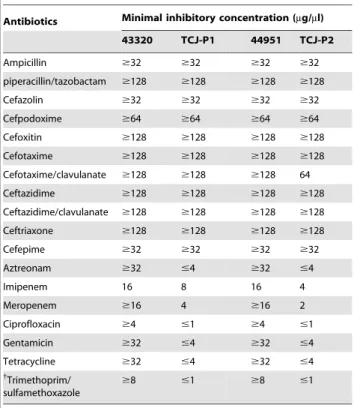
Antimicrobial susceptibility testing results showed thatblaNDM-1
carrying K. pneumoniae clinical isolates, 43320 and 44951, from patient 1 and 2 respectively, were resistant to all tested antibiotics (Table 1). Addition of ab-lactamase inhibitor did not increase the susceptibility to b-lactams. The E. coli transconjugants, TCJ-P1 and TCJ-P2, respectively from 43320 and 44951 had a different resistance profile when compared with the corresponding clinical isolates but were still resistant to allb-lactams except aztreonam. Reduced MICs for imipenem and meropenem were observed in both transconjugants. Both transconjugants were susceptible to non-b -lactam antibiotics including ciprofloxacin, gentamicin, tetracycline and trimethoprim/sulfamethoxazole. PFGE of 43320 and 44951 showed that they were unrelated with more than six bands difference. MLST indicated that 43320 and 44951 belonged to ST273 and ST1 respectively (data not shown). The plasmid incompatibility typing initially was positive for a product with a size consistent with the PCR product for IncN. However, subsequent sequencing of the PCR products showed unrelated sequences for a putative IS911 transposase orfA with KpLE2 phage-like element.
Sequence Annotation and Comparison of the Two blaNDM-1Plasmids
Complete sequencing was performed for the two circular
blaNDM-1plasmids, pTR3 and pTR4, respectively from 43320 and
plasmid pJIE137, a 58,107-kbblaCTX-M-62-encoding plasmid from
K. pneumoniaeJIE137 identified in Australia [23]. Similar to p271A, and JIE137, pTR3/4 also have a backbone organization similar to the IncN plasmid R46. In addition, the conserved repAin these plasmids are unrelated to the IncN plasmids [23]. Since the 5.2-kb CUP region is missing in p271A, the backbone of pTR3/4 is more closely related to pJIE137. Comparative genomics studies revealed that, apart from a 9-kb region containing the blaNDM-1gene in
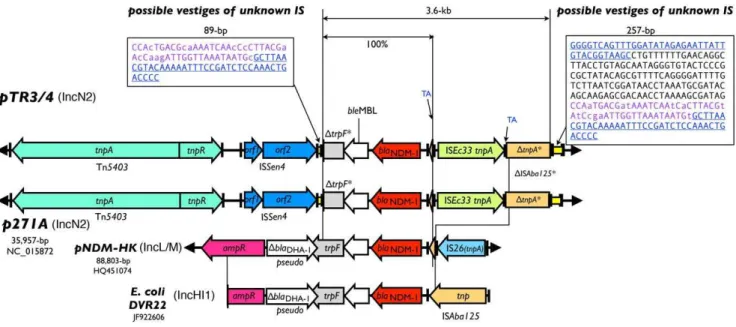
pTR3/4 (Figure 2) and two resistance regions (a class 1 integron/ Tn and a complex ISEcp1-blaCTX-M-62 transposition unit) in
pJIE137, the backbone sequences of pTR3/4 and pJIE137 are 97% identical (Figure 1).
Sequence Comparison of the Immediate Region Near blaNDM-1
The immediate flanking regions of blaNDM-1, including the
bleMBLbleomycin-resistance protein gene, thetrpFpseudogene, the
nearby ISAba125 (interrupted), ISEc33, ISSen4 and Tn5403 are identical in pTR3/4 and p271A (Figure 2). Upstream ofblaNDM-1
is a short fragment corresponding to the left extremity of an ISAba125. When compared with theE. coliDVR22 sequence from Spain [GeneBank accession no. JF922606; [24]], it is apparent that the ISAba125 was interrupted by insertion of the ISEc33, which produces a 2-bp target duplication (TA) during the event (Figure 2, marked blue adjacent to the ISEc33 IRs). When compared with the DVR22 sequence, the ISAba125 in pTR3/4 and p271A were all interrupted at the same position (…TATCAˆ ). A detailed analysis of the sequences adjacent to the interrupted ISAba125revealed a 257-bp element bounded by a pair of 39-bp
inverted repeats (blue and underlined in Figure 2) [23]. An 89-bp incomplete version, which consists of only the right end of the 257-bp element (11 differences in 89-257-bp, shown in lowercase in Figure 2), including one of the 39-bp IR, was found at the other side of the NDM-1 region. The 39-bp imperfect IR (6 differences) associated with these elements are different from the 38-bp IR of the nearby Tn5403. Compared to pNDM-HK and DVR22, the
trpFpseudogenes in pTR3/4 and p271A were all truncated by this IR-associated element, of which the left extremity is further truncated by the ISSen4. We hypothesize that the 257-bp element and the 89-bp element (marked yellow and sequence shown in the boxes in Figure 2) may be the remains of an unknown IS that transposed into a progenitorial sequence similar to that of theE. coliDVR22.
Discussion
A diversity ofblaNDM-1plasmids have been observed in different
published studies. Although plasmid carrying blaNDM-1 was first
described in K. pneumoniae, the plasmid incompatibility type was not determined in that study [13]. Subsequent studies revealed plasmid scaffolds of IncL/M type in Hong Kong [14], IncA/C type in Japan [25], IncN2 type from Bangladesh [22], IncF, type in India [26], and recently IncP type in China [9]. In this study, two isolates carryingblaNDM-1on plasmids similar to IncN2 were
identified in two patients who were not epidemiologically linked to each other (Figure 1). These two isolates were resistant to all tested antibiotics (Table 1). Transconjugants showed resistance only to all tested b-lactams except aztreonam. Thus, chromosomal and/or other plasmid-mediated resistance to antibiotics other than b -lactams were very likely present in their parental strains. Complete sequencing showed that although the parent isolates were unrelated based on molecular typing using PFGE and MLST, the plasmid carrying theblaNDM-1is the same.
Overall, the blaNDM-1–carrying plasmid pTR3/4 is very
similar to the blaNDM-1-encoding plasmid p271A from E. coli
strain 271 collected in 2009 from a patient from Bangladesh [22]. A recently reported blaCTX-M-62-containing plasmid,
pJIE137, also possesses a similar backbone to p271A, but carries a 5.2-kb CUP regulon region in addition [23]. These plasmids are referred to as an IncN2 subgroup which have a backbone similar to the IncN plasmid R46 but a repA gene unrelated to incN plasmids [22,23]. Plasmid pTR3 and pTR4 also possesses the CUP regulon region and are closely related to these plasmids, especially with respect to the pJIE137 backbone. The discovery of pTR3/4 adds to the IncN2 subgroup of plasmids that cannot be classified using current PCR-based surveys. It appears that the resistance genes were acquired by this plasmid backbone and have been spreading to different locations in the world. Comparison with pJIE137 revealed that the 9,180-bp blaNDM-1-containing insert region in pTR3/4, as
depicted in Figure 2, was bounded by the outermost IR of Tn5403 and the 257-bp element at the other end. It had been proposed that in p271A the formation of this insert region was probably a result of progressive insertions and deletions of transposons in the fipA gene in the pJIE137 backbone or insertion of the entire region as a hybrid transposon created elsewhere [23]. The loss of the 5.2-kb CUP regulon region in p271A, on the other hand, may be explained by recombination between CUP repeats [23,27]. It is likely the 9,180-bp bp
blaNDM-1 containing region may have been inserted and settled
in the pJIE137-like backbone form pTR3/4, while subsequently loss of the CUP regulon region in pTR3/4 resulted in p271A. The unknown IR-associated elements associated with blaNDM-1 Table 1.Antimicrobial susceptibility test amongblaNDM-1
carrying isolates and their transconjugants.
Antibiotics Minimal inhibitory concentration (mg/ml)
43320 TCJ-P1 44951 TCJ-P2
Ampicillin $32 $32 $32 $32
piperacillin/tazobactam $128 $128 $128 $128
Cefazolin $32 $32 $32 $32
Cefpodoxime $64 $64 $64 $64
Cefoxitin $128 $128 $128 $128
Cefotaxime $128 $128 $128 $128
Cefotaxime/clavulanate $128 $128 $128 64
Ceftazidime $128 $128 $128 $128
Ceftazidime/clavulanate $128 $128 $128 $128
Ceftriaxone $128 $128 $128 $128
Cefepime $32 $32 $32 $32
Aztreonam $32 #4 $32 #4
Imipenem 16 8 16 4
Meropenem $16 4 $16 2
Ciprofloxacin $4 #1 $4 #1
Gentamicin $32 #4 $32 #4
Tetracycline $32 #4 $32 #4
{
Trimethoprim/ sulfamethoxazole
$8 #1 $8 #1
*43320 and 44951, clinical isolates from patient 1 and 2 respectively; TCJ-P1 and TCJ-P2, transconjugants from 43320 and 44951 respectively.
{
and the interrupted ISAba125 was first described in a comparative analysis between p271A and pJIE137 [23]. In our analysis, the sequence associated with the IR in the 89-bp element is 88% identical to that bounded by the IRs in the 257-bp element (11 in 89 nucleotide positions, colored purple in Figure 2). While we think these elements may be the remains of an unknown IS, it is also possible that they are from related but different IS. The similarities between these IRs and the 38-bp IR from the nearby Tn5403 (50% and 53% identity in 38 nucleotide positions) have also been reported [23]. When comparing the sequence homology to other NDM-1-encoding plasmids, the 257-bp and 89-bp elements comprised by the
remains of unknown IS are very likely the factor to facilitate the transposition ofblaNDM-1from the progenitor sequence inE. coli
DVR22 instead of pNDM-HK. This finding suggests that different IS elements increase the efficiency of resistance gene spreading.
In the present study, we have observed that the transmission of
blaNDM-1 could be achieved by incorporation of transposable
elements prior to plasmid spreading. This dual method for spreading may increase the incidence in the prevalence of bacteria carrying blaNDM-1. Since transposition could have occurred by
incorporation of the resistance gene into the plasmid or chromosome, a diversity of Inc plasmid types withblaNDM-1is to Figure 1. Circular map of plasmid pTR3 and pTR4.The open reading frames are marked along the map by arrows and significant ones are labeled. TheblaNDM-1gene (red) is located in a region with several transposon/IS-related genes (gray). The region corresponding to the IncN2 backbone of pJIE137 is indicated by a black line. Positions of the two resistance regions (a class 1 integron/Tn and a complex ISEcp1-blaCTX-M-62
transposition unit) present in pJIE137 but missing in pTR3/4 are marked by the arrowheads. The CUP-related region betweenrepAandstbABCis missing in p271A. G+C% are shown in the inner circle.
be expected and should also be identified in bacteria other than
K. pneumoniae. In conclusion, we have identified a plasmid spreading in K. pneumoniae strains that are not epidemiologically linked. An unknown insertion element may be responsible for the mobilization ofblaNDM-1into an IncN2 plasmid backbone similar
to pJIE137 and p271A. Comparative genomic studies on the IncN2 plasmids have revealed interesting features related to the accumulation and molecular evolution mechanisms of the plasmid scaffold.
Author Contributions
Conceived and designed the experiments: Y-TC A-CL LKS. Performed the experiments: Y-TC A-CL LKS. Analyzed the data: Y-TC A-CL LKS THK. Contributed reagents/materials/analysis tools: Y-TC A-CL LKS THK. Wrote the paper: Y-TC.
References
1. Nordmann P, Poirel L, Toleman MA, Walsh TR (2011) Does broad-spectrum
b-lactam resistance due to NDM-1 herald the end of the antibiotic era for treatment of infections caused by Gram-negative bacteria? J Antimicrob Chemother 66: 689–692.
2. Poirel L, Fortineau N, Nordmann P (2011) International transfer of NDM-1-producing Klebsiella pneumoniae from Iraq to France. Antimicrob Agents Chemother 55: 1821–1822.
3. Poirel L, Lagrutta E, Taylor P, Pham J, Nordmann P (2010) Emergence of metallo-b-lactamase NDM-1-producing multidrug-resistant Escherichia coli in Australia. Antimicrob Agents Chemother 54: 4914–4916.
4. Poirel L, Ros A, Carricajo A, Berthelot P, Pozzetto B, et al. (2011) Extremely drug-resistantCitrobacter freundiiisolate producing NDM-1 and other carbape-nemases identified in a patient returning from India. Antimicrob Agents Chemother 55: 447–448.
5. Kumarasamy KK, Toleman MA, Walsh TR, Bagaria J, Butt F, et al. (2010) Emergence of a new antibiotic resistance mechanism in India, Pakistan, and the UK: a molecular, biological, and epidemiological study. Lancet Infect Dis 10: 597–602.
6. Walsh TR, Weeks J, Livermore DM, Toleman MA (2011) Dissemination of NDM-1 positive bacteria in the New Delhi environment and its implications for human health: an environmental point prevalence study. Lancet Infect Dis 11: 355–362.
7. Struelens MJ, Monnet DL, Magiorakos AP, Santos O’Connor F, Giesecke J (2010) New Delhi metallo-b-lactamase 1-producing Enterobacteriaceae: emer-gence and response in Europe. Euro Surveill 15.
8. Woodford N, Turton JF, Livermore DM (2011) Multiresistant Gram-negative bacteria: the role of high-risk clones in the dissemination of antibiotic resistance. FEMS Microbiol Rev 35: 736–755.
9. Hu H, Hu Y, Pan Y, Liang H, Wang H, et al. (2012) Novel plasmid and its variant harboring both ablaNDM-1gene and type IV secretion system in clinical isolates ofAcinetobacter lwoffii. Antimicrob Agents Chemother 56: 1698–1702.
10. Potron A, Poirel L, Nordmann P (2011) Plasmid-mediated transfer of the blaNDM-1gene in Gram-negative rods. FEMS Microbiol Lett 324: 111– 116.
11. Pfeifer Y, Witte W, Holfelder M, Busch J, Nordmann P, et al. (2011) NDM-1-producingEscherichia coliin Germany. Antimicrob Agents Chemother 55: 1318– 1319.
12. CLSI (2010) Clinical and Laboratory Standards Institute. Performance standards for antimicrobial susceptibility testing; 20th informational supplement M100-S17. Wayne, PA: Clinical and Laboratory Standards Institute. 13. Yong D, Toleman MA, Giske CG, Cho HS, Sundman K, et al. (2009)
Characterization of a new metallo-b-lactamase gene,blaNDM-1, and a novel erythromycin esterase gene carried on a unique genetic structure inKlebsiella pneumoniae sequence type 14 from India. Antimicrob Agents Chemother 53: 5046–5054.
14. Ho PL, Lo WU, Yeung MK, Lin CH, Chow KH, et al. (2011) Complete sequencing of pNDM-HK encoding NDM-1 carbapenemase from a multidrug-resistantEscherichia colistrain isolated in Hong Kong. PLoS One 6: e17989. 15. Diancourt L, Passet V, Verhoef J, Grimont PA, Brisse S (2005) Multilocus
sequence typing ofKlebsiella pneumoniaenosocomial isolates. J Clin Microbiol 43: 4178–4182.
16. Ma L, Lin CJ, Chen JH, Fung CP, Chang FY, et al. (2009) Widespread dissemination of aminoglycoside resistance genesarmA andrmtBin Klebsiella pneumoniae isolates in Taiwan producing CTX-M-type extended-spectrumb -lactamases. Antimicrob Agents Chemother 53: 104–111.
17. Tenover FC, Arbeit RD, Goering RV, Mickelsen PA, Murray BE, et al. (1995) Interpreting chromosomal DNA restriction patterns produced by pulsed-field gel electrophoresis: criteria for bacterial strain typing. J Clin Microbiol 33: 2233– 2239.
18. Carattoli A, Bertini A, Villa L, Falbo V, Hopkins KL, et al. (2005) Identification of plasmids by PCR-based replicon typing. J Microbiol Methods 63: 219– 228.
Figure 2. Schematic diagram of the NDM-1 region of pTR3 and pTR4, compared to those from the other known plasmids.Thebla NDM-1(red), and nearby IS elements (various colors) are shown. ORFs are depicted with arrows and the IRs were depicted by short vertical bars. The regions
corresponding to possible vestiges of unknown IS identified in pTR3/4 and p271A are marked by yellow rectangles. Nucleotide sequences of the two regions are shown in the boxes, of which the 39-bp putative IRs are underlined. Corresponding repeat sequences in the boxes are shown in the same color. Differences are shown in lower case.
19. Margulies M, Egholm M, Altman WE, Attiya S, Bader JS, et al. (2005) Genome sequencing in microfabricated high-density picolitre reactors. Nature 437: 376–380. 20. Aziz RK, Bartels D, Best AA, DeJongh M, Disz T, et al. (2008) The RAST Server: rapid annotations using subsystems technology. BMC Genomics 9: 75. 21. Siguier P, Perochon J, Lestrade L, Mahillon J, Chandler M (2006) ISfinder: the reference centre for bacterial insertion sequences. Nucleic Acids Res 34: D32–36. 22. Poirel L, Bonnin RA, Nordmann P (2011) Analysis of the resistome of a multidrug-resistant NDM-1-producingEscherichia colistrain by high-throughput genome sequencing. Antimicrob Agents Chemother 55: 4224–4229. 23. Partridge SR, Paulsen IT, Iredell JR (2012) pJIE137 carryingblaCTX-M-62is
closely related to p271A carryingblaNDM-1. Antimicrob Agents Chemother 56: 2166–2168.
24. Sole M, Pitart C, Roca I, Fabrega A, Salvador P, et al. (2011) First description of anEscherichia colistrain producing NDM-1 carbapenemase in Spain. Antimicrob Agents Chemother 55: 4402–4404.
25. Sekizuka T, Matsui M, Yamane K, Takeuchi F, Ohnishi M, et al. (2011) Complete sequencing of theblaNDM-1-positive IncA/C plasmid fromEscherichia coliST38 isolate suggests a possible origin from plant pathogens. PLoS One 6: e25334.
26. Poirel L, Dortet L, Bernabeu S, Nordmann P (2011) Genetic features ofbla NDM-1-positiveEnterobacteriaceae. Antimicrob Agents Chemother 55: 5403–5407. 27. Delver EP, Belogurov AA (1997) Organization of the leading region of IncN