J of Evolution of Med and Dent Sci/ eISSN- 2278-4802, pISSN- 2278-4748/ Vol. 4/ Issue 73/ Sept 10, 2015 Page 12659
A STUDY OF IRREGULAR ANTIBODIES IN 200 MULTI-TRANSFUSED
PATIENTS
Rakesh P. Pimpaldara1, Arpit C. Patel2, Jitendra Patel3, Snehal Patel4, A. N. Pandya5,
Sangita Wadhwani6
HOW TO CITE THIS ARTICLE:
Rakesh P. Pimpaldara, Arpit C. Patel, Jitendra Patel, Snehal Patel, A. N. Pandya, Sangita Wadhwani. A Study of Irregular Antibodies in 200 Multi-Transfused Patients . Journal of Evolution of Medical and Dental Sciences 2015; Vol. 4, Issue 73, September 10; Page: 12659-12667, DOI: 10.14260/jemds/2015/1825
ABSTRACT: BACKGROUND: Alloimmunization isone of the major concern in the management of patients who required repeated blood transfusion as a lifesaving treatment. The knowledge of incidenceofsuchalloantibodiesisessentialforselectingappropriateredbloodcellsfortransfusion. AIMS:Thisstudywascarriedouttogetthefrequencyandtypeofunexpectedredcellantibodiesin the multi-transfused patient at a tertiary level government hospital in SouthGujarat. MATERIALS AND METHODS: This prospective study was carried out in 200 patients who required multiple blood transfusions. The antibody screening was done with 3 & 11 commercial cell screening & identification panel by columnagglutination technique(Matrix GelSystem & Matrix ErygenAS
-
ID, TulipDiagnostics,India)atsaline&anti-
humanglobulinphase.RESULTS:Theoverallprevalenceof alloimmunization was 7.0%. The majority of these had a single alloantibody (11 cases, 84.62%) whereasthe remaining2 cases(15.38%) had multipleantibodies.The anti-candanti-D antibodies comprisedthemostcommonalloantibody(27%
eachboth)followedby,anti-N(20%),anti-C(13%), anti-e &anti-M (7%) antibodies.Gender & numberof blood unitswerefound to be risk factorsof alloimmunizationin transfused patients. Inour study we found females (79%)are more proneto alloimmunization. Those who were transfused more than 2 units have higher frequency of alloimmunization.Thehighestincidence of alloimmunizationwas observedin obstetricsandsickle cell patients. CONCLUSIONS: The majority of alloantibodies detected in the current study were clinically significant and of mainly belonging to Rh blood group system. Thus pre-transfusion antibodyscreening onpatients’samples priorto cross-match needsto be initiatedinIndia andwe canat-leastprovidecorrespondingRhantigennegativebloodtoensuresafetransfusionpractice KEYWORDS: Red Cell, Red cell antigen, Alloimmunization, alloantibodies, Indirect Antiglobulin Test. MESHTERMS: Erythrocyte, Isoantibodies, Coombs test.INTRODUCTION: Alloimmunization is one of the major concern in the management of patients who required repeated blood transfusion as a lifesaving treatment. In the patients affected with haemoglobinopathies, haematologic diseases, various types of cancers, recipients of organ transplantation, and patients with renal failure, the prevalence of alloimmunization has been reported to be up to 60 per cent.[1] Alloimmunization further complicates the transfusion therapy due
to difficulty in getting compatible blood & delayed haemolytic transfusion reaction.[2] The knowledge
J of Evolution of Med and Dent Sci/ eISSN- 2278-4802, pISSN- 2278-4748/ Vol. 4/ Issue 73/ Sept 10, 2015 Page 12660
MATERIALS AND METHODS: The study was performed between the years 2012 to 2014 at blood bank attached to department of Immunohematology & blood transfusion of tertiary level Government Medical College and Hospital of South Gujarat after obtaining ethical committee clearance from the institute and assessed for the presence of alloantibodies. Antibody screening was carried out in 200 multi-transfused patients prior to compatibility testing. A detailed clinical and transfusion history was taken using a set performa which included the name, identification number, age, sex, diagnosis, blood group, transfusions done till date of request, transfusions during the present study period, result of serological testing like direct antiglobulin test and auto control, antibody screen tests in the study period with results and antibody identification results.
The blood requisition for these patients were received along with samples (plain & EDTA) for antibody screen testing and compatibility testing as a protocol. ABO and Rhesus blood grouping tests were done by forward and reverse grouping in all patients so as to confirm the blood group. Subsequent antibody screening was performed on all samples using a commercially available three cell panel (Matrix gel system & Matrix Erygen AS; Tulip Diagnostics, India) by the column agglutination method, using saline, antiglobulin & enzyme phase.
Antibody screening was done for antigens of blood groups which include Rh, Kell, Kidd, Duffy, Lewis, P and MNS antigens along with an auto-control. Antibody screen positive samples were further analysed for the specificity of the alloantibody with an eleven cell identification panel (Matrix gel system & Matrix Erygen ID, Tulip Diagnostics, India). Later on compatible blood at anti-human globulin phase was issued for transfusion whenever required. An auto control using the patient's own cell and serum was tested in parallel with each screen to exclude presence of autoantibodies. The criteria for antibody screening and identification were based on the standard recommendations and Manufacturer Company.[3,4]
STATISTICAL ANALYSIS: The patient with positive screen was assessed based on gender, age, and history of transfusion, clinical diagnosis and alloantibody specificity. The two sided chi square t test & odds ratio were performed to determine the difference in antibody rate by gender and no of transfusions. P<0.05 was considered significant. The analyses and data management were performed using Epi Info software version.
J of Evolution of Med and Dent Sci/ eISSN- 2278-4802, pISSN- 2278-4748/ Vol. 4/ Issue 73/ Sept 10, 2015 Page 12661
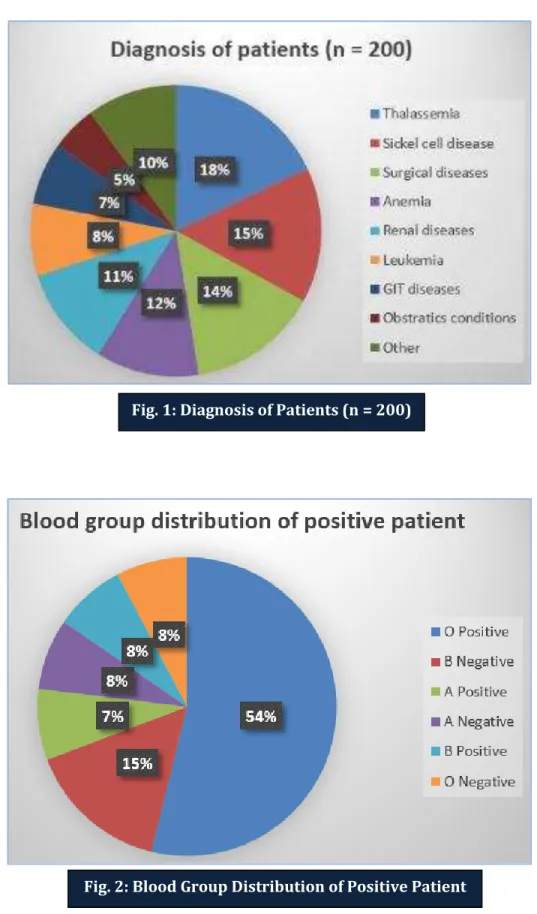
Female patients were significantly more positive for irregular antibodies (Chi-square test 2 tailed P value is 0.012). The odds ratio for male and female positivity was 5.4 indicating that female were 5 times more prone to develop alloantibodies in comparison to male patients. Among the positive cases, blood group distribution is shown in Figure 2. Out of 200 patients, 94(47%) patients had received ≤2 units of blood transfusion, among which 01(01.06%) had developed irregular
antibodies while 106(53%) patients had received >2 units of blood transfusion, among which 12(11.32%) had developed irregular antibodies which showed significant difference between these
two groups (chi-square test 2 tailed P value is 0.008). Among the 13 patients with alloantibodies, 11 patients (84.62%) had a single alloantibody, whereas two patients (15.38%) had multiple alloantibodies.
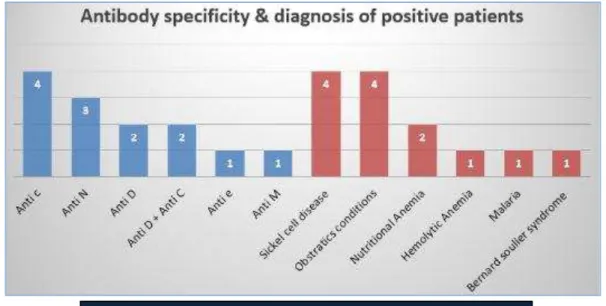
Among the total 13 patients with alloantibody/alloantibodies, four (31%) patients were having anti-c antibodies, Three (23%) patients were having anti-N antibodies, two (15%) patients were having Anti-D, two (15%) patients were found positive for both anti-D & C, one (08%) each patient was having Anti-e and anti-M (Figure 3). The adsorption & elusion study to find out possibility of Anti G antibody in two patients who were found positive screen for both anti D and anti C was not done. Among the positive cases, four (31%) cases were that of sickle cell anaemia, four (31%) cases of obstetrics, two (15%) cases of anaemia, and one each case of P. vivex (8%), hemolytic anaemia (7%) and Bernard soulier syndrome (8%).
DISCUSSION: It is a routine practice to perform pre transfusion compatibility testing before blood transfusion to prevent immune mediate haemolytic transfusion reactions. The steps of pre-transfusion testing involve reviewing the acceptability of blood sample, checking the ABO group and Rh D type, antibody screening test, determining the specificity of antibodies detected unexpectedly, choosing donor RBC units suitable for recipients, and carrying out cross-match.[3] As blood is
routinely matched with respect to major blood group antigens i.e. ABO and Rh D antigen, there is a high probability that the donor will have minor blood group antigens not present in the recipients which will result in alloimmunization. Factors for immunization are complex and involve at least three main contributing elements. This includes RBC antigenic difference between the blood donor and the recipient, the recipient's immune status and immuno-modulatory effect of the allogenic blood transfusions on the recipient's immune system.[5]
The development of red cell antibodies (Allo as well as autoantibodies) occurs in a variable number of multiple transfused patients. In such circumstances, transfusion therapy may become significantly complicated. Effects of alloimmunization may include difficulty in finding compatible RBC units because of the presence of clinically significant RBC antibodies, transfusion reactions, or platelet refractoriness.[6] Present study is an effort to characterize blood group alloantibody
formation in the patient population.
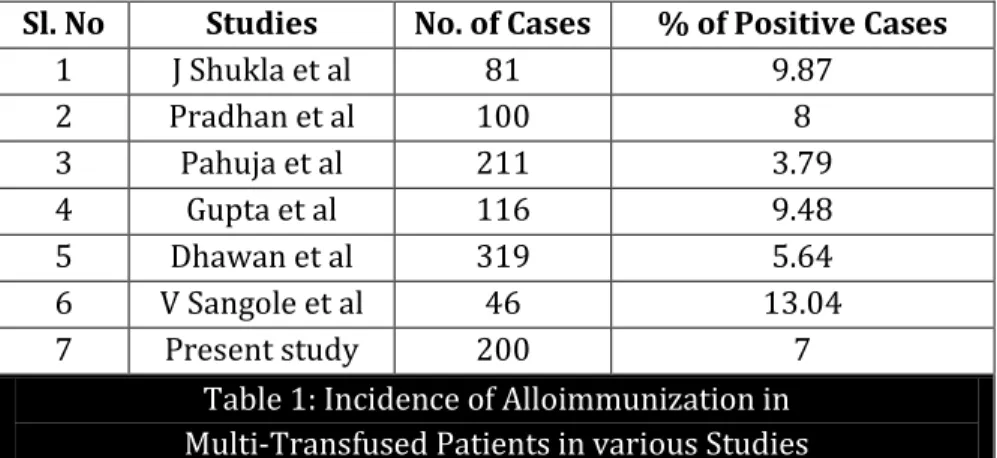
Few studies of multiple transfused patients in India had revealed rate of alloimmunization ranging from 3 to 13% as mentioned in Table 1. The rate of present study was 07% which is similar to the studies conducted by J Shukla et al (9.87%), Pradhan et al (08%) and Gupta et al (9.48).[7,9] The
studies done by Pahuja et al (3.7%) and Dhawan et al (5.64%) had lower rate while study of V Sangole et al had higher rate of 13.04 %.[10,12]
J of Evolution of Med and Dent Sci/ eISSN- 2278-4802, pISSN- 2278-4748/ Vol. 4/ Issue 73/ Sept 10, 2015 Page 12662
In present study, 11(79%) out of 14 alloimmunized patients were women, with significant association in chi-squares test (P value <0.05). This finding of the present study is in agreement with the study done by Alick et al while studies done by Bhaskar S et al & Makroo et al did not show such association with gender.[13,15] In the present study, female were five times more prone to develop
alloantibodies in comparison to male patients. Clinical diagnosis of the study group may lead to a vulnerable immune status which may predispose to altered or increased immune response to various antigens. In our study, significant number of sickle cell anaemia patients developed alloantibodies. Out of 30 sickle cell cases, alloimmunization was found in four (13.33%) cases, which is comparable to study by Elliott et al (30%) and Murao et al (9.9%).[16,17]
Though antigen typing before transfusion of people with sickle cell disease and providing antigen negative units is now widely employed by sickle cell centers, the alloimmunization rate remains quite high in contemporary sickle cell populations and may be due in large part to transfusions received at institutions not providing extended matching. Two out of 21 patients of chronic anemia developed alloantibodies (9.52%), which is comparable to study by Elliott et al (05%).[16] Out of 5 patients of obstetrics, 4 (80%) patients developed alloantibodies. (Figure 3).
The specificity of most alloantibodies detected in the present study was against Rh system (85%) due to their high immunogenicity, which is similar to previous reports of Thakral et al (61%), Hmida et al (59%) and Dhawan et al (52%).[11,18,19] Anti c was detected in four patients, Anti-D in four,
Anti-N in three, anti-C in two and Anti-M, Anti e in one patient each. Anti-c and anti-D (27%) were the most common antibodies in our study, which is comparable to Thakral et al (38.8%).[18] Hence, the
transfusion of blood matched for Rh could prevent alloimmunization resulting in a significant difference in the alloimmunization rates, but the potential to form RBC alloantibodies to unmatched antigens will exist.[20] In our study, majority of the patients with anti-D (either singly or in
combination) were multiparous females who might have formed anti-D due to previous pregnancies or transfusions. (Figure 3)
In the present study, there was an absence of anti-Kell antibody in all subjects which was similar to the findings of the study done by Thakral et al while other studies found anti Kell anti-bodies.[11,13,15,18] This could be due to differences in blood group antigen frequencies in different
populations. According to the study on blood donors of the South Gujarat, Kell antigen positivity was found to be 6%.[21] Thus, the lower frequency of Kell antigen in donated blood might be the reason
behind the lesser risk of alloimmunization from transfusion of a Kell antigen positive unit and the result was absence of anti Kell antibody in present study.
In the present study we detected single antibody in 84.62% of cases and multiple antibody in 15.38% of cases, which is comparable to study by Alick et al who found single antibody in 78.6% and multiple antibody in 21.4%.[14] Similar results was also found by Dhawan et al (22%cases had dual
allo antibodies).[11] Since pre-transfusion antibody screening in patients' samples is not a routine
practice in India, these patients might have received antigen mismatched blood leading to formation of multiple alloantibodies.
J of Evolution of Med and Dent Sci/ eISSN- 2278-4802, pISSN- 2278-4748/ Vol. 4/ Issue 73/ Sept 10, 2015 Page 12663
CONCLUSION: By considering the results of present and other reference Indian studies, blood banks of India should go for universal type and screen policy for finding the prevalence of alloantibodies in general patient and donor population. The indigenous development of local cell panels would be a better option to ensure adequate supplies of reagent red cells and introduction of type and screen policy for all the patients. Patients with identified alloantibodies can be flagged in a database and the information can be shared between institutions and shared with the patient in the form of report issuing to the concern person as well as patient education if possible. To avoid the effects of alloimmunization, after antibody screen and identification, corresponding antigen negative blood should be given to the patient.
The other approach to avoid alloimmunization in regularly transfused patients like sickle cell disease & thalassemia is to allot a group of 10-15 donors to such single patient. Whenever the transfusion required, donor will be selected from this group. In this way we can minimize alloimmunization as well as better safety in terms of transfusion transmitted infections also.
STUDY LIMITATION: The adsorption & elusion study to find out possibility of Anti G antibody in two patients who were found positive screen for both anti D and anti C was not done. The limitations of this study was follow up data was not available due tovarious reasons & phenotyping of each & every donor was not possible so only cross match compatible blood were issued.
Tables:
Sl. No Studies No. of Cases % of Positive Cases
1 J Shukla et al 81 9.87
2 Pradhan et al 100 8
3 Pahuja et al 211 3.79
4 Gupta et al 116 9.48
5 Dhawan et al 319 5.64
6 V Sangole et al 46 13.04
7 Present study 200 7
Table 1: Incidence of Alloimmunization in Multi-Transfused Patients in various Studies
Studies Most common Antibody % Satyam arora et al anti kell 35 J Shukla et al anti C & anti E 50 R Gupta et al anti E 36.4 B Shenoy et al anti C & anti kell 43
R Makroo et al anti E 37
Thakral et al anti c 39
Present study anti c and anti D 27
J of Evolution of Med and Dent Sci/ eISSN- 2278-4802, pISSN- 2278-4748/ Vol. 4/ Issue 73/ Sept 10, 2015 Page 12664
Fig. 1: Diagnosis of Patients (n = 200)
J of Evolution of Med and Dent Sci/ eISSN- 2278-4802, pISSN- 2278-4748/ Vol. 4/ Issue 73/ Sept 10, 2015 Page 12665
REFERENCES:
1. Khademi Reyhaneh, Gharehbaghian Ahmad, Karimi Gharib, Vafaiyan Vida, Khademi Raheleh & Tabrizi Namini Mehdi. Frequency & specificity of RBC alloantibodies in patients due for surgery in Iran. Indian J Med Res 138, August 2013, pg. 252-256.
2. Domen R.E., Ramirez G: Red cell alloimmunisation in chronic renal failure patients undergoing hemodialysis. Nephron 48:284-285, 1998.
3. SaranR K, editor. Transfusion Medicine Technical Manual. 2nd edition. Directorate General of
Health services, Ministry of health & welfare, Government of India, New Delhi; 2003. f.
4. Kathy D Blaney, Paula R Howard. Basic & applied concepts of blood banking and transfusion practices. 3rd edition. Mosby, elsevier inc.; 2009. p.
5. Lasky L. C. Ross P. R., Polesky H. F.: Incidence of antibody formation and positive direct antiglobulin tests in a multi-transfused hemodialysis population: Transfusion 24:198-200, 1984.
6. Brecher E. Technical Manual. Chap 18, 19. 12th edition. United States: American Association of
Blood Banks; 2009. p. 389-91,407.
7. Shukla JS, Chaudhary RK. Red cell alloimmunization in multi-transfused chronic renal failure patients undergoing hemodialysis. Indian J PatholMicrobiol 1999; 42:299-302.
8. Pradhan V, Badakere S, Vasantha K, Korgaonkar S, Panjwani S, Jajoo N. Antibodies to red cells in beta thalassemia major patients receiving multiple transfusions: A short report. Indian J Hematol Blood Transfus. 2001; 19:100–1.
9. Gupta R., Singh D. K., Singh B., Rusia U. Alloimmunization to red cells in thalassemics: emerging problem and future strategies. Transfusion and Apheresis Science. 2011; 45(2):167–170. 10.Pahuja S., Pujani M., Gupta S. K., Chandra J., Jain M. Alloimmunization and red cell
autoimmunization in multitransfused thalassemics of Indian origin. Hematology. 2010; 15(3):174–177.
J of Evolution of Med and Dent Sci/ eISSN- 2278-4802, pISSN- 2278-4748/ Vol. 4/ Issue 73/ Sept 10, 2015 Page 12666
11.Dhawan HK, Kumawat V, Marwaha N, Sharma RR, Sachdev S, Bansal S, Marwaha RK, and Arora S. Alloimmunization and autoimmunization in transfusion dependent thalassemia major patients: Study on 319 patients. Asian J Transfus Sci. 2014 Jul-Dec; 8(2): 84–88.
12.Sangole VM, Chaudhari DR. Alloimmunisation of red blood cells in multitransfused patients. Int J Health Sci Res. 2013; 3(5):39-41.
13.Makroo RN, Vimarsh Riana, Rosamma NL, Rashmi S.; Detection of alloimmunization to ensure safer transfusion practice; Asian Journal of Transfusion Science, Vol. 7, No. 2, July-December, 2013, pp. 135-139.
14.M Alick, S Nathan. Frequency and Distribution of RBC Alloantibodies among Transfused Patients at Ndola Central Hospital, Zambia: International Journal of Science and Research. 2014; 3 (5): 1.
15.BhaskarShenoy, Murali Mohan Voona, Shivaram C, Nijaguna, Shivananda. Red Cell AlloimmunizationIn Multi Transfused Patients with Beta Thalassemia Major-A Study from South India. Int J Med Pharm Sci, June 2013; 03 (10): 31-40.
16.Elliott PV, Earles A, Johnson RA, Hoag MS, Williams A, Lubin B. Allo-immunization in Sickle Cell Anemia and Transfusion of Racially Unmatched Blood: N Engl J Med 1990; 322:1617-1621. 17.Murao M, Viana MB. Risk factors for alloimmunization by patients with sickle cell disease. Braz
J Biol Med Res 2005; 38:675-82.
18.Thakral B, Saluja K, Sharma RR, Marwaha N. Red cell alloimmunization in a transfused patient population: a study from a tertiary care hospital in north India. Haematology. 2008; 13(5): 313-8.
19.Hmida S, Mojaat N, Maamar M, Bejaoui M, Mediouni M, Boukef K. Red cell alloantibodies in patients with haemoglobinopathies. Nouv Rev FrHematol. 1994 Oct; 36(5):363-6.
20.Vishinski E, Earles A, Johnson R, Hoag M, Williams A, Lubin B. Alloimmunization in sickle cell anaemia and transfusion of racially unmatched blooding Engle. J Med 1990; 322:1617-21. 21.Kahar MA, Patel RD. Phenotype frequencies of blood group systems (Rh, Kell, Kidd, Duffy, MNS,
P, Lewis, and Lutheran) in blood donors of south Gujarat, India. Asian J Transfus Sci. 2014 Jan; 8(1):51-5.
J of Evolution of Med and Dent Sci/ eISSN- 2278-4802, pISSN- 2278-4748/ Vol. 4/ Issue 73/ Sept 10, 2015 Page 12667
AUTHORS:
1. Rakesh P. Pimpaldara 2. Arpit C. Patel
3. Jitendra Patel 4. Snehal Patel 5. A. N. Pandya 6. Sangita Wadhwani
PARTICULARS OF CONTRIBUTORS:
1. 3rd Year Resident, Department of
Pathology, Government Medical College, Surat.
2. 3rd Year Resident, Department of
Immunohematology and Blood Transfusion Department, Government Medical College, Surat.
3. Assistant Professor, Department of Immunohematology and Blood Transfusion Department, Government Medical College, Surat.
FINANCIAL OR OTHER COMPETING INTERESTS: None
4. 3rd Year Resident, Department of
Immunohematology and Blood Transfusion Department, Government Medical College, Surat.
5. Professor and HOD, Department of
Immunohematology and Blood Transfusion Department, Government Medical College, Surat.
6. Blood Transfusion Officer, Blood Bank, New Civil Hospital, Surat.
NAME ADDRESS EMAIL ID OF THE CORRESPONDING AUTHOR:
Dr. Jitendra Patel, Blood Bank, 2nd Floor,
New Civil Hospital, Majura Gate,
Surat-395001, Gujarat. E-mail: [email protected]