w ww.e l s e v i e r . c o m / l o c a t e / b j p
Original
Article
Biological
activities
and
phytochemical
profile
of
Passiflora
mucronata
from
the
Brazilian
restinga
Marlon
H.
de
Araujo
a,b,
Isabel
C.V.
da
Silva
c,
Pollyana
F.
de
Oliveira
a,
Arielly
R.R.
Barreto
a,
Tatiana
U.P.
Konno
d,
Francisco
de
A.
Esteves
d,
Thiago
Barth
a,
Fernando
A.
Aguiar
e,
Norberto
P.
Lopes
e,
Renee
K.
Dermenjian
f,
Denise
O.
Guimarães
a,
Ivana
C.R.
Leal
a,c,
Elena
B.
Lasunskaia
b,
Michelle
Frazão
Muzitano
a,∗aLaboratóriodeProdutosBioativos,CursodeFarmácia,UniversidadeFederaldoRiodeJaneiro,CampusMacaé,Macaé,RJ,Brazil
bLaboratóriodeBiologiadoReconhecer,CentrodeBiociênciaseBiotecnologia,UniversidadeEstadualdoNorteFluminenseDarcyRibeiro,CamposdosGoytacazes,RJ,Brazil cLaboratóriodeProdutosNaturaiseEnsaiosBiológicos,DepartamentoDeProdutosNaturaiseAlimentos,FaculdadedeFarmácia,UniversidadeFederaldoRiodeJaneiro,Riode
Janeiro,RJ,Brazil
dNúcleodeEstudosemEcologiaeDesenvolvimentoSócio-AmbientaldeMacaé,UniversidadeFederaldoRiodeJaneiro,Macaé,RJ,Brazil
eNúcleodePesquisaemProdutosNaturaiseSintéticos,FaculdadedeCiênciasFarmacêuticasdeRibeirãoPreto,UniversidadedeSãoPaulo,RibeirãoPreto,SP,Brazil fDepartmentofProcessandAnalyticalChemistry,MRL,Rahway,NJ,UnitedStates
a
r
t
i
c
l
e
i
n
f
o
Articlehistory:
Received7April2017
Accepted6July2017
Availableonline7September2017
Keywords:
Passifloraceae Terpenes Flavonoid Antimycobacterial Immunomodulatory Antioxidant
a
b
s
t
r
a
c
t
Ingeneral,Passifloraspecies havebeenreportedfortheirfolkmedicinaluseassedativeand anti-inflammatory.However, P.caeruleahasalreadybeenreportedtotreatpulmonarydiseases.Severe pulmonarytuberculosis,generallycausedbyMycobacteriumtuberculosisstrainsresistanttomultiple drugs,canleadtodeleteriousinflammationandhighmortality,encouragingnewapproachesindrug discovery.Thus,theaimofthisworkwastoevaluatethePassifloramucronataLam.,Passifloraceae, poten-tialfortuberculosistreatment.Specifically,relatedtoantimycobacterialactivityandanti-inflammatory relatedeffects(basedoninhibitionofnitricoxide,tumornecrosisfactor-alphaproductionand antioxi-dantpotential),aswellasthechemicalprofileofP.mucronata.Highperformanceliquidchromatography coupledwithdiode-arrayultravioletandmassspectrometeranalysesofcrudehydroalcoholicextractand ethylacetatefractionshowedthepresenceofflavonoids.Ethylacetatefractionshowedtobeas antiox-idantasGinkgobilobastandardextractwithEC50of14.61±1.25g/ml.Onemajorflavonoidisolated fromethylacetatefractionwascharacterizedasisoorientin.Thehexanefractionanditsmainisolated compound,thetriterpene-amyrin,exhibitedsignificantgrowthinhibitoryactivityagainst Mycobac-teriumbovisBCG(MIC501.61±1.43and3.93±1.05g/ml,respectively).Inaddition,Passifloramucronata samples,speciallyhexaneanddichloromethanefractions,aswellaspure-amyrin,showeda dose-relatedinhibitionoflipopolysaccharide(LPS)-inducednitricoxideproduction.Inconclusion,Passiflora mucronatapresentedrelevantbiologicalpotentialandshouldbeconsideredforfurtherstudiesusing invivopulmonarytuberculosismodel.
©2017SociedadeBrasileiradeFarmacognosia.PublishedbyElsevierEditoraLtda.Thisisanopen accessarticleundertheCCBY-NC-NDlicense(http://creativecommons.org/licenses/by-nc-nd/4.0/).
Introduction
The Passiflora genus, Passifloraceae, comprises about 520 species(Wohlmuthetal.,2010)thatarefoundpredominantlyin tropicalandsubtropicalregionsoftheworld(Dhawanetal.,2004). Somespecies,suchasPassifloraalata,P.edulisandP.incarnataare knownfortheirsedativepropertiesandhaverelevantinterestfor thefoodandpharmaceuticalindustry(Dhawanetal.,2004;Zeraik etal.,2010).
∗ Correspondingauthor.
E-mails:[email protected],[email protected](M.F.Muzitano).
SeveralspeciesofPassifloraexhibitbiologicalactivitythrough productionofdifferenttypesofsecondarymetabolites,especially flavonoids,phenolsandalkaloids(Dhawanetal.,2004).Theaerial partsofPassifloracaeruleaareusedinfolkmedicineasmild antimi-crobialagentindiseaseslikecatarrhandpneumonia(Anesiniand Perez,1993).TheethanolicextractofPassifloraincarnataexhibits anti-inflammatorypropertiesatadoseof125–500mg/kginrats (Borrellietal.,1996).Passifloraedulisleafextractshowedpotential antioxidantactivity(SunithaandDevaki,2009;Silvaetal.,2013).
PassifloramucronataLam.wasfoundasaclimbingplantina tropicalsandycoastalplant community,a habitatlocallycalled restinga,inthesoutheasternstateofRiodeJaneiro,Brazil(Garbin etal.,2012).TheplantcommunitiesaroundtheAtlanticrainforest
https://doi.org/10.1016/j.bjp.2017.07.005
0102-695X/©2017SociedadeBrasileiradeFarmacognosia.PublishedbyElsevierEditoraLtda.ThisisanopenaccessarticleundertheCCBY-NC-NDlicense(http://
complex,suchasrestinga,differfromthecoreformationwhere theyexhibit more extremeenvironmental conditions;drought, salinity,hightemperaturesandpoorsoilnutritionarethemain lim-itingfactorsintherestingavegetationopenscrubhabitat(Scarano, 2002).
Toourknowledge,therehavebeennopharmacologicalstudies forP.mucronata,butratherecologicalandbotanicalinvestigations. Thepollinationbiologyoffourpassionflowerspecieswas stud-iedinsoutheastBrazil,specificallytheimportanceoffloralnectar chemicalfeatures,pigmentsandodors.Allspeciesrequired pol-linatorstoproducefruitsanditwasobservedthatP.mucronata waspollinatedbybats(Varassinetal.,2001).Gas chromatography-massspectrometry(GC–MS)analysisofdichloromethaneextracts fromP.mucronataflowerfringefilamentsrevealedeicosene, ben-zylalcoholandlimoneneasthemainconstituents(Varassinetal., 2001).P.mucronatahasbeenusedtotreatinsomnia,hemorrhoid, andassedativeandvermifugeformedicinalpurposesinQuissamã, RiodeJaneiroState,arestingaareawhichbelongstoJurubatiba NationalPark(BoloscoandValle,2008).ThisNationalPark com-prisedthecitiesofCarapebus,Quissamã,Macaéand hasa total areaof148.6km2(Imbassahyetal.,2009).
BecauseotherspeciesofthegenusPassiflorashowantimicrobial, anti-inflammatoryandantioxidantactivitiesandinviewofthelack ofinformationonthisspecies,itisimportanttoinvestigatethe sec-ondarymetabolitesfoundinP.mucronataspeciesfromthisregion, andtoquestiontheirpossiblebiologicalactivity.Thisstudyaimed to:(1)evaluatetheactivityof leafcrude hydroalcoholicextract ofP.mucronataagainstMycobacterium,aswellasactivityofits fractionsandisolatedcompound(s);(2)verify thattheextracts, fractionsandisolatedcompoundsinhibitNOandTNF-␣ produc-tionbythemacrophagesandtheirabilitytoactasanantioxidant; (3)evaluatethecytotoxicityinthemacrophages,whicharethe Mycobacteriumhostcells;and(4)investigatethephytochemical profileofP.mucronataleaves.
Materialsandmethods
Generalexperimentalprocedures
1HNMR and 13C NMR spectrawereobtainedfrom 400MHz
and100MHz,respectively,onaBrukerDRX-400NMR spectrom-eterand aVarianMERCURY-VXfrom400MHz.Chemicalsshifts (ı)werereferenced tointernal TMSstandards (ı=0, 1H)being expressed in parts per million (p.p.m.) units and the coupling constants(J)inhertz(Hz).Preparativeflashchromatographywas performedonsilica(SiliaflashGCO;70–230mesh).Eluateswere monitoredbythin-layerchromatography(TLC)onsilica60F254 usingbutanol/aceticacid/water(BAW8:1:1),visualizedunderUV light and revealed withNP-PEG or using hexane/ethyl acetate (9.5:0.5)revealedwithanisaldehyde/sulphuricacid.Thefractions wereanalyzedby HPLC-DADonShimadzuSCL-10A withDiode ArrayDetector SPD-M10Awithabsorptionsmeasuredfrom200 to450nm.Additionally,GC–MSanalysiswasperformedon GCMS-QP2010system(Shimadzu).
Plantmaterial
PassifloramucronataLam.,Passifloraceae,leaveswerecollected in February 2011 at the Restinga de Jurubatiba National Park, Quissamã,RiodeJaneiro,Brazil(22.19828◦S;41.46338◦W;10m altitude).VoucherspecimensweredepositedatUniversityFederal RiodeJaneiroHerbarium,Brazil(RFA38758)afteridentificationby thebotanistTatianaU.P.Konno.Thisresearchhascompliedwith allrelevantfederalguidelinesandinstitutionalpoliciesrelatedto thebotanicalmaterialforresearchpurposes.
Extractionandisolation
Freshleaves(50.4g)weretrituratedandextractedwith500ml ofethanol/water(85:15)atroomtemperaturebymacerationfor 24h.Thesolventwasrenewedfivetimes,completingthe extrac-tionafter120h.Theextractwaslyophilizedandthenanaliquotof 6.96gofthetotaldriedcrudehydroalcoholicextract(codePMCE) (7.42g) was re-suspended withmethanol and partitioned with hexanetoobtainPMH(1.14g).Theresidualmethanolphasewas driedandre-suspendedwithpurewaterandpartitioned sequen-tiallywithdichloromethane,ethylacetateandbutanol,affording PMDM(532.9mg),PMEA(134.6mg),PMB(1.2465g),respectively. TheresidualaqueousphasewasnamedPMA(2.5915g).Analiquot of 501.6mg of PMH was chromatographed on a silica column (62.0×2.0cm; hexane/ethyl acetate/methanol gradient), yield-ing 271 fractions. Fraction PMH-113 crystallized via the slow evaporationofhexane/ethylacetate(8:2),affordingcompound1 (108.6mg)aswhitecrystallineneedles.Compound1was identi-fiedastriterpene-amyrinbasedonMSdata(GC–MSanalysis), m/z498[M+SiMe3]+(trimethylsilylated-amyrin),andNMR spec-troscopydata,inaccordancetoliteraturereports(Carvalhoetal., 1998).Analiquotof54.2mgofPMEAwaschromatographed on a reverse-phase C18-bonded silica column (61.0×1.5cm; dis-tilledwater/methanolgradient),yielding48fractions.Thefractions 18–19(85:15)and20–22(80:20)werecombinedaffording com-pound2(5.3mg).Compound2wasidentifiedasflavoneisoorientin by NMR spectroscopy data, in accordance to literature reports (Costaetal.,2011;Wenetal.,2007).
Gaschromatography–massspectrometry(GC–MS)analyses
Thehexanefractionandisolatedcompound1weredissolved in N-methyl-N-trimethylsilyltrifluoroacetamide, and resultant trimethylsilylatedproductsweredirectlysubjectedtoGC–MS anal-ysisonDBcolumn(0.25mm×15m,0.25mfilmthickness,J andWScientific)withheliumcarrier(flowrate1ml/min). Injec-torandinterfaceweremaintainedat270and230◦C,respectively. Columntemperatureincreasedfrom60to280◦C,witha15◦C/min temperatureramp.
ChromatographicanalysisbyHPLC-DAD
Crudeextractfromleavesandethylacetatewereanalyzedby HPLC-DAD(Shimadzu)withanRP-18reverse-phasecolumn(5m particle, 250mm×4.60mm, Supelcosil, Supelco) maintained at 30◦C. The eluentswere H2O adjusted topH 3 withH3PO4 (A) and acetonitrile (ACN, B). Thefollowing mobile phase gradient (v/v)wasused:0–10min,A–B(100:0→82:18);10–35min,A–B (82:18→80:20);35–40min,A–B(80:20→79:21);40–45min,A–B (79:21→78:22);45–50min,A–B (78:22→0:100).Theinjection volumewas10landtheflowratewas1.00ml/min.HPLC analy-seswereperformedoneachsample,afterdilutionof5mgin1ml ofultrapurewater.
ChromatographicanalysisbyHPLC-MS
(65:35→55:45);50–59min,A–B(55:45→40:60);60–69min,A–B (40:60→20:80);69–74min,A–B(20:80–0:100);75–76min,A–B (0:100→95:5).Theinjectionvolumewas10landtheflowrate was1ml/min.HPLCanalyseswereperformedoneachsample,after dilutionof5mgin1mlofultrapurewater.
Flavonoidquantificationinthecrudeextractanditsethylacetate fraction
TheflavonoidquantificationbyHPLCwascarriedoutusinga ten-pointcalibrationcurveobtainedusingrutin (Sigma–Aldrich ≥94%purity)amountsrangingfrom0.20to10.0g.The detec-torresponselinearityrangewasverifiedusingaseriesoftwo-fold dilutedrutinsolutions.Therelationshipbetweenpeakareas (detec-torresponses)andamountofrutinwaslinearover1000–20g/ml (r2=0.9999).Toevaluatetheinjectionintegrationrepeatability,the rutinstandardsolutionandsampleswereinjectedthreetimesand therelativestandarddeviationvaluescalculated.
Antimycobacterialactivity
Samples were evaluated for their antimycobacterial activ-ityusinga[3-(4,5-dimethylthiazol-2-yl)-2,5diphenyl-tetrazolium bromide]MTTassaytomeasuremycobacterialgrowthinaliquid medium.Initially,Mycobacteriumbovis BCGstrainMoreau (pro-videdbyButantanInstitute–Brazil)orM.tuberculosisH37Rv(ATCC 27294)suspensionwasgrowninMiddlebrook7H9medium sup-plementedwith0.05%Tween80andalbumin,dextrose,catalase (ADC).Duringthemiddlelogarithmicgrowthphase,thebacterial suspensionwasplatedina96-wellmicroplate(1×10⁶CFU/well) inthepresenceofeachsampleatfourconcentrations.Thesealed platewasincubatedat37◦Cand5%CO2 for7daysforM.bovis BCGand5daysforM.tuberculosisH37Rv.Afterthisperiod,the mycobacteriawereincubatedfor3hwithMTTsolutionandlysed viatreatmentwithlysisbuffer(20%w/vsodiumdodecylsulfate –SDS/50%dimethylformamide–DMFindistilledwater–pH4.7) (Gomez-Floresetal.,1995).Theplatewasincubatedovernightat 37◦C andthereadingwasmadeusingaUV spectrophotometer at570nm.Aspositivecontrol,abacterialsuspensiontreatedwith isoniazid(Sigma–Aldrich≥99%purity),atconcentrationsof0.032, 0.16,0.8and4g/ml.Asanegativecontrol,anuntreated bacte-rialsuspensionwasused.Concentrationsarereportedintermsof g/mlsothatisolatedcompoundcouldbeplottedtogetherwith fractionsandextract.
DeterminationofNOandTNF-˛productionfromLPS-activated RAW264.7cells
MacrophagesRAW264.7(ATCC,TIB-71)wereculturedin Dul-becco’sModifiedEagle’smedium(DMEM-F12)supplementedwith 10%fetalbovineserum(FBS)andgentamicin(0.2%)inthepresence 5%CO2at37◦C.Thesecells wereseededin96-wellmicroplates (2×10⁴cells/well)inthepresenceofeachsampleatthree concen-trationsandstimulatedwith1g/mlLPS(Escherichiacoli0111:B4; Sigma-Aldrich).After24hincubationperiod,culturesupernatants werecollectedforNOandTNF-␣assays.IntheNOexperiments,a nitricoxideinhibitor,NG-methyl-l-arginineacetatesalt(l-NMMA – Sigma–Aldrich 98% purity), was used as positive control at 20g/ml.Asanegativecontrol,untreatedmacrophageswereused. Nitrite,astableNOmetabolite,wasquantifiedbyusingtheGriess method(Griess,1879).Thenitriteconcentrationwascalculated fromaNaNO2standardcurve.Theopticaldensitywasmeasuredby spectroscopyat570nm.TNF-␣wasmeasuredbyanL929 fibrob-last(ATCC,CCL-1)bioassay,basedonsensitivityofL929cellsto cytotoxiceffectofTNF-␣.Forthis,theL929cellswereseededin 96-wellmicroplates(2.5×10⁴cells/well).After24hincubation,the
resultingcellmonolayersweretreatedwiththemacrophage cul-turesupernatantsinthepresenceofactinomycinD(2g/ml).After anadditional24hincubation,theL929cellviabilitywasassayed bytheMTTmethod(Mosmann,1983).Thecytokineconcentrations weredeterminedbyusingarecombinantmousecytokinetoobtain astandardcurvecorrelatingcellularviabilityandTNF-␣ concentra-tion.Eachwell’sopticaldensitywasmeasuredat570nmemploying amicroplatereader(DynatechMR5000).
Cytotoxicity
CytotoxiceffectsofP.mucronatasamplesonmacrophageswere examinedusingacommercialLDHkit(Doles®).Releaseoflactate dehydrogenase(LDH,cytoplasmicenzyme)fromRAW264.7cells treated with the samples was determined colorimetrically, as described previously (Muzitano et al., 2006). Briefly, the cells (2×10⁴ cells/well),seededin96-wellmicroplates,weretreated withsamplesat0.8,4,20and100g/mlfor24h.ExtracellularLDH concentrationswerequantifiedinsupernatantculture.Celllysates obtainedthroughthetreatmentwith1%TritonX-100wereused asapositivecontrol.DMSOwasusedassolventforthesample dilutions,andwastestedinparallelascontrol.
Antioxidantactivityassay
Passiflora mucronataextract and fractionsradical scavenging activitywasestimated usingstable freeradical 2,2-diphenyl-1-picryl-hydrazylhydrate(DPPH,Sigma).Theassaywasdetermined in96-wellmicroplatesusinga modifiedmethod(Mensoretal., 2001).Theextractsand fractionsweredilutedtothefinal con-centrationsof1, 5,10, 25,50, 100and 200g/ml inmethanol. Ginkgo bilobaextract (GBE) is an importantantioxidant extract and is composedmainlyby terpenoids, flavonoids (Jiang et al., 2017),aswellas,P.mucronatacrudeextractandethylacetate frac-tion.Foraninterestingcomparison,theGBEwasusedaspositive control and prepared using the same samples dilution proce-dures. In each well wereadded 125lof sample solution and 50lofDPPHsolution(300M).Themicroplatewasallowedto reactatroomtemperatureandabsenceoflight.After30minthe absorbancevaluesweremeasuredat518nmin spectrophotome-terSpectraMaxandconvertedintopercentageantioxidantactivity (AA%=100−{[(Abssample−Absblank)×100]/Abscontrol} (Gonc¸alves etal.,2015).Methanol(50l)plussamplessolutionorGBE(125l) wasusedasblank.DPPHsolution(50l)plusmethanol(125l) wasusedasnegativecontrol.TheEC50valueofeachsamplewas calculatedbynon-linearregressionfromtheplottedgraphof per-centageDPPHneutralizationvs.concentrationofsample.
Statisticalanalysis
The tests were performed in triplicate and values were expressedasmean±standarddeviation(SD).Statisticalanalyses wereperformedbyone-wayANOVA,followedbyTukey’s post-test.Theresultswereconsideredstatisticallysignificantforp<0.05. EC50,IC50andMIC50valueswerecalculatedbynon-linear regres-sionbasedontheconcentration-responsecurveofeachsampleby GraphPadPrism5.
Resultsanddiscussion
37.35%.FromthePMEA,theflavonoidisoorientin(luteolin6-C --d-glucopyranoside),compound2,wasisolatedandcharacterized byNMR.
Inviewofnewperspectivesforresearchoftuberculosis(TB) treatment, the antimycobacterial activity of the samples from P. mucronata was investigated. The search for new promising compoundsthatcouldbeusedasadjuvanttreatmentforsevere pulmonarytuberculosishasbeenfocusedbyourgroup(Machado etal.,2014;Venturaetal.,2015a,b,c).P.mucronatawaschosen becausePassifloraspecieshavebeenreportedfortheirpopularuse totreatpulmonarydiseases(AnesiniandPerez,1993)andfortheir anti-inflammatorypotential(Borrellietal.,1996).
Currently,tuberculosisstillrepresentsamajorthreattopublic healthinseveralregionsoftheworld.Mycobacteriumtuberculosis isthemaincausativeagentforthisinfectiousdiseaseinhumans. In 2015therewerean estimated10.4 millionnewcasesof TB, including580.000casesofmultidrug-resistantTB(MDR-TB)and 1.4milliondeathsfromthisdisease(WHO,2016).Thisdatashows theimportance ofa constant search fornew antimycobacterial agents.
Naturalproductsplayanimportantroleinthissearch,asplant specieshaveshownpromisinginvitroactivityagainstM. tubercu-losis,withalkaloids,terpenoidsandpolyphenolsrepresentingthe mostpromisingclassesofsecondarymetabolitesrelatedto antimy-cobacterialbioactivity (Okunade et al.,2004; Copp and Pearce, 2007;SalomonandSchmidt,2012).Thisstudyrepresentsthefirst timethatantimycobacterialactivitywasdescribedforP.mucronata and,toourknowledge,forPassifloragenus.
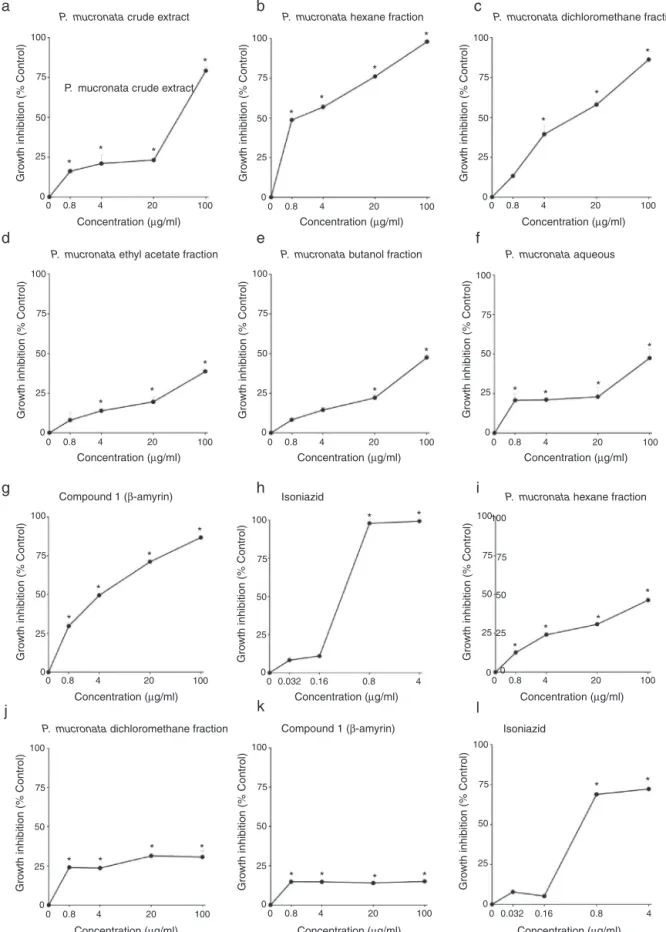
Intheinitialscreening,samplesfromP.mucronatawereable toinhibitM.bovisBCGgrowth.ThisattenuatedstrainofM.bovis is non-virulent,but closely related toM.tuberculosis (Mahairas et al., 1996). As shown in Fig. 1a, at 100g/ml, P. mucronata crudeextract(PMCE)inhibited79.22±3.48%oftheMycobacterium growth.PMH,PMDM,PMEA,PMBand aqueous(PMA)fractions inhibited97.92±0.56,86.21±0.0,38.63±2.40,47.50±2.40 and 47.42±7.98%,respectively,at100g/ml(Fig.1b–f).PMH,themost active,showedMIC50of1.61±1.43g/ml anddichloromethane fraction showed MIC50 of 8.83±1.17g/ml. Compound 1, at
100g/mlshowed86.76±0.21%ofMycobacteriumgrowth
inhi-bition(MIC50 3.93±1.05g/ml)(Fig.1g).Compound 2wasnot evaluatedduetothelowactivityfoundtoPMEA.
Inthenextstep,thethreemostpromisingsamples:PMH,PMDM andcompound 1wereevaluatedagainst avirulent strainofM. tuberculosisH37Rv.Althoughinhibitionpercentagesprovedlow, thefractionsandcompound1werestillabletoinhibitthegrowthof thisvirulentstrain(Fig.1i–k).Theseresultsareinagreementwith literaturedata,which reporteda lowactivityfor M.tuberculosis growthinhibitionby-amyrin(Martinsetal.,2011).Astudy eval-uatedamixtureoflupeoland␣-and-amyrinshowingpromising antimicrobialactivity,butconfirmedlowactivityof-amyrinonce isolated(Higuchietal.,2011).
Inflammationisstronglycorrelated withthepathogenesisof mostinfectiousdiseases,includingTB.Ingeneral,forprotection againstmycobacteria,theproductionofpro-inflammatory medi-ators, such as NO and TNF-␣, by the infected macrophages is essential.However,inthecasesofsevereformsofTB,suchas mil-itaryTBortuberculousmeningitis,additionalanti-inflammatory therapyisrequiredtopreventexcessiveinflammation(Garlanda etal.,2007).Inaddition,anti-inflammatorytherapyreduces mor-tality in patientsexhibiting hyperinflammatory phenotypethat couldbedeterminedbyhostgeneticpolymorphisms,increased bacterial virulence or specific comorbid states (Critchleyet al., 2013).
Such aspects could also be pre-clinical investigated dur-ing new TB drug development. In vivo studies done by our groupusingTBmodelin C57BL/6miceinfectedwiththehighly
virulentM.tuberculosisstrainM299reproducethe hyperinflamma-toryresponseofaTB-resistantimmunocompetenthosttohighly virulentmycobacteria.Thisresponsewasstronglyassociatedwith excessive recruitment of polymorphonuclear and mononuclear phagocytesandproinflammatorycytokineproductioninthelungs thatcancontributetopulmonarynecrosis(Almeidaetal.,2017).
The needfor suchan alternativetreatmentfor TB therefore exists,especiallyfortheseveredestructiveanddisseminatedforms ofTBfrequentlyassociatedwithexacerbatedinflammation. Per-hapsanidealsolutionwouldbedually-activecompoundswhich exhibitboth antimycobacterialand anti-inflammatoryactivities. Indeed,ourgrouphasdescribedseveralsuchcompounds possess-ingdualactivities(Machadoetal.,2014;Venturaetal.,2015a,b,c). The importance of development of newdrugs withdual, anti-inflammatory andantimycobacterial,activitiesis highlightedby emergencyofincreasingprevalenceofmultidrugresistant(MDR) TBandextensivelydrug-resistant(XDR)TB,whereapproximately oneinfivetuberculosisisolatesworldwideareresistanttoatleast onemajorfirst-line(Dhedaetal.,2017).
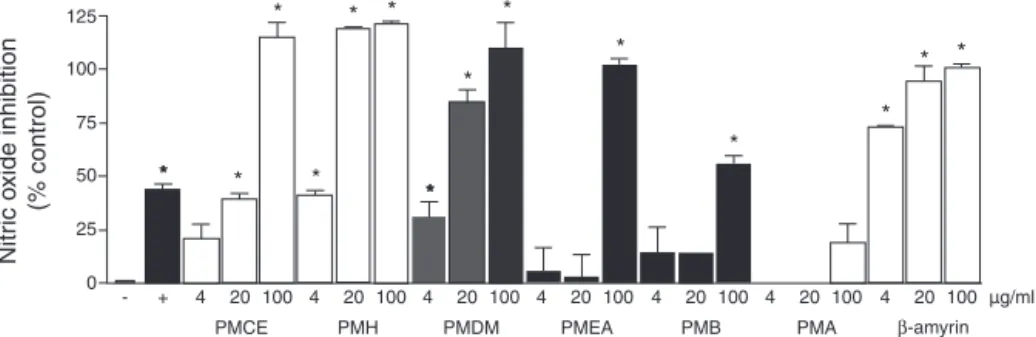
IntheevaluationofP.mucronataimmunomodulatory proper-ties, withfocus onpro-inflammatorymediators, itwas verified whethercrude extract,fractions and compound 1couldinhibit nitric oxide (NO) and tumor necrosis factor-alpha (TNF-␣) production, induced in RAW 264.7 macrophages stimulated with lipopolysaccharide(LPS). The PMCE showed IC50 value of
9.43±1.88g/ml. PMH, PMDM, PMEA, PMB and PMA showed
IC50 value of 4.24±1.90, 1.95±1.93, 14.69±3.04, 87.27±1.58 and>100g/ml,respectively.Compound1wasactiveatalltested concentrations(Fig.2),withIC50<0.8g/ml.Thissuggeststhat -amyrincontributestotheactivityobservedforthehexanefraction fromwhichitwasoriginated.Isoorientin,isolatedfromPMEA,was reportedintheliteraturetosignificantlyinhibittheLPS-stimulated productionofNOinRAW264.7cells(Luyenetal.,2014).
With respect to TNF-␣ production, P. mucronata showed poor inhibitory activity (data not shown). Only hexane and dichloromethanefractionsshowedIC50valueof44.43±1.52and 56.52±1.34g/ml.However,TNF-␣productioninhibitoryeffects exhibitedbyPMHcanbeassociatedwiththeircytotoxicityinthe highestconcentration(100g/ml)(Fig.3).Previously,-amyrin obtainedfromEuphorbiahirtawasevaluatedforanti-inflammatory activityandshowedinhibitoryeffectonNOproduction by LPS-activated RAW 264.7 macrophages by inhibiting iNOS protein expression.However,whenotherinflammatoryfactorsasPGE2, TNF-␣andIL-6wereevaluated,onlyaslightinfluenceof-amyrin ontheirslevelswasobserved(Shihetal.,2010).
When cytotoxicity was analyzed, only the hexane fraction showedalevelgreaterthan35%intheconcentrationof100g/ml, butthisvaluewasnotmaintainedatlowconcentrations,which alsoshowedhighinhibitoryeffectsofNOproductionand Mycobac-teriumgrowthinhibition.Theremainingsamplesinthesmaller concentrationsshowednosignificantcytotoxicitywhencompared tocontrol0%lysis(p<0.05)(Fig.3).
P. mucronata crude extract
Concentration (µg/ml)
Compound 1 (β-amyrin)
Compound 1 (β-amyrin) Isoniazid
Isoniazid Concentration (µg/ml)
Concentration (µg/ml)
Concentration (µg/ml)
Gro
wth inhibition (% Control)
Gro
wth inhibition (% Control)
Gro
wth inhibition (% Control)
Gro
wth inhibition (% Control)
Gro
wth inhibition (% Control)
Gro
wth inhibition (% Control)
Gro
wth inhibition (% Control)
Gro
wth inhibition (% Control)
Gro
wth inhibition (% Control)
Gro
wth inhibition (% Control)
Gro
wth inhibition (% Control)
Gro
wth inhibition (% Control)
Concentration (µg/ml) Concentration (µg/ml) Concentration (µg/ml)
Concentration (µg/ml) Concentration (µg/ml) Concentration (µg/ml) Concentration (µg/ml) Concentration (µg/ml)
P. mucronata hexane fraction
P. mucronata crude extract
P. mucronata ethyl acetate fraction
P. mucronata dichloromethane fraction
P. mucronata butanol fraction P. mucronata aqueous
P. mucronata hexane fraction
P. mucronata dichloromethane fraction
0 0.8 4 20 100 0 0.8 4 20 100 0 0.032 0.16 0.8 4
0 0.8 4 20 100
0 0.032 0.16 0.8 4
0 0.8 4 20 100
0 0.8 4 20 100
0 0.8 4 20 100 0 0.8 4 20 100 0 0.8 4 20 100
0 0.8 4 20 100 0 0.8 4 20 100
100
75
50
25
0 100
75
50
25
0
100
75
50
25
0
100
75
50
25
0 100
75
50
25
0 100
75
50
25
0 100
75
50
25
0 100
75
50
25
0 100
75
50
25
0
100
75
50
25
0 100
75
50
25
0
100
75
50
25
0
100
75
50
25
0
*
*
*
*
* *
* *
* *
*
*
*
* *
* *
* * * *
* *
* *
*
* *
*
* *
* *
*
*
*
* * *
*
a
b
c
d
e
f
g
h
i
j
k
l
Fig.1.Anti-mycobacterialactivityofPassifloramucronataextract,fractionsandcompound1at0.8,4,20and100g/ml.InhibitionofthegrowthofMycobacteriumbovisBCG
(A–H).PMCE(A),PMH(B),PMDM(C),PMEA(D),PMB(E),PMA(F),compound1(G).PositiveControl–MycobacteriumbovisBCGtreatedwithantibioticisoniazidat0.032,
0.16,0.8and4g/ml(H).NegativeControl–MycobacteriumbovisBCGuntreated.InhibitionofMycobacteriumtuberculosisH37Rv(I–L).PMH(I),PMDM(J),compound1(K).
PositiveControl–MycobacteriumtuberculosisH37Rvtreatedwithantibioticisoniazidat0.032,0.16,0.8and4g/ml(L).NegativeControl–MycobacteriumtuberculosisH37Rv
* * *
*
*** *
* **
*
*
*
*
* *
125
100
75
50
25
0
- + 4 20100 4 20 100 4 20 100 4 20 100 4 20 100 4 20100 4 20 100 µg/ml
PMCE PMH PMDM PMEA PMB PMA β-amyrin
Nitr
ic o
xide inhibition
(% control)
Fig.2.Evaluationofnitricoxide(NO)productionfromLPS-activatedRAW264.7macrophagestreatedwithPassifloramucronataextracts,fractionsandcompound1at4,
20and100g/ml.Crudeextract(PMCE),hexane(PMH),dichloromethane(PMDM),ethylacetate(PMEA),butanol(PMB)andaqueous(PMA)fractions.Negativecontrol:
macrophagesstimulatedwith1g/mlLPS(0.01%inhibitionand45.77±0.56MofNOproduction).Treatmentwithl-NMMAwasusedaspositivecontrolforNOinhibition,
reducing43.89±4.60%oftheNOproductionat20g/ml.Resultsrepresentthemean±standarddeviationoftwoindependentexperimentswithintriplicate.*p<0.05
comparedtonegativecontrol.
PMCE
PMDM PMEA PMB PMA PMH
β-amyrin 100
90
80
70
60
50
40
30
20
10
0 0
Cytoto
xicity(%)
Concentration (µg/ml)
* * * * *
0.8 4 20 100
Fig.3.CytotoxicactivityofPassifloramucronataextracts,fractionsandcompound
1at0.8,4,20and100g/mlonRAW264.7macrophagecells.Cytotoxicitywas
measuredbylactatedehydrogenase(LDH)specificreleasepercentage.Thespecific
releasewascalculatedaspercentageofmacrophagestreatedwithdetergentTriton
X-100(1%)aspositivecontrol(Lise100%)andmacrophagesnon-treatedasnegative
control(Lise0%).Arithmeticmean±standarddeviation(n=3).*p<0.05compared
tocellsnon-treated.
isoorientinwaspreviouslyreportedwithveryhighactivity(EC50 8.0±0.2g/ml)andcanbecomparabletothatofascorbicacidin DPPHradicalscavengingantioxidantactivity(Sientzoffetal.,2015). Hexanefractionwasnottestedbecauseitsinsolubilityandlackof probableantioxidantcharacteristiccompounds.
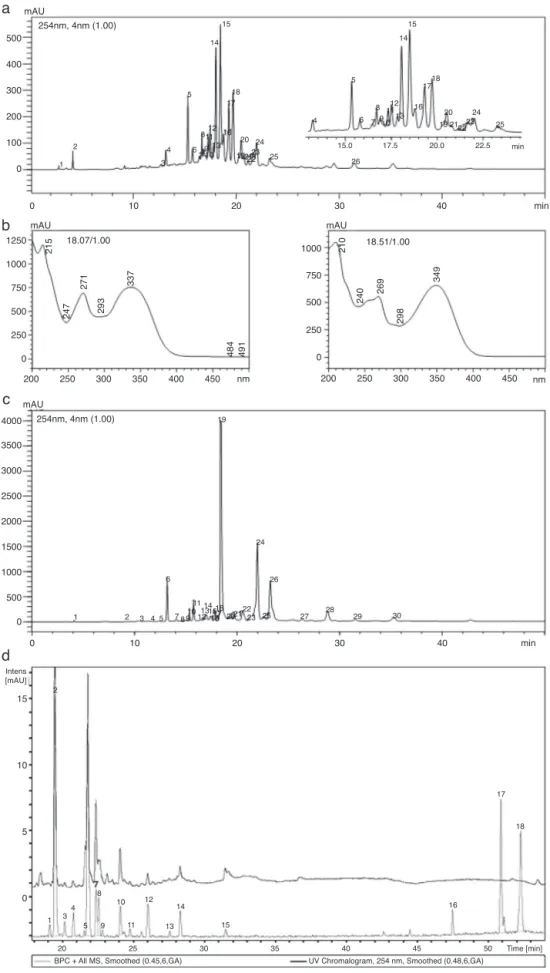
InordertobetterunderstandP.mucronataantioxidant activ-ity,andalsotocontributetophytochemicalknowledgeaboutthis species,PMCEandPMEAwereanalyzedbyHPLC-DAD-MSto ver-ifytheirchemicalprofile(Fig.5a–d).Majorpeaks,14and15,at tR 18.07 and 18.51min, displayed thetypical UV absorptionof flavonoids withmax at 271and 337nm, and 269and 349nm, respectively(Fig.5b).Besidesmajorflavonoids, HPLC-DADdata allowedtheidentificationofadditionalflavonoidpeaksbetweentR 15.77–23.32min.Theethylacetatefractionchromatogramshowed onlyonemajorpeak,number19,attR18.44min,alsocharacteristic offlavonoid(Fig.5c).
HPLC-MSwasusedtoidentifythemajorflavonoidspresentin theethylacetatefraction(Fig.5d,Table1),comparingMSspectrum andelutionorderforisomerspairs.Anumberofflavonoid glyco-sideswhich havebeenreportedinotherPassifloraspecieswere identified.Isochaftoside,schaftoside,isoorientin,orientin,vitexin andisovitexinareflavonesconsideredstandardsusedtoidentify differentPassifloraspecies (Sakalem etal., 2012), suchas Passi-floraedulisfo.flavicarpa,P.incanata,P.tripartite(Sakalemetal., 2012;Zucolottoetal.,2012;Pereiraetal.,2005;Abourashedetal.,
150
135
120
105
90
75
15 30
0 60
45
EC
50
µ
g/ml
CTL+ PMCE PMDM PMEA PMB PMA
*
Fig.4.AntioxidantactivityofPassifloramucronataextractandfractionsevaluated
byDPPH•
assay:crudeextract(PMCE),hexane(PMH),dichloromethane(PMDM),
ethylacetate(PMEA),butanol(PMB)fractionsandaqueous(PMA).Ginkgobiloba
extractwasusedaspositivecontrol(CTL+).Thevaluesshownrepresentthemedian
effectiveconcentration(EC50)andareexpressedasg/ml.Resultsrepresentthe
mean±standarddeviationofthreeindependentexperimentswithintriplicate.*No
significantdifferencewhencomparedtoCTL+.
2002).Flavonoidglycosidesareamongthecompoundsresponsible forPassifloraactivityinthecentralnervoussystem,as sedative-hypnotics,anxyoliticand analgesic(Sakalemetal.,2012).These identified and isolated flavonoids seem not to be involved in antimycobacterialactivity,sinceethylacetatefractionpresented lowactivity.However,theycouldparticipateinanti-TBactivityof P.mucronataextract,usinginvivomurinemodel,sincetheypresent anti-inflammatorypotential,describedhereandinliterature(Melo etal.,2005;Zucolottoetal.,2009).
Flavonoidswerequantifiedbasedonanarea×gcalibration curve obtainedusing a rutin external standard. The sum of all flavonoidpeaks in chromatogram wasassumed torepresent P. mucronataextracttotalflavonoidcontent.Resultsareexpressedas apercentage(w/w)−g/100goflyophilizedextract.Itwasfound that flavonoids represent13.32% w/wof thecrude extract and 14.78%w/wofthePMEA.ItisimportanttomentionP.mucronata extractflavonoidcontentwashigherthanothersobservedinplant specieswhereflavonoidsareresponsibleforpharmacological activ-ity(Muzitanoetal.,2011).
mAU
500
400
300
200
100
0
1250
1000
750
500
250
0
0 10 20 30 40 min
200 250 300 350 400 450 nm 200 250 300 350 400 450
4000
3500
3000
2500
2000
1500
1000
500
0 mAU
254nm, 4nm (1.00)
1000
750
500
250
0
nm 254nm, 4nm (1.00)
18.07/1.00 mAU
0
15
10
5
0
10 20 30 40 min
mAU
18.51/1.00 1
2
3 4
5
6 7
8
9 10 11 12
13 14
15
16 17
18
19 20
212223 24
25
26 4
15.0 17.5 20.0 22.5 5
6 7 8
9 10
1112 13
14 15
16 18
20 19 212223
24 25 17
min
Intens [mAU]
1 2
3 4
5
20
BPC + All MS, Smoothed (0.45,6,GA) UV Chromalogram, 254 nm, Smoothed (0.48,6,GA)
25 30 35 40 45 50
8 7
9 10
11 12
13 14
15
16 17
18
Time [min]
1 2 3 4 5
6
7 8910 11
1213 14
15 1617
18 20212223
24
25 26
27 28 29 30
19
215
247
271
293
337
484 491
240
210
269
298
349
a
b
c
d
Fig.5. Passifloramucronatacrudeextractchromatogramat254nm(A).Ultravioletspectraofcrudeextractchromatogrammajorpeaks,attR18.07min(peak14)and18.51min
(peak15)(B).ChromatogramofP.mucronataethylacetatefractionat254nm(tR18.44)(C).HPLC-DAD-MSchromatogramofP.mucronataethylacetatefraction,where
1-isoschaftoside;2-isoorientin;3-apigenindi-C--hexoside;4-schaftoside;5-apigenindi-C--hexoside;6-isovitexinorvitexin;8-methoxyluteolin-Chexoside;9-orientin
Table1
TheflavonoidspresentinethylacetatefractionfromPassifloramucronata.
Flavonoids Retentiontime(min) Molecularweight [M+H]+·m/z Referencesa
ApigeninC-pentosideC-hexoside(isoschaftoside) 19.2 564 565 [I,II]
LuteolinC-hexoside(isoorientin) 19.4 448 449 [I–IV]
Apigenindi-C--hexoside 20.2 594 595 [I,II,III]
ApigeninC-pentosideC-hexoside(schaftoside) 20.8 564 565 [I,III]
Apigenindi-C-hexoside 21.6 594 595 [II,III]
ApigeninC-hexoside(isovitexinorvitexin) 21.9 432 433 [I–IV]
Methoxy-luteolin-C-hexoside 22.6 462 463 [II]
LuteolinC-hexoside(orientin) 22.9 448 449 [I–IV]
aI,Sakalemetal.(2012);II,Zucolottoetal.(2012);III,Pereiraetal.(2005);IV,Abourashedetal.(2002).
steps,itwillbeinvestigatedtheinvivopotentialofP.mucronata activesamplesusingaTBmodel,previouslydescribed(Almeida etal.,2017),usefulfortestingofnewapproachesforthetreatment ofsevereTB,aimedatreducingthehyperinflammatoryresponse andthepreventionorreductionofpulmonarynecrosis.
Authors’contributions
TUPKcontributedincollectingplantsample,identificationand herbariumconfection.Conceivedanddesignertheexperiments: MFM,EBL,ICRL.Performedtheexperiments:MHA,ICVS,PFO,ARRB, FAA.Analyzedthedata:MHA,ICVS,MFM,EBL,ICRL,DOG,TB,NPL, FAE.Wrotethepaper:MHA,MFM,ICVS,RKD.Alltheauthorshave readthefinalmanuscriptandapprovedthesubmission.
Conflictsofinterest
Theauthorsdeclarenoconflictsofinterest.
Acknowledgments
TheauthorsthankCNPq,FAPERJandInstitutoMacaédeCiência eTecnologia(IMCT)forfinancialsupportandfellowship.
References
Abourashed,E.A.,Vanderplank,J.R.,Khan,I.A.,2002.High-speedextractionandHPLC
fingerprintingofmedicinalplants–I.ApplicationtoPassifloraflavonoids.Pharm. Biol.40,81–91.
Aguilera,G.,Colín-González,A.L.,Rangel-López,E.,Chavarría,A.,Santamaría,A.,
2017.Redoxsignaling,neuroinflammation,andneurodegeneration.Antioxid.
RedoxSignal.
Almeida,F.M.,Ventura,T.L.B.,Amaral,E.P.,Ribeiro,S.C.M.,Calixto,S.D.,Manhães,
M.R.,Rezende,A.L.,Souza,G.S.,Carvalho,I.S.de,Silva,E.C.,Silva,J.A.da,
Car-valho,E.A.C.Q.,Kritski,A.L.,Lasunskaia,E.B.,2017.HypervirulentMycobacterium
tuberculosisstraintriggersnecroticlungpathologyassociatedwithenhanced recruitmentofneutrophilsinresistantC57BL/6mice.PLOSONE12,e0173715.
Anesini,C.,Perez,C.,1993.ScreeningofplantsusedinArgentinefolkmedicinefor
antimicrobialactivity.J.Ethnopharmacol.39,119–128.
Bendini,A.,Cerretani,L.,Pizzolante,L.,Toschi,T.G.,Guzzo,F.,Ceoldo,S.,Marconi,
A.M.,Andreetta,F.,Levi,M.,2006.Phenolcontentrelatedtoantioxidantand
antimicrobialactivitiesofPassifloraspp.extracts.Eur.FoodRes.Technol.223, 102–109.
Bolosco,O.H.,Valle,L.deS.,2008.PlantasdeusomedicinalemQuissamã,Riode
Janeiro,Brasil.IheringiaSér.Bot.63,263–277.
Borrelli,F.,Pinto,L.,Izzo,A.A.,Mascolo,N.,Capasso,F.,Mercati,V.,Toja,E.,Autore,
G.,1996.Anti-inflammatoryactivityofPassifloraincarnataL.inrats.Phytother.
Res.10,104S–106S.
Carvalho,M.G.,Velandia,J.R.,deOliveira,L.F.,Bezerra,F.B.,1998.Triterpenesisolated
fromEschweileralongipesmiers(Lecythidaceae).Quím.Nova21,740–743.
Copp,B.R.,Pearce,A.N.,2007.NaturalproductgrowthinhibitorsofMycobacterium
tuberculosis.Nat.Prod.Rep.24,278–297.
Costa,G.M., Ortmann,C.F.,Schenkel, E.P.,Reginatto, F.H.,2011. AnHPLC-DAD
methodtoquantificationofmainphenoliccompoundsfromleavesofCecropia species.J.Braz.Chem.Soc.22,1096–1102.
Critchley,J.A.,Young,F.,Orton,L.,Garner,P.,2013.Corticosteroidsforpreventionof
mortalityinpeoplewithtuberculosis:asystematicreviewandmeta-analysis. LancetInfect.Dis.13,223–237.
Dhawan,K.,Dhawan,S.,Sharma,A.,2004.Passiflora:areviewupdate.J.
Ethnophar-macol.94,1–23.
Dheda,K.,Gumbo,T.,Maartens,G.,Dooley,K.E.,McNerney,R.,Murray,M.,Furin,
J.,Nardell,E.A.,London,L.,Lessem,E.,Theron,G.,vanHelden,P.,Niemann,
S.,Merker,M.,Dowdy,D.,VanRie,A.,Siu,G.K.,Pasipanodya,J.G.,Rodrigues,
C.,Clark,T.G.,Sirgel,F.A.,Esmail,A.,Lin,H.H.,Atre,S.R.,Schaaf,H.S.,Chang,
K.C.,Lange,C.,Nahid,P.,Udwadia,Z.F.,HorsburghJr.,C.R.,Churchyard,G.J.,
Menzies,D.,Hesseling,A.C.,Nuermberger,E.,McIlleron,H.,Fennelly,K.P.,
Goe-maere,E.,Jaramillo,E.,Low,M.,Jara,C.M.,Padayatchi,N.,Warren,R.M.,2017.
Theepidemiology,pathogenesis,transmission,diagnosis, andmanagement ofmultidrug-resistant,extensivelydrug-resistant,andincurabletuberculosis. LancetRespir.Med.5,291–360.
Garbin,M.L.,Corrijo,T.T.,Sansevero,J.B.B.,Sánchez-Tapia,A.,Scarano,F.R.,2012.
Subordinate,notdominant,woodyspeciespromotethediversityofclimbing plants.Perspect.PlantEcol.Evol.Syst.14,257–265.
Garlanda,C.,DiLiberto,D.,Vecchi,A.,LaManna,M.P.,Buracchi,C.,Caccamo,N.,
Salerno,A.,Dieli,F.,Mantovani,A.,2007.Dampingexcessiveinflammationand
tissuedamageinMycobacteriumtuberculosisinfectionbyTollIL-1receptor 8/singleIgIL-1-relatedreceptor,anegativeregulatorofIL-1/TLRsignaling.J. Immunol.179,3119–3125.
Gomez-Flores,R.,Gupta,S.,Tamez-Guerra,R.,Mehta,R.T.,1995.Determinationof
MICsforMycobacteriumavium-M.intracellularecomplexinliquidmediumbya colorimetricmethod.J.Clin.Microbiol.33,1842–1846.
Gonc¸alves,A.S.M.,Peixes,R.G.,Sato,A.,Muzitano,M.F.,Souza,R.O.M.A.,Machado,
T.B.,Amaral,A.C.F.,Moura,M.R.L.,Simas,N.K.,Leal,I.C.R.,2015.Pilosocereus
arrabidae(BylesandRowley)oftheGrumarisandbank,RJ,Brazil:physical, chemicalcharacterizationsandantioxidantactivitiescorrelatedtodetectionof flavonoids.FoodRes.Int.70,110–117.
Griess,J.P.,1879.BemerkungenzuderAbhandlungderHH:WeselyundBenedikt
‘UbereinigeAzoverbindungen’.Ber.Dtsch.Chem.Ges.12,426–428.
Higuchi,C.T.,Sannomiya,M.,Pavan,F.R.,Leite,S.R.,Sato,D.N.,Franzblau,S.G.,
Sacra-mento,L.V.,Vilegas,W.,Leite,C.Q.,2011.ByrsonimafagifoliaNiedenzuapolar
compoundswithantitubercularactivity.Evid.BasedComplement.Altern.Med., 1–5.
Imbassahy,C.A.A.,Costa,D.P.,Araujo,D.S.D.,2009.BriófitasdoParqueNacionalda
RestingadeJurubatiba,RJ,Brasil.ActaBot.Bras.23,558–570.
Jiang,G.B.,Xu,L.,Cao,F.L.,Li,G.Z.,Lei,M.,2017.Electronparamagneticresonance
(EPR)studiesonfreeradicalscavengingcapacityofEGBandEGBcigarette. Spectrosc.Spect.Anal.37,1322–1328.
Luyen,B.T.T.,Tai,B.H.,Thao,N.P.,Cha,J.Y.,Lee,Y.M.,Kim,Y.H.,2014.Anewphenolic
componentfromTriticumaestivumsproutsanditseffectsonLPS-stimulated productionofnitricoxideandTNF-␣inRAW264.7cells.Phytother.Res.28, 1064–1070.
Machado, F.L.S., Ventura, T.L.B., Gestinari, L.M., Cassano, V., Resende, J.A.,
Kaiser,C.R.,Lasunskaia, E.B.,Muzitano,M.F., Soares,A.R.,2014.
Sesquiter-penesfromtheBrazilianredalgaLaurenciadendroidea.J.Agardh. Mol.19, 3181–3192.
Mahairas,G.G.,Sabo,P.J.,Hickey,M.J.,Singh,D.C.,Stover,C.K.J.,1996.Molecular
analysisofgeneticdifferencesbetweenMycobacteriumbovisBCGandvirulent M.bovis.J.Bacteriol.178,1274–1282.
Martins, A.,Vasas, A., Viveiros,M.,Molnár,J.,Hohmann, J.,Amaral, L.,2011.
AntibacterialpropertiesofcompoundsisolatedfromCarpobrotusedulis.Int.J. Antimicrob.Agents37,438–444.
Melo,G.O.de,Muzitano,M.F.,Legora-Machado,A.,Almeida,T.A.,Oliveira,D.B.de,
Kaiser,C.R.,Koatz,V.L.,Costa,S.S.,2005.C-glycosylflavonesfromtheaerialparts
ofEleusineindicainhibitLPS-inducedmouselunginflammation.PlantaMed.71, 362–363.
Mensor,L.L.,Menezes,F.S.,Leitão,G.G.,Reis,A.S.,dosSantos,T.C.,Coube,C.S.,Leitão,
S.G.,2001.ScreeningofBrazilianplantextractsforantioxidantactivitybythe
useofDPPHfree.Radic.Method.Phytother.Res.15,127–130.
Mosmann,T.,1983. Rapidcolorimetricassayforcellulargrowthand survival:
applicationtoproliferationandcitotoxicityassays.J.Immunol.Methods65, 55–63.
Muzitano,M.F.,Bergonzi,M.C.,DeMelo,G.O.,Lage,C.L.,Bilia,A.R.,Vincieri,F.F.,
Rossi-Bergmann,B.,Costa,S.S.,2011.Influenceofcultivationconditions,season
ofcollectionandextractionmethodonthecontentofantileishmanialflavonoids fromKalanchoepinnata.J.Ethnopharmacol.133,132–137.
Muzitano,M.F.,Cruz,E.A.,DeAlmeida,A.P.,DaSilva,S.A.G.,Kaiser,C.R.,Guette,C.,
Rossi-Bergmann,B.,Costa,S.S.,2006.Quercitrin:anantileishmanialflavonoid
glycosidefromKalanchoepinnata.PlantaMed.72,81–83.
Okunade,A.L.,Lewis,M.P.F.E.,Lewis,W.H.,2004.Naturalantimycobacterial
Oz,H.S.,2017.Chronicinflammatorydiseasesandgreenteapolyphenols.Nutrients 9,E561.
Pereira, C.A.M., Yariwake, J.H., McCullagh, M., 2005. Distinction of the
C-glycosylflavoneisomerpairsorientin/isoorientinandvitexin/isovitexinusing HPLC-MSexactmassmeasurementandin-sourceCID.Phytochem.Anal.16, 295–301.
Sakalem,M.E.,Negri,G.,Tabach,R.,2012.Chemicalcompositionof
hydroethano-licextractsfromfivespeciesofthePassifloragenus.Braz.J.Pharmacogn.22, 1219–1232.
Salomon,C.E.,Schmidt,L.E.,2012.Naturalproductsasleadsfortuberculosisdrug
development.Curr.Top.Med.Chem.12,735–765.
Scarano,F.R.,2002.Structure,functionandfloristicrelationshipsofplant
commu-nitiesinstressfulhabitatsmarginaltotheBrazilianAtlanticrainforest.Ann.Bot. 90,517–524.
Shih,M.F.,Cheng,Y.D.,Shen,C.R.,Cherng,J.Y.,2010.Amolecularpharmacologystudy
intotheanti-inflammatoryactionsofEuphorbiahirtaL.ontheLPS-inducedRAW 264.7cellsthroughselectiveiNOSproteininhibition.J.Nat.Med.64,330–335.
Sientzoff,P.,Hubert,J.,Janin,C.,Voutquenne-Nazabadioko,L.,Renault,J.H.,
Nuzil-lard,J.M.,Harakat,D.,Magid,A.A.,2015.Fastidentificationofradicalscavengers
fromSecurigeravariabycombining13C-NMR-baseddereplicationto
bioactivity-guidedfractionation.Molecules20,14970–14984.
Silva,J.K.,Cazarin,C.B.B.,Colomeu,T.C.,Batista,A.G.,Meletti,L.M.M.,Paschoal,J.A.R.,
Júnior,S.B.,Furlan,M.F.,Reyes,F.G.,Augusto,F.,Júnior,M.R.M.,Zollner,R.L.,
2013.Antioxidantactivityofaqueousextractofpassionfruit(Passifloraedulis)
leaves:invitroandinvivostudy.FoodRes.Int.53,882–890.
Sunitha,M.,Devaki,K.,2009.AntioxidantactivityofPassifloraedulissimsleaves.
IndianJ.Pharm.Sci.71,310–311.
Varassin,I.G.,Trigo,J.R.,Sazima,M.,2001.Theroleofnectarproduction,flower
pig-mentsandodourinthepollinationoffourspeciesofPassiflora(Passifloraceae) insouth-easternBrazil.Bot.J.Linn.Soc.136,139–152.
Ventura,T.L.B.,Calixto,S.D., Abrahim-Vieira,B.A.,De Souza,A.M.,Mello,M.V.,
Rodrigues,C.R.,Miranda,L.S.M.,DeSouza,R.O.A.,Leal,I.C.R.,Lasunskaia,E.B.,
Muzitano,M.F.,2015a.Antimycobacterialandanti-inflammatoryactivitiesof
substitutedchalconesfocusingonananti-tuberculosisdualtreatmentapproach. Molecules20,8072–8093.
Ventura,T.L.B.,Machado,F.L.S.,Araujo,M.H.,Gestinari,L.M.S.,Kaiser,C.R.,Esteves,
F.A.,Lasunskaia,E.B.,Soares,A.R.,Muzitano,M.F.,2015b.Nitricoxide
produc-tioninhibitionandanti-mycobacterialactivityofextractsandhalogenated sesquiterpenesfromtheBrazilianredalgaLaurenciadendroidea.J.Agardh. Phar-macogn.Mag.11,S611–S618.
Ventura,T.L.B.,Silva,D.R.C.,Lasunskaia,E.B.,Maria,E.J.,Muzitano,M.F.,Oliveira,R.R.,
2015c.Coumarineanalogueswithantimycobacterialandimmunomodulatory
activity.Curr.Bioact.Compd.11,109–115.
Wen,P.,Han,H.,Wang,R.,Wang,N.,Yao,X.,2007.C-glycosylfavonesandaromatic
glycosidesfromCampylotropishirtella(Franch.)Schindl.AsianJ.Trad.Medic.2, 149–153.
Wohlmuth,H.,Penman,K.G.,Pearson,T.,Lehmann,R.P.,2010.Pharmacognosy
andchemotypesofpassionflower(PassifloraincarnataL.).Biol.Pharm.Bull.33, 1015–1018.
WHO,2016.GlobalTuberculosisReport.1-201.WorldHealthOrganization.
Zeraik,M.L.,Pereira,C.A.M.,Zuin,V.G.,Yariwake,J.H.,2010.Passionfruit:afunctional
food?Rev.Bras.Farmacogn.20,459–471.
Zucolotto,S.M.,Fagundes,C.,Reginatto,F.H.,Ramos,F.A.,Castellanos,L.,Duque,
C.,Schenkel,E.P.,2012.AnalysisofC-glycosylflavonoidsfromSouth
Amer-ican Passifloraspecies by HPLC-DAD and HPLC-MS. Phytochem.Anal. 23, 232–239.
Zucolotto,S.M.,Goulart,S.,Montanher,A.B.,Reginatto,F.H.,Schenkel,E.P.,Fröde,
T.S.,2009.Bioassay-guidedisolationofanti-inflammatoryC-glucosylflavones