EVALUATION OF CONVENTIONAL RADIODIAGNOSIS SERVICES
IN TWO HOSPITALS OF THE STATE PUBLIC NETWORK IN RIO
BRANCO, ACRE*
José Geraldo Pacheco1, Marcelo Benício dos Santos2, José Tavares-Neto3
OBJECTIVE: The main objective of the present study was to evaluate radiodiagnosis services in two public hospitals with x-ray equipment in the city of Rio Branco, Acre, Brazil. MATERIALS AND METHODS: Inter-views, measurements and direct observation were performed, following the Brazilian legislation in force, especially the Order (Portaria) SVS/MS 453 of 1998 of the Ministry of Health establishing the basic guide-lines for radiation exposure protection in medical and odontological x-ray facilities. RESULTS: The data indi-cated a high rate of non-compliance with the legislation in both radiological services, especially concerning poor equipment operation, and non-compliance with some safety protocols. CONCLUSION: Basically, tech-nical and operational infractions have occurred as a result of a broad unfamiliarity with the legislation, the absence of a preventive equipment maintenance program, besides low investment in training and/or courses for professional updating. Therefore, a considerable number of simple and complex changes are demanded to improve the quality of the investigated radiodiagnosis services.
Keywords: Radiodiagnosis services; Service evaluation; Exposure risk; Acre State.
Avaliação dos serviços de radiodiagnóstico convencional de dois hospitais da rede pública estadual de Rio Branco, Acre.
OBJETIVO: O objetivo principal deste trabalho foi avaliar os serviços de radiodiagnóstico médico de dois hospitais públicos que fazem uso de equipamentos de raios X na cidade de Rio Branco, Acre. MATERIAIS E MÉTODOS: Foram realizadas entrevistas, medições e observações diretas, usando como referência a legis-lação brasileira em vigor, com especial ênfase à Portaria SVS/MS nº 453 de 1998, que estabelece as dire-trizes básicas de proteção radiológica em radiodiagnóstico médico e odontológico. RESULTADOS: Os dados obtidos indicaram a ocorrência de elevado número de itens em desacordo com a legislação consultada em ambos os serviços radiológicos dos hospitais pesquisados, especialmente equipamentos funcionando de forma parcial e o descumprimento de alguns protocolos de segurança. CONCLUSÃO: As infrações técnicas ou operacionais foram, basicamente, em decorrência do desconhecimento sobre a legislação, a ausência de programa de manutenção preventiva dos equipamentos e da falta de investimentos em treinamentos e/ou cursos de atualização profissional. A melhoria dos serviços de radiodiagnóstico médico das instituições in-vestigadas requer, portanto, uma série de modificações, que vão de simples às mais complexas.
Unitermos: Serviço de radiodiagnóstico; Avaliação de serviço; Risco de exposição; Estado do Acre. Abstract
Resumo
* Study developed at Fundação Hospitalar do Acre and Hos-pital de Urgência e Emergência de Rio Branco, Rio Branco, AC, Brazil.
1. Mathematician, Master’s Degree in Medicine and Health, Professor at União Educacional do Norte (Uninorte).
2. MD, Doctorate in Medicine (Clinical Radiology), Titular Pro-fessor at Universidade Federal da Bahia.
3. MD, Private Docent at Faculdade de Medicina da Universi-dade Federal da Bahia.
Mailing Address: José Geraldo Pacheco. Rua Plutão, 399, Bairro Morada do Sol. Rio Branco, AC, 69910-390 – Brazil. E-mail: [email protected]
Received April 14, 2005. Accepted after revision October 10, 2006.
INTRODUCTION
In Brazil, one can say that the necessity to establish more rigorous standards for the sectors of radiodiagnosis and radiotherapy is a relatively recent concern triggered by the incident occurred in Goiânia, GO, in
September of 1987, when outsiders de-structed with a hammer a powered cesium-137 source obtained from an abandoned private medical facility. This episode was widely divulged both in the national and international media, and several adjust-ments and new practices started being implemented in the sector(1,2).
For several reasons, the major concern with regards to the standards severity has not led to the immediate publishing of the new legislation; an example is the Portaria (Order) SVS/MS no. 453dated of June 1st, 1998(3), published only ten years after the
incident in Goiânia. Most recently, this Order has been gradually improved by means of supplementary resolutions: RDC Anvisa no. 50, of February 21, 2002,
regu-lating the technical planning, scheduling, elaboration and analysis of physical projects of health care facilities(4), and the
RE Anvisa no. 64, of April 4, 2003, includ-ing the Guia de Procedimentos para Segu-rança e Qualidade de Imagem em Radio-diagnóstico Médico (Procedures Guidance for Safety and Imaging Quality in Medical Radiodiagnosis)(5).
Clemen-tino Fraga Filho of Universidade Federal do Rio de Janeiro, for example, only three of twenty services working with ionizing ra-diation kept individual dosimetric monitor-ing of their employees, but there was no control for cases where high doses were found(6)
. Another study carried out in den-tal offices in the city of Bauru, SP, has re-ported that the patients could receive lower radiation doses if simple precautions, like a better films positioning, were adopted(7)
. More serious situations have been ob-served in the radiology service of Hospital Central do Exército do Rio de Janeiro, like inadequate supplies (for example, films and films developing solutions) storage, wrong positioning of the patient or of the film, use of equipment out of order, and in some cases partially damaged(8)
. These and other examples(9–12)
reinforce the necessity that legal mechanisms, including educa-tional programs, are employed by the Bra-zilian sanitary authority to increase safety of the workers in these services as well as of their user-population.
In the state of Acre, a process was initi-ated in 2001 for updating the register of health care facilities with conventional and dental radiodiagnosis services, In this pro-cess, 29 conventional x-ray equipment and about 200 dental x-ray equipment (Pereira Filho T, Visa-Acre: personal communica-tion). However, these services have not been evaluated under the criteria estab-lished by the legislation in force. So the objective of the present study was to evalu-ate the services of conventional radiodiag-nosis of two hospital of the state public network in the city of Rio Branco, in com-pliance with the Brazilian guidelines(3–5)
.
MATERIALS AND METHODS
In the period between February 2 and 27 of 2004, the services of conventional radiodiagnosis in two institutions of the public state network in the city of Rio Branco, AC were evaluated. For the present study purposes, these institutions hereafter will be named “institution 1” and “institu-tion 2”. Institu“institu-tion 1 provides specialized attendance in 21 medical areas, and 159 hospital beds, distributed throughout four ambulatories and one intensive care unit, all of them dedicated to the Sistema Único
de Saúde – SUS (Brazilian Unified Health System). The institution’s staff includes 157 professionals with superior educa-tional level(13)
; among them, four physi-cians specialized in radiology, and nine technicians classified in this same area. This hospital is also accredited by the Min-istry of Education as an ancillary teaching hospital, where residency programs are developed in the areas of pediatrics, medi-cal clinimedi-cal practice, obstetrics and gynecol-ogy, general surgery, and communitarian general medicine. Recently, institution 1 was included in the Projeto Hospitais-sentinela (Sentinel-Hospitals Project) cre-ated by Anvisa(14)
. In this institution, the mean monthly number of hospital admis-sions is 650, and in 2002 about 24,000 conventional x-ray studies were per-formed(15)
.
Institution 2 is an emergency hospital with 200 hospital-beds registered at SUS. Of these hospital-beds, 39 are assigned to general surgery, 98 to medical clinical prac-tice, two to psychiatry, 31 to pediatrics, and five to phthisiology. The institution also counts on services considered as non-ur-gency in the area of infectious and parasit-ary diseases, and its staff includes 272 pro-fessionals(16)
of superior educational level; among them one physician specialized in radiology, and nine technicians classified in this same area. Seven hundred hospital admissions, on average, occur per month, with a mean monthly hospital occupation rate of 75%. In 2002, 67,952 x-ray studies were performed in the institution 2(17)
. The following aspects were taken into consideration in the analysis of the radiodiagnosis services of institutions 1 and 2: professional education, working-day, technicians and ancillary personnel routine and time of experience, documen-tation of the services; physical structure as a whole, exam rooms, individual protection equipment, conventional x-ray equipment, dark chambers, report rooms, procedures with patients, procedures with films and films development, and services protocols. This evaluation was performed in compli-ance with criteria established by the Bra-zilian legislation currently in force(3–5)
. The characterization of technicians and ancillary personnel, and the evaluation of physical and operational facilities of the
medical radiodiagnosis services were made by means of visits to the facilities, inter-views with the head of the service (or a representative indicated by the manage-ment of the unit), interviews with techni-cians and ancillary personnel, and direct observation, with quantitative and qualita-tive descriptions. Previously to the data collection, the proposed interviews ques-tionnaires were applied to 10% of the tar-get-public for validation. Once validated, visits were performed to both institutions as necessary, until the two questionnaires were completely answered by both institu-tions. (Pacheco JG, unpublished data: Master’s Dissertation, Universidade Fed-eral da Bahia). Additionally, whenever possible, photos were taken from the equip-ment and facilities.
In the qualitative analysis, comparisons were made between expected situation (ac-cording to the referred legislation) and the actual situation found during the visits to the health care facilities included in the present study(3–5)
. In the quantitative analy-sis, whenever possible, means and fre-quency calculations were performed.
For practical reasons, all the profession-als developing activities at the level of tech-nicians in radiology, in this study were named “technicians”. However, according to the Law no. 7394, of October 29, 1985, regulating the practice of the profession(18)
, only those professionals holding a diploma issued by a technical radiology school are legally recognized as “technicians”.
The research project was approved by the Committee for Ethics in Research of Fundação Hospital Estadual do Acre (Re-port no. 049/2003). All the workers who proposed to collaborate in this project were given all the necessary explanations before being asked to sign the Term of Free In-formed Consent (Pacheco JG, unpublished data: Master’s Dissertation, Universidade Federal da Bahia). Previously, the study had been authorized by the titular manag-ers of both institutions, and also by the Secretary of Health for the State of Acre.
RESULTS
Evaluation of the services
Table 2 Conditions of x-ray rooms and radiodiagnosis equipment evaluated in Rio Branco, AC.
B
No No No No No No
No
No No No
No No No Yes No No A
No No No No No No
No
No No No
No No No Yes No No 2
No No — No No No
No
No No No
No No No No No Yes 1
Yes No — Yes Yes No
Yes
No No No
No No No No No Yes
Institution
1 2
Rooms Rooms
* Institution 1 does not have a WC or washbasin in the x-ray room.
Researched items
1. X-ray rooms present a good hygiene and cleaning standard
2. The electrical installations of the rooms are in good order and functioning 3. The hydraulic installations of the rooms are in good order and functioning* 4. When closed, the doors offer a perfect isolation
5. The bucky mural is good condition
6. The command cabin localization allows observation of the room door
7. The spotlight localization system opens symmetrically and the light intensity is sufficient to allow visualization of the field
8. There is a visible noticeboard warning women on the necessity of infoming the physician or technician on the existence or suspect pregnancy, before the examination
9. There is a warning noticeboard: “Entry prohibited while red light is on”
10. The protocol for radiographic technique (exposure table) is beside the control panel of the equipment 11. There is a quality control and preventive maintenence program in force, assuring that the equipment is in
compliance with performance standards
12. The unit runs a performance reevaluation test after equipment maintenance 13. There are radiation protective gonad and thyroid shields for patients 14. There is sufficient number of lead aprons
15. The dark chamber is appropriately sealed to avoid natural light entrance 16. There is a quality control for post-processing water
Table 1 Evaluation of the conditions of radiological protection in two services of radiology at two institutions in the city of Rio Branco, AC.
1
No No No No No No Yes No No No Yes No No No No
2
No No No No No No No — Yes No Yes No Yes No No Institution
*Individual monitoring is not undertaken.
1. There is a radiological protection supervisor 2. There is a technical expert in charge
3. There is a Committee for radiological protection
4. There is a calculation for shielding of radiological facilities performed by an accreditated specialist 5. The unit holds a functioning permit for the radiodiagnosis service, issued by Visa-Acre
6. The basic architectural project was aproved by Visa-Acre, in compliance with radiological protection standards 7. There are individual dosimeters for the personnel in the radiodiagnosis unit
8. Individual monitoring data on the occupationally exposed personnel are registered and updated* 9. Public circulation inside the facility is restricted
10. There is a copy of Portaria (Order) SVS/MS 453/1998 available in the unit
11. Radiological studies are appropriately registered, with date and identification data of the patients 12. The clinical indication for the study is included in the register
13. The corridors allow an adequate circulation of people and stretchers
14. There is a documentation on the routine work procedure, including those regarding radiological protection 15. The unit has already been radiologically inspected by Visa-Acre
Researched items
In summary, in the institutions 1 and 2, 87% (15/2) and 80% (15/3) of the items, respectively, were in disagreement with the legislation in force. The Table 2 includes the conditions of hygiene and cleaning of the x-ray rooms, as well as the technical limitations observed in at least one of the fixed x-ray equipments and furniture
ob-served in each institution. Both the institu-tion 1 and instituinstitu-tion 2 have two x-ray rooms. In the institution 1, the rooms are identified with number plates (1 or 2). In the institution 2, there is no identification plate for the rooms (for practical effects, the room at left side in the radiodiagnosis unit was named “A”, while the room at right
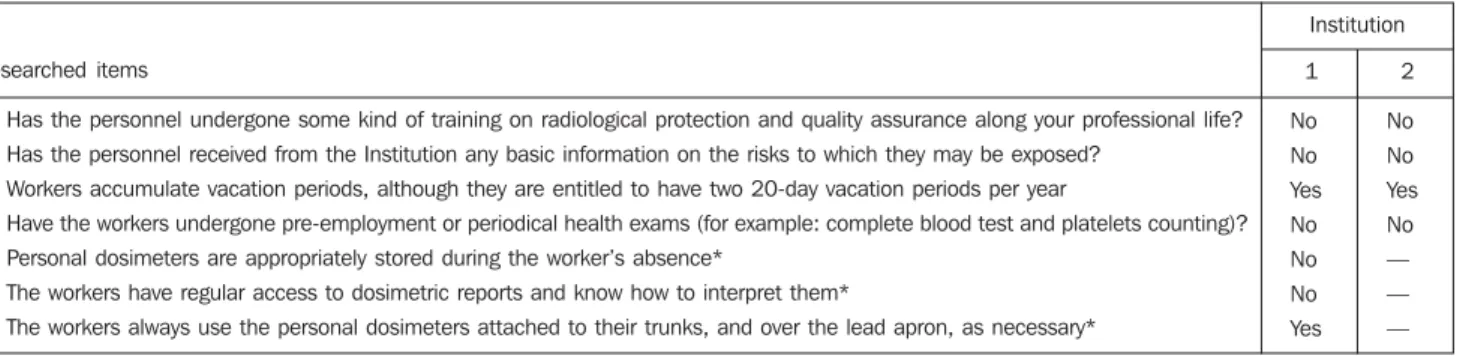
them had completed a 3-year technical course in radiology (one in each of the in-stitutions). The other had attended the fin-ished Programa de Reeducação e Avaliação Profissional (Program for Re-education and Professional Evaluation), and 86.6% of the interviewed technicians reported that they has learned to perform x-ray examina-tions by observing their more experienced colleagues. In the institution 1, the profes-sional who had completed the technical course in radiology had less than one year of experience in this position, while the other had between 12 and 15 years of ex-perience. None of the technicians had un-dergone any kind of training in radiologi-cal protection and quality assurance along their professional career. Additionally, none of the interviewed had received ba-sic information from the institutions on the risks they were exposed to. Among the re-spondents, there was one technician who had completed post-graduation in a non-re-lated area, one with superior course in physics, eleven technicians who has com-pleted high school, one with complete el-ementary course, and other with incom-plete elementary course. In 100% of cases, the contractual working-day (24 hours/ week) was different from the actual work-ing-day in both institutions: 30 weekly hours, on average, in Institution 1, and 65 weekly hours in Institution 2. In institution 1, four (66.6%) of the six technicians worked also for another institution. A simi-lar situation was seen in Institution 2 (55.5% of cases, i.e., five of nine respon-dents). With the exception of one techni-cian of institution 1, the other technitechni-cians in radiology of institution 1 and the tech-nicians of institution 2 did not receive the 40%-additional pay for hazardous duty,
although the majority of them (73.3%) had already such additional pay while em-ployed by these institutions. Although they were entitled to have two 20-day vacation periods per year, in both institutions, it was frequent accumulation of vacation periods for more than 3 years. Apparently, this was the solution they found to avoid a decrease in the total value received at the end of each month formed by wage and additional pays resulting from overtime and shifts.
According the workers in both institu-tions, pre-admission laboratory tests (com-plete blood test and platelets counting) were not performed, and nor did the half-year blood tests required by the Order (Portaria) GM/SSSTb 24/1994.
The technicians of institution 1 reported that they always worn the personal dosim-eter attached to their trunk, and over the lead apron, as necessary. However, they were not given access to dosimetric reports and did not know how to interpret them. Also, a worker in institution 1 was ob-served wearing the dosimeter of another worker who had been dismissed.
Neither institution 1, nor institution 2 had a protocol for radiographic technique. Consequently, each technician followed his/her own parameter to perform exami-nations. During the interviews, 26.6% of respondents informed not to be adequately prepared, and nor did they know how to ac-complish their tasks safely.
Overall, 15 technicians and six ancillary workers in radiology, respectively, six tech-nicians from institution 1, and nine techni-cians and six ancillary workers from insti-tution 2 were interviewed. However, the three ancillary workers from institution 1 opted not to participate in this study. Table 3 shows the evaluation of the conditions of
individual monitoring in both institutions, as well as their compliance with the law in terms of special vacation periods. As re-gards individual dosimetry in institution 2, it could not be evaluated, since it is not undertaken.
Procedures of the technicians in radiology with patients and their companions
During the visits to both institutions, the following irregularities were observed: 1) bedside procedures were restricted to im-movable patients, but without using a mo-bile shielding and neglecting the duly mini-mum 2 m distance to be kept by compan-ions and other patients from the x-ray equipment; 2) in two occasions, the tech-nicians performed the procedures with the x-ray room door open.; 3) the technicians did not offer the lead aprons to companions, although they were available in the room; 4) the possibility of the patients’ or compan-ions’ pregnancy was not checked in any of the cases observed (n = 45); 5) The most sensitive organs of the patients (thyroid and gonads) were not protected during the ra-diological examinations, since both institu-tions did not had this type of individual protection equipment available.
In institution 1, there were occasions where the technician had to operate the mobile x-ray equipment without wearing a lead apron because all the aprons available in the Institution were being used in other radiological procedures. In institution 2, there were situations where the technician could not delimitate the precise site of x-ray beam incidence, because the collimator lamp was broken. In such situations, the collimator remained with its maximum aperture, irradiating a larger area than the
Table 3 Condition of radiological protection of workers in services of radiology of two institutions in Rio Branco, AC.
2
No No Yes No — — — 1
No No Yes No No No Yes
Institution
*Individual monitoring is not performed.
Researched items
1. Has the personnel undergone some kind of training on radiological protection and quality assurance along your professional life? 2. Has the personnel received from the Institution any basic information on the risks to which they may be exposed?
3. Workers accumulate vacation periods, although they are entitled to have two 20-day vacation periods per year
4. Have the workers undergone pre-employment or periodical health exams (for example: complete blood test and platelets counting)? 5. Personal dosimeters are appropriately stored during the worker’s absence*
6. The workers have regular access to dosimetric reports and know how to interpret them*
necessary one for the examination; in this same institution, in more than one occa-sion, a situation was observed where the stretcher handler supported the patients during the radiological procedure without wearing any individual protection equip-ment. Therefore, the stretcher handler was exposed to several radiation doses during a day. Once during a visit, we observed the simultaneous presence of two patients and two stretchers handlers in the x-ray room during radiological procedures.
DISCUSSION
Comparatively, the problems diagnosed in institution 2 are the same in institution 1. It is important to note, however, that it is expected that, in a very short time insti-tution 1 will have a more efficient radio-diagnosis service, since it has been in-cluded in the Projeto Hospitais-sentinela da Anvisa (Anvisa Sentinel-Hospitals Pro-ject)(14)
.
Both in institution 1 and institution 2 several items were in disagreement with the referred legislation (3–5)
. At least four mea-sures must be adopted by both institutions aiming at achieving compliance with the current legislation: 1) assignment or hiring of a radiological protection supervisor and a technical expert in charge; 2) constitution of a Committee for Radiological Protec-tion, in compliance with provisions of Or-der (Portaria) SVS/MS 453/1998(3)
; 3) pe-riodical training and updating courses; 4) implementation of a program for quality assurance in the institutions, including a routine equipment preventive maintenance. Experiences with other institutions demonstrate that hiring experienced and skilled professionals, as well as investment in training and updating courses, are effec-tive measures, contributing significantly to improve the quality standards of radio-diagnosis services. In 1999, the laborato-ries of hormones and nuclear medicine of Hospital Universitário Clementino Fraga Filho at Universidade Federal do Rio de Janeiro presented the lowest indices in monthly personal dosimeters readings(6)
. According to the authors, this has occurred mainly as a result of training programs for the laboratories staff, and the presence of a physicist, in the case of nuclear medicine,
continuously managing and guiding the personnel on the occupational risk of ion-izing radiation(6)
. Also, in Hospital
Univer-sitário do Rio de Janeiro, the implementa-tion of a quality assurance pilot-program in the mammography unit, in 2002, included training for technicians, a more appropri-ate mammograph maintenance, and an in-crease in the mean daily number of patients from 7 to 12, which has contributed to the stability of the films processor(9)
. These changes have resulted in an improvement in the images quality, with absence of arti-facts; a significant decrease in costs and films rejection indices (from 21% to 7.7%); and, consequently, a significant decrease in radiation doses for patients(9)
.
A serious problem found, concerning radiodiagnosis procedures, was the exami-nation of women or patients accompanied by women of fertile age. In both institu-tions, the possibility of pregnancy was by no means investigated, and this is particu-larly concerning, as it is likely that there may be pregnant women undergoing un-necessary radiation exposure, and a conse-quent higher risk of mutations-related con-genital abnormalities and injury to the fe-tal central nervous system, besides delayed effects for women(19–21)
. Just affixing a notice board on the risks of radiation ex-posure for pregnant women, according to Order (Portaria) SVS/MS 453/1998(3)
, does not suffice; however there is a necessity for a reeducation program and guidance for patients and companions in the occasion of the request, scheduling, and also before the radiological procedure performance. How-ever, a limitation to this kind of program is the high rate of functional illiteracy in the Acre State - in 2001, it was 30.2%(22)
. An-other alternative, provided the clinical situ-ation permits, is to establish a certain pe-riod for performing radiological studies in women of fertile age, for example, ten days after the last day of the menstrual period (23)
. Another serious problem was stretchers handlers supporting patients during radio-logical procedures without wearing any type of individual radiation protection equipment. According to the Order (Porta-ria) SVS/MS 453/1998(3)
: 1), the presence of a companion in the room during radio-logical procedures should occur only on voluntary basis and out of the context of the
companion professional activity; 2) a same person is forbidden to go about this activ-ity on a regular basis; 3) it is mandatory for the companions wearing an individual ra-diation protection equipment compatible with the radiological procedure.
Most probably because the radiation originating from the x-rays is an invisible phenomenon, several other procedures in-compatible with the activity of workers in radiodiagnosis services were observed. For reverting this situation, it is necessary not only a significant investment in training, but also the development of systematic activities aiming at stimulating and valoriz-ing the workers in this sector, besides mak-ing them aware of the occupational radia-tion exposure risks.
Although the investigated institutions had two x-ray rooms as well as infra-strutucture sufficient for two processors, both have been effectively operating with only one room and with a single processor. Since a preventive maintenance does not exist, and both institutions operate 24 hours a day, the immediate consequences are: fquent interruptions of the services as a re-sult of technical problems, and equipment overheating, affecting the images quality. Considering the relevance of the radio-diagnosis services for the population in the Acre State, the lack of a qualified mainte-nance and spare parts for immediate re-placement, the availability of additional x-ray equipment and processor is essential for both institutions.
Considering that these government agencies should not only to inspect and define penalties for infringements ob-served, but also guide and educate with basis on the Order (Portaria) SVS/MS 453/ 1998(3)
, as well as on federal, state and municipal regulations on this matter, the proximity of State and city sanitary vigi-lance agencies may result in an improve-ment of the radiodiagnosis services.
the studied institutions is highly dependent on urgent changes which, most of times, are simple and easy to be implemented, with immediate effects on the quality of the ser-vices.
Acknowledgements
The authors thank to Marcos Vinícius Teixeira Navarro, Coordinator for Núcleo de Tecnologia em Saúde do Centro Federal de Educação Tecnológica da Bahia; Tito Pereira Filho, Technician for Visa-Acre; Andréa F Giacomet, Technician for Anvisa; José Amsterdam de M. Sandres Sobrinho and Thor Oliveira Dantas, Director for Fundação Hospitalar do Acre and Hospital de Urgência e Emergência de Rio Branco; and to all the people in the sector of medi-cal radiodiagnosis who have collaborated on the present study.
REFERENCES
1. Rosa LP. A questão nuclear brasileira. Saúde em debate 1988;20:15–17.
2. International Atomic Energy Agency. The radio-logical accident in Goiânia. [cited 2003 Nov 6]. Available from: http:// www-pub.iaea.org/MTCD/ publications/PDF/Pub815_web.pdf
3. Agência Nacional de Vigilância Sanitária.
Porta-ria MS/SVS nº 453, de 1º de junho de 1998.
Brasília: Diário Oficial da União, 2/6/1998. 4. Agência Nacional de Vigilância Sanitária.
Reso-lução RDC nº 50, de 21 de fevereiro de 2002.
Brasília: Diário Oficial da União, 20/3/2002. 5. Agência Nacional de Vigilância Sanitária.
Reso-lução RE nº 64, de 4 de abril de 2003. Brasília:
Diário Oficial da União, 10/4/2003.
6. Oliveira SR, Azevedo ACP, Carvalho ACP. Ela-boração de um programa de monitoração ocupa-cional em radiologia para o Hospital Universitá-rio Clementino Fraga Filho. Radiol Bras 2003;36: 27–34.
7. Kuroiva AM. Avaliação das condições de radio-proteção em consultórios odontológicos da ci-dade de Bauru, Estado de São Paulo – estudo comparativo de dez anos. (Dissertação de Mes-trado). Bauru: Universidade de São Paulo, Facul-dade de Odontologia de Bauru, 2000. 8. Oliveira R. Avaliação das condições operacionais
e de proteção radiológica na prática da radiolo-gia convencional. (Dissertação de Mestrado). Rio de Janeiro: Instituto Militar de Engenharia, 2001. 9. Magalhães LAG, Azevedo ACP, Carvalho ACP. A importância do controle de qualidade de proces-sadoras automáticas. Radiol Bras 2002;35:1–14. 10. Oliveira ML, Khoury H. Influência do procedi-mento radiográfico na dose de entrada na pele de pacientes em raios X pediátricos. Radiol Bras 2003;36:105–109.
11. Fernandes GS, Carvalho ACP, Azevedo ACP. Avaliação dos riscos ocupacionais de trabalhado-res de serviços de radiologia. Radiol Bras 2005; 38:279–281.
12. Silva MO, Carvalho ACP, Azevedo ACP. Levan-tamento das condições de funcionamento dos serviços de radiologia de hospitais públicos e universitários do Rio de Janeiro. Radiol Bras 2004;37:271–278.
13. Cadastro Nacional de Estabelecimentos de Saúde. [citado 28/1/2005]. Disponível em: http://cnes.
datasus.gov.br/Mod_Profissional.asp?VCo_ Unidade=1200402001586
14. Agência Nacional de Vigilância Sanitária. Carti-lha de notificações em tecnovigilância. [citado 3/ 4/2005]. Disponível em: http://www.anvisa.gov. br/tecnovigilancia/cartilha.pdf
15. Secretaria de Estado de Saúde do Acre. Estatísti-cas hospitalares. Rio Branco: Fundhacre, 2002 (Mimeografado).
16. Cadastro Nacional de Estabelecimentos de Saúde. [citado 28/1/2005]. Disponível em: http://cnes. datasus.gov.br/Mod_Profissional.asp?VCo_ Unidade=1200402001578
17. Secretaria de Estado de Saúde do Acre. Estatísti-cas hospitalares. Rio Branco: HUERB, 2002 (Mimeografado).
18. Ministério do Trabalho e Emprego. Lei nº 7394,
de 29 de outubro de 1985. Brasília: Diário Oficial da União, 30/10/1985.
19. International Commission on Radiological Pro-tection. ICRP 34. Protection of the patient in di-agnostic radiology. 1st ed. USA: Pergamon, 1982; v.9.
20. International Commission on Radiological Pro-tection. ICRP 60. 1990 Recommendations of the International Commission on Radiological Pro-tection. 1st ed. USA: Pergamon, 1991;v.21. 21. International Commission on Radiological
Pro-tection. Radiation and your patient: a guide for medical practitioners. [cited 2004 Jun 3]; Avail-able from: http://www.icrp.org/docs/Rad_for_ GP_for_web.pdf
22. Instituto Paulo Montenegro. Indicador nacional de analfabetismo funcional. [citado 13/3/2004]. Disponível em: http://www.ipm.org.br/an.php 23. Ayad M. Risk assessment of an ionizing-radiation