26 Rev Bras Med Esporte – Vol. 18, No 1 – Jan/Fev, 2012
RESISTANCE TRAINING INFLUENCE ON THE
QUALITY OF LIFE OF HYPERTENSIVE
ELDERLY WOMEN
ABSTRACT
Introduction: High Blood Pressure (HBP), also known as Hypertension, is one of the major worldwide public health problems and mainly affects elderly women. Hypertensive patients may have their quality of life (QOL) affected by comorbidities associated with this disease. Thus, resistance training (RT) has been increasingly recommended as a non-pharmacological therapy for HBP since it contributes to reduce the disability level in individuals with and without cardiovascular disease. Objective: To assess QOL through generic (SF-36) and specific (MINICHAL) questionnaires in elderly women with controlled hypertension undergoing a resistance training program. Methods: RT was developed for eight weeks, three times per week on alternated days. The intensity of the RT was periodized throughout the training. For the QOL assessment, the SF-36 and MINICHAL were used before and after the RT program. The Kolmogorov-Smirnov test was used for statistical analysis to verify data normality, and the t-Student test was applied to compare pre and post training results, with the significance level set as p < 0.05. Results: The analysis of the SF-36 showed increase in the average value of almost all variables, in contrast only to the social and mental health domains. There was significant difference only for general health (GH) (p = 0.02). Concerning the MINICHAL, no significant difference was observed in the areas examined, although reduction in the average value of all variables had been identified. Conclusion: Our data suggest that the RT was effective when related to the GH field from the SF-36. However, no change was evident in the QOL of the elderly women when they were evaluated through the MINICHAL questionnaire.
Keywords: elderly, hypertension, training, quality of life.
INTRODUCTION
High blood pressure (HBP) is one of the main public health pro-blems worldwide and is associated with mortality within the other cardiovascular diseases. The values which determine the presence of HBP in individuals older than 18 years are higher or equal to 140 x 90mmHg. However, estimations suggest higher hypertension rates in the sixth decade of life, especially among women1.
Alterations in life style for HBP prevention, treatment and control are crucial, being physical exercise a component of this program. Some studies demonstrate the efficiency of resistance training (RT) in increasing muscle strength and endurance, quality of life (QOL), as well as in reducing incapacity in individuals with and without cardiovascular diseases2-7.
The hypertensive patient may have his/her quality of life har-med due to the comorbidities intrinsic to the disease under dis-cussion8-10. It is defined by the World Health Organization (WHO) as
the individual’s perception on his/her position in life, in the cultural and value system context in which he/she lives concerning his/her goals, expectations, patterns and concerns11.
In order to assess quality of life in HBP, the literature presents generic and specific questionnaires, among which the 36-item Short-Form Health Survey (SF-36) and the Mini-Cuestionario de Calidad Vida em Hipertensión Arterial (MINICHAL) are the most widely used8,12.
However, the literature lacks investigations about the possible influence of RT on quality of life of hypertensive elderly women. In association, there are few studies in hypertensive elderly women which comparatively assess quality of life through two types of questionnaires. Thus, the aim of the present study was to assess QOL given by the generic (SF-36) and specific (MINICHAL) questio-nnaires in hypertensive elderly women submitted to a RT program.
METHODS
Patients selection
Patients with controlled HBP diagnosis were recruited from the High Blood Pressure Support and Care Program (PACHA), linked to a cardiology high complexity hospital.
The cases which presented female patients, age equal or older than 60 years, clinical stability, and previous medical authorization based on the clinical evaluation and ergometric testwere con-sidered eligible. Exclusion occurred when the patients presen-ted inappropriate blood pressure or heart rate responses during the exertion test (ET), ventricular arrhythmias induced by the ET, pulmonary severe hypertension, or another severe pulmonary disease, alcohol consumption and/or smoking, use of sedative medications, confusion or dementia, orthopedic limitation and/or cognitive deficit which could hamper the tests performance, pain
Rudolfo Hummel Gurgel Vieira1 Ivan Daniel Bezerra Nogueira1 Eline Silva da Cunha1
Gardênia Maria Holanda Ferreira1 Patrícia Angélica de Miranda Silva Nogueira1
1. Federal UniversityofRio Grande do Norte (UFRN), Natal –
Rio Grande do Norte, Brazil.
Mailing address:
Patrícia Angélica de Miranda Silva Nogueira
Rua Ataulfo Alves, 1.904, ap.1.101, Candelária – 59064-570 – Natal, RN. E-mails: [email protected] / idpa01@ hotmail.com
ORIGINAL ARTICLE
27
Rev Bras Med Esporte – Vol. 18, No 1 – Jan/Fev, 2012
or incapacity to perform the protocol established by the research, alteration in medication during the research period, number of absences higher than 15% of the period proposed for training or three consecutive absences, so that there is not bias in the evaluation at the end of the training, being fitness obtained with the RT program kept by all participants.
Previously, the patients were informed on the aim of the stu-dy and they agreed on the participation in the stustu-dy through the signature of a consent form approved by the ethics committee of the institution under the number 223/08.
Study dynamics
In this prospective and longitudinal study the selected patients were submitted to a clinical evaluation for participation in the RT protocol, including analysisof the rest electrocardiogram and ergo-metric test, besides being interviewed for evaluation of health-rela-ted quality of life through the SF-36 and MINICHAL questionnaires.
Exertion test
Micromed®, treadmill, model Centurion 200 was used. The
pro-tocol used was the ramp one, in which the load increase was con-tinuous and gradual during the entire exertion time. The ratio the load was increased was individually defined for each patient, and the sex, age and physical fitness of the patient was known. Thus, there was a good proximity of the maximum oxygen consumption (VO2máx) of the individual. From this point, the protocol suggested
the percentage of the inclination, as well as velocity, which would be necessary to take the patient to maximum effort in a desired time, usually between eight and 12 minutes13.
Strength training program
Prior to the RT, the volunteers were submitted to an adaptation period to the exercises with duration of two weeks to learn the correct technique of the exercises performance.
After the adaptation process, tests of eight repetitions ma-ximum were performed (8-RM) for the muscular groups to be trained. The 8-RM test corresponded to the maximal load which can be lifted by the participant in the entire normal range of motion with maintenance of the suitable technique, in eight successive repetitions.
The RT consisted of the eight weeks period with weekly fre-quency of three times on alternated days, performed in two bouts of eight repetitions, always during the day shift. The training intensity was progressively increased during the training program; that is, at the end of each week the patient was told to perform two extra repetitions of each exercise, and in case it was not possible, the current load was increased in 5%14,15.
The training method adopted was the alternated by segment with exercises performed in sequence in the following order: leg press, bench press, extensor chair, front pulley, knee flexor bench, shoulder abduction with dumbbells, hip abduction and front curl. The performance velocity used was 2:2 and the recovery interval was of two minutes between bouts6.
During the movements performance the patients were told to suitably and continuously breathe during each exercise repetition, exhaling during the concentric contraction and inhaling during the
eccentric contraction, and hence reducing the chance to perform the Valsalva maneuver.
Prior to the RT, the patients performed five minutes of warm--up as a light walk followed by self-stretching of the main solicited muscles, which was previously oriented. After each training session, the self-stretching exercises were repeated.
Instruments of evaluation of quality of life
One generic and one specific questionnaire of evaluation of quality of life, the SF-36 and the MINICHAL, respectively, were used. The SF-36 was validated to Portuguese by Ciconelli17. This
questionnaire is an instrument which can be applied in indivi-duals from 12 years old and aims to research the physical and mental health status in the clinical practice individually and in the general population.
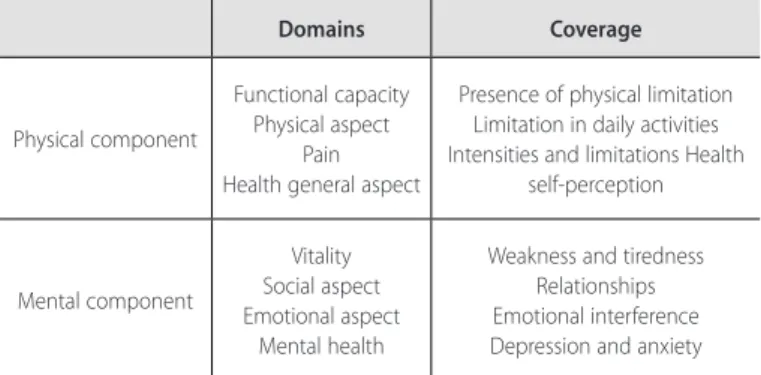
The questionnaire is composed of 36 questions which approach eight domains in two great components: the physical component which involves functional capacity (FC), pain, general health status (GHS) and physical aspect (PA). The mental component includes mental health (MH), emotional aspect (EA), social aspect (SA) and vitality (V), which is evaluated by 35 questions (table 1). The aim of the questions was to change subjective measurements into objec-tive data which would enable a specific, global and reproducible analysis. The score of each domain ranges between 0 and 100, where 0 corresponds to the worst general health status and 100 to the best health status.
The MINICHAL questionnaire has its original version in Spanish and is an adaptation by Badiaet al.3 from the Cuestionario de
Cali-dad de Vida emHipertensión Arterial (CHAL) instrument, designed by the same group of authors. Once adapted, the MINICHAL was translated and validated to Portuguese by Schulz et al.16.
The MINICHAL contains 16 multiple choice questions orga-nized in two domains: mental status (10 questions) and somatic manifestations (six questions). However, there is a question which evaluates the general health perception of the patient, totalizing 17 questions. The responses of the domains have four options, in a scale ranging from0 (No, absolutely) and 3 (Yes, very much). Thus, the closer to 0 the result is, considering the set of questions, the better quality of life.
Both questionnaires were applied as an interview,a procedure to make the conduct more uniform, due to the educational back-ground variability of the patients.The interviews were conducted before and after the RT program.All the interviews were interper-sonally performed by the same researcher.
Table 1. SF36 domains and its respective coverage.
Domains Coverage
Physical component
Functional capacity Physical aspect
Pain Health general aspect
Presence of physical limitation Limitation in daily activities Intensities and limitations Health
self-perception
Mental component
Vitality Social aspect Emotional aspect
Mental health
28 Rev Bras Med Esporte – Vol. 18, No 1 – Jan/Fev, 2012
All patients made use of anti-hypertensivemedication for control of this disease, being the most common: diuretics (62.5%) andan-giotensin converting enzyme inhibitor (ACE) (31.2%). It is important to remember that a medication association was commonly used to obtain a better clinical response. Nevertheless, in any of the cases the initial medication was altered during the entire period of the RT program.
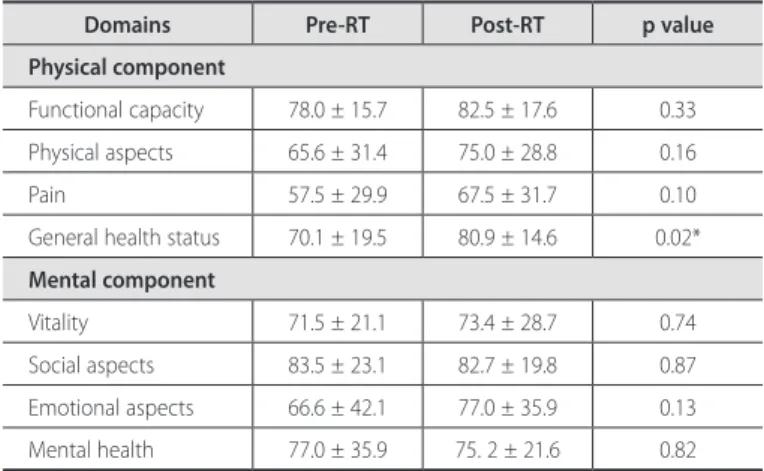
Concerning the topics analyzed in the SF-36 questionnaire, increase in the mean value of almost all variables assessed was observed, except for the social aspects and mental health domains. However, there was significant difference concerning the general health status (p= 0.02) (table 3).
In the MINICHAL questionnaire significant difference was not observed in the analyzed domains (p = 0.28), although it had pre-sented reduction of mean value of all evaluated topics (table 4).
STATISTICAL ANALYSIS
The data were analyzed by the statistical software Statistical Packa-ge for Social Science version 17.0 (SPSS Inc., Chicago, IL, USA). The des-criptive analysis was presented in mean and standard deviation (SD).
The normality test for the studied variables presented normal data distribution by the Kolmogorov-Smirnov test, which allo-wed that a parametric test could be used for the data. Thus, the MINICHAL analysis as well as of all the variables present in the SF-36 in pre and post-RT comparison was assessed through the Student’s t test paired for dependent samples. The significance level for the test was5%, with confidence interval (CI) of 95% for all analyses.
RESULTS
Between June, 2009 and March, 2010, 32 patients with HBP di-agnosis and who presented illegibility criteria for our study were evaluated. However, there was a loss of 16 patients, by the follow-ing reasons: six patients were excluded after ergometric evaluation and 10 patients gave up participating for personal reasons, among which cataract surgery, unviability to arrive at the training site and family matters. Therefore, our sample was composed of 16 patients. During the ET performance no arrhythmias or any symptoms which could hamper the resistance training protocol performance were observed.
The clinical and sociodemographic characteristics of the patients are summarized in table 2. Age mean of the patients submitted to the RT was 68.7 ± 7.2 years. The sample occupations ranged within some activities. Such as: domestic tasks (housekeeping); retirement associated with domestic tasks and work with income associated with domestic asks, each one with two (12.5%), 11 (68.7%) and three (18.7%) patients, respectively.
Table 2. General characteristics of the studied population.
Age (years) 68,7 ± 7,2
Weight (Kg) 63,4 ± 12,5
Height (m) 1,55 ± 0,09
BMI (kg/m2) 26,4 ± 4,4
Hemodynamic variables (rest) hypertension controlled by anti-hypertensive medication
SBP (mmHg) 130,2 ± 12,8
DBP (mmHg) 70,4 ± 10,2
HR (bpm) 75,6 ± 8,9
Comorbidities
Diabetes mellitus 3 (18,7%)
Hypercholesterolemia 9 (56,2%)
Osteoporosis 4 (25%)
Arthritis 4 (25%)
Obesity 3 (18,7%)
Denial 2 (12,5%)
Medication in use
Betablocker 3 (18,7%)
ACE inhibitor 5 (31,2%)
Diuretics 10 (62,5)
Calcium channel blocker 2 (12,5%)
BMI – Body mass index; ACE – angiotensin converting enzyme.
Table 3. Mean, standard deviation and p values of the punctuations obtained for each domain of the SF-36 generic questionnaire of health-related quality of life in 16 patients with diagnosis of high blood pressure.
Domains Pre-RT Post-RT p value
Physical component
Functional capacity 78.0 ± 15.7 82.5 ± 17.6 0.33 Physical aspects 65.6 ± 31.4 75.0 ± 28.8 0.16
Pain 57.5 ± 29.9 67.5 ± 31.7 0.10
General health status 70.1 ± 19.5 80.9 ± 14.6 0.02*
Mental component
Vitality 71.5 ± 21.1 73.4 ± 28.7 0.74
Social aspects 83.5 ± 23.1 82.7 ± 19.8 0.87
Emotional aspects 66.6 ± 42.1 77.0 ± 35.9 0.13 Mental health 77.0 ± 35.9 75. 2 ± 21.6 0.82
RT – resistance training, *p < 0.05.
Table 4. Means, standard deviation and p values of the punctuations obtained for each domain of the MINICHAL specific questionnaire of health-related quality of life in 16 patients with diagnosis of high blood pressure.
Domains Pre-RT Post-RT p value
Mental status 4.6 ± 3 4.0 ± 3.6 0.438
Somatic manifestations 3.8 ± 3.1 2.9 ± 2.5 0.130
Total 8.2 ± 5.3 7.0 ± 5.5 0.282
RT – resistance training.
DISCUSSION
Quality of life is a subjective term, which suffers influence from countless factors which can be intrinsic from the daily routine of each individual or intrinsic to the human beings. The health-related quality of life concept tries to limit these factors to those more connected to physical, psychological and social conditions of each individual17. In this context, many investigations have shown
de-crease in quality of life of hypertensive individuals when compared to normotensive ones18-20. However, this issue still presents some
29
Rev Bras Med Esporte – Vol. 18, No 1 – Jan/Fev, 2012
such as the MINICHAL, despite being less used, have as advantage greater sensibility to clinical alterations16.
In this study, the application of the SF-36 questionnaire eviden-ced significant difference in the mean value of the general health status domain. Nevertheless, almost all domains presented increase in their mean values after the RT program, except for the social aspects and mental health domains. Our sample presented mean relatively high of all domains, presenting good QOL even before the RT. Some authors when assessing QOL in hypertensive patients inserted in a RT program have not presented alterations in any of the QOL domains assessed by the SF-36 questionnaire. According to these authors, the fact is justified by the lack of comorbidities related to the HBP, as well as alterations in general wellness of the patients from those samples7,21,22.
Corroborating these findings, another study, when assessing the effect of physical exercise in the elderly population, stated that resistance training is positively correlated with many quality of life domains, but not with all of them23. Research in this context has
shown that physical exercise is associated with improvement in self--efficiency; that is, in the personal ability in successfully performing tasks or presenting behavior for the production of the expected results; increase in QOL is very likely to occur24.
Concerning the QOL scores presented through the application of the specific questionnaire MINICHAL, no significant alterations have been observed. Nonetheless, in both pre and post-RT phases of the evaluation the scores were very low (8.2 ± 5.3 versus 7.0 ± 5.5, respectively), suggesting that the studied population already had
good quality of life, since the means of the MINICHAL scores were very below the half of the maximum punctuation which could be obtained in that questionnaire. This situation can be justified by the minimum impact of hypertension on QOL, being that disease asymp-tomatic and being expressed only with long-term complications 25.
In a prospective study developed in eight countries which eva-luate QOL in chronic diseases, it was observed that hypertensive patients presented the best quality of life indices, close to those obtained by the control group, when compared with the other chronic diseases, such as arthritis, pulmonary diseases, diabetes, congestive cardiac failure and ischemic cardiac diseases25.
The participation of the studied sample in a program of support to HBP patients in which they receive guidance on their disease and engage in social programs, among other activities, can also be another factor which has influenced on the satisfactory quality of life of the women participating in this study. Therefore, further investigation including hypertensive individuals not engaged in programs of this nature should be developed.
CONCLUSION
Our data suggest that RT was efficient in the GH domain from the SF-36. On the other hand, alterations in QOL of the elderly women when assessed with the specific questionnaire MINICHAL have not been found.
All authors have declared there is not any potential conflict of interests concerning this article.
REFERENCES
1. Sociedade Brasileira de Cardiologia. V Diretrizes Brasileiras de Hipertensão Arterial. Arq Bras Cardiol 2007;89:e24-e79.
2. Cornelissen VA, Fagard RH. Effect of resistance training on resting blood pressure: a meta analysis of randomized controlled trials. J Hypertens 2005;23:251-9.
3. McCartney N, Hicks AL, Martin J, Webber CE. Long-term resistance training in the elderly: effects on dynamic strength, exercise capacity, muscle and bone. J Gerontol 1995;50:97-104.
4. Fagard RH, Cornelissen VA. Effect of exercise on blood pressure control in hypertensive patients. Eur J Cardiovasc Prev Rehabil 2007;14:12-7.
5. Nelson ME, Rejeski WJ, Blair SN, Duncan PW, Judge JO, King AC, et al. Physical activity and public health in older adults: recommendation from the American College of Sports Medicine and the American Heart Association. Circulation 2007;116:1094-105.
6. Terra DF, Mota MR, Rabelo HT, Bezerra LMA, Lima RM, Ribeiro AG, et al. Redução da Pressão Arterial e do Duplo Produto de Repouso após Treinamento Resistido em Idosas Hipertensas. Arq Bras Cardiol 2008;91:299-305.
7. Chodzko-Zajko WJ, Proctor DN, Fiatarone Singh MA, Minson CT, Nigg CR, Salem GJ, et al. American College of Sports Medicine position stand. Exercise and physical activity for older adults. Med Sci Sports Exerc 2009;41:1510-30.
8. Bardage C, Isacson DGL. Hypertension and health-related quality of life: an epidemiological studyin Sweden. J Clin Epidemiol 2001;54:172-81.
9. Arslantas D, Ayranci U, Unsal A, Tozun M. Prevalence of hypertension among individuals aged 50 yearsand over and its impact on health related quality of life in a semi-rural area of western Turkey. Chin Med J 2008;121:1524-31.
10. Roca-Cusachsa À, Badia X, Dalfód A, Gascóne G, Abellánf J, Lahozc R, et al. Relación entre variables clínicas y terapêuticas y calidad de vida relacionada con la salud en pacientes con hipertensión arterial. Estudio MINICHAL. Med Clin (Barc) 2003;121:12-7.
11. Development of the World Health Organization WHOQOL-BREF quality of life assessment. The WHO-QOL Group Psychol Med 1998;28:551-8.
12. Badia X, Roca-Cusachs A, Dalfó A, Gascón G, Abellán J, Lahoz R, et al. Validation of the short form of the Spanish hypertension Quality of Life Questionnaire (MINICHAL). Clin Ther 2002;24:2137-54.
13. Sociedade Brasileira de Cardiologia. II Diretrizes da Sociedade Brasileira de Cardiologia Sobre Teste Ergométrico. Arq Bras Cardiol 2002;78(supl II):1-18.
14. Bird SP, Tarpenning KM, Marino FE. Designing Resistance Training Programmes to Enhance Muscular Fitness. A Review of the Acute Programme Variables. Sports Med 2005;35:841-51.
15. Fleck SJ. Periodized Strength Training: A Critical Review. J Strength Cond Res 1999;13:82-9. 16. Cavalcante MA, Bombig MTN, Luna Filho B, Carvalho ACC, Paola AAV, Póvoa R. Qualidade de Vida de
Pacientes Hipertensos em Tratamento Ambulatorial. Arq Bras Cardiol 2007;89:245-50.
17. Schulz RB, Rossignoli P, Correr CJ, Fernández-Llimós F, Toni PM. Validação do Mini-Questionário de Qualidade de Vida em Hipertensão Arterial (MINICHAL) para o Português (Brasil). Arq Bras Cardiol 2008;90:139-44.
18. Roca-Cusachs A, Dalfó A, Badia X, Arístegui I, Roset M. Relation between clinical and therapeutic variables and quality of life in hypertension. J Hypertens 2001;19:1913-9.
19. Li w, Liu L, Puente JG, Li Y, Jiang X, Jin S, et al. Hypertension and health-related quality of life: an epidemiological study in patients attending hospital clinics in China. J Hypertens 2005;23:1667-76. 20. Wang R, Zhao Y, He X, Ma X, Yan X, Sun Y, et al. Impact of hypertension on health-related quality of
life in a population-based study in Shanghai, China. Public Health 2009;123:534-9.
21. Fletcher AE, Chester PC, Hawkins CMA, Latham AN, Pike LA, Bulpitt CJ. The effects of verapamil and propranolol on quality of life in hypertension. J Hum Hypertens 1989;3:125-30.
22. Gusmão JL, Mion Jr D, Pierin AMG. Health-related quality of life and blood pressure control in hyper-tensive patients with and without complications. Clinics 2009;64:619-28.
23. Rejeski WJ, Mihalko SL. Physical activity and quality of life in older adults. J Gerontol A Biol Sci Med Sci 2001;56:23-35.
24. McAuley E, Katula J. Physical activity interventions in the elderly: influence on physical health and psychological function. In: Schulz MPLR, Maddox G, editors. Annual Review of Gerontology and Geriatrics. New York (NY): Springer Publishing, 1998. p. 115-54.