51
EXPERIMENTAL INFECTION WITH
TRYPANOSOMA
CRUZI
IN MICE: INFLUENCE OF EXERCISE
VERSUS
STRAINS AND SEXES
Roberta Cristhiany Occhi Soares1
Cristiano Schebeleski Soares2
Solange Marta Franzói-de-Moraes3
Márcia Regina Batista4
Heloisa Nakai Kwabara4
André Morelli Rodrigues de Sousa5
Neide Martins Moreira1
Mônica Lúcia Gomes6
Silvana Marques de Araújo6
1. Post-Graduation Program in Health Sciences – State University ofMaringá, PR, Brazil.
2. Physical Education Department– University Center of Maringá, PR, Brazil. 3. Physiological Sciences
Department– State University of Maringá, PR, Brazil.
4. Clinical Analyses Department– State University of Maringá, PR, Brazil. 5. Dentistry Department – State University of Maringá, PR, Brazil. 6. Health Basic Sciences Department– State University of Maringá, PR, Brazil.
Mailing address:
Departamento de Ciências Básicas da Saúde, Bloco I-90 – Universidade Estadual de Maringá
Av. Colombo, 5.790, Jd. Universitário – 87020-900 – Maringá, PR, Brasil E-mail: [email protected]
ABSTRACT
Background: Chagas disease is an infection caused by Trypanosoma cruzi that affects eight million people in Latin America. One factor linked to the lifestyle that significantly interferes in the response to infection is physical exercise, depending on the kind, intensity and frequency of the activity practiced. Objective: To evaluate the influence of pre-infection chronic moderate aerobic exercise in the development of experimental infection with T. cruzi in mice of two distinct lineages from both sexes. Methods: 30-day old Swiss and BALB/c mice (male and female) were divided into four groups for each strain and sex (total 16) and named as follows: SM (Swiss males), SF (Swiss females) BM (BALB/c mice) and BF (BALB/c mice). The groups were: NT NI (untrained uninfected) T NI (trained not infected); NT I (untrained infected), TI (trained infected). The aerobic exercise pre-moderate chronic infection training was performed with one daily session for eight weeks, five times a week. The inoculum was 1,400 blood trypomastigotes of Y strain of T. cruziintraperitoneally. The peak of parasites, parasitemia total and average measurements of the serum activities of CK and CK-MB were evaluated. Results and Conclusions: The physical training promoted reduction in peak, parasitemia parasites and total average in animals infected with T. cruzi in both strains and sexes. Physical training induced reduction in serum activities of CK and CK-MB in animals infected with T. cruzi of both sexes and from the two strains, except for females in the Swiss CK activity.
Keywords: physical training, Trypanosoma cruzi, creatine kinase (CK), creatine kinase-MB (CK-MB), parasite
EXERCISE AND SPORTS SCIENCES
ORIGINAL ARTICLE
INTRODUCTION
Chagas disease is an infection caused by Trypanosoma cruzi whi-ch affects eight million people in Latin America1. A factor linked to
the lifestyle that significantly interferes in the response to infection is physical exercise, depending on the kind, intensity and frequency of the activity practiced2,3.
The literature has referred that one or few exercise sessions, performed at moderate intensity, either extenuating or long du-ration, inhibit type 1 T helper lymphocytes (Th1), of inflammatory character and stimulate type 2 T helper lymphocytes (Th2), of anti-inflammatory character4. The difference between exercise
per-formance intensity is in the fact that moderate physical exercise, even during infection, may not alterorimprove the immunologi-cal response of the host, both in viral infections5 and in parasitic
infections3,6, while extenuating exercise promotes higher risk for
the development of infections7and worsens the immunological
response of the host8.
A recent study using a physical training program with mo-derate intensity for BALB/c mice concluded that chronic exer-cise is able to improve the body’s response to infection by the
Trypanosoma cruzi, significantly decreasing the parasite peak and increasing survival3.
The difference of response between sexes is another factor which affects the correlation between exercise and infection. In the ma-jority of studies with parasitic diseases, including with the T. cruzi, the female sexual hormones seem to be directly related to better response ofthe body to infection, while the male sexual hormones seem to be associated with increase of susceptability9. In rodents,
ovariectomy was related to lower resistance of females to infection by the T. cruzi10, while orchiectomy was related to improvement of
the male response to infection11,12. In the infections by virus estrogen
presents reduction of the pro-inflammatory response activity and the anti-inflammatory response stimulation which is related to better response to infection13.
Creatine phosphokinase (CPK) is a great protein found in two or more presentations. These ways – dimericisoenzymes–are cons-tituted by two distinct polypeptidic subunits, M and B. Three CPK isoenzymes are naturally found in human tissues: CK-MM (skeletal muscle), CK-MB (cardiac muscle) and CK-BB (brain)14,15.
52
are the most widely used enzymes as markers in the diagnosis of myocardial and skeletal muscle injury16.
In the experimental infection by T. cruzi a positive correlation between the plasma levels of CK-MB and the inflammatory infiltrates and a non-correlation of this enzyme with the parasite nests was observed. Such information suggests that the myocardial injury oc-cur due to the inflammatory response and not the straight effect of the T. cruzi and that the measurement of the CK-MB activity may be used as a marker of cardiac injury17.
There are no references in the literature about evaluation of correlation of CK and CK-MB activity, T. cruzi, physical exercise, and sex and strain differences in mice or rats. The information obtained is found in works comparing only two out of the three variables, and in some cases, using another kind of intervention and/or treatment.
The study of the aerobic physical exercise in the evolution of the experimental infection by T. cruzi related to sex, CK and CK--MB activity and genetics of the host presents countless interesting points which can be elucidated, bringing new information both concerning the exercise per se as new alternatives for the treatment and quality of life of patients infected by the T. cruzi.
Thus, the aim of this investigation was to evaluate the in-fluence of moderate physical exercise in the evolution of the experimental infection by the T. cruzi in male and female mice from two distinct strains.
MATERIAL AND METHODS
The study was approved by the Ethics Behavior in the Use of Animals in Experiments Committee (CEAE/UEM) under the legal resolution 076/2008.
Animals
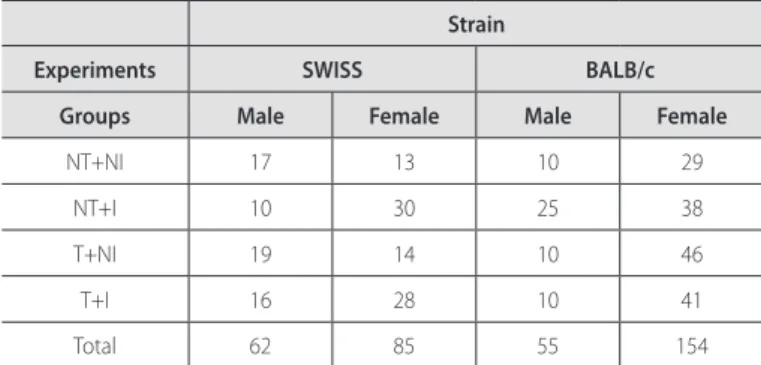
Mice from the Swissand BALB/c strains (male and female), with approximately 30 days of life were used. Four groups for each strain and sex (total of 16) were sorted for the experiments: NT+NI (not trained +not infected), T+NI (trained + not infected), NT+I (not trai-ned + infected) and T+I (traitrai-ned + infected) (table 1).
The animals were placed in polypropylene boxes (414 x 344 x 168mm) covered with zinc fencing with a central depression for placement of food and a bottle of water. The boxes were kept in a climatized animal facility (temperature between 22 and 24º C) with light/dark cycle of 12 hours, with wood shaving and cleaned three times per week, with water (chloride) and food (Nuvilab Cr-1®
by Nuvital®
) ad libitum.
Table 1. Total number of animals used in the experiments with mice from the Swiss and BALB/c strains (male and female), submitted or not to eight weeks of chronic moderate aerobic physical exercise pre-infection and infected or not with the Ystock of T. cruzi.
Strain
Experiments SWISS BALB/c
Groups Male Female Male Female
NT+NI 17 13 10 29
NT+I 10 30 25 38
T+NI 19 14 10 46
T+I 16 28 10 41
Total 62 85 55 154
In order to evaluate the infection evolution, 50% of the animals were sacrificed on the eighth day of infection and the other half was kept alive for follow-up of parasitemia.
Physicalexerciseprotocol
The animals were submitted to chronic moderate aerobic phy-sical exercise pre-infection on treadmill (Inbrasport®
model Classic CI®
) with an adapter for small animals training and with a system which enabled the programing of training sessions and digital con-trol of velocity with sensitivity of two meters per minute (m/min). The physical exercise protocol used corresponds to a moderate exertion3,18. Shock or other similar mechanisms have not been used
to induce the animals to exercise. An initial period of week of trai-ning was considered for exclusion of the animals considered inapt for physical exercise.
The physical exercise program was conducted during eight weeks, being composed of a daily training session, five times per week, with duration of 30 to 45 minutes with velocity of six to 14m/min on the first week, 45 to 60 minutes and velocity of eight to 16m/min on the second week and 60 minutes with velocity of 10 to 20m/min on the remaining ones (mean velocity of 13m/min on the first four weeks and of 17.5m/min on the four last ones).
Infection
The inoculum used was of 1,400 blood trypomastigotes units from the Y stock from the T. cruzi19, intraperitoneally.The animals
were infected three days after the end of the pre-infection chronic physical exercise program.
Parasitemia curve
The parasitemia was evaluated using the Brener technique20
col-lecting 5µL of blood from the tail and examining 50 fields between the mounting and the slide (22mm x 22mm), daily, from the fourth to the 11th day of infection. The parasitemia curve was traced using the mean
of the parasites counting of the inoculated animals for each group.
Collection of biological material
On the eighth day of infection, 50% of the animals were sac-rificed through deepening of inhaling anesthesia with ethyl ether (ethoxyethane). Subsequently, cardiac punction was performed for blood collection though a heparinized syringe for collection of about 1mL for BALB/c mice and 2mL for Swiss mice. The blood was kept in ice bath in assay tubes (hemolysis type) until being centrifuged at 2,000 RPM, the supernatant was removed and cen-trifuged at 4,000 RPM in a centrifuge refrigerated at 4ºC and then divided in 85μL aliquots in Eppendorf tubes, being frozen at –70ºC for evaluation of the CK and CK-MB serum activities.
Determination of the CK and CK-MB serum activities
53 STATISTICS ANALYSIS
The statistics comparisons were performed through the Assistat program version 7.5 (made available by the Federal University of Campina Grande, Brazil), using variance analysis (ANOVA), followed by Tukey test (for results which presented normality), Mann-Whitney test (U test) (for parasitemia results which did not present normality), Kruskal-Wallis test (for the remaining results which did not present normality), and also the Microsoft Excel program, version 2007 (Mi-crosoft). The data were expressed as mean ± standard deviation, being adopted significance level of 10%.
RESULTS
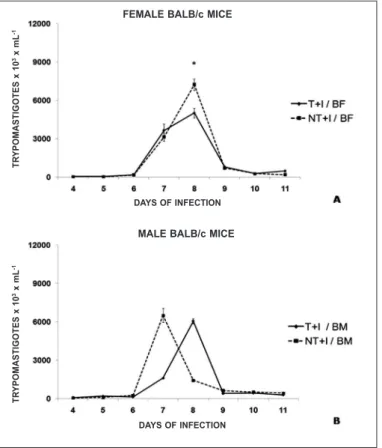
Both in the Swiss and BALB/c strains, for both sexes, the trained and infected groups (T+I) presented parasite peak lower than their respective controls (NT+I). The difference was significant for male Swissand female BALB/c mice (figures 1 and 2).
It can be seen in figures 3 and 4 that the parasite peak was statistically higher in male BALB/c animals from the trained and infected group (T+I) than in Swiss animals of the same sex (p< 0.10). Concerning the female comparison, the parasite peak was higher in Swiss animals (SF and BF/T+I) (p < 0.05). Swiss females (SF) trained and infected (T+I) presented higher parasite peak than males from the same strain and group (SM/T+I)(p < 0.05).
The mean total parasitemia was statistically lower for Swiss mice of both sexes from the trained and infected group (T+I) (table 2).
Regarding the male not trained and infected animals (NT+I), mean total parasitemia was higher for the Swiss strain (p < 0.10).
Figure 2. Parasitemia curve (mean ± standard deviation) demonstrating the parasite peak observed in Swiss mice (male and female), submitted or not to eight weeks of pre-infection chronic moderate aerobic physical exercise and infected with Y stock
of the T. cruzi. Comparison performed between the groups NT+I and T+I, isolatedly,
for each strain and sex. NT+I, not trained+infected; T+I, trained+infected. A) SF, Swiss female mice B) SM, Swiss male mice. * = p < 0.05.
Figure 1. Parasitemia curve (mean ± standard deviation) demonstrating the parasite peak observed in BALB/c mice (male and female), submitted or not to eight weeks of pre-infection chronic aerobic physical exercise and infected with Y stock of the do T. cruzi. Comparison performed between the groups NT+I and T+I, isolatedly, for each strain and sex. NT+I, not trained+infected; T+I, trained+infected. A) BF, female BALB/c mice. B) BM, male BALB/c mice. * = p < 0.05.
Figure 3. Parasite peak (mean ± standard deviation) observed in Swiss and BALB/c mice (male and female), submitted or not to eight weeks of pre-infection
chro-nic aerobic physical exercise and infected with Y stock of the T. cruzi. NT+I, not
trained+infected; T+I, trained+infected. SM – male Swiss; SF – female Swiss; BM – male BALB/c; BF – female BALB/c.A and B) Comparison between strains (Swiss and BALB/c) of mice of same sex.* = p < 0.05; † = p < 0.10.
FEMALE BALB/c MICE
T
R
YPO
MA
ST
IG
O
T
ES
x
1
0
3 x
m
L
-1
DAYS OF INFECTION
DAYS OF INFECTION
T
R
YPO
MA
ST
IG
O
T
ES
x
1
0
3 x
m
L
-1
MALE BALB/c MICE
FEMALE SWISS MICE
T
R
YPO
MA
ST
IG
O
T
ES
x
1
0
3 x
m
L
-1
DAYS OF INFECTION
DAYS OF INFECTION
T
R
YPO
MA
ST
IG
O
T
ES
x
1
0
3 x
m
L
-1
MALE SWISS MICE
PARASITE PEAK
STRAIN COMPARISON
T
R
YPO
MA
ST
IG
O
T
ES
x
1
0
6 x
m
L
-1
PARASITE PEAK
STRAIN COMPARISON
T
R
YPO
MA
ST
IG
O
T
ES
x
1
0
6 x
m
L
54
Among female mice, mean total was also statistically higher for the Swiss strain of the not trained and infected group (SF/NT+I – p< 0.05). Concerning the trained an infected groups (SF and BF/ T+I), parasitemiawas higher for the BALB/c strain (p< 0.05) (figure 5).
In the trained and infected animals (T+I), the comparison be-tween sexes presented higher mean total parasitemia only for male Swiss mice (SM) (p< 0.05) (figure 6).
The physical training promoted statistical reduction in the CK and CK-MB serum activities for the two strains in both sexes, except for female Swiss mice in the CK and CK-MB activity (table 3).
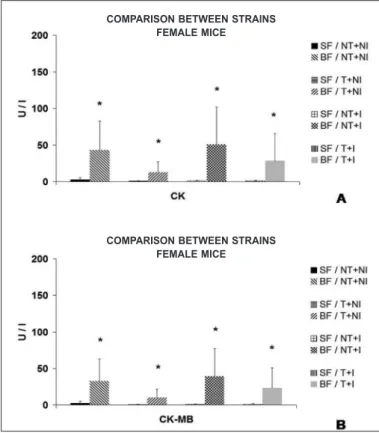
Swiss female mice presented statistically lower CK and CK-MB activity levels in all groups (figure 7).
Figure 4. Parasite peak (mean ± standard deviation) observed in Swiss and BALB/c mice (male and female), submitted or not to eight weeks of pre-infection
chro-nic aerobic physical exercise and infected with Y stock of the T. cruzi. NT+I, not
trained+infected; T+I, trained+infected. SM – male Swiss; SF – female Swiss; BM – male BALB/c; BF – female BALB/c. A and B) Comparison between sexes (male and female) fromthe same strain. * = p < 0.05.
Table 2. Mean total parasitemia (mean ± standard deviation) observed in mice from the Swiss ans BALB/c strains (male and female), submitted or not to eight weeks of chronic moderate aerobic physical exercise pre-infection and infected with the Y stock of T. cruzi.
NT+I T+I p
Mean total parasitemia (trypomastigotes x 106 x mL-1)
SM 16.9 ± 9.6 9.4 ± 4.6 < 0.05
SF 19.7 ± 6.1 6.0 ± 5.5 < 0.05
BM 9.9 ± 7.3 9.2 ± 1.5 NS
BF 11.7 ± 3.9 10.4 ± 5.8 NS
SM – Swiss male; SF – Swiss female; BM – BALB/c male; BF – BALB/c female. NT+I – non-trained + infected; T+I – trained+infected. Comparison performed between groups NT+I and T+I, isolatedly, for each strain and sex. NS = not significant.
Figure 5. Mean total parasitemia (mean ± standard deviation) observed in Swiss and BALB/c mice (male and female), submitted or not to eight weeks of pre-infection
chronic aerobic physical exercise and infected with Y stock of the T. cruzi. NT+I, not
trained+infected; T+I, trained+infected. SM – male Swiss; SF – female Swiss; BM – male BALB/c; BF – female BALB/c.A and B) Comparison between strains (Swiss and BALB/c) of mice of the same sex.* = p < 0.05; † = p < 0.10.
Figura 6. Mean total parasitemia (mean ± standard deviation) observed in Swiss and BALB/c mice (male and female), submitted or not to eight weeks of pre-infection chronic aerobic physical exercise and infected with Y stock of the T. cruzi. NT+I, not trained+infected; T+I, trained+infected. SM – male Swiss; SF – female Swiss; BM – male BALB/c; BF – female BALB/c;.A and B) Comparison between the two sexes (male and female) from the same strain.* = p < 0.05.
PARASITE PEAK SEX COMPARISON
T
R
YPO
MA
ST
IG
O
T
ES
x
1
0
6 x
m
L
-1
PARASITE PEAK SEX COMPARISON
T
R
YPO
MA
ST
IG
O
T
ES
x
1
0
6 x
m
L
-1
MEAN TOTAL PARASITEMIA
STRAIN COMPARISON
MEAN TOTAL PARASITEMIA STRAIN COMPARISON
T
R
YPO
MA
ST
IG
O
T
ES
x
1
0
6 x
m
L
-1
T
R
YPO
MA
ST
IG
O
T
ES
x
1
0
6 x
m
L
-1
MEAN TOTAL PARASITEMIA COMPARISON BETWEEN SEXES
T
R
YPO
MA
ST
IG
O
T
ES
x
1
0
6 x
m
L
-1
MEAN TOTAL PARASITEMIA COMPARISON BETWEEN SEXES
T
R
YPO
MA
ST
IG
O
T
ES
x
1
0
6 x
m
L
55 Table 3. CK and CK-MB serum activities (mean ± standard deviation) observed in
Swiss and BALB/c mice (male and female), submitted or not to eight weeks of pre--infection chronic moderate aerobic physical exercise, and infected or not with Y stock of the T. cruzi.
NT+NI T+NI NT+I T+I p
CK (U/l)
SM 1.9 ± 0.5 1.2 ± 0.4 62.0 ± 54 2.2 ± 1.2 < 0.01
SF 2.5 ± 2.8 0.8 ± 0.5 1.2 ± 0.5 1.5 ± 0.3 N.S.
BM 53.1 ± 75.2 1.9 ± 2.4 97.4 ± 85 0.1 ± 0.0 < 0.01
BF 42.9 ± 40.0 12.5 ± 14.6 50.8 ± 51.2 28.6 ± 36.9 < 0.01
CK-MB (U/l)
SM 0.9 ± 0.7 0.7 ± 0.4 32.4 ± 28.5 1.3 ± 0.8 < 0.01
SF 2.1 ± 2.8 0.4 ± 0.3 0.8 ± 0.4 1.1 ± 0.5 < 0.05
BM 44.5 ± 63.5 1.3 ± 1.8 73.3 ± 65.9 0.0 ± 0.0 < 0.01
BF 32.7 ± 30.5 10.0 ± 11.6 38.8 ± 38.3 23.0 ± 27.9 < 0.01
SM – Swiss male; SF – Swiss female; BM – BALB/c male; BF – BALB/c female. NT+NI – not-trained + not-infected; T + NI - trained + non-infected; NT + I - non-trained + infected; T + I - trained + infected. Comparison performed between non-trained and trained isoladetly for each strain and sex. N.S. = non-significant.
Figure 7. CK and CK-MB serum activities (mean ± standard deviation) observed in Swiss and BALB/c mice, submitted or not to eight weeks of pre-infection chronic moderate aerobic physical exercise and infected or not with Y stock of the T. cruzi. BF – female BALB/c; SF – female Swiss. NT+NI – nor trained+not infected T+NI – trained+notinfected; NT+I – not trained+infected T+I – trained+infected. A) Com-parison between strains (Swiss and BALB/c) of the CK serum activity of female mice. B) Comparison between strains (Swiss and BALB/c) of the CK-MB serum activity of female mice. * = p < 0.05.
Figure 8. CK and CK-MB serum activity (mean ± standard deviation) observed in Swiss and BALB/c mice submitted or not to eight weeks of pre-infection chronic
moderate aerobic physical exercise, and infected or not with Y stock of the T. cruzi.
BM – male BALB/c; SM – male Swiss. NT+NI – not trained +not infected; T+NI – trained+not infected; NT+I – not trained+infected; T+I – trained+infected. A) Com-parison between strains (Swiss and BALB/c) of the CK serum activity of male mice. B) Comparison between strains (Swiss and BALB/c) of the CK-MB serum activity of male mice. * = p < 0.05; † = p < 0.10.
Male BALB/c animals (BM) trained and infected (T+I) presented significantly lower CK and CK-MB serum activity than male Swiss mice (SM) from the same group (figure 8).
In the BALB/c strain, female not trained and infected (NT+I) mice showed significantly lower CK and CK-MB activity levels than the male from the same group (figure 9).
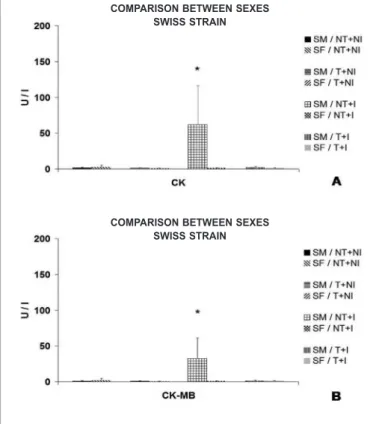
Female Swiss mice, not trained and infected (NT+I), presented significantly lower CK and CK-MB activity levels than the male Swiss mice from the same group (figure 10).
Figure 9. CK and CK-MB serum activities (mean ± standard deviation) observed in BALB/c mice (male and female), submitted or not to eight weeks of pre-infection
chronic moderate physical exercise, and infected or not with Y stock with the T.
cruzi. BM – male BALB/c; BF – female BALB/c. NT+NI – not trained+not infected; T+NI – trained+not infected; NT+I – not trained+infected; T+I – trained+infected. A) Comparison between sexes, of the CK serum activity of BALB/c mice. B) Comparison between sexes of the CK-MB serum activity of BALB/c mice. * = p < 0.05. COMPARISON BETWEEN STRAINS
FEMALE MICE
COMPARISON BETWEEN STRAINS FEMALE MICE
COMPARISON BETWEEN STRAINS
MALE MICE
COMPARISON BETWEEN STRAINS MALE MICE
COMPARISON BETWEEN SEXES
BALB/c STRAIN
COMPARISON BETWEEN SEXES
56
DISCUSSION
This study evaluated the influence of an aerobic physical training program performed on treadmill for eight weeks before the infec-tion in both sexes of two mice strains, being one strain isogenic (BALB/c mice) and the other non-isogenic (Swiss mice).
The comparison between sexes in the two strains demonstrated that physical training reduces the parasitic load for male and female mice in both strains.In studies evaluating parasitic diseases, including by the T. cruzi, positive correlations have been observed in the body response to infection for the female animals9-12.
However, for this study, females submitted or not to the physical training did not present lower parasitic load when compared to the male mice.
The studies which assess the correlation between physical exercise and infection by the T. cruzi have pointed out that aerobic physical training performed before the infection may interfere on the response of the host to the parasite; however, the manner and the extent the such alterations will interfere in the infection course are not well ex-plained yet3,21. The data obtained for parasitemia present significant
differences and tendency observed in other studies recently carried out3, in which the animals which are submitted to physical training
and then to infection respond better to the infectious agent. Sex22,
age23 and genetic constitution of the host can influence the infection
course by the T. cruzi in vertebrates24.
The genetic response of each strain and sex present interesting points to be elucidated in further research approaching the immu-negenetics involved in defense mechanisms of the animals.
Figure 10. CK and CK-MB serum activity (mean ± standard deviation) observed in Swiss mice (male and female), submitted or not to eight weeks of pre-infection chronic moderate aerobic physical exercise, and infected or not with Y stock of the T. cruzi. SM – male Swiss; SF – female Swiss. NT+NI – not trained+not infected; T+NI – trained+not infected; NT+I – not trained+infected; T+I – trained+infected. A) Comparison between sexes, of the CK serum activity of Swiss mice. B) Comparison between sexes of the CK-MB serum activity of Swiss mice. * = p < 0.05.
The great individual variation in the CK and CK-MB serum ac-tivity levels observed in this work is a point to be cleared. It is worth highlighting that methodological problems should not be considered, since all recommendations in the instructions of the enzyme kits were followed and the temperature range of the serum storage used was respected.
The high level of the CK and CK-MB activities for the not trained and infected groups of mice and decrease of activity of these enzymes for the trained and infected groups, for both strains, except for female Swiss ones, shows that the infection interferes in the circulating levels of these enzymes and that physical training provides decrease in their activity levels. This phenomenon could be explained by an adaptation of the body of animals submitted to training in purifying the enzyme in the blood25.
Newhamet al.26 suggested three explanations for the
adapta-tion effect of training: an alteraadapta-tion in the recruiting pattern of mus-cle fibers, which, as the exercise sessions pass by, would preserve damaged muscle fibers; muscle fiber adaptation, making it more resistant to stress caused by exercise; and end of the growth cycle and substitution of the fibers. These explanations would answer for the result found in this study, in which the animals submitted to physical training and infection did not add to the inflamma-tion response in the tissues caused by the infectious agent and physical training, being the exercise able to have caused tissue protection effect.
The CK activity levels also presented differences when sexes were compared in humans. The female sex presents lower serum activity of this enzyme at rest compared with the male sex. This difference excessively in creases after exercising27. The same au-The same
au-thors observed this difference when compared sedentary men and women performing test on ergometric bicycle using 50% of O2 maximum. The men presented CK serum levels five times higher, from the initial value (at time zero), going from 122mU/mL to 664mU/mL, while the women obtained increase of two times the initial value (72mU/mLto 152mU/mL).
Many theories have already been proposed to explain the differences observed in the CK serum activity for the sexes. One of them discusses the variations in the recruiting of muscle fibers or the difference in muscle mass observed between men and women28,29. The role of the estrogen and its derivatives has also
been implied in the CK levels reduction in women compared to men. Estrogen seems to protect the muscle from the injury derived from exercising30. In the study under consideration, both
female Swiss and BALB/c mice, generally speaking, presented this difference compared with the male sex.
The results obtained in these experiments suggest the involve-ment of physiological alterations derived from genetics of the host and sexes. The physical training influence promoted in the two strains and in both sexes reduction in the parasite peak, in the mean total parasitemia and in the CK and CK-MB serum activities in animals infected by the T. cruzi, except for female Swiss mice in the CK and CK-MB activity.
All authors have declared there is not any potential conflict of interests concerning this article.
COMPARISON BETWEEN SEXES SWISS STRAIN
COMPARISON BETWEEN SEXES
57 REFERENCES
1. WHO (World Health Organization): New global effort to eliminate Chagas disease. Wkly Epidem Rec 2007;82(28-29):259-60.
2. Nieman D, Pedersen BK. Nutrition and exercise immunology. Boca Raton – London: CRC Press, 2000; p.191.
3. Schebeleski-Soares C, Occhi-Soares RC, Franzói-De-Moraes SM, Dalálio MMO, Almeida FN, Toledo MJO, et al. Preinfection Aerobic Treadmill Training Improves Resistance Against Trypanosoma cruzi Infection in Mice. Appl Physiol Nutr Metab 2009;34:659-65.
4. Lowder T, Padgett DA, Woods JA. Moderate exercise early after influenza virus infection reduces the Th1 inflammatory response in lungs of mice. Exerc Immunol Rev 2006;12:97-111.
5. Lowder T, Padgett DA, Woods JA. Moderate exercise protects mice from death due to influenza virus. Brain Behav Immun 2005;19:377-80.
6. Chao CC, Strgar F, Tsang M, Peterson PK. Effects of swimming exercise on the pathogenesis of acute murine Toxoplasma gondii Me49 infection. Clin Immunol Immunopathol 1992;62:220-6. 7. Gleeson M. Immune function in sport and exercise. J Appl Physiol 2007;103:693-9. 2007;
Epub Feb 15.
8. Murphy EA, Davis JM, Carmichael MD, Gangemi JD, Ghaffar A, Mayer EP. Exercise stress increases susceptibility to influenza infection. Brain Behav Immun 2008; Jun 21. [Epub ahead of print] 9. Klein SL. Hormonal and immunological mechanisms mediating sex differences in parasite infection.
Parasite Immunol 2004;26:247-64. Review.
10. do Prado JC Jr, Leal M de P, Anselmo-Franci JA, de Andrade Júniur HF, Kloetzel JK. Influence of female gonadal hormones on the parasitemia of female Calomys callosus infected with the «Y» strain of Trypanosoma cruzi. Parasitol Res 1998;84:100-5.
11. Filipin Mdel V, Brazão V, Caetano LC, Santello FH, Toldo MP, Caetano LN, et al. Trypanosoma cruzi: orchiectomy and dehydroepiandrosterone therapy in infected rats. Exp Parasitol 2008;120:249-54. Epub 2008; Jul 30.
12. Pinto AC, Caetano LC, Levy AM, Fernandes RD, Santos CD, do Prado JC Jr. Experimental Chagas’ disease in orchiectomized Calomys callosus infected with the CM strain of Trypanosoma cruzi. Exp Parasitol 2009; Aug 19. [Epub ahead of print]
13. Fish EN. The X-files in immunity: sex-based differences predispose immune responses. Nat Rev Immunol 2008;8:737-44. Review.
14. Dawson DM, Fine IH: Creatine kinase in human tissues. Arch Neural 1967;16:175-80.
15. Lang H: Creatine Kinase lsoenzymes: Pathophysiology and Clinical Application. New York, Springer--Verlag New York, Inc, 1981.
16. Schneider CM, Dennehy CA, Rodearmel SJ, Ayward JR. Effects of physical activity on creatine phosphokinase and the isoenzyme creatine kinase-MB. Ann Emerg Med 1995;25:520-4. 17. Souza AP, Olivieri BP, De Castro SL, Araújo-Jorge TC. Enzymatic markers of heart lesion in mice
infect-ed with Trypanosoma cruzi and submittinfect-ed to benznidazole chemotherapy. Parasitol Res 2000;86:800-8. 18. Lerman I, Harrison BC, Freeman K, Hewett TE, Allen DL, Robbins J, et al. Genetic Variability in
Forced and Voluntary Endurance Exercise Performance in Seven Inbred Mouse Strains. J Appl Physiol 2002;92:2245-55.
19. Silva LHP, Nussenzweig V. Sobre uma Cepa de Trypanosoma cruzi Altamente Virulenta para o Camun-dongo Branco. Fol Clin Biol 1953;20:191-207.
20. Brener, Z. Therapeutic Activity and Criterion of Cure on Mice Experimentally Infected With Trypanosoma cruzi. Rev Inst Med Trop Sao Paulo 1962;4:389-96.
21. Soares CS, Occhi RC, Carvalho LGL, Moraes SMF, Dalálio MMO, Araújo SM. Produção de fator de ne-crose tumoral-alfa e peróxido de hidrogênio na infecção pelo Trypanosoma cruzi em camundongos submetidos ao exercício - DOI: 10.4025/actascihealthsci.v32i1.6757. Acta Scientiarum. Health Science, Brasil, 32 dez. 2010.
22. Hauschka TS. Sex of host as a factor in chagas’ disease. Journal of Parasitology 1947;33:399-404. 23. Culbertson JT, Kessler WR. Age resistance of mice to Trypanosoma cruzi. J Parasitol 1942;28:155-8. 24. Brener Z. Biology of Trypanosoma cruzi. Annu Rev Microbiol 1973;27:347-82.
25. Noakes TD. Effect of exercise on serum enzyme activities in humans. Sports Med 1987;4:245-67. 26. Newham DJ, Jones DA, Clarkson PM. Repeated high-force eccentric exercise: effects on muscle
pain and damage. J Appl Physiol 1987;63:1381-6.
27. Shumate JB, Brooke MH, Carroll JE, Davis JE. Increased serum creatine kinase after exercise: a sex-linked phenomenon. Neurology 1979;29:902-4.
28. Rogers MA, Stull GA, Apple FS. Creatine kinase isoenzyme activities in men and women following a marathon race. Med Sci Sports Exerc 1985;17:679-82.
29. Novak LP, Tillery GW. Relationship between serum creatine phosphokinase and body composition. Hum Biol 1977;49:375-80.