Original article (short paper)
Effect of combined aerobic and resistance
training in body composition of obese
postmenopausal women
Fabrício E. Rossi
São Paulo State University, Rio Claro, SP, Brazil
Camila Buonani Juliana Viezel Eduardo P. da Silva
São Paulo State University, Presidente Prudente, SP, Brazil
Tiego A. Diniz Vanessa R. dos Santos
São Paulo State University, Rio Claro, SP, Brazil
Rômulo A. Fernandes Ismael F. Freitas Junior
São Paulo State University, Presidente Prudente, SP, Brazil
Abstract—The aim of this study was to investigate the effects of a 16-week program of combined aerobic and resistance training on the body composition of postmenopausal women who are obese. The participants were divided into two groups: training group (TG, n = 37) and non-trained control group (CG, n = 18). The trunk fat, fat mass, percentage of fat mass and fat-free mass were estimated using DXA. Three nonconsecutive 24-hour dietary recalls were conducted. The training protocol consisted of 50 minutes of resistance training followed by 30 minutes of aerobic training. After the 16-week training program, differences were observed in trunk fat (CG= 0.064 x TG= -0.571 Kg; p-value = .020), fat mass (CG= -0.088 x TG= -1.037 Kg; p-value = .020) and fat-free mass (CG= -0.388 x TG= 1.049 Kg; p = .001). Therefore, a 16-week program of systematic combined aerobic and resistance training in obese postmenopausal women was effective in improving fat-free mass and decreasing both whole and abdominal adiposity.
Keywords: obesity, endurance training, DXA, climacteric
Resumo—“Efeito do treinamento aeróbico e resistência combinada na composição corporal de mulheres obesas pós-me-nopáusicas.” O objetivo deste estudo foi investigar os efeitos de 16 semanas de treinamento aeróbio e resistido combinados na composição corporal de mulheres na pós-menopausa. As participantes foram divididas em dois grupos: grupo treina-mento (GT, n = 37) e grupo controle (GC, n = 18). A gordura de tronco, massa gorda, percentual de gordura e massa livre de gordura foram estimadas pelo DEXA. O recordatório alimentar de 24 h foi realizado três dias não consecutivos para controle alimentar. O protocolo de treinamento consistiu de 50 minutos de treinamento resistido seguido por 30 minutos de treinamento aeróbio. Após 16 semanas de treinamento diferenças foram observadas na gordura de tronco (GC= 0,064 x GT= -0,571 Kg; p-valor= 0,020), massa gorda (GC= -0,088 x GT= -1,037 Kg; p-valor= 0,020) e massa livre de gordura (GC= -0,388 x GT= 1,049 Kg; p-valor=0,001). Assim, 16 semanas de treinamento aeróbio e resistido combinado em mu-lheres obesas na pós-menopausa é efetivo em aumentar a massa livre de gordura e reduzir adiposidade total e abdominal.
Palavras-chave: obesidade, treinamento de endurance, DEXA, climatério
en la grasa del tronco (C= 0,064 x GE= -0,571 Kg; p-valor= 0,020), la masa grasa (C= -0,088 x GE= -1,037 Kg; p-valor = 0,020 Kg) y libre de grasa (C= -0,388 x GE= 1,049 Kg; p= 0,001). Así, 16-semana de entrenamiento aeróbico y de
resistencia combinada en las mujeres posmenopáusicas con obesidad es eicaz en la mejora de la masa libre de grasa y
la disminución de la masa grasa y la adiposidad abdominal.
Palabras claves: obesidad, entrenamiento de la resistencia, DEXA, climaterio
The aim of this study was to verify the effects of 16-weeks of CT on body composition variables (whole and central adiposity) of postmenopausal women who are obese.
Methods
Participants
Adult women were invited through television and news-paper advertising to participate in the study. The participants contacted the researchers by phone and an appointment was made in order to carry out a more detailed interview. The in-clusion/exclusion criteria were: 1) being in menopause (having had no menstrual cycle for at least one year and an FSH level of 30 U/liter or greater) (WHO, 1996); 2) being obese (BM I> 29.9 Kg/m2), according to WHO (2004); 3) not presenting any physical limitations or health problems that could prevent the completion of the assessments and exercise intervention; 4) presenting a medical referral to participate in the training; 5) not having participated in any systematic physical exercise for, at least, six months prior to the study; 6) not receiving treatment for hormone replacement and 7) signing the consent form. The project was approved by the Ethics Research Group of the University (Protocol 64/2011).
The minimum sample size was estimated using data provided by a previous pilot study, which involved women with similar characteristics to the analyzed sample, as well as the same exercise protocol (body fatness mean difference: -1.59kg and standard-deviation 2.33kg). The pilot study’s sample has not been
included in this study. A power of 80% and two tailed test identiied
the necessity of at least 18 women in each group. In the sampling process, the allocation of the volunteers into the intervention and control groups was made using a random process. However, after both groups had reached the minimum sample size (including predicted losses), the additional volunteers were allocated only to the intervention group, due to the increased likelihood of drop outs.
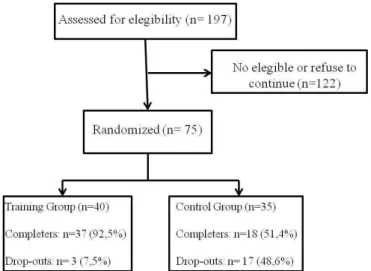
Out of a total of 197 women who participated in the irst
screening, only 75 met all the inclusion criteria and agreed to participate in the study protocol. Participants were randomly distributed into two study groups: TG (N = 40) and CG (N = 35). During the 16-weeks of intervention, 20 of the 75 women dropped out of the study (a dropout rate of 26.6%). The reasons for drop outs included minor injury related to CT (n = 1), refusal of the 16-week post protocol testing (n = 6), personal/family problems (n = 3), unspeciied reasons (n=8), and accumulation of three consecutive absences or four nonconsecutive absences during one month (n = 2). The inal sample was composed of 55 subjects who completed the 16-wks of the protocol, made up of the TG n = 37 and the CG n = 18 (Figure 1).
Introduction
Epidemiological studies have identiied that menopause promotes signiicant changes in body composition (Auber -tin-Leheudre, Lord, Labonte, Khalil, & Dionne, 2008; Day, Gozansky, Van Pelt, Schwartz, & Kohrt, 2005; Donato, Fuchs, Oppermann, Bastos, & Spritzer, 2006) and that postmenopausal women are at an increased risk of deve-loping cardiovascular complications, such as endothelial dysfunction, stroke and cerebrovascular agents (Miller et al.,
2013). Several scientiic studies have suggested that some
alterations in body composition (predominantly an increase in abdominal fat) play a central role in harmful events related to the postmenopausal period (Day et al., 2005; Donato et al., 2006; Huang, 2009).
Not only physiological aspects are related to increased cardiovascular risk during the postmenopausal period, but also unhealthy behaviors such as physical inactivity and ina-dequate diet which have been pointed out as complementary risk factors due to their strong relationship with weight gain (Ignarro, Balestrieri, & Napoli, 2007). Buonani et al. (2013) reported that postmenopausal women, evaluated using a tri-axial accelerometer, who demonstrated higher values in minutes of moderate-vigorous physical activity (> 150 minutes/week) had lower levels of body fat (43.8 vs. 47. 2%) and higher levels of lean body mass (53.8 vs.49.6 kg) compared to women who demonstrated less than 150 minutes/week.
The chronic effect of aerobic exercise is effective in the reduction/control of whole and central adiposity among post-menopausal women (Choquette et al., 2011; Friedenreich et al., 2011; Yassine et al., 2009), however, this kind of exercise is not enough for the preservation/maintenance of fat-free mass. On the other hand, resistance training is effective in improving muscle mass, but, in turn, its effectiveness in the reduction of body fat is unclear (Nelson et al., 2007).
Therefore, although the beneits of isolated aerobic and
Methods
This intervention study was carried out from February to July of 2012 at São Paulo State University (UNESP), Presidente Prudente, Brazil. The initial assessment occurred two weeks before the baseline moment (M0) and consisted of the anamnesis to verify whether the participants met the inclusion criteria. During this period, anthropometry and body composition were evaluated. After 16-weeks of inter-vention all measurements were repeated (M16). The Training Group (TG) performed a 16-week intervention program of CT and the Control Group (CG) maintained 16 weeks of a sedentary lifestyle without participating in any regular physical exercise.
Anthropometric measurements and body composition
Anthropometry was composed of body weight and height
measurements. Height was measured on a ixed stadiometer
of the Sanny brand, with an accuracy of 0.1 cm and length of 2.20 m. Body weight was measured using an electronic scale (Filizola PL 50, Filizzola Ltda., Brazil), with a preci-sion of 0.1 kg.
Whole and trunk fat (TF) were estimated using a Dual -Energy X-ray Absorptiometry (DXA) scanner, version 4.7 (General Electric Healthcare, Lunar DPX-NT; England). The subjects were positioned in a supine position and remained still throughout the examination. Fat mass (FM), fat-free mass (FFM) and trunk fat (TF) were assessed and expressed in ab-solute values by the DEXA software. The TF was estimated
in the abdominal region, and was deined as 20% of the length
from a circumference line at the pelvis to a circumference line at the neck (Bhupathiraju et al., 2011). All measurements were carried-out at the University laboratory, in a temperature controlled room. Each morning, before the beginning of the measurements, the equipment was calibrated by the same researcher, according to the manufacturer’s instructions.
Dietary record assessment
Twenty-four hour dietary recalls were conducted on three nonconsecutive days (one weekend and two weekdays) (Thompson & Byers, 1994). The participants were oriented by a nutritionist as to how to complete the dietary record. Data were analyzed by the same nutritionist using the software NutWin, version 1.5 (Programa de Apoio à Nutrição, Universidade Fe-deral de São Paulo, Brazil, 2002).
Exercise protocol
CT was performed three times per week on non-consecutive
days (approximately 90 minutes per day, comprised of ive minutes
of warm-up, 50 minutes of resistance training, 30 minutes of aerobic
training and ive minutes of stretching at the end). At the beginning
of the activities there was a two-week period of familiarization to both the aerobic and the resistance exercises (the test of one maximum repetition occurred after two weeks of training familia-rization). The exercises used in the program were: 45º leg press, leg extension, leg curl, bench press, seated row, arm curl, triceps extension, side elevation with dumbbells and abdominal exercises.
Aerobic exercise intensity
The intensities of the aerobic training were established according to the anaerobic threshold (LAN) determined by the protocol of double not exhaustive efforts (Chassain, 1986)]. The
training was performed on an oficial running track, marked
every 50 meters. The initial intensity of training was 100% (1st to 4th week) followed by 110% (5th to 8th week) of the LAN performed pre-intervention. After eight weeks of training, a new test was performed to adjust the intensities. The intensity of the exercise was monitored through the time required to traverse each 400m (1 lap), with the heart rate at around 70% of maximum heart rate (Mcardle et al., 2008). To ensure that the training speed was correct, the group was followed by pro-fessionals who monitored the speed of the training. Participants were instructed to drink water and wear appropriate clothes and shoes during training.
Resistance training intensity
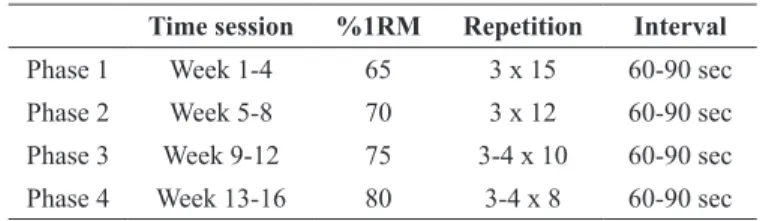
The resistance training program consisted of four progres-sive phases [phase 1 (1st to 4th week, 15 repetitions at ~65% of maximum, three sets per exercise, 60–90 sec between sets); phase 2 (5th to 8th week, 12 repetitions at ~70% of maximum, three sets per exercise, 60-90 sec between sets); phase 3 (9th to 12th week, 10 repetitions at ~75% of maximum, three to four sets per exercise, 60-90 sec between sets) and phase 4 (13th to 16th week, eight repetitions at ~80% of maximum, three to four sets per exercise, 60-90 sec between sets)]. The training loads were adjusted every four weeks of training in order to maintain the number of repetitions prescribed (Table 1).
The intensity of the resistance training was controlled through the zone of maximum repetitions (MR). The series were executed until momentary exhaustion, meaning that, when participants performed the training with repetitions varying from 12 to 15 MR, they were always stimulated to execute at least 12 and no more than 15 repetitions (Silva, Gurjão, Ferreira, Gobbi, & Gobbi, 2006). In the case of the participants executing more than 15 repetitions, the overload was increased in order to have the training zone respected (Silva et al., 2006). The test of one maximum repetition (1MR) was performed only in the leg press and bench press. The load was increased gradually during the test until the participants were unable to perform the entire movement, and three attempts were considered to meet the correspon-ding 1MR load (ACMS, 2006). To allow for recovery, an interval of 3 to 5 minutes was given between the attempts (ACMS, 2006).
Data analysis
The Kolmogorov-Smirnov test analyzed the data set distribution. All variables had normal distribution
(sig-niicance > .05) and therefore, mean, standard-deviation and 95% conidence intervals were adopted as descriptive
statistics. Initially, in order to identify the similarity of both groups at baseline (basic assumption), dependent variables were compared between the CG and TG using the Student t test for independent samples. In the longitudinal analysis, dependent variables were treated as “mean differences” (post exercise value minus baseline value) and the Student t test for independent samples was used once more to compare these mean differences between the CG and TG. Finally, the Spearman rank correlation (rho) was used to analyze the relationship between the mean differences of TF, FM and FFM and dietary intake.
All analyzes were performed using the statistical software
BioEstat (version 5.0). The level of signiicance was set at 5%.
Results
The mean age of the participants was 61.2±6.0 (TG: 60.5±6.0 and CG: 62.6±5.9; p-value= .230). At baseline, all variables were similar between the groups (Table 2).
After 16-wks of intervention, there were statistically
sig-niicant differences between the TG group and the Control
group, for TF (CG= 0.064 [95%CI= -0.06; 0.36] and TG= -0.571 [95%CI= -0.99; -0.37]; p-value= .020), FM (CG= -0.088
[95%CI= -1.07; 0.54] and TG= -1.037 [95%CI= -1.83; -0.81]; p-value = .020) and FFM (CG= -0.388 [95%CI= -1.28; -0.11] and TG= 1.049 [95%CI= 0.57; 1.34]; p = .001) (Figure 2). When
the changes in weight were analyzed, there were no signiicant
differences observed between the groups. Time session Aerobic Training
Week 1-4 100% of the LAn pre-intervention
Week 5-8 110% of the Lan pre-intervention
Week 9-12 100% of the Lan post-eight weeks
Week 13-16 110% of the Lan post-eight weeks Table 1. Aerobic training protocol.
Figure 2. Absolute variation after the 16 weeks of intervention. TG= Training Group; CG= Control Group.
Time session %1RM Repetition Interval
Phase 1 Week 1-4 65 3 x 15 60-90 sec
Phase 2 Week 5-8 70 3 x 12 60-90 sec
Phase 3 Week 9-12 75 3-4 x 10 60-90 sec
Phase 4 Week 13-16 80 3-4 x 8 60-90 sec Table 2. Resistance training protocol.
(~3.0 kg), an increase in fat mass (~2.5 kg) and a decrease in resting metabolic rate (~100 kilocalories per day) (Poehman et al., 1995; Poehman, 2002). Toth et al. (2000) examined the effects of the menopausal status on body composition and ab-dominal fat distribution in 53 middle-aged, premenopausal and postmenopausal women and observed that the postmenopau-sal women had 36% more trunk fat (p < .01), a 49% greater intra -abdominal fat area (p < .01), and a 22% greater subcutaneous abdominal fat area (p < .05) than the premenopausal women.
In addition to excessive body fatness, scientiic literature has identiied that, abdominal adipose tissue has neuroendocrine
characteristics, which are related to metabolic and cardiovas-cular implications (Van Gaal, Mertens, & De Block, 2006).
Similar to our indings, previous studies have identiied
that abdominal adipose tissue in postmenopausal women is affected by aerobic exercise (Friedenreich et al., 2011). Another study observed similar results in women aged 39 to 64, after 21-weeks of combined exercise (resistance training and aerobic exercise applied on different week days) (Sillanpää et al., 2009), identifying that this protective effect on abdominal obesity is also observed in other age groups and could be used to explain the effect of the combined training on the metabolic syndrome components in women aged 40 years (Seo et al., 2010). In ge-neral, responses to acute exercise suggest that higher-intensity exercise may be more effective than low-to-moderate-intensity exercise for inducing the secretion of lipolytic hormones, facili-tating greater post-exercise energy expenditure and fat oxidation (Pritzlaff et al., 2000).
Dietary habits are signiicantly related to body composition modiications and thus, modiications in dietary intake during
the exercise protocol could affect the analyzed outcomes (Faria,
Faria, Bufington, De Almeida Cardeal, & Ito, 2011). However, in this sample, there was no signiicant relationship between modiications in diet and body composition, which decreases the likelihood of this kind of bias related to dietary modiications.
The present study showed some beneits of combined trai -ning on the whole and segmental body composition variables, but other studies must be done to verify the effect of this exercise protocol on other variables, such as metabolic and hemodyna-mic. Furthermore, there was no isolated aerobic or resistance groups for better comparison.
However, if the purpose is the improvement of maximal strength, muscle power and performance, some care in the pres-cription of training programs is necessary (Leveritt, Abernethy, Barry, & Logan 1999). In this case, an interesting alternative would be for aerobic and resistance training to be done on non-consecutive days, as well as other strategies discussed in the review by Paulo et al. (2005).
In conclusion, the combination of aerobic and resistance training in the same session, over a relatively short period of sys-tematic training, was effective in improving FFM and decreasing whole and segmental fat mass in obese postmenopausal women and could be a useful strategy for improving health status and preventing some disorders related to sedentary habits as well as minimizing some of the side effects of aging. Furthermore, it may be an effective non-pharmacological strategy in the pre-vention and treatment of obesity, thereby decreasing drug intake. Regarding dietary intake (expressed in kcal), after 16-wks
of intervention, no differences were observed for the CG (Base-line= 1,615.2±345.9 Kcal versus 16-wks= 1.660.9±244.1 Kcal; p = .552) or the TG (Baseline= 1,641.9±398.7 Kcal versus 16-wks= 1,550.1±431.2 Kcal; p = .140). The values of the Spearman correlation between the mean differences in dietary intake and the composition variables are shown in Table 3. There was no
signiicant relationship between dietary intake, whole and trunk
fat and fat-free mass in either group analyzed.
Discussion
Previous studies have shown that long term aerobic exercise is effective in reducing FM in postmenopausal women, but chan-ges in FFM have not been observed (Friedenreich et al., 2011; Lee et al., 2012; Wanderley et al., 2013). On the other hand, the isolated effect of resistance training on body composition in elderly women has shown an increase in FFM but without a decrease in FM (Binder et al., 2005).
In the present study, the combined training protocol was effective in both decreasing FM and increasing FFM. Endu-rance training improves the oxidative capacity and maximal oxygen uptake, and increases the activity of aerobic enzymes, intramuscular glycogen, mitochondrial and capillary densities in
the muscles, but without leading to signiicant improvement in
FFM (Chtara et al., 2005; Hakkinen et al., 2003). Additionally, resistance training is effective in increasing FFM and, in turn, muscle strength (Hunter et al., 2004). The biological mecha-nisms related to the effects of resistance training are supported by the recruitment of satellite cells, improvement in motor unit activations and increased high-energy phosphate availability (Hunter et al., 2004). Therefore, the presented protocol seems
to be effective in this population, not only due to its beneits in
the improvement of these two body composition components, but also for other unhealthy outcomes, such as osteoporosis and sarcopenia (Bemben & Bemben, 2011; Hanson et al., 2009).
Obesity is related to the postmenopausal period and is also considered an important public health concern in different age groups (Bhuiyan & Zaman, 2013; De Onis, Blossner, & Borghi, 2010; Ghorbani, Ziaee, Oveisi, & Afaghi, 2013), as it affects a large variety of biological systems and is responsible for an increasing number of chronic diseases (Whitcroft & Herriot,
2011). After the postmenopausal period there are signiicant
changes in body composition, with a decrease in fat-free mass Training Group
(n=37)
Control Group (n=18)
p-value
Mean (SD) Mean (SD)
Weight (kg) 62.02 (15.2) 63.79 (15.6) .971
TF (kg) 14.85 (5.5) 14.63 (7.5) .886
FM (kg) 26.77 (10.7) 29.00 (13.0) .802
FFM (kg) 34.41 (4.4) 34.31 (6.0) .578 Table 3. General characteristics of the sample at baseline (M0).
References
American College of Sports Medicine. KaminskyL, editor. (2006). ACSM’s guidelines for exercise testing and prescription. 7th ed. Baltimore: Lippincott, Williams & Wilkins.
Aubertin-Leheudre, M., Lord, C., Labonte, M., Khalil, A., & Dionne, I.J. (2008). Relationship between sarcopenia and fracture risks in obese postmenopausal women. Journal of Women & Aging, 20, 297-308. dói: 10.1080/08952840801984964
Bemben, D.A., & Bemben, M.G. (2011). Dose-response effect of 40 weeks of resistance training on bone mineral density in older adults. Osteo-porosis International, 22, 179-186. dói: 10.1007/s00198-010-1182-9 Bhuiyan, M.U., Zaman, S., & Ahmed, T. (2013). Risk factors associa-ted with overweight and obesity among urban school children and adolescents in Bangladesh: a case–control study. BMC Pediatrics, 13, 72. doi:10.1186/1471-2431-13-72
Binder, E.F., Yarasheski, K. E., Steger-May, K., Sinacore, D.R., Brown, M., Schechtman, K.B., & Holloszy, J.O. (2005). Effects of Pro-gressive Resistance Training on Body Composition in Frail Older Adults: Results of a Randomized, Controlled Trial. Journal of Gerontology Series A: Biological Sciences and Medical Sciences, 60, 1425–1431. dói: 10.1093/gerona/60.11.1425
Bouchard, D.R., Soucy, L., Senechal, M., Dionne, I.J., & Brochu, M. (2009). Impact of resistance training with or without caloric restriction on physical capacity in obese older women. Menopause, 16, 66-72. dói: 10.1097/gme.0b013e31817dacf7
Bhupathiraju, S.N., Dawson-Hughes, B., Hannan, M.T., Lichtenstein, A.H., & Tucker, K.L. (2011). Centrally located body fat is associa-ted with lower bone mineral density in older Puerto Rican adults. The American Journal of Clinical Nutrition, 94, 1063-1070. dói: 10.3945/ajcn.111.016030
Buonani, C., Rosa, C.S.D.C., Diniz, T.A., Christofaro, D.G.D., Montei-ro, H.L., Rossi, F.E., & Freitas Júnior, I.F. (2013). Physical activity and body composition in menopausal women. Revista Brasileira de Ginecologia e Obstetrícia, 35, 153-158.
Chassain, A. (1986). Methode d appreciation objective de la tolerance de l’ organism á l effort: application á la mensure des puissances de la frequence cardiaque et de la lactatemie [A method for objective evaluation of body tolerance to effort applied to measurement of critical peaks in heart rate and lactatemia]. Science & Sports, 1, 41-44. dói: 10.1016/S0765159786800739
Choquette, S., Riesco, E., Cormier, E., Dion, T., Aubertin-Leheudre, M., & Dionne, I.J. (2011). Effects of soya isolavones and exercise on body composition and clinical risk factors of cardiovascular diseases in overweight postmenopausal women: a 6-month dou-ble-blind controlled trial. The British Journal of Nutrition, 105, 1199-1209. dói: 10.1017/S0007114510004897
Chtara, M., Chamari, K., Chaouachi, M., Chaouachi, A., Koubaa, D., Feki Y., …Amri, M. (2005). Effects of intra-session concurrent endurance and strength training sequence on aerobic performance and capacity. British Journal of Sports Medicine, 39, 555-560. dói: 10.1136/bjsm.2004.015248
Day, D.S., Gozansky, W.S., Van Pelt, R.E., Schwartz, R.S., & Kohrt, W.M. (2005). Sex hormone suppression reduces resting energy expenditure and {beta}-adrenergic support of resting energy ex-penditure. The Journal of Clinical Endocrinology and Metabolism, 90, 3312-3317. dói: 10.1210/jc.2004-1344
De Onis, M., Blossner, M., & Borghi, E. (2010). Global prevalence and trends of overweight and obesity among preschool children. The American Journal of Clinical Nutrition, 92, 1257–1264. dói: 10.3945/ ajcn.2010.29786
Donato, G.B., Fuchs, S.C., Oppermann, K., Bastos, C., & Spritzer, P.M. (2006). Association between menopause status and central
adiposity measured at different cutoffs of waist circumference and waist-to-hip ratio. Menopause, 13, 280-285. dói: 10. 1097/01. gme.0000177907.32634.ae
Faria, S.L., Faria, O.P., Bufington, C., De Almeida Cardeal, M., & Ito, M.K. (2011). Dietary protein intake and bariatric surgery patients: a review. Obesity Surgery, 21, 1798-1805. dói: 10.1007/ s11695-011-0441-y
Fernandes, R.A., & Zanesco, A. (2010). Early physical activity promo-tes lower prevalence of chronic diseases in adulthood. Hypertension Research, 33, 926-931. dói: 10.1038/hr.2010.106
Friedenreich, C.M., Woolcott, C.G., McTiernan, A., Terry, T., Brant, R., Ballard-Barbash, …Courneya, K.S. (2011). Adiposity changes after a 1-year aerobic exercise intervention among postmenopausal women: a randomized controlled trial. International Journal of Obesity, 35, 427–435. dói: 10.1038/ijo.2010.147
Ghorbani, A., Ziaee, A., Oveisi, S., & Afaghi, A. (2013). A Compa-rison of Health-Related Quality of Life among Normal-Weight, Overweight and Obese Adults in Qazvin Metabolic Diseases Study (QMDS), Iran. Global Journal of Health Science, 5, 156-162. dói: 10.5539/gjhs.v5n3p156
Hakkinen, K., Alen, M., Kraemer, W. J., Gorostiaga, E., Izquierdo, M., Rusko, H., … Paavolainen L. (2003). Neuromuscular adaptations during concurrent strength and endurance training versus strength training. European Journal Applied Physiology, 89, 42-52. dói: 10.1007/s00421-002-0751-9
Hanson, E.D., Srivatsan, S.R., Agrawal, S., Menon, K.S., Delmonico, M.J., Wang, M.Q., & Hurley, B.F. (2009). Effects of strength trai-ning on physical function: inluence of power, strength, and body composition. Journal of Strength and Conditioning Research, 23, 2627–2637. dói: 10.1519/JSC.0b013e3181b2297b
Huang, P.L. (2009). eNOS, metabolic syndrome and cardiovascular disease. Trends in Endocrinology and Metabolism, 20, 295-302. dói: 10.1016/j.tem.2009.03.005
Hunter, G.R., McCarthy, J.P., & Bamman, M.M. (2004). Effects of resistance training on older adults. Sports Medicine, 34, 329-348. Ignarro, L.J., Balestrieri, M.L., & Napoli, C. (2007). Nutrition, physical activity, and cardiovascular disease: an update. Cardiovascular Research, 73, 326-340. dói: 10.1016/j.cardiores.2006.06.030 Lee, S., Bacha, F., Hannon, T., Kuk, J.L., Boesch, C., & Arslanian,
S. (2012). Effects of aerobic versus resistance exercise without caloric restriction on abdominal fat, intrahepatic lipid, and insulin sensitivity in obese adolescent boys: a randomized, controlled trial. Diabetes, 61, 2787-2795. dói: 10.2337/db12-0214
Leveritt, M., Abernethy, P.J., Barry, B.K., & Logan, P.A. (1999). Concurrent strength and endurance training. A review. Sports medicine, 28, 413-427.
Mcardle, W.D., Katch, F.I., & Katch, V.L. (2008). Exercise Physiology - Energy, Nutrition and Human Performance. Rio de Janeiro: Koogan. Miller, V.M., Garovic, V.D., Kantarci, K., Barnes, J.N., Jayachandran, M., Mielke, M. M, … Rocca, W.A. (2013). Sex-speciic risk of car -diovascular disease and cognitive decline: pregnancy and menopau-se. Biology of Sex Differences, 4, 6. dói: 10.1186/2042-6410-4-6 Nelson, M.E., Rejeski, W.J., Blair, S.N., Pamela, W., Duncan, P.W.,
James, J.O., … Castaneda-Sceppa, C. (2007). Physical activity and public health in older adults: recommendation from the American College of Sports Medicine and the American Heart Association. Circulation, 116, 1094-1105. dói: 10.1249/mss.0b013e3180616aa2 Organización Mundial De La Salud. (1996). Investigaciones sobre la
menopausia en los años noventa. Genebra: Organización Mundial de la Salud.
Authors’note
Fabrício E. Rossi, Tiego A. Diniz, and Vanessa R. dos Santosare af-iliated with the Institute of Bioscience, São Paulo State University, Rio Claro, São Paulo, Brazil.
Camila Buonani, Juliana Viezel, Eduardo P. da Silva, Rômulo A. Fer-nandes, and Ismael F. Freitas Junior are afiliated with theDepartment of Physical Education, São Paulo State University, Presidente Prudente, São Paulo, Brazil.
Corresponding author
Fabrício E. Rossi
Department of Physical Education, Universidade Estadual Paulista “Júlio Mesquita Filho”, Roberto Simonsen Street, nº 305, Educational Center, Presidente Prudente, 19060-900, São Paulo, Brazil.
Telephone: 55 18 32295828 Fax. 55 18 3221 4391. e-mail: [email protected]
Conlict of interest
The authors declare that they have no conlict of interest.
Manuscript received on March 25, 2014 Manuscript accepted on January 30, 2015
Motriz. The Journal of Physical Education. UNESP. Rio Claro, SP, Brazil - eISSN: 1980-6574 – under a license Creative Commons - Version 3.0 Poehlman, E.T., Toth, M.J., & Gardner, A.W. (1995). Article
RE-TRACTED: Changes in Energy Balance and Body Composition at Menopause: A Controlled Longitudinal Study. Annals of Internal Medicine, 123, 673-675.
Poehlman, E.T. (2002). Menopause, energy expenditure, and body composition. Acta obstetricia et gynecologica Scandinavica, 81, 603-611.
Pritzlaff, C.J., Wideman, L., Blumer, J., Jensen, M., Abbott, R.D., Gaesser, G.A., … Weltman, A. (2000). Catecholamine release, growth hormone secretion, and energy expenditure during exercise vs. recovery in men. Journal of Applied Physiology, 89, 937–946. Seo, D.I., Jun, T.W., Park, K.S., Chang, H.K., So, W.Y., & Song, W. (2010). 12 weeks combined exercise training is better than aerobic exercise for increasing Growth Hormone in middle-aged women. International Journal of Sport Nutrition and Exercise Metabolism, 20, 21-26.
Silva, C.M., Gurjão, A.L.D., Ferreira, L., Gobbi, L.T.B., & Gobbi, S. (2006). Efeito do treinamento com pesos, prescrito por zona de repetições máximas , na força muscular e composição corporal em idosas. [Effect of resistance training, prescribed by zone of maximum repetitions, on the muscular strength and body compo-sition in older women]. Revista Brasileira de Cineantropometria e Desempenho Humano, 8, 39-45.
Sillanpää, E., Laaksonen, D.E., Karavirta, A.H.L., Jensen, B., Kraemer, W.J., Nyman, K., & Häkkinen, K. (2009). Body composition, it -ness, and metabolic health during strength and endurance training and their combination in middle-aged and older women. Europe-an Journal of Applied Physiology, 106, 285–296. dói: 10.1007/ s00421-009-1013-x
Toth, M.J., Tchernof, A., Sites, C.K., & Poehlman, E.T. (2000). Meno-pause-related changes in body fat distribution. Annals of the New York Academy of Sciences, 904, 502-506.
Thompson, F., & Byers, T. (1994). Dietary assessment resource ma-nual. The Journal of Nutrition, 124, 2245S–317S.
Van Gaal, L.F., Mertens, I.L., & De Block, C.E. (2006). Mechanisms linking obesity with cardiovascular disease. Nature, 444, 875-880. dói: 10.1038/nature05487
Wanderley, F.A., Moreira, A., Sokhatska, O., Palmares, C., Moreira, P., Sandercock, G., ... Carvalho, J. (2013). Differential responses of adiposity, inlammation and autonomic function to aerobic versus resistance training in older adults. Experimental Gerontology, 48, 326-333. dói: 10.1016/j.exger.2013.01.002
Whitcroft, S., & Herriot, A. (2011). Insulin resistance and management of the menopause: a clinical hypothesis in practice. Menopause International, 17, 24-28. dói: 10.1258/mi.2011.011003
WHO. World Health Organization Consequences of overweight and obesity on the health of adults and children. In: WHO. Obesity Preventing and Controlling Global Epidemic. 1. Ed. Sao Paulo: ROCA, 2004.