ORIGINAL ARTICLE
Enteral nutrition during bone marrow transplantation in
patients with pediatric cancer: a prospective cohort study
Nutrição enteral durante o transplante de medula óssea em pacientes com câncer
infanto-juvenil: estudo prospectivo de coorte
Adriana Garófolo
IGrupo de Apoio ao Adolescente e à Criança com Câncer (GRAACC), Universidade Federal de São Paulo (Unifesp), São Paulo, Brazil
ABSTRACT
CONTEXT AND OBJECTIVE: Cancer patients undergoing bone marrow transplantation (BMT) often re-quire nutritional therapy due to treatment toxicities. The aim here was to evaluate the use of tube feeding and its applicability, indications, contraindications and complications in these patients.
DESIGN AND SETTING: Prospective observational study conducted at a public university in São Paulo between January 2002 and August 2007.
METHODS: The patients were followed up daily in the BMT unit by a research dietitian. Tube feeding was indicated when oral supplementation proved to be insuicient, when the patient had severe malnutrition or there was an impediment to use of oral feeding. It was contraindicated in the presence of gastroin-testinal toxicity of grade 3 and 4 or other conditions that implied a risk or hindered its use or placement. Complications of tube feeding were divided into minor and major, according to whether they had life-threatening implications.
RESULTS: Forty-two (47.2%) patients had indications for tube feeding: the main reasons were transplanta-tion inadequate food and supplement intake, insuicient intake with malnutritransplanta-tion or weight loss, severe malnutrition or need for oral fasting. Thirty-one (73.8%) received tube feeding: 11 autologous and 20 al-logenic patients (P = 0.04). The main contraindications were severe gastrointestinal toxicities and sinusitis. Minor complications from tube feeding were more prevalent in patients with allogenic BMT, but no major complications were observed.
CONCLUSION: Enteral nutrition is a feasible procedure in patients undergoing BMT and should be en-couraged. The main diiculty in BMT patients, in relation to tube feeding, is gastrointestinal toxicities.
RESUMO
CONTEXTO E OBJETIVO: Pacientes com câncer submetidos ao transplante de medula óssea (TMO) fre-quentemente necessitam de terapia nutricional devido às toxicidades do tratamento. O objetivo foi avaliar uso de sonda enteral, aplicabilidade, indicações, contraindicações e complicações nesses pacientes.
TIPO DE ESTUDO E LOCAL: Estudo observacional prospectivo, conduzido de janeiro de 2002 a agosto de 2007 em uma universidade pública em São Paulo.
MÉTODOS: Os pacientes foram acompanhados diariamente na unidade de TMO por uma nutricionista da pesquisa. Indicações de sonda: suplementação oral insuiciente, desnutrição grave, ou alguma con-traindicação para alimentação via oral. A concon-traindicação da sonda ocorreu na presença de toxicidades gastrintestinais de grau 3 e 4 ou outras condições que implicassem em risco ou impedissem seu uso ou passagem. As complicações da sonda foram divididas em menores e maiores, de acordo com implicações para o risco de vida.
RESULTADOS: Quarenta e dois (47,2%) pacientes tiveram indicações de nutrição por sonda: os principais motivos foram: ingestão alimentar e de suplemento inadequada, ingestão insuiciente com desnutrição ou perda de peso, desnutrição grave ou necessidade de jejum. Trinta e um (73,8%) pacientes usaram sonda: 11 com transplantes autólogos e 20 alogênicos (P = 0,04). As principais contraindicações foram toxicidades gastrintestinais graves e sinusite. Complicações leves com a sonda foram mais prevalentes nos pacientes em TMO alogênico, mas nenhuma complicação grave foi observada.
CONCLUSÃO: O uso de sonda enteral é um procedimento factível em pacientes durante o TMO e deve ser encorajado. A principal diiculdade nesse grupo em relação ao uso de sonda foi a toxicidade gastrintestinal.
IMSc, PhD. Founder and Coordinator of
Nutritional Services, Grupo de Apoio ao Adolescente e à Criança com Câncer (GRAACC), Universidade Federal de São Paulo (Unifesp), São Paulo, Brazil.
KEY WORDS:
Transplants. Enteral nutrition. Neoplasms. Child. Adolescent.
PALAVRAS-CHAVE:
INTRODUCTION
Bone marrow transplantation (BMT) or hematopoietic stem cell transplantation (HSCT) is a recognized therapeutic method for a variety of hematologic malignancies, congenital abnormalities and malignancies. he procedure is used to restore bone marrow function in patients receiving intensive chemotherapy and radia-tion, through infusion of progenitor cells or stem cells with an ability to multiply and diferentiate into all types of mature blood cells: red cells, white cells and platelets.1
he transplants may be autologous or allogenic, depend-ing on the origin of the cells. When the cells originate from the patient, the transplant is autologous, but when they are donated by another individual, it is allogenic. If the donor is an identical twin, the transplant is called syngenic.1,2
he complications from BMT can be acute or chronic and depend on the underlying disease and its initial condition before the procedure, the type of transplant, the chemotherapy and the preparatory regimen for radiotherapy. he main post-trans-plant complications include bleeding, infections, organ failure, grat versus host disease (GVHD), grat failure or rejection, and recurrent disease.2
Besides these complications, nutritional status is strongly afected by the process of BMT. he reduced protein intake, for example, may inluence immune function during metabolic stress. hus, studies have demonstrated the importance of adjust-ing the energy needs to maintain a zero nitrogen balance.3-5
Patients who receive BMT oten require nutritional support because of their reduced food intake, which is associated with the toxicities of the conditioning regimen, especially in the gastroin-testinal tract.5,6
Patients receiving allogenic BMT undergo a conditioning regimen with high-dose chemotherapy combined with total body irradiation, thereby leading to immunosuppression. he body irradiation is extremely toxic and leads to severe and prolonged mucositis. hese patients’ immunity is more highly compro-mised and they are at greater risk of overall complications than are those who undergo autologous BMT. herefore, it is believed that patients who undergo allogenic BMT are also at greater risk of nutritional and metabolic complications and therefore need specialized nutritional support.7 Total parenteral nutrition (TPN)
has been the method most commonly used to provide nutrients during BMT. However, circumstances such as risk of infection and lipid and glucose metabolism disorders may limit its use in these patients.8
OBJECTIVE
Since it is known that patients undergoing BMT oten require nutritional support due to treatment toxicities, the objective of the present study was to evaluate the use of enteral nutrition through tube feeding and its applicability, indications, contraindications
and complications in patients undergoing BMT, with compari-sons between autologous and allogenic transplants.
METHODS
his was a prospective observational study carried out from Jan-uary 2002 to August 2007, among patients admitted to undergo autologous or allogenic BMT procedures. he study was con-ducted in accordance with a follow-up protocol from the BMT research unit at a pediatric oncology institute in a public univer-sity in São Paulo.
he study included all patients diagnosed with cancer for whom BMT was indicated, and the study excluded those whose family or legal guardian (and the patient, if over 18 years) had not agreed to sign the consent form, thereby refusing to participate. Patients who had been referred for transplantation but were not sufering from cancer were also excluded.
he patients were followed up daily by a research dieti-tian, using a standardized report form schedule that had been developed to gather data on food intake; gastrointestinal signs and symptoms; oral supplements; administration of and indi-cations and contraindiindi-cations for enteral and parenteral nutri-tional support; the antineoplastic treatment protocol; and other treatments. To estimate the total daily energy requirement, we used the World Health Organization (WHO) or Harris Benedict equation, according to the age group.9-11 A calculation of baseline
energy expenditure (EE) plus a factor of 1.2 (illness) was applied in order to obtain the total EE (TEE).
Weight-for-height (W/H) Z-scores from < -1.0 to -2.0 among children12 and body mass index (BMI) from greater than or equal
to the ith percentile to greater than the iteenth percentile among adolescents13 were considered to represent mild
malnu-trition; and W/H Z-scores < -2.0 in children and less than the ith percentile of BMI in adolescents were considered severe.14
In young adults, the WHO cutof values15 were applied: < 18.5 for
mild and < 17 for severe malnutrition.
Nutritional management
Indications for nutritional support were made in accordance with the routine protocol of the transplantation unit. They were applied by the nutrition team and consisted of indica-tions of nutritional supplementation when the food intake was insufficient (less than 70-80% of energy needs) for three to five days.
by the oncologist and the nursing staff, in order to implement this procedure.
Placement or use of the tube was contraindicated by the medical staf if the patient presented gastrointestinal toxicity of grade 3 or 4, or other medical complications that resulted in risk or could impede its use or placement. Parenteral nutrition was therefore administered when previous procedures had not been successful or were contraindicated.
he complications of tube feeding were divided into minor and major, according to whether they had life-threatening impli-cations. Minor complications, referred to as non-life-threatening, comprised categories such as problems with the tube (inadvertent tube dislodgement or tube clogging), intensiication of episodes of vomiting or diarrhea, colic or abdominal pain and infection in the oral cavity. Major complications were those that were systemic and life-threatening, and included malpositioned feeding tubes involv-ing inadvertent placement into the respiratory tract, bleedinvolv-ing or injury in the oral cavity or gastrointestinal tract, perforation of the esophagus or stomach, disrupted breathing (obstruction of nasal breathing), sinusitis, epistaxis or aspiration pneumonia.16
Statistical analysis
he data were registered and analyzed using the NCSS/PASS sta-tistical sotware.17 Diferences between groups were investigated
using the Mann-Whitney test for continuous variables. For cat-egorical variables, the chi-square test was applied.
he sample size was calculated considering an estimated rate of 30% for the malnutrition outcome in the autologous group and 60% in the allogenic group, a signiicance level of 5% (chance of type 1 error or alpha = 0.05) and a power of 80% (chance of type 2 error or beta = 0.2).
Ethics committee
he nutritional support protocol from which this analysis was derived was approved by the Institutional Review Board/Eth-ics Committee of Universidade Federal de São Paulo — Escola Paulista de Medicina (Unifesp-EPM), under protocol num-ber 0132/06. Informed consent was obtained from the parents, guardians or patients, ater the study protocol had been explained to them.
RESULTS
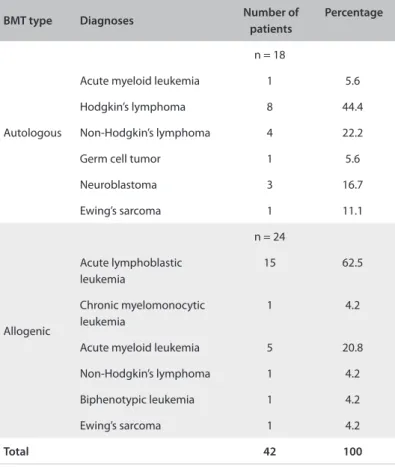
Eighty-nine patients out of the 101 followed up during the study period fulilled the inclusion criteria: 45 autologous transplant cases (50.6%) and 44 allogenic transplant cases (49.5%). Of these, forty-two (47.2%) had an indication for tube feeding: 18 autolo-gous and 24 allogenic cases (Table 1). he patients’ demographic characteristics are shown in Table 2.
he mean of length of hospital stay was 30.4 days for autolo-gous and 37.2 days for allogenic transplant patients (P = 0.06).
BMT type Diagnoses Number of patients
Percentage
Autologous
n = 18
Acute myeloid leukemia 1 5.6
Hodgkin’s lymphoma 8 44.4
Non-Hodgkin’s lymphoma 4 22.2
Germ cell tumor 1 5.6
Neuroblastoma 3 16.7
Ewing’s sarcoma 1 11.1
Allogenic
n = 24
Acute lymphoblastic leukemia
15 62.5
Chronic myelomonocytic leukemia
1 4.2
Acute myeloid leukemia 5 20.8
Non-Hodgkin’s lymphoma 1 4.2
Biphenotypic leukemia 1 4.2
Ewing’s sarcoma 1 4.2
Total 42 100
Table 1. Cancer diagnoses according to the type of bone marrow transplant (BMT)
Transplant Male Female Children* Adolescents† Adults‡
Autologous (n = 11)
6 (55%) 5 (45%) 3 (27%) 6 (55%) 2 (18%)
Allogenic (n = 20)
13 (65%) 7 (35%) 12 (60%) 6 (30%) 2 (10%)
Total 19 12 15 12 4
Table 2. Demographic characteristics of the patients (n = 31)
*Children: 0-9 years; †Adolescents: 10-18 years; ‡Adults: over 18 years.
In the light of these indications, 31 (73.8%) received tube feeding and 11 (26.2%) did not. Out of the 31 patients with the tube, 11 were autologous and 20 were allogenic cases (P = 0.04).
Among the autologous cases, the reasons associated with not using tube feeding were non-acceptance by the patient or fam-ily in three cases, severe gastrointestinal toxicities in two, high risk of intestinal perforation in one and sinusitis in one. Among the allogenic cases, the reasons were the presence of signiicant
sinusitis in two cases, gastrointestinal toxicity in one and high-output colostomy in one.
Twelve patients (38.7%) received tube placement on day zero of BMT (day of infusion of bone marrow cells) and 19 (61.3%) ater that day, ranging from one to 20 days later. he average duration of tube use was 14 days for allogenic cases and 20 days for autologous cases (P = 0.08).
A semi-elemental diet was required at some time during the treatment in 21/31 patients (67.7%): 81.8% of the autologous cases and 60% of the allogenic cases (diference not signiicant). he descriptions of the type of diet and tube position according to group are shown in Graph 1. No analysis was performed on the infusion of enteral diet.
Twenty patients only used the feeding tube as an addition to the oral route; the sum of these two routes contributed 79.6% of TEE. he average adequacy of energy intake only with tube feed-ing was 51% for the whole group: 56% versus 38% for the autol-ogous and allogenic cases, respectively (P = 0.08); 39.7% of the patients used a nasogastric tube feeding (NGT) and 46% used a nasoenteral tube (NET).
here were no major complications from tube feeding, but some minor complications were observed in 17 patients (54.8%): intensiication of the episodes of vomiting or diarrhea with pro-gression of the volume of diet in ive (16.1%), tube dislodgement in six (19.4%), fungal infection in the oral cavity in three (9.7%) and problems with the tube (tube clogging) in two (6.5%).
Comparing the complications between the autologous and allogenic cases (36% versus 60%; not signiicant), intensiication Graph 1. Description of feeding tube placement and type of diet
according to the transplant.
Autologous Allogenic
Semi-elemental diet 0.6
81.8%
0.4 18.2%
0.6 54.5%
0.4 45.5% Polimeric diet
NET
NGT
NET = nasoenteral tube; NGT = nasogastric tube.
Bone marrow
transplantation type Nutritional status At admission Percentage At discharge Percentage
Autologous (n = 11)
Severe malnutrition 2 18 1 9
Mild malnutrition 2 18 3 27.3
Normal weight 7 63.6 6 54.5
Overweight/obese 0 0 0 0
Allogenic (n = 20)
Severe malnutrition 2 10 1 5
Mild malnutrition 0 0 0 0
Normal weight 12 60 12 60
Overweight/obese 6 30 4 20
Total (n = 31)
Severe malnutrition 4 12.9 2 6.5
Mild malnutrition 2 6.5 3 9.7
Normal weight 19 61.3 18 58
Overweight/obese 6 19.4 4 12.9
Table 3. Nutritional diagnosis of the patients before bone marrow transplant (at admission) and afterwards (at discharge) (n = 31)*
*Four patients were lost at discharge: one autologous case with normal weight at admission and three allogenic cases (one obese individual and two with
of the episodes of vomiting or diarrhea was found in one (9.1%) versus four (20%), respectively. he three patients with fungal infection in the oral cavity belonged to the allogenic group. Tube clogging and tube dislodgement were found in 9% versus 5% and 18.2% versus 20% in the autologous and allogenic cases, respec-tively (not signiicant).
DISCUSSION
Currently, hematopoietic stem cell transplantation may be an alternative to conventional treatment that can be indicated for treating various malignant childhood tumors. According to a recent consensus, the main indications in pediatric oncology patients may be some leukemias and lymphomas and some solid tumors such as neuroblastoma, some central nervous system tumors, Wilms’ tumor, germ cell tumors and some bone tumors such as Ewing’s sarcoma.18
Patients undergoing this procedure are at greater nutritional risk because of the aggressiveness of the therapy. Gastrointestinal toxicities such as mucositis, nausea and vomiting are observed in all patients undergoing BMT.19
Parenteral nutrition is a method of nutritional therapy that is widely used and recommended as a choice for patients who undergo BMT, mainly because of the results of an earlier study that demonstrated that its prophylactic use had a positive impact on patient survival ater three years of follow-up.20 However, the
use of total parenteral nutrition (TPN) is also associated with an increased risk of complications, especially infectious and meta-bolic diseases, for which the greatest risk may be among patients with severe immunosuppression, such as BMT patients. here-fore, routine use of TPN is not warranted, unless toxicity or seri-ous complications of the gastrointestinal tract, preclude the full use of enteral nutrition.21-24
herefore, nutritional therapy has been widely recommended for pediatric patients undergoing BMT, and enteral nutrition through a feeding tube is preferred over TPN in the absence of severe mucositis.25 In the present study, severe
gastrointes-tinal toxicities and sinusitis were the main problems that con-traindicated placement of tube feeding among the allogenic and autologous BMT patients. However, this group of patients who experienced such problems was receiving the only alternative to parenteral nutrition for support.
Several research groups have advocated the use of percutane-ous endoscopic gastrostomy (PEG) for cancer patients, especially when nutritional therapy is required for a prolonged period.25-27
Although this method has not been tested in BMT patients, it may be useful and feasible if used early, before lesions occur in the oral mucosa and gastrointestinal tract thereby preventing tube placement in situations of aplasia with severe thrombocytope-nia. Even though all the procedures for tube placement were fol-lowed, in accordance with the indications and contraindications,
it was observed that more than 60% of the patients underwent tube placement ater infusion of bone marrow cells, i.e. when the blood cell count was already very low and the lesions in the gas-trointestinal mucosa were starting to emerge. Delay in indication of nutritional support may hamper the use of tube feeding, and predispose towards increased risk of complications. herefore, early indication of tube feeding could beneit a greater number of patients, thereby reducing the need for TPN, or at least reduc-ing its length of use.
On the other hand, some groups of experts are resistant to using tube feeding in BMT patients, believing that the pro-cedure has a high risk due to gastrointestinal toxicities and the low platelet and leukocyte counts that occur in these individu-als.4 Although usually considered to be a harmless procedure,
blind placement of tube feeding may result in serious and even lethal complications. Given the widespread use of tube feeding in patients of all ages, even a small percentage of such problems may afect a signiicant number of people.16 In this study, tube feeding
was used without major complications, thereby contributing 51% of TEE and demonstrating that the method was feasible in this population of cancer patients.
Enteral nutrition has been extensively recommended for adults and infants during cancer treatment.28-30 Several studies
have found it to be feasible in patients with cancer undergoing BMT, with favorable evolution of nutritional status achieved by means of feeding tubes.31,33 Langdana et al. found that nutritional
therapy through an aggressive program of enteral nutrition using feeding tubes was possible in a pediatric population that under-went BMT, including patients who received conditioning with total body irradiation. hey noted that this method contributed between 33% and 48% of energy requirements per kilogram of weight during the program.34
he main indications for use of tube feeding found in the present study were low food intake and malnutrition. Such con-ditions are common in cancer patients who undergo BMT. here-fore, nutritional support is crucial during this period in order to ensure a more favorable response to treatment, thereby improv-ing the chances of cure and survival.
borderline diference. his diiculty may be associated with the type of transplant, thus showing that patients who underwent allogenic BMT were at higher nutritional risk.
In this study, no diferences in the reasons that contraindi-cate use or placement of tube feeding could be perceived between the types of BMT. However, with the exception of the refusal of patients or relatives to undergo this procedure, the main reasons that did not allow the use of tube feeding in both groups were severe gastrointestinal problems and the presence of sinusitis.
Patients undergoing BMT procedures are at increased risk of organ toxicity due to the aggressiveness of the therapeutic implants. Gastrointestinal toxicities such as mucositis, nausea and vomiting are expected in patients undergoing BMT.19 Several patients in this
study had tube placement contraindicated for reasons relating to BMT complications, which frequently occur over the two weeks following infusion of marrow cells. his probably contributed towards the lower success of enteral nutrition. Even transfusion of platelets in the presence of severe thrombocytopenia or adminis-tration of medications to control vomiting, in order to reduce the risk of tube feeding and improve the therapy, did not ensure full infusion volume of the diet planned to meet the requirements. his probably contributed towards the results in terms of energy supply, thereby reducing the eicacy of the therapy.
hus, this study highlights the importance of developing clinical trials using tube feeding and PEG at the beginning of the BMT treatment. his could provide nutritional support with less risk of infections and less use of TPN or its use for a shorter period.
Moreover, early placement of percutaneous endoscopic gas-trostomy (PEG) would eliminate the risks associated with the procedure for placing tubes in situations of marrow aplasia and severe toxicities of the gastrointestinal tract, as well as contraindi-cations for placement of the tube, for the same reason. herefore, this approach could ensure a more adequate supply of enteral diet throughout the period of transplantation, without loss of the tube accidentally or through vomiting, with increased diet tolerance, decreased risk and a positive impact on nutritional status and consequently on the prognosis.
Because of the frequency of gastrointestinal toxicities in these patients, especially mucositis and enteritis, changes in the formu-lation of enteral feeding may be necessary in order to facilitate tolerance. In many cases, diets that are easier to digest and absorb are used. In this study, we observed that a semi-elemental diet was required at some time during the treatment in 81% of the autologous and 60% of the allogenic BMT patients.
Bone marrow toxicity, which leads the patient to bone mar-row failure, is one of the biggest challenges faced by the team, because of the high risk of death in this group. here is evidence that allogenic transplantation contributes more to the risk factors for overall complications, mainly due to increased inlammatory
response, with higher synthesis of pro-inlammatory cytokines during this phase. his condition seems to be further aggravated in allogenic unrelated transplantation, which was not included in this study because, at that time, the institution had not yet per-formed this type of BMT.8,35
Although no signiicant diferences between autologous and allogenic cases were observed in this study, regarding the presence of minor complications from use of tube feeding, the patients who underwent allogenic BMT had a greater percentage of these complications, which were mainly gastrointestinal and infectious diseases, thus corroborating the data in the literature.
he results also showed that patients who underwent allo-genic BMT had more diiculty in achieving energy supply with nutritional support. his could be correlated with the greater number and severity of complications in this group, thereby also indicating higher nutritional risk and a worse clinical outcome.
Finally, enteral nutrition through the tube was seen to be a feasible procedure in patients undergoing BMT. his procedure should be encouraged, in keeping with the recommendations for care in relation to gastrointestinal toxicities, mucosal lesions, risk of bleeding and other conditions that lead patients to the risk of acquiring infections.
Moreover, early indication, correct choice of enteral feeding, speciic care during tube placement procedures, attention to pro-duction and administration of diet and appropriate use of medi-cations can optimize the tube feeding method. Nevertheless, in the event of severe gastrointestinal toxicities, use of TPN should be considered when the patient requires nutritional support and tube feeding is temporarily contraindicated.
Hence, there is a need for controlled trials to assess the appli-cability and beneits of nutritional support, in particular regard-ing the use of tube feedregard-ing and PEG, and especially through investigating early indication.
CONCLUSION
Enteral nutrition is a feasible procedure in patients undergoing BMT and should be encouraged. he main diiculty faced by BMT patients in using tube feeding is gastrointestinal toxicities. It is important to conduct controlled clinical trials to assess the applicability and beneits of nutritional support, and in particu-lar the applicability of tube feeding and PEG, with investigations on early indication.
REFERENCES
1. Serber A. Transplante de células progenitoras em Pediatria [Stem cells graft in Pediatrics]. Pediatr Mod. 1999;35(8):630-2.
2. Lozano JE, Cuellar F. Trasplante de médula ósea. Revisión de actualidad. Acta Méd Colomb. 1991;16(6):322-33.
recipients. JPEN J Parenter Enteral Nutr. 1985;9(2):139-43.
4. Geibig CB, Owens JP, Mirtallo JM, et al. Parenteral nutrition for marrow transplant recipients: evaluation of an increased nitrogen dose. JPEN J Parenter Enteral Nutr. 1991;15(2):184-8.
5. Weisdorf SS, Schwarzenberg. Nutritional support of hematopoietic stem cell recipients. In: Thomas DE, Blume KG, Forman SJ, editors. Hematopoietic cell transplantation. Malden: Blackwell Science; 1999. p. 723-32.
6. Stif P. Mucositis associated with stem cell transplantation: current status and innovative approaches to management. Bone Marrow Transplant. 2001;27 Suppl 2:S3-S11.
7. Muscaritoli M, Grieco G, Capria S, Iori AP, Fanelli F. Nutritional and metabolic support in patients undergoing bone marrow transplantation. Am J Clin Nutr. 2002;75(2):183-90.
8. Garófolo A, Modesto PC, Gordan LN, Petrilli AS, Seber A. Peril de lipoproteínas, triglicérides e glicose plasmáticos de pacientes com câncer durante o transplante de medula óssea [Plasma lipoproteins, triglycerides and glucose proile of cancer patients during bone marrow transplantation]. Rev Nutr. 2006;19(2):281-8.
9. Harris JA, Benedict FG. A biometric study of basal metabolism in man. Washington: Carnegie Institute of Washington; 1919.
10. World Health Organization.Energy and protein requirements. Report of a Joint FAO/WHO/UNU Expert Consultation. Geneva: World Health Organization. Technical Report Series 724; 1985. Available from: http://www.fao.org/docrep/003/aa040e/AA040E00.HTM. Accessed in 2011 (Sep 21).
11. Finan K, Larson DE, Goran MI. Cross-validation of prediction equations for resting energy expenditure in young, healthy children. J Am Diet Assoc. 1997;97(2):140-5.
12. Bowman LC, Williams R, Sanders M, et al. Algorithm for nutritional support: experience of the Metabolic and Infusion Support Service of St. Jude Children’s Research Hospital. Int J Cancer Suppl. 1998;11:76-80. 13. Lusky A, Barell V, Lubin F, et al. Relationship between morbidity and
extreme values of body mass index in adolescents. Int J Epidemiol. 1996;25(4):829-34.
14. World Health Organization. Malnutrition in adolescents and adults. In: World Health Organization. Management of severe malnutrition: a manual for physicians and other senior health workers. Geneva: World Health Organization; 1999. p. 37-9. Available from: http:// whqlibdoc.who.int/hq/1999/a57361.pdf. Accessed in 2011 (Sep 21). 15. World Health Organization. Physical status: the use and interpretation
of anthropometry. Report of a WHO Expert Committee. Technical Report Series No. 854. Geneva: World Health Organization.; 1995. Available from: http://www.who.int/childgrowth/publications/ physical_status/en/index.html. Accessed in 2011 (Sep 21).
16. Metheny NA, Meert KL, Clouse RE. Complications related to feeding tube placement. Curr Opin Gastroenterol. 2007;23(2):178-82. 17. Dawson B, Trapp RG. Epi info [computer program] Version NCSS/
PASS 2000: statistical software Dawson edition. Rio de Janeiro: McGraw-Hill; 2003.
18. Seber A, Bonfim CMS, Daudt LE, et al. Indicações de transplante de células-tronco hematopoéticas em pediatria: consenso apresentado no I Encontro de Diretrizes Brasileiras em Transplante de Células-Tronco Hematopoéticas – Sociedade Brasileira de Transplante de Medula Óssea, Rio de Janeiro, 2009 [Indications for pediatric hematopoietic stem cell transplantation: consensus presented at the First Meeting on Brazilian Hematopoietic Stem Cell Transplantation Guidelines - Brazilian Society of Bone Marrow Transplantation, Rio de Janeiro, 2009]. Rev Bras Hematol Hemoter. 2010;32(3):225-39.
19. Castro Júnior CG, Gregianin LJ, Brunetto AL. Análise clínica e epidemiológica do transplante de medula óssea em um serviço de oncologia pediátrica [Clinical and epidemiological analysis of bone marrow transplantation in a pediatric oncology unit]. J Pediatr (Rio J). 2003;79(5):413-22.
20. Weisdorf SA, Lysne J, Wind D, et al. Positive efect of prophylactic total parenteral nutrition on long-term outcome of bone marrow transplantation. Transplantation. 1987;43(6):833-8.
21. Christensen ML, Hancock ML Gattuso J, et al. Parenteral nutrition associated with increased infection rate in children with cancer. Cancer. 1993;72(9):2732-8.
22. Peltz G. Nutrition support in cancer patients: a brief review and suggestion for standard indications criteria. Nutr J. 2002;1:1. 23. Sheean PM. Nutrition support of blood or marrow transplant
recipients: how much do we really know?Practical Gastroenterology. 2005;26:84-97. Available from: http://www.medicine.virginia.edu/ clinical/departments/medicine/divisions/digestive-health/nutrition-support-team/copy_of_nutritionarticles/0405-newsletter.pdf. Accessed in 2011 (Sep 21).
24. Bozzetti F, Arends J, Lundholm K, et al. ESPEN Guidelines on Parenteral Nutrition: non-surgical oncology. Clin Nutr. 2009;28(4):445-54. 25. Aquino VM, Smyrl CB, Hagg R, et al. Enteral nutritional support by
gastrostomy tube in children with cancer. J Pediatr. 1995;127(1):58-62. 26. Barron MA, Ducan DS, Green GJ, et al. Eicacy and safety of
radiologically placed gastrostomy tubes in paediatric haematology/ oncology patients. Med Pediatr Oncol. 2000;34(3):177-82.
27. Pedersen AM, Kok K, Petersen G, et al. Percutaneous endoscopic gastrostomy in children with cancer. Acta Paediatr. 1999;88(8):849-52.
28. Arends J, Bodoky G, Bozzetti F, et al. ESPEN Guidelines on Enteral Nutrition: Non-surgical oncology. Clin Nutr. 2006;25(2):245-59. 29. Papadopoulou A, MacDonald A, Williams MD, Darbyshire PJ, Booth
IW. Enteral nutrition after bone marrow transplantation. Arch Dis Child. 1997;77(2):131-6.
30. Papadopoulou A. Nutritional considerations in children undergoing bone marrow transplantation. Eur J Clin Nutr. 1998;52(12):863-71. 31. den Broeder E, Lippens RJ, van’t Hof MA, et al. Nasogastric tube
32. Sefcick A, Anderton D, Byrne JL, Teahon K, Russell NH. Naso-jejunal feeding in allogeneic bone marrow transplant recipients: results of a pilot study. Bone Marrow Transplant. 2001;28(12):1135-9.
33. Hastings Y, White M, Young J. Enteral nutrition and bone marrow transplantation. J Pediatr Oncol Nurs. 2006;23(2):103-10.
34. Langdana A, Tully N, Molloy E, Bourke B, O’Meara A. Intensive enteral nutrition support in paediatric bone marrow transplantation. Bone Marrow Transplant. 2001;27(7):741-6.
35. Takatsuka H, Takemoto Y, Iwata N, et al. Oral eicosapentaenoic acid for complications of bone marrow transplantation. Bone Marrow Transplant. 2001;28(8):769-74.
Acknowledgement: To the dietitians who participated in the nutrition team during the study, assisting in data collection: Patricia C. Modesto, Evilânia Dantas and Micheline das Neves
Collaborators: Adriana Garófolo coordinated the research, designed the study, performed the analysis, interpreted the data and drafted the article
Sources of funding: None
Conlict of interest: None
Date of irst submission: March 29, 2011
Last received: August 8, 2011
Accepted: September 29, 2011
Address for correspondence: Adriana Garófolo
Rua Manoel da Nóbrega, 1.088 — apto 131 Paraíso — São Paulo (SP) — Brasil CEP 04001000