Sao Paulo Med J. 2015; 133(4):367-70 367
SHORT COMMUNICATION
DOI: 10.1590/1516-3180.2014.9490902Main reasons for medical consultations in family healthcare
units in the city of Recife, Brazil: a cross-sectional study
Principais motivos de consultas médicas em unidades de saúde da família na cidade
do Recife, Brasil: um estudo transversal
Rinailda de Cascia Santos Torres
I, Karine Sobral Marques
I, Kamila de Nazaré Ribas Leal
I, Pedro Augusto Sampaio Rocha-Filho
IIUniversidade de Pernambuco (UPE) and Universidade Federal de Pernambuco (UFPE)
ABSTRACT
CONTEXT AND OBJECTIVE: Only a few studies have focused on the main reasons for consultations at primary healthcare units within the Family Health Program. The aim here was to describe the reasons that led patients to seek assistance at four primary healthcare units in the city of Recife, Brazil.
DESIGN AND SETTING: Cross-sectional study at primary healthcare units in the city of Recife.
METHODS: Among adult patients who were consecutively attended at four primary healthcare units in the city of Recife, their two main reasons for going there were recorded by medical students. The students did not interfere in the consultation dynamics. The data were gathered between September 2010 and March 2011 and between November 2012 and August 2013. The reasons for the consultations were grouped into broader categories in accordance with the International Classiication of Primary Care (ICPC-2).
RESULTS: 478 patients were included. Their mean age was 45.9 years (± 16 years) and 71% were female. Pain was the main reason for seeking medical attention (34%), followed by evaluation of tests, prescription renewal and medical certiicates (17.6%). The most frequent types of pain were musculoskeletal pain (15.7%), headache (10.4%) and abdominal pain (8%). The main reasons for consultation according to ICPC-2 were in the general and nonspeciic, musculoskeletal, nervous system-related and digestive tract categories.
CONCLUSION: Pain was the most frequent reason for seeking medical attendance at these primary healthcare units.
RESUMO
CONTEXTO E OBJETIVO: Existem poucos estudos sobre quais as principais causas de atendimento nas unidades básicas de saúde do Programa de Saúde da Família. O objetivo foi descrever quais as razões que levam os pacientes a procurar quatro Unidades Básicas de Saúde da cidade do Recife, Brasil.
TIPO DE ESTUDO E LOCAL: Estudo transversal em unidades básicas de saúde na cidade do Recife.
MÉTODOS: Pacientes adultos consecutivamente atendidos em quatro unidades básicas de saúde na cidade do Recife tiveram as duas principais razões para o atendimento registradas por estudantes de medicina. Os estudantes não interferiram na dinâmica da consulta. A coleta de dados ocorreu entre setembro de 2010 e março de 2011 e entre novembro de 2012 e agosto de 2013. As razões para as consultas foram agrupadas em categorias mais amplas de acordo com a Classiicação Internacional da Atenção Primária (ICPC-2).
RESULTADOS: 478 pacientes foram incluídos, a idade média foi de 45,9 anos (± 16 anos), 71% eram do sexo feminino. A dor foi a principal razão para procura de atendimento médico (34%), seguida por avalia-ção de exames, renovaavalia-ção de receitas ou atestados médicos (17,6%). A dor musculoesquelética foi a mais frequente (15,7%), seguida por cefaleia (10,4%) e dor abdominal (8%). As principais causas de atendimen-to foram gerais e não especíicas, musculoesqueléticas, relacionadas ao sistema nervoso e ao aparelho digestivo (ICPC-2).
CONCLUSÃO: A dor foi o motivo mais frequente para procurar atendimento médico nas unidades básicas de saúde.
IMedical Student, Universidade de
Pernambuco (UPE), Recife, Pernambuco, Brazil. IIMD, PhD. Adjunct Professor, Department of Neuropsychiatry, Universidade Federal de Pernambuco (UFPE), and Neurologist, Universidade de Pernambuco (UPE), Recife, Pernambuco, Brazil.
KEY WORDS:
Health services. Primary health care. Community health centers. Epidemiology.
Pain.
PALAVRAS-CHAVE:
Serviços de saúde. Atenção primária à saúde. Centros comunitários de saúde. Epidemiologia.
SHORT COMMUNICATION | Torres RCS, Marques KS, Leal KNR, Rocha-Filho PAS
368 Sao Paulo Med J. 2015; 133(4):367-70
INTRODUCTION
he Family Health Program (Programa de Saúde da Família, PSF) is put into practice through multiprofessional teams that are based at primary care facilities. Recife is the capital of the state of Pernambuco, in the northeastern region of Brazil. PSF was the strategy used by Recife’s Public Health Department to reorga-nize its primary care provision. Recife is divided in six health-care districts. District I has nine family health teams; district II, 17 teams; district III, 22 teams; district IV, 32 teams; district V, 15 teams; and district VI, 31 teams. According to data from the Primary Care Information System (SIAB), more than 200,000 families had been registered for attendance through the PSF in Recife up to August 2013.1
Only a few studies have focused on the main reasons for seeking consultations at primary care units. he main reasons have been found to relate to general and unspeciied, respiratory, digestive and musculoskeletal symptoms.2-4
Knowing what kind of illnesses are treated by PSF teams is extremely important for training the teams and planning pri-mary care, thereby making it possible to create a list of priorities and alternatives for solving these problems.
OBJECTIVE
he purpose of this article was to describe the most frequent rea-sons for seeking consultations at four primary care facilities in the city of Recife, Brazil.
METHODS
his study was carried out from September 2010 to March 2011 and from November 2012 to August 2013 in four primary care facilities in the city of Recife (Santo Amaro, in healthcare district I; Chié, in district II; Alto do Maracanã, in district III; and Sinos, in district IV). hese units are linked to Pernambuco University and to the “Professor Fernando Figueira” Integral Medicine Institute, and they were chosen because of their availability of structural conditions for receiving undergraduates.
Patients over the age of 18 who were consecutively attended dur-ing the study periods, at medical consultations that had previously been scheduled at the four primary care facilities, were included.
he data were recorded by medical undergraduates who did not interfere in the consultation dynamics and did not ask the patients any questions. he patients’ two main reasons for seeking the consul-tation were logged through an open questionnaire during the medi-cal consultation, based on what was said to the doctor. he students were trained for three months before the beginning of the study.
All the patients gave their informed consent for their inclu-sion in the study. he study was approved by the Research Ethics Committees of the “Professor Fernando Figueira” Integral Medicine Institute and of the Oswaldo Cruz University Hospital.
he reasons for seeking medical consultations were grouped into broader categories in accordance with the 17 chapters of the second edition of the International Classiication of Primary Care (ICPC-2).5
he statistical analysis was carried out using Epi-Info 7.1.3.10 for Windows. All the variables were analyzed descriptively. Means and standard deviations were calculated for quantitative variables. Absolute and relative frequencies were calculated for qualitative variables. Categorical variables were compared across groups using the chi-square test.
RESULTS
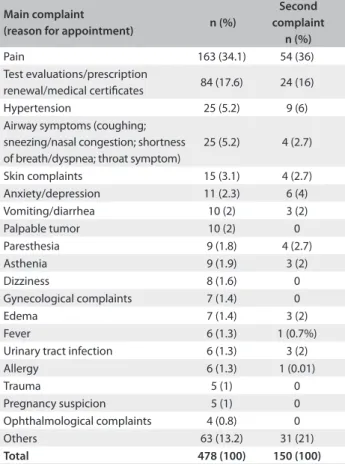
he total number of patients seen at the primary care units over the study period was 481. hree patients refused to participate in the study. hus, 478 patients were included in the study, of whom 338 (71%) were female. he patients’ mean age was 45.9 years (± 16 years). Table 1 shows the reasons for seeking consultations at the
primary care units. Pain was the most commonly reported com-plaint at all the primary care facilities.
he kinds of pain reported by patients were as follows, in fre-quency order: musculoskeletal pain (15.7%; 75/478); headache (10.4%; 50/478); abdominal pain (8%; 38/478); and chest pain
Table 1. Patients’ most frequent reasons for seeking medical consultations at primary care units
Main complaint
(reason for appointment) n (%)
Second complaint
n (%)
Pain 163 (34.1) 54 (36)
Test evaluations/prescription
renewal/medical certiicates 84 (17.6) 24 (16)
Hypertension 25 (5.2) 9 (6)
Airway symptoms (coughing; sneezing/nasal congestion; shortness of breath/dyspnea; throat symptom)
25 (5.2) 4 (2.7)
Skin complaints 15 (3.1) 4 (2.7)
Anxiety/depression 11 (2.3) 6 (4)
Vomiting/diarrhea 10 (2) 3 (2)
Palpable tumor 10 (2) 0
Paresthesia 9 (1.8) 4 (2.7)
Asthenia 9 (1.9) 3 (2)
Dizziness 8 (1.6) 0
Gynecological complaints 7 (1.4) 0
Edema 7 (1.4) 3 (2)
Fever 6 (1.3) 1 (0.7%)
Urinary tract infection 6 (1.3) 3 (2)
Allergy 6 (1.3) 1 (0.01)
Trauma 5 (1) 0
Pregnancy suspicion 5 (1) 0
Ophthalmological complaints 4 (0.8) 0
Others 63 (13.2) 31 (21)
Main reasons for medical consultations in family healthcare units in the city of Recife, Brazil: a cross-sectional study | SHORT COMMUNICATION
Sao Paulo Med J. 2015; 133(4):367-70 369
Table 3. All reasons for seeking medical consultations grouped according to the 17 chapters of the International Classiication of Primary Care (ICPC-2)
ICPC chapters n (%)
General and unspeciied 153 (32)
Musculoskeletal 95 (19.9)
Neurological 89 (18.6)
Digestive 59 (12.3)
Cardiovascular 51 (10.7)
Respiratory 30 (0.06)
Psychological 26 (0.05)
Female genital 23 (0.05)
Skin 22 (0.05)
Endocrine/metabolic and nutritional 14 (0.03)
Urological 14 (0.03)
Pregnancy, childbearing, family planning 10 (0.02)
Ear 10 (0.02)
Eye 7 (0.02)
Male genital 5 (0.01)
Blood, blood-forming organs and immune mechanism 3 (0.01)
Social problems 0
Total 478 (100)
*Chi-square test.
Pain
(main reason) Pvalue*
Test evaluations/prescription renewal/
medical certiicates (main reason) Pvalue*
More than one reason for
the medical appointment Pvalue*
Age (years)
18-39 (n = 175) 68 (38.9%)
0.04
20 (11.4%)
0.02
45 (25.7%)
0.14
40-59 (n = 203) 71 (35%) 40 (19.7%) 71 (35%)
> 59 (n = 100) 24 (24%) 24 (24%) 34 (34%)
Sex
Male (n = 139) 35 (25.2%)
0.01 21 (15.1%) 0.38 26 (18.7%) < 0.01
Female (n =339) 128 (37.8%) 63 (18.6%) 124 (36.6%)
Primary care unit
Santo Amaro (n = 47) 22 (46.8%)
0.09
4 (8.5%)
0.13
12 (25.5%)
0.06
Chié (n = 62) 19 (30.7%) 10 (16.1%) 17 (27.4%)
Alto do Maracanã (n = 322) 111 (34.5%) 65 (20.2%) 113 (35.1%)
Sinos (n = 47) 11 (23.4%) 5 (10.6%) 8 (17%)
Table 2. Association of patients’ characteristics and primary care unit with the reasons for seeking the medical consultation (1.1%; 5/478). he most frequent types of musculoskeletal pain
were back pain (33%) and joint pain (33%).
Table 2 shows the associations between the
sociodemo-graphic variables, primary care facilities and reasons for seek-ing consultations. Older individuals had signiicantly less pain and asked for more evaluations of tests, prescription renewals and medical certiicates. Women had signiicantly more pain and more reasons for seeking consultations.
Table 3 shows the reasons for seeking consultations, grouped
according to ICPC chapters. he most common reasons were in the categories of the “general and unspeciic”, “musculoskeletal”, “neurological” and “digestive” chapters.
DISCUSSION
Pain was the most frequent reason for seeking consultations at primary care units, according to our study. Other authors have also found that pain is an important reason for seeking consul-tations at primary care units.2,4 Magnago et al. found a difer-ent result, but they used a structured questionnaire that did not include pain among its options.6
Although pain is a frequent reason why patients seek medical consultations, it is not being properly evaluated and treated.4 If pri-mary care teams are trained to diagnose the causes of pain and to provide treatment for this symptom, the demand among patients for healthcare at levels dealing with cases of higher complexity, as well as overloading of emergency services, can be avoided.
A signiicant number of patients went to the primary care unit to request prescription renewals and have tests evaluated. his was concordant with what was found in other studies.4,6,7
Even though hypertension had previously been found to be one of the most frequent reasons for consultations, its fre-quency in our study was lower than what we had expected. With the aim of providing attendance for hypertension and
SHORT COMMUNICATION | Torres RCS, Marques KS, Leal KNR, Rocha-Filho PAS
370 Sao Paulo Med J. 2015; 133(4):367-70
HIPERDIA only seek medical consultations in cases of compli-cations relating to these diseases.
Women presented signiicantly more reasons for seeking medical consultations in our study. As far as we know, only one previous study evaluated what is related to the number of rea-sons for medical consultations within primary care in Brazil. hat study also found that women presented more reasons than men did, and that the number of reasons increased with advancing age.4
We found that the most common reasons for seeking medical consultation, as categorized in the chapters of the ICPC related to the “general and unspeciic”, “musculoskeletal”, “neurological” and “digestive” chapters. hese were among the most frequent reasons in another two studies,3,4 and the “general and unspeciic” category was the irst reason in one of them.4
Our study has some limitations. he primary care facilities were selected using convenience criteria and not randomly from among all the units in the city. he units selected are teaching units that regularly receive medicine undergraduates and may not be representative of the city’s primary care. Nevertheless, we tried to include primary care facilities from four of the city’s six healthcare districts. Sixty-seven percent of the patients were interviewed at a single primary care unit. However, it should be highlighted that we did not ind any signiicant diferences among the primary care facilities.
CONCLUSIONS
Pain was the most frequent reason for seeking medical attention at all the primary care facilities, followed by requests for test eval-uation, prescription renewal and medical certiicates. he most frequent type of pain was musculoskeletal pain, followed by headache and abdominal pain. he most common reasons for seeking medical consultations, according to the ICPC categories related to the general and unspeciic, musculoskeletal, neurologi-cal and digestive chapters.
REFERENCES
1. Brasil. Ministério da Saúde. DATASUS. Sistema de Informação de
Atenção Básica - Cadastramento Familiar – Pernambuco. Available from:
http://tabnet.datasus.gov.br/cgi/deftohtm.exe?siab/cnv/SIABFPE.def.
Accessed in 2015 (Mar 19).
2. Pimentel IR, Coelho BC, Lima JC, et al. Caracterização da demanda
em uma Unidade de Saúde da Família [Description of demand in
a Family Health Unit]. Revista Brasileira de Medicina de Família e
Comunidade. 2011;6(20):175-81. Available from: http://www.rbmfc.
org.br/rbmfc/article/view/95/364. Accessed in 2015 (Feb 20).
3. Colombo D, Santa Helena ET, Agostinho ACMG, Didjurgeit JSMA.
Padrão de prescrição de medicamentos nas unidades de programa
de saúde da família de Blumenau [Prescribed drugs in attendance
sampling at basic health service in Blumenau]. Rev Bras Cienc Farm.
2004;40(4):549-58.
4. Landsberg GAP, Savassi LCM, Sousa AB, et al. Análise da demanda em
Medicina de Família no Brasil utilizando a Classiicação Internacional
de Atenção Primária [Analysis of demand for family medical care in
Brazil using the International Classiication of Primary Care]. Ciênc
Saúde Coletiva. 2012;17(11):3025-36.
5. World Organization of National Colleges, Academies, and Academic
Associations of General Practitioners/Family Physicians. Classiicação
Internacional de Atenção Primária (CIAP 2)- Comitê Internacional
de Classiicação da WONCA. Florianópolis: Sociedade Brasileira de
Medicina de Família e Comunidade; 2009. Available from: http://
www.sbmfc.org.br/media/ile/CIAP%202/CIAP%20Brasil_atualizado.
pdf. Accessed in 2015 (Feb 20).
6. Magnago RF, Moreira DS, Cunha L, Sakae TM. Peril dos usuários do
posto de saúde da família do bairro Humaitá, Tubarão – SC [Proile of
users of users of the Humaitá Family care station in Tubarão, Santa
Catarina]. ACM Arq Catarin Med. 2009;38(2):7-15.
7. Radaelle SM, Takeda SMP, Gimeno LID, et al. Demanda de serviço de
saúde comunitária na periferia de área metropolitana. [The demand
for community health services in the metropolitan periphery area].
Rev. Saúde Pública. 1990;24(3):232-40.
8. Brasil. Ministério da Saúde. Secretaria de Políticas de Saúde. Departamento
de Ações Programáticas Estratégicas. Plano de reorganização da atenção
à hipertensão arterial e ao diabetes melittus. Brasília: Ministério da Saúde;
2001. Available from: http://bvsms.saude.gov.br/bvs/publicacoes/
miolo2002.pdf. Accessed in 2015 (Feb 20).
Acknowledgements: Scientiic Initiation Fellowship Institutional
Program grants (CNPq) to Rinailda de Cascia Santos Torres andKamila
de Nazaré Ribas Leal
Sources of funding: None
Conlict of interest: None
Date of irst submission: August 19, 2014
Last received: January 24, 2015
Accepted: February 9, 2015
Address for correspondence:
Pedro Augusto Sampaio Rocha Filho
Rua General Joaquim Inácio, 830 — Sala 1.412 — Edifício The Plaza
Business Center
Recife (PE) — Brasil
CEP 50070-270
Tel. (+55 81) 3129-8897