Video laparoscopic intervention for an interstitial
pregnancy after failure of clinical treatment
Intervenção videolaparoscópica na gestação intersticial
após falha com o tratamento clínico
Nilson Abrão Szylit
I, Sérgio Podgaec
II, Evelyn Traina
III, Rita de Cassia Sanches Oliveira
IVHospital Israelita Albert Einstein (HIAE), São Paulo, Brazil
ABSTRACT
CONTEXT: Interstitial pregnancy is a rare form of ectopic pregnancy for which the best therapeutic course of action has yet to be determined. Surgical intervention entails a high risk of hemorrhage due to the great vascularization of the cornual region of the uterus. Case descriptions facilitate the analysis of results and aid clinicians in determining the most appropriate course of action in these situations.
CASE REPORT: In a patient with an ultrasound diagnosis of interstitial pregnancy, clinical treatment using methotrexate was chosen. However, after one week, there was a marked decline in the serum level of the β subunit of chorionic gonadotropin hormone, although an ultrasound examination re-vealed embryonic cardiac activity. A second dose of the chemotherapy was administered. Embryonic cardiac activity persisted 48 hours later. Video laparoscopy was performed to achieve right-side cor-nual resection, which resulted in satisfactory resolution of the case.
RESUMO
CONTEXTO: A gestação intersticial é uma forma rara de gestação ectópica. A melhor opção terapêu-tica ainda não está definida, havendo risco de hemorragia com o tratamento cirúrgico, em decorrên-cia da grande vascularização na região cornual uterina. A descrição de casos facilitam a análise dos resultados e ajuda os clínicos a determinarem a melhor conduta nessas situações.
RELATO DE CASO: Em paciente com diagnóstico ultrassonográfico de gestação intersticial, optou-se por tratamento clínico com administração de metotrexate. Após uma semana, houve declínio acen-tuado do nível sérico da sub-unidade β do hormônio gonadotrófico coriônico, porém, na ultrasso-nografia, foi detectada a presença de atividade cardíaca embrionária. Foi administrada uma segunda dose do quimioterápico. Após 48 horas, a atividade cardíaca persistia. Realizou-se vídeo-laparoscopia para ressecção cornual direita, com resolução satisfatória do caso.
IMD, MSc. Volunteer at Birth Control Outpatient Clinic of Instituto Israelita de Responsabilidade Social Albert Einstein, São Paulo, Brazil. IIMD, PhD. Gynecological Clinic, Hospital das Clínicas da Faculdade de Medicina da Universidade de São Paulo, São Paulo, Brazil. IIIMD, PhD. Obstetrician and Gynecologist, Mother and Child Department, Hospital Israelita Albert Einstein (HIAE), São Paulo, Brazil. IVMD PhD. Head of Fetal Medicine, Mother and Child Department, Hospital Israelita Albert Einstein (HIAE), São Paulo, Brazil.
KEY WORDS: Pregnancy, ectopic. Laparoscopy. Ultrasonography. Prenatal care. Methotrexate.
PALAVRAS-CHAVE Gravidez ectópica. Laparoscopia. Ultrassonograia. Cuidado pré-natal. Metotrexato.
INTRODUCTION
Interstitial pregnancy is a rare form of ectopic pregnancy that occurs when a blastocyst implants between the ostium and the isthmic region of the fallopian tube, where the tube
transverses the muscle wall of the uterus.1 Interstitial pregnancy should not be confused
with cornual pregnancy, which develops in the horn of a bicornuate uterus.2 Interstitial
pregnancy accounts for 2 to 4% of all ectopic pregnancies and has a mortality rate of 2.0 to 2.5%. Accordingly, interstitial pregnancy is the main cause of maternal death in the first trimester of pregnancy, and its associated risks are approximately seven times greater
than the risks of ectopic pregnancies in general.3-6 This high maternal mortality rate can
be attributed to the possibility of rupture. If this occurs, it results in catastrophic
hemor-rhaging because of the extensive vascularization of the region.2 The treatment for
inter-stitial pregnancy remains controversial. Conservative treatment with methotrexate is an option for patients with a confirmed diagnosis who wish to preserve their reproductive
function, provided that there has not been any occurrence of uterine rupture.7 Late
diag-nosis diminishes the viability of conservative treatment or minimally invasive surgery,
was 35.6. Her Hb and Ht levels were 11.1 g/dl and 34.7, one day ater this procedure. No complications occurred, and the patient made a very good recovery. She was released two days ater the procedure.
DISCUSSION
he isthmic portion of the fallopian tube, which transverses the uterine wall, is the segment that commences at the ostium of the fallopian tube and ascends laterally to the exterior of the uterus. It measures 0.7 mm in diameter and 2 cm in length, and is the region where the tube is enclosed by a thin ilm of uterine mus-cle tissue. he anatomy of the isthmic portion of the fallopian tube is thought to enable greater expansion than is possible in other tubular regions. As a consequence, interstitial pregnancy
can persist, in rare cases, asymptomatically for up to 16 weeks.1
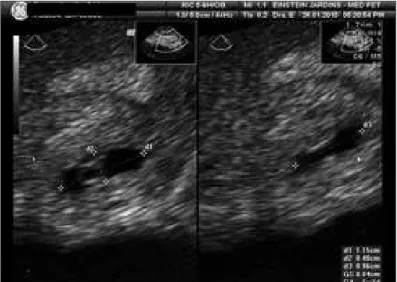
Figure 1. Gestational sac at time of diagnosis of interstitial pregnancy.
Figure 2. Embryonic cardiac activity in a case of interstitial pregnancy.
CASE REPORT
The patient was 33 years old and had a history of having deliv-ered a baby by caesarian section 23 months before the proce-dure reported here. Six months prior to that delivery, she had undergone laparoscopic myomectomy of the right cornual region, excision of ovarian cysts on the left side and resec-tion of the terminal ileum, cecum and appendix because of endometriosis. The patient had not undergone any reproduc-tive treatments. Given the characteristics of the case and the requirements under the code of conduct, the protocol did not require submission of this study to the ethics committee at Hospital Israelita Albert Einstein (HIAE).
The patient presented a five-day menstrual delay,
β-fraction human chorionic gonadotropin (β-hCG)
con-centration of 11,631 mIU/ml, and did not show any clinical signs such as pelvic floor pain or vaginal bleeding. Transvagi-nal ultrasonography revealed an empty uterine cavity and the presence of an oval entity between the endometrial cavity and the extrauterine tubular region. A thin rim of myometrial tis-sue (cross-sectional area, 17 mm x 15 mm) encircling an echo-genic center (11 mm x 4 mm x 9 mm) suggestive of a gesta-tional sac with an interior vitelline vesicle 2.3 mm in diameter
was observed (Figure 1), and Doppler velocimetry indicated
peripheral flow. These findings corresponded to a gestation period of 5.5 weeks.
Serial measurements of serum β-hCG concentrations
showed an increase to 21,281 mIU/ml, 48 hours later. In such cases, an intramuscular injection of methotrexate at a
dos-age of 50 mg/m2 of body surface area is recommended in the
treatment protocols used for extrauterine pregnancies.7 In
this case, a 96-mg dose, corresponding to the patient’s height of 1.76 m, was used. One week later, the patient’s serum
β-hCG concentrations showed a significant decrease (to
18,144 mIU/ml), and the patient remained asymptomatic. However, routine transvaginal ultrasonography revealed a small increase in the size of the gestational sac and
embry-onic cardiac activity (Figure 2).
Given the abovementioned indings, a decision was made to give a second intramuscular injection of methotrexate, with ultrasonographic control 48 hours later. he patient’s
serum β-hCG concentrations continued to decrease (to 14,212
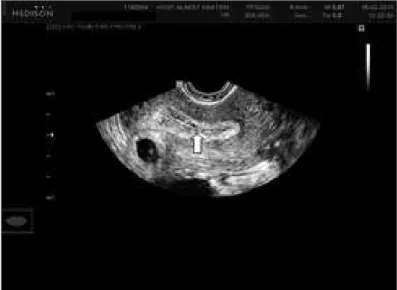
mIU/ml), but embryonic vitality persisted. he gestational sac increased longitudinally in size, in the direction of the isthmic
portion of the fallopian tube (Figure 3 and 4). Ater
discuss-ing the risks associated with progression of the gestational sac, such as rupture of the fallopian tube, the couple in question opted for video laparoscopy to resect the right-side section of the cornua
(Figure 5). he procedure was completed without any
Figure 3. Gestational sac next to endometrium in a case of interstitial pregnancy. White arrow shows the empty uterine cavity.
Figure 4. Gestational sac growing into the fallopian tube (white arrow).
Figure 5. Laparoscopic image. White arrow shows gestational sac.
On the other hand, recent evidence has demonstrated that rupture in an interstitial pregnancy always occurs before 12
weeks.1 Other forms of ectopic pregnancy present similar
rup-ture time ranges, namely, seven to nine weeks.9 In two reports
relating to interstitial pregnancy, it was concluded that the
aver-age gestation periods at the time of the diagnosis were 6.9 ± 0.3
weeks1 and 8 ± 2 weeks,10 respectively. hese indings were
simi-lar to what was reported from a prospective study on 119 cases of ectopic pregnancy that were not interstitial (6.8 to 8.8 weeks
gestation).11
he patient whose case is reported here had undergone uterine surgery and appendectomy because of endometrio-sis: both of these were risk factors that supported investigating the possibility of an ectopic pregnancy. High-resolution trans-vaginal ultrasonography is the primary method used to diag-nose ectopic pregnancy, thus enabling diagnosis prior to uter-ine rupture. hree-dimensional transvaginal ultrasonography has some advantages over two-dimensional transvaginal ultra-sonography, in that it enables viewing of the cornual area of the uterus, which facilitates diferentiation between an interstitial
and a corneal gestational site.12-15
Early diagnosis makes conservative treatment with methotrexate feasible, which avoids the risks associated with surgical procedures and preserves reproductive func-tions. Local or systemic administration of methotrexate, or a combination of the two, can be used. The course of treat-ment most often used is one or two cycles of intramuscular injection of methotrexate. The success rates of local injec-tion and of combined or systemic treatment vary between
62.5 and 83%.1,2,16,17 Although many authors have
recom-mended a particular serum β-hCG concentration as a crite-rion for proceeding with conservative treatment using meth-otrexate, there is no consensus in the literature regarding
the safety and expected outcome of this method.1 Generally,
cases of interstitial pregnancy are associated with elevated
serum β-hCG levels.7
Tulandi and Al-Jaroudi1 reported that in three patients for
whom methotrexate treatment failed, the serum β-hCG lev-els ranged from 600 to 13,420 mIU/ml. Given this wide range, serum β-hCG levels may not be a good predictive measure-ment of success in clinical treatmeasure-ment for cases of interstitial pregnancy. In another study, the success rate of systemic meth-otrexate treatment for interstitial pregnancy exceeded 80% in patients with serum β-hCG levels up to 106,634 IU/l, even
when an embryonic heartbeat was present.18
treatment diminishes the proliferation of the trophoblast, even
though it fails to cause embryonic death.2 When cardiac activity
is observed, the recommended treatment is an intra-amniotic injection of potassium chloride and methotrexate, guided by
transvaginal ultrasonography.1,7,13 In the case reported here, the
initial treatment chosen was a single intramuscular injection of methotrexate. his treatment has the advantages of generally being highly efective, not causing any side efects and avoiding
possible complications associated with a surgical procedure.18
One week ater the initial dose, the patient’s serum β-hCG con-centration had decreased by over 15%, which is considered to
be suicient decline on the seventh day ater treatment.7
Never-theless, transvaginal ultrasonography examination detected an embryo with cardiac activity.
A second dose of methotrexate is recommended when serum β-hCG levels do not decrease properly. In a review on 20 cases, a second dose was required in 30% of them, with a
success rate of 94%.18 Ater conservative treatment with
metho-trexate, it is necessary to continue making regular examinations on the patient, because of the risk of rupture, and to measure serum β-hCG levels to assess whether the treatment was suc-cessful. Serially repeated transvaginal ultrasonographic exam-inations are not necessary, since the diferences that can be detected in such examinations are not indicative of, or able to
predict, treatment failure.18,19
Nevertheless, the evidence of embryonic cardiac activity one week ater the initial treatment, despite a signiicant decrease in serum β-hCG levels, showed that one follow-up transvaginal ultrasonographic examination was indispensable in our case. In the present case, the option of repeating the systemic dose was chosen, with a follow-up transvaginal ultrasonography, in the hope that embryonic cardiac activity would cease spontane-ously. his approach has been shown to be successful in other
cases described previously in the literature.1,13
When embryonic cardiac activity is present, local injection of 2 mEq/ml potassium chloride with 1 mg/kg of methotrexate into the gestational sac, guided by transvaginal
ultrasonogra-phy, produces good results.1,2,7,20,21 Although a local injection is
relatively safe and effective, it does require extensive technical training and experience. The cornual region is highly
vascu-larized and there is a risk of a puncture-related hemorrhage.9
Additionally, some authors have reported side effects in more
than 40% of patients treated with multiple doses.22
Regarding surgical treatment, the most notable immediate risk is hemorrhage during surgical manipulation of the
myo-metrial tissue.1,13 Considering that, in the present case,
embry-onic cardiac activity persisted even after the second treatment with methotrexate, the risks and benefits of a local injection of potassium chloride and methotrexate and the option of lap-aroscopy were discussed with the couple. The couple opted for
minimally invasive video laparoscopic surgery. This procedure preserves the patient’s fertility and also enables fast recovery that allows the patient to resume regular activities quickly. In the present case, it is possible that the successful laparoscopic resection with minimal blood loss that was achieved can be attributed to the preceding treatment with methotrexate,
which had attenuated trophoblast development.23 Treatment
of interstitial pregnancy using methotrexate in conjunction with embolization of the uterine arteries, with transcervical suction under laparoscopic and hysteroscopic guidance and with dactinomycin as second-line chemotherapy has also been
reported recently.24-28
he most appropriate treatment for interstitial pregnancy remains undeined and always requires individualization for each patient. he choice of treatment will depend on the initial serum β-hCG levels and whether an embryo is present, as well as the local resources available and the experience of the medi-cal team. Depending on each patient’s clinimedi-cal proile, and pro-vided that there is no imminent risk of rupture, treatment with methotrexate can be considered as a irst line of treatment. It should, however, be followed by ultrasonographic examination. he decline in serum β-hCG levels cannot be used as the sole measurement of success, since it does not guarantee involution of the pregnancy. Video laparoscopy remains a safe and eicient treatment option for interstitial pregnancy when pharmacolog-ical treatment is unsuccessful.
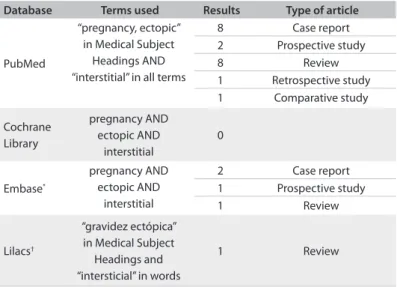
Since occurrences of interstitial pregnancy are rare and the options for treatment decisions remain open, we carried out a review of the literature in order to complete this report. In PubMed, we searched for the term “pregnancy, ectopic” in the medical subject headings, and the term “interstitial” in all words. he date range for this search was from July 31, 2005, to July 30, 2010, in the English or Portuguese languages. In Lilacs (Literatura Latino-Americana e do Caribe em Ciências da Saúde), we searched for the term “gravidez ectópica” in the subject and “intersticial” in all words. he date range for this search covered ive years prior to July 30, 2010. In the Cochrane Library, we searched for the expression “interstitial pregnancy”. he date range for this search covered ive years prior to July 30, 2010. In the Embase database, we searched for the expres-sion “interstitial pregnancy” in “all ields”. he date range for this search covered ive years prior to February 23, 2011.
In PubMed, we found 55 papers, and 20 of them related directly to treatment. In Lilacs, we found only one paper (in Portuguese), which had already been selected from the PubMed
database.7 In the Cochrane Library, we found seven references,
which all dealt with other types of ectopic pregnancy. In the Embase databases, we found 45 references. Four of these were
directly pertinent to our study: two case reports,23,24 one
been selected from the PubMed database. A descriptive
sum-mary of these searches is presented in Table 1.
Since interstitial pregnancy is a rare form of ectopic preg-nancy, conducting a randomized study would be problematic. Hence, case studies documenting the experiences of diferent medical teams are important, since they facilitate future reviews of the evidence and add to the medical knowledge base perti-nent to this condition. hus, documentation of more cases will enable analysis across cases and aid in establishing improved medical practices.
CONCLUSION
In the case presented here, methotrexate was not efective for treating an interstitial pregnancy. Persistent embryonic cardiac activity indicated a second dose, without success. Resection was done successfully using video laparoscopy.
REFERENCES
1. Tulandi T, Al-Jaroudi D. Interstitial pregnancy: results generated from
the Society of Reproductive Surgeons Registry. Obstet Gynecol.
2004;103(1):47-50.
2. Lau S, Tulandi T. Conservative medical and surgical management of
interstitial ectopic pregnancy. Fertil Steril. 1999;72(2):207-15.
3. Bouyer J, Coste J, Fernandez H, Pouly JL, Job-Spira N. Sites of ectopic
pregnancy: a 10 year population-based study of 1800 cases. Hum
Reprod. 2002;17(12):3224-30.
4. DeWitt C, Abbott J. Interstitial pregnancy: a potential for misdiagnosis
of ectopic pregnancy with emergency department ultrasonography.
Ann Emerg Med. 2002;40(1):106-9.
5. Berg CJ, Chang J, Callaghan WM, Whitehead SJ. Pregnancy-related mortality
in the United States, 1991-1997. Obstet Gynecol. 2003;101(2):289-96.
6. Walker JJ. Ectopic pregnancy. Clin Obstet Gynecol. 2007;50(1):89-99.
7. Elito Junior J, Montenegro NA, Soares RC, Camano L. Gravidez ectópica
não rota: diagnóstico e tratamento. Situação atual [Unruptured
ectopic pregnancy: diagnosis and treatment. State of art]. Rev Bras
Ginecol Obstet. 2008;30(3):149-59.
8. Lewis G. Conidential Enquiry into Maternal and Child Health. Saving
Mothers’ Lives: reviewing maternal deaths to make motherhood
safer - 2003-2005. The Seventh Report on Conidential Enquiries into
Maternal Deaths in the United Kingdom. London: CEMACH; 2007.
Available from:
http://www.cemach.org.uk/getattachment/26dae364-
1fc9-4a29-a6cb-afb3f251f8f7/Saving-Mothers’-Lives-2003-2005-(Full-report).aspx. Accessed in 2011 (Jun 6).
9. Moawad NS, Mahajan ST, Moniz MH, Taylor SE, Hurd WW. Current
diagnosis and treatment of interstitial pregnancy. Am J Obstet
Gynecol. 2010;202(1):15-29.
10. MacRae R, Olowu O, Rizzuto MI, Odejinmi F. Diagnosis and laparoscopic
management of 11 consecutive cases of cornual ectopic pregnancy.
Arch Gynecol Obstet. 2009;280(1):59-64.
11. Elito Junior J, Camano L. Unruptured tubal pregnancy: diferent
treatments for early and late diagnosis. Sao Paulo Med J.
2006;124(6):321-4.
12. Araujo Júnior E, Zanforlin Filho SM, Pires CR, et al. Three-dimensional
transvaginal sonographic diagnosis of early and asymptomatic
interstitial pregnancy. Arch Gynecol Obstet. 2007;275(3):207-10.
13. Jermy K, Thomas J, Doo A, Bourne T. The conservative management
of interstitial pregnancy. BJOG. 2004;111(11):1283-8.
14. Patel MD. “Rule out ectopic”: Asking the right questions, getting the
right answers. Ultrasound Q. 2006;22(2):87-100.
15. Kirk E, Bourne T. The nonsurgical management of ectopic pregnancy.
Curr Opin Obstet Gynecol. 2006;18(6):587-93.
16. Smorgick N, Vaknin Z, Pansky M, et al. Combined local and systemic
methotrexate treatment of viable ectopic pregnancy: outcomes of
31 cases. J Clin Ultrasound. 2008;36(9):545-50.
17. Lin YS, Chen CL, Yuan CC, Wang PH. Successful rescue of an early
interstitial pregnancy after failed systemic methotrexate treatment:
a case report. J Reprod Med. 2007;52(4):332-4.
18. Tang A, Baartz D, Khoo SK. A medical management of interstitial
ectopic pregnancy: a 5-year clinical study. Aust N Z J Obstet Gynaecol.
2006;46(2):107-11.
19. Dudley PS, Heard MJ, Sangi-Haghpeykar H, Carson SA, Buster JE.
Characterizing ectopic pregnancies that rupture despite treatment
with methotrexate. Fertil Steril. 2004;82(5):1374-8.
20. Chou MM, Tseng JJ, Yi YC, Chen WC, Ho ES. Diagnosis of an interstitial
pregnancy with 4-dimensional volume contrast imaging. Am J
Obstet Gynecol. 2005;193(4):1551-3.
Table 1. Studies relating to “interstitial pregnancy” between 2005 and 2010, found in the PubMed, Cochrane Library, Lilacs and Embase databases. These searches were made on July 30, 2010, for the first three databases, and on February 23, 2011, for the last of these databases
Database Terms used Results Type of article
PubMed
“pregnancy, ectopic” in Medical Subject
Headings AND “interstitial” in all terms
8 Case report 2 Prospective study
8 Review
1 Retrospective study 1 Comparative study Cochrane Library pregnancy AND ectopic AND interstitial 0 Embase* pregnancy AND ectopic AND interstitial
2 Case report 1 Prospective study
1 Review
Lilacs†
“gravidez ectópica” in Medical Subject
Headings and “intersticial” in words
1 Review
21. Chetty M, Elson J. Treating non-tubal ectopic pregnancy. Best Pract
Res Clin Obstet Gynaecol. 2009;23(4):529-38.
22. Cassik P, Oili-Yebovi D, Yazbek J, et al. Factors inluencing the success
of conservative treatment of interstitial pregnancy. Ultrasound Obstet
Gynecol. 2005;26(3):279-82.
23. Ciavattini A, Cerè I, Tsiroglou D, Caselli FM, Tranquilli AL.
Angular-interstitial pregnancy treated with minimally invasive surgery after
adjuvant methotrexate medical therapy. JSLS; 2007;11(1):123-6.
24. Deruelle P, Lucot JP, Lions C, Robert Y. Management of interstitial
pregnancy using selective uterine artery embolization. Obstet
Gynecol. 2005;106(5 Pt 2):1165-7.
25. Cai Z, Wang F, Cao H, Xia Q. Transcervical suction of interstitial
pregnancy under laparoscopic and hysteroscopic guidance. J Minim
Invasive Gynecol. 2009;16(6):761-4.
26. Fujioka S, Yamashita Y, Kawabe S, et al. A case of a
methotrexate-resistant ectopic pregnancy in which dactinomycin was efective as
a second-line chemotherapy. Fertil Steril. 2009;91(3):929.e13-5.
27. Tamarit G, Lonjedo E, González M, et al. Combined use of uterine artery
embolization and local methotrexate injection in interstitial ectopic
pregnancies with poor prognosis. Fertil Steril. 2010;93(4):1348.e1-4.
28. Takeda A, Koyama K, Imoto S, et al. Successful management of
interstitial pregnancy with fetal cardiac activity by
laparoscopic-assisted cornual resection with preoperative transcatheter uterine
artery embolization. Arch Gynecol Obstet. 2009;280(2):305-8.
Sources of funding: None
Conlict of interest: None
Date of irst submission: January 5, 2011
Last received: June 15, 2011
Accepted: July 11, 2011
Address for correspondence:
Nilson Abrão Szylit
Rua Dr. Renato Paes de Barros, 750 — cj. 24
Itaim Bibi — São Paulo (SP) — Brasil
CEP 04530001
Tel. (+55 11) 3078-5011