Original Article 363
-POPULAR KNOWLEDGE AND PRACTICES REGARDING HEALTHCARE
USING MEDICINAL PLANTS
Marcio Rossato Badke1, Maria de Lourdes Denardin Budó2, Neide Aparecida Titonelli Alvim3, Gilberto Dolejal Zanetti4, Elisa Vanessa Heisler5
1 Master in Nursing. Assistant Professor, Department of Health Sciences, Universidade Federal de Santa Maria (UFSM). Rio Grande do Sul, Brazil. E-mail: [email protected]
2 Ph.D. in Nursing. Associate Professor, Nursing Department and Nursing Graduate Program, UFSM. Rio Grande do Sul, Brazil. E-mail: [email protected]
3 Ph.D. in Nursing, Associate Professor, Fundamental Nursing Department, Anna Nery School of Nursing, Universidade Federal do Rio de Janeiro. Fellow of the CNPq Productivity Program. Rio de Janeiro, Brazil. E-mail: [email protected] 4 Ph.D. in Botany. Adjunct Professor, Universidade Federal do Rio de Janeiro. Rio de Janeiro, Brazil. E-mail: zanettigd@yahoo.
com.br
5 Nurse. Rio Grande do Sul, Brazil. E-mail: [email protected]
ABSTRACT: The objective of this study was to identify the origin of the knowledge and practices regarding the therapeutic use of medicinal plants, by individuals living in a community in the central region of Rio Grande do Sul, Brazil. This is a qualitative study, in which the data collection was performed through semi-structured interviews and participant observation. The participants were selected through their own relationship network. A thematic analysis of the data was performed. It was found that the participants
learn how to use and manage medicinal plants in their family context; it is highlighted that women have a strong inluence on the
transmission of this particular knowledge; they usually obtain the plants at their own homes; and most plants that are used also have
their indication supported by scientiic evidence. It is believed that the present study is important for nurses and the society as a whole, as it points to the need for an approximation between popular and scientiic knowledge, as well as the need to invest in projects that
address this particular topic.
DESCRIPTORS: Nursing. Medicinal plants. Careful nursing. Collective health.
SABERES E PRÁTICAS POPULARES DE CUIDADO EM SAÚDE COM O
USO DE PLANTAS MEDICINAIS
RESUMO: Objetivou-se conhecer a origem dos saberes e das práticas sobre o uso terapêutico de plantas medicinais, por moradores de comunidade da região central do Estado do Rio Grande do Sul, Brasil. Trata-se de uma pesquisa qualitativa, com coleta de dados por meio de entrevista semiestruturada e observação participante. Os entrevistados foram selecionados por meio da rede de relações dos mesmos. Para análise dos dados foi utilizada a análise temática. Constatou-se que o aprendizado do uso e manipulação de plantas
medicinais teve sua origem no contexto familiar; ressaltou-se a inluência da mulher na transmissão desse conhecimento; que as plantas são obtidas geralmente na própria residência; e grande parte das plantas utilizadas encontram respaldo no saber cientíico. Acredita-se
que a pesquisa tenha relevância para enfermeiros e sociedade como um todo, apontando para uma necessária aproximação entre o
saber popular e o cientíico, bem como para investimentos em projetos que trabalhem com essa temática.
DESCRITORES: Enfermagem. Plantas medicinais. Cuidados de enfermagem. Saúde coletiva.
SABERES Y PRÁCTICAS POPULARES EN EL CUIDADO DE LA SALUD
CON EL USO DE PLANTAS MEDICINALES
RESUMEN: El objetivo fue conocer el origen de los conocimientos y prácticas sobre el uso terapéutico de plantas medicinales por los residentes de la comunidad en la región central de Rio Grande do Sul, Brasil. Se trata de una investigación cualitativa con recolección de datos que se dio a través de entrevistas semi-estructuradas y observación participante. Los encuestados fueron seleccionados a través de la misma red de relaciones. Los datos fueron analizados a través del análisis temático. Se encontró que: aprender el uso y
manipulación de las hierbas medicinales tiene su origen en el contexto familiar; se resaltó la inluencia de la mujer en la transmisión
de los conocimientos, las plantas se encuentran generalmente en el hogar, la mayoría de las plantas utilizadas son respaldadas por el
conocimiento cientíico. Se cree que la investigación tiene relevancia para los enfermeros y la sociedad en su conjunto, que apunta a una conexión necesaria entre el conocimiento popular y cientíico, así como para inversiones en proyectos que trabajan con este tema.
INTRODUCTION
Since the ancient times, human societies ac-cumulate information and experience about the environment around them, so they can interact with it and obtain their needs for survival.1 Among the many practices disseminated by popular culture, plants have always had a fundamental importance for many reasons, particularly because of their therapeutic use that is applied across generations.
In the beginning of civilizations, care and health were developed by women, who obtained their knowledge within the family, being exempt from any prestige or social power.2 Therefore, it became clear there was a close relationship be-tween women and plants, because they were the main therapeutic resource used to treat the health of people and their families.
However, with the advancements in health sciences, new ways to treat and cure diseases emerged, such as the use of industrialized medica-tions, gradually introduced in people’s everyday lives, not only through healthcare professionals but also through the advertisement of the labo-ratories that manufactured those drugs, with the promise to cure a variety of diseases.
In spite of the development of synthetic drugs, medicinal plants remained as an alternative form of treatment in several parts of the world, and over the last decades it has been observed there has been an increase in the use of plant-based solutions for therapeutic purposes.3
Currently, several factors have contributed to the increase in the use of medicinal plants, such
as the high cost of industrialized drugs, the difi -cult access of the population to medical care, and the tendency to use natural products. It is believed
that care using medicinal plants is more beneicial
to human health, provided the user knows about its purposes, risks and benefits. Furthermore, healthcare professionals, particularly nurses, should consider popular medicinal plants in their practice, thus promoting unique care, centered on the beliefs, values, and lifestyles of the people receiving the care.4
The legitimization and institutionalization of healthcare approaches, focused on traditional medicine in Brazil, was initiated in the 1980’s, particularly after the Unified Health System (Sistema Único de Saúde - SUS) was established. Years later, the National Policy for Integrative and Complementary Practices (Política Nacional
de Práticas Integrativas e Complementares - PNPIC) was created in the SUS, implemented by the Ministry of Health Ordinance 971, on May 3, 2006.5 The objective of the PNPIC was to broaden the therapeutic choices for SUS clients, including the use of medicinal plants, guaranteeing safe, effective and quality access to phytotherapeutics and related services, from the perspective of com-prehensive healthcare.6 In addition, the National Program for Medicinal Plants and Phytotherapeu-tics, implemented in 2007, aims to “guarantee the Brazilian population a safe access to and rational use of medicinal plants and phytotherapeutics, promoting a sustainable use of biodiversity, and the development of the productive chain and the national industry”.7:7
With a view to reach this goal, one of the main propositions of the referred program is to “promote and acknowledge the popular and tra-ditional practices involving the use of medicinal plants, phytotherapeutics and home remedies”.7:7 Thus, in February 2009, the Ministry of Health an-nounced the National List of Medicinal Plants of Interest to the SUS (Relação Nacional de Plantas Medicinais de Interesse ao SUS - Renisus), which includes 71 plant species used by popular wisdom
and scientiically conirmed.8
Considering the public policies, and in regards to the popular healthcare practices, the objective of the present study was to identify the origin of popular knowledge and practices regard-ing the therapeutic use of medicinal plants by a community located in the central region of the state of Rio Grande do Sul (RS). The main socio-cultural relevance of the present study is to
estab-lish a connection between popular and scientiic
knowledge, thus allowing for an approximation between people and healthcare services, including the professionals working there, with special em-phasis, herein, on nurses, with the perspective of comprehensive healthcare, presupposes respect-ing the differences and the sociocultural contexts of the people receiving the care.
METHODOLOGY
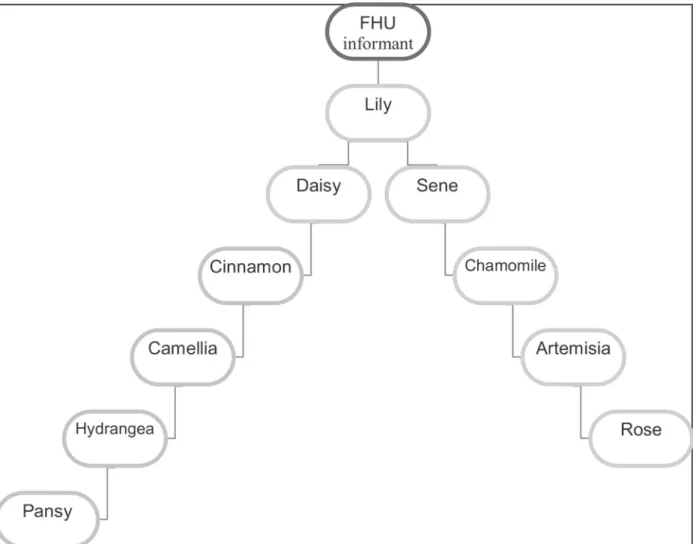
The participants were ten individuals - eight women and two men – who lived in the area covered by the referred FHU. The inclusion criteria were: be a resident of the area covered by the Family Health Unit, have 18 years of age or more, and use medicinal plants for healthcare. The subjects were selected considering their indication of people from their relationship network, which consists of a process in which “each participant refers other members from their network for sub-sequent investigations”.11:69
The aforementioned network was initiated when the community health agent from the FHU, who lived in the neighborhood and knew a large part of the local population, contacted one indi-vidual who used medicinal plants and scheduled
the irst interview. After being interviewed, the
participant indicated two people who he believed also used medicinal plants for healthcare, and, successively, each interview helped form the re-lationship network was formed.
Figure 1 – Relationship network comprised of the study participants
In order to know the origin of the par-ticipants’ knowledge and practice regarding the therapeutic use medicinal plants for healthcare, data collection was performed through semi-structured interviews and participant observa-tion conducted at their homes,10 performed in the period from March to June of 2008, always in the morning, between 8 and 12 o’clock. This type of observation is used to complement the data from the interview, and it does not require a longer
period of interaction as do traditional participant observations.10 The interviews were recorded us-ing a digital device (MP4) and later transcribed.
With the purposed to organize the data col-lection, an interview and observation script was created, consisting of six items: origin of the plant (purchased, own garden, or donation); harvest, cleansing, storage and conservation of the plants; mode of preparation; part of the plant that is used
-tions of the plants (sate of conservation, cleanliness, color, smell, taste); storage and conservation after the preparation (if the tea, for instance, was pre-pared at the time of drinking, kept warm or cold in a thermal bottle, in the refrigerator or at room temperature); and the place it was planted (garden, accessible to domestic animals, close to septic tanks, open sewers, close to breeding areas). The referred
items were observed and noted on the ield diary.
The data from the interviews and the
ob-servations made on the ield diary were submit -ted to thematic content analysis, which consists of identifying the meaning units comprising a communication.12 Three stages are involved: pre-analysis, which consists in choosing and organiz-ing the material; the exploration of the material, a
classiicatory operation used with the purpose of
reaching the meaning unit of the text; results were treated according to the inference and interpreta-tions. Hence, the analysis was performed after reading the material and identifying the reality, thus revealing the categories according to their relevance for the study.12
It is emphasized that the present study is in agreement with the ethical premises of the National Health Council/Ministry of Health
Reso-lution 196, of October 10 1996, which deines the
principles of bioethics regarding human research.13 The research proposal was approved by the Re-search Ethics Committee at Universidade Federal de Santa Maria, under number 23081.020270/2007-64 and CAE 0207.0.243.000-07.
All the participants signed the Free and Informed Consent Form, after being individually informed about the study objectives, as well as of
the beneits it would provide, and, yet, that they would be assured privacy and conidentiality in terms of their identiication, and only the infor -mation they provided would be used in this and further studies. Therefore, the participants were assigned codenames, using the names of plants, as presented in Figure 1. Finally, it was also explained that the study did not involve any risks, nor were they obligated to participate, as they could with-draw from the study at any time. Each participant agreed on a time when they could be observed handling the plants and when the conversations would be recorded for study purposes.
RESULTS AND DISCUSSION
In order to discuss about the origin of the participants’ knowledge and practices regarding
the therapeutic use of the medicinal plants, the following categories were used: “I grew up with this”, which reports how they learned to use the medicinal plants; “I plant to have them at home”, a description of how they the plant is obtained; and “Approximation between popular knowledge and
scientiic knowledge”.
“I grew up with this”
In this category, it is described how the par-ticipants learned to use the medicinal plants. When
asked, seven participants mentioned that their irst
contact with the medicinal plants occurred in their childhood, when they saw this practice being per-formed by their mothers and grandmothers. The other three participants reported they learned this practice as adults, motivated by their need because
of the dificult access to healthcare services, espe -cially at night and/or due to a personal interest, because it is a natural therapy.
In general, the knowledge was transmit-ted verbally from one person to the other, which
agrees with studies that mention that the irst
manifestations of this particular knowledge being during childhood, and pass from one generation to the other.14 One example can be observed in the statement by Ms. Sene, who, when asked about how she learned to use the plants, mentioned: since childhood, since we were children. I grew up with this [tea]. My mother [taught me]. Mother was very helpful with these things for tea... (Sene).
This manifestation reinforces the mode of knowledge transmission about medicinal plants, supported on the affective relationship between the woman-mother and her children, in an attempt to pass on her knowledge to the next generations. Nearly all participants mentioned having learned to use medicinal plants with women; eight men-tioned the mother, grandmother, or older sister as the main transmitter of this knowledge.
The female importance, above all, of the
mother igure in transmitting this type of knowl -edge, is expressed in the following reports:
[...] I learned with my mother, who taught it. She prepared it when we were little. Then she had us prepare it. She would put it in a little cup, and then she would come and put boiling water on top. (Chamomile).
[...] it was my mother. She taught me when I was little [...]. She had this thing about making tea (Artemisia).
of view, of health care to those living under her roof. Depending on the contexts in which she lives,
the female igure is often overwhelmed, because of
the cultural values assigned to her, forcing them to assume responsibilities that could be shared with other members of the family.17
On participant said she learned on her own, by testing the properties of the plant on herself. Another participant mentioned learning about the curative property of the plants through an older women, a stranger, who casually passed in front of his house, talked to him, learned about his backache and recommended he use sarsaparilla, in the form of a home-made tea.
The answers as to how the participants learned to use the medicinal plants agree with the studies on this particular topic, highlight-ing that most use them to take care of their own health or of the health of family members, and that this knowledge is usually transmitted in the
socio-familiar context. It is, therefore, conirmed
that the therapeutic use of plans is a millenary practice, historically constructed on common sense knowledge, which combines culture and health, considering that these aspects do not occur alone, but, rather, are inserted within a historically de-termined context.15-18
Throughout the interviews, it was notices
how fulilling it was for the participants to remem -ber of the family relationships, the affection and tenderness they received from the person who taught them this complementary healthcare prac-tice. These memories suggest that learning and maintaining this practice persisted through time, in part, because of these socio-affective bonds.
In addition to the fact that the access to this type of knowledge is disseminated by family and
neighborhood relationships, scientiic studies on
these plants have also provided the population with information through several types of media, such as newspapers, magazines, radio and
televi-sion. It was observed that ive participants were
interested in studying and improving their knowl-edge about the therapeutic properties of plants. They had books, magazines, and notebooks with information about the use of medicinal plants, which they obtained in the media and other sourc-es. Two of these participants mentioned they have delivered lectures about herbs to the community, in the FHU health groups, as a way to disseminate and increase their knowledge.
Although the knowledge and practices are kept in their original places, something transits
among them, because some individuals have ac-cess to the production of science and vice-versa. In this sense, they maintain their beliefs rooted to
their family culture, and some seek, in scientiic knowledge, as in the case of these ive participants,
to understand and complement their popular knowledge.
On the other hand, science is interested in this popular knowledge, including in its expropriation.
Scientiic evidence of the use of some medicinal
plants is one of the ways of showing the motiva-tors of this rescue.18 For this reason, the Ministry of Health announced the National List of Medicinal Plants of Interest to the SUS (Relação Nacional de Plantas Medicinais de Interesse ao SUS - Renisus), which includes 71 plant species used by popular
wisdom and with scientiic evidence, with the
objective to guide studies that could support the creation of a list of the available safe and effec-tive phytotherapeutics for the population for the treatment of several diseases.8 Therefore, it is high-lighted that it is necessary to approximate family
– popular – knowledge and scientiic – professional
– knowledge, valuing the previous experiences of the community, because there are intimately imbricated with their cultural context. Hence, it is evinced that the knowledge and practices of care must be shared. In this view, the present study emphasized the importance of forming an alliance between popular and academic knowledge, thus allowing for the reconstruction of the knowledge about complementary health practices.4-17
Furthermore, ive participants mentioned
they kept all the knowledge they obtained about plants over the years only in their minds (memory). Therefore, it was observed that human memory serves as one of the ways of recording
popular knowledge. On the other hand, scientiic
knowledge requires systematic observation and detailed records of events and facts.
“I plant to have them at home”
During the interview, the participants were asked about how they obtained the plants, and all of them mentioned they planted some of them at home, such as Boldo, Lemon balm, Guaco and Rosemary; while others were bought at the popu-lar street markets or, yet, obtained from rural areas (Macela and Chamomile) or forests (Guabiroba and Horsetail).
empha-size on the importance of planting them in a clean environment and without the use of pesticides. In other words, cultivating them at home is a way of controlling the quality of these aspects. Eight par-ticipants made this same statement, mentioning the need to know the origin of the herbs, because, as they say, the conditions in which they were planted, harvested, and stored interfere in their medicinal properties. Their preference for plants
of which they know the origin is justiied because,
some of them, when purchased, have a different color, smell moldy and look dirty, making them doubt not only about whether they can be used, but also about their therapeutic properties. This concern is observed in the following statements:
[...] today we see that there are only a few people selling herbs. And they don’t work like they should, because the remedies after being harvested, they should be stored in a plastic bag with little holes so there is no air inside or else the remedy gets moldy. And they don’t do this. One time I noticed an Indian, who now has already died, I saw him put the herb remedy to sell downtown, he used to pick Macela and other stuff, and people used to lay on it, even dogs. What a rude Indian, he had no hygiene. And the remedy, no matter which one, you must have hygiene, because hygiene is part of health (Lilly).
[...] I never bought [medicinal plants], because I don’t know how what they do [with the plant], how those plants are prepared (Hydrangea).
In general, the interviews and ield observa -tions revealed that the participants’ taste for the plants and the desire to plant the herbs at their own homes are common feelings among all the participants. It was observed that the medicinal plants are usually cultivated in a garden, which consist of areas of usually three to four meters long by two to three meters wide, located around the house, always away from the septic tank or any other possible source of contamination. Only one
participant did not take this speciic care. At his
house, it was observed there were animals, such as a dog, cat, and hens around the yard, and inside his house as well. In this case, as we observed him preparing the tea, he was very carful to wash the plant well, and stated that animals might be around, but there must be hygiene when making the tea (Lilly).
At the homes with gardens, it was observed that there was some kind of protection around them to keep out any animals that could harm or contaminate the plants. This protection usu-ally consisted of a screen fence. One participant
used two-liter plastic bottles illed with water to
make them heavy, so that when they were placed opposite each other, in a vertical position, they could protect the garden from creeping animals. This way, the animals were unable to trespass the bottles. The bottles were also positioned this way to hold in the fertilizers during the rainy seasons. Regarding fertilizers, it was observed they only used organic fertilizers, made from the rest of fruits, greens, and vegetables.
It was also observed that other cultivation
locations, such as lowerpots and plastic pots, were
always located around the house or even inside it. This form of cultivation is common at the homes of participants who did not have a garden, either because their property was too small or because they did not want a garden, as well as for those who once had a garden but no longer do. Examples of this are Ms. Sene and Ms. Chamomile, which had to remove their gardens because of some con-struction that was taking place in their homes. At the time of the interview, both of them emphasized how they were sorry they did not have a good place to cultivate their plants, and that they were anxious for the construction to end so they could rebuild their gardens. Both of them, knowing they would spend some time without their medicinal plants, improvised the cultivation of a few herbs in small pots, as a way to assure they could continue making their teas.
Approximation between popular knowledge
and scientiic knowledge
During the data collection, the participants were asked to describe the last time they used the medicinal plants to take care of their own health or of a relative. Therefore, regarding the cura-tive propertied of the plants in the form of tea, the most common report among the participants was their use as analgesics for stomachaches (Boldo, Cancorosa - Maytenus ilicifolia), headache (Macela), backache (Sarsaparilla), and generalized pain (Horsetail, Chapéu de couro - Echinodorus grandilorus).
In second place, with four indications,
ap-pear the teas used as a tranquilizer and for lus
and/or colds (Rosemary, Horsetail, Lemon-balm,
Orange-tree lower, Guaco). The third place, with
Che-nopodium ambrosioides, Arnica - Arnica chamissonis), to treat heart problems (Boldo), liver problems (Artichoke), excoriations (Horsetail), to increase diuresis (Sene), and improve sleep (Guaco).
Among the referred plants, ifteen have simi
-lar popu-lar and scientiic therapeutic indications.
In this context, the following are highlighted: Arti-choke (Cynara scolymus L.), Rosemary (Rosmarinus oficinalis L.), Garlic (Allium sativum L.), Boldo (Plec-tranthus barbatus Andrews), Cancorosa (Maytenus ilicifolia Mart.), Horsetail (Equisetum giganteum L.), Chapéu de couro (Grandilorus (C&S)), Lemmon-balm (Cymbopogon citratus (DC) Stapf), Orange-tree
lower (Citrus sinensis (L.) Osbeck.), Guabirova (Campomanesia xanthocarpa Berg.), Guaco (Micania glomerata Spreng.), Mentruz (Coronopus didymus (L.) Sm), Sarsaparilla (Smilax sp.), and Sene (Senna occidentalis (L.) link.).
Five plants stated by the participants are included in the National List of Medicinal Plants of Interest to the SUS, published in February 2009, by the Ministry of Health. They are: Artichoke (Cynara scolymus (L.)), Garlic (Allium sativum (L.)), Boldo (Plectranthus barbatus Andrews), Cancorosa (Maytenus ilicifolia Mart.), and Guaco (Mikania glomerata Spreng.).8 This evinces the importance
of studies in the ield of medicinal plants, with
the purpose to approximate popular knowledge
to scientiic knowledge, offering the population more safety and eficacy.
FINAL CONSIDERATIONS
This study provided greater information regarding the origin of the knowledge and prac-tices of the therapeutic use of medicinal plants by individuals living in a community in Central Rio Grande do Sul, Brazil. It is concluded that the use of medicinal plants, usually learnt in the family context, and their curative power assume great value in the lives of the participants, who transmit their knowledge from generation to generation.
The inluence of the woman igure is high -lighted in the transmission of this particular knowledge and in encouraging the cultivation of medicinal plants, as well as the feeling of want-ing to continue this complementary healthcare
practice. Comparing the popular and scientiic knowledge regarding the pharmacological eficacy
of the medicinal plants, it was observed that there is an approximation between them, because most of the plants reported by the participants have
indications conirmed by scientiic studies.
Therefore, it is believed that its curative power should not be considered exclusively as a tradition that parents pass on to their children,
but, rather, as a ield in science, which should be
studied and improved to be applied safely and effectively by healthcare professionals. Special emphasis should be given to nursing care, because this is an area of popular knowledge that can be used as an instrument for proximity, autonomy and for valuing the culture of each citizen that these professionals take care of.
REFERENCES
1. Rangel M, Bragança FCR. Representações de gestantes sobre o uso de plantas medicinais. Rev Bras Pl Med. 2009 Jan-Mar; 11(1):100-9.
2. Alvim NAT, Ferreira MA, Faria PG, Ayres AV. Tecnologias na enfermagem: o resgate das práticas naturais no cuidado em casa, na escola e no trabalho. In: Figueireso NMA, organizador. Tecnologias e técnicas em saúde: como e porque utilizá-las no cuidado de enfermagem. São Paulo: Difusão Editora; 2004, p. 338-35.
3. Turolla MSR, Nascimento ES. Informações toxicológicas de alguns itoterapicos utilizados no Brasil. Rev Bras Cienc Farm [online]. 2006 Abr-Jun [acesso 2009 Mar 18] 42(2). Disponível em: http:// www.scielo.br/scielo.php?script=sci_arttext&pid =S1516-93322006000200015
4. Iserhard ARM, Budó MLD, Neves ET, Badke MR. Práticas culturais de cuidados de mulheres mães de recém-nascido de risco do Sul do Brasil. Esc Anna Nery. 2009. Jan-Mar; 13(1):116-22.
5. Ministério da Saúde (BR). Secretaria Executiva. Secretaria de Atenção a Saúde. Secretaria de Ciência, Tecnologia em Insumos Estratégicos. Política Nacional de Práticas Integrativas e Complementares no SUS. Brasília: (DF); 2006.
6. Rodrigues AG, Santos MG, Amaral ACF. Políticas públicas em plantas medicinais e itoterápicos. In: Ministério da Saúde (BR), Secretaria de Ciência, Tecnologia e Insumos Estratégicos, Departamento de assistência farmacêutica. Fitoterapia no SUS e o programa de pesquisas de plantas medicinais da central de medicamentos. Brasília: (DF): MS; 2006. p.9-28.
7. Ministério da Saúde (BR). Programa Nacional de plantas medicinais e itoterápicos. [on line]. 2007 [acesso 2009 Mar 20]. Disponível em: http://portal. saude.gov.br/portal/arquivos/pdf/politica_ plantas_medicinais_itoterapia.pdf
9. Budó MLD, Mattioni FC, Machado TS, Ressel LB, Lopes LFD. Qualidade de vida e promoção da saúde na perspectiva dos usuários da estratégia de saúde da família. Online Brazilian J Nurs [online] 2008 Jan; [acesso 2008 Mar 10] 7(1): 8 telas. Disponível em:http://www.uff.br/objnursing/index.php/ nursing/article/view/j.1676-285.2008.1104/291 10. Minayo MCS. O desaio do conhecimento: pesquisa
qualitativa em saúde. 10ª ed. São Paulo (SP): Hucitec; 2007.
11. Víctora CG, Knauth DR, Hassen MN. A pesquisa qualitativa em saúde:uma introdução ao tema. Porto Alegre (RS): Tomo Editorial; 2000.
12. Bardin L. Análise de conteúdo. Lisboa (PT): Presses Universitaires de France; 2008.
13. Ministério da Saúde (BR). Conselho Nacional de Saúde. Comissão Nacional de Ética em Pesquisa. Resolução nº 196 de 10 de outubro de 1996: diretrizes e normas regulamentadoras de pesquisa envolvendo seres humanos. Brasília: (DF); 1996.
14. Colliére MF. Promover a vida: da prática das mulheres de virtude aos cuidados de enfermagem. Paris (FR): Inter Editions;1989.
15. Farias PG, Ayres A, Alvim NAT. O diálogo com gestantes sobre plantas medicinais: contribuições para os cuidados básicos de saúde. Acta sci., Health sci. 2004 Jul-Dez; 26(2):287.
16. Tomazzone MI, Negrelle RR, Centa ML. Fitoterapia popular: a busca instrumental enquanto prática terapêutica. Texto Contexto Enferm. 2006 Jan-Mar; 15(1):115-21.
17. Budó MLD, Resta DG, Denardin JM, Ressel LB, Borges ZN. Práticas de cuidado em relação à dor - a cultura e as alternativas populares. Esc Anna Nery. 2008 Mar; 12(1):90-6.
18. Alvim NAT, Ferreira MA, Cabral IE, Filho AJA. O uso de plantas medicinais como recurso terapêutico: das inluências da formação proissional às implicações éticas e legais de sua aplicabilidade como extensão da prática de cuidar realizada pela enfermeira. Rev Latino-am Enfermagem [online]. 2006 Mai-Jun [acesso 2009 Jan 28] 14 (3). Disponível em: http:// www.scielo.br/pdf/rlae/v14n3/pt_v14n3a03.pdf 19. Santos CAM, Torres KR, Leonart R. Plantas
medicinais:herbarium, lora et scientia. 2ª ed. São Paulo (SP): Ícone; 1988.
Correspondence to: Marcio Rossato Badke Rua Ricardo Shultz Marques, 33, ap. 204