3 4 3 3 4 3 3 4 3 3 4 3 3 4 3 Rev Saúde Pública 2002;36(3):343-9
www.fsp.usp.br/rsp
Popular beliefs regarding the treatment of
senile cataract
Concepções populares do tratamento da
catarata senil
Edméa Rita Temporinia, Newton Kara Juniorb,Newton Kara Joséa e Nilo Holzchuha
aDepartamento de Oftalmologia da Faculdade de Ciências Médicas da Universidade Estadual de
Campinas. Campinas, SP, Brasil. b Departamento de Oftalmologia da Faculdade de Medicina da
Universidade de São Paulo.São Paulo, SP, Brasil
Correspondence to: Edméa Rita Temporini Av. Piassanguaba, 2900 04060-004 São Paulo, SP, Brasil E-mail: [email protected]
Abstract
Objective
To identify popular beliefs regarding the treatment of senile cataract in patients enrolled in the community health programs on eye rehabilitation.
Methods
A cross-sectional survey was carried out using an interview questionnaire that was applied to 776 subjects drawn from a non-probabilistic sample in five cities of the state of São Paulo. The sample was made up of 47.2% males and 52.8% females, aged 50 to 96 years (average age 71.6 years).
Results
Of the total of subjects studied, 41.9% had never attended school, and 78.5% were no longer in the employment market. Most (85.1%) credited the sight restoration to cataract surgery. Among those unconvinced, 47.4% asserted that sight restoration depended only on God’s will. A greater proportion of women than men (p 0.0000) believed in the association of cataract and menopause, maternity, and menstrual periods and they admitted using herbal and rose teas for treating cataract.
Conclusions
Misbeliefs related to the causes and treatment of senile cataract were identified, most probably of sociocultural basis, indicating the need of education on the subject.
Resumo Objetivo
Identificar concepções populares em relação ao tratamento de catarata senil entre pacientes atendidos em projetos comunitários de reabilitação visual.
Métodos
Em cinco municípios do Estado de São Paulo, Brasil, foi realizado estudo transversal aplicando-se questionário, por entrevista, a uma amostra não-probabilística composta por 776 sujeitos. A amostra foi formada por indivíduos do sexo masculino (47,2%) e do sexo feminino (52,8%), com idade entre 50 e 96 anos, média de 71,6 anos.
Resultados
Do total dos sujeitos estudados, 41,9% nunca estudaram, e 78,5% não exerciam mais atividades profissionais. A maioria declarou confiar em resultados de cirurgia de catarata (85,1%); entre os que mostraram dúvida, 47,4% disseram achar que a cura da catarata
Keywords
Cataract, rehabilitation. Eye health. Blindness, prevention. Health education. Cataract, surgery. Knowledge, attitudes, practice. Community ophthalmology. Popular conceptions.
Descritores
Catarata, reabilitação. Saúde ocular. Cegueira, prevenção. Educação em saúde. Extração da catarata. Conhecimentos, atitudes e prática. Oftalmologia comunitária. Concepções populares.
Research supported by “Fundação de Amparo à Pesquisa do Estado de São Paulo” (Fapesp -Process nº 1997/01848-9). Presented on the 103th Annual Meeting of the American Academy of Ophthalmology, 1999, Orlando, Flórida, USA Edition supported by Fapesp (Process n.01/01661-3)
3 4 4 3 4 43 4 4 3 4 4
3 4 4 Rev Saúde Pública 2002;36(3):343-9
www.fsp.usp.br/rsp Treatment of the senile cataract
Temporini ER et al.
INTRODUCTION
Cataract is the main cause of blindness in the world, responsible for approximately 50% of the existing cases in both developed and developing countries.17,20
Yet it is a condition that can be treated by means of a rather safe and low-cost surgical procedure.10
The community’s access to cataract surgery is reported to be restricted both by health services’ availability at the local level and patient’s attitudes. Studies on the social aspects of senile cataract surgery carried out in Campinas (Brazil) and Chimbote (Peru) concluded that 50.0% of blindness cases as a result of cataract were due to the lack of surgical procedure.5
A community program called Cataract Free-Zone Project, established in 1987, has been trying to eliminate the obstacles and allow individuals who are visually impaired due to cataract to have access to eye examinations and surgery. It is part of the program to make facilities known and promote the education of the affected population. This initiative has been important in making health authorities and non-governmental organizations aware of the magnitude of the problem and the local resources available. This program is pioneered in Brazil by the “Universidade Estadual de Campinas, Núcleo de Prevenção da Cegueira” (Center for Blindness Prevention of the State University of Campinas) with the support of the National Eye Institute (USA), Helen Keller International, Pan American Association of Ophthalmology and Lions International Foundation.6
State government authorities and local health units are involved in setting the project’s local objectives and identifying resources required at the local level prior to implementation. Implementation then involves making health services available on weekends at easily accessible residential areas, combined with service promotion targeting the affected population. This strategy is effective as is demonstrated by increasing participation in cataract surgery of all affected individuals examined.7,13
dependia apenas da vontade de Deus. As mulheres acreditavam, mais do que os homens (p£0,0000), na relação entre menopausa, maternidade, menstruação e ocorrência da catarata. Admitiram usar chás de ervas e de rosas para seu tratamento.
Conclusões
Foram identificadas concepções falsas, de provável origem sociocultural, a respeito de causas e tratamento da catarata senil que indicam a necessidade de intervenções educativas em saúde ocular.
Nevertheless, it is worth studying the reasons why cataract remains the main cause of blindness even in places where these efforts of intervention do occur as well as in places where patients can afford the surgery costs and have geographical facilities locally available.2,11,17
There is a need for investigating community knowledge, habits, attitudes, beliefs, values, education and life-styles likely to be barriers to the effective treatment of senile cataract and other eye conditions.18
Effective health services should take into account economic, social and demographic factors, as well as the community’s needs and expectations.16
The people’s willingness to engage in health promotion is generally taken for granted. However, they manage their behavior in the light of their own life experiences, and the community’s social and cultural patterns may influence attitudes regarding eye care. Discrepancies between stated beliefs and what people actually do in order to avoid eye conditions have been demonstrated in studies that identified behaviors of social and cultural origin that may be risky or may jeopardize their visual system.4,8,19
Self-treatment of eye diseases implies practices that, besides not yielding a cure, might also put in risk the individual’s visual ability. Identifying harmful “self-therapy” practices helps to promote eye health. Researching their knowledge, attitudes and practices may help to identify the perceptions and behaviors senile cataract visually impaired individuals hold regarding their eye condition. Such knowledge can be then used in specific programs to realign individuals, groups, and communities, targeting at the preservation of their visual ability and recovery from eye disorders.
3 4 5 3 4 5 3 4 5 3 4 5 3 4 5 Rev Saúde Pública 2002;36(3):343-9
www.fsp.usp.br/rsp
Treatment of the senile cataract Temporini ER et al.
METHODS
A cross-sectional survey was carried out in five cities of the state of São Paulo, Brazil. The study population was individuals who were seen at specific sites for eye care of the “Cataract Free-Zone Projects”.6
Individuals of both sexes aged 50 and more, with visual acuity in their best eye due to senile cataract equal to or less than 20/100 were included in the study. A non-probabilistic sample of 776 (42.2% males; 53.8% females) was created and comprised subjects who were diagnosed as having senile cataracts and in need of surgery in order to be visually rehabilitated at the ophthalmologic exam carried out during the Cataract Free-Zone Project.
Sex, age, schooling, and occupational status were the sample variables. The age groups were as follows: 50 to 59; 60 to 69; 70 to 79; and 80 to 96 .
Based on an exploratory study, a questionnaire including 24 closed-ending questions was devised. This methodological procedure involved open question interviews of individuals with similar characteristics to those individuals of the study sample. It was obtained information on the study subject matter and the vocabulary to be employed, and they were subsequently used in the formulation of the questionnaire items.
The exploratory study is a methodological procedure of qualitative and contextual nature which allows the researcher to get to know beforehand aspects of the setting to be studied. A consecutive and orderly set of face-to-face interviews and/or small group interviews (no more than 5 subjects at a time) takes place with individuals bearing similar features to those of the target population. In general, it develops in various stages and each one of them is analyzed separately and serves as a basis for the following one. Participants of the exploratory stage are excluded from the final data collection. This procedure allows introducing closed-ending questions.12
The present paper focuses on the following variables: the subjects’ degree of trust concerning cataract surgery; their beliefs regarding the influence of menopause, menstrual periods, and maternity on the development of cataract; the time elapsed since their last eye examination; and the practice of self-treatments at home for cataract. Other questionnaire items were included in another published paper.8 To avoid
“missing answers”, answers such as “do not know” and “do not have an opinion” were included and considered as valid. The questionnaire was applied
using face-to-face interviews conducted by trained research assistants (medical residents) at the specific sites of care. Data were collected according to a protocol for projects on visual rehabilitation at two different weekends for each site. There were no impracticalities or unwillingness to participate in the study. None of the subjects refused to participate in the survey.
Data were processed using the EPI-INFO system. Statistical analysis was performed employing arithmetical mean, median, and mode (for the variable “age”), Chi-square test (c2), and t-test (using time as
continuous) at 0.05 level of significance, in order to ascertain the association between the variables.
RESULTS
The age range was 50 to 96 years, with an arithmetical mean of 71.6, median of 72, and mode of 70; there was a predominance of the age group 70-79 (42.8%). As to schooling, 41.9% had never attended school; 16.9% completed the first four grades of elementary school, 38.9% completed intermediate grades, and 2.3% completed elementary and intermediate grades (eight years of school). Regarding occupational status, 78.5% were no longer in the employment market.
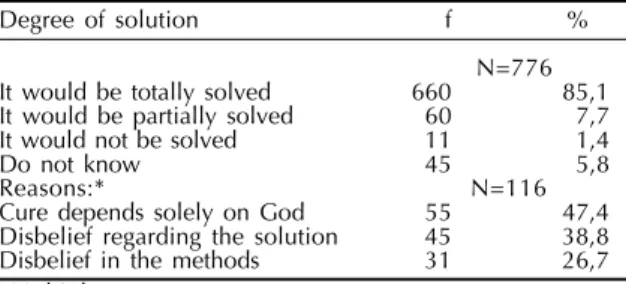
Respondents manifested a high degree of confidence in cataract surgery as a way to solve their eye condition: 85.1% believed it as a definite solution (Table 1). Among those uncertain about the surgery, the belief that cure depends “solely on God’s will” predominated (47.4%).
Table 1 - Degree to which cataract surgery is perceived to provide a solution.
Degree of solution f %
N=776
It would be totally solved 660 85,1
It would be partially solved 60 7,7
It would not be solved 11 1,4
Do not know 45 5,8
Reasons:* N=116
Cure depends solely on God 55 47,4
Disbelief regarding the solution 45 38,8
Disbelief in the methods 31 26,7
*Multiple answers
3 4 6 3 4 63 4 6 3 4 6
3 4 6 Rev Saúde Pública 2002;36(3):343-9
www.fsp.usp.br/rsp Treatment of the senile cataract
Temporini ER et al.
there was a tendency to give more importance to the belief that their condition is due to God’s will. This answer was given by comparable percentages of respondents, regardless of their age group.
Women more than men (p =0.0000) believe that biological phenomena particular to the female sex are important in the onset of cataract (Table 3). Women provided affirmative answers in a greater proportion than men; i.e., they asserted that the onset of the cataract was a result of menopause, maternity, and menstrual periods. However, if it is considered the answer “do not know” men reveal to be more ignorant on this issue, no matter which variable is being analyzed. In short, the significant differences indicated by p-values =0.0000 were due to the inclusion of “do not know” answers.
The time elapsed since the last eye examination varied according to sex, though not significantly (p <0.0389). The average for males was 2 years and 3 months, and for females, one year and 7 months (Table 4). Among men, 50.4% had their last eye appointment more than one year after the previous one, and 7.1% had no recollection of the time of their last eye appointment. Among women, 49.4% returned for an eye examination more than one year after the previous visit and 8.8% declared to have no recollection of the time of that appointment. It is worth emphasizing that among 148 subjects of both sexes (19.1%), 93 said they had not had a previous eye examination, and 55 said they had no recollection of it.
Of the respondents, 14.4% affirmed to have been self-medicated at home for cataract. Among home-made remedies, herbal teas, such as rue and rosemary (36.6%) and rose petals tea (33.0%), were mostly employed. There is no record of the associated use of these preparations, except for herbs (4.5%) and water mixed with salt or sugar (3.6%). Although less frequently, other products were mentioned for home management of cataract: maternal milk, honey, lemon/ sweet lime, and holy water (Table 5).
DISCUSSION
Cataract blindness prevention relies on providing the community the access to specialized care services and their adoption of health oriented behaviors. The access to surgery should be facilitated, eliminating obstacles related to health care costs and geographical distance. However, misbeliefs (seen as truths)
Table 2 - Opinion about the relationship between the existence of a severe visual problem and God’s will, according to age. Age (in years)
Opinion 50 |— 60 60 |— 70 70 |— 80 80 |— 97
(N=68) (N=236) (N=332) (N=140)
f % %* f % %* f % %* f % %*
It happens by divine design 27 39,7 54,0 86 36,4 48,3 132 39,8 53,7 60 42,8 60,0
It does not happen by divine design 23 33,8 46,0 92 39,0 51,7 114 34,3 46,3 40 28,6 40,0
Do not have an opinion 18 26,5 - 58 24,6 - 86 25,9 - 40 28,6
-*Excludes “do not have an opinion” χ2 =4,30; p≤0,6359
Table 3 - Opinion about the causes of the onset of cataracts in women, according to sex. Sex
Causal factor of cataracts Male Female p value **
(N=336) (N=410)
f % %* f % %*
Menopause 0,0000
Yes 39 10,7 26,5 64 15,6 24,2
No 108 29,5 73,5 201 49,0 75,8
Do not know 219 59,8 —— 145 35,4 ——
Maternity 0,0000
Yes 40 10,9 25,0 50 12,2 18,4
No 120 32,8 75,0 222 54,1 81,6
Do not know 206 56,3 —— 138 33,7 ——
Menstruation 0,0000
Yes 39 10,7 25,7 47 11,5 17,7
No 113 30,9 74,3 219 53,4 82,3
Do not know 214 58,4 —— 144 35,1 ——
*Excludes “do not know”
**Chi-squared including the answers “do not know”, corrected Yates.
Table 4 - Time elapsed since last eye examination, according to sex.
Sex
Time elapsed Male Female
(in years)* (N=288) (N=340)
f % f %
<1 143 49,7 172 50,6
1 |— 3 72 25,0 101 29,7
3 |— 6 46 16,0 50 14,7
6 |— 10 11 3,8 7 2,1
>10 16 5,6 10 2,9
x=2,3 years x=1,7 years
Declared having no recollection: 22 men (7.1% of 310) and 33 women (8.8% of 373). Another 93 respondents (12,0%) declared never had an eye examination.
3 4 7 3 4 7 3 4 7 3 4 7 3 4 7 Rev Saúde Pública 2002;36(3):343-9
www.fsp.usp.br/rsp
Treatment of the senile cataract Temporini ER et al.
concerning cataract surgery and its results might be a source of reluctance, or even denial, on the part of these individuals to submit themselves to surgery. Although it might be able to minimize structural and financing barriers, the under-utilization of health services can be surmounted by means of education programs focusing on changing individuals’ perceptions and behaviors regarding the risk of visual loss and the benefits of early detection and treatment.4
If educational initiatives are to be developed there would be a need to get further knowledge on the factors pervading the individuals’ decision-making processes, which should be attained by means of scientific research.18
In the present study, the sample consisted of an almost equivalent proportion of elderly men and women who generally had little schooling and were out of the employment market. This seems to be indicative of a low socioeconomic status.
The high degree of confidence observed in the answers concerning cataract surgery outcome might be grounded on the credibility attributed to the eye care service in charge of the consultations (Table 1). Besides, the fact that subjects sought care provided by a community project with the purpose of solving these people’s eye condition might be indicative of the existence of financial and social difficulties allied to their hope of obtaining visual rehabilitation. The service’s geographical proximity and its free-of-charge character probably make up facilitating factors for eye care. The study findings call attention to individuals (around 15.0%) who, though having sought care provided in the project, show either partial or complete disbelief in surgically treating their cataract. To justify their disbelief, the majority entangled in mystical arguments (47.4%), revealing a strong belief in God, “without his intervention the cure would not have
occurred.” This makes one infer that, although displaying confidence in the surgical procedure, the surgery success is bound to the divine will.
The results presented on Table 2 reinforce this assumption since in almost all age groups prevails the belief that visual conditions occur by divine design. Yet it is worth noting that this conception is stronger among older individuals (aged 70 to 96 years), which can be expected since religious beliefs become stronger as people age. Similar results were obtained in a study carried out in an interior municipality of the state of São Paulo among individuals seen in an comparable community project: 41.4% of the subjects attributed the onset of cataract to a divine design, showing an inclination to believe in the disease’s inevitability.19
Various misconceptions related to the causes and implications of blindness were also identified in a survey conducted in Ethiopia aiming to understand the public’s attitudes towards blindness. In this study, 1,751 heads of household were randomly selected, of whom 1,401 were sighted, 246 were unilaterally blind, and 104 were blind in both eyes. According to 85% of the respondents blindness was a problem of the elderly. Of the totally blind, 33% mentioned supernatural factors, such as divine punishments and curses, as causes of blindness.1
Such beliefs are likely to derive a feeling of resignation that could become an obstacle for seeking eye treatment; hence the importance of having these misbeliefs identified and taken into account in the planning of any education effort.
When compared to women, men (p =0.0000) are less familiar or aware of an existing association between biological phenomena particular to females and senile cataract (Table 3). Allied to a lack of opinion
Table 5 - Home treatment of cataracts (associate answers). (N=112)
Home treatment of cataracts
Respondents Herbal teas Petal rose Water Lemon/ Honey Water Blessed
(rue, rosemary) tea with sugar sweet lime with salt water
f % % % % % % % %
14 12,5 12,5
10 8,9 8,9
7 6,3 6,3
6 5,4 5,4
5 4,5 4,5 4,5
5 4,5 4,5
4 3,6 3,6
4 3,6 3,6 3,6
4 3,6 3,6 3,6
3 2,7 2,7 2,7
3 2,7 2,7
65* 58,0
*Among the other respondents, groups of 2 and 1 provided other forms of association of answers and 13 declared having no recollection of the kind of treatment used.
3 4 8 3 4 83 4 8 3 4 8
3 4 8 Rev Saúde Pública 2002;36(3):343-9
www.fsp.usp.br/rsp Treatment of the senile cataract
Temporini ER et al.
REFERENCES
1. Alemayehu W,Tekle-Haimanot R, Forsgren L, Ekstedt J. Perceptions of blindness. World Health Forum
1996;17:379-81.
2. Ellwein LB, Kupfer C. Strategic issues in preventing cataract blindness in developing countries. Bull. World Hlth. Org. , 1995 , 73 : 681 - 90.
3. Grandi TSM, Trindade JA, Pinto MJF , Ferreira LL, Catella AC.. Plantas medicinais de Minas Gerais, Brasil. Acta Botan Bras 1989;3:supl. p 15-19.
4. Javitt JC. Preventing blindness in Americans: the need for eye health education. Survey Opthalmol
1995;40:41-4.
on the subject, this is indicative of the need for developing programs on health education and eye health that, besides providing information, should also promote preventive behaviors.
Concerning eye care consultations, a considerable portion of the sample reported poor memory of the time of their last appointment or a time gap longer than a year. There are some suppositions that might explain these facts: (1) lapse of memory preventing exact recollection is more frequently seen in elderly people; and (2) previous obstacles to access to eye care treatment.7
A study carried out by the Cataract Project (1991) in patients diagnosed as senile cataract showed that 49.3% did not previously seek specialized treatment due to personal difficulties and obstacles in accessing the health system.19
The use of herbs as a part of home self-treatment is a observable fact in all social strata, either in small communities or great urban centers.3,15 The existence
of popular therapies in Brazil based on medicinal herbs is thought to be due, above all, to social and cultural factors.9 The choice of alternative treatments depends on the characteristics of a given community in which tradition, customs and local values play an important role. Brazilian culture is crammed with popular beliefs concerning both health care and eye care in particular.14
The topical use of herb teas for treating cataract (Table 5) is part of Brazilian tradition and customs concerning medicinal use of plants coming from African and indigenous influences.3
Research on knowledge and use of popular medicine for home management of diseases carried out among teachers and students of elementary schools in the state of Minas Gerais, Brazil, revealed that, among the teachers, 65.7% believed in home remedies for treating any disease; 51.4% specified plants for treating particular diseases; and 21.7% cited herbs for general treatment without associating them to specific diseases.15
The present study’s findings are not surprising since they are an expression of popular culture. However, the use of citric substances (lemon, sweet lime) and salt diluted in water is a source of concern due to the aggressive and irritant action these substances exert on the eye. On the other hand, innocuous home remedies generally cause a delay in seeking eye care, resulting sometimes in an aggravation of the eye condition.
Although these results come from an a convenient sample, it can be inferred that similar factors to those identified can play a role in other analogous communities.
The misbeliefs and lack of knowledge relating to the causes and treatment of senile cataracts found in this study indicate the need for education initiatives promoting eye rehabilitation of visual impaired individuals by senile cataracts.
In addition, there is a need of further studies to identify the reasons why not many people seek eye care in face of cataracts. Though they may differ from individual to individual and place to place, they should be identified in order to become targets of intervention programs.18,21
5. Kara-José N, Contreras F, Campos MA, Delgado AM, Mowery RL, Ellwein LB. Screening and surgical intervention results from cataract free - zone projects in Campinas, Brazil and Chimbote, Peru. Int
Ophthalmol 1990;14:155-64.
6. Kara-José N, organizador. Prevenção de cegueira por catarata. Campinas: Ed. UNICAMP; 1996.
7. Kara-José N, Arieta CEL, Temporini ER, Kang KM, Ambrósio LE. Tratamento cirúrgico de catarata senil : óbices para o paciente. Arq Bras Oftalmol
1996;59:573-7.
8. Kara-José N, Temporini ER. Cirurgia de catarata: o porquê dos excluídos. Rev PanamSalud Publica
3 4 9 3 4 9 3 4 9 3 4 9 3 4 9 Rev Saúde Pública 2002;36(3):343-9
www.fsp.usp.br/rsp
Treatment of the senile cataract Temporini ER et al.
9. Luz MT. Cultura contemporânea e medicinas alternativas: novos paradigmas em saúde no fim do século XX. PHYSIS: Rev Saúde Coletiva 1997;7:13-43.
10. Minassian DC. Epidemiological methods in prevention of blindness. Eye 1998;2 Suppl:S3-S12.
11. Organizacion Mundial de La Salud. Tratamiento de la catarata en los servicios de atención primaria de salud. 2a ed. Ginebra: OMS; 1997.
12. Piovesan A, Temporini ER. Pesquisa exploratória: procedimento metodológico para o estudo de fatores humanos no campo da saúde pública. Rev Saúde Pública 1995;29:318-25.
13. Prado Jr-J, Silva ALB, Alves MR, Kara-José N, Temporini ER. Tratamento cirúrgico da catarata senil no Hospital das Clínicas da Faculdade de Medicina da USP - aspectos da rotina operacional. Rev Med (São Paulo) 1997;76:192-6.
14. Rocha JCP, Gondim EL, Braga FTC, Dantas FJ, Temporini ER, Kara-José N. Ocular health myths among a hospital staff. Ophthalmic Epidemiol
1997;4:107-13.
15. Santos MG, Dias AGP, Martins MM. Conhecimento e uso da medicina alternativa entre alunos e
professores de primeiro grau. Rev Saúde Pública
1995;29:221-7.
16. Schwab L. Eye care delivery in developing nations: paradigms, paradoxes, and progress. Ophthalmic Epidemiol 1994;1:149-54.
17. Sommer A. Public health aspects of ophthalmic disease. Ann Rev Public Health 1996;17:115-9.
18. Temporini ER. Pesquisa de oftalmologia em saúde pública: considerações metodológicas sobre fatores humanos. Arq Bras Oftalmol 1991;54:279-81.
19. Temporini ER, Kara-José N, Kara-José, Jr-N. Características e percepções de pacientes atendidos em projeto comunitário de reabilitação visual. Arq Bras Oftalmol 1997;60:79-83.
20. Thylefors B. Much blindness is avoidable. World Health Forum 1991;12:78-86.
21. Wormald R. Delivery of eye care to the elderly: practical considerations. Comm EyeHealth