RESUmo
Estudo transversal realizado com o
ob-jeivo de avaliar uso do Coping Religioso
--Espiritual (CRE) e veriicar suas possíveis modulações com o padrão de consumo de alcoólicos em pacientes atendidos em ambulatório de hepatologia entre abril e dezembro de 2009, uilizando o CAGE, o AUDIT e a escala CRE. Foram encontradas associações entre coping religioso-espiritu
-al negaivo (CREN) e consumo de -alcoólicos na vida no úlimo ano e com a combinação resultante. Sujeitos ideniicados como
CAGE negaivos com uso de baixo risco no
úlimo ano iveram frequência acima da es
-perada na categoria abaixo da mediana. Os ideniicados como CAGE posiivo com uso de médio risco foram relaivamente mais frequentes na categoria acima da mediana (p=0,017). Resultados reforçam a relevân
-cia do CREN na avaliação de eventos rela
-cionados com a saúde.
dEScRitoRES
Consumo de bebidas alcoólicas Espiritualidade
Religião
Religious-spiritual coping and the
consumption of alcoholic beverages
in male patients with liver disease
*O
riginal
a
r
ticle
AbStRAct
This cross-secional study was performed with the objecive to evaluate the use of Religious Spiritual Coping (RSC) and verify its relaionship with the patern of alco
-holic beverage consumpion in paients atending a liver disease outpaient clinic between April and December of 2009, us
-ing the CAGE, AUDIT and RSC Scale. Asso
-ciaions were observed between negaive religious-spiritual coping (NRSC) and the consumpion of alcoholic beverages over the last year and with the resuling com
-binaion. Subjects ideniied as negaive CAGE with low-risk consumpion over the
last year had a frequency above the ex
-pected in the category below the median. Those ideniied as posiive CAGE with moderate-risk consumpion were relaively more frequent in the category above the median (p=0.017). Results reinforce the relevance of the NRSC in the evaluaion of health-related events.
dEScRiPtoRS Alcohol drinking Spirituality Religion
RESUmEn
Estudio transversal realizado con el objei
-vo de evaluar el uso del Coping Religioso Espiritual (CRE) y veriicar sus posibles mo -dulaciones con el estándar de consumo de
alcohol en pacientes atendidos en ambula
-torio de hepatología entre abril y diciem
-bre de 2009, uilizando el CAGE, el AUDIT y la escala CRE. Se encontraron asociaciones entre coping religioso espiritual negaivo (CREN) y consumo de bebidas alcohólicas en la vida, en el úlimo año y con la com
-binación resultante. Sujetos ideniicados
como CAGE negaivos con abuso de bajo
riesgo en el úlimo año tuvieron frecuencia por sobre la esperada en la categoría por debajo de la mediana. Los ideniicados
como CAGE posiivo con abuso de mediano
riesgo fueron relaivamente más frecuen
-tes en la categoría por encima de la media
-na (p=0,017). Los resultados refuerzan la importancia del CREN en la evaluación de eventos relacionados a la salud.
dEScRiPtoRES
Consumo de bebidas alcohólicas Espiritualidad
Religión
maria Evangelista martins1,Luiz cláudio Ribeiro2,thales Januzzi Feital3,Rafael Alves, baracho4,
mário Sérgio Ribeiro5
Coping religioso-espiritual e Consumo de alCoóliCos em hepatopatas do sexo masCulino
Coping religioso-espiritual y Consumo alCohóliCo en hepatópatas de sexo masCulino
*extracted from the dissertation “uso de alcoólicos, personalidade, qualidade de vida e coping religioso espiritual em hepatopatas” medical school, Federal university of Juiz de Fora, 2011. 1psychologist. msc in health. researcher in the personality, alcohol and drugs research laboratory, psychosocial Care
Center at the university hospital of Federal university of Juiz de Fora, Juiz de Fora, mg, Brazil. [email protected] 2phd in demography. associate
professor, statistics department, Federal university of Juiz de Fora. Juiz de Fora, mg, Brazil. [email protected] 3undergraduate student in statistics,
Federal university of Juiz de Fora. research Fellowship in the personality, alcohol and drugs research laboratory. Juiz de Fora, mg, Brazil. thalesfeital@ hotmail.com 4psychologist. research Fellowship in the personality, alcohol and drugs research laboratory. Juiz de Fora, mg, Brazil. rafael12baracho@
intRodUction
Spiritual Religious coping is deined as the use of be
-liefs and spiritual and religious pracices as a resource to facilitate problem solving and prevent or alleviate nega
-ive emoional consequences arising from stressful cir
-cumstances in life(1-2).
A review study indicates that religious pracices and beliefs are associated with physical and mental health, lower rates of depressive symptoms, anxiety and sui -cide(2). The posiive results of Spiritual religious coping
have already been described in relaion to pain, physical weakness, heart diseases, infecious diseases and can -cer(3), as well as in relaion to hepaiis C(4) and liver
trans-plant paients(5).
The dysfuncional use of alcohol is a signiicant pub
-lic health problem: it is esimated that it was the cause of 4.5% of cases of impairment and 3.8% of total deaths worldwide in 2004(6). In an evaluaion of the World
Health Organizaion’s classiicaion of harm to health atributed to the dysfuncional use of alcohol, Brazil was ranked at level 3 in 2005 on a scale of 1 to 5. In this same year, the rate of mortality caused by cir
-rhosis of the liver in the Brazilian popula
-ion older than 15 years old was 24.4 per 100,000 male inhabitants and 4.7 for the female populaion(7).
When we examine factors associat
-ed with the use of alcohol, religion has been consistently associated with lower alcohol consumption patterns. More re
-ligious individuals drink less frequently and experience fewer problems related
to the use of alcohol when compared to less religious
individuals(2,8).
A review of studies evaluaing the associaion between spirituality and the use of psychoacive substances found that most studies were conducted with the North Ameri
-can populaion and that of the United Kingdom and a few studies addressed clinical populaions(9).
Even though many internaional studies suggest there is an inverse associaion between the use of alcohol and Spiritual religious coping variables, there are few studies in Brazil observing this relaionship since most address only adolescents and students(10).
The objecive of this study was to evaluate the use of spiritual religious coping among adult paients with liver disease and verify its possible mediaion of the consump
-ion of alcohol.
mEtHod
Cross-secional study conducted with paients in the process of diagnosic evaluaion or undergoing treatment in the hepatology ambulatory unit of the Gastroenterolo
-gy Service of the Healthcare Center at the Federal Univer
-sity of Juiz de Fora (CAS-UFJF). This ambulatory is a refer
-ral facility in the region— Zona da Mata, South of Minas Gerais and Campo das Vertentes—for care provided to individuals with liver diseases of various eiologies, both alcoholic and non-alcoholic.
Inclusion criteria were: male gender, aged between 20 and 59 years old, and having atended at least up to the 5th
grade. Exclusion criteria were: hepaic encephalopathy, being unable to answer the study instruments due to evi
-dent cogniive limitaions, including alcohol intoxicaion, and refusing to sign the free and informed consent forms. This study was submited to and approved by the Ethics Research Commitee at the University Hospital at the Fed
-eral University of Juiz de Fora (protocol 0004/2009). The following self-administered instru
-ments were used:
1 – Structured and self-applied instru
-ment addressing sociodemographic data. 2 – CAGE quesionnaire to idenify po
-tenial alcohol dependence syndrome: stan
-dardized and validated in Brazil, with sensi
-ivity and speciicity similar to the original instrument in English(11). The paricipants
were grouped into never used alcohol,
CAGE-negaive and CAGE-posiive (airma
-ive answers to two or more quesions). 3 – Alcohol Use Disorders Ideniicaion Test (AUDIT). Instrument developed by the World Health Organizaion, translated and validated for Brazil(12), to idenify the dysfuncional use of alcohol in the past year. According to scores obtained on the AUDIT, the individu
-als were classiied as: has never had a drink containing alcohol; recent abstemious or low-risk user (from 0 to 7
points); average-risk user (from 8 to 15 points); and high-risk user or with likely diagnosis of Mental Disorder relat
-ed to the use of alcohol (16 or more points).
4 –Spiritual Religious Coping scale (SRC Scale) devel
-oped in Brazil(13-14). It contains 87 statements concerning
the use of 66 strategies considered to be posiive spiritual religious coping and 21 strategies considered to be nega
-ive spiritual religious coping. Scores range from 1 (not at all) to 5 (very much). The SRC scale has four evaluaion indexes: Posiive SRC (PSRC) and Negaive SRC (NSRC), To
-tal SRC and NSRC/PSRC raio. Higher scores in each of the three direct indexes indicate higher use of that speciic
even though many international studies
suggest there is an inverse association between the use of alcohol and spiritual
religious coping variables, there are few studies in Brazil observing this
type of coping. Once it is expected a more frequent use of posiive coping, lower NSRC/PSRC raio indicates a beter-balanced use of spiritual religious coping. In this study, the indexes of posiive and negaive spiritual religious coping and the NSRC/PSRC raio were categorized as below the median and above the median.
Data were collected by two researchers, trained prior to the study, who atended the Hepatology ambulatory on the days and imes medical appointments were sched
-uled. The researchers organized a list of all the paients scheduled by consuling the physicians’ schedules and the paients’ forms. These paients were then approached in the waiing room and were screened according to the inclusion criteria and invited to paricipate in the study. Those who consented were given clariicaion concerning the study’s objecives, ethical and legal procedures, and signed free and informed consent forms.
We took all possible measures to ensure that the paricipants did not share or discuss the content of the instruments with their companions or those unrelated to the study. For that, a researcher was always present during the enire applicaion of the quesionnaire. Most quesionnaires were answered in a single stage before the scheduled consultaion. When the individual had to atend the consultaion before compleing the quesion
-naire, the researcher waited for the paient to return to the waiing room to complete the quesionnaire. In 27 cases, the quesionnaire was completed ater the paient returned for a new consultaion.
A total of 354 male paients who had appointments between April and December 2009 were approached and the selecion process ceased when virtually all the paients had already been invited. Fourteen out of the 354 paients refused to paricipate; 156 did not meet the inclusion criteria (69 of which did not have minimum educaion, 80 were not included in the age group, seven were not included in the age group nor had the mini
-mum educaion and nine presented evident cogniive impairment); 52 either did not complete the quesion
-naire or provided inconsistent answers, e.g. concomi
-tantly reported no use of alcohol at all and alcohol con
-sumpion in the past year. Thus, there were a total of 123 paricipants.
All 123 individuals included in the analysis answered the four quesions of the CAGE, eight or more quesions of AUDIT, and at least 90% of each set of items in the Posi
-ive SRC and Nega-ive SRC.
The database was constructed using SPSS for Win
-dows, version 14.0 (serial number 9656438). Data were then submited to descripive and exploratory analysis (bivariate analysis in which spiritual religious coping is the dependent variable). Staisical signiicance was veriied
through Person’s Chi-square test (results were considered signiicant when p≤ 0.05 and marginally signiicant when 0.1<p>0.05) and through the adjusted residual (cells that present signiicant diferences, that is, the adjusted re
-sidual with an absolute value greater than 1.96, since it is normally distributed).
For the descriptive analysis, the sociodemographic variables were grouped as follows: age was categorized into 20 to 29, 30 to 39, 40 to 49 and 50 to 59 years old; marital status was grouped into single, married or
cohabitating and others (widowed, divorced, or sepa
-rated); schooling into bellow high school, incomplete or
complete high school and incomplete college or above;
occupation into active worker, inactive worker (un
-employed or retired) and (employed or unemployed) student; income into less than the minimum wage
(ap-proximately US$ 300,00); more than 1 until up to 3
times the minimum wage and more than 3 times the
minimum wage; religion was classified as non-religious,
Catholic, Evangelical or Protestant and others; and how
frequently attend religious services was classified as
non-religious, not frequently and frequently (at least
once a week).
For the bivariate analysis, the results from the CAGE and the AUDIT were combined and analyzed according to the resulting six subgroups: Group I (never used al-cohol) and Group II (CAGE negative and AUDIT from 0 to 7 points), which constitutes the group of individu
-als who were not identified as potential alcohol depen
-dents and abstemious or with a low-risk consumption in the past year; Group III (CAGE negative and AUDIT from 8 to 15 points) those not identified as potential al
-cohol dependents with an average-risk consumption in the past year; Group IV (CAGE positive and AUDIT from de 0 to 7 points), those individuals with potential alco
-hol dependence syndrome and abstemious or with low consumption in the last year); Group V (CAGE positive and AUDIT from 8 to 15 points), composed of individu
-als with potential alcohol dependence syndrome and average-risk consumption in the past year and group VI (CAGE positive and AUDIT from 16 or more), those with potential alcohol dependence syndrome in life and high-risk consumption or potential dependence in the past year.
RESULtS
The average age of the 123 studied paients was 42.64 (SD= 9.71) years old; 43.9% of the patients reported complete middle school and only 13% reported incom
-plete or com-plete college; 55.7% were married/cohabi
active workers and 44.7% were inactive workers. In re
-gard to religion, 60.3% of the 121 patients reporting were Catholics, 15.7% were Evangelical or Protestant, 16.6% reported other religions and 7.4% reported no religion; of the 115 who reported attending religious services, 45.2% did not participate frequently and 47.0% participated in services at least once a week. The medians for the spiritual religious coping indexes were 1.95 for the NSRC, 3.01 for PSRC, and 0.65 for the NSRC/PSRC ratio.
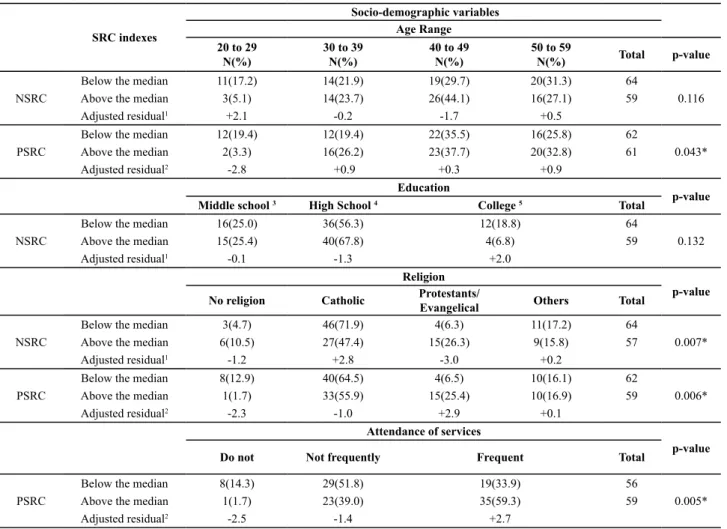
The results of the bivariate analyses indicate that reli
-gion signiicantly correlated with the three indexes used to evaluate spiritual religious coping. Protestants and evangelicals were more represented among those using both posiive and negaive coping. Catholic paricipants were among those using negaive coping less frequently, while non-religious individuals were signiicantly less rep
-resented among those making a greater use of posiive
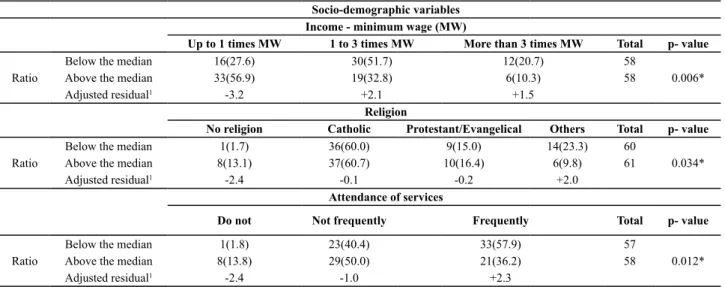
coping. When the NSRC/PSRC raio was considered, ab
-sence of religion was associated with a greater pre-sence in the category above the median while those reporing a religion other than Catholicism or Protestant/Evangeli
-cal had greater representaion in the category below the median. The category atends religious services frequently
was signiicantly correlated with PSRC above the median
and NSRC/PSRC raio below the median. Both categories concerning low income were associated with the NSRC/ PSRC raio: individuals that fell on the middle category of income (between one and up to three imes the minimum wage) were signiicantly more represented in the category
below the median (Tables 1 and 2). The analysis of residues indicate that individuals aged between 20 and 29 years old were signiicantly more represented in the category below the median in the NSRC index and less represented in the category above the median in the PSRC index. Paricipants with more educaion were also more represented in the category below the median in the NSRC index.
Table 1 – Negative and positive spiritual religious coping (NSRC and PSRC) and socio-demographic variables
SRC indexes
Socio-demographic variables Age Range 20 to 29
N(%)
30 to 39 N(%)
40 to 49 N(%)
50 to 59
N(%) Total p-value
NSRC
Below the median 11(17.2) 14(21.9) 19(29.7) 20(31.3) 64
0.116
Above the median 3(5.1) 14(23.7) 26(44.1) 16(27.1) 59
Adjusted residual1 +2.1 -0.2 -1.7 +0.5
PSRC
Below the median 12(19.4) 12(19.4) 22(35.5) 16(25.8) 62
0.043*
Above the median 2(3.3) 16(26.2) 23(37.7) 20(32.8) 61
Adjusted residual2 -2.8 +0.9 +0.3 +0.9
Education
p-value
Middle school 3 High School 4 College 5 Total
NSRC
Below the median 16(25.0) 36(56.3) 12(18.8) 64
0.132
Above the median 15(25.4) 40(67.8) 4(6.8) 59
Adjusted residual1 -0.1 -1.3 +2.0
Religion
p-value
No religion Catholic Protestants/
Evangelical Others Total
NSRC
Below the median 3(4.7) 46(71.9) 4(6.3) 11(17.2) 64
0.007*
Above the median 6(10.5) 27(47.4) 15(26.3) 9(15.8) 57
Adjusted residual1 -1.2 +2.8 -3.0 +0.2
PSRC
Below the median 8(12.9) 40(64.5) 4(6.5) 10(16.1) 62
0.006*
Above the median 1(1.7) 33(55.9) 15(25.4) 10(16.9) 59
Adjusted residual2 -2.3 -1.0 +2.9 +0.1
Attendance of services
p-value
Do not Not frequently Frequent Total
PSRC
Below the median 8(14.3) 29(51.8) 19(33.9) 56
0.005*
Above the median 1(1.7) 23(39.0) 35(59.3) 59
Adjusted residual2 -2.5 -1.4 +2.7
Table 2 – Ratio between negative and positive spiritual religious coping (NSRC/PSRC) and socio-demographic variables
Socio-demographic variables Income - minimum wage (MW)
Up to 1 times MW 1 to 3 times MW More than 3 times MW Total p- value
Ratio
Below the median 16(27.6) 30(51.7) 12(20.7) 58
0.006*
Above the median 33(56.9) 19(32.8) 6(10.3) 58
Adjusted residual1 -3.2 +2.1 +1.5
Religion
No religion Catholic Protestant/Evangelical Others Total p- value
Ratio
Below the median 1(1.7) 36(60.0) 9(15.0) 14(23.3) 60
0.034*
Above the median 8(13.1) 37(60.7) 10(16.4) 6(9.8) 61
Adjusted residual1 -2.4 -0.1 -0.2 +2.0
Attendance of services
Do not Not frequently Frequently Total p- value
Ratio
Below the median 1(1.8) 23(40.4) 33(57.9) 57
0.012*
Above the median 8(13.8) 29(50.0) 21(36.2) 58
Adjusted residual1 -2.4 -1.0 +2.3
*p-value<0.05 11adjusted residual concerning frequency below the median (0.65)
The bivariate analysis between the use of alcohol and negaive and posiive spiritual religious coping presented staisical signiicance both for the NSRC and PSRC indexes (p-values 0.017 and 0.004 respecively). The individuals
ideniied as negaive CAGE were more frequently ob
-served in the categories below the median for both NSRC and PSRC while the results indicated the opposite for those ideniied as posiive CAGE (Table 3).
Table 3 – Spiritual religious coping and the use of alcohol
Indexes of Spiritual religious coping – SRC scale
CAGE classiication Never used alcohol
N (%)
Negative N(%)
Positive
N(%) Total p-value
NSRC
Below the median Above the median
Adjusted residual1
7 (10.9) 9 (15.3) -0.7
36 (56.3) 16 (27.1) +3.3
21 (32.8) 34 (57.6) -2.8
64
59 0.004*
PSRC
Below the median Above the median
Adjusted residual2
9 (14.5) 7 (11.5) -0.5
33 (53.2) 19 (31.1)
-2.5
20 (32.3) 35 (57.4) +2.8
62
61 0.017*
Ratio NSRC/ PSRC
Below the median Above the median
Adjusted residual3
7 (11.3) 9 (14.8) -0.6
29 (46.8) 23 (37.7) +1.0
26 (41.9) 29 (47.5) -0.6
62
61 0.578
*p<0.5 1Adjusted residual concerning frequency below the median 2Adjusted residual concerning frequency above the median 3Adjusted residual concerning frequency
below the median
When the use of alcohol for the last year was taken into account, the results indicated marginal staisical sig
-niicance (p = 0.090) only for the NSRC index. However, when the adjusted residual was taken into account, the
individuals ideniied as abstemious or of low risk were more frequently represented in the category below the median concerning the use of negaive spiritual religious coping (Table 4).
Table 4 – Spiritual religious coping and the consumption of alcohol in the last year
Spiritual Religious coping indexes – SRC scale
AUDIT classiication Never used
alcohol N (%)
Abstemious or low risk N (%)
Average risk N (%)
High risk or likely
dependency N(%) Total p-value
NSRC
Below de median Above de median
Adjusted residual1
7 (10.9) 9 (15.3) -0.7
N (%) N (%)
2 (3.1) 7 (11.9)
-1.9
64
59 0.090**
CREP
Below de median Above de median
Adjusted residual2
9 (14.5) 7 (11.5) -0.5
35 (56.5) 32 (52.5) -0.4
15 (24.2) 16 (26.2) +0.3
3 (4.8) 6 (9.8) +1.1
62
61 0.704
Razão CREN/ CREP
Below de median Above de median
Adjusted residual3
7 (11.3) 9 (14.8) -0.6
39 (62.9) 28 (45.9) +1.9
13 (21.0) 18 (29.5) -1.1
3 (4.8) 6 (9.8) -1.1
62 61
0.278
The variable resulting from the combination of re
-sults obtained in the CAGE and the AUDIT presented statistically significant differences in relation to the use of negative spiritual religious coping (p= 0.017). Indi
-viduals identified as negative CAGE and with a low risk
in the past year presented a frequency above that ex
-pected for the category below the median while those identified as positive CAGE and with average risk were relatively more frequently categorized as above the median (Table 5).
Table 5 – The use of spiritual religious coping and the consumption of alcohol in the last year
Spiritual religious coping indexes – SRC scale
Joint classiication CAGE and AUDIT Group I N(%) Group II N(%) Group III N(%) Group IV N(%) Group V N(%) Group VI
N(%) Total p-value
NSRC
Below de median Above de median
Adjusted residual1
7 (10.9) 9 (15.3) -0.7 29 (45.3) 14 (23.7) +2.5 7 (10.9) 2 (3.4) +1.6 12 (18.8) 12 (20.3) -0.2 7 (10.9) 15 (25.4) -2.1 2 (3.1) 7 (11.9) -1.9 64 59 0,017* PSRC
Below de median Above de median
Adjusted residual2
9 (14.5) 7 (11.5) -0.5 26 (41.9) 17 (27.9) -1.6 7 (11.3) 2 (3.3) -1.7 9 (14.5) 15 (24.6) +1.4 8 (12.9) 14 (23.0) +1.5 3 (4.8) 6 (9.8) +1.1 62
61 0,107
Ratio NSRC/ PSRC
Below de median Above de median
Adjusted residual3
7 (11.3) 9 (14.8) -0.6 24 (38.7) 19 (31.1) +0.9 5 (8.1) 4 (6.6) +0.3 15 (24.2) 9 (14.8) +1.3 8 (12.9) 14 (23.0) -1.5 3 (4.8) 6 (9.8) -1.1 62
61 0,407
*p<0.5 1adjusted residual concerning frequencies below the median 2adjusted residual concerning frequencies above the median 3adjusted residual
concerning frequencies below the median group i: never used alcohol group ii: negative Cage and low-risk use group iii: negative Cage and average-risk use group iV: positive Cage and low-average-risk use group V: positive Cage and average-average-risk use group Vi: Cage positive and high-risk use
diScUSSion
Spiritual religious coping and sociodemographic variables
This study’s indings— the relaively less frequent use of religious and spiritual mechanisms to cope with stress
-ful events on the part of paients aged between 20 and 29 years old— corroborate the conclusion of an American naional survey(15) reporing a low probability of younger
individuals being more religious than older individuals. We should, however, note that the less frequent use of religious coping was balanced between the posiive and negaive dimensions of the SRC scale. Such a fact is con
-irmed by the non-signiicance of diferences when the NSRC/PSRC raio is considered.
As opposed to the results found by a study(16) using
a probabilisic sample of the Brazilian populaion, which did not ind an associaion between income and religious variables, the results presented here indicate signiicant diferences concerning the patern of use of Spiritual re
-ligious coping among the individuals: those within the lower income category (at most one minimum wage) were frequently observed, above what was expected, in the category above the median in the NSRC/PSRC raio, while individuals with income between one and three imes the minimum wage presented the inverse behav
-ior. Such a result suggests the role of posiive and nega
-ive factors in diferent combinaions for these two sub
-groups.
The higher frequency of Protestants and Evangelicals among paients with a greater use of both posiive and negaive religious coping coincides with the indings of a study(17) reporing the same patern of spiritual religious
coping among members of the Evangelical churches when exposed to negaive events afecing their life cycle.
It is not unusual to ind individuals who report hav
-ing no religion but sill have spiritual beliefs and behav
-ior, even if not linked to an organized religion(15). The
paients in this study reporing no religion presented relaively less frequent Spiritual religious coping than those reporing a religion. Moreover, the results indicate a more predominant use of negaive coping strategies than in the irst group, which include negaive reevalu
-aion of the idea of God and/or dissaisfacion with reli
-gious insituions(13-14).
Associaion between high atendance of religious ser
-vices and the use of PSRC indicates the involvement of strategies that go from a posiive relaionship with the idea of God and religious rituals to a personal transforma
-ion and ofering help to another(13-14).
Spiritual religious coping and the use of alcohol
The use of both posiive and negaive spiritual reli
-gious coping on the part of studied paients with liver disease is coherent with studies reporing that stress
-ful life events can mobilize the use of both posiive and negaive SRC(1,18-19). A person may perceive the stressful
experience as an opportunity for personal growth and becoming closer to God or interpret it as His abandon
-ment or punish-ment of the individual(20). Considering the
categorizaion of the studied paients according to the CAGE, the negaive CAGE individuals had greater repre
-sentaion in the category below the median in the NSRC and PSRC, while the posiive CAGE were more frequently observed in the category above the median in these two dimensions. The use of the two dimensions was, how
non-dependents - and the opposite for the likely alco
-hol-dependents - may, at irst, seem contradictory given studies reporing that more religious individuals tend to
consume less alcohol(8,21). Nonetheless, if we consider
the frequency individuals turn to their faith in the face of illnesses and stressful events in life, these results(2,18,22)
can be more easily understood. Considering that all the paricipants in this study had liver disease and alcohol dependence may be considered as an addiional prob
-lem - for the posiive CAGE group - these results are consistent with indings indicaing the use of spiritual religious coping in direct proporion to the number of physical or mental health problems(18).
The analysis of spiritual religious coping in relaion to the use of alcohol in the year preceding the study, by the adjusted residual, only showed a less frequent use of negaive coping among abstemious paients or those with a low-risk consumpion (Table 4). This patern was also ideniied among negaive CAGE and abstemious paients or those with a low consumpion of alcohol in the past year (Group II). We also veriied a more frequent use of negaive coping among those with consumpion, indicat
-ing a likely alcohol dependence and with an average-risk consumpion in the past year for this combined variable (Group V) (Table 5).
Some authors suggest that the frequent use of nega
-ive coping strategies are more harmful in their efects or even more harmful to health than the same frequency of posiive coping would be beneicial(1,18-20). Even though
most studies report the beneicial efects of posiive cop
-ing, this study’s results reinforce the inluence of nega
-ive coping in disinguishing the subgroups of more and less severe paients. In fact, various researchers have ideniied an associaion between more frequent use of negaive coping and worse outcomes in both physi -cal and mental health(1,18). The beneicial efect to health
would be associated with a raio of at least 1NSRC to 2 PSRC(13).
It is possible that the low number of individuals in some cells of the combined variable limited the observaion of staisically signiicant diferences for some subgroups. The use of alcohol compaible with non-dependence and low-risk consumpion in the past year, however, seems to indicate there is a clinically relevant correlaion with the use of negaive coping strategies.
LimitAtionS
Not being possible to measure how severe the disease was at the ime of data collecion was an important limita
-ion imposed on this study, hindering discuss-ions concern
-ing the relaionship between clinical condiion and spiritu
-al religious coping. This limitaion is due to restricions in the insituion itself at the ime the study was conducted: the insituion limited laboratory exams outside of the fa
-cility’s care protocol. These evaluaions were permited only for paients with a more severe clinical condiion. Ob
-viously, the cross-secional design and the use of paients with liver disease under treatment hinder both causal in
-ference and the generalizaion of results. Another limita
-ion to be considered was the small number of individu
-als in certain subgroups, especially in the subgroup with greater alcoholic severity evaluated by the AUDIT.
concLUSion
This study’s results reinforce previous studies report
-ing diferences in the use of Spiritual religious cop-ing among diferent religions and that it is more frequently used by individuals who atend religious services more regularly. When the use of negaive and posiive religious coping was evaluated in the diferent subgroups in rela
-ion to the consump-ion of alcohol, the results indicate diferences in the use of negaive strategies. These results reinforce the importance of discussing not only the use of PSRC but also the use of NSRC when considering the po
-tenial mediaion of spiritual religious coping for physical and mental health. One should consider not only the posi
-ive aspects of religion but also its use with undesirable results for the health condiions of paients.
Since the use of spiritual religious pracices can con
-tribute to prevening or alleviaing physical and mental consequences of stressful circumstances, as is the case of diferent clinical circumstances nursing professionals observe with their paients. The results of this study also contribute to increasing nursing knowledge concerning the relaionship between alcohol consumpion paterns and the use of spiritual religious coping among paients with liver disease. These results reinforce the importance of paying special atenion to the possibility of negaive SRC strategies when planning integral care to paients cared for by the nursing staf due to the worse outcomes associated with the use of negaive coping strategies.
REFEREncES
1. Koenig HG, Pargament KI, Nielsen J. Religious coping and health status in medically ill hospitalized older adults. J Nerv Ment Dis. 1998;186(9):513-21.
2. Koenig HG. Research on religion, spirituality, and mental health: a review. Can J Psychiatry. 2009;54(5):283-91.
3. Koenig HG. Religion and medicine IV: religion, physical health, and clinical implicaions. Int J Psychiatry Med. 2001;31(3):321-36.
5. Bonaguidi F, Michelassi C, Filipponi F, Rovai D. Religiosity as -sociated with prolonged survival in liver transplant recipients. Liver Transpl. 2010;16(10):1158-63.
6. World Health Organizaion. Global Strategy to reduce the harm -ful use of alcohol. Geneva: World Health Organizaion, 2010.
7. World Health Organizaion (WHO). Global Status Report on Alcohol and Health. Geneva; 2011.
8. Nonnemaker JM, McNeely CA, Blum RW. Public and private domains of religiosity and adolescent health risk behaviors: evidence from the Naional Longitudinal Study of Adolescent Health. Soc Sci Med. 2003;57(11):2049-54.
9. Cook CCH. Addicion and spirituality. Addicion. 2004;99(5):39-51.
10. Moreira-Almeida A, Lotufo Neto F, Koenig HG. Religious -ness and mental health: a review. Rev Bras Psiquiatr. 2006;28(3):242-50.
11. Masur J, Monteiro MG. Validaion of the “CAGE” alcoholism screening test in a brazilian psychiatric inpaient hospital seing. Braz J Med Biol Res. 1983;16(3):189-282.
12. Mendez EB. Uma versão brasileira do AUDIT - Alcohol Disor -ders Ideniicaion Test. [dissertação]. Pelotas: Universidade Federal de Pelotas; 1999.
13. Panzini RG. Escala CRE: tradução, adaptação e validação da escala RCOPE, abordando relações com saúde e qualidade de vida [dissertação]. Porto Alegre: Insituto de Psicologia, Universidade Federal do Rio Grande do Sul; 2004.
14. Panzini RG, Bandeira DR. Escala de coping religioso/espiritu -al (esc-ala CRE): elaboração e v-alidação de construto. Psicol Estudo. 2005;10(3):507-16.
15. Michalak L, Trocki K, Bond J. Religion and alcohol in the U.S. Naional Alcohol Survey: how important is religion for abstenion and drinking? Drug Alcohol Depend. 2007;87(2-3):268-80.
16. Moreira-Almeida A, Pinsky I, Zaleski M, Laranjeira R. En -volvimento religioso e fatores sociodemográicos: resulta -dos de um levantamento nacional no Brasil. Rev Psiq Clin. 2010;37(1):12-5.
17. Bjorck JP, Thurman J. Negaive life events, paterns of posi -ive and nega-ive religious coping, and psychological func -ioning. J Sci Study Relig. 2007;46(2):159-67.
18. Pargament KI, Smith BW, Koenig HG, Perez LM. Paterns of posiive and negaive religious coping with major life stress -ors. J Sci Study Relig. 1998;37(4):710-24.
19. Bousso RS, Poles K, Seraim TS, Miranda MG. Religious be -liefs, illness and death: family’s perspecives in illness expe -rience. Rev Esc Enferm USP [Internet]. 2011 [cited 2011 Apr 10];45(2):397-403. Available from: htp://www.scielo.br/ pdf/reeusp/v45n2/en_v45n2a13.pdf
20. Pargament KI, Koenig HG, Tarakeshwor N, Hahn J. Religious struggle as a predictor of mortality among medically ill el -derly paient: A two-year longitudinal study. Arch Intern Med. 2001;161(15):1881-5.
21. Border TF, Curran GM, Matox R, Booth BM. Religiousness among at-risks drinkers: is it prospecively associated with the development or maintenance of an alcohol-use disor -ders. J Study Alcohol Drugs. 2010;71(1):136-42.