1 Associate Professor, University of the State of Rio Grande do Norte, Caicó, RN, Brazil. 2 Titular Professor of the Nursing Department, Federal University of Rio Grande do Norte, Natal, RN, Brazil.
3 Professor, Department of Medical and Surgical Nursing, School of Nursing, São Paulo University, São Paulo, SP, Brazil.
4 Master’s Student, Federal University of Rio Grande do Norte, Natal, RN, Brazil.
5 Professor, University of the State of Rio Grande do Norte, Mossoró, RN, Brazil.
Instrument for evaluating care given by undergraduate
nursing students to people with wounds
Instrumento para avaliar o cuidado de graduandos de enfermagem à pessoa com ferida Instrumento para evaluar el cuidado de graduandos de enfermería a la persona con herida
Roberta Kaliny de Souza Costa1, Gilson de Vasconcelos Torres2, Marina de Góes Salvetti3, Isabelle Campos de Azevedo4, Maria Antônia Teixeira da Costa5
Received: 07/30/2014 Approved: 11/07/2014
ORIGINAL ARTICLE
Correspondence Addressed to: Gilson de Vasconcelos Torres Av. Senador Salgado Filho, 3000 CEP 59078-970 - Natal, RN, Brasil [email protected]
DOI: 10.1590/S0080-623420150000200018
ABSTRACT
Objective: he aim of this study was to present the process of construction and validation of an instrument for evaluating the care provided to people with wounds, to be used with undergraduate nursing students. Method: methodological study, with quantitative approach, using the Delphi technique in two rounds, the irst with 30 judges and the second with 18. he analysis was made with Kappa coeicient ≥0.80, and content validity index greater than >0.80, also using the Wilcoxon test for comparison of the indices between the rounds. Results: It was found that of the 20 categories of the instrument, 18 presented better scores in the second Delphi round. Scores were greater in the second round in seven of the ten evaluation categories. Conclusion: Based on the evaluation by the judges, a version of the instrument was deined with adequate indices of agreement and validity, which will be able to help in evaluating care of people with cutaneous injury given by undergraduate nursing students.
DESCRIPTORS
Instrument for evaluating care given by undergraduate nursing students to people with wounds INTRODUCTION
Injuries are a frequent problem in health services, weak-ening and often incapacitating the individual and adversely afecting quality of life, as well as causing great impact for the health sector and burden on public expenditure(1-2).
Healthcare for these patients requires systematized care, provided by a multi-professional team and oriented by healthcare protocols, availability of material resources and pharmacological products, coordination and interaction be-tween the levels of complexity of healthcare, and efective participation by patients, members of family, and caregivers(3).
Nursing professionals have an important role in provid-ing care for these patients, evaluatprovid-ing and diagnosprovid-ing the problem, planning and executing treatment at home and in the health services(4), performing a series of activities that
require preparation during graduation, as well as continuous and renewed theoretical learning/qualiication and practice for their development.
he preparation of the future nurse is decisive for the quality of the assistance given to these patients, and should be evaluated based on construction and use of instruments for measurement that are able to characterize the student’s theoretical and practical knowledge in the execution of cer-tain tasks related to this type of care.
In nursing, there has been a scarcity of studies evaluat-ing trainevaluat-ing in competencies and abilities, and also of the use of measurement instruments based on situations of real-ity, which reproduce the routine of the activities of the nurse in professional life and provide evaluation of the student’s cognitive, psycho-motor and afective learning – all three dimensions are indispensable to realization of full and hu-manized care.
he instruments to be adopted in the performance evaluation of care provided by the undergraduate nursing student should be validated, grounded on scientiic stud-ies, and include the systematization of care, as a means of ensuring consistent, efective conduct in teaching and in clinical practice(5).
We emphasize the shortage, in the literature, of available measurement tools for evaluation of nursing students’ care of a person with a cutaneous lesion, especially those based on the opinion/agreement of the nurses involved in un-dergraduate teaching and in healthcare for this population. In this context, this study present the process of con-struction and validation of an instrument, to be applied to undergraduate nursing students, for evaluating care pro-vided to persons with cutaneous injury.
METHOD
his was a methodological study, with a quantitative ap-proach, to present the process of construction and validation of a structured observation routine, of the ‘checklist’ type, to evaluate the care provided by undergraduate nursing stu-dents to people with injuries, assessed by specialist judges, using the Delphi technique, demarcated in two rounds.
his technique comprises a tool used in validation of survey content, and in construction and adaptation of
mea-surement instruments, based on obtaining opinions from experienced professionals, also referred to as specialist judg-es(6), and establishing degrees of consensus between them.
he theoretical element of the procedure in develop-ing the instrument involved, initially, a search for the items that were representative of the construct under investiga-tion (areas of skill that were relevant in nursing care for a person with a skin lesion), through an integrative review of the literature in healthcare protocols, scientiic articles, dissertations and thesis.
From this process of analysis of the literature, the items of interest for evaluating the care provided by an under-graduate student to an injured person were extracted, and classiied under these domains:
1) Initial observations (items: initial care, and hygienic cleaning of the hands).
2) Evaluation of the person and of the skin injury (items: anamnesis; identiication of risk factors; physical examination; vital signs; evaluation of pain; assessment of the lesion; identiication of signs of infection; identiication of the need for any complementary examinations, and ar-ranging for them to happen).
3) Care for the injury and for the perilesional skin (items: clean the injury; bandaging; evaluate the need for debridement; indicate coverage);
4) Referrals and orientations for the injured person and family member/caregivers (items: educational action; identify the injured person’s needs for any referrals, and arrange them).
5) Registry and documentation (items: record of clinical assessment; record of assessment of the lesion).
6) Final observations (items: organize the environment; hygienic treatment of hands after care).
After deciding the items on the ‘checklist’, the next step was to describe them, followed by an explanation adopted as parameter for evaluation of the procedure carried out by the student. his resulted in a irst version of the instrument, and this was submitted to consideration by a body of judges, with the objective of verifying evidence of validity of content.
his version of the checklist was submitted, in the pe-riod January through March 2013, to specialist judges with experience in the subject, who made the irst evaluation on the checklist – the irst Delphi round. After the irst evaluation by the judges, and inclusion of the suggestions presented, the checklist was reformulated, and the second evaluation of the reformulated version – the second Delphi – was carried out between May and July of the same year, aiming to reine the opinions of the panel of specialists, seek improved levels of consensus, and thus improvement of the measurement instrument.
he nurses to act as judges of the instrument were se-lected using the advanced research tool under the subject ‘wound’ on the Lattes platform of the National Scientiic and Technological Development Council (Conselho Nacio-nal de Desenvolvimento Cientíico e Tecnológico, or CNPq).
undergraduate teaching; and persons with scientiic activity or production in the area of wounds in the last ive years.
he nurses selected were contacted by email and invited to take part in the investigation as judges, by a letter of in-vitation stating the objectives and the methodology of the study, with an access link to the form for evaluation of the instrument – built in Google Docs (now known as ‘Drive’ at docs.google.com) and with the Free and Informed Consent Form (Termo de Consentimento Livre e Esclarecido, or TCLE).
he form sent to the judges for evaluation of the in-strument was in two parts. he irst asked questions on the participants themselves – included questions on age, gender, professional qualiication, professional experience, and time of experience in teaching and in healthcare. he second part was the checklist format for structured observation, with 20 items for assessment of the theoretical knowledge and technical abilities of undergraduate nursing students when providing care for a person with an injury.
he judges were asked to evaluate the attributes chosen, according to their ‘appropriateness’ in relation to the fol-lowing aspects: Utility/relevance; consistency; clarity; objec-tivity; simplicity; ability to be executed in practice; up-to-date-ness; vocabulary; precision; and as to the order of the items in terms of instruction. When a judge found an item to be inappropriate or inadequate, he or she was encouraged to present reasons and suggestions, so that the items could be re-written, modiied and improved.
he degree of relevance of the items was obtained by agreement between observers (and from variations between opinions of the same observers at diferent times) by means of the Kappa index (κ), intermediated by the Online Kappa Calculator(7), and through the Content Validity Index (CVI).
he Kappa coeicient measures the proportion of agree-ment between observers due to chance, in relation to the classiication of a group of items in a given number of cat-egories.(8) It varies from ‘minus 1’ to ‘plus 1’ – so that, the
closer it is to 1, the greater is the level of agreement between the observers.
he CVI is an index that makes it possible to assess the degree of agreement between judges on certain aspects of an instrument and of its items, individually, based on a measurement of proportion or percentage. his is calculated based on the division of the number of judges who judged the item as appropriate by the total of judges (the CVI for each item). For evaluation of the instrument as a whole, the CVI can be calculated as the ratio between the total number of items considered to be relevant by the judges, and the total number of items(9).
In the irst round of evaluation of the checklist by the judges, the following levels of agreement were was deined as ‘good’, and adopted as a criterion of acceptance, greater than or equal to 0.61 for Kappa, and greater than 0.75 for the CVI.
he conclusion of the irst process of analysis generated a version with alterations to the content of the initial instru-ment, based on the comments and suggestions of the judges, and pointed to the need for a new evaluation of the check-list. In the second round, the 30 nurses that participated in the irst analysis were invited to continue the evaluation of
the reformulated instrument. Of these, 18 agreed to con-tinue participating in the investigation as judges (i.e. in the second Delphi round).
he process of submission, composition and criteria for evaluation of the instrument by the committee of specialists in the second round of opinions followed the same proce-dures adopted in the initial analysis.
he data collected were organized in a spreadsheet, and subsequently exported to a statistical software. After input and tabulation, the information was analyzed using descrip-tive and inferential statistics, with absolute and reladescrip-tive fre-quencies and application of the Wilcoxon test, adopting a signiicance level lower than 5%.
In the second round of evaluations, the aim was to in-crease the scores in relation to the initial evaluation, adopt-ing as acceptable a level of agreement greater than or equal to 0.80 for the Kappa index and above 0.80 for the IVC. hus, the results below present the data of the evaluation of the second Delphi round in relation to the irst, indicating, based on the comparison, evidences of improvement in the checklist, based on the values of Kappa and CVI obtained in the general analysis and for each item of the instrument.
he study was submitted and approved while Resolu-tion 196/96 of the NaResolu-tional Health Council was in efect, and has as its ethical governance Resolution 466/12(10). It
was sent to the Research Ethics Committee of the Ono-fre Lopes University Hospital (CEP-HUOL), and its ex-ecution was authorized by approval opinion no 181.037
(CAAE: 11090212.2.0000.5292), homologated on De-cember 22, 2012.
RESULTS
he majority of the judges that took part in the inves-tigation were female, both in Delphi round 1 (80%) and in Delphi round 2 (77.8%), and predominantly aged above 40 in both rounds (33.3%, and 38.9%, respectively).
In both Delphi rounds, the majority of the nurses had doctorate degrees (76.7% and 83.3%), had experience in teaching and in healthcare (93.3% and 94.4%). heir place of work was primarily in the Southeastern Region of Bra-zil (56.7% and 39.9%), followed by the Northeast (20% and 27.8%). hey primarily had worked in teaching be-tween 1 and 20 years (73.4% and 61.1%), with experience in healthcare predominantly of between 1 and 10 years (40% and 33.2%).
In the evaluation of the 20 initial categories of competi-tion of the instrument relating to nursing care for an injured person, it was found that 18 presented better scores in the Second Delphi round, one maintained the same scores as in the previous round (‘carries out educational actions’), and in one other the score was reduced (referral of the injured person), but within the established level.
Instrument for evaluating care given by undergraduate nursing students to people with wounds
Chart 1. Judges’ opinions on the categories of composition of the checklist in Delphi round 1 and Delphi round 2, and competencies and skills evaluated by the instrument. Natal, RN, Brazil, 2013.
Categories of composition of the checklist
Delphi 1 (n=30)
Delphi 2 (n=18)
Competencies and skills Kappa IVC Kappa IVC
Initial observations
Communication; Obey biosafety rules; Carry out procedures;
Deal with client
Preparation for care 0.76 0.87 0.87 0.93
Cleaning of hands 0.73 0.84 0.77 0.86
Evaluation of the person and of the injury
Communication; Obey biosafety rules; Carry out procedures; Clinical reasoning; Execute introductory techniques.
Anamnesis 0.78 0.87 0.85 0.91
Physical examination 0.73 0.84 0.85 0.91
Identify risk factors 0.74 0.85 0.86 0.92
Verify vital signs 0.78 0.88 0.88 0.93
Evaluate pain 0.77 0.87 0.88 0.93
Identify infection
in the wound 0.76 0.85 0.89 0.94
Assess the wound 0.72 0.83 0.82 0.88
Identify tests needed,
and provide them 0.82 0.90 0.88 0.93
Care for the lesion and perilesional skin
Clean the wound 0.65 0.78 0.78 0.87 Obey biosafety rules;
Carry out procedures; Clinical reasoning;
Bandaging 0.66 0.78 0.72 0.83
Evaluate need for debridement 0.79 0.87 0.87 0.93
Indicate coverage 0.81 0.89 0.85 0.92 Problem solving.
Referral, and orientation of the person and family/carer
Educational action 0.85 0.91 0.85 0.91 Information and orientation;
Organization.
Refer patient 0.84 0.91 0.80 0.88
Registry and documentation
Report clinical assessment 0.81 0.89 0.85 0.91
Written communication; Organization. Report assessment
of the wound 0.82 0.89 0.84 0.91
Final observations
Organize care environment 0.74 0.85 0.81 0.89 Obey biosafety rules;
Carry out procedures; Organization.
Clean hands after providing care 0.80 0.88 0.83 0.91
continued...
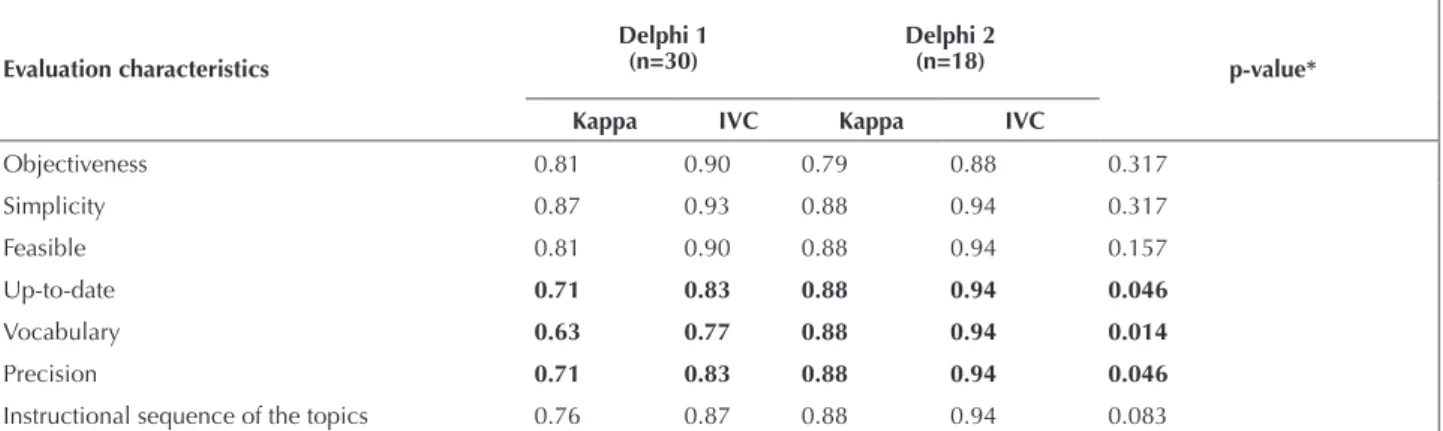
As to the requirements for evaluation of the instru-ment, it was found that the scores in the second round were higher in seven of the 10 items, and showed a sta-tistical difference in the aspects relating to (i) being up to date with information, (ii) vocabulary, and (iii)
pre-cision. his indicated that after the judges’ suggestions the instrument was better structured, following practices based on more up-to-date evidence, using correct terms, and separating some items to avoid confusion and am-biguity (Chart 2).
Chart 2. Kappa, IVC and Wilcoxon test values for comparison of the indices of the checklist obtained in Delphi round 1 and Delphi round 2. Natal, RN, Brazil, 2013.
Evaluation characteristics
Delphi 1 (n=30)
Delphi 2
(n=18) p-value* Kappa IVC Kappa IVC
Utility / relevance 0.93 0.97 0.88 0.94 0.317
Consistency 0.81 0.90 0.79 0.88 0.157
Evaluation characteristics
Delphi 1
(n=30) Delphi 2(n=18) p-value* Kappa IVC Kappa IVC
Objectiveness 0.81 0.90 0.79 0.88 0.317
Simplicity 0.87 0.93 0.88 0.94 0.317
Feasible 0.81 0.90 0.88 0.94 0.157
Up-to-date 0.71 0.83 0.88 0.94 0.046
Vocabulary 0.63 0.77 0.88 0.94 0.014
Precision 0.71 0.83 0.88 0.94 0.046
Instructional sequence of the topics 0.76 0.87 0.88 0.94 0.083
* Wilcoxon test. ...continuation
he results of the version prepared and validated by the judges made it possible to set out a schematic explanation for
use of the instrument of observation in evaluation of the nurs-ing care given to a person with a skin wound, as per igure 1.
Figure 1. Diagram explaining the use of the instrument to evaluate care given by undergraduate nursing students to a person with a skin lesion. Natal, RN, Brazil, 2013.
FIRST CARE
Anamnesis Identification of risk factors
Preparation for care
Hygienically clean hands before and after care Physical examination Check vital signs
Assess Pain Assess presence of infection Characteristics of the lesion
Bandage Cleaning of lesion
Indication of coverage
Health education of the injured
person and family/carer Assessment of needfor debridement
Organization of the care environment
Recording and documentation of the clinical assessment and characterístics of the lesion
Identify need for complementary tests, and arrange for them
Identify need for referral to other professionals, and
arrange it
WHEN NECESSARY EACH
INSTANCE OF CARE
he diagram proposed covers the aspects of nursing care given to a person with a skin injury, grouped by the need for realization, thus facilitating application of the instrument as a teaching resource to orient assessment of care given by undergraduate nursing students in real situations. While the student is providing care to a per-son with an injury, the examiner observes and records the student’s performance in the evaluation exercise, identi-fying the competencies and skills that are shown to be
good and those that still need more investment. hus, this is a tool to be used in a teaching and learning on the subject.
DISCUSSION
Instrument for evaluating care given by undergraduate nursing students to people with wounds
he time of experience in teaching and in healthcare reported by the judges in the two rounds of the Delphi technique showed professional experience with interaction between teaching and care capable of transforming and im-proving the processes of both learning and care(11), and
con-irming the qualiication of the participants of the study to consider the instruments used in the evaluation of care given by nursing undergraduates to a person with a skin lesion.
he Delphi technique has been widely used as a tool for validating content of investigations in the health area, with the objective of reining opinions and reaching a consensus between a group of specialists in a given subject, based on application of questionnaires in successive rounds, and us-ing the feedback of information from the participants(5,12).
Usually, the method adopted for obtaining consensus from a panel of judges is to carry out two or three rounds, depending on the nature and homogeneity of the group of participants and the complexity of the subjects studied(12).
he levels of consensus are chosen by the investigator and, according to the literature, can vary from 0.50 to 0.80. Also, loss of participants is a fact expected at each round of the Delphi technique, although it is not a limiting factor for the analysis of the data of the investigation (12-13).
In this study, the form for assessment of the checklist was submitted to the panel of specialists twice – in two rounds – with a lower number of participants in the second round. Improvement in the indices of agreement (CVI and Kappa) was obtained in the second round, after the refor-mulations resulting from feedback, and this was understood as evidence of validation of the instrument proposed.
We emphasize that the form submitted for the irst round of opinions covered the aspects of care and the de-scription of the parameter expected for its execution by the student in application of the checklist, but the procedures involved in the process of care did not include a detailed de-scription of the technique. his initial coniguration of the form inluenced the Kappa and CVI values obtained, and supported the reformulations of the instrument for the sec-ond Delphi round. he increase in the indices of agreement between the judges from the irst round to the second indi-cates reinement of the content of the instrument proposed. It was seen that the majority of the items of the checklist obtained Kappa and CVI values higher than 0.80, but the categories relating to cleaning of hands be-fore provision of care, cleaning of the lesion, and bandag-ing did not reach this score, even though they presented an improvement in the level of consensus in the second Delphi round.
An increase in CVI was obtained in assessment of the item ‘cleaning of hands before provision of care’, an increase in the CVI was obtained in the second round of opinions, with statistical signiicance when the Wilcoxon test was applied to the Kappa values. he disagreements between the judges in relation to this item related to the descrip-tion of the assessment parameter of the procedure to be carried out by the student, in relation to the need to divest personal adornments, and in the indication of need to carry out simple hygiene of the hands when they are visibly dirty.
he modiication in the item about removal of ‘divest adornments’ in the description of the procedure of cleaning of hands was justiied by the judges by relation to Regula-tory Rule 32 (NR32), which speciies non-use of adorn-ments by professionals in the environment of health institu-tions(14). he judges recognized that the literature describes
the presence of dirt as one of the indications for carrying out hygiene of the hands(15), but were opposed to keeping
this stage in the description of the procedure, because they believed it causes confusion and has a negative inluence on its realization by the student.
he items referring to cleaning of the wound and the technique of bandaging received the lowest indices of ac-ceptance among the judges of this survey, although they presented a signiicant improvement in the Kappa and CVI values, higher than 0.80, in the second Delphi round.
In these items, the description of the parameter to be assessed was questioned in relation to the use of irrigation of the wound with jets of 0.9% saline solution, with perfora-tion of the lask with a 40x12mm needle – the shortage of scientiic evidence on this practice being presented as a jus-tiication. Suggestions of improvements were also indicated: statement of requirement to use clean or sterile technique; and specifying the procedure to be carried out for wounds with primary, secondary or tertiary wound healing.
It is has been observed, indeed, that there is little litera-ture, and of a low level, about the procedures and techniques involved in care for a person with a skin injury, such as cleaning and bandaging the wound. However, the technique described in the checklist, involving these procedures, is supported in the literature, principally in books and proto-cols for care of wounds(16-19).
he shortage of standardized valid and reliable conducts favors use of diferent, divergent or conlicting practices in care of wounds by an interdisciplinary team. In the attempt to create a more eicacious and eicient intervention in the process of wound healing and in the quality of care given to the injured person, new technologies and instruments of evaluation are being created, validated and used in the ield of treatment of wounds, facilitating systematic and detailed study of lesions, and also education of care teams, especially in the clinical context(20-21).
he alterations suggested by the judges in the items that achieved a level of agreement lower than 0.80 were com-plied with or rejected after analysis and comparison with the literature. However it was decided not to remove the items that did not meet the Kappa or CVI index adopted (0.80), since there had been an increase in the level of agree-ment in the second round of opinions, and because of scores of above 0.80 in the criterion relating to the usefulness/ relevance of each item.
he category ‘referral of the person with the skin lesion’ was the only one among the 20 items in the composition of the checklist that showed a reduction in scores in the second round, in relation to the irst Delphi round; but it remained within the Kappa and CVI values adopted.
pa-rameter, of other professionals of the team to whom the injured person might possibly need to be referred; this de-scription was included in the initial version of the checklist, submitted in the irst Delphi round. Also, suggestions of improvements were made in terms of listing the more fre-quent minor complications, to give more consistency to the action recommended.
Referral for evaluation by specialists is fundamental in qualifying and completing the healthcare given to a person with a wound, and is necessary whenever evolution and re-assessment indicate the need for the clinical examination and evaluation of the wound by other health professionals(22-23).
However, since this is a case of an instrument for assess-ment of nursing care, and not of a multi-professional team, referral of the person with a wound to some health profes-sionals ceases to be an attribution of the nurse, who, within his/her level of competence, should know how to identify the need for assessment of the patient by specialists and to arrange for a medical consultation, to request the referral(19).
Usually, referrals to specialists (surgeons, endocrinolo-gists, angioloendocrinolo-gists, infectious disease specialists, dermatolo-gists, etc.) are made after the assessment by a doctor and discussion with the nursing team, with the exception of certain cases supported by healthcare protocols and rules established in some health services(24).
In relation to the evaluation parameters of the check-lists, it was found that the level of agreement of the judges in Delphi round 2 was higher in seven of the 10 parameters, which was understood to demonstrate evidence of valid-ity of the instrument, according to the consensus reached between the specialists. Further, it is important to note that the agreement of the judges in the second Delphi round was greater in all the categories and parameters of evaluation of the instrument, but, with the adjustments involved in the calculation of the Kappa and CVI indices which were applied to the reduced sample of participants in the second round (18 judges), some of the scores were lower than, and/ or the same as those of the irst Delphi round.
Further, it should be noted that compliance or non-compliance by the student with the requirements listed in the checklist will be evidence of the student’s theoretical knowledge about the aspects of care for a person with a skin injury, but also of the acquisition of competencies and skills (humanistic, verbal and written communication, problem solving, organization, clinical reasoning and execution of techniques). In this regard, one should note its
‘horizon-tal’ importance. In other words, although certain skills and competencies are necessarily associated with speciic tasks in care for an injured person, as presented in the checklist, they should not be limited to those tasks, but need to be mobilized by the student in other moments of the care being provided.
Summing up, it is observed that, in the inal version, the instrument assessed by the judges was longer and less objective, but more complete, clear and consistent, covering activities, and description of their manner of execution, which are fun-damental to the process of evaluation of the care provided by the undergraduate student to people with skin lesions.
CONCLUSION
he checklist proposed presented better scores in its component categories in the second Delphi round in rela-tion to the Kappa and CVI scores of the irst round.
In relation to the evaluation parameters, it was found that the agreement of the participants in the second round of the technique was greater in all the items, and this con-sensus of the judges was understood to indicate evidence of validity of the instrument, and its appropriateness for measurement of the care given by undergraduate nursing students to a person with a skin injury.
Measurement instruments based on scientiic evidence provide a better-qualiied assessment of the care being pro-vided, and contribute to systematization of care in the train-ing of students, and indeed even of professional nurses.
It is understood to be the case that the construction of reliable instruments of measurement is important for nursing and can provide elements supporting identiica-tion of deiciencies, and the taking of measures to resolve the failures identiied. It is important to provide safe and good-quality care for patients with injuries, and overcome the dichotomy between theory and practice in the training of professionals to face problem situations.
he Delphi technique used for evaluating the checklist made it possible to reine the opinions and to achieve a consensus of the judges in relation to care of the person with a skin lesion, including standardization of essential conducts to be evaluated systematically in measurement of the performance of the undergraduate student.
However, more surveys are necessary to conirm the validity and reliability of this instrument. he second step should be the application of this checklist in clinical sce-narios of teaching-learning, to assess their contributions to the public for which they are intended.
RESUMO
Instrument for evaluating care given by undergraduate nursing students to people with wounds
DESCRITORES
Ferimentos e Lesões; Cuidados de Enfermagem; Estudos de Validação; Estudantes de Enfermagem.
RESUMEN
Objetivo: Presentar el proceso de construcción y validación de un instrumento para evaluar el cuidado a la persona con herida a in de aplicarlo a los graduandos de enfermería. Método: Investigación metodológica, cuantitativa, con aplicación de la técnica Delphi en dos rondas. La primera con 30 jueces y la segunda con 18. El análisis se hizo mediante el coeiciente Kappa ≥0,80, el índice de validez de contenido >0,80, además de la prueba de los rangos con signos de Wilcoxon para comparaciones de los índices entre las rondas. Resultados: Se veriicó que, de las 20 categorías del instrumento, 18 presentaron mejores puntajes en la fase Delphi 2. En cuanto a los requisitos de evaluación, se advirtió que los puntajes en la segunda fase fueron mayores en siete de los 10 ítems. Conclusión: Desde la evaluación de los jueces, se deinió una versión del instrumento con índices de concordancia y validez adecuados, la que podrá contribuir con la evaluación del cuidado de graduandos de enfermería a la persona con lesión cutánea.
DESCRIPTORES
Herydas y Traumatismos; Atención de Enfermería; Estudios de Validación; Estudiantes de Enfermería.
REFERENCES
1. Waidman MAP, Rocha SC, Correa JL, Brischiliari A, Marcon SS. O cotidiano do indivíduo com ferida crônica e sua saúde mental. Texto Contexto Enferm. 2011;20(4):691-9.
2. Yamada BFA, Santos VLCG. Development and validaion of Ferrans & Powers Quality of Life Index: wound version. Rev Esc Enferm USP [Internet].
2009 [cited 2014 July 9];43(n.spe):1105-13. Available from: htp://www.scielo.br/pdf/reeusp/v43nspe/en_a15v43ns.pdf
3. Dantas DV, Torres GV, Dantas RAN. Assistência aos portadores de feridas: caracterização dos protocolos existentes no Brasil. Ciênc Cuid Saúde. 2011; 10(2):366-72.
4. Torres GVT, Mendes FRP, Mendes AFRF, Silva AO, Torres SMSGSO, Viana DMO, et al. Nurses’ evaluation about primary health care of users with venous ulcers: study in Évora, Portugal. Rev Enferm UFPE on line [Internet]. 2011 [cited 2014 July 9]; 5(n.spe):388-98. Available from: http://www.revista.ufpe.br/revistaenfermagem/index.php/revista/article/viewArticle/1731
5. Bittencourt HR, Creutzberg M, Rodrigues ACM, Casartelli AO, Freitas ALS. Desenvolvimento e validação de um instrumento para avaliação de disciplinas na educação superior. Est Aval Educ [Internet]. 2011 [citado 2014 jul. 9];22(48):91-114. Disponível em: http://educa.fcc. org.br/pdf/eae/v22n48/v22n48a06.pdf
6. Kuwabara CCT, Évora YDM, Oliveira MMB. Risk management in technovigilance: construction and validation of a medical-hospital product evaluation instrument. Rev Latino Am Enfermagem [Internet]. 2010 [cited 2014 July 9];18(5):943-51. Available from: http://www.scielo. br/pdf/rlae/v18n5/15.pdf
7. Randolph JJ. Online Kappa calculator [Internet]. 2008 [cited 2013 Sept 25]. Available from: http://justus.randolph.name/kappa
8. Fonseca R, Silva P, Silva R. Acordo inter-juízes: o caso do coeiciente Kappa. Lab Psicol [Internet] 2007 [citado 2013 set. 25];5(1):81-90.
Disponível em: http://repositorio.ispa.pt/bitstream/10400.12/1263/1/LP%205%281%29%2081-90.pdf
9. Alexandre NMC, Coluci MZO. Validade de conteúdo nos processos de construção e adaptação de instrumentos de medidas. Ciênc Saúde Coletiva. 2011;16(7):3061-68.
10. Brasil. Ministério da Saúde; Conselho Nacional de Saúde. Resolução nº 466, de 12 de dezembro de 2012. Dispõe sobre as diretrizes e normas regulamentadoras de pesquisas envolvendo seres humanos [Internet]. Brasília; 2012 [citado 2013 set. 25]. Disponível em: http:// conselho.saude.gov.br/resolucoes/2012/Reso466.pdf
11. Reibnitz KS, Daussy MFS, Silva CAJ, Reibnitz MT, Kloh D. Rede Docente Assistencial UFSC/SMS de Florianópolis: relexos da implantação
dos projetos Pró-Saúde I e II. Rev Bras Educ Med [Internet]. 2012 [citado 2014 jul. 9];36(1):68-75. Disponível em: http://www.scielo.br/ pdf/rbem/v36n1s2/a11v36n1s2.pdf
12. Scarparo AF, Laus AM, Azevedo ALCS, Freitas MRI, Gabriel CS, Chaves LDP. Relexões sobre o uso da técnica Delphi em pesquisas na
enfermagem. Rev RENE [Internet]. 2012 [citado 2014 jul. 9];13(1):242-51. Disponível em: http://www.revistarene.ufc.br/revista/index. php/revista/article/download/36/31
13. Fernandes IR, Tilbery CP, Avelar MCQ. Validação das condutas de enfermagem na orientação de clientes com esclerose múltipla em uso de imunomoduladores. Rev Neurocienc. 2011;19(1):68-76.
14. Brasil. Ministério do Trabalho e Emprego. Portaria GM n. 485, de 11 de novembro de 2005. Aprova a norma regulamentadora nº 32 (Se-gurança e Saúde no Trabalho em Estabelecimentos de Saúde) [Internet]. Brasília; 2005 [citado 2013 set. 27]. Disponível em: http://sbbq. iq.usp.br/arquivos/seguranca/portaria485.pdf
15. Brasil. Ministério da Saúde; Agência Nacional de Vigilância Sanitária. Anexo 1: Protocolo para a prática de higiene das mãos em Serviços de Saúde [Internet]. Brasília; 2013 [citado 2013 set. 27]. Disponível em: http://www.sbpc.org.br/upload/conteudo/protocolo_higiene_ maos_09jul2013.pdf
16. Santos AAR, Medeiros ABA, Soares MJGO, Costa MML. Avaliação e tratamento de feridas: o conhecimento de acadêmicos de enfermagem. Rev Enferm UERJ. 2010;18(4):547-52.
17. Borges EL, Saar SRC, Magalhães MBB, Gomes FSL, Lima VLAN. Feridas: como tratar. 2ª ed. Belo Horizonte: Coopmed; 2008.
19. Ribeirão Preto. Secretaria Municipal da Saúde. Programa de Educação Continuada. Manual de assistência integral as pessoas com feridas crônicas [Internet]. Ribeirão Preto; 2011 [citado 2013 set. 25]. Disponível em: http://www.ribeiraopreto.sp.gov.br/ssaude/programas/sad/ manual_feridas_2011.pdf
20. Zhong X, Nagase T, Huang L, Kaitani T, Iizaka S, Yamamoto Y, et al. Reliability and validity of the chinese version of DESIGN-R, an assess-ment instruassess-ment for pressure ulcers. Ostomy Wound Manage. 2013;59(2):36-43.
21. Thompson N, Gordey L, Bowles H, Parslow N, Houghton P. Reliability and validity of the revised photographic wound assessment tool on digital images taken of various types of whronic wounds. Adv Skin Wound Care. 2013;26(8):360-73.
22. Morais GFC, Oliveira SHS, Soares MJGO. Avaliação de feridas pelos enfermeiros de instituições hospitalares da rede pública. Texto Con-Avaliação de feridas pelos enfermeiros de instituições hospitalares da rede pública. Texto Con-texto Enferm. 2008;17(1):98-105.
23. Moreira RAN, Queiroz TA, Araújo MFM, Araújo TM, Caetano CA. Condutas de enfermeiros no tratamento de feridas numa unidade de terapia intensiva. Rev RENE. 2009;10(2):45-51.