Article
J. Braz. Chem. Soc., Vol. 25, No. 1, 104-111, 2014. Printed in Brazil - ©2014 Sociedade Brasileira de Química 0103 - 5053 $6.00+0.00
A
http://dx.doi.org/10.5935/0103-5053.20130275*e-mail: [email protected]
Synthesis and Antimicrobial Properties of 1,3,4-Oxadiazole Analogs Containing
Dibenzosuberane Moiety
Manjunath Moger,a,b Vijay Satam,a Darshan Raj C. Govindaraju,c Paniraj A. S.,a Vadiraj S. Gopinath,a Rama Mohan Hindupura and Hari N. Pati*,a
aAdvinus Therapeutics Ltd., 21 & 22, Phase II, Peenya Industrial Area, Bangalore 560058, Karnataka, India
bDepartment of Chemistry, Mangalore University, Mangalagangotri 574199, Karnataka, India
cDepartment of Bio-Medicinal Research, Vidya Herbs Pvt. Ltd., Bangalore 562106, Karnataka, India
Uma série de dez novos análogos de 1,3,4-oxadiazóis contendo uma parte dibenzosuberano foram sintetizados usando tanto uma aproximação de síntese linear, quanto convergente. Todos os compostos foram caracterizados por espectrometria de massas, espectroscopias no infravermelho (IR), de ressonância magnética nuclear de 1H (1H NMR ) e 13C (13C NMR) e análise elementar.
As atividades bactericidas e antifúngicas destes compostos foram avaliadas, determinando-se que entre estes, quatro derivados, especificamente 8a,8d, 8e e 8j, foram altamente bactericidas e antifúngicos.
A series of ten novel 1,3,4-oxadiazole analogs containing dibenzosuberane moiety were synthesized using linear as well as convergent synthesis approach. All the compounds were characterized by mass spectrometry, infrared (IR), 1H and 13C nuclear magnetic resonance (1H NMR
and 13C NMR) spectroscopies and elemental analysis. These compounds were evaluated for
antibacterial and antifungal activities. Among ten analogs, four compounds, namely, 8a,8d, 8e
and 8j were found to be highly active antibacterial and antifungal agents.
Keywords: dibenzosuberane, 1,3,4-oxadiazole, antibacterial, antifungal
Introduction
The rigid, tricyclic framework of dibenzosuberane (10,11-dihydro-5H-dibenzo[a,d]cycloheptene, (A), Figure 1) constitutes an integral part of the structure of molecules that are known to be effective for the treatment of depressive disorders.1 Analogs of dibenzosuberane such
as amitriptyline2 ((B), Figure 1) and nortriptyline3 ((C),
Figure 1) are well known tricyclic antidepressants which are used as first line medicines in the treatment of migraines, tension headaches, anxiety, psychosis, aggression and violent behavior. Derivative of dibenzosuberane, 1,1a,6,10b-tetrahydrodibenzo[a,e]cyclopropa[c]cycloheptene ((D), Figure 1), obtained on annellation of a cyclopropyl ring to the dibenzosuberane framework, has been incorporated in the structure of potent multiple drug resistance modulators.4
Easy access and close structural resemblance to popular
pharmaceutical intermediate, dibenzazepine, makes dibenzosuberane an attractive drug scaffold.
Moger et al. 105 Vol. 25, No. 1, 2014
2,5-Disubstituted-1,3,4-oxadiazoles ((E), Figure 1) are known to exhibit a broad range of potent biological activities. A number of 1,3,4-oxadiazoles having appropriate substituents at 2 and 5 position are widely used as antimicrobial,5 anti-HIV,6 analgesic,7 antiinflammatory,8,9
anticonvulsant,10,11 and antitumor12,13 agents. We envisaged
that attachment of dibenzosuberane framework to versatile 1,3,4-oxadiazole ring would produce synergistic effect and lead to novel hybrid molecules that may possess interesting biological activities. To validate this hypothesis, a series of ten novel hybrid molecules (8a-8j, Figure 1) in which a derivative of dibenzosuberane, 1,1-difluoro-1a,10b-dihydrodibenzo[a,e]cyclopropa[c]cycloheptane, was linked to 2-methyl-5-(substituted-phenyl)-1,3,4-oxadiazole ring were synthesized. All ten novel compounds were characterized by mass spectrometry, IR and NMR spectroscopy and elemental analysis and evaluated for antimicrobial properties. The study revealed that a number of novel dibenzosuberane containing 1,3,4-oxadiazole analogs possessed excellent antibacterial as well as antifungal activity.
Results and Discussion
Synthesis of novel 1,3,4-oxadiazole analogs containing dibenzosuberane moiety (8a-8j)
In order to synthesize novel 1,3,4-oxadiazole analogs containing dibenzosuberane unit (8a-8j), first, we adopted linear strategy as disclosed in Scheme 1. Dibenzosuberenone 1 was heated with sodium chlorodifluoroacetate in triglyme at 180-190 °C to obtain 1,1-difluoro-1a,10b-dihydrodibenzo[a,e]cyclopropa[c] cyclohepten-6-one 2.Compound 2 on reduction with sodium borohydride in methanol at 0-5 °C afforded corresponding alcohol 314 which on treatment with ethyl bromoacetate in
presence of sodium hydride in DMF gave compound 4. The reaction of compound 4 with hydrazine hydrate in ethanol under reflux yielded hydrazide 5. Interestingly, cyclization reaction of hydrazide 5 with benzoic acid in phosphorous oxychloride to construct 1,3,4-oxadiazole framework did not give corresponding dibenzosuberane-1,3,4-oxadiazole analog 8a. Alternatively, hydrazide 5 was treated with benzaldehyde (6) in ethanol under reflux to obtain corresponding N’-benzylidenehydrazide (7) which was cyclized using chloramine-T in ethanol at 60 °C to afford desired analog (8a). Although, the compound was isolated in good purity, yield of the final cyclization reaction did not exceed 15%.
Lower yield in the linear synthesis strategy (Scheme 1) prompted us to explore alternate convergent synthesis
approach as depicted in Scheme 2. 2-Chloromethyl-5-(substituted-phenyl)-1,3,4-oxadiazoles15 (12a-12j)
needed for the convergent synthesis route were prepared by reacting appropriately substituted benzoic acids (9a-9j) with hydrazine hydrate in the presence of ethyl chloroformate in DCM to obtain corresponding hydrazides (10a-10j) which were further reacted with chloroacetyl chloride in ethyl acetate under reflux to afford corresponding N’-(2-chloroacetyl)-substituted-phenyl hydrazides (11a-11j). Compounds (11a-11j) thus obtained were cyclized in phosphorus oxychloride at 80 °C to yield corresponding 2-chloromethyl-5-(substituted-phenyl)-1,3,4-oxadiazoles (12a-12j). Coupling of compound 314
with suitable 2-chloromethyl-5-(substituted-phenyl)-1,3,4-oxadiazole (12a-12j) in DMF in the presence of sodium hydride gave desired dibenzosuberane containing analogs of 1,3,4-oxadiazole (8a-8j) in good to very good (60-77%) yield. All the compounds were purified by column chromatography using silica gel and gradient (0-50%) ethyl acetate in hexane as the eluent and characterized by
1H NMR, 13C NMR, IR spectroscopy, mass spectrometry
and elemental analysis.
Antibacterial and antifungal activity of 1,3,4-oxadiazole analogs containing dibenzosuberane unit (8a-8j)
With a range of target molecules at hand, their antibacterial activity against four bacterial strains namely,
Staphylococcus aureus, Escherichia coli, Pseudomonas aeroginosa and Klebsiella pneumonia was determined using disc diffusion method16,17 and compared with
well-known antibacterial drug, nitrofurazone. The minimum inhibitory concentration (MIC, µg mL-1) was
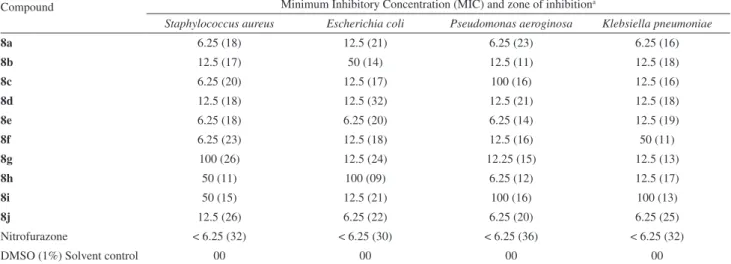
determined for each compound in triplicate experiments, the values were averaged and are presented in Table 1. Among ten analogs, four analogs 8a, 8d, 8e and 8j showed very good activity against all the bacterial stains. Except three compounds 8g, 8h and 8i remaining all compounds were found to be active against Staphylococcus aureus. Out of ten analogs, two analogs 8b and 8h were found to be inactive against Escherichia coli. Eight analogs namely, 8a, 8b, 8d, 8e, 8f, 8g, 8h, and 8j showed very good activity against Pseudomonas aeroginosa. Two analogs 8f and 8i were found to be inactive against
Synthesis and Antimicrobial Properties of 1,3,4-Oxadiazole Analogs J. Braz. Chem. Soc.
106
phenyl ring result in higher antibacterial activity (e.g., compounds 8e, 8f and 8j). However, fluorine atom at meta
position in combination with chlorine at para position of the phenyl ring diminishes antibacterial activity to a great extent (compound 8i). Interestingly, compound 8a, devoid of any substitution on the phenyl ring, showed remarkable
activity against all four bacterial strains. Compounds 8a, 8d, 8e, and 8j showed uniform activity against gram-positive (Staphylococcus aureus) and gram-negative (Escherichia coli, Pseudomonas aeroginosa and Klebsiella pneumoniae) bacterial strains. Compound 8g was found to be inactive against gram-positive bacteria and moderately active Scheme 1. Linear synthesis pathway of 1,3,4-oxadiazole analogs containing dibenzosuberane unit.
Moger et al. 107 Vol. 25, No. 1, 2014
against gram-negative bacteria. In general, all compounds showed broad spectrum of activity against both gram-positive and gram-negative bacterial strains.
All compounds were also assessed for antifungal activity against Penicillium marneffei (recultured), Trichophyton mentagrophytes (recultured), Aspergillus flovus (NCIM No. 524) and Aspergillus fumigatus (NCIM No. 902). The compounds were dissolved in DMSO and antifungal activity was determined using serial dilution method.18 For comparison, well-known antifungal drug
Amphotericin B was used as a standard. The minimum inhibitory concentration (MIC, µg mL-1) was determined
for each compound in triplicate experiments; the values were averaged and are presented in Table 2. Six
compounds 8a, 8b, 8d, 8e, 8h and 8j displayed very good activity against all four fungal strains. Compounds 8c and 8i showed activity against all strains except
Trichophyton mentagrophyte and Penicillium marneffei, respectively. While compound 8f was found to be active against two strains namely, Penicillium marneffei and
Trichophyton mentagrophyte, compound 8g showed
activity against Trichophyton mentagrophytes and
Aspergillus fumigatus. The values presented in the
Table 2 reveal interesting trends in antifungal activity of compounds depending on substitution pattern on the phenyl ring attached to 1,3,4-oxadiazole ring. Alkyl substituents on the phenyl ring, as in the case of compounds 8b and 8d impart good antifungal activity against all four Table 1. Antibacterial activity of analogs (8a-8j)
Compound
Antibacterial activity
Minimum Inhibitory Concentration (MIC) and zone of inhibitiona
Staphylococcus aureus Escherichia coli Pseudomonas aeroginosa Klebsiella pneumoniae
8a 6.25 (18) 12.5 (21) 6.25 (23) 6.25 (16)
8b 12.5 (17) 50 (14) 12.5 (11) 12.5 (18)
8c 6.25 (20) 12.5 (17) 100 (16) 12.5 (16)
8d 12.5 (18) 12.5 (32) 12.5 (21) 12.5 (18)
8e 6.25 (18) 6.25 (20) 6.25 (14) 12.5 (19)
8f 6.25 (23) 12.5 (18) 12.5 (16) 50 (11)
8g 100 (26) 12.5 (24) 12.25 (15) 12.5 (13)
8h 50 (11) 100 (09) 6.25 (12) 12.5 (17)
8i 50 (15) 12.5 (21) 100 (16) 100 (13)
8j 12.5 (26) 6.25 (22) 6.25 (20) 6.25 (25)
Nitrofurazone < 6.25 (32) < 6.25 (30) < 6.25 (36) < 6.25 (32)
DMSO (1%) Solvent control 00 00 00 00
aZone of inhibition in mm is given in parenthesis; MIC is expressed in µg mL-1 (MIC for the standard drug, nitrofurazone, is reported earlier19); standard
drug used: nitrofurazone;solvent control: 1% DMSO.
Table 2. Antifungal activity of analogs (8a-8j)
Compound
Antifungal activity
Minimum Inhibitory Concentration (MIC) and zone of inhibitiona
Penicillium marneffei Trichophyton mentagrophyte Aspergillus flovus Aspergillus fumigatus
8a 12.5 (10) 12.5 (13) 6.25 (11) 6.25 (16)
8b 12.5 (12) 12.5 (11) 12.5 (12) 12.5 (18)
8c 6.25 (11) R 12.5 (09) 12.5 (11)
8d 12.5 (16) 12.5 (16) 12.5 (12) 12.5 (13)
8e 6.25 (16) 6.25 (12) 6.25 (12) 12.5 (14)
8f 6.25 (14) 12.5 (14) R R
8g R 12.5 (13) R 12.5 (14)
8h 6.25 (12) 12.5 (13) 12.5 (12) 12.5 (12)
8i R 6.25 (10) 12.5 (14) 6.25 (12)
8j 12.5 (13) 6.25 (12) 6.25 (12) 6.25 (13)
Amphotericin B < 6.25 (33) < 6.25 (38) < 6.25 (29) < 6.25 (24)
DMSO (1%) Solvent control 00 00 00 00
aZone of inhibition in mm is given in parenthesis; MIC is expressed in µg mL-1 (MIC for the standard drug, amphotericin B, is reported earlier19); standard
Synthesis and Antimicrobial Properties of 1,3,4-Oxadiazole Analogs J. Braz. Chem. Soc.
108
strains. Electron withdrawing fluorine substituent at para
position of the phenyl ring, as in the case of compounds 8e and 8j, resulted in remarkably high antifungal activity against all strains. Presence of chlorine substituent at the para position of the phenyl ring (compound 8f) caused diminished activity against Aspergillus flovus and
Aspergillus fumigatus. Interestingly, this trend was reversed by introduction of fluorine substituent at meta position next to chloro group (compound 8i). Presence of electron donating methoxy group on the phenyl ring caused good to very good antifungal activity (compound 8c and 8h). However, compound 8c having para-methoxy substituent showed resistance to Trichophyton mentagrophyte
strain. The compound 8a having no substitution on the phenyl ring attached to 1,3,4-oxadiazole ring showed good antifungal activity against Penicillium marneffei
and Trichophyton mentagrophyte and very good activity against Aspergillus flovus and Aspergillus fumigatus. Phenyl substitution at para position of the phenyl ring (compound 8g) caused resistance for Penicillium marneffei
and Aspergillus flovus strains.
Conclusions
A series of ten novel 1,3,4-oxadiazole analogs containing dibenzosuberane moiety (8a-8j) having various substituents on the phenyl ring attached to 1,3,4-oxadiazole ring were synthesized and well characterized. All the analogs were investigated for antibacterial and antifungal activities. In general, all compounds showed moderate-to-good activity against the bacterial and fungal strains used in this study. Four compounds 8a,8d, 8e and 8j were uniformly active against all bacterial as well as fungal strains used for the study. para-Fluoro substitution on the phenyl ring attached to 1,3,4-oxadiazole framework causes marked increase in both antibacterial as well as antifungal activities of the novel molecules.
Experimental
Material and methods
All chemicals used for the synthesis were of reagent grade and procured from Sigma-Aldrich, Bangalore, India.
1H and 13C NMR spectra were recorded on AS 400 MHz
Varian NMR spectrometer using TMS as an internal standard. IR spectra were recorded by using Perkin-Elmer Spectrum 100 Series FT-IR spectrometer. Mass spectra were recorded on Agilent 1200 Series LC/MSD VL system. Melting points were determined by using Büchi melting point B-545 instrument and are uncorrected. All
the reactions were monitored by thin layer chromatography (TLC) using precoated silica 60 F254, 0.25 mm aluminum plates (Merck). The crude compounds were purified by column chromatography using silica gel (100-200) and gradient (0-50%) ethyl acetate in hexane as the eluent system.
Synthesis
General procedure for the preparation of 1,3,4-oxadiazole analogs containing dibenzosuberane moiety (8a-8j)
A solution of compound 314 (200 mg, 0.77 mmol) in
DMF (5.0 mL) was cooled to 0-5 °C. Sodium hydride (60%, 47.0 mg, 1.16 mmol) was added to it and stirred for 15 min. To the reaction mixture was added suitably substituted 2-chloromethyl-5-phenyl-1,3,4-oxadiazole15
(12a-12j, Scheme 2) (0.85 mmol, 1.1 eq) at 0-5 °C and stirred for 1.0 h. Progress of the reaction was monitored by TLC. Upon completion, the reaction mixture was poured on crushed ice. The precipitated solid was filtered, washed with water and dried. The crude product was purified by column chromatography using silica gel (100-200) and gradient (0-50%) ethyl acetate in hexane as the eluent.
1,1-Difluoro-1,1a,6,10b-tetrahydro-(1a,6,10b)-dibenzo[a,e] cyclopropa[c]cyclohepten-6-yloxymethyl-5-phenyl-[1,3,4]-oxadiazole (8a)
White solid; yield 77%; mp 183-185 °C; IR (KBr)
ν
max/cm-1: 3011, 1456, 1169, 747; 1H NMR (400 MHz,
DMSO-d6) d 3.53 (d, 2H, J 13.6 Hz), 5.09 (s, 2H), 6.55 (s, 1H), 7.20-7.27 (m, 6H), 7.45 (d, 2H, J 7.2 Hz), 7.60-7.66 (m, 3H), 8.01-8.03 (m, 2H); 13C NMR (100 MHz,
DMSO-d6) d 27.3, 61.7, 77.8, 122.5, 123.6, 126.8, 127.1, 127.8, 128.3, 129.9, 131.8, 132.6, 142.7, 163.7, 165.1; MS (ESI) m/z: 417.1 [M + H]+; anal. calcd. for C
25H18F2N2O5: C,
72.11; H, 4.36; F, 9.12; N, 6.73; O, 7.68; found: C, 72.13; H, 4.31; F, 9.14; N, 6.68; O, 7.62.
1,1-Difluoro-1,1a,6,10b-tetrahydro-(1a,6,10b)-dibenzo [a,e]cyclopropa[c]cyclohepten-6-yloxymethyl-5-(4-methyl-phenyl)-[1,3,4]-oxadiazole(8b)
Off white solid;yield 76%;mp 218-220 °C; IR (KBr)
ν
max/cm-1: 3011, 1495, 1169, 747; 1H NMR (400 MHz,
DMSO-d6) d2.4(s, 3H), 3.52 (d, 2H, J 13.6 Hz), 5.07 (s, 2H), 6.54 (s, 1H), 7.23-7.26 (m, 6H), 7.41 (m, 4H), 7.88 (d, 2H, J 8.4 Hz); 13C NMR (100 MHz, DMSO-d
6) d 26.3,
32.2, 66.5, 82.5, 125.5, 127.3, 131.3, 131.8, 132.5, 133.1, 135.2, 136.6, 147.5, 147.6, 168.2, 169.9; MS (ESI) m/z: 431.1 [M + H]+; anal. calcd. for C
26H20F2N2O2: C, 72.55;
Moger et al. 109 Vol. 25, No. 1, 2014
1,1-Difluoro-1,1a,6,10b-tetrahydro-(1a,6,10b)-dibenzo [a,e] cyclopropa[c]cyclohepten-6-yloxymethyl-5-(4-methoxy-phenyl)-[1,3,4]-oxadiazole (8c)
White solid; yield 65%; mp 165-168 °C; IR (KBr)
ν
max/cm-1: 3012, 1613, 1496, 1260, 746; 1H NMR (400 MHz,
DMSO-d6) d3.53 (d, 2H, J 13.6 Hz), 3.86 (s, 3H), 5.06 (s, 2H), 6.54 (s, 1H), 7.15 (d, 2H, J 8.8 Hz), 7.23-7.27 (m, 6H), 7.44 (d, 2H, J 6.4 Hz), 7.93-7.97 (m, 2H); 13C NMR (100
MHz, DMSO-d6) d 27.3, 55.9, 61.7, 77.7, 115.4, 115.9, 122.5, 126.8, 127.8, 128.3, 128.9, 131.8,142.7, 162.6, 163.1, 165.1; MS (ESI) m/z: 447.1 [M + H]+; anal. calcd.
C26H20F2N2O3: C, 69.12; H, 3.94; F, 13.12; N, 6.45; O,
7.37; found: C, 69.15; H, 3.91; F, 13.09; N, 6.41; O, 7.30.
1,1-Difluoro-1,1a,6,10b-tetrahydro-(1a,6,10b)-dibenzo[a,e] cyclopropa[c]cyclohepten-6-yloxymethyl-5-(4-t e r t
-butylphenyl)-[1,3,4]-oxadiazole (8d)
White solid; yield 73%; mp 157-160 °C; IR (KBr)
ν
max/cm-1: 2960, 1460, 1165, 749; 1H NMR (400 MHz,
DMSO-d6) d1.32 (s, 9H),3.53 (d, 2H, J 13.2 Hz), 5.08 (s, 2H), 6.54 (s, 1H), 7.21-7.27 (m, 6H), 7.44 (d, 2H, J 6.8 Hz), 7.63 (d, 2H, J 8.8 Hz), 7.92 (d, 2H, J 10.4 Hz); 13C NMR
(100 MHz, DMSO-d6)d 27.3, 31.2, 35.3, 61.7, 77.7, 120.8, 122.5, 126.7, 126.9, 127.8, 128.3, 131.9, 142.7, 155.6, 163.5, 165.1; MS (ESI) m/z: 473.2 [M + H]+; anal. calcd.
for C29H26F2N2O2: C, 73.71; H, 5.55; F, 8.04; N, 5.93; O,
6.77; found: C, 73.75; H, 5.51; F, 8.10; N, 5.90; O, 6.77.
1,1-Difluoro-1,1a,6,10b-tetrahydro-(1a,6,10b)-dibenzo[a,e] cyclopropa[c]cyclohepten-6-yloxymethyl-5-(4-fluorophenyl)-[1,3,4]-oxadiazole (8e)
White solid; yield 62%; mp 220-223 °C; IR (KBr)
ν
max/cm-1: 3011, 1607, 1496, 1168, 746; 1H NMR (400 MHz,
DMSO-d6) d 3.53 (d, 2H, J 13.2 Hz), 5.08 (s, 2H), 6.54 (s, 1H), 7.20-7.27 (m, 6H), 7.44-7.49 (m, 4H), 8.06-8.09 (m, 2H); 13C NMR (100 MHz, DMSO-d
6) d 27.3, 61.7, 77.8,
117.1, 117.3, 120.3, 122.5, 126.8, 127.80, 128.3, 129.8, 129.9, 131.9,142.7, 163.7, 164.3; MS (ESI) m/z: 435.1 [M + H]+; anal. calcd. for C
25H17F3N2O2: C69.95; H, 4.52; F,
8.51; N, 6.27; O, 10.75; found: C,69.93; H, 4.47; F, 8.49; N, 6.21; O, 10.72.
1 , 1 D i f l u o r o 1 , 1 a , 6 , 1 0 b t e t r a hy d r o ( 1 a , 6 , 1 0 b ) - dibenzo[a,e]cyclopropa[c]cyclohepten-6-yloxymethyl-5-(4-chlorophenyl)-[1,3,4]-oxadiazole (8f)
White solid; yield 70%;mp 212-214 °C; IR (KBr)
ν
max/cm-1: 3006, 1607, 1458, 1166, 747; 1H NMR (400 MHz,
DMSO-d6) d 3.53 (d, 2H, J 13.2 Hz), 5.09 (s, 2H), 6.55 (s, 1H), 7.22-7.27 (m, 6H), 7.44 (d, 2H, J 6.4 Hz), 7.69 (d, 2H, J 8.4 Hz), 8.01 (d, 2H, J 8.8 Hz); 13C NMR (100 MHz,
DMSO-d6)d 27.4, 61.7, 77.8, 122.5, 126.8, 127.8, 128.3,
128.9, 130.1, 131.8, 137.4, 142.7, 163.9, 164.3; MS (ESI)
m/z: 451.0 [M + H]+; anal. calcd. for C
25H17ClF2N2O2: C,
66.60; H, 3.80; Cl, 7.86; F, 8.43; N, 6.21; O, 7.10; found: C, 66.66; H, 3.77; Cl, 7.80; F, 8.47; N, 6.18; O, 7.06.
1,1-Difluoro-1,1a,6,10b-tetrahydro-(1a,6,10b)-dibenzo [a,e]cyclopropa[c]cyclohepten-6-yloxymethyl-5-(4-phenyl-phenyl)-[1,3,4]-oxadiazole (8g)
White solid; yield 70%; mp 241-244 °C; IR (KBr)
ν
max/cm
-1 3011, 1455, 1169, 747; 1H NMR (400 MHz,
DMSO-d6) d3.54 (d, 2H, J 13.6 Hz), 5.11 (s, 1H), 6.56 (s, 1H), 7.22-7.27 (m, 6H), 7.44-7.55 (m, 5H), 7.77 (d, 2H,
J 7.2 Hz), 7.92 (d, 2H, J 8.4 Hz), 8.09 (d, 2H, J 8.4 Hz); MS (ESI) m/z: 493.0 [M + H]+; anal. calcd. for C
31H22F2N2O2: C,
75.60; H, 4.50; F, 7.71; N, 5.69; O, 6.50; found: C, 75.65; H, 4.47; F, 7.76; N, 5.63; O, 6.55.
1,1-Difluoro-1,1a,6,10b-tetrahydro-(1a,6,10b)-dibenzo[a,e] cyclopropa[c]cyclohepten-6-yloxymethyl-5-(3,4-dimethoxy-phenyl)-[1,3,4]-oxadiazole (8h)
White solid; yield 60%; mp 205-208 °C; IR (KBr)
ν
max/cm
-1: 3011, 1607, 1500, 1170, 748; 1H NMR (400 MHz,
DMSO-d6) d 3.53 (d, 2H, J 13.2 Hz), 3.85 (s, 6H), 5.07 (s, 2H), 6.54 (s, 1H ), 7.16-7.27 (m, 7H), 7.44-7.48 (m, 3H), 7.57 (dd, 1H, J 2.0,8.0 Hz, ); 13C NMR (100 MHz,
DMSO-d6) d 27.4, 56.1, 61.7, 77.7, 109.5, 112.5, 115.8, 120.6, 122.5, 126.7, 127.8, 128.3, 131.9, 142.7, 149.5, 152.4, 163.2, 165.1; MS (ESI) m/z: 477.1 [M + H]+; anal.
calcd. C27H22F2N2O4: C, 68.06; H, 4.65; F, 7.97; N, 5.88; O,
13.43; found: C, 68.02; H, 4.60; F, 7.92; N, 5.72; O, 13.41.
1,1-Difluoro-1,1a,6,10b-tetrahydro-(1a,6,10b)-dibenzo[a,e] cyclopropa[c]cyclohepten-6-yloxymethyl-5-(4-chloro-3-fluorophenyl)-[1,3,4]-oxadiazole (8i)
Off white solid;yield 60%;mp 207-210 °C; IR (KBr)
ν
max/cm
-1: 3010, 1608, 1497, 1168, 746; 1H NMR (400
MHz, DMSO-d6) d 3.52 (d, 2H, J 13.2 Hz), 5.09 (s, 2H), 6.54 (s, 1H), 7.23-7.27 (m, 6H), 7.43 (d, 2H, J 6.4 Hz), 7.86 (d, 2H, J 3.6 Hz), 8.01 (d, 1H, J 8.8 Hz); MS (ESI)
m/z: 469.0 [M + H]+; anal. calcd. for C
25H16ClF3N2O2: C,
64.04; H, 3.44; Cl, 7.56; F, 12.16; N, 5.97; O, 6.82; found: C, 64.07; H, 3.40; Cl, 7.51; F, 12.11; N, 5.99; O, 6.85.
1,1-Difluoro-1,1a,6,10b-tetrahydro-(1a,6,10b)-dibenzo[a,e] cyclopropa[c]cyclohepten-6-yloxymethyl-5-(4-fluoro-2-trifluoromethylphenyl)-[1,3,4]-oxadiazole (8j)
Off white solid; yield 60%; mp 153-155 °C; IR (KBr) ν
max/cm
-1: 3011, 2932, 1479, 1168, 748; 1H NMR
Synthesis and Antimicrobial Properties of 1,3,4-Oxadiazole Analogs J. Braz. Chem. Soc.
110
(m, 1H); 13C NMR (100 MHz, DMSO-d
6) d 27.3, 61.5,
77.7, 115.9, 116.2, 118.4, 120.8, 121.1, 122.4, 126.8, 127.8, 128.2, 128.3, 131.9, 135.4, 135.5, 142.6, 162.5, 162.7, 164.7; MS (ESI) m/z: 503.1 [M + H]+; anal. calcd.
for C26H16F6N2O2: C, 62.16; H, 3.21; F, 22.69; N, 5.58; O,
6.37; found: C, 62.10; H, 3.24; F, 22.63; N, 5.52; O, 6.30.
Biological assays
The bacterial strains were collected from patients with different infectious status who had not been administered any antibacterial drugs for at least two weeks with the suggestions of an authorized physician and authenticated by a microbiologist at Kiran Diagnostic Health Center, Chitradurga, Karnataka (India). Fungal strains were taken from Dept. of Post Graduate Studies and Research in Microbiology, Tumkur University, Tumkur, Karnataka (India).
Antibacterial activity
The newly synthesized compounds were screened for their antibacterial activity against Staphylococcus aureus, Escherichia coli, Pseudomonas aeroginosa and Klebsiella pneumoniae strains by disc diffusion method.16,17 The
discs measuring 6.25 mm in diameter were punched from Whatman No. 1 filter paper. Batches of 100 discs were dispensed to each screw capped bottles and sterilized by dry heat at 140 °C for an hour. The test compounds were prepared with different concentrations using DMSO. One milliliter containing 100 times the amount of chemical required in each disc was added to each bottle which contained 100 discs. The discs of each concentration were placed in triplicate in nutrient agar medium seeded with fresh bacteria separately. The incubation was carried out at 37.8 °C for 24 h. The minimum inhibitory concentration (MIC) was noted. For comparison, nitrofurazone was used as a drug standard. Solvent and growth controls were kept. Antibacterial activity was determined by measuring the diameter of the inhibition zone. Zone of inhibition (inhibition halos) was calculated as average of three repeated experimental data. Compounds which inhibited bacteria growth (more than 3 mm zone of inhibition) were considered as active. MIC was determined for compounds which showed positive activity. The minimum inhibitory concentration (MIC) for the nitrofurazonein 1% DMSO was more than 1.0 mg mL-1
against the tested species.19 One percent DMSO was used as
solvent control; the data is illustrated in Table 1.
Antifungal activity
Antifungal activity of the compounds was determined against Penicillium marneffei (recultured), Trichophyton
mentagrophytes (recultured), Aspergillus flovus (NCIM No. 524) and Aspergillus fumigatus (NCIM No. 902) using serial dilution method.18 Sabouraud’s agar media was prepared
by dissolving peptone (1.0 g), D-glucose (4.0 g) and agar (2.0 g) in distilled water (100 mL) and adjusting the pH to 5.7. Normal saline was used to make a suspension of spores of fungal strain for lawning. A loopful of particular fungal strain was transferred to 3.0 mL saline to get a suspension of corresponding species. A 20.0 mL of agar media was poured into each of the Petri dishes. Excess of suspension was decanted and the plates were dried by placing in an incubator at 37 °C for 1.0 h. Using an agar punch wells were made on these seeded agar plates and 10 mg mL-1 of the test
compounds in 1% DMSO were added into each labeled well. A control was also prepared for the plates in the same way using 1% DMSO. The Petri dishes were prepared in triplicate and maintained at 37 °C for 3-4 days. Antifungal activity was determined by measuring the diameter of the inhibition zone. Zone of inhibition (inhibition halos) was calculated as average of three repeated experimental data. Compounds which inhibited fungal growth (more than 3 mm zone of inhibition) were considered as active. MIC was determined for compounds which showed positive activity. Activity of each compound was compared with amphotericin B as standard. The minimum inhibitory concentration (MIC) for the amphotericin Bin 1% DMSO was more than 1.0 mg mL-1
against the tested species.19 One percent DMSO was used as
solvent control; the data is illustrated in Table 2.
Supplementary Information
1H NMR, 13C NMR, IR and mass spectra of compounds
are available free of charge at http://jbcs.sbq.org.br as a PDF file.
Acknowledgements
Authors are grateful to Advinus Therapeutics Ltd., Bangalore, India for invaluable support throughout this research work. Authors also thank Department of Chemistry, Mangalore University, India.
References
1. Gillman, P. K.; Brit. J. Pharma. 2007,151, 737.
2. Mao, X.; Hou, T.; Cao, B.; Wang, W.; Li, Z.; Chen, S.; Fei, M.; Hurren, R.; Gronda, M.; Wu, D.; Trudel, S.; Schimmer, A. D.;
Mol. Pharm. Fast Forward 2011, 79, 672.
3. Wilens, T. E.; Biederman, J.; Geist, D. E.; Steingard, R.; Spencer, T.; J. Am. Acad. Child and Adolescent Psych. 1993,
Moger et al. 111 Vol. 25, No. 1, 2014
4. Pfister, J. R.; Makra, F.; Muehldorf, A. V.; Nelson, J. T.; Slate, D. L.; Bioorg. Med. Chem. Lett.1995, 5, 2473.
5. Oliveira, C. S.;Lira, B. F.; Barbosa-Filho, J. M.; Lorenzo, J. G.; Athayde-Filho, P. F.; Molecules 2012, 17, 5095.
6. Johns, B. A.; Weatherhead, J. G.; Allen, S. H.; Thompson, J. B.; Garvey, E. P.; Foster, S. A.; Jeffry, J. L.; Miller, W. H.; Bioorg. Med. Chem. Lett.2009, 19, 1807.
7. Amir, M.; Kumar, S.; Acta Pharm.2007, 57, 31.
8. Manjunatha, K.; Poojary, B.; Lobo, P. L.; Fernandes, J.; Kumari, N. S.; Eur. J. Med. Chem.2010, 45, 5225.
9. Palusa, S. K.; Udupi, R. H.; Himabindu, V.; Sridhara, A. M.;
Org. Commun.2011, 4, 82.
10. Kashaw, S. K.; Gupta, V.; Kashav, V; Mishra, P.; Stables, J. P.; Jain, N. K.; Med. Chem. Res.2010, 19, 250.
11. Zarghi, A.; Tabatabai, S. A.; Faizi, M.; Ahadian, A.; Navabi, P.; Zanganeh, V.; Shafiee, A.; Bioorg. Med. Chem. Lett. 2005, 15, 1863.
12. Savariz, F. C.; Formagio, A. S. N.; Barbosa, V. A.; Foglio, M. A.; Carvalho, J. E.; Duarte, M. C. T.; Dias Filho, B. P.; Sarragiotto, M. H.; J. Braz. Chem. Soc.2010, 21, 288.
13. Tuma, M. C.; Malikzay, A.; Ouyang, X.; Surguladze, D.; Fleming, J.; Mitelman, S.; Camara, M.; Finnerty, B.; Doody, J.; Chekler, E. L.; Kussie, P.; Tonra, J. R.; Trans. Oncology2010,
3,318.
14. Astleford, B. A.; Barnett, C. J.; Kobierski, M. E.; Wilson, T. M.;
US pat. 6,570,0162003.
15. Balsells, J.; DiMichele, L.; Liu, J.; Kubryk, M.; Hansen, K.; Armstrong, J. D.; Org. Lett.2005, 7, 1039.
16. Collins, A. H.; Microbiological Methods, 2nd ed; Butterworth:
London, 1976.
17. Arthington, B. A.; Motley, M.; Warnock, D. W.; Morrison, C. J.;
Clin. J. Microbiol.2000, 38, 2254.
18. Cruickshank, R.; Duguid, J. P.; Marmion, B. P.; Swain, R. H. A.;
Medical Microbiology, Vol. 2, 12th ed.; Churchill Livingstone:
London, 1975, p. 196.
19. Sarojini, B. K.; Krishna, B. G.; Darshanraj, C. G.; Bharath, B. R.; Majunatha, H.; Eur. J. Med. Chem.2010, 45, 3490.
Supplementary Information
S
I
J. Braz. Chem. Soc., Vol. 25, No. 1, S1-S20, 2014.Printed in Brazil - ©2014 Sociedade Brasileira de Química 0103 - 5053 $6.00+0.00
*e-mail: [email protected]
Synthesis and Antimicrobial Properties of 1,3,4-Oxadiazole Analogs Containing
Dibenzosuberane Moiety
Manjunath Moger,a,b Vijay Satam,a Darshan Raj C. Govindaraju,c Paniraj A. S.,a
Vadiraj S. Gopinath,a Rama Mohan Hindupura and Hari N. Pati*,a
aAdvinus Therapeutics Ltd., 21 & 22, Phase II, Peenya Industrial Area, Bangalore 560058, Karnataka, India
bDepartment of Chemistry, Mangalore University, Mangalagangotri 574199, Karnataka, India
cDepartment of Bio-Medicinal Research, Vidya Herbs Pvt. Ltd., Bangalore 562106, Karnataka, India
Figure S1. 1H NMR spectrum (400 MHz, DMSO-d
Synthesis and Antimicrobial Properties of 1,3,4-Oxadiazole Analogs J. Braz. Chem. Soc.
S2
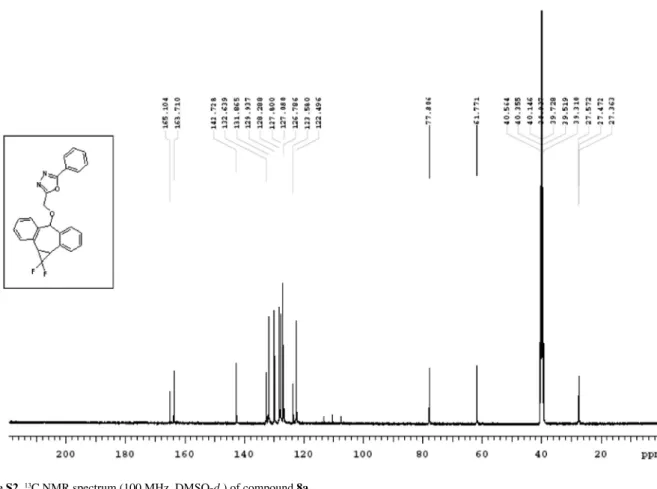
Figure S2. 13C NMR spectrum (100 MHz, DMSO-d
6) of compound 8a.
Moger et al. S3 Vol. 25, No. 1, 2014
FigureS4. FT-IR (KBr) spectrum of compound 8a.
Figure S5. 1H NMR spectrum (400 MHz, DMSO-d
Synthesis and Antimicrobial Properties of 1,3,4-Oxadiazole Analogs J. Braz. Chem. Soc.
S4
Figure S6. 13C NMR spectrum (100 MHz, DMSO-d
6) of compound 8b.
Moger et al. S5 Vol. 25, No. 1, 2014
Figure S8. FT-IR (KBr) spectrum of compound 8b.
Figure S9. 1H NMR spectrum (400 MHz, DMSO-d
Synthesis and Antimicrobial Properties of 1,3,4-Oxadiazole Analogs J. Braz. Chem. Soc.
S6
Figure S10. 13C NMR spectrum (100 MHz, DMSO-d
6) of compound 8c.
Moger et al. S7 Vol. 25, No. 1, 2014
Figure S12. FT-IR (KBr) spectrum of compound 8c.
Figure S13. 1H NMR spectrum (400 MHz, DMSO-d
Synthesis and Antimicrobial Properties of 1,3,4-Oxadiazole Analogs J. Braz. Chem. Soc.
S8
Figure S14. 13C NMR spectrum (100 MHz, DMSO-d
6) of compound 8d.
Moger et al. S9 Vol. 25, No. 1, 2014
FigureS16. FT-IR (KBr) spectrum of compound 8d.
Figure S17. 1H NMR spectrum (400 MHz, DMSO-d
Synthesis and Antimicrobial Properties of 1,3,4-Oxadiazole Analogs J. Braz. Chem. Soc.
S10
Figure S18. 13C NMR spectrum (100 MHz, DMSO-d
6) of compound 8e.
Moger et al. S11 Vol. 25, No. 1, 2014
FigureS20. FT-IR (KBr) spectrum of compound 8e.
Figure S21. 1H NMR spectrum (400 MHz, DMSO-d
Synthesis and Antimicrobial Properties of 1,3,4-Oxadiazole Analogs J. Braz. Chem. Soc.
S12
Figure S22. 13C NMR spectrum (100 MHz, DMSO-d
6) of compound 8f.
Moger et al. S13 Vol. 25, No. 1, 2014
FigureS24. FT-IR (KBr) spectrum of compound 8f.
Figure S25. 1H NMR spectrum (400 MHz, DMSO-d
Synthesis and Antimicrobial Properties of 1,3,4-Oxadiazole Analogs J. Braz. Chem. Soc.
S14
FigureS26. Mass spectrum of compound 8g.
Moger et al. S15 Vol. 25, No. 1, 2014
Figure S28. 1H NMR spectrum (400 MHz, DMSO-d
6) of compound 8h.
Figure S29. 13C NMR spectrum (100 MHz, DMSO-d
Synthesis and Antimicrobial Properties of 1,3,4-Oxadiazole Analogs J. Braz. Chem. Soc.
S16
FigureS30. Mass spectrum of compound 8h.
Moger et al. S17 Vol. 25, No. 1, 2014
Figure S32. 1H NMR spectrum (400 MHz, DMSO-d
6) of compound 8i.
Synthesis and Antimicrobial Properties of 1,3,4-Oxadiazole Analogs J. Braz. Chem. Soc.
S18
FigureS34. FT-IR (KBr) spectrum of compound 8i.
Figure S35. 1H NMR spectrum (400 MHz, DMSO-d
Moger et al. S19 Vol. 25, No. 1, 2014
Figure S36. 13C NMR spectrum (100 MHz, DMSO-d
6) of compound 8j.
Synthesis and Antimicrobial Properties of 1,3,4-Oxadiazole Analogs J. Braz. Chem. Soc.
S20