Article
J. Braz. Chem. Soc., Vol. 25, No. 1, 98-103, 2014. Printed in Brazil - ©2014 Sociedade Brasileira de Química 0103 - 5053 $6.00+0.00
A
*e-mail: [email protected], [email protected]
Inhibitory and Enzyme-Kinetic Investigation of Chelerythrine and Lupeol Isolated
from
Zanthoxylum rhoifolium
Against Krait Snake Venom Acetylcholinesterase
Mustaq Ahmad,*,a Andréia D. Weber,b Graciane Zanon,b Luciana de C. Tavares,b Vinicius Ilha,b Ionara I. Dalcolb and Ademir F. Morel*,b
aDepartment of Biotechnology, University of Science and Technology, Bannu, Pakistan
bDepartamento de Química, Universidade Federal de Santa Maria, 97105-900 Santa Maria-RS, Brazil
A atividade in vitro de queleritrina e lupeol, dois metabólitos isolados de Zanthoxylum rhoifolium, foram estudados contra o veneno da cobra Bungarus sindanus (Elapidae). O veneno, que é altamente tóxico para os seres humanos, é constituído principalmente pela enzima acetilcolinesterase (AChE). Ambos os compostos apresentaram atividade contra o veneno, e o alcalóide queleritrina apresentou maior atividade do que triterpeno lupeol.
The in vitro activity of chelerythrine and lupeol, two metabolites isolated from Zanthoxylum rhoifolium were studied against the venom of the snake Bungarus sindanus (Elapidae). The venom, which is highly toxic to humans, consists mainly by the enzyme acetylcholinesterase (AChE). Both compounds showed activity against the venom, and the alkaloid chelerythrine presented higher activity than did triterpene lupeol.
Keywords: Zanthoxylum rhoifolium, chelerythrine, lupeol, inhibition of AChE, venom of the
Bungarus sindanus
Introduction
Natural phenomena such as insects, microbes and mutation can cause human illness. However, nature itself remains our ally, providing remedies to treat various diseases that are more economically viable than industrialized pharmaceuticals. Death from snake poisoning is an important public health problem in rural areas, especially in countries in Africa, Asia, Oceania and South America.1 The disadvantaged populations of
these countries and those who work in agriculture or near forests, have the greatest exposure to this danger. These populations may not have access to anti-venoms, which are usually the only effective therapeutic agent. In this context, there has been much scientific interest in finding faster and cheaper solutions to mitigate or delay the ailments caused by poisonous snakes’ bites. One solution is to use extracts, fractions or pure substances obtained from plants, which are more accessible to underprivileged populations.2-6 Except for Mamba snakes, Elapidaevenom
contains large amounts of acetylcholinesterase.7 The serine
hydrolase, acetylcholinesterase (AChE - acetylcholine acetylhydrolase, E.C.3.1.1.7), is a non proteolytic enzyme mainly found in the synaptic tissue of muscles, brain, erythrocytes and cholinergic neurons.8 Its major function
is the inactivation of neurotransmitter acetylcholine (ACh) through enzymatic breakdown which plays an essential role in the control of physiological events.9-10 ACh is stored
in the form of vesicles in the nerve terminals and when depolarization occurs, ACh is released from the vesicles and enters the synapse, binding to the receptor.
There are two types of receptors in which ACh binding takes place: muscarinic and nicotinic. Muscarine receptors are mainly found in the peripheral nervous system with smooth and cardiac muscles, while nicotinic receptors are chiefly associated with the central nervous system.11
ACh binding with muscarinic receptors is generally associated with stimulation of the parasympathetic nervous system which entails decreased blood pressure, heart rate, constriction of bronchi, increased intestinal peristalsis and salivation. In the central nervous system, ACh binding causes stimulation of nicotinic receptors which is associated with cognitive processes and memory.12
Recent investigation has revealed that this enzyme is also present in non-synaptic tissue, i.e., snake venom.7 However,
the snake venom acetylcholinesterase is different from other vertebrate tissues in that it is present in soluble non-amphiphilic monomeric form,13,14 while from all other
sources it occurs in multimeric form, having two or more subunits. Furthermore, in snake venom it is more stable than any other source.15 In snake venom, this enzyme is
mainly present in family Elapidae which is well known due to highly toxic components in its venom. Furthermore, slight amount of AChE is also present in non-poisonous snake,16 where its function is unknown. Generally, peptide
sequence study shows that snake venom enzymes have 65% homology with other acetylcholinesterases, and have the same catalytic triad for substrate hydrolysis.14
Medicinal plants with anti-snake venom AChE activities might be useful as first aid treatment for victims of krait (Bungarus sindanus) snake bite, as well as those from other species of the Elapidae family common in South America, such as the coral snake (Micrurus carallinus). This is of particular importance especially in local areas where antivenom is not readily available. An example is the species Zanthoxylum rhoifolium, found in Brazil and in countries of the African and Asian continents. Species of the genus Zanthoxylum, that are used as anti-snake venom, along with other medicinal uses,17 are rich in
metabolites belonging to the class of alkaloids, mainly benzophenanthridines, lignans and terpenoids. Although plant extracts containing alkaloids have been proven to possess anti-snake venom activity,18 there is no scientific
proof for this type of activity for Z. rhoifolium.
Results and Discussion
In a preliminary test of the anti-AChE activity with the crude methanol extract of Zanthoxylum rhoifolium using
the bioautographic assay in thin layer chromatography ( T L C ) p l a t e s g ave p r o m i s i n g r e s u l t s .1 9 T h e s e
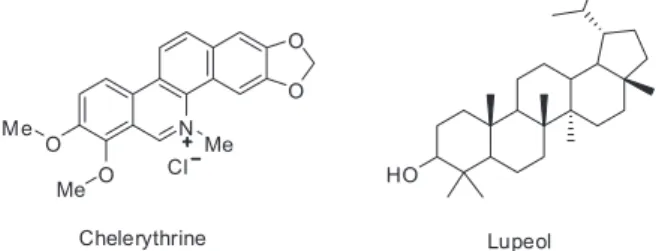
results prompted the study of isolated metabolites, benzophenanthridine alkaloids and triterpenoids from this extract. Due to the small amount of enzyme available, the two most abundant compounds, chelerythrine, representing the class of benzophenanthridine alkaloids, and lupeol, a triterpenoid, were selected for the study (Scheme 1).
Chelerythrine and lupeol were found to modify the activity of the krait (Bungarus sindanus) venom acetylcholinesterase (AChE) in a dose-dependent response with the addition of 0.5 mmol L-1 acetylthiocholine
(AcSCh) fixed substrate (Figure 1 A and B).
The enzymatic behavior of krait venom AChE was measured under increasing concentrations of chelerythrine (3.86-11.58 µmol L-1) and lupeol (124-372 µmol L-1).
The Lineweaver-Burk plot20 and double reciprocal
plot indicated that chelerythrine caused linear mixed-type inhibition, which is considered to be a partial competitive and pure noncompetitive mixture. Lupeol had a similar pattern of inhibition with krait venom AChE. The double reciprocal plot indicated that Km
(Michaelis-Menten constant =substrate concentration at which the reaction is half of Vmax increased)and Vmax
(the maximum rate achieved by the system at maximum
Figure 1. Krait venom acetylcholinesterase activity in the presence and absence of different concentrations of chelerythrine (A) and lupeol (B). The compounds were pre-incubated at 37 oC for 10 min before addition of fixed substrate 0.5 mmol L-1 acetylthiocholine (AcSCh). The results represent the
mean of three different experiments down in duplicate and significantly different from control. *P < 0.05.
substrate concentrations) decreased with increased concentrations of chelerythrine/ lupeol (Figure 2 A and B).
The Km values increased from 75 to 236.6% while Vmax
decreased from 15 to 42% with increased of chelerythrine concentration (3.86 to 11.58 µmol L-1, see Table 1) while
for lupeol the Km values increased from 25 to 106.6% and
Vmax decreased from 15.5 to 50.5% with concentrations
ranging from 124 to 372 µmol L-1 (Table 2).
The IC50value for chelerythrine that inhibited 50%
of enzymatic activity of venom AChE was found to be 6.7 µmol L-1 (Figure 3 A) while for lupeol it is found to be
323 µmol L-1 (Figure 3 B).
Comparing the data shown above (Km,Vmax andIC50),
we could find that the alkaloid chelerythrine presented
Figure 2. Kinetic analysis of the inhibition of krait venom AChE by chelerythrine (A) and lupeol (B).
Table 1. Chelerythrine modified Km and Vmax of the krait (Bungarus sindanus) venom acetylcholinesterase (AChE) Chelerythrine / (µmol L-1) Km / (mmol L-1) Increase / % V
max / (µmol AcSCh min-1 mg-1 of protein) Decrease / %
0 0.153 0 1085 0
3.86 0.268 75 919 15.3
7.72 0.367 139.9 691 36.3
11.58 0.515 236.6 625 42.4
Table 2. Effect of lupeol of Km and Vmax of the krait (Bungarus sindanus) venom acetylcholinesterase (AChE) Lupeol / (µmol L-1) Km / (mmol L-1) Increase / % V
max / (µmol AcSCh min-1 mg-1 of protein) Decrease / %
0 0.16 0 1052 0
124 0.22 25 889 15.5
248 0.26 62.5 753 28.2
372 0.33 106.6 517 50.5
Figure 3. IC50 value of chelerythrine (A) and lupeol (B). The compounds were pre-incubated at 37 oC for 10 min before addition of fixed substrate
0.5 mmol L-1 acetylthiocholine (AcSCh). The results presented are the
more potent inhibitory effect than the triterpenoid lupeol. In addition, the Ki(Inhibition Constant = concentration of
inhibition which is required to decrease the maximal rate of the reaction to half of the uninhibited value, in the presence of a low substrate concentration) valuefor chelerythrine was found to be 4.3 µmol L-1, whereas for lupeol was found
to be 223 µmol L-1 obtained using Cornish-Bowden plots
of S/V vs. [I] (substrate concentrations/hydrolysis rates vs.
inhibitor concentrations).21
Conclusions
The results of the present study indicate that chelerythrine, a benzophenanthridine alkaloid, isolated from Z. rhoifolium, has potential anti-AChE activity. This activity is less pronounced for lupeol, a triterpenoid commonly found in various plants, including Z. rhoifolium. In correlation, there is 65% amino acid sequence homology between venom and human AChE, therefore these compounds, mainly the benzophenanthridine alkaloids, need further studies for the treatment of Alzheimer’s disease. In conclusion, the results support one of the popular uses of species of the genus Zanthoxylum as anti-snake venom.15,17
Experimental
General experimental procedures
Melting points were determined in an MQAPF-301 melting point apparatus and are uncorrected. NMR spectra were acquired on a Bruker DPX-400 operating at 400 and 100 MHz, for 1H and 13C, respectively. Chemical shifts
are given in δ (ppm) using TMS as internal standard. Thin layer chromatography was performed on pre-coated TLC plates (Merck, silica 60 F-254). The spots were detected using one or more of the following methods: UV (254 nm), spraying with Dragendorff’s reagent or 10% H2SO4/EtOH,
followed by heating.
DTNB [5,5’-dithiobis-(2-nitrobenzoic acid)], acetylthiocholine iodide, ethopropazine, arachidonic acid and bovine serum albumin were purchased from Sigma (St. Louis, MO, USA). Sodium dihydrogen phosphate and disodium hydrogen phosphate were purchased from Neon Commercial LTDA (São Paulo, Brazil). All other reagents used were of analytical grade.
Plant material
Bark of Z. rhoifolium was collected in Santana do Livramento, Rio Grande do Sul, Brazil, in November
2008, and authenticated by Prof Gilberto D. Zanetti, Department of Pharmacy, Universidade Federal de Santa Maria, RS, Brazil, where a specimen sample (HDFI 134) is retained.
Extraction and isolation
Isolation and purification of lupeol and chelerythrine from Zanthoxylum rhoifolium
The dried stem bark of Z. rhoifolium (1 kg) was powdered and extracted four times with MeOH at room temperature. At this stage, we observed the formation of an insoluble precipitate, which was recovered by filtration (2.5 g) and saved for later analysis. The MeOH extract was filtered and concentrated in vacuum to obtain a crude extract (150 g).
Part of the MeOH extract (70 g) was dissolved in H2O
(100 mL) and acidified with 2 mol L-1 HCl to pH 2-3.
After exhaustive extraction with Et2O, the acidic solution
was made basic with NH4OH to pH 8-9 and extracted
with dichloromethane (DCM) (5 × 100 mL)to yield the basic extract (4.5 g). The DCM basic fraction (4.0 g) was chromatographed on a silica gel column (230-400 mesh, 320 g) and eluted with CH2Cl2: MeOH mixture to
prepare fractions 1-90. Fractions 35-38 obtained from CH2Cl2: MeOH, 80:20, and consisting of one alkaloid
(TLC), were combined and concentrated in vacuum to give chelerythrine after crystallization from Et2O:MeOH
(120 mg). Chelerytrine was identified by direct comparison of TLC with authentic samples, and by comparison of spectral data (EIMS, 1H and 13C NMR) with reported values
in the literature.22-23
Part of the MeOH extract (10.0 g) was dissolved in H2O (50 mL) and exhaustively extracted with n-hexane.
The n-hexane fraction (3.0 g) was chromatographed on a silica gel column (230-400 mesh, 240 g) and eluted with n-hexane:CH2Cl2 mixture to prepare fractions 1-20.
Fractions 10-12, obtained from n-hexane:CH2Cl2, 80:20,
were combined and concentrated in vacuum to give lupeol (150.0 mg). Lupeol was identified by direct comparison of TLC with authentic samples, and by comparison of spectral data (1H and 13C NMR).
Venom
Venom from krait (Bungarus sindanus) snakes was milked manually, mixed, lyophilized immediately and stored at –20 °C for further use.
Protein determination
Protein was assayed by the method of Bradford24 using
Acetylcholinesterase assay
Acetylcholinesterase activity of krait snake venom was determined by the method of Ellman et al.25 with some
modification.26,27 Dose dependent assays were performed
in the absence and presence of different concentrations of chelerythrine (3.86-11.58 µmol L-1) or lupeol
(124.0-372.0 µmol L-1) by the addition of fixed 0.5 mmol L-1
acetylthiocholine (AcSCh) while kinetic analysis hydrolysis rates (V) were measured at various acetylthiocholine iodide (S) concentrations (0.05-1 mmol L-1) in 1 mL assay
solutions with 62 mmol L-1 phosphate buffer, pH 7.5, and
0.2 mmol L-1 5,5’-dithiobis(2-nitrobenzoic acid) (DTNB)
at 25 °C. In enzymatic assay, 20 µL diluted snake venom (4 µg of protein) were added to the reaction mixture and pre-incubated for 10 min at 37 °C, 0.06 mmol L-1
ethopropazine (a classic selective, potent inhibitor of butyrylcholinesterase (BChE)) was used to inhibit the presence of any contamination of BChE in the sample (ethopropazine does not affect the activity of snake venom AChE). The enzyme substrate reaction was started by the addition of different substrate concentrations after pre-incubation with ligand (chelerythrine and lupeol). The amount of yellow color which developed over time was a measure of the activity of AChE. It was monitored at 412 nm after every 15 s during 2 min using a Hitachi 2001 spectrophotometer (Hitachi, Japan). All samples were run in duplicate and repeated at least four times.
Statistical analysis
Statistical analysis was performed using one way ANOVA, which was followed by post-hoc analysis (Duncan multiple range test) using the Statistica software package (Stat Soft®, TULSA, OK, USA).
Supplementary Information
Supplementary data and spectra of the compounds are available free of charge at http://jbcs.sbq.org.br as a PDF file.
Acknowledgments
The authors thank CNPq (Conselho Nacional de Desenvolvimento Científico e Tecnológico), CAPES (Coordenação de Aperfeiçoamento de Pessoal de Nível Superior) and FAPERGS (Fundação de Amparo a Pesquisa do Estado do Rio Grande do Sul)-PRONEX 10/0029-0 for financial support for this work. Mustaq Ahmad thanks the Academy of Sciences for the Developing World (TWAS) for the grant received.
References
1. Chippaux, J. P.; Bull. W. H. O.1998, 76, 515.
2. Momoh, S.; Friday, E. T.; Raphael, E.; Stephen, A.; Umar, S.; E3 J. Med. Res.2012, 1, 69.
3. Lakshmi, K. S.; Vadivu, R.; Pharm. Lett.2010, 2, 77. 4. Magalhães, A.; Santos, G. B.; Verdam, M. C. S.; Fraporti, L.;
Malheiro, A.; Lima, E. S.; Dos-Santos, M. C.; J. Ethnopharmacol.
2011, 134, 82.
5. Ribereau-Gayon, P.In The Tannins; Heywood, V. H., ed.; Oliver & Boyd: Edinburgh, 1972.
6. Haslam, E.In Polyphenols-vegetable tannins;Phillipson, J. D.; Ayres, D. C., Baxter, J., eds.; Cambridge University Press: Cambridge, 1989.
7. Frobert, Y.; Creminon, C.; Cousin, X.; Cousin, M. H.; Remy, J. M.; Chatel, S.; Bon, C.; Grassi, J.; Biochim. Biophys. Acta, Protein Struct. Mol. Enzymol. 1997, 1339, 253.
8. Adamson, E. D.; J. Neurochem.1977, 28, 605.
9. Prody, C. A.; Zevinsonkin, D.; Gnatt, A.; Goldberg, O.; Soreq, H.; Proc. Natl. Acad. Sci. U. S. A.1987,84, 3555. 10. Katyare, S. S.; Dave, K. R.; Syal, A. R.; Z. Naturforsch., C:
J. Biosci.2000, 55, 100.
11. Kurachi, Y.; Ishii, M.; Curr. Pharm. Des.2006, 12, 3573. 12. Hogg, R. C.; Raggenbass, M.; Bertrand, D.; Rev. Physiol.,
Biochem. Pharmacol.2003, 147, 1.
13. Cousin, X.; Bon, S.; Duval, N.; Massoulie, J.; Bon, C.; J. Biol. Chem.1996, 271, 15099.
14. Cousin, X.; Creminon, C.; Grassi, J.; Méflah, K.; Cornu, G.; Saliou, B.; Bon, S.; Massoulié, J.; Bon, C.; FEBS Lett.1996, 387, 196.
15. Ahmed, M.; Latif, N.; Khan, R. A.; Ahmad, A.; Rocha, J. B. T.; Mazzanti, C. M.; Bagatini, M. D.; Morsch, V. M.; Schetinger, M. R. C.; J. Venomous Anim. Toxins Incl. Trop. Dis. 2012, 18, 236. 16. Mackessy, S. P.; Sixberry, N. M.; Heyborne, W. H.; Fritts, T.;
Toxicon.2006, 47, 537.
17. Villalba, M. A.; Leite, M. I.; Souza, O. V.; Rev. Bras. Farmacogn.
2007, 17, 236.
18. Ahmed, A.; Rajendaran, K.; Jaiswal, D.; Singh, H. P.; Mishra, A.; Chandra, D.; Yadav, I. K.; Jain, D. A.; Int. J. Chem. Tech. Res.2010, 2, 744.
19. Marston, A.; Kissiling, J.; Hostettmann, K. A.; Phytochem. Anal.2002, 13, 51.
20. Lineweaver, H.; Burk, D.; J. Am. Chem. Soc.1934, 56, 658. 21. Cornish-Bowden, A.; Analysis of Enzyme Kinetic Data,
Learmonth, R. P., ed.; Oxford Univ. Press: Oxford, 1995. 22. Miao, F.; Yang, X. J.; Zhou, L.; Hu, H. J.; Zheng, F.; Ding,
X. D.; Sun, D. M.; Zhou, C. D.; Sun, W.; Nat. Prod. Res. 2011, 25, 863; Dostál, J.; Slavík, J. In Studies in Natural Products
Chemistry; 1st ed.; Atta-ur-Rahman, ed.; Elsevier Scicence B.V:
23. Miao, F.; Yang, X. J.; Ma, Y. N.; Zheng, F.; Song, X. P.;Zhou, L.; Chem. Pharm. Bull. 2012, 60, 1508.
24. Bradford, M. M.; Anal. Biochem.1976, 72, 248.
25. Ellman, G. L.; Courtney, K. D.; Andres, V.; Featherstone, R. M.; Biochem. Pharmacol.1961, 7, 88.
26. Schetinger, M. R. C.; Ahmed, M.; Rocha, J. B. T.; Mazzanti, C. M.; Morsch, A. L.; Cargnelutti, D.; Corrêa, M.; Loro, V.; Morsch, V. M.; Ecotoxicology2007,16, 363.
27. Schetinger, M. R. C.; Ahmed, M.; Rocha, J. B. T.; Corrêa, M.; Mazzanti, C. M.; Zanin, R. F.; Morsch, A. L.; Morsch, V. M.; Chem. Biol. Interact.2006, 162, 165.
Submitted on: August 4, 2013