878 Brazilian Journal of Physics, vol. 36, no. 3B, September, 2006
Negatively Charged Donors in Flat Quantum Dots
Luis F. Garc´ıa∗, Jairo H. Mar´ın†, and Ilia D. Mikhailov∗ ∗Universidad Industrial de Santander. A.A.678, Bucaramanga, Colombia
† Universidad Nacional de Colombia A.A 3840. Medell´ın, Colombia
Received on 8 December, 2005
The ground state energies of off-axis negatively charged donors in axially symmetrical quantum dots, with different shapes but in all cases with a small height-to-base radius aspect ratio are calculated in adiabatic ap-proximation by using the Hylleraas-type trial function. The dependencies of the neutral and negative donor binding energies and their ratios on the base radius in the pyramid, lens and disk are calculated and compared with previously obtained results for the spherical quantum dot. We also present the contour plots of the binding energies of the neutral and negative donors with different positions along a vertical cross section in the middle of the quantum dots.
Keywords: Self-assembled quantum dot; Adiabatic approximation; Binding energies
I. INTRODUCTION
It is increasing the interest in the study of the electronic structure and properties of excitons, neutral, D0and
nega-tively charged, D−donors in the self-assembled quantum dots (SAQDs) which are formed by the Stranski-Krastanow growth mode by deposition a material on the substrate with different lattice parameter [1]. The electrical and optical properties of these structures may be changed in a controlled form by dop-ing the shallow impurities whose energy levels are defined by the interplay between the reduction of the physical dimension, the Coulomb attraction and the inter-particle correlation. Pre-viously, it has been shown that the electronic spectrum of D0 and D−in a spherical quantum dot (QD) is very sensible to the variation of the heterostructure size and the donor position [2]. In particular, it was established that the confinement leads to the enhancement of the binding energies bothEb
¡
D0¢of the neutral donor and Eb(D−)of the negatively charged donor
in such way that the ratioσ=Eb(D−)/Eb¡D0¢successively
increases with the decrease of the dimensionality of the struc-ture. For example, this ratio for the on-center donor in a spher-ical QD (SQD) increases from 0.055 as the QD’s radius is very large up to 0.3 as the QD’s radius becomes less than the effec-tive Bohr radius [3], i.e. the difference between binding en-ergies within the heterostructures there is no longer as signif-icant as in bulk. It would be interesting to extend this results obtained previously for a spherical quantum dot to SAQDs with different shapes.
The calculation of the energy spectrum of both the D0and
the D−confined in a heterostructure that has not a high sym-metry as a QD requires a lot of computational efforts. To simplify these calculations in the papers [4] it has been used a simple variational procedure, which permits to reduce the wave equations for D0and D−confined in semiconductor het-erostructures to the similar equations for the hydrogen atom, H and negatively charged ion, H− in an isotropic effective space with a non-power-law dependence of the Jacobian on the electron-ion distance. It has been shown that the procedure gives for the D0and D−in QW, cylindrical QWW and spher-ical QD binding energies which are in an excellent concor-dance with the Monte Carlo and variational calculations [4].
The morphology of SAQDs generally is sufficiently com-plicated, and a direct calculation of the Jacobian similar to one for the SQD can not be fulfilled. But one can take an advantage of the adiabatic approximation (AA) applicable to these systems due to their small height-to-base radius aspect ratio. By using this approximation in this work we calculate the ground state energies of the neutral and negative donors in flat QDs with axial symmetry as a function of the distance from the donor position to the axis and the base radius of the quantum dot. Comparing results of calculation for structures with different geometry such as disk, lens and pyramid we analyze the QDs shape on donor’s ground state energies.
II. THEORETICAL MODEL
In our calculation, we consider three different types of QDs with cylindrical symmetry whose 3D images are pre-sented schematically in Fig.1: disk, lens and pyramid with the heightd0, the base radiusR0. Their profiles can be described by
a functiond(ρ), which defines the dependency of the thickness din z-direction on the distanceρfrom the axis of symmetry. For the sake of the mathematical convenience we choose the dependenciesd(ρ)in a form of a piecewise continuous linear functions.
ε
(
FIG. 1: The 3D images of QDs with different shapes: a) disk, b) lens, and c) pyramid.
The confinement potential due to the conduction band dis-continuity in the junction of the QD is given by the piecewise constant functionV(ρ,z)which is equal to zero in the well
(0<z<d(ρ)and equal toV0 in the barrier. The effective
Bohr radiusa∗0=ε~2±m∗e2and the effective RydbergRy∗= e2±
Luis F. Garc´ıa et al. 879
the electron effective massm∗and the dielectric constantε, in the well and in the barrier are not included in the calculation. In what follows we present the results of calculation for the heterostructures of In0.55 Al0.45As/Ga0.65Al0.35As where the
values of a∗0 andRy∗ are equal to 8.86nm and 6.40meV, re-spectively, and the barrier heightV0≈40Ry∗[5]. It should
be noted that in heterostructures of GaAs/Ga0.7Al0.3As where
units of length and energy, a∗0 andRy∗ are equal to 9.8 nm and 5.83 meV, respectively, the dimensionless barrier height have approximately the same value and therefore the results presented below are also applicable to these heterostructures.
For the potentialV(ρ,z)the one-particle Schr¨odinger equa-tion do not completely separate and no exact soluequa-tions have been found. It is therefore some approximation method should be used to find the ground state wave function f0(r) of free electron corresponding to the lowest energy
E(e−)in a QD. In what follows we consider a typical
situa-tion when the QD’s height is much smaller than its in-plane dimension(d0<<2R0), condition that allows us to take
ad-vantage of the AA. Following the AA standard scheme we represent f0(r)as a product of two wave functions, fz(z,ρ)
which describes the rapid motion in the strongly confined transverse direction andfρ(ρ)which corresponds to a slow
in-plane motion:
f0(r) =fz(z,ρ)fρ(ρ) (1)
The function fz(z,ρ) and the associated lowest energy Ez(ρ)can be found exactly as the well-known solution of the
wave equation for a rectangular quantum well of widthd(ρ) and barrier heightV0:
Once fz(z,ρ)andEz(ρ)are found, the functionfρ(ρ)may
then be obtained as a solution of the two-dimensional central force problem with potentialEz(ρ)
−fρ?(ρ)−1
ρf ′
ρ(ρ) +Ez(ρ)fρ(ρ) =E¡e−¢fρ(ρ) (2)
To solve Eq. 2 we use the numerical procedure similar to trigonometric sweep method described in the paper [6]
To find the ground state wave functions ΨDo(r)for
neu-tral donor andΨD−(r1,r2)for a negatively charged donor in QD corresponding to the lowest energiesE(Do)andE(D−), we use the following trial functions:
ΨD0(r) =f0(r)ΦD0(|r−ξ|);
ΨD−(r1,r2) =f0(r1)f0(r2)ΦD−(|r1−ξ|,|r2−ξ|,r12)
(3) Hereξandri (i=1,2)are vectors of the ion and electrons
positions, respectively. The donor position in QDs with axial symmetry given by the vectorξ below is described by two parameters,ξρ, the distance from the axis andξz, the distance
from the base.
In Eq. 3, functions ΦD0andΦD−take into account the ef-fect of the correlation produced by the Coulomb interaction. As it has been demonstrated in [4], the trial functions (3) sat-isfy the Schr¨odinger variational principle, ifΦD0andΦD−are
solutions of wave equations for the hydrogen atom H and the negatively charged ion H−, respectively, with modified Lapla-cian in which the radial part of the Jacobian (equal tor2in 3D
space) is replaced byJ(r) =r2R f02(r′)δ(|r′| −r)dr′. Func-tionsΦD0andΦD−and the energiesE(Do)andE(D−), can be found by using any standard method from the atomic physics one of which is described in details in Ref. [4]. Particularly, forΦD−we use a three-parameter Hylleraas trial function [7].
III. RESULTS AND DISCUSSION
Below we present the results of calculation of the binding energiesEb(Do)andEb(D−)of the neutral and the negatively
charged donors, defined as:
Eb
¡
D0¢=E(e−)−E¡D0¢; Eb(D−) =E
¡
D0¢+E(e−)−E(D−) (4) In Fig. 2 we show the dependencies of the ground state binding energies of the D−and the ratio of the binding en-ergies of the D0 and D−located at the middle of the axis (ξρ=0,ξz=0.5d0)on the base radii of the disk, lens and
con-ical pyramid with two different heightsd0, 2nm (solid lines)
and 4nm (dashed lines).
The binding energies presented in these figures should be compared with the corresponding values of the binding en-ergies of the D− in 3D bulk, 0.055Ry* [7], in 2D bulk, 0.511Ry*[9], respectively. As the QD radius is very large the structures can be considered as quasi-two dimensional sys-tems with a strong but incomplete confinement in z-direction due to the finite values of the thickness and the barrier height. Therefore as the radius increases and it becomes very large the binding energies of the D− tend to the values slightly lower than those for 2D bulk. In the region of the large base radii the largest binding energy presents in the conical pyramid and the disk presents the smallest binding energy. Comparing the curves for different structures one can see that effect of leak-ing of the wave functions in the barrier region due to decrease of the QD radius first occurs in conical pyramid following by lens and lastly in a disk. As result, the crossovers and the in-version of the binding energies order with the decrease of the base radius can be observed in Figs. 2. Besides, one can com-pare the maximum values of D−binding energies for differ-ent structures with corresponding values obtained previously for the SQD, 2.4Ry* and the cylindrical quantum well wire, 1.2Ry* [4]. It is seen that the maximum values of the binding energies in quasi-two dimensional structures are lower than the corresponding values for the SQD.
In order to achieve a better understanding of the di-mensional characteristics of the D− centers and the QD’s geometrical-shape effect, we present in Fig. 2 the correspond-ing ratiosσof D−to D0binding energies as a function of the
880 Brazilian Journal of Physics, vol. 36, no. 3B, September, 2006
FIG. 2: Ground state binding energies Eb¡D−¢and ratios σ of Eb¡D−¢toEb¡D0¢as a function of the base radiusR0for donors
located at the middle of the axis of the disk, lens and conical pyra-mid with the heights 2 nm (solid lines) and 4 nm (dashed limes).
structures about 0.3 is also valid for all SAQDs independent of their geometrical shape. In the limit, as the radius becomes large, σdecreases monotonically and it tends to its 2D bulk limit.
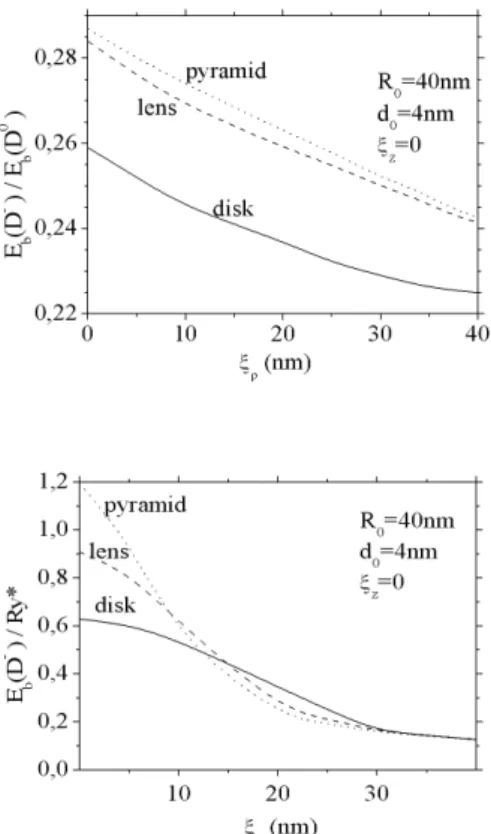
To study the effect of the donor position on the ground state binding energy we calculate the binding energies of the D− centers located in different places of QDs. The results of cal-culation we show in the form of the curves in Fig. 3 and the contour plots in Fig.4. In Figs. 3 we have plotted the D− binding energies and ratiosσas a function ofξρfor QDs with
different shapes. The binding energies in all QDs decrease as the donor is removed from the axis. It is due to the fact that in these structures the motion of electron is mainly re-stricted close to axes independently on the donor position and therefore the electron-donor separation increases as the donor removes from the axis whereas the ratioσdecreases from the value typical for 0D structure, about 0.3 to the value typical for 1D structure, about 0.2.
The results of calculation for off-axis D0 and D−centers we show in Fig. 4 contour plots, which correspond to the level lines of the binding energies of the D− with different positions along a cross section in the middle of the pyramids, lens and disk perpendicular to theydirection. The shadowed parts of figures indicate the cross section of the corresponding
FIG. 3: Ground state binding energies of negative donors and ratios
σas a function of the distance from the donor position to the axis in QDs with radius 40nm and height 4nm.
Luis F. Garc´ıa et al. 881
structures. It is seen the evolution which undergoes the level lines as the shape of the QD varies from the conical pyramid to disk. Along the ρdirection the level lines become more extended due to the decrease of the confinement as the QD’s shape varies from the conical pyramid to disk.
In conclusion, we present the results of calculation the en-ergies of the negatively charged donors and the ratios of the negative to neutral binding energies in flat SAQDs in order to study their dependencies on the dot shape, radius, height and
the donor position.
Acknowledgement
This work was financed by the Colombian Agency COL-CIENCIAS (Cod 1102-05-16923) and “Centro de Excelencia en Nuevos Materiales (CENM)” J. H. Mar´ın wishes to thank the Universidad Nacional-Sede Medell´ın for the permission to study at the UIS.
[1] L. Jacak, P. Hawrylack, A. W´ojs,In Quantum Dots(Springer, Berlin, 1997). A. Lorke, R. J. Luyken, A. O. Govorov, and J. P. Kotthaus, Phys. Rev. Lett.84, 2223 (2000).
[2] G. Bastard, Phys. Rev. B24, 4714 (1981).
[3] J. L. Zhu, J. H Zhao ,W. H. Duan, and B. L. Gu, Phys. Rev. B
46, 7546 (1992); J. L. Zhu, J. H Zhao, and J.-J. Xiong, Phys. Rev. B50, 1832 (1994); J. L. Zhu, Xi Chen, Phys. Rev. B 50, 4497 (1994).
[4] I. D. Mikhailov, F. J. Betancur, R. Escorcia, and J. Sierra-Ortega, Phys. Stat. Sol. (b)234, 590 (2002); I. D. Mikhailov, F. J. Betancur, R. Escorcia, and J. Sierra-Ortega, Phys. Rev. B
67, 156317 (2003).
[5] K. L. Janssens, F. M. Peeters, and V. A. Schweigert, Phys. Rev. B63, 205311 (2001).
[6] F. J. Betancur, I. D. Mikhailov, and L. E. Oliveira, J. Phys. D: Appl. Phys.31, 3391 (1998).
[7] H. A. Bethe and E. E. Salpeter, Quantum Mechanics of one-and two-Electron Atoms(Springer-Verlag, Berlin, 1957). [8] J. L. Zhu, J. H. Zhao, W. H. Duan, and B. L. Gu, Phys. Rev. B
46, 7546 (1992).
[9] T. Pang and S. G. Louie, Phys. Rev. Lett.65, 1635 (1990). [10] I.D. Mikhailov, J. H. Mar´ın, and F. Garc´ıa, Phys. Stat. Sol. (b)