INFORMATION SEEKING PATTERN IN ELECTRONIC
ENVIRONMENT OF SCIENCES AND ARTS RESEARCHERS:
A COMPARATIVE STUDY
Sanjay Kumar
Praveen Shukla
Banaras Hindu University India
ABSTRACT
The purpose of this paper is to examine information seeking pattern of science and art research scholars and for this the data was gathered using questionnaire survey of 139 (one hundred and thirty-nine) randomly selected, PhD scholars of science and arts departments of Asia’s largest residential university Banaras Hindu University, India. It has been found that both the groups of researchers have some similarities and some dissimilarity in information seeking. Even in this electronic era some research scholars of art discipline depend on print form of publications for their information needs.
Keywords: Information Seeking-Behavior; Electronic Environment; User Studies; Researcher Arts Area; Researcher Sciences Area.
1 INTRODUCTION
A researcher is always curious to know what is going in his field of interest
and for this he/she accesses library documents, attends conference, seminars,
discusses experts of concerned field etc. to update him/her. But in the era which we
are living have been blessed with electronic resources which seemed to be the best
among the all mediums of information seeking for researchers.
A library is supposed to fulfill the researcher’s information need(s) and it must recognize the information seeking pattern of the researcher. Information seeking
behavior and need differs from user group to group, as for example the need of arts
information seeking pattern of research scholars (arts and science only) of Banaras
Hindu University.
2 BACKGROUND INFORMATION
Banaras Hindu University (BHU) established by the parliamentary legislation
BHU Act 1915, is one of the oldest and internationally reputed universities, it ranks
among the first few in the India in the field of academic and research output. This
university has 2 (two) campuses, 3 (three) institutes, 16 (sixteen) faculties, 140 (one
hundred forty) departments, 4 (four) advanced centers and 4 (four) interdisciplinary
schools. The University is making its mark at the national and international levels in a
number of frontier areas of Science, Arts, Social Science, Technology, Medicine and
Agriculture etc. The University Library System consists of Central Library and
Department Libraries supporting researchers learning and research needs. Library is
opened 12 (twelve) hours a day while the electronic journals subscribed by the
Library can be accessed through library website within the campus 24 (twenty four)
hours a day.
3 OBJECTIVES
The study intends to look at differences and similarities between arts and
science research scholars regarding information seeking. In other words the objective
has been broken to: a) Determine the kinds of information sources used by
researchers of both the groups; b) Find out the time spent on electronic resources by
researchers; c) Investigate the main information intermediary to researcher; d) Find
the most preferred way for monitoring recent information.
4 LITERATURE REVIEW
There is no dearth of literature on information seeking behavior. Although
research scholars compared with other academic groups. This literature review is not
intended to cover all of the literature on information seeking behavior rather it
highlights the comparative studies of academic user groups.
Ellis, Cox and Hall (1993) carried out a study in which he investigated the
information seeking patterns of researchers in the physical and social science. They
identified the information seeking pattern of scientists that included 6 (six) generic
features (starting; chaining; browsing; differentiating; monitoring; & extracting) for
getting information from electronic resources.
Prasad (1998) found significant difference in information seeking behavior of
physical and social scientists. Their study highlighted the methods used by scientists
for gathering information they concluded with scientists differed in their approaches,
need and sources used. Brown (1999)3 conducted a survey of Science Faculty at the
University of Oklahoma and he found that at less than 50% of the science faculty
were using electronic journals for teaching and research.
Dalgleish and Hall (2000) studied the information seeking behavior pattern of
researchers in the web environment. They found that access of online library
information resources become easy and fast, without any space and time constraints.
Researchers have shown that many information seekers prefer to use electronic
resources and the Internet to obtain information quickly and easily.
Tenopir (2003) conducted a study of the ways in which students and faculty
in an academic use Internet and others electronic resources, the study revealed that
relevant articles were generally got from electronic resources.
Francis’ (2005) study of social scientists’ information seeking behavior at University of West Indies revealed that a preference for journal articles in electronic format over print articles, which demonstrated that social scientists “have embraced electronic resources.
Hamid and David (2008) studied at differences and similarities between
different research areas within physics and astronomy with regard to two aspects of
information-seeking behavior, including methods used for keeping up-to-date and
Sheeja (2010) in her study examined the information seeking behavior of
science and social science research scholars, including service effectiveness,
satisfaction level on different type of sources and various method adopted by the
scholars for keeping up to date.
5 METHODOLOGY
The survey was conducted by means of a structured questionnaire circulated
among research scholars of faculty of arts and faculty of science, Banaras Hindu
University. A stratified accidental random sample method was used for the selection
of respondents and interaction with those who were available in the university during
the survey period (Nov. 2010 to Mar. 2011). The collected data was analyzed,
classified and tabulated by implying statistical methods.
6 DATA ANALYSIS AND INTERPRETATION
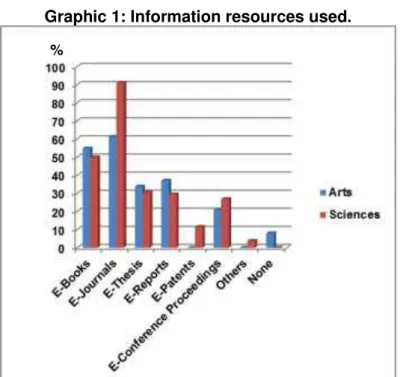
When we see the comparative use of each resource individually we can
conclude that e-books are more preferred by Arts researcher than the Science
researchers. The e-journals is more used by the Science researchers than their
counterpart, electronic-thesis is being more used by the Arts researcher than the
Science researcher, electronic patents are only seen by the Science researchers,
electronic conference proceedings are being used by Science researchers more than
the Arts, it has also been found that there are some researchers of Arts stream who
never used to use electronic resources in the forms mentioned above they even
today use the print form of information resources but this population is very nominal.
Hence we can conclude that both the group of researchers use electronic resources
for information seeking and electronic journal is mostly preferred by them for the
Table 1: Information resources used.
Resources
Arts Researcher Sciences Researcher
Number of Respondents
(n=61) %
Number of Respondents
(n=78) %
E-Books 34 54.83 39 50
E-Journals 38 61.29 71 91.02
E-Thesis 21 33.87 24 30.76
E-Reports 23 37.09 23 29.48
E-Patents 0 0.00 9 11.53
E-Conference Proceedings 13 20.96 21 26.92
Others 0 0.00 3 3.84
None 5 8.06 0 0.00
Note: It permitted to multiple choices.
From the Graphic 1, it is clear that the best choice for information seeking to
both the groups of research scholars i.e. arts and science researchers is electronic
journals then electronic books, electronic reports, electronic thesis, electronic
conference proceedings respectively and then the other sources are thought of for
information.
Graphic 1: Information resources used.
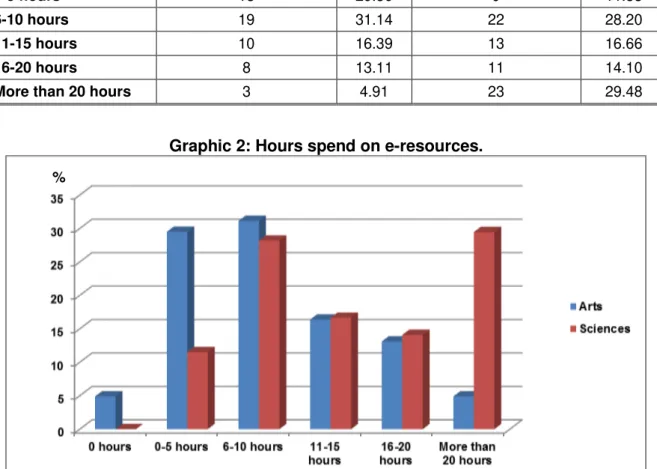
From the Table 2 it is clear that there are still in this era some researchers of
arts discipline which never used to use electronic resources while on the other hand
the scholars of science used to spend more than twenty hours a week gazing for
information on electronic resources. Thirty percent of arts researchers used to spend
approximately five hours a week while ten percent of science researchers spend the
same time on electronic resources.
Table 2: Hours spend on e-resources.
Hours Spend
Arts Researcher Sciences Researcher
Number of
Respondent (n=61) % Respondent (n=78) Number of %
0 hours 3 4.91 0 0.00
0-5 hours 18 29.50 9 11.53
6-10 hours 19 31.14 22 28.20
11-15 hours 10 16.39 13 16.66
16-20 hours 8 13.11 11 14.10
More than 20 hours 3 4.91 23 29.48
Graphic 2: Hours spend on e-resources.
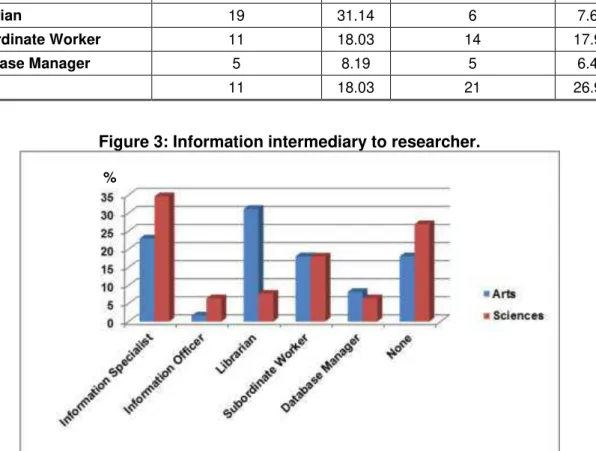
From the Table 3 it is clear that information specialist seems to be
information intermediary to science scholars in majority of cases, while in the case of
workers also play important role as information intermediary to both the groups of
researchers as the Graphic 3 shows both the group of researchers had
approximately given the equal preference to subordinate, coordinate worker as
information intermediary. It is interesting to note that there are 18% of arts
researchers which never rely on any of the information intermediary while on the
other hand 27% of science researchers are also in favor of searching the required
information without the help of any information intermediary.
Table 3: Information intermediary to researcher.
Intermediary
Arts Researcher Sciences Researcher
Number of
Respondent (n=61) % Respondent (n=78) Number of %
Information Specialist 14 22.95 27 34.61
Information Officer 1 1.63 5 6.41
Librarian 19 31.14 6 7.69
Subordinate Worker 11 18.03 14 17.94
Database Manager 5 8.19 5 6.41
None 11 18.03 21 26.92
Figure 3: Information intermediary to researcher.
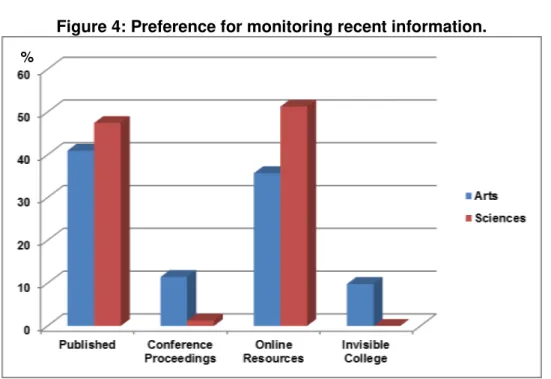
More than half of the science researchers used to use online resources to
to use information published in print form, it is interesting to see that none of the
science researcher had favored invisible college as source of nascent information.
Table 4: Preference for monitoring recent information.
Monitoring
Arts Researcher Sciences Researcher
Number of
Respondent (n=61) % Respondent (n=78) Number of %
Published 25 40.98 37 47.43
Conference Proceedings 7 11.47 1 1.28
Online Resources 23 37.70 40 51.28
Invisible College 6 9.83 0 0.00
Figure 4: Preference for monitoring recent information.
7 CONCLUSION
Information seeking pattern of arts researcher and science researcher seems
to be same in several cases while they also differ. Though the statement seems to be
contradictory but this is the reality. The information needs differ to both the groups of
researcher hence the information seeking patterns too. On the one hand it is seen
that science researcher used to use electronic resource for information seeking in
majority of cases while arts researcher even rely on print resources. The result of the
pattern of two important groups of users in university and accordingly mold there
collection development to satisfy their user’s information needs.
REFERÊNCIAS
BROWN, C. M. Information seeking behaviour of scientists in the electronic
information age: Astronomers, Chemists, Mathameticians and Physicists. Journal of American Society for Information Science, v.50, n.10, p.929-943, 1999.
DALGLEISH, A.; HALL, R. Uses and Perceptions of the World Wide Web in an information- seeking environent. Journal of Librarianship and Information Science, v.32, n.3, p.104-116, 2000.
ELLIS, D.; COX, D. ; HALL, K. A comparision of the information seeking patterns of researchers in the Physical and Social Sciences. Journal of Documentation, v.49, n.4, p.356-369, 1993.
FRANCIS, H. The information seeking behaviour of Social Science Faculty at the University of the West Indies, St. Augustine Campus. Journal of Academic Librarianship, v.31, n.5, p.67-72, 2005.
JAMALI, H. R.; NICHOLAS, D. Information seeking behaviour of physicist and astronomers. Aslib Proceedings, v.60, n.5, p.444-462, 2008.
PRASAD, H. N. Information seeking behaviour of physical scientists and social scientists. Annals of Library Science and Documentation, v.45, n.2, p.41-48, 1998.
SHEEJA, N. Science vs Social Science: A study of information-seeking behavior and user perceptions of academic researchers. Library Review, v.59, n.7, p.522-530, 2010.
Sanjay Kumar
Banaras Hindu University Research Scholar
E-Mail: [email protected] India
Praveen Shukla
Banaras Hindu University Research Scholar