EFFECT OF THE CULTURE CONDITIONS ON THE PRODUCTION OF AN EXTRACELLULAR PROTEASE BY THERMOPHILIC BACILLUS SP AND SOME PROPERTIES OF THE ENZYMATIC
ACTIVITY
Camila Rocha da Silva; Andréia Boechat Delatorre; Meire Lelis Leal Martins*
Centro de Ciências e Tecnologias Agropecuárias, Universidade Estadual do Norte Fluminense. Campos dos Goytacazes, RJ, Brasil
Submitted: October 26, 2006; Returned to authors for corrections: January 04, 2007; Approved: March 19, 2007.
ABSTRACT
Protease production by thermophilic Bacillus sp strain SMIA-2 cultivated in liquid cultures containing 1% maltose as a carbon source and supplemented with whey protein (0.1%) and corn steep liquor (0.3%) reached a maximum at 14 h, with levels of 42 U/mg protein. The microorganism was capable of utilizing a wide range of carbon sources, but protease activity varied according the carbon source. Starch and maltose were the best carbon sources in the present study for protease secretion, while lactose and sucrose were less effective. Increasing maltose concentration in the medium until 1%, improved the growth of the organism and the enzyme activity. Regarding the amounts of corn steep liquor and whey protein in the medium, the concentrations of 0.2% and 0.1% respectively, were considered the most effective for protease secretion by the organism. Studies on the protease characterization revealed that the optimum temperature of this enzyme was 70ºC. Thermostability profile indicated that the enzyme retained 80% of the original activity after 2 h heat treatment at 60ºC. At 70ºC, 70% of the original activity was retained after 15 min heat treatment. The optimum pH of the enzyme was found to be 8.5. After incubation of crude enzyme solution at room temperature for 2 h at pH 6.0-10.0, a decreased of about 15% of its original activity at pH 8.5 was observed. At pH 10.0, the decrease was 24%. In the presence of 1.0 M and 5.0 M NaCl, 76% and 37% of protease activity was retained after 2 h incubating at 45ºC respectively.
Key words: Protease, thermophilic bacterium, Bacillus sp.
*Corresponding Author. Mailing address: Centro de Ciências e Tecnologias Agropecuárias, Universidade Estadual do Norte Fluminense. Av. Alberto Lamego, 2000. CEP 28015-620. Campos dos Goytacazes, RJ. Brazil. Tel.: (22) 2726-1460/(22) 2726-3875. E-mail: [email protected]
INTRODUCTION
Thermostable proteases are advantageous for some applications because higher processing temperatures can be employed, with the consequences of faster reaction rates, increase in the solubility of nongaseous reactants and products, and reduced incidence of microbial contamination from mesophilic organisms (25). Thermo-stable proteases, produced from thermophilic bacteria are thus of considerable interest in a range of commercial applications (5-9,14). However, thermophilic bacteria investigated to date produce proteases at levels about an order of magnitude lower than do most mesophiles, and an
increase in the level of production is necessary before thermophilic proteases can become competitive as industrial enzymes (1).
anthracis), they are harmless saprophytes which produce no toxins and are included in the group of organisms generally recognized as safe (GRAS) (16).
Recently, a bacterial thermophilic Bacillus sp strain SMIA-2 capable of produce proteases, was isolated from a soil sample collected in Campos dos Goytacazes city, Rio de Janeiro, Brazil (18,19). Phylogenetic analysis showed that this strain is a member of the Bacillus rRNA group 5. This group includes Bacillus stearothermophilus and other thermophilic Bacillus spp.
The aim of the present work was to identify the medium composition that supports protease production by Bacillus sp strain SMIA-2, using inexpensive materials as whey protein and corn steep liquor. Some properties of the enzyme produced were also determined.
MATERIALS AND METHODS
Organism
The bacterial strain used in this studywas the thermophilic Bacillus sp strain SMIA-2, previously solated from a soil sample collected in Campos dos Goytacazes City, Rio de Janeiro, Brazil (19).
Enzyme production
The culture medium used in this work for protease production contained (g/L of destilled water): whey protein 1.0; corn steep liquor 3.0; maltose 10; KCl 0.3; MgSO4 0.5; K2HPO4 0.87; CaCl2 0.29; ZnO-2.03x10⁻³; FeCl
3.6H2O-2.7x10⁻²; MnCl2.4H2O-1.0x10⁻²; CuCl2.2H2O-8.5x10⁻⁵; CoCl2.6H2O-2.4x10⁻³; NiCl3.6H2O-2.5x10⁻⁴ and H3BO3-3,0x10⁻⁴. The pH was adjusted to 6.9-7.0 with NaOH, and this medium was sterilised by autoclaving at 121ºC for 15 min. Maltose was sterilised separately and aseptically added to the flasks containing the liquid medium, after cooling. The above medium (50 mL in 250 mL Erlenmeyer flasks) was inoculated with 1mL of an overnight culture and incubated at 50ºC in a orbital shaker (Thermo Forma, Ohio, USA) operated at 150 rpm. Triplicate flasks were withdraw at regular intervals and analysed for growth (OD600nm) and pH. The contents were then centrifuged at 15.500 g for 15 min at 4ºC and the cell free supernatant was used as crude enzyme preparation.
Effect of medium composition on enzyme production
The effect of the carbon source 1% (w/v) on enzyme secretion were investigated replacing maltose by D(+) galactose, lactose, sucrose, fructose, D(+) glucose, and starch. In addition, the concentration of maltose was varied in the culture medium from 0.05% to 2%. In order to find the best concentrations of whey protein and corn steep liquor on protease production its amounts were also varied in the culture medium from 0.025% to 2.0% and 0.05% to 0.7%, respectively. The effect of temperature on enzyme secretion was investigated by incubating culture flasks at 42, 45, 50 and 55ºC in a rotary incubator shaker. The
effect of the medium pH variation on enzyme secretion was studied in a pH range of 6.5 - 9.5 by adding 1% Na2CO3.
Enzymes assay
Protease activity was assessed in triplicate by measuring the release of trichloroacetic-acid soluble peptides from 0.2% (w/v) azocasein in 50 mM HEPES/NaOH buffer (pH 7.5) at 70ºC for 10 min. The 1-mL reaction was terminated by the addition of 0.5 mL of 15% trichloroacetic acid and then centrifuged at 20.600 g for 10 min, after cooling. One enzyme activity unit (U) was defined as the amount of enzyme required to produce an increase in absorbance at 420nm equal to 0.1 in 60 minutes (12).
Protein was measured by the method of the Lowry, as modified by Petterson (20,21).
Effect of the pH on protease activity and stability
The pH optimum was determined with azocasein 1% (w/v) as substrate, dissolved in different buffers (citrate phosphate, pH 5-6, sodium phosphate, pH 7.0, Tris-HCl, pH 8.0 and glycine NaOH, pH 9-10). The effect of pH on enzyme stability was determined by pre-incubating the crude enzyme preparation without substrate at different pH values (6.0-10.0) for 2 h at room temperature, and measuring the residual activity at 70ºC.
Effect of temperature on the proteolytic activity and stability
The effect of temperature on the enzyme activity was determined by performing the standard assay procedure at pH 7.5 within a temperature range of 40-100ºC. Thermostability was determined by incubation of crude enzyme preparating at temperatures ranging from 40-100ºC for 2 h in a constant-temperature water bath. After treatment the residual proteolytic activity was assayed.
Stability of protease in sodium chloride
Crude enzyme preparation was pre-incubated in phosphate buffer (0.05 M, pH 8.5) containing various NaCl concentrations (0.5-5.0 M), at 45ºC for 1 and 2 h. In each case the activity of the enzyme was measured in the same way as mentioned earlier.
RESULTS AND DISCUSSION
Culture conditions for enzyme production
variation. Thus the pH profile provides a useful means of monitoring the production process.
Bacillus sp SMIA-2 was capable of using a wide range of carbon sources, but production of protease varied according each carbon source (Table 1). Starch and maltose were the best carbon sources in the present study for protease secretion while lactose and sucrose were less effective. Moderate to good amount of protease activity was produced in the presence of fructose, galactose, and glucose. In a similar study Basalp et al. (2) showed that although glucose could not support for maximum protease production in Bacillus subtilis, yet it emerged as a better substrate than maltose, starch and galactose. On the other hand, Johnvesly and Nailk (13) reported that culturing Bacillus sp. JB-99 in glucose 1% (w/v) the protease synthesis was completely repressed.
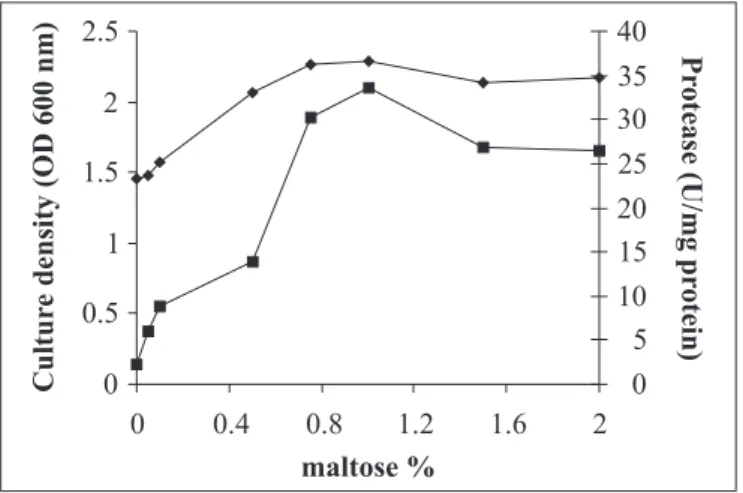
The effect of maltose on protease production was studied (Fig. 2). Increasing maltose concentration in the medium to 1%, improved the growth of the organism and the protease production. At higher maltose concentrations, enzyme production was comparatively lower.
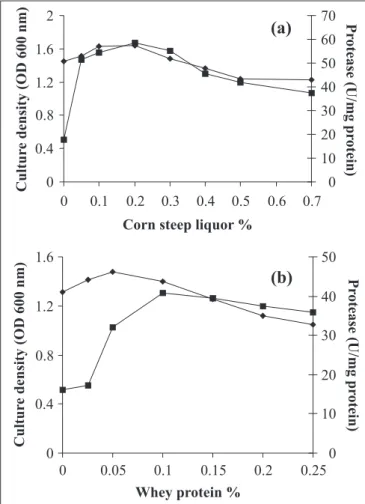
In order to find the optimum level of whey protein and corn steep liquor to protease production, its concentrations were varied in the culture medium. The activity of the enzyme increased between 0.05% and 0.2% corn steep liquor concentration and then fell beyond this point (Fig. 3a). In Bacillus subtilis ATCC 14416 the best concentration of corn steep liquor in the medium to protease production was 0.5% (4). Regarding to whey protein, concentrations between 0.1% and 0.15% were optimum for maximum protease activity (Fig. 4). Thus, the medium containing 0.2% corn steep liquor and 0.1% whey protein was considered the most effective for protease production by Bacillus sp strain SMIA-2.
Protease activity varied with initial pH of the culture medium (Table 2). The highest levels of protease activity were detected in cultures grown at pH 7.5 - 8.0. Although the growth was highest at pH 9.5 the amount of protease was almost a half of that observed at pH 7.5 - 8.0. The protease secretion was maximum at 50ºC (Table 3) and was less at high (55ºC) and low (42ºC) temperatures.
Effect of pH on protease activity and stability
A pH range between 6.0 and 10.0 was used to study the effect of pH on protease activity (Fig. 4). Optimum pH was found to be 8.5. The protease activity at pH 6.0 and pH 10.0 were 65% and 83% of that at pH 8.5, respectively. After incubation of crude enzyme solution at room temperature for 2
Table 1. Effect the carbon source on Bacillus sp growth and protease activity by. The culture density and extracellular protease activity were determined during 16 h incubation at 50ºC and at initial pH 7.0.
Carbon source Culture density Maximum (OD600nm) enzyme activity
(U/mg protein)
Starch 1.58 36.4
Frutose 1.33 25.0
Galactose 1.52 24.3
Glucose 1.22 22.2
Lactose 1.39 15.5
Maltose 1.55 35.8
Sucrose 1.08 12.6
Figure1. Protease production as a function of cultivation time by Bacillus sp grown on maltose (1.0%), whey protein (0.1%) and corn steep liquor (0.3%) in shake flasks at initial pH 7.5 and at 50ºC.
h at pH 6.0-10.0, a decreased of about 15% of its original activity at pH 8.5 was observed. At pH 10.0, the decrease was 24%. Thus, protease of Bacillus sp strain SMIA-2 seems to be active in very broad pH range.
Effect of temperature on protease activity and stability
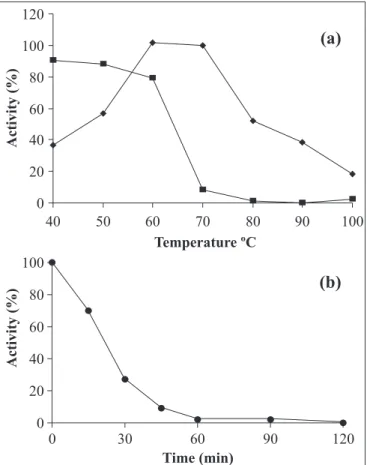
Protease activity was assayed at different temperatures ranging from 40ºC-100ºC at a constant pH of 8.5 (Fig. 5a). Enzyme activity increased with temperature within the range of 40ºC to 70ºC. A reduction in enzyme activity was observed at values above 70ºC. The optimum temperature of this protease was 70ºC, which was higher or similar to that described for other Bacillus proteases (1,11,13,17). The thermostability of the protease was examined by measuring the remaining activities at 70ºC, after incubation of the enzyme without substrate at various temperatures between 40 and 100ºC for 2 h (Fig. 5a). Thermostability profile indicated that the enzyme
Table 2. Effect of initial pH on growth and protease activity by Bacillus sp cultivated in a liquid medium containing maltose (1.0%), whey protein (0.1%) and corn steep liquor (0.2%) in shake flasks during 16 h at 50ºC.
Initial pH Culture density Maximum (OD600nm) protease activity
(U/mg protein)
6.5 0.93 16.7
7.0 1.11 37.2
7.5 1.22 49.1
8.0 1.34 48.0
8.5 1.69 40.2
9.0 1.91 39.7
9.5 1.94 25.9
Figure 3. Effect of corn steep liquor concentration (a) and whey protein concentration (b) on growth (u) and protease activity (
n
) of Bacillus sp cultivated in a liquid medium containing maltose (1.0%) in shake flasks at initial pH 7.5 and at 50ºC.Figure 4. Optimum pH (u) and stability (
n
) of protease activity produced by Bacillus sp grown at 50ºC for 14 h. Relative activity is expressed as a percentage of the maximum (100% of enzyme activity = 35.8 U/mg protein).Table 3. Effect of temperature on growth and protease activity by Bacillus sp cultivated in a liquid medium containing maltose (1.0%), whey protein (0.1%) and corn steep liquor (0.2%) in shake flasks at initial pH 7.5 during 16 h.
Temperature ºC Culture density Maximum (OD600nm) protease activity
(U/mg protein)
42 1.10 37.2
45 1.42 40.1
50 1.92 59.2
Figure 5. Optimum temperature (u) and stability (
n
) of protease activity produced by Bacillus sp grown at 50ºC for 14 h (a). Thermostability of protease at 70ºC (b). Relative activity is expressed as a percentage of the maximum (100% of enzyme activity = 43.3 U/mg protein).retained 80% of the original activity after 2 h heat treatment at 60ºC. At 70ºC, 70% of the original activity was retained after 15 min heat treatment (Fig. 5b). The protease from Bacillus sp JB-99 retained 63% and 25% of original activity after 1 h heat treatment at 70ºC and 80ºC (13). In addition, the protease from Bacillus licheniformis SMI 4.C.1. retained 60% of original activity after 30 min heat treatment at 70ºC (17).
Protease stability in sodium chloride
In the presence of 1.0 M and 5.0 M NaCl, 76% and 37% of protease activity respectively, was retained after 2 h incubating at 45ºC. Bacillus sp. JB-99 retained 84% and 41% of protease activity when incubating at 45ºC, in the presence of 1.0 M and 5 M for 2 h, respectively.
Collectively, these results may justify the suitability of the Bacillus sp SMIA-2 for commercial production of protease, using inexpensive materials.
ACKNOWLEDGMENTS
The authors thank the FAPERJ (Fundação Carlos Chaga Filho de Amparo à Pesquisa do Estado do Rio de Janeiro) for financial support.
RESUMO
Efeito das condições de cultivo sobre a produção de proteases extracelulares pelo termofílico Bacillus sp
e algumas propriedades da atividade enzimática
A produção de proteases pelo termofílico Bacillus sp cepa SMIA-2 cultivado em culturas líquidas contendo maltose (1%) e suplementada com proteínas de soro (0,1%) e água de maceração de milho (0,3%) alcançou o máximo em 14 h, com níveis de 42 U/mg proteína. O microrganismo foi capaz de utilizar várias fontes de carbono, mas a atividade da protease variou com cada fonte. Amido e maltose foram as melhores fontes para a secreção da protease, enquanto lactose e sacarose não foram muito efetivas. O aumento da concentração de maltose no meio de cultura até 1% melhorou o crescimento do organismo e a atividade da enzima. Em relação à concentração de proteínas do soro e da água de maceração de milho no meio de cultura, 0,1% e 0,2% respectivamente, foram as mais efetivas para a secreção da enzima pelo organismo. Estudos sobre a caracterização da protease revelaram que a temperatura ótima desta enzima foi 70ºC. Em relação a termoestabilidade da enzima, a protease manteve 80% de sua atividade original após 2 h de tratamento a 60ºC. A 70ºC, 70% de sua atividade original foi mantida após 15 min. O pH ótimo para atividade da enzima foi 8,5. Após a incubação da solução enzimática bruta a pH 6,0-10.0 por 2 h a temperatura ambiente, foi observado um decréscimo de em torno de 15% da sua atividade original a pH 8,5. A pH 10,0 o decréscimo
na atividade foi de 24%. Na presença de 1.0 M e 5.0 M NaCl, 76% e 37% da atividade da protease foi mantida após 2 h de incubação a 45ºC respectivamente.
Palavras-chaves: Protease, bactéria termofílica, Bacillus sp.
REFERENCES
1. Banerjee, U.C.; Sani, R.K.; Azmi, W.; Soni, R. (1999). Thermostable alkaline protease from Bacillus brevis and its characterization as a laundry detergent additive. Process Biochem., 35, 213-219. 2. Basalp, A.; Ozeengiz, G.; Alaeddinglin, N.G. (1992). Changes in
patterns of alkaline serine protease and Bacilysin formation caused by common effectors of sporulation in Bacillus subtilis 168. Curr Microbiol., 24, 129-135.
3. Beg, Q.K.; Gupta, R. (2003). Purification and characterization of an oxidation-stable, thiol-dependent serine alkaline protease from
Bacillus mojavensis. Enzyme Microbial. Technol.,32, 294-304. 4. Chu, I.-M.; Lee, C.; Li, T-S. (1992). Production and Degradation of
Alkaline Protease in Batch Cultures of Bacillus subtilis ATCC 14416.
Enzyme Microbial. Technol., 14, 755-761.
5. Cowan D.A.; Daniel, R.M.; Morgan, H.W. (1985). Thermophilic proteases: properties and potencial applications. Trends in Biotechnol., 3, 68-72.
6. Ferrero, M.A.; Castro, G.R.; Abate, C.M.; Baigori, M.D.; Singeriz, F. (1996). Thermostable alkaline proteases of Bacillus licheniformis
MIR 29: isolation, production and characterization. Appl. Microbiol. Biotechnol.,45, 327-332.
7. Gupta, R.; Gupta, K.; Saxena, R.K.; Khan, S. (1999). Bleach-stable, alkaline protease from Bacillus sp. Biotechnol. Lett.,21, 135-138. 8. Gupta, R.; Beg, Q.K.; Lorenz, P. (2002). Bacterial alkaline proteases: molecular approaches and industrial applications. Appl. Microbiol. Biotechnol., 59, 15-32.
9. Haki, G.D.; Rakshit, S.K. (2003). Developments in industrially important thermostable enzymes: a review. Biores. Tecnol.,89, 17-34.
10. Han, X.Q., Damodaran, S. (1997). Isolation, identification and fermentation of a Bacillus species producing a detergent-stable endopeptidase. J. Agric. Food Chem., 45, 4191-4195.
11. Horikoshi, K. Enzymes of alkalophilies. (1990). In: Microbial Enzyme and Biotechnology, 2nd, 275-94.
12. Janssen, P.H.; Peek, K.; Morgan, H.W. (1994). Effect of culture conditions on the production of a extracellular proteinase by Thermus
sp. Rt41A. Appl. Microbiol. Biotechnol., 41, 400-406.
13. Johnvesly, B.; Naik, G.R. (2001). Studies on production of thermostable alkaline protease from thermophilic and alkaliphilic
Bacillus sp. JB-99 in a chemically defined medium. Process Biochem., 37, 139-144.
14. Kim, Y.; Bae, J.; Oh, B.; Lee, W.; Choi, J. (2002). Enhanced of proteolytic enzyme activity excreted from Bacillus stearothermophilus
for a thermophilic aerobic digestion process. Biores. Technol., 82, 157-164.
15. Kumar, C.G.; Tiwari, M.P.; Jany, K.D. (1999). Novel alkaline serine proteases from alkalophilic Bacillus spp.: Purification and some properties. Process Biochem., 34, 441-449.
16. Mahmood, A.U.; Greenman, J.; Scragg, A.H. (1998). Orange and potato pell extracts: Analysis and use as Bacillus substrates for the production of extracellular enzymes in continuous culture. Enzyme Microbial. Technol., 22, 130-137.
17. Manachini, P.L.; Fortina, M.G.; Parini, C. (1988). Thermostable alkaline protease produced by Bacillus thermoruber a new species of
Bacillus. Appl. Microbiol., 28, 409-413.
18. Nascimento, W.C.A.; Martins, M.L.L. (2004). Production and properties of an extracellular protease from thermophilic Bacillus
sp. Braz. J. Microbiol., 35, 91-96.
19. Nunes, A.S.; Martins, M.L.L. (2001). Isolation, properties and kinetics of growth of a thermophilic Bacillus. Braz. J. Microbiol., 32, 271-275.
20. Peterson, G.L. (1977). A simplification of the protein assay method of Lowry et al. which is more generally applicable. Analytical Biochem., 83, 346-356.
21. Rao, M.B.; Tanksale, A.M.; Ghatge, M.S. (1998). Molecular and biotechnology aspects of microbial proteases. Microbiol. Mol. Biol. Ver., 62, 597-635.
22. Singh, J.; Batra, N.; Sobti, C.R. (2001). Serine alkaline protease from a newly isolated Bacillus sp. SSR1. Process Biochem., 36, 781-785. 23. Sinha, N.; Satyanarayana, T. (1991). Alkaline protease by thermophilic
Bacillus licheniformis. Indian J. Microbiol., 31, 425-430.
24. Sookkheo, B.; Sinchaikul, S.; Phutrakul, S.; Chen, S.T. (2000). Purification and characterization of the highly thermostable proteases from Bacillus stearothermophilus TLS33. Prot. Exp. Pur., 20, 142-151.
25. Ward, O.P. Proteolytic enzymes. (1985). In: M. Moo-Young Editor,