Article
Printed in Brazil - ©2019 Sociedade Brasileira de Química
*e-mail: [email protected]
Eco-Friendly Synthesis of 2,3-Dihydroquinazolin-4(1
H
)-ones Catalyzed by
FeCl
3/Al
2O
3and Analysis of Large
1H NMR Diastereotopic Effect
Isabel Monreal,a Mariano Sánchez-Castellanos,b Karla Ramírez-Gualito,c Gabriel Cuevas,d Karla A. Espinozaa and Ignacio A. Rivero *,a
aCentro de Graduados e Investigación, Instituto Tecnológico de Tijuana,
22414 Tijuana, B.C., Mexico
bFacultad de Química de la Universidad Autónoma de México (UNAM),
Circuito Exterior s/n, Ciudad Universitaria, 04510 Mexico City, Mexico
cInstituto de Química, Universidad Nacional Autónoma de México (UNAM),
Circuito Exterior s/n, Ciudad Universitaria, 04510 Mexico City, Mexico
dCentro de Nanociencias y Micro y Nanotecnologías, Instituto Politécnico Nacional,
Av. Luis Enrique Erro s/n, Unidad Profesional Adolfo López Mateos, Zacatenco, 07738 Mexico City, Mexico
In the present study, we have carried out a condensation reaction for the synthesis of 2,3-dihydroquinazolin-4(1H)-ones from 2-amino-N-benzylbenzamide and different aromatic
aldehydes using FeCl3 catalyst supported on Al2O3. It was demonstrated that this material can be
used successfully for the nucleation of quinazolinones with good to excellent yield; furthermore, the FeCl3/Al2O3 catalyst can be recovered and reused. This catalyst was used before in the
synthesis of imidazole with very good yields. The synthesized quinazolinones showed a large range diastereotopic effect over the methylene group and, this anomalous difference was studied through nuclear magnetic resonance (NMR) and computational calculations.
Keywords: quinazolinone, 2-amino-N-benzylbenzamide, diastereotopic, eco-friendly
Introduction
Quinazolinone (QZ) heterocycles and their derivatives are a very important group of molecules. One of the first QZ’s synthesized was methaqualone (Figure 1), originally used as an antimalarian drug.1 The sedative-hypnotic
activity of methaqualone was observed since 1951; and later was used for the treatment of insomnia, as a sedative and muscle relaxant.2 QZ’s have a wide extent of
biological actions3 such as central nervous system activity,4
anticonvulsant and antidepressant agents,5 they have
been used for biological evaluation and docking studies (Alzheimer’s disease),6 in nuclear medicine as potential
labeler.7 Their analgesic and anti-inflammatory properties
have been evaluated8 in endocrinology as inverse agonist
for the human thyroid-stimulating hormone receptor,9
as enzymatic inhibitors of thermolysin10 and chorismate
mutase,11 as potent antitumor agents that inhibit tubulin.12
They have been evaluated as anticancer agents,13,14 for
insecticidal,15 antibacterial16,17 and antifungal18 activity.
Additionally, these compounds can easily be oxidized to their quinazolin-4(3H)-one analogs, which are biologically active compounds.19 Thus, an efficient synthesis of these
compounds has been of great interest in past years.20 There
have been developed different methods of synthesis for 2,3-dihydroquinazolin-4(1H)-ones (DQZ) most recently; MnIII-based reaction,21 under ultrasonic irradiation,22 zeolite
catalyzed method,23 with green chemistry using
nano-indium oxide24 and carbon nanotubes as a heterogeneous
catalyst,25 etc.26-31 QZ skeleton is very common in many
natural alkaloids.32-34 Keeping in view the above, we
report a convenient and high yield eco-friendly synthesis of QZ using FeCl3/Al2O3 as catalyst; FeCl3/Al2O3 could be
recovered and reused.
Eco-Friendly Synthesis of 2,3-Dihydroquinazolin-4(1
H
)-ones Catalyzed by
FeCl
3/Al
2O
3and Analysis of Large
1H NMR Diastereotopic Effect
Experimental
Computational methods
A molecular mechanics conformational analysis of compounds 3b, 3f and 3h was done with the CompúteVOA35
commercial software. The most stable conformers were optimized at the mPW1B95/6-311+G(2d,p) level of theory with Gaussian 09.36 The charge and electronic delocalization
index were calculated with the wave function obtained from the optimization using the AIMAll software.37
General procedures
Thin-layer chromatography (TLC) was performed on silica gel F254 plates (Merck). All compounds were
detected using UV light. Melting points were obtained on an Electrothermal 88629 apparatus and are not corrected. Infrared spectra (IR) were recorded on a PerkinElmer FT-IR 1600 spectrometer. 1H and 13C nuclear magnetic
resonance (NMR) spectra at 200 and 50 MHz, respectively, were recorded on a Varian Mercury 200 MHz Spectrometer in CDCl3 and/or dimethyl sulfoxide (DMSO-d6) with
tetramethylsilane (TMS) as internal standard. Mass spectra were obtained on an Agilent Technologies 5975C MS Spectrometer at 70 eV by direct insertion. Diffraction data were collected on a Smart Apex X-ray diffractometer.
General method for preparing catalyst FeCl3/Al2O3
In a flask, FeCl3 (18.6 g, 11.4 mmol), Al2O3 (acid
alumina, 10.0 g, 98.0 mmol) were placed in acetone (17 mL) and the reaction mixture was stirred constantly for 1 h. The acetone was removed under reduced pressure, then the catalyst was dried at 120 °C for 12 h in an oven under reduced pressure (equation 1).19
(1)
General method for preparing quinazolinones (3a-3i)
In a vial, 2-amino-N-benzylbenzamide (100.0 mg, 0.450 mmol), aldehyde (0.450 mmol), MeOH (2 mL),
and FeCl3/Al2O3 (160 mg) were placed. It was capped and
shook for 2 h, the reaction was followed by TLC and filtered by gravity. The residues were washed with ethyl acetate, the solvent was eliminated to reduced pressure, the solid obtained was purified by chromatography column, eluted with petroleum ether and EtOAc. The recovery percentage were between 85-98%.
Results and Discussion
Synthesis of quinazolinones
The ortho-aminobenzamide (OAB) (2) is a precursor
of several types of compounds with biological activity. Initially, we prepare 2 from the isatoic anhydride and
benzylamine in dimethylformamide (DMF) at 60 °C, allowing the formation of CO2.38 The 2 was obtained in
quantitative yield.
In our group, imidazole compounds were prepared with the FeCl3/Al2O3 catalyst, obtaining very good yields.39
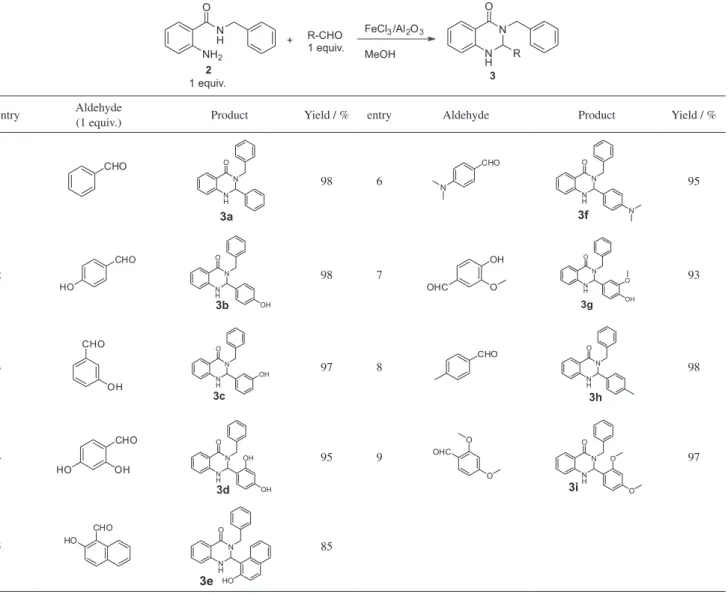
This methodology was used to prepare the QZ and only produced DQZ in all cases. It was necessary to oxidize with 2,3-dichloro-5,6-dicyano-1,4-benzoquinone (DDQ) to obtain the QZ. The synthesis of DQZ was carried out with OAB and different benzaldehydes as a starting material in MeOH, using the base reaction shown on Table 1.
The catalyst was prepared with a reported methodology,40
and the reactions were carried out at room temperature, during 4 h, to afford compounds 3a-3i (Table 1). The nine
DQZ were obtained in good to excellent yields (Table 1). In Scheme 1, a plausible mechanism is shown that begins with the preparation of the catalyst. The FeCl3 and the silica
are mixed in an acetone solution, the solvent is removed and the FeCl3/silica gel was dried. The FeCl3 was adsorbed on the
surface of the silica, the chloride ion occupying some vacancy of the surface causing the ferric salt to behave in ionic form. This effect of synergism due to the dissociation of the iron salt in its ionized form, increases the catalytic capacity. The Fe + salt interacts on the oxygen of the aldehyde (Scheme 1a) catalyzing the condensation of OAB to form the imine and, subsequently, this catalyst acts on the amide oxygen promoting the equilibrium with the imidic acid, which was condensed to form the imidazolinone.
1H NMR characterization
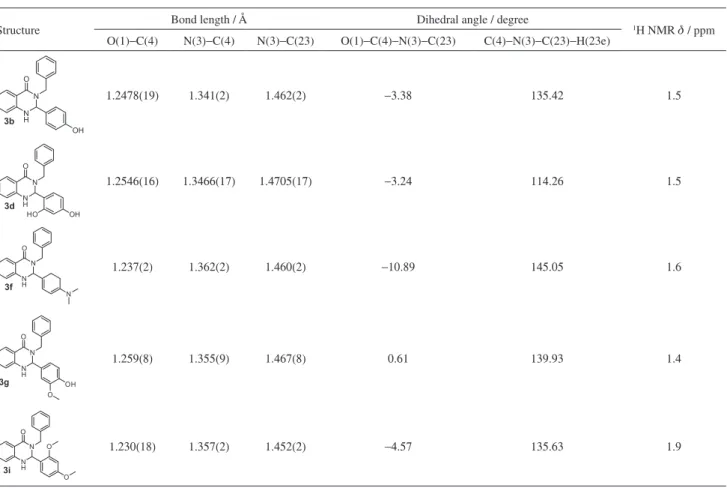
The DQZ has a chiral center that modifies the benzyl methylene protons and makes them diastereotopic protons. These protons show a difference from 1.4 to 1.9 ppm (Table 2), which is very large and unusual, so it is an important fact to highlight (Figure 2).
The 1H NMR spectrum of compound 3b shows two
diastereotopic protons (proR and proS) with a chemical shift of 3.81 and 5.31 ppm, respectively. This is an unusual fact for this kind of protons and is due to the existence of a stable rotamer that makes this difference so relevant (Figure 3).
X-ray diffraction structures
In Figure 4, the ORTEP structures of compounds 3b, 3d, 3f, 3g and 3i are shown. The bond lengths and angles related
to the carbonyl group, the nitrogen bonded to this group and the methylene group that contains the two diastereotopic protons (proR and proS) were analyzed.
These molecules exhibit an unusual shift of the methylene hydrogens, which is too large for diastereotopic hydrogens. Such large differences are associated to charge transfer as is explained by computational calculation.
The geometrical properties of the molecules around the methylene group were determined by X-ray structures. Initially, the atom bonds length values were obtained: in the segment C(4)−N(3)−C(23), the C23 corresponds to the
methylene carbon where the diastereotopic hydrogens are located, in 3f, is the C25. Table 2 shows that compound 3i
has the largest chemical shift difference and has the shorter distances. The O(1)−C(4) and the N(3)−C(23) bonds
distances are illustrative, it is shown that they have a very important role in the difference of the chemical shift of the diastereotopic hydrogens. When the O−C and N−C bond distances diminish, the chemical shift difference is large, with values between 1.5 and 1.9 ppm. The dihedral angle is an indication of the spatial arrangement, the negative value of the dihedral angle (O−C−N−C) affects the difference between the diastereotopic hydrogens. Table 1. Synthesis of DQZ (3) from OAB (2)
entry Aldehyde (1 equiv.) Product Yield / % entry Aldehyde Product Yield / %
1 98 6 95
2 98 7 93
3 97 8 98
4 95 9 97
Computational analysis
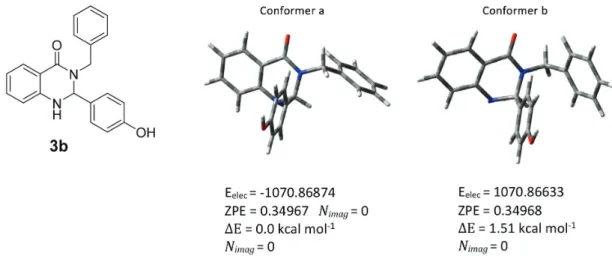
In order to explain the chemical shifts determined for the protons proR and proS, a conformational analysis at the molecular mechanic’s level was done with the computeVOA software. In Figure 5, a selection of the most stable conformers of compound 3b is shown. These conformers
were optimized at the mPW1B95/6-311+G(2d,p) level of theory. The most important difference between these Scheme 1. Mechanism proposed in the synthesis of quinazolinone 3.
Figure 2. Diastereotopic protons in benzyl methylene of the DQZ.
Table 2. X-ray and 1H NMR data
Structure Bond length / Å Dihedral angle / degree 1H NMR d / ppm
O(1)−C(4) N(3)−C(4) N(3)−C(23) O(1)−C(4)−N(3)−C(23) C(4)−N(3)−C(23)−H(23e)
1.2478(19) 1.341(2) 1.462(2) −3.38 135.42 1.5
1.2546(16) 1.3466(17) 1.4705(17) −3.24 114.26 1.5
1.237(2) 1.362(2) 1.460(2) −10.89 145.05 1.6
1.259(8) 1.355(9) 1.467(8) 0.61 139.93 1.4
1.230(18) 1.357(2) 1.452(2) −4.57 135.63 1.9
NMR: nuclear magnetic resonance.
structures is the orientation of the hydrogen proR and proS. In conformer a, the hydrogen proR is in the same direction as the carbonyl group, while in the conformer b this occurs with the proS hydrogen.
Considering the topological theory of atoms in molecules and using the AIMAll software, the charges41
of the oxygen, hydrogens proR and proS were calculated and are summarized in Table 3.
These results show that when the hydrogen is near to the oxygen of the carbonyl group a charge deficiency is observed. To explain the chemical shifts observed, the charge of the considered atoms was calculated considering these two conformers as in equation 2:
q(i) = χaq(i)a + χbq(i)b (2)
where i represents the atom of interest, χ the conformational
population of each conformer and q(i)x is the charge of i in
the conformer x. Results of charges are shown in Table 4. It can be observed that the charge of the atoms is defined by the most important conformer a as expected by the energy values.
These differences in the charges can be explained by suggesting the existence of an interaction between the hydrogen proR in a and proS in conformer b with oxygen in the carbonyl group of the molecule promoting
downfield shift and electronic charge deficiency generated by dispersion forces.42 The same analysis was done for
structures 3f and 3h, where the same phenomenon was
observed. Electronic delocalization index DI(A,B), an average number of electrons delocalized between atoms A and B, is an additional information that can be extracted from AIM calculations.43 Table 5 shows the delocalization
index between the oxygen and the analyzed hydrogens. These values are higher when the hydrogen is closer to the carbonyl group, showing that the difference in chemical shifts of protons proR and proS may be attributed to this interaction.
Conclusions
It has been shown that the use of FeCl3/Al2O3 in MeOH
in this reaction is an environmentally benign reaction media. This is a new approach that meet with the requirements of Figure 5. Lower energy conformers of compound 3b optimized at the level of theory mPW1B95/6-311+G(2d,p). Energy values (E), zero point energy (ZPE) in Hartrees and the number of imaginary frequencies (Nimag) are included. Nimag = 0 refers to a structural minimum.
Table 3. AIM charges of the selected conformers of 3b calculated at the
mPW1B95/6-311+G(2d,p) level of theory
Conformer Proton
Oxygen HproR HproS
a −1.187584 +0.107024 +0.027274
b −1.190171 +0.021578 +0.086625
Table 4. Charges of oxygen and hydrogens proR and proScalculated with AIM using the functional mPW1B95 and the 6-311+G(2d,p) basis
Compound Atom
Oxygen HproR HproS
3b −1.198 +0.101 +0.031
3f −1.184 +0.104 +0.030
3h −1.186 +0.104 +0.039
Table 5. Electron delocalization index calculated with AIM at the mPW1B95/6-311+G(2d,p) level of theory
Compound DI(O,HproR) DI(O,HproS)
3b 0.052525 0.007972
3f 0.054580 0.010253
3h 0.055304 0.009755
sustainable chemistry. The remarkable advantages of this method are simple experiments, mild reaction conditions, excellent yields and catalyst recovery. In addition, this catalyst is highly recommended to be used in the synthesis of quinazolinones. The computational analysis of the chemical shift of the diasterotopic hydrogens indicates that the main cause of the large difference between these two hydrogens were the interaction of these hydrogens with oxygen atom. The X-ray structures show that when the distance of the C−O bond is smaller, a greater difference in ppm between
the diasterotopic hydrogens is present. The dihedral angle (O−C−N−C) is another factor that affects the difference of
the chemical shift of the diasterotopic hydrogens
Supplementary Information
Supplementary information (spectroscopic data, 1H and 13C NMR spectra and mass spectra (EI)) is available free
of charge at http://jbcs.sbq.org.br as PDF file.
Acknowledgments
We gratefully acknowledge the support for this project by Consejo Nacional de Ciencia y Tecnología (CONACyT, grant No. 242823) and for graduate scholarship (No. 221455). We also acknowledge Tecnológico Nacional de México for supporting this project (Clave 5871.16-P).
References
1. Kacker, I. K.; Zaheer, S. H.; J. Indian Chem. Soc. 1951, 28, 344.
2. Amin, A. H.; Mehta, D. R.; Samarth, S. S.; Prog. Drug Res. 1970, 14, 218.
3. Ibrahim, S. M.; Abo-Kul, M.; Soltan, M. K.; Barakat, W.; Helal, A. S.; Med. Chem. 2014, 4, 351.
4. Wolfe, J. F.; Rathman, T. L.; Sleevi, M. C.; Campbell, J. A.; Greenwood, T. D.; J.Med. Chem. 1990, 33, 161.
5. Amir, M.; Ali, I.; Hassan, M. Z.; Arch. Pharmacal Res.2013,
36, 61.
6. Liu, P.; Wang, Y. N.; Sun, Q.; Zhai, Y.; Yu, J.; Sun, J.; Xu, F.; Yan, G.; Huang, W.; Liang, L.; Xu, P.; Eur. J. Med. Chem.2014, 79, 413.
7. Kumari, S.; Kalra, N.; Mishra, P.; Chutani, K.; Mishra, A.; Chopra,M.; Nucl. Med. Biol. 2004, 31,1087.
8. El-Sabbagh, O. I.; Ibrahim, S. M.; Baraka, M. M.; Kothaye, H.;
Archiv. Pharm. 2010, 343, 274.
9. Neumann, S.; Huang, W.; Eliseeva, E.; Titus, S.; Thomas, C. J.; Gershengorn, M. C.; Endocrinology2010, 151,3454. 10. Khan, T. H.; Khan, R.; Wuxiuer, Y.; Arfan, M.; Ahmed, M.;
Sylte, I.; Bioorg. Med. Chem.2010, 18, 4317.
11. Rambabu, D.; Kumar, S. K.; Sreenivas, B. Y.; Sandra, S.; Kandale, A.; Misra, P.; Basaveswara, M. V.; Pal, R. M.;
Tetrahedron Lett.2013, 54, 495.
12. Chang, Y. H.; Hsu, M. H.; Wang, S. H.; Huang, L. J.; Qian, K.; Morris-Natschke, S. L.; Hamel, E.; Kuo, S. C.; Lee, K. H.;
J. Med.Chem.2009, 52, 4883.
13. Rajput, S.; Gardner, C. R.; Failes, T. W.; Arndt, G. M.; Black, D. S.; Kumar, N.; Bioorg. Med. Chem.2014, 22,105.
14. Kamal, A.; Bharathi, E. V.; Reddy, J. S.; Ramaiah, M. J.; Dastagiri, D.; Reddy, M. K.; Viswanath, A.; Reddy, T. L.; Shaik, T. B.; Pushpavalli, S. N. C. V. L.; Bhadra, M. P.; Eur. J. Med. Chem.2011, 46, 691.
15. Zhou, Y.; Feng, Q.; Di, F.; Liu, Q.; Wang, D.; Chen, Y.; Xiong, L.; Song, H.; Li, Y.; Li,Z.; Bioorg. Med. Chem.2013, 21, 4968.
16. Alaimo, R. J.; Russell, H. E.; J. Med. Chem.1972, 15, 335. 17. Mohammadi, A. A.; Askari, S.; Rohi, H.; Soorki, A. A.; Synth.
Commun. 2014,44, 457.
18. Xu, Z.; Zhang, Y.; Fu, H.; Zhong, H.; Hong,K.; Zhu, W.; Bioorg. Med. Chem. Lett. 2011, 13, 4005.
19. Tiwari, V. K.; Kale, R. R.; Mishra, B. B.; Singh, A.; ARKIVOC 2008, 14, 27.
20. Karimi-Jaberi, Z.; Arjmandi, R.; Monatsh. Chem.2011, 142,
631.
21. Nishino, H.; Kumabe, R.; Hamada, R.; Yakut, M.; Tetrahedron 2014, 70, 1437.
22. Wang, J.; Zong, Y.; Fu, R.; Niu, Y.; Yue, G.; Quan, Z.; Wang, X.; Pan, Y.; Ultrason. Sonochem.2014, 21, 29.
23. Takács, A.; Fodor, A.; Németh, J.; Hell, Z.; Synth. Commun. 2014, 44, 2269.
24. Santra, S.; Rahman, M.; Roy, A.; Majee, A.; Hajra, A.; Catal. Commun.2014, 49, 52.
25. Safari, J.; Gandomi-Ravandi, S.; RSC Adv.2014, 4, 11654.
26. Sharma, M.; Pandey, S.; Chauhan, K.; Sharma, D.; Kumar, B.; Chauhan, P. M. S.; J. Org. Chem. 2012, 77, 929.
27. Cabrera-Rivera, F. A.; Ortíz-Nava, C.; Román-Bravo, P.; Leyva, M. A.; Escalante, J.; Heterocyles2012, 85, 2173.
28. Zong-Bo, X.; Shi-Guo, Z.; Guo-Fang, J.; Da-Zhao, S.; Zhang-Gao, L.; Green Chem. Lett. Rev. 2015, 8, 95.
29. Badolato, M.; Aillo, F.; Neamati, N.; RSC Adv.2018, 8, 20894.
30. Esmaeilpour, M.; Javidi, J.; Zahmatkesh, S.; Fahimi, N.;
Monatsh. Chem. 2017, 148, 947.
31. Hakimelahi, R.; Mousazadeh, M. H.; Orient. J. Chem.2017, 34, 86.
32. Maskey, R. P.; Shaaban, M.; Grün-Wollny, I.; Laatsch, H.;
J. Nat. Prod. 2004, 67, 1131.
33. Tiwary, B. K.; Pradhan, K.; Nanda, A. K.; Chakraborty, R.;
J. Chem. Biol. Ther.2015, 1, 104.
34. Rajput, R.; Mishra, A. P.; Int. J. Pharm. Pharm. Sci. 2012, 4,
66.
35. Debie, E.; Bultinck, P.; Nafie, L. A.; Dukor, R. K.; ComputeVOA;
36. Frisch, M. J.; Trucks, G. W.; Schlegel, H. B.; Scuseria, G. E.; Robb, M. A.; Cheeseman, J. R.; Scalmani, G.; Barone, V.; Petersson, G. A.; Nakatsuji, H.; Li, X.; Caricato, M.; Marenich, A.; Bloino, J.; Janesko, B. G.; Gomperts, R.; Mennucci, B.; Hratchian, H. P.; Ortiz, J. V.; Izmaylov, A. F.; Sonnenberg, J. L.; Williams-Young, D.; Ding, F.; Lipparini, F.; Egidi, F.; Goings, J.; Peng, B.; Petrone, A.; Henderson, T.; Ranasinghe, D.; Zakrzewski, V. G.; Gao, J.; Rega, N.; Zheng, G.; Liang, W.; Hada, M.; Ehara, M.; Toyota, K.; Fukuda, R.; Hasegawa, J.; Ishida, M.; Nakajima, T.; Honda, Y.; Kitao, O.; Nakai, H.; Vreven, T.; Throssell, K.; Montgomery Jr., J. A.; Peralta, J. E.; Ogliaro, F.; Bearpark, M.; Heyd, J. J.; Brothers, E.; Kudin, K. N.; Staroverov, V. N.; Keith, T.; Kobayashi, R.; Normand, J.; Raghavachari, K.; Rendell, A.; Burant, J. C.; Iyengar, S. S.; Tomasi, J.; Cossi, M.; Millam, J. M.; Klene, M.; Adamo, C.; Cammi, R.; Ochterski, J. W.; Martin, R. L.; Morokuma, K.; Farkas, O.; Foresman, J. B.; Fox, D. J.; Gaussian 09, Revision A.02; Gaussian, Inc., Wallingford, 2016.
37. Keith, T. A.; AIMAll, version 12.09.23; TK Gristmill Software, Overland Park, KS, USA, 2012. Available at aim.tkgristmill. com, accessed in August 2018.
38. Cortez, R.; Rivero, I. A.; Somanathan, R.; Aguirre, G.; Ramírez, F.; Hong. E.; Synth. Commun. 1991, 21, 285.
39. Monreal, I.; Torres Pacheco, L. J.; Oropeza Guzman, M. T.; Rivero, I. A.; Int. J. Electrochem. Sci. 2015,10, 6743.
40. Chen, G. F.; Dong, X. Y.; E-J. Chem.2012, 9, 289.
41. Bader, R.; Atoms in Molecules: A Quantum Theory; Oxford
University Press: New York, 1994.
42. Lambert, J. B.; Mazzola, E. P.; Nuclear Magnetic Resonance Spectroscopy: An Introduction to Principles, Applications, and
Experimental Methods; Prentice Hall: New York, 2003.
43. Buschbeck-Alvarado, M. E.; Hernandez-Fernandez, G.; Hernandez-Trujillo, J.; Cortes-Guzmán, F.; Cuevas, G.; J. Phys. Org. Chem.2018, 31, e3793.
Submitted: May 30, 2018
Published online: August 21, 2018