José António Barata de Oliveira
Coalition Based Approach for Shop Floor
Agility – A Multiagent Approach
Dissertation submitted for a PhD degree in Electrical Engineering, speciality of Robotics and Integrated Manufacturing from the Universidade Nova de Lisboa, Faculdade de Ciências e Tecnologia, under the supervision of Professor Luís Camarinha de Matos.
Lisboa
To Tomboco, the small village in the mother Africa where I grew up,
and learned to appreciate the importance
and beauty of the plurality of people.
A word of thanks also to the seven seas and all
There are certain individuals that render the journey simpler, others which render it bearable and a few without whom one would probably never make it. I would hereby like to thank all of those that, in one or more of the above mentioned ways, have contributed to this work.
A special recognition should be made to the person that has well and truly been the instigator, motivator and spiritual mentor to my work: Prof. Luís Camarinha de Matos. He is probably the most important reason for the achievement herewith being presented, and nothing I could do would ever thank him. This thesis has received a lot of his valuable criticism and suggestions, without which this work would be far lesser. All the years that I have been working with him have been very rewarding both in scientific and personal terms. He has always been willing to share with me his vast scientific knowledge and experience as well as his indefatigable attitude towards science. My gratitude to all the effort he has made to help me become a better scientist, engineer, and teacher, is endless. But I am also grateful to his friendship and personal support I have had from him since I joined his group. I would like to extend my thanks also to his wife and kids that have been always very helpful and friendly.
to accept completely different views from his own have been a valuable support. Thanks Mauro, soul brother of our mother Africa.
A special word of thanks goes for my students. They have all given me the joy and motivation to pursue this work. Teaching future engineers is a challenge and pleasant activity. In this process of trying to provide them with the right tools and skills to master their future as engineers, and responsible citizens, I am continuously learning with their youth and eagerness towards knowledge. A special thank is addressed to the students that have in a way or another worked with me and contributed to this thesis: João Carlos Silva, Sandra Gadanho, Nuno, Florbela Queiroz, Luís Flores, Rui Monteiro, David Costa, Luís Mendes, Paulo Compadrinho, Rui Rodrigues, Bruno, João Sarraipa, Eduardo Costa, Inês Oliveira, Filipa Ferrada, André Grosso, and João Praça.
My colleagues from the department where I work (DEE) should also be thanked for their support and friendship. Things get easier when the people with whom you need to interact are more than easy to deal with, when they are helpful. The people in this department, from professors to auxiliary personnel, are all responsible for the creation of a pleasant and helpful atmosphere that has been extremely important for my well-being. A warm thanks to all of you.
My current and past PhD colleagues also deserve a special word of thanks. All of them have engaged me in important scientific and technical discussions that proved beneficial for this thesis. On the other hand, they were also a source of encouragement whenever I needed it. Thanks, Hélder Pita, Luís Osório, Ricardo Rabelo, Fernando Martinelli, Octavio Castolo, Celson Lima, and Walter Vieira.
During the realisation of this work I have interacted with many knowledgeable and interesting people. In particular I have worked and learned a lot in European research projects, involving researchers both from Europe and Latin America. I am grateful to all of them and I will not forget how much I have learned with them through the uncountable discussions we have had, that eventually proved an important tool in the building of the work described in this thesis. However, there are some individuals from these projects that I need to individualise because of their help, support, and friendship: Uwe Kirchhoff (ATB Bremen), José Lastra (TUT Tampere), Rolf Bernhardt (IPK Berlin), Volker Katshinsky (IPK Berlin), Gilberto Cunha (UFRGS Porto Alegre), Dagmar Menken (Airbus Hamburg), Raimo Launonen (VTT Finland), and Goran Lange (Univ. of Stockholm).
To Luís Flores I am grateful for all his availability to discuss and help in many of the contents in this thesis related to industrial application.
I am also indebted to my English teachers at the Cambridge School of Almada, who have quite an important share of responsibility in this thesis. Together with my colleagues and supporting staff they have made classes enjoyable and learning much easier. I shall thank Tony Hilzbrich (Bill), Tina Sealey, Joanne Marsden, Robert Hart, and Adrian Matters. In particular I would like to express my gratitude to Joanne Marsden for all her effort in proofreading some chapters of this thesis. Nevertheless, any errors in the English are entirely my responsibility.
My friends João Lisboa and Luís Assunção whose friendship and attention have been important, also deserve a word of recognition.
I would like to thank my parents for being always supportive in this journey. Even at a cost of their own well-being they have always encouraged and supported my studies. I am tremendously grateful for that as well as for all their lessons that encouraged me to pursue learning and knowledge for life.
I cannot also forget my sister Tucha, which, from my earliest memories, has been always there, helping without expecting anything in return.
Abstract
This thesis addresses the problem of shop floor agility. In order to cope with the disturbances and uncertainties that characterise the current business scenarios faced by manufacturing companies, the capability of their shop floors needs to be improved quickly, such that these shop floors may be adapted, changed or become easily modifiable (shop floor reengineering).
One of the critical elements in any shop floor reengineering process is the way the control/supervision architecture is changed or modified to accommodate for the new processes and equipment. This thesis, therefore, proposes an architecture to support the fast adaptation or changes in the control/supervision architecture. This architecture postulates that manufacturing systems are no more than compositions of modularised manufacturing components whose interactions when aggregated are governed by contractual mechanisms that favour configuration over reprogramming.
Glossary of Abbreviations
ACL Agent Communication Language AI Artificial Intelligence AMI Agent Machine Interface
API Application Programming Interface AUML Agent Unified Modelling Language
BA Broker Agent
BAS Balanced Automation Systems BIS Business Information Systems BPR Business Process Reengineering CA Coordinating Agent
CAC Cluster Adhesion Contract CAD Computer Aided Design CAM Computer Aided Manufacturing CAQ Computer Aided Quality
CAPP Computer Aided Process Planning CIM Computer Integrated Manufacturing CMgA Cluster Manager Agent
CNC Computer Numerical Controls
CoBASA Coalition Based Approach for Shop Floor Agility DAI Distributed Artificial Intelligence
FAS Flexible Assembly System
FMS Flexible Manufacturing System ICT Information and Communication Technology IGES Initial Graphics Exchange Standard
IT Information Technology
JADE Java Agent Development Environment
JIT Just In Time
MAS Multiagent Systems MCC Multilateral Coalition Contract
MES Manufacturing Execution System MRA Manufacturing Resource Agent MRP Material Requirements Planning MRP II Manufacturing Resources Planning
NC Numerical Control
OKBC Open Knowledge Base Connectivity PMC Physical Manufacturing Component PPC Production Planning and Control PVC Professional Virtual Communities PDM Product Data Management PDT Product Data Technology
RMS Reconfigurable Manufacturing Systems SFCS Shop Floor Control Systems
SME Small and Medium Enterprise UML Unified Modelling Language
VE Virtual Enterprise
Table of Contents
ACKNOWLEDGEMENTS...III
ABSTRACT ...VII
GLOSSARY OF ABBREVIATIONS... IX
TABLE OF CONTENTS... XI
TABLE OF FIGURES ...XV
TABLE OF TABLES ... XXI
1 INTRODUCTION ...1.1
1.1 RESEARCH PROBLEM...1.1
1.2 OUTLINE OF THE THESIS...1.6
2 MANUFACTURING TRENDS AND SHOP FLOOR REENGINEERING...2.1
2.1 HISTORICAL PERSPECTIVE...2.1
2.1.1 MANUFACTURING BUSINESS PARADIGMS...2.3 2.1.2 EXTERNAL FACTORS OF THE MANUFACTURING BUSINESS PARADIGMS...2.26
2.2 CURRENT CHALLENGES...2.43
2.2.2 INFORMAL INTERVIEWS... 2.47 2.2.3 OTHER OBSERVATIONS... 2.51
2.3 A SCENARIO FOR A SHOP FLOOR REENGINEERING METHODOLOGY... 2.52
2.4 CONCLUSIONS... 2.57
3 SUPPORTING CONCEPTS... 3.1
3.1 INTRODUCTION... 3.1
3.2 MULTIAGENTS SYSTEMS... 3.2
3.2.1 INDIVIDUAL AGENTS... 3.2 3.2.2 MULTIAGENTS... 3.14
3.3 ONTOLOGIES... 3.32
3.3.1 INTRODUCTION... 3.32 3.3.2 IMPORTANT ASPECTS... 3.33 3.3.3 CHALLENGES AND IMPLEMENTATIONS... 3.36
3.4 CONTRACTS... 3.40
3.4.1 BACKGROUND ON LEGAL ISSUES... 3.41 3.4.2 HOW COMPUTERS ARE CHANGING THE LAW... 3.45 3.4.3 ELECTRONIC CONTRACTS – STATE OF THE ART... 3.45
3.5 SHOP FLOOR CONTROL... 3.49
3.5.1 EXISTING SHOP FLOOR REFERENCE ARCHITECTURES... 3.50
3.6 COLLABORATIVE NETWORKED ORGANISATIONS... 3.61
3.6.1 CLUSTERS... 3.62 3.6.2 COOPERATION FORMS... 3.65
3.7 INTEGRATION INFRASTRUCTURES... 3.67
3.7.1 ENTERPRISE MODELING... 3.69 3.7.2 ONTOLOGIES... 3.72 3.7.3 STANDARDS... 3.72 3.7.4 INFORMATION INTEGRATION... 3.74 3.7.5 APPLICATION INTEGRATION... 3.76 3.7.6 LEGACY SYSTEMS... 3.79
4 SYSTEM ARCHITECTURE TO SUPPORT SHOP FLOOR REENGINEERING ... 4.1
4.1 INTRODUCTION AND BASIC APPROACH... 4.1
4.1.1 COOPERATION AND CONTRACTS APPLIED TO THE SHOP-FLOOR... 4.6
4.2.1 THE COMPONENTS...4.10 4.2.2 CLUSTERING...4.13 4.2.3 COALITIONS / CONSORTIA...4.24 4.2.4 COALITIONS LIFE CYCLE...4.39 4.2.5 COBASA SOCIETY...4.49
4.3 INDIVIDUAL COMPONENTS ARCHITECTURE...4.50
4.3.1 THE BROKER...4.52 4.3.2 THE CLUSTER MANAGER – CMGA...4.53 4.3.3 THE MANUFACTURING RESOURCE AGENT - MRA...4.56 4.3.4 THE GENERIC AGENT – GA ...4.57 4.3.5 THE AGENT MACHINE INTERFACE – AMI ...4.66
5 PROTOTYPE AND VALIDATION ...5.1
5.1 INTRODUCTION...5.1
5.2 DEVELOPMENT TOOLS...5.3
5.2.1 MULTIAGENT DEVELOPMENT ENVIRONMENT...5.3 5.2.2 KNOWLEDGE MODELLING SUPPORT...5.13
5.3 PROTOTYPE DESCRIPTION...5.16
5.3.1 COMMON IMPLEMENTATION DETAILS...5.16 5.3.2 COMMUNICATIONS...5.22 5.3.3 CLUSTER MANAGER – CMGA ...5.24 5.3.4 GENERIC AGENT – GA...5.28 5.3.5 BROKER AGENT – BA ...5.32
5.4 THE STEPS OF THE METHODOLOGY...5.36
5.4.1 JOIN THE CLUSTER...5.37 5.4.2 CREATE A CONSORTIUM...5.42 5.4.3 CHANGE A CONSORTIUM...5.43 5.4.4 DELETE A CONSORTIUM...5.44
5.5 EXPERIMENTAL VALIDATION...5.44
5.6 EXTERNAL VALIDATION...5.50
5.7 THEORETICAL VALIDATION...5.50
6 CONCLUSIONS AND FUTURE WORK ...6.1
6.1 CONCLUSIONS...6.1
6.1.2 OBSTACLES TO INDUSTRIAL DISSEMINATION... 6.7
6.2 SUGGESTIONS FOR FURTHER RESEARCH... 6.8
6.3 CONCLUDING REMARKS... 6.10
REFERENCES ... Ref.1
Table of Figures
Table of Tables
1 Introduction
This thesis addresses the problem of shop floor agility. In order to cope with the disturbances and
uncertainties that characterise the current business scenarios manufacturing companies need to
improve the capability of their shop floors in order to be to be quickly adapted or easily
modifiable (agile shop floor reengineering). One of the critical elements in any shop floor
reengineering process is the way the control/supervision system is changed or modified.
Addressing this need, an approach and system’s architecture is proposed to support the fast
adaptation of agile shop floor control/supervision systems. According to this approach
manufacturing systems are no more than compositions of modularised manufacturing components
whose interactions, when aggregated, are governed by contractual mechanisms that favour
configuration over reprogramming.
1.1 RESEARCH PROBLEM
Shop floor agility is a central problem in current manufacturing companies. Internal and external constraints, such as growing number of product variants and volatile markets, are changing the way these companies operate by requiring continuous adaptations or reconfigurations of their shop floors. This need for continuous shop floor changes is so important that finding a solution to this problem would offer a competitive advantage to contemporary manufacturing companies.
perspectives and actors involved in the various phases of the life cycle of these systems. Moreover, supporting methods and tools should be designed and developed to accommodate the continuous evolution of the manufacturing systems along their life cycle phases – a problem of shop floor reengineering. The design and development of a methodology to address shop floor reengineering is thus an important research issue aiming to improve shop floor agility, and, therefore, increasing the global competitiveness of contemporary manufacturing companies.
Before detailing the focus of the present work in the context of shop floor agility, the concept of agility will be further detailed. Agility is a fundamental requirement for modern manufacturing companies in order to face challenges provoked by the globalisation, changes on environment and working conditions regulations, improved standards for quality, fast technological mutation, and changes of the production paradigms. The turbulent and continuous market changes have impacts at different levels, from company management to shop floor. Only companies that exhibit highly adaptable structures and processes can cope with such harsh environments. Furthermore, the capability to rapidly change the shop floor infrastructure is a fundamental condition to allow participation of manufacturing enterprises in dynamic cooperative networks. Networked enterprise associations, such as virtual enterprises, advanced supply chains, etc. are examples of cooperative structures created to cope with the mentioned aspects. Manufacturing companies wishing to join these networked structures need to be highly adaptable in order to cope with the requirements imposed by very dynamic and unpredictable changes. In such scenarios, agility means more than being flexible or lean. Flexibility in this context means that a company can easily adapt itself to produce a range of products (mostly predetermined), while lean essentially means producing without waste. On the other hand, agility corresponds to operating efficiently but in a competitive environment dominated by change and uncertainty (Goldman, Nagel, & Preiss, 1995), which means adaptation to conditions that are not determined or foreseen a-priori. The participation in dynamic (and temporary) organisations requires agile adaptation of the enterprise to each new business scenario, namely in terms of its manufacturing capabilities, processes, capacities, etc.
research works (Huff & Edwards, 1999; Koren et al., 1999; Mehrabi, Ulsoy, & Koren, 2000), in which shop floor agility is achieved by focusing on the reconfigurability of the individual equipment rather than considering a global agility approach. Nevertheless the situation is that a non-agile shop floor seriously limits the global agility of a manufacturing company even if its higher levels are agile. A good indication of how great the demand for agile shops-floors is within manufacturing companies is the increasing number of shop floor alteration projects (Barata & Camarinha-Matos, 2000). As long as people in the shop floor are faced with the need to often change (adapt) their production systems, the need to have methods and tools to cope with such challenge increases significantly.
Consequently, the work described in this thesis, besides being important in terms of the mentioned practical need, is pioneering because to the author’s knowledge it is the first one that attempts a holistic approach to the agility problem.
Nonetheless, it must be pointed out that the aim of this thesis cannot be that of solving the global shop floor agility problem since this would demand the development of several methods and tools, which would demand a scale of resources that goes beyond the scope of a PhD work. The goal is therefore to present an approach to the problem which applies a holistic perspective and in which partial contributions to the global solution are expected. Once the global problem is understood, and a sub-problem is focused upon, the thesis attempts to propose a solution to it.
A particularly critical element in a shop floor reengineering process is the control system. Current control/supervision systems are not agile because any shop floor change requires programming modifications, which imply the need for qualified programmers, usually not available in manufacturing SMEs. To worsen the situation, the changes (even small changes) might affect the global system architecture, which inevitably increases the programming effort and the potential for side-effect errors. It is therefore vital to develop approaches, and new methods and tools that eliminate or reduce these problems, making the process of change (re-engineering) faster and easier, focusing on configuration instead of codification. Hence the decision to focus this PhD work on the reengineering aspects required by the control/supervision architecture, which covers an important part of any global life cycle support methodology.
The proposed contributions to improve the shop floor reengineering task aim at accommodating the following requirements:
Good level of modularity. Manufacturing systems should be created as compositions of
modularised manufacturing components, which become basic building blocks. The building blocks should be developed on the basis of the processes they are to cater for.
Configuration rather than programming. The addition or removal of any manufacturing
programming effort. The system composition and its behaviour are established by configuring the relationships among modules, using contractual mechanisms.
High reusability. The building blocks should be reused for as long as possible, and easily
updated for further reuse.
Legacy systems migration. Legacy and heterogeneous controllers should be considered in the
global architectures and a process should be found out to integrate them in the new agile architecture.
Reducing the programming effort that is usually required whenever any changes or adaptations take place in the shop floor becomes one of the most important requirements for this thesis.
The research question addressed by this work can be summarised as:
Research question
Which methods and tools should be developed to make current manufacturing control/supervision systems reusable and swiftly modifiable?
The adopted work hypothesis to address the research question is defined bellow:
Research Hypothesis
Shop floor control/supervision reengineering agility can be achieved if manufacturing systems are abstracted as compositions of modularised manufacturing components that can be reused whenever necessary, and, whose interactions are specified using configuration rather than reprogramming.
The approach followed to tackle the problem raised in the research question was the following:
Approach
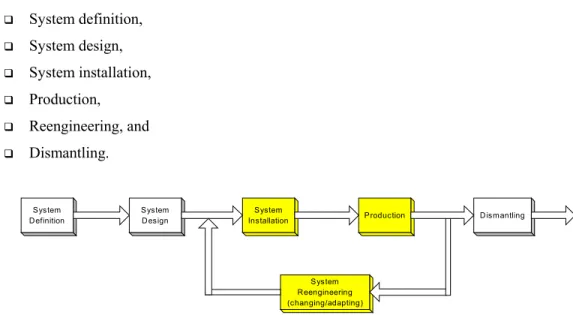
The life cycle of shop floor manufacturing systems should explicitly include a new phase: the reengineering phase that captures the time frame in which the systems are being changed or adapted (reengineered).
Manufacturing components are agentified (transformed from physical manufacturing components into agents) to become modules that can be used and reused to compose complex systems.
The different types of manufacturing systems are represented by coalitions or consortia of agentified manufacturing components, which are essentially societies of self-interested and heterogeneous agents whose behaviour is governed by contracts.
Contract negotiation is the configuration basis required whenever a control/supervision system needs to be changed or adapted.
The main scientific contributions that have been developed under the framework of this thesis are:
Main Contributions
1. Shop floor agility is achieved by using coalitions/consortia of agentified manufacturing components (basic building blocks), whose members are chosen from an entity (cluster) that contains all the manufacturing components of a certain cell, using a broker agent as an intermediary.
2. A multiagent based architecture, called Coalition Based Approach for Shop Floor
Agility – CoBASA, was created to support the reengineering process of shop floor control/supervision architectures. In an innovative way, CoBASA uses contracts to govern the relationships between coalitions members (manufacturing agents).
3. The postulation of a new methodological approach in which the reengineering process is included within the life cycle. Note that the multiagent approach requires the manufacturing community to structure and classify the process involved, thus leading to a more systematic or structured methodological approach.
1.2 OUTLINE OF THE THESIS
This thesis is organised in six chapters: Introduction, Manufacturing Trends and Shop Floor Reengineering, Supporting Concepts, System Architecture to Support Shop Floor Reengineering, Prototype and Validation, and Conclusions and Future Work.
The Introduction i.e. the current chapter, motivates the reader for the domain under analysis, and
briefly outlines the research problem as well as the approach followed in the research. In the end of the chapter the thesis is outlined.
Chapter 2 (Manufacturing Trends and Shop Floor Reengineering) presents an historical perspective of the evolution of manufacturing/business paradigms (section 2.1) to show that there is a direct connection between these paradigms and manufacturing systems requirements. This description shows that the requirements for shop floor agility start to become determinant only in the case of the more recent business/manufacturing paradigms, what highlights the importance of shop floor reengineering, and consequently, of this thesis. The enablers and barriers that constrain the evolution of business paradigms are also discussed in order to give the reader some insight on which factors, in the end, constrain the requirements of control/supervision architectures. After the historical perspective the current challenges faced by manufacturing companies are emphasised, and, in particular, it is clarified why manufacturing companies really need to solve the shop floor reengineering problem (section 2.2). After this, a suggested shop floor reengineering methodology scenario to face the indicated manufacturing challenges is described in section 2.3. Finally some concluding observations are discussed in section 2.4.
Chapter 3 (Supporting Concepts) describes the underlying concepts used to framework the architecture being proposed (CoBASA). It provides the reader with insight on the themes that contributed to structure and build CoBASA, which facilitates the reader’s understanding of the architecture and the concepts behind it. Moreover, it shows that the problem of shop floor reengineering, or more generically shop floor agility, can only be addressed by integrating or considering a large number of domains.
concepts were inspired on them. Finally in section 3.7 integration infrastructures are described to emphasise the importance of integration in this context.
Chapter 4 (System Architecture to Support Shop Floor Reengineering) describes the most important contribution from this thesis: the CoBASA architecture. This multiagent based architecture and methodology supports the shop floor control/supervision reengineering. The basic approach followed by CoBASA is described in section 4.1. Section 4.2, which introduces the global architecture, details the basic components that compose the architecture, and the cluster and coalition concepts. At the end of the section the life cycle phases of a coalition are described. Finally, in section 4.3 the architecture of each individual CoBASA component is detailed.
Chapter 5 (Prototype and validation) includes the aspects related to the implementation of a validation prototype based on the CoBASA architecture, and the validation of the proposed approach. The approach followed to validate the work is discussed in section 5.1. The implementation of a multiagent based software architecture cannot be successfully achieved in a feasible time frame without the help of supporting tools. Therefore, it was of outmost importance to find two supporting tools for two relevant activities: multiagent development environment, and the ontology support. Section 5.2 briefly describes the selected tools and why they were chosen. In section 5.3 the implementation details of the prototype are outlined, in which snapshots of user interfaces of the basic agents that compose CoBASA are shown. Section 5.4 describes the main steps required to operate CoBASA, mainly by describing what are the steps required to transform manufacturing components into agents that, later on, might be used as candidates to participate in future coalitions, as well as how coalitions are created, changed, and deleted. In sections 5.5, 5.6, and 5.7 the contributions of this thesis are validated. Section 5.5 is about the experiments that have been developed to support experimental validation, while section 5.6 is about external validation. Finally, section 5.7 discusses the validation of the thesis being proposed using a theoretical approach.
2 Manufacturing Trends and Shop
Floor Reengineering
This chapter presents an historical perspective of the evolution of manufacturing business
paradigms (section 2.1) to show that there is a direct connection between these paradigms and
manufacturing systems requirements. This description shows that the requirements for shop floor
agility are important in recent manufacturing business paradigms, which highlights the
importance of shop floor reengineering and consequently of this thesis. The enablers and barrier
factors that constrain the evolution of business paradigms are also discussed to give the reader
some insight into which factors, in the end, constrain the requirements of control and supervision
architectures. After the historical perspective, the current challenges faced by manufacturing
companies are emphasise, and, in particular, it is clarified why there is a need to solve the shop
floor reengineering problem (section 2.2).
2.1 HISTORICAL PERSPECTIVE
C1 H uman Fact ors C2 Business Trends C3 Technological Evolut ion C4 A vailable Technology I 1 Business Goals O 1 Cont rol Solut ion Define Requirement s A 1 Creat e Cont rol/ Supervision
Archit ect ure A 2 Creat e
M et hodology
A 3 M anufact uring
Requirement s
O 2 ShopFloor Reengineering M et hodology
M 1 A vailable Technology M 2
Researchers
Figure 2-1 – Activities to create a manufacturing control/supervision architecture
“Business Trends” group all those external business factors that directly and indirectly influence the way manufacturing systems are organised. Market trends, for instance, are included here. Finally, “Technological Evolution” represents those factors that are related to how technology influences manufacturing requirements. The technological evolution suffered by a certain product, for instance, has a direct impact on the way this product is manufactured (process) (Erixon, 1996).
To create a control and supervision architecture for a manufacturing system, which is able to respond to the company’s business goals, it is first necessary to define the requirements needed by that manufacturing system. These requirements are then used to create a suitable methodology that will be applied to the development of the control and supervision architecture, which, in turn, transforms the manufacturing requirements into a suitable control architecture. This activity is also influenced by the available technology. The set of manufacturing requirements as well as the architecture varies according to the period being considered. An architecture might be totally adequate for one period and completely inadequate in another one, just because the factors that constrain the process have changed.
The various manufacturing business paradigms and their temporal evolution are indicated before detailing the various external factors, and their temporal evolution. While some factors are typically associated with a period or paradigm, others cover more than one period.
2.1.1 Manufacturing business paradigms
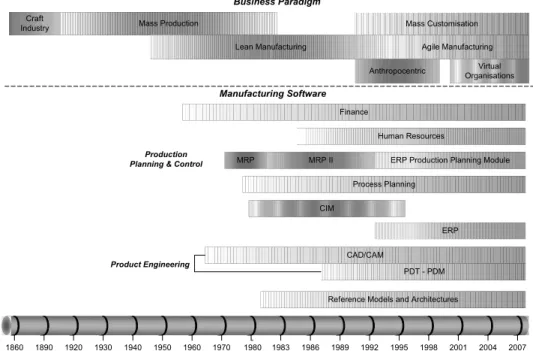
Figure 2-2 shows the manufacturing business paradigms that characterise the various periods from the nineteenth century to the twenty-first century. Only the most important ones are shown for the sake of clarity. On the other hand, this section’s goal is more about giving an historical perspective for the framework of this thesis than providing a detailed record of historical facts. The different important ages in the considered time frame as considered by several authors (Clarke & Clegg, 1998; De Masi, 2000; Negroponte, 1996; Toffler, 1981) are also indicated in the figure.
1920 1930 1940 1950 1960 1970 1980 1983 1986 1989 1992 1995 1998 2001 2004 2007 1890
1860
Business Paradigm
Craft
Industry Mass Production
Lean Manufacturing
Mass Customisation
Agile Manufacturing Virtual Organisations Antropocentric
Industrial Age Information Age Pós-Information Age
Figure 2-2 – Business paradigms
The transition from one age to another is not abrupt, in the sense that there is a clear point in time in which one age is considered terminated and the other starts. On the contrary, during the transition from one age to another the two ages might overlap for a long time. Nevertheless, this transition time is, in general, turbulent because while one age is not really superseding the other there is a lot of ambiguity. The same happens when transiting from one paradigm to another. Turbulence as a landmark for paradigm changing was pioneered by Thomas Khun (Kuhn, 1970). A key feature of his theory is the emphasis placed on the revolutionary character of scientific progress, where a revolution involves the abandonment of one theoretical structure and its replacement by another incompatible one. The disorganised and diverse activities that precedes the formation of a new age or paradigm eventually becomes structured and directed when a new age or paradigm becomes adhered to by a group of people (Chalmers, 1999).
Changing from one age to another involves many aspects: business, political, and social. While the manufacturing business paradigms are only related to business and manufacturing, ages involve other aspects.
The industrial age is considered to have started in the middle of the eighteenth century, with the
advent of the industrial revolution, up to the middle of the twentieth century (De Masi, 2000).
Nations” (Smith, 2000), which was written in 1776. The following factors contributed to the rise of this age:
Availability of massive supplies of raw materials, such as timber, iron ore, oil and other resources.
Development of new inventions and technologies.
Existence of a large labour force constantly replenished by immigration. Emergence of highly talented, but often unscrupulous business leaders.
The generic characteristics of the industrial age, according to a sociological/political view (De Masi, 2000; Toffler, 1981), are indicated in Table 2-1.
Concentration of employed workers in factories
Predominance of workers from the secondary over the primary and tertiary sectors
The gross national product (GNP) is predominantly formed by industry Application of scientific discoveries in the industry
The work is progressively organised and scientific methods are used in its organisation
Division of labour and its fragmentation Clear separation between the living place and the working place
Progressive urbanisation and increased education
Fewer social inequalities
More geographical and social mobility Increased mass produced products and increased consumption
The life of humans is now more synchronised with the pace of machines than with nature
Thinkers are separated from those that do the work (doers)
The only important criteria to optimise the production are productivity and efficiency Labour relations are characterised by conflicts between employers and employees
Nations are organised in a hierarchy based on the GNP, the ownership of raw
materials and means of production
Table 2-1 – Main characteristics of the industrial age
A management view of the important aspects of the industrial age, adapted from (Hames, 1999) are indicated in Table 2-2.
contrary, a severe crisis hit the world in 1973 due to the oil shock. Despite this, the crisis had already become visible in western countries since the sixties due to strong social movements that were the sign that a new era was coming (the hippie movement is just an example). In addition to the social revolution underway, the influence of electronics and computer technology was also starting to be perceptible. The dissemination of electronic equipment among consumers was already a reality while computers were starting to show up, not really to the normal consumer, but in business circles. Although there is no consensus about why the industrial age came to a crisis, there is some consensus that the dissemination of electronics and computers are the basis for the change from the industrial age to the information age, mainly because computers and electronic equipment became so disseminated that new forms of communication and organisation became possible. The disruptive factor that led to this age is thus the computer and electronic technology.
Focus on measurable outcomes. Physical products
Highly specialised knowledge base resulting in single-skilling
Individual accountability Life long employability
Clearly differentiated and segmented organisational positions, roles, and responsibilities
Linear input-output thinking about programmes
Reactive in solving problems
Local perspective informs programming Economies of scale
Centralised command
Hierarchical linear information flows and bureaucracy
Internal control
Attention to quantitative differences
The assets are capital, labour, and resources
Achieving effectiveness through methods Initiatives for improvement emanates from a management elite – blue collar workers Doing what is known now (present oriented)
Standardisation
Table 2-2 – Industrial age aspects according to a management view
The information age started to be felt after the dissemination of communication means (based on
The information age can also be known by other names depending on the research area. A well known name is third wave, which was coined by Alvin Tofler (Toffler, 1981), who first discussed the impact that the convergence of telecommunications and computer technology would have on the society. Names such as industrialism (Beck & Ritter, 1992; Bell, 1976; De Masi, 2000), post-modernism (Lyotard, 1984) are also used as well as second industrial divide (Piore & Sabel, 1984).
Daniel Bell states that the industrial age naturally evolves into post-industrial (service) economies, and sees the information sector as part of the infrastructure for a post-industrial society (Bell, 1981). However, Manuel Castells has a view in which communication technologies and networks have a much stronger influence on society. According to him, after the industrial age came the information age, which is based on the pervasive implementation of technological innovation since the 1970s, clustering around the convergence of computing and telecommunication (Castells, 1996). Manders and Brenner, who state that the introduction of computers in the 1970s into the realm of machine control provided greater flexibility into the organisation of the production, support the same idea (Manders & Brenner, 1999). Peter Drucker, one of the most outspoken management theorists of the twentieth century, has also examined the implications of post-industrialism for management practice (Drucker, 1969, 1992). Another well-known management theorist that has written about this turbulent time is Charles Handy, who says in (Handy, 1991, 1994), “Today the language is not that of engineering but of politics, with talk of cultures and networks, of teams and coalitions, of influence or power rather than control, of leadership not management”.
Compared to the information age the industrial age was “perfect and predictable”, with “perfect” and uniform factories and machines, and the people that worked there were also alike. In a way, dehumanisation (because human beings are far from being uniform and perfect) is the ultimate consequence of the Industrial Age thinking. This age of uniformity, standardisation, and “perfection” gave way to the age of variety and turbulence as stated in (Strackbein, 1998). Words like excellence, leading edge, high performing, or innovative are widely used, and characterise a turbulent world where innovation is mandatory. Another key characteristic is more differentiated products (customised for the customer), shorter product life cycles, and services associated with the products. Customers, on the other hand, are becoming more and more demanding. Manuel Castells considers that these characteristics have occurred in the shift from “industrialism” to “informationalism” (Castells, 1997a).
The main important aspects of the information age, adapted from (Hall, 1995; Hames, 1999; Morrison & Schmid, 1997; Naisbitt, 1982), are presented in Table 2-3.
age because there was some disruption from the previous time. The disruptive factor is computer networks. Nicholas Negroponte in his book “Being Digital” (Negroponte, 1996) refers:
“The transition from an industrial age to a post-industrial or information age has been discussed so much and for so long that we may not have noticed that we are passing into a post-information age. The industrial age, very much an age of atoms gave us the concept of mass production, with the economies that come from manufacturing with uniform and repetitious methods in any one given space and time. The information age, the age of computers, showed us the same economies of scale, but with less regard for space and time. (…) In the information age, mass media got bigger and smaller at the same time. New forms of broadcast like CNN and USA Today reached larger audiences and made broadcast broader. (…) In the post-information age, we often have an audience the size of one. Everything is made to order, and information is extremely personalized. A widely held assumption is that individualization is the extrapolation of narrowcasting--you go from a large to a small to a smaller group, ultimately to the individual.”
Concepts such as information highways (Berquist & Berquist, 1996; Chung, 1996; Lebow, 1995), electronic commerce, information society (Bell, 1981; Brown & Duguid, 2000; Castells, 1997b; Dertouzos, 1997; Minsky, 1986), knowledge management (Pfeffer & Sutton, 2000), and virtual organisations (Matos, 2002a; Matos & Afsarmanesh, 1999a; Camarinha-Matos, Afsarmanesh, & Rabelo, 2001), among others are typical from this age.
High technology Decentralisation Networking Multiple options
Assets are knowledge and people People that do the things (doers) are the same as the ones that think
Workers with interdisciplinary skills resulting in multi-skilling
Lean and Agile production
Market is focused on the consumer – customer satisfaction is first priority. Mass customisation
Electronic commerce
Organisations are made of individuals and networks. Work organised in teamwork. Team accountability
Short life employability
Integrated marketing with partnership based relationships with suppliers and customers. Integrated view of work and enterprise
Lifelong training
Holistic approach to organisations
More workers in the services than in the industrial sectors
Table 2-3 – Main aspects of the information age
2.1.1.1 Craft Production
production process, and simple but flexible tools (Piore & Sabel, 1984; Womack, Jones, & Roos, 1990).
The components were not standardised, which turned the production process into a ‘one of a kind’ process, where unique products are produced. The lack of standardisation was a drawback because, without it, it is not possible to create interchangeable parts that are the basis to build identical products. No two items were exactly identical and, in many cases, each item was intentionally made different from others. In many craft industries the workers were their own bosses, often serving as independent contractors or as independent machine-shop owners with whom major companies contracted for specific parts or components. Workers applied their own personal know-how, or “tacit knowledge”, which is knowledge stored in the minds of individual workers, to create value (Victor & Boynton, 1998).
Despite the lack of standardisation in the European craft industry, there were already in the United States some experiences in terms of standardisation that became the ground basis for mass production. The most well known examples are Colt and Springfield, which used interchangeable parts for producing their products in quantities. Please note that their techniques were closer to mass production than craft. Since it was not pure mass production this system is called the American System (Cammarano, 1997; Davidow & Malone, 1993).
Craft companies were decentralised even if concentrated in a single city. These companies, for instance, coordinated in direct contact a set of small machine shops. Suppliers and customers were in direct contact with the company. The world of craft production was a world of small producers, each specialised in one line of work and dependent on the others.
Although the products were expensive and, consequently, only a few customers could afford them, craft companies could respond appropriately and flexibly to unique, unpredictable, and changing markets by relying on workers with tacit knowledge. Although craft companies could produce a great variety of products (product flexibility), this was done at a very slow pace. Changing or adapting the shop floor to new requirements in terms of product changes or quantities produced was very difficult. Therefore, craft industries, although flexible, were not agile.
2.1.1.2 Mass Production
The following conditions, adapted from (Piore & Sabel, 1984; Womack et al., 1990), were the basis for the emergence of mass production in America:
High costs of the products from the craft industry.
The low reliability of the craft products, which were prototypes, due to a lack of standardised components.
The existence in the USA of a market of immigrants (customers) connected by an effective railroad network and willing and able to purchase crude standardised products. It must be taken into account that their movement to America had erased the diversity of tastes that characterise these immigrants in Europe.
The fact that these immigrants constituted a short skilled labour force and speaking various languages, which would make their interaction difficult.
The existence of enough raw materials to fuel inefficient machines.
The theoretical work about division of labour already developed by Adam Smith (Smith, 2000) and Karl Marx (Marx & Engels, 1990).
Its most important characteristics are: division of labour, interchangeable parts, and mechanisation. The most remarkable sign of this emergence is the construction of the Ford model T automobile plant at Highland Park in Detroit in 1913. The impact of this plant in the way manufacturing was organised is the reason why Henry Ford (Ford & Crowther, 1988; Gross, 1997) is widely recognised as the fundamental industrialist of the mass production paradigm. Ford coined the name mass production in an article for the Encyclopedia Britanica, in 1926, and is so important that industrial sociologists call this paradigm Fordism. Ford’s new recast of techniques and concepts such as the continuous-flow assembly line reduced costs while increased product quality and productivity. Before the assembly line, workers had to move from one assembly shop to another rather than the car. By improving the assembly line so that the Model T could be produced ever more inexpensively, Ford placed the car within reach of the average citizen.
Ford also adopted the techniques of Frederick Taylor (Taylor, 1998) by combining them with his own synchronized methods of mass production. Taylor developed time and motion studies, and scientific management methods, which are called Taylorism, and are an important philosophy of the mass production paradigm. Taylorism increased production without increasing the individual workload, and the work became easier to manage. By incorporating Taylorism, Fordism resulted in a greater division of labour and the de-skilling of manual labour that implied workers with no freedom to be creative in terms of how their jobs should be completed, which became a downside of mass production.
Another important character definitely associated with this paradigm is Alfred Sloan (Sloan, 1986), who was a contemporary of Henry Ford and the president of General Motors. Sloan’s unique contribution to organisational development was the decentralised divisional structure and the use of financial controls. In addition, he also introduced the concept of marketing as an important tool to create a mass market. Such management helped the spread of the mass production paradigm. These concepts, together with what Ford had pioneered (factory practices), completed what is known today as the mass production paradigm.
must adapt to the product and not vice-versa. The famous statement from Henry Ford that the customer could have a car of any colour they wanted as long as it was black is a good example of the low variety of products that characterised this paradigm. The paradigm was mastered and dominated by the USA and, later on, was spread through Europe and even to Japan. In the beginning its dissemination through Europe was not easy because the way the industry and the customers were organised were totally different from America. European customers were used to more customised products. Nevertheless, in the end, the paradigm became predominant at the cost of destructing a very important European concept: the industrial district or cluster (Bartezzaghi, 1999; Piore & Sabel, 1984).
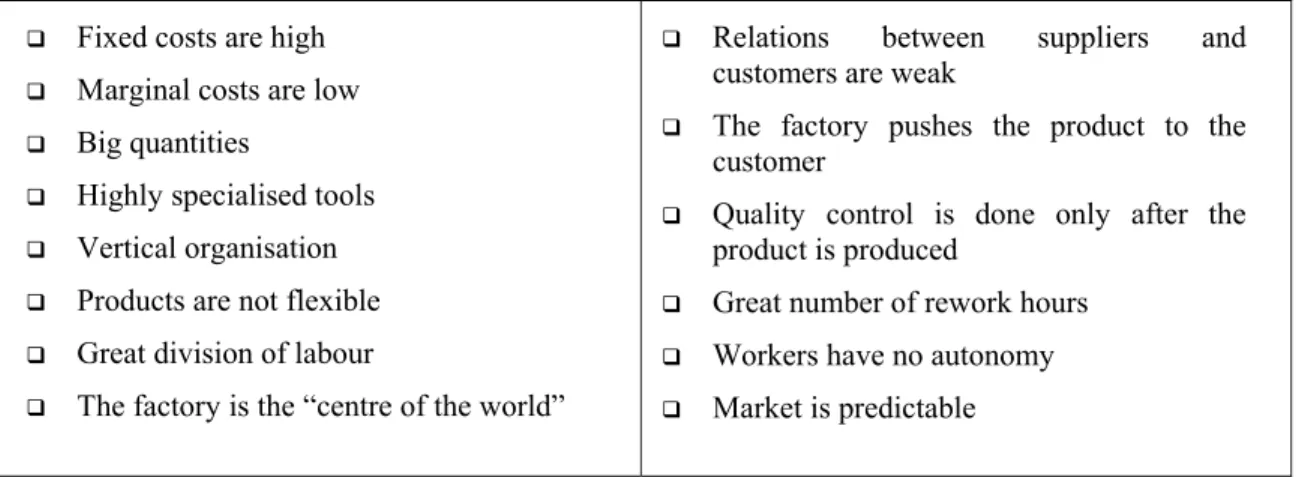
The most important aspects of the mass production paradigm are summarised in Table 2-4.
Fixed costs are high Marginal costs are low Big quantities
Highly specialised tools Vertical organisation Products are not flexible Great division of labour
The factory is the “centre of the world”
Relations between suppliers and customers are weak
The factory pushes the product to the customer
Quality control is done only after the product is produced
Great number of rework hours Workers have no autonomy Market is predictable
Table 2-4 – Mass production characteristics
Between 1965 and 1973 there was also an economic downturn, which was intensified after the oil shock (1973).
For some time, between the 1950s and the 1970s, the paradigm was able to cope with this changing world. However, the paradigm was becoming less and less able in dealing with an increasingly turbulent world that was moving from the industrial to the information age. To answer these problems, Japanese companies followed one approach while European and American companies followed a different one.
Japanese companies, in effect were already using a model that had been implemented since the early 1960s by Taiichi Ohno(Ohno, 1988). He developed a model that would later become known as Lean Manufacturing. Although less known, the words Toyotism and Toyota Production System are also used.
The main characteristic of the shop floors that exist during the mass production paradigm was rigidity. As everything was more or less predictable (no product variability) and no big changes in terms of capacity, shop floors were designed to be optimised in terms of producing as much as possible units at low cost. Therefore, flexibility and agility were not requirements, and consequently, control/supervision architectures were designed to privilege efficiency rather than functionalities to make them changeable. This was the time of specialised machines that, whenever changes were required, they were scrapped and the system was entirely designed.
2.1.1.3 CIM / Flexible Manufacturing Systems / Flexible Assembly Systems
European and American manufacturing companies, in order to find the best path to overcome the crisis, first concentrated on massive investments in technology, namely on automation and software to manage the production. The use and dissemination of heterogeneous computer hardware and software in manufacturing companies, without a global strategy, created a big problem because they could only be effective if all systems could be effectively integrated. Consequently, the integration of different computer systems became a very important research theme in the 1980s and early 1990s – systems integration (Barata & Camarinha-Matos, 1995; Barata, Vieira, & Camarinha-Matos, 1996; Bernhardt, 1992; Camarinha-Matos, Seabra Lopes, & Barata, 1996; Grady, 1994; Karagiannis, 1991; Miller & Walker, 1990; Olsson & Piani, 1992; Stark, 1989).
Companies also realised that flexibility was the key to cope with an increased tendency towards more diversified products and with varying demand. Automation, with the help of computers, could help this effort. Huge investments have, and are still being made to develop the most flexible and totally automated shop floor, often known as the “factory of the future”. Concepts like Flexible Assembly Systems (FAS) and Flexible Manufacturing Systems (FMS) (Barata & Camarinha-Matos, 1994, 1995; Cheng, Simmons, & Ritchie, 1997; Kaighobadi & Venkatesh, 1994; Maleki, 1991; Miller & Walker, 1990; Onori, 1996; Parrish, 1990; Vos, 2001) were developed in an effort to create systems able to cope with varying products and demand. FMS consist of CNC machines connected by an automated material-handling system. Its flexibility arises from the automatic tool exchanging mechanisms, the programming of the CNC, and the flexibility of the material handling system. FAS on the other hand consist of assembly stations (for instance, robot based) connected by automated material-handling system. A difference between FAS e FMS is the type of operations, machining for the latter and assembly for the former. Fully automated FAS systems later came to be termed Flexible Automatic Assembly (FAA) systems.
An example of the thought that CIM and the like could lead to a completely automated factory is expressed by the following phrase from (Teicholz & Orr, 1987):
“In CIM the need for paper is eliminated, and so also are most human jobs (…) Why is CIM desirable? Because it reduces the human component of manufacturing and thereby relieves the process of its most expensive and error-prone ingredient.”
The idea that CIM would be the right panacea to implement the automated factory is strengthened by the vision that CIM is more than an integrating technology as it is the case of Mitchell that provides a very broad definition of CIM in (Mitchell, 1991):
“CIM is not a product that can be purchased and installed. CIM is a way of thinking about and solving problems. The emphasis is on understanding how to create effective manufacturing enterprises. The determination to apply this understanding must come from personal commitment.”
Langbeck, & Grondahl, 1997). Only CNC, machining centres and surface-mounted automation became cost-effective, primarily because networks and standardisation communities were established at an early stage. In addition, the control and supervision architectures were not very reliable and became obsolete very rapidly (M.G. Mehrabi, A.G. Ulsoy, & Y. Koren, 2000). In a desperate attempt to create solutions that could perform a wide range of tasks fairly well, they never became excellent performers at any given task. Optimised for a given flexibility, they became sub-optimised at individual process level.
Eventually it was understood/realised that the solution was not only technological but also organisational.
Flexibility is the landmark of this period. At the time, agility or system reengineering was not considered so important because it was imagined that systems would be built that were so generic that changes were not necessary or at least very few would be necessary. Generic machines (programmable) turned out to answer the requirements for flexibility, however, in spite of being flexible, shop floors could not cope well with changes (system reengineering) because the concept of systems’ evolution (life cycle support) was missing.
2.1.1.4 Lean Manufacturing
The USA in its effort to solve the mentioned problems, and to understand why the Japanese industry was so successful, created the International Motor Vehicle Program (IMVP) at the Massachusetts Institute of Technology (MIT). This program studied thoroughly the automobile industry around the world and produced a report, which is known by the book name “The Machine that Changed the World” (Womack et al., 1990). This study revealed the Japanese production and organisational techniques to the western world, and coined the term Lean Manufacturing. Before this study, western companies thought the Japanese manufacturing success was mainly a cultural question even if, for instance, some academia members were already pinpointing some of the aspects later associated to lean manufacturing (Cammarano, 1997; Svensson, 2001). It was believed that the way Japanese society is organised greatly contributed to the way production and manufacturing business was organised. Although this is partially true, there are many factors associated with the Toyota Production System that can be successfully applied elsewhere, even if requiring some adaptations to cope with the cultural differences.
A lean manufacturing system is one that meets high throughput or service demands with very little inventory, and with minimal waste. “Lean thinking” has consequences for the way production is organised and managed, the way work is done, and in the relationship between manufacturing companies and their suppliers and customers.
Lean organisations claim they are more efficient because they only spend resources in activities that add value. There is, of course, the problem of identifying the value of an activity. An activity which value is not immediately recognised is at risk of being removed, even if this activity proves, later, to be important. Consider the risk of removing innovation just because its value is not immediately recognised. This is why this aspect of “lean thinking” is also one of the most controversial ones. Many authors argue that the goal of reducing waste can be dangerous because the company can become too slim and not able to react to the unexpected events of a turbulent world (Duguay, Landry, & Pasin, 1997; Katayama & Bennet, 1996). (Lewis, 2000), for instance states “the more successfully any firm applies lean production principles, the less it will engage in general innovative activity”.
Another aspect of lean manufacturing is the way the production line (shop floor) is organised. Shop floor workers are organised into teams with a team leader rather than a foreman, as it occurred in mass production. The workers are polyvalent and able to execute the various tasks assigned to the team. This permits that a worker could easily be substituted by another whenever necessary. The teams are also assigned with some minor repairs and quality control tasks. This increases the final quality of the product (less rework) because they are inspected along its production life cycle, instead of being inspected only at the end of the line.
In clear contrast to the mass production assembly line, teams have the right to stop the assembly line, whenever they think it is necessary, as when repairing it. Furthermore, workers are stimulated to participate with suggestions to improve the process. This continuous improvement (kaizen in Japanese1) (Imai, 1988) took place in collaboration with industrial engineers who are much lesser than in the mass production case. The continuous improvement strategy can be effective because workers, if properly motivated, can contribute substantially since they are the ones that truly master the processes being taken care of.
The other aspect of lean thinking is the reduction of inventory. In lean thinking buffers and warehouses are avoided because they are a kind of muda, which is costly. The idea behind this is that an item must only be produced when it is needed (there is an order). This requires a highly synchronised system involving the plant and its suppliers and customers. The philosophy used to coordinate the flow of parts within the supply chain is called Just In Time (JIT) (Chase & Aquilano, 1989; Silver, Pyke, & Peterson, 1998) or kanban in Japanese (PPDT, 2002). JIT is a method of production supply and inventory control to guarantee a synchronised flow to make only what is needed with no waste and low inventories through the whole supply chain, i.e., in the marketing channel and in the processes of manufacturers.
JIT is often confused with lean production. However, JIT is only a philosophy, with roots as far back as the 1880s, while lean production is a combination of Kanban, Kaizen and Muda. A visible effect of well-applied JIT is the elimination of warehouses inside the final producer to store product components, which only arrive at the company whenever they are required. Some critics say that JIT
1
implementations are just a clever way of transferring the inventories from the final producer into its suppliers.
At the core of the JIT procedure is Kanban control, which uses the levels of buffer inventories in the system to regulate production. When a buffer reaches its preset maximum level, the upstream machine is told to stop producing that part type. This is often implemented by circulating cards, the kanbans, between a machine and the downstream buffer. The machine must have a card before it can start an operation. It can then pick raw materials out of its upstream (or input) buffer, perform the operation, attach the card to the finished part, and put it in the downstream (or output) buffer. Kanban, therefore, operates in a pull mode and ensures that parts are not made except in response to a demand.
Lean production is a build-to-order system in which the dealer (distributor) is the first step in the JIT system. He starts the process by sending orders to the producer for presold products for delivery to specific customers. Products are pulled by customers out of the factory instead of being pushed by the factory to the customers.
The final important aspect of lean production is the establishment of a new type of relationship
between the company and its suppliers and dealers. The involvement of suppliers and dealers in the
conception of the product, for instance, leads to products better suited for customers, with improved quality, and better suited for manufacturing. Since suppliers and dealers together with the company become used to working together, they create a stronger and more effective structure, in other words a supply chain. This structure becomes more and more a horizontal organisation rather than vertical, as it was the case in mass production. The most important aspects of lean production are summarised in Table 2-5.
Team work Communication
Elimination of waste - muda Continuous improvement - kaizen
Cooperation with customers and suppliers Just in time (JIT) and kanban
Customers pull the products from the factory
Supply-chain
Customers and suppliers participate in the development of the product
Workers have no autonomy Market is predictable
Table 2-5 – Lean manufacturing characteristics
sectors, which are high volume with low variety industries. Applications of lean in sectors characterised by highly differentiated products and low volume are rare (James-Moore & Gibbons, 1997). The recent economic difficulties of Nissan and Mazda, which were forced respectively to merge with Renault and Ford is also a sign that the paradigm may not be well suited to all market situations. The main disadvantages of lean production can be found in Table 2-6.
It can be even worse for workers than mass production. Pressures on the managers to reduce waste force downsizing (fewer people, fewer resources, fewer everything) and increase the level of anxiety over the workers for better efficiency (Allen, 1997; Biazzo & Panissolo, 2000; Freyssenet, 1998; Kinnie, Hutchinson, & Purcell, 1997; Kovács & Castillo, 1998; Spithoven, 2001)
Too much slimming down can make the company vulnerable to market turbulence. Innovation can also be slowed down because of a lack of resources (Lewis, 2000)
Difficulties in finding where and when “value” is realised in the manufacturing chain
The efficiency of lean is based on the assumption that Japanese forms of long-term contracting will become an industry practice, which in effect cannot be assumed
The influence of social and political institutions is largely ignored by lean supporters (Lewis, 2000)
Lean production deals badly with variations or reductions in the demand for finished products (Katayama & Bennet, 1996)
Table 2-6 – Lean disadvantages
Since the capacity to produce different products at different production rates is also a landmark of the lean manufacturing paradigm, the control and supervision architecture designed for these shop floors needed to be flexible. In addition, there were also requirements for changes and adaptations because of the continuous improvement philosophy. In spite of the requirements for easy adaptation/changes of the shop floor (reengineering) the control/supervision architecture was designed mainly to be flexible rather than agile. Shop floor reengineering was slow and difficult to perform.
2.1.1.5 Anthropocentric and sociotechnical production
The anthropocentric approach can be considered the European answer to the troubles European companies were facing in the 1970s, and eventually an answer to the spread of lean manufacturing (Berggren, 1992; Higgins, 1995; Kovács & Castillo, 1998; Wobbe & Communities, 1992). This concept was developed in the framework of the FAST – Forecasting and Assessment in Science and Technology, European Union research project in the early 1990s.
from this area often state that Computer Integrated Manufacturing (CIM) concepts, CNC machines and robots, and FMS/FAS systems were introduced using the old tayloristic methods of organisation, which contributed to its failure. However, these researchers did not consider other reasons such as market pressures for fast solutions as well as that the promises of high-tech were not realised because basic technologies were not mature, the requirements were not well detailed, and the customer-producer relationship was changing. The reason for missing non-human related reasons is likely due to their sociology-based background that tends to emphasise human related aspects. It can be noticed here the old European tradition of craft industry, which concedes the human as being of great importance in the productive process. This is why some researchers call this approach neocraftism (Womack et al., 1990).
Since its basic principles arebased in the Sociotechnical approach that started to be developed in the 1950s2 (Trist, 1963), it can be considered an evolution of that approach. However, the sociotechnical approach was only incremented after 1962 due to the Industrial Democracy project in Norway (Teixeira, 1996). Even though the dissemination of these ideas was not very important among Norwegian or worldwide industries, the same did not happen in Sweden where they had much more acceptance, especially at Volvo, the biggest Swedish car producer, which, in 1974, installed a plant in Kalmar following this approach. Volvo followed this approach because at that time it was difficult to get people to work in the assembly line (Karlsson, 1996).
However, the most remarkable and studied case is the Volvo Uddevalla plant. The basic concept behind this plant was to let the workers build complete cars. This was completely against the tayloristic/fordistic approach of making the job as easy as possible. Volvo, to attract workers, announced they wanted car builders instead of assembly workers. Work was organised into result-oriented teams, which implied that the workers that were actually producing the car were in contact with the customer. This had a psychological effect on the customer and the worker. The customer thought his car was being carefully assembled while the worker felt he was making something useful for some identified entity3. The industrial culture of Volvo was thus very much oriented towards the humanization of work posts4 (Muffatto, 1999).
This Swedish model is better known as Volvoism or Reflective Production and has been deeply studied by (Berggren, 1993; Ellegard et al., 1992; Engstrom, 1994, 1998; Engstrom, Jonsson, & Medbo, 1996; Niepce & Molleman, 1996).
Despite the apparent success of Volvoism in Sweden it has not spread over to other countries. To make things even worse, the Kalmar and Uddevalla plants were closed in 1994 and 1993 respectively. However, Uddevalla was reopened in 1999 as a joint venture between Volvo and TRW. According to its supporters, Volvoism was just stopped when the evolutionary process would have taken it to a new peak of development (Muffatto, 1999), while for the critics it was just that the model could not
2
The sociotechnical first ideas were developed in the Tavistock Institute of human relations in England.
3
The influence of craft is also evident here
4
produce cars effectively and economically. The picture, however, is not so simple. If big and complex products are being produced in small volumes, it can be a great concept. If, on the other hand, big and complex products are being produced in big volumes, it can be very poor.
The diffusion of Volvoism and the Anthropocentric approaches in Europe were restrained by the importance of lean manufacturing or, in other words, by the strong case which had been made by lean supporters. “Lean thinking” was quite popular among managers and entrepreneurs, which avoided the emergence of the more human oriented approaches.
Table 2-7 indicates the most important aspects of the anthropocentric approach, adapted from (Kovács & Castillo, 1998).
The concept of Balanced Automation Systems (BAS) (Camarinha-Matos & Afsarmanesh, 1996; Camarinha-Matos, Afsarmanesh, & Erbe, 2000; Camarinha-Matos, 1995; Camarinha-Matos, Afsarmanesh, & Marik, 1998) was introduced in the mid 1990s by researchers from the technology domain as a direct result of the CIMIS.net and FlexSys collaborative projects between the European Union and Latin America, launched by an exploratory ESPRIT basic research activity in 1993. BAS addresses an industrial environment with appropriate level of automation. In contradiction to both pure human based and the total automation environments, its emphasis is on the combination of Anthropocentric, Technocentric, and Economic approaches (Camarinha-Matos & Afsarmanesh, 1996). The goal is the achievement of a right balance between automated and manual components and the hybrid solutions. It was already considered that BAS should cover the reengineering aspects of shop floors as well as life cycle support.
Increase the quality of products by continuous improvement and flexibility of the production system
Increase the working conditions of workers using new organisational forms and technologies
Human resources are valorised by qualifications, training, and involvement with the production
Technology is specifically adapted to human needs and not vice versa
Workers are organised in teams using the sociotechnical principles
Decentralisation and fewer hierarchies. Responsibilities are spread through the teams
Polivalence of competencies
Table 2-7 – Characteristics of the anthropocentric approach