1 Çankırı Karatekin University, Faculty of Health Sciences, Department of Public Health Nursing, Çankırı, Turkey.
2 Ege University, Faculty of Nursing, Department of Public Health Nursing, İzmir, Turkey.
Knowledge and practices of primary care providers
on skin cancer and skin self-examination
Conhecimento e práticas dos provedores de cuidados primários sobre o câncer de pele e o autoexame da pele
Conocimiento y prácticas de los proveedores de cuidados primarios acerca del cáncer de piel y el autoexamen de la piel
İlknur Göl1, Özüm Erkin2
How to cite this article:
Göl İ, Erkin Ö. Knowledge and practices of primary care providers on skin cancer and skin self-examination. Rev Esc Enferm USP. 2018;52:e03359. DOI: http://dx.doi.org/10.1590/S1980-220X2017039703359
Received: 10/18/2017 Approved: 02/27/2018 Corresponding author:
Özüm Erkin
Ege University, Faculty of Nursing, Department of Public Health Nursing Bornova-Izmir, Turkey
ORIGINAL ARTICLE DOI: http://dx.doi.org/10.1590/S1980-220X2017039703359
ABSTRACT
Objective: To determine the knowledge and practices related to skin cancer and skin self-examination of primary care providers. Method: This cross-sectional descriptive study was conducted in Turkey. The study was carried out in primary health centers such as family health centers, community health centers, early cancer detection centers and family planning centers in 2016-2017. Participants’ socio-demographic characteristics, their knowledge and practices related to skin cancer, skin cancer risk factors and skin self-examination were determined. Results: The study population included 94 primary care providers. The symptoms of which the participants were most aware were changes in the color of moles or skin spots (95.71%), and of which participants were the least aware was the itching of a mole (71.43%). Among participants, the most recognized risk factor was having fair skin (97.14%), whereas the least known was the presence of birthmarks (24.29%). The mean scores the participants obtained from the questionnaire were as follows: 5.39±1.61 for skin cancer risk factors and 10.47±2.73 for skin cancer symptoms. Of the participants, 14.29% received training on skin self-examination, 38.57% knew how to perform skin self-examination, and 67.14% did not perform skin self-examination. Of the participants, 61.7% did not perform skin self-examination because they did not know what to look for. Of the participants, 85.71% did not have continuing education/workshop about skin self-examination after graduation.
Conclusion: Although the primary care providers’ knowledge of skin cancer symptoms was adequate, their knowledge of skin cancer risk factors was not sufficient. Primary care providers’ knowledge of skin self-examination was good, but they did not perform skin self-examination adequately.
DESCRIPTORS
INTRODUCTION
Skin cancer is the most common form of cancer worl-dwide, and thus it is a global public health issue(1).Changes in the ozone layer have increased the harmful effects of ultraviolet (UV) A and UVB rays, and exposed the skin, the largest organ of our body, to these harmful effects(2). The Disability-Adjusted Life Year lost due to UV is calculated as 1.5 million days per year worldwide(3). This is mainly caused by the increased incidences of skin cancer globally(2).The World Health Organization has reported that one in three people diagnosed with cancer has skin cancer(4).In Australia, skin cancer is the most commonly diagnosed form of cancer among people aged 15 to 44 years. It also has the highest mortality rate. In the United States (USA), melanoma ranks the fifth most common form of cancer in males and ranks seventh in females(3).The incidence of melanoma in the UK is estimated to increase by 88% in men and 66% in women by 2020(5).The incidence of melanoma in Turkey is 1.6 per 100,000 people, and the mortality rate is 1.0 per 100,000 people(6). It was also reported that the incidence of mela-noma in Turkey is 1.8 per 100,000 people in males and 1.2 per 100,000 people in females(7). The incidence rates of malignant melanoma across the southeastern region of Europe are increasing. Significant increases in mortality rates were observed in older men in the Czech Republic, Serbia and Turkey(8). In one Turkish study that took place in two different centers over a twenty-year and ten-year study period(9), 239 and 183 cases of primary cutaneous melanoma were diagnosed after screening and the mean melanoma diagnosis per year was 11.9 and 18.3, respectively. It was reported that the number of melanoma diagnosis markedly increased over time in both centers(9).
Factors leading to skin cancer include overexposure to sunlight, gender, phenotypic traits, family history, Fitzpatrick I-II skin type, childhood sunburn, immunosuppression, ioni-zing radiation, Psoralen-UVA (PUVA) treatments, environ-mental carcinogens, HPV infection, artificial light sources, nevi and genetic syndromes. Even though everyone is at risk of developing skin cancer, fair-skinned individuals, and individuals having: a large number of moles and spots, exten-ded sun exposure, and/or childhood history of sunburn are at a greater risk of developing skin cancer(10-13). According to the list released by the National Comprehensive Cancer Network (NCCN), wearing sunscreen products with at least sun protection factor (SPF) 30, wearing sun protective clothing, wearing sunglasses with UV protection, avoiding sun exposure between 10 a.m. and 4 p.m. unless necessary, refraining from solariums, regular self-examining skin spots, moles and freckles seasonally are skin cancer prevention methods(14). The most important known fact about skin cancer is that it is a preventable disease with early diagno-sis. When diagnosed early, the survival rate in melanoma patients is more than 98%(15). Therefore, skin self-exami-nation is of great importance in the early diagnosis and treatment of skin cancers(15).Skin self-examination (SSE) is an early diagnostic method recommended by organizations such as the American Cancer Society, The Cancer Council
Australia, and The Skin Cancer Foundation(15-17). It is recom-mended that SSE be performed every month. An exami-nation takes about 10 minutes. In SSE, any mole, freckle or spot on the skin, whether congenital or acquired should be evaluated according to the ABCDE rule. ABCDE rule involves the following criteria: A-Asymmetry, B-Border, C-Color, D-Diameter, and E-Evolving(16-17).
Raising public awareness plays an important role in the prevention and early diagnosis of skin cancer. In this context, health personnel should play a fundamental role, and if they are to be role models and enlighten the public, they should first protect their own health(18).It is especially important for primary care providers to have accurate and adequate knowledge of the issue based on their roles as educators and counselors in cancer preventive health services. The purpose of this study is to determine primary care providers’ know-ledge of skin cancer, and their SSE practices.
METHOD
The study is a cross-sectional descriptive study. The study was carried out in several primary health centers (7 Family Health Centers, 1 Community Health Center, 1 Early Cancer Detection Center and 1 Family Planning Center) affiliated with the Provincial Directorate of Public Health in a province located in the Central Anatolian Region of Turkey between November 2016 and February 2017.
The study population included 94 physicians, nurses and midwives working in primary health services. No sampling method was implemented in the present study. All the study population was intended to be included in the study. Of the study population, 70 health workers volunteered to partici-pate in the research. The participation rate was 75%.
Göl İ, Erkin Ö emergence of new spots after the age of 21”, “itching, crusting,
disintegration and/or bleeding of a mole or wound”. For each correct answer, 1 point was given, and for each wrong answer 0 points were given. The minimum and maximum possible scores obtainable from the responses regarding the symptoms of skin cancer were 0 and 12, respectively. High scores indicate that the level of knowledge is sufficient. The questionnaire was evaluated for validity and reliability(21). In the original study(21), content validity and Kuder-Richardson value of the questionnaire were found to be 0.81 and 0.83, respectively. In this study content validity and Kuder-Richardson value of the questionnaire were found to be 0.85 and 0.88, respectively. To determine the participants’ knowledge levels regarding their risks for skin cancer, they were asked 8 questions(20). The participants obtained 1 point for each correct response and 0 points for each incorrect response on the following items: “having fair skin”, “having light-colored eyes”, “having a family history of skin cancer”, “the presence of brown/large moles on the skin”, “the presence of a birthmark on the skin”, “having ever had sunburn blisters”, “tanning in a solarium”, “lifetime, long-term exposure to sun”. The minimum and maximum possible scores to be obtained from the responses regarding the risks for skin cancer were 0 and 8, respectively. High scores
indicate that the participant has adequate knowledge about factors that increase the risk of skin cancer. The questionnaire was found valid and reliable(20). In this study, content validity (0.84) and Kuder-Richardson (0.86) value of the question-naire were calculated. “The participants’ knowledge and practices related to skin self-examination (SSE)”; this section contains 8 items. The items question whether the participants were knowledgeable of SSE practices and the ABCDE rule. The participants were expected to choose the correct answer “once a month” in response to the question “How often should self--skin examination be performed”, the correct answer; “Yes, always” in response to the questions “a full-length mirror is used during SSE” and “a hand-held mirror is used during SSE” and the correct answer “all parts of the body” in response to the question “which areas should be examined when self--skin examination is performed”. The participants were asked whether they performed self-skin examination. Those who did not were also asked “why not?” The responses to these questions were not rated. In October 2016, a pilot application was conducted with 30 primary health care workers working in another city who were not participating in the study. The study design is presented in Figure 1.
Pilot application in 30 Primary Care Providers
October 2016
Data collection
November 2016 and February 2017
Universe
Questionnaire
94 physicians, nurses and midwives working in the primary health services
Sample
Willingness of Primary Care Providers – Attainability to Primary Care Providers
(Socio-demographic characteristics, knowledge and practices, skin cancer risk factors and SSE Questions) Physician 37.14% Nurse 31.43% Midwife 31.43%
Figure 1 – Design of study by authors, Çankırı, Turkey, 2016-2017.
The data were analyzed using the SPSS 16.0 program. Descriptive statistics such as number and percentage distri-butions were calculated.
To carry out the research, written permissions were obtained from the ethics committee of the university (13 Oct 2016; number 2016/03) where the study was to be
RESULTS
The participants’ socio-demographic characteristics and risks of skin cancer; of the participants, 70% were female, 30% were in the 33-38 age group. 37.14% were physicians, 31.43% were nurses, 31.43% were midwives, 15.7% had sandy red/
blonde hair, 20% had blue-gray-light color eyes, 12.86% had fair skin, 40% had more than 10 moles, 7.4% had blood relatives diagnosed with skin cancer, 55.71% considered the-mselves at risk for skin cancer, and 97.14% did not have any skin cancer screening previously (Table 1).
Table 1 – Descriptive variables and skin cancer risk status of primary care providers – Çankırı, Turkey, 2016-2017.
Variables n* %
Age 21-26 7 10.0
27-32 18 25.71
33-38 21 30.0
39-44 19 27.14
≥45 5 7.14
Gender Female 49 70.0
Male 21 30.0
Position Physician 26 37.14
Nurse 22 31.43
Midwife 22 31.43
Workplace Family health center 42 60.0
Public health center 20 28.57
Cancer screening center 5 7.14
Family planning center 3 4.29
Natural Hair Color Sandy red, blonde 9 12.86
Chestnut or dark blond 11 15.72
Brown 36 51.43
Black 14 20.0
Eye color Light colors (Blue, gray or green) 14 20.0
Dark 25 35.71
Brown 23 32.86
Black 8 11.43
Natural skin color Fair 9 12.86
Pale 28 40.0
Beige or olive 16 22.86
Brown 11 15.71
Dark brown 6 8.57
Freckles, moles ≥ 31 3 4.29
11-30 37 52.86
1-10 23 32.86
None 7 10.0
Skin sensitive Very sensitive, easily reacts 14 20.0
Sensitive 15 21.43
Reacts normal 39 55.71
Very resistive, hardly reacts 2 2.86
Skin turns brown Never/always burns 6 8.57
Rarely 21 30.0
Sometimes 25 35.71
Frequently 12 17.14
Always 6 8.57
A blood relative diagnosed with skin cancer Yes 5 7.14
No 65 92.86
Perception of skin cancer risk Yes 39 55.71
No 31 44.29
Skin cancer screening seeing a dermatologist Yes 2 2.86
No 68 97.14
Total 70 100.00
Göl İ, Erkin Ö
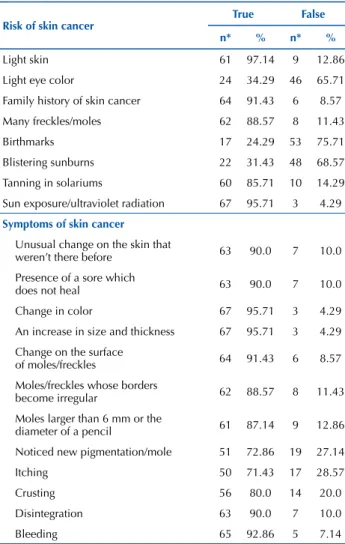
The participants’ knowledge and practices regarding skin cancer and skin self-examination(SSE);the mean score that the participating primary care providers obtained for the knowledge of skin cancer risk factors was 5.39 ± 1.61 (min: 0, max: 8). Of the risk factors, the ones that the participants were aware of most were having a fair skin (97.14%), life--time long-term exposure to sun rays (95.71%), and having a family history of skin cancer (91.43%). The risk factors of which the participants were least aware were the presence of birthmarks (24.29%), having had sunburn blisters (31.43%) and light eye color (34.29%).
The mean score the participants obtained for the kno-wledge of skin cancer symptoms was 10.47±2.73 (min: 0, max: 12). The symptoms of which the participants were most aware were changes in the color of congenital or acquired moles or skin spots (95.71%), increases in the size and thickness of congenital or acquired moles or skin spots (95.1%), and the bleeding of a mole or wound (90%). The symptom of which the participants were least aware was the itching of a mole (71.43%). The participants’ know-ledge regarding skin cancer risks and symptoms are given in Table 2.
In Table 3, the participants’ knowledge and practices of skin self-examination are given. Of the participants, 14.29% had continuing education/workshop about SSE after gradua-tion. Of the participants, 67.14% did not perform SSE. Of the participants who did not perform SSE, 61.7% did not perform SSE because they did not know what to look for. Of the partici-pants, 41.3% were aware that SSE should be performed once a month, 87.14% and 60% knew that when performing SSE they should always use a full-length mirror or a hand-held mirror, respectively; and 97.14% pointed out that all parts of the body should be examined during SSE (Table 3).
Table 2 – Knowledge of primary care providers about risks and symptoms of skin cancer –Çankırı, Turkey, 2016-2017.
Risk of skin cancer True False
n* % n* %
Light skin 61 97.14 9 12.86
Light eye color 24 34.29 46 65.71
Family history of skin cancer 64 91.43 6 8.57
Many freckles/moles 62 88.57 8 11.43
Birthmarks 17 24.29 53 75.71
Blistering sunburns 22 31.43 48 68.57
Tanning in solariums 60 85.71 10 14.29
Sun exposure/ultraviolet radiation 67 95.71 3 4.29
Symptoms of skin cancer
Unusual change on the skin that
weren’t there before 63 90.0 7 10.0
Presence of a sore which
does not heal 63 90.0 7 10.0
Change in color 67 95.71 3 4.29
An increase in size and thickness 67 95.71 3 4.29
Change on the surface
of moles/freckles 64 91.43 6 8.57
Moles/freckles whose borders
become irregular 62 88.57 8 11.43
Moles larger than 6 mm or the
diameter of a pencil 61 87.14 9 12.86
Noticed new pigmentation/mole 51 72.86 19 27.14
Itching 50 71.43 17 28.57
Crusting 56 80.0 14 20.0
Disintegration 63 90.0 7 10.0
Bleeding 65 92.86 5 7.14
* The total was not expressed since one participant selected more than one state-ment. Note: (n=70).
Table 3 – Knowledge and practices of primary care providers about SSE – Çankırı, Turkey, 2016-2017.
Variables n* %
Knowledge of SSE Yes 27 38.57
No 43 61.43
Continuing education/ workshop about SSE
Yes 10 14.29
No 60 85.71
How often should SSE be performed?
Once a week 6 8.57
Once a month 29 41.43
Once every six months 28 40.0
Once a year 7 10.0
ABCDE rule Yes 14 20.0
No 56 80.0
Using a wall mirror No 1 1.43
Sometimes 8 11.43
Yes, always 61 87.14
Using a hand mirror No 4 5.71
Sometimes 24 34.29
Yes, always 42 60.0
Body parts in SSE Only the body parts where there
are moles 2 2.86
All body parts 68 97.14
Performing SSE Yes 23 32.86
No 47 67.14
Reasons for not performing SSE
Don’t know what to look for 29 61.7
Don’t have time 13 27.66
I’m worried I will find something bad 5 10.64
*The total was not expressed since one participant selected more than one statement. Note: (n=70).
DISCUSSION
Skin cancers which constitute nearly half of all cancer cases are the most common type of cancer. By raising socie-tal awareness of skin cancer, morbidity and morsocie-tality due to skin cancer, which is common, can be reduced. Education is of great importance in raising awareness of the risks and symptoms of skin cancers and in their diagnosis and treat-ment. In this respect, health workers, in particular primary care providers, assume great tasks and responsibilities. This study was conducted to determine primary care providers’ knowledge and practices regarding the issue.
four in ten participants had more than 10 moles. In the literature, it is indicated that light hair color, light eyes and the presence of more than one mole/freckle increase the risk of skin cancer(10-11,22). In light of this literature data, a significant part of the participants were at risk of develo-ping skin cancer because they had light skin and color eyes. More than half of the participants in the present study stated that they considered themselves at risk for skin cancer. In several studies conducted on the issue, it has been reported that an individual’s perception of risk affects his/her health behavior, medical decision-making and acquisition of health information(23-26). In the current study, although more than half of the participants considered themselves at risk of skin cancer, the rate of those who visited a dermatologist was low. In a study conducted in Turkey, 67.3% of the physicians did not visit a dermatologist for skin cancer screening(19). These results suggest that health workers who do not adopt disease prevention methods do not recommend these methods to their patients or do not refer them to a dermatologist.It is clear that not only should healthcare professionals encourage their patients to pay regular visits to a dermatologist but they also should pay more attention to their own skin health.
In the present study, although the participants’ scores for their knowledge about the skin cancer symptoms were high, their scores for knowledge about skin cancer risks were lower than expected. It is noteworthy that more than half of the participants did not know the relationship between skin cancer and risk factors such as birthmarks, sunburn blisters and light eye color. In a study conducted in North Carolina, 23% of the participants reported that they were aware of skin cancer risks(27).In a study conducted in Morocco, 66.7% of the participants had never heard of skin cancer before, and 18% of them had moderate levels of knowledge about skin cancer(28).
In three similar studies(29-31) it was reported that the participants’ knowledge levels about skin cancer were low. However, given the fact that the aforementioned studies were conducted with patients rather than healthcare workers, the importance of the results of the present study becomes even more obvious.
Primary care providers should appreciate the importance of gathering a detailed patient history to identify patients with the highest risk of developing skin cancer(23-24). Awareness of the risks and symptoms of skin cancers and of the ways to prevent skin cancer play an important role in avoiding beha-viors posing risks in the development of cancer and in taking the necessary precautions(23). Accordingly, the importance of providing information and raising awareness about skin can-cer whose incidence is on the rise becomes more evident. In the literature, it is reported that if health workers are aware of skin cancer risk factors and adopt SSE practices, they would have an advantage in accessing a large population in terms of taking precautions to prevent skin cancer(32).
In the present study, although a significant number of the primary care providers knew when and how often SSE should be performed and which parts of the body should be examined, they did not perform SSE because they did not know how to do it. A study(33) reported that health care
workers’ skin cancer and sun protection behaviors were not different from those of patients, although they knew the importance of the improvement of health and primary pre-vention. In studies conducted in Mediterranean countries, it has been determined that although primary care physicians are well aware of recommendations on sun protection, their skin cancer and sun protection practices are inadequate(32,34). That the rate of the participants who performed SSE was lower than expected in the current study supports the findings in the relevant literature, which suggests that the health workers who participated in the present research were inadequate about SSE in general and they needed training on the issue. Only a small proportion of the participants (14%) participated in post-graduate training on skin cancer and SSE. The participants’ inadequate participation rate in post-graduate continuing education and workshops regar-ding SSE might be associated with the fact that they did not know what to look for in SSE. If health workers are to teach primary and secondary skin cancer prevention tips to the public, first of all, they should know and implement them. Inadequate precautionary behaviors of health workers to protect themselves from skin cancer may lead to failures in role modeling, and provision of information and coun-seling to people.
The limitations of this study are that it was carried out with only those working in primary healthcare centers in one city. The results cannot be generalized to all health pro-fessionals in the country. The results of the study were based on self-reported data. On the other hand, the questionnaire was considered a valid and reliable tool to measure health professionals’ knowledge and practices regarding skin cancer and SSE.
CONCLUSION
The present study aimed at determining whether the knowledge and practices of primary care providers about skin cancer and SSE contributed to the determination of their health behaviors towards skin cancer.
Göl İ, Erkin Ö care workers in Turkey. Within this context, health workers
should teach people how to perform SSE in order to detect skin cancer and what to observe in this examination and should enhance their knowledge of SSE and raise awareness of SSE. Therefore, it is important for health workers, who are role models in society, to have adequate knowledge and practice about skin cancer, and to be aware of the risks and symptoms of skin cancers and of the ways to prevent them. Patient assessment is important for the detection of skin cancer in primary care. Continuing education is the way in which healthcare workers gather new knowledge and practices. Therefore, organizing post-graduation training
and certification programs for health workers will positively contribute to the community’s health. After which, if they have knowledge and skills they can become public counselors and educators. It may be recommended to perform further studies with a larger sample to determine health workers’ levels of knowledge and prevention practices related to skin cancers in Turkey. Because the determination of knowledge and practices of primary care providers who are to encourage people to participate in campaigns on skin cancer prevention will be effective in planning interventions, the results of this study are expected to shed light on attempts to be planned to prevent skin cancer in the future.
RESUMO
Objetivo: Determinar o conhecimento dos provedores de cuidados primários e suas práticas relacionadas com o câncer de pele e o autoexame da pele. Método: Este estudo descritivo transversal foi conduzido na Turquia. O estudo foi realizado em centros de saúde primários, tais como centros de saúde da família, centros de saúde comunitários, centros de detecção precoce do câncer e centros de planejamento familiar em 2016-2017. As características sociodemográficas dos participantes, seu conhecimento e práticas relacionados com o câncer de pele, fatores de risco para o câncer de pele e o autoexame da pele foram determinados. Resultados: A população do estudo incluiu 94 provedores de cuidados primários. Os sintomas dos quais os participantes estiveram mais conscientes foram mudanças na cor das pintas ou manchas na pele (95,71%) e dos quais os participantes estiveram menos conscientes foi a coceira em uma pinta (71,43%). Entre os participantes, o fator de risco mais reconhecido foi ter pele clara (97,14%), ao passo que o menos conhecido foi a presença de marcas de nascença (24,29%). Os principais scores que os participantes obtiveram do questionário foram os seguintes: 5,39±1,61 para fatores de risco para câncer de pele e 10,47±2,73 para sintomas de câncer de pele. Dos participantes, 14,29% receberam treinamento sobre autoexame, 38,57% sabiam como realizar o autoexame e 67,14% não realizavam autoexame de pele. Dos participantes, 61,7% não realizavam autoexame porque não sabiam o que procurar. Dos participantes, 85,71% não tiveram educação continuada/workshop sobre autoexame de pele após a graduação. Conclusão: Embora o conhecimento dos provedores de cuidados primários sobre os sintomas do câncer de pele foi adequado, seu conhecimento dos fatores de risco para o câncer de pele não foi suficiente. O conhecimento dos provedores de cuidados primários sobre o autoexame da pele foi bom, mas eles não realizaram o autoexame da pele adequadamente.
DESCRITORES
Neoplasias Cutâneas; Autoexame; Atenção Primária à Saúde; Enfermagem de Atenção Primária; Prática Profissional.
RESUMEN
Objetivo: Conocimiento y prácticas de los proveedores de cuidados primarios y sus prácticas relacionadas con el cáncer de piel y el autoexamen de la piel. Método: Este estudio descriptivo transversal fue conducido en Turquía. El estudio fue llevado a cabo en centros de salud primaria, tales como centros de salud de la familia, centros de salud comunitarios, centros de detección precoz del cáncer y centros de planificación familiar en 2016-2017. Las características sociodemográficas de los participantes, su conocimiento y prácticas relacionadas con el cáncer de piel, factores de riesgo para el cáncer de piel y el autoexamen de la piel fueron determinados. Resultados:
La población del estudio incluyó a 94 proveedores de cuidados primarios. Los síntomas de los que los participantes estuvieron más enterados fueron los cambios en el color de los lunares o manchas en la piel (95,71%) y de los que los participantes estuvieron menos enterados fue la picazón en un lunar (71,43%). Entre los participantes, el factor de riesgo más reconocido fue tener piel clara (97,14%), mientras que el menos conocido fue la presencia de marcas de nacimiento (24,29%). Los principales scores que los participantes obtuvieron del cuestionario fueron los siguientes: 5,39±1,61 para factores de riesgo para cáncer de piel y 10,47±2,73 para síntomas de cáncer de piel. De los participantes, el 14,29% recibieron entrenamiento acerca del autoexamen, el 38,57% sabían cómo realizar el autoexamen y el 67,14% no realizaban el autoexamen de la piel. De los participantes, el 61,7% no realizaban el autoexamen porque no sabían qué buscar. De los participantes, el 85,71% no tuvieron educación continuada/taller sobre autoexamen de la piel después del grado académico. Conclusión: Aunque el conocimiento de los proveedores de cuidados primarios acerca de los síntomas del cáncer de piel fue adecuado, su conocimiento de los factores de riesgo para el cáncer de piel no fue suficiente. El conocimiento de los proveedores de cuidados primarios acerca del autoexamen de la piel fue bueno, pero ellos no llevaron a cabo el autoexamen de la piel adecuadamente.
DESCRIPTORES
Neoplasias Cutáneas; Autoexamen; Atención Primaria de Salud; Enfermería de Atención Primaria; Práctica Profesional.
REFERENCES
1. Kyle JW, Hammitt JK, Lim HW, Geller AC, Hall-Jordan LH, Maibach EW, et al. Economic evaluation of the US Environmental Protection Agency’s SunWise program: sun protection education for young children. Pediatrics. 2008;121(5):e1074-84.
2. De Gruijl FR. Skin cancer and solar UV radiation. Eur J Cancer. 1999;35(14):2003-9.
3. Tuong W, Cheng LS, Armstrong AW. Melanoma: epidemiology, diagnosis, treatment, and outcomes. Dermatol Clin. 2012;30(1):113-24. 4. World Health Organization. Skin cancers. How common is skin cancer? [Internet]. Geneva: WHO; 2017 [cited 2017 Apr 11]. Available
from: http://www.who.int/uv/faq/skincancer/en/index1.html
6. World Health Organization; International Agency for Research on Cancer. GLOBOCAN 2008: cancer incidence, mortality and prevalence worldwide [Internet]. Geneva: WHO; 2010.
7. Turkey. Ministry of Health of Turkey. Turkey Cancer Statistics. Turkey: Ankara; 2017.
8. Barbaric J, Sekerija M, Agius D, Coza D, Dimitrova N, Demetriou A, et al. Disparities in melanoma incidence and mortality in South-Eastern Europe: increasing incidence and divergent mortality patterns. Is progress around the corner? Eur J Cancer. 2016;55:47-55.
9. Baykal C, Atci T, Akay BN. Is the frequency of primary cutaneous melanoma increasing in Turkey? An evaluation of the experiences of two dermatology centers. J Oncol Sci. 2017:1-5. DOI: https://doi.org/10.1016/j.jons.2017.11.002
10. Baum A, Cohen L. Successful behavioral interventions to prevent cancer: the example of skin cancer. Annu Rev of Public Health. 1998;19:319-33. 11. Emmons KM, Geller AC, Viswanath V, Rutsch L, Zwirn J, Gorham S, et al. The SunWise Policy intervention for school-based sun protection:
a pilot study. J Sch Nurs. 2008;24(4): 215-21.
12. Fehér K, Cercato MC, Prantner I, Dombi Z, Burkali B, Paller J, et al. Skin cancer risk factors among primary school children: investigations in Western Hungary. Prev Med. 2010;51(3-4):320-4.
13. Heckman CJ, Coups EJ. Correlates of sunscreen use among high school students: a cross-sectional survey. BMC Public Health [Internet]. 2011 [cited 2017 Oct 13];11:679. Available from: https://www.ncbi.nlm.nih.gov/pmc/articles/PMC3179453/
14. National Comprehensive Cancer Network. NCCN Clinical Practice Guidelines in Oncology. Basal cell and squamous cell skin cancers [Internet]. Washington: NCCN; 2012 [cited 2017 Apr 13]. Available from: http://pic2.cmt.com.cn/WebImages/ Res/20130528/20130528_44232c3f-7105-48a1-8e30-b49a4cdca3e6.pdf
15. American Cancer Society. Cancer Facts and Figures 2017 [Internet]. Atlanta; 2017 [cited 2017 Oct 17]. Available from: https://www.cancer. org/content/dam/cancer-org/research/cancer-facts-and-statistics/annual-cancer-facts-and-figures/2017/cancer-facts-and-figures-2017.pdf 16. Australia. The Cancer Council. National cancer prevention policy 2007-2009 [Internet]. Sydney; 2010 [cited 2017 Oct 17]. Available
from: http://www.cancer.org.au/content/pdf/CancerControlPolicy/NationalCancerPreventionPolicy/NCPP07-09-FULL.pdf
17. Koştu N, Erkin Ö, Bayık Temel A. Turkish version of skin self examination form: validity study [Internet]. Dokuz Eylül University; 2014 [cited 2017 Oct 17]. Available from: http://acikerisim.deu.edu.tr/xmlui/handle/12345/4524
18. Özçam H, Çimen G, Uzunçakmak C, Aydın S, Özcan T, Boran B. Evaluation of the knowledge, attitude, and behavior of female health workers about breast cancer, cervical cancer, and routine screening tests. Istanbul Med J. 2014;15(3):154-60.
19. Uslu M, Karaman G, Şavk E, Şendur N. Investigation of knowledge about sun effects, skin cancer and sun protection behaviour among doctors in Adnan Menderes Hospital. Meandros Med Dent J. 2006;7(1):5-10.
20. Balyacı OE, Koştu N, Temel AB. Training program to raise consciousness among adolescents for protection against skin cancer through performance of skin self examination. Asian Pac J Cancer Prev. 2012;13(10):5011-7.
21. Erkin Ö, Ardahan M, Temel AB. Effects of creating awareness through photographs and posters on skin self-examination in nursing students. J Cancer Educ. 2018;33(1):52-8.
22. Cokkinides VE, Weinstock MA, O’Connell MC, Thun MJ. Use of indoor tanning sunlamps by US youth, ages 11–18 years, and by their parent or guardian caregivers: prevalence and correlates. Pediatrics. 2002;109(6):1124-30.
23. Lucas AS, Chung E, Marchetti MA, Marghoob AA. A guide for dermatology nurses to assist in the early detection of skin cancer. J Nurs Educ Pract. 2016;6(10):71.
24. Gordon R. Skin cancer: Increasing awareness and screening in primary care. Nurse Pract. 2014;39(5):48-54.
25. Janda M, Youl PH, Lowe JB, Elwood M, Ring IT, Aitken JF. Attitudes and intentions in relation to skin checks for early signs of skin cancer. Prevent Med. 2004;39(1):11-8.
26. Öncel S, Gündoğdu D. The Effect on the sun protection behaviour of skin cancer risk perception: systematic review. Turkish Clin J Public Health Nurs Special Topics. 2017; 3(1):52-60.
27. Roman C, Lugo-Somolinos A, Thomas N. Skin cancer knowledge and skin self-examinations in the Hispanic population of North Carolina: the patient’s perspective. JAMA Dermatol. 2013;149(1):103-4.
28. Baybay H, Atassi M, Elfakir S, Gallouj S, Meziane M, Mernissi FZ. Skin cancer knowledge and attitudes in the region of Fez, Morocco: a cross-sectional study. BMC Dermatol. 2017;17(1): 2.
29. Alberg AJ, Herbst R, Genkinger JM, Duszynski KR. Knowledge, attitudes, and behaviors toward skin cancer in Maryland youths. J Adolesc Health. 2002;31(4):372-7.
30. Korta DZ, Saggar V, Wu TP, Sanchez M. Racial differences in skin cancer awareness and surveillance practices at a public hospital dermatology clinic. J Am Acad Dermatol. 2014; 70(2):312-7.
31. Kaminska-Winciorek G, Wydmanski J, Gajda Tukiendorf A. Melanoma awareness and prevalence of dermoscopic examination among internet users: a cross-sectional survey. Postepy Dermatol Allergol. 2016;33(6):421-8.
32. Troya Martín M, Padilla-España L, Férnandez-Morano T, Delgado-Sánchez N, Sánchez NB, Rivas-Ruiz F, et al. Sun protection habits and attitudes among healthcare personnel in a Mediterranean population. J Cancer Educ. 2016;31(4):789-95.
33. Darling M, Ibbotson SH. Sun awareness and behaviour in healthcare professionals and the general public. Clin Exp Dermatol. 2002;27(6):442-4.
34. Isvy A, Beauchet A, Saiag P, Mahé E. Medical students and sun prevention: knowledge and behaviours in France. J Eur Acad Dermatol Venereol. 2013;27(2):274-51.