Human Action Description from Static Images
Eleni Tsironi
Dissertação
Mestrado Internacional em Processamento de Linguagem Natural
e Indústrias da Língua
International Masters in Natural Language Processing
and Human Language Technology
Trabalho efetuado sob a orientação de:
Prof. Doutor Jorge Manuel Evangelista Baptista (Universidade do Algarve) Prof. Henri Madec (Université de Franche-Comté)
Dr. Constantin Orăsan, University of Wolverhampton (University of Wolverhampton) Faro - 2014
Declaração de autoria do trabalho
Declaro ser o(a) autor(a) deste trabalho, que é original e inédito. Autores e trabalhos consultados estão devidamente citados no texto e constam da listagem de referências incluída.
© 2014, Eleni Tsironi / Universidade do Algarve
A Universidade do Algarve tem o direito, perpétuo e sem limites geográficos, de arquivar e publi-citar este trabalho através de exemplares impressos reproduzidos em papel ou de forma digital, ou por qualquer outro meio conhecido ou que venha a ser inventado, de o divulgar através de reposi-tórios científicos e de admitir a sua cópia e distribuição com objetivos educacionais ou de investi-gação, não comerciais, desde que seja dado crédito ao autor e editor.
First of all, I would like to express my sincere gratitude to the Erasmus Mundus Program and European Commission for the scholarship they awarded me, giving me the opportunity to study this interesting masters program.
Secondly, I would like to thank the University of Wolverhampton, Université de Franche-Comté, Toyohashi University of Technology, Universidade do Algarve, and all the professors and
lecturers, for their knowledge and guidance during those two year. I would especially like to thank the coordinator Sylviane Cardey Greenfield and Gabriel Secondat for making sure that everything during the two years of our studies worked properly.
Consequently, I would like to express my deepest thanks to my three supervisors Prof. Jorge Baptista, Prof. Henri Madec and Dr. Constantin Oraŝan for their useful guidance and their advices.
I would like to specially thank my friends Robertus Paulus Hegge and José Luis Vieyra Sagaón, who first of all supported me psychologically during my work, but also with their technical help and knowledge during the development of the annotation platform. I should also thank Robertus Paulus Hegge for his participation as an assessor during the manual evaluation of my system and my friend Vlad Niculae for the interesting discussions with him, his bright ideas and his
inspiration, that influenced the way to develop my methodology.
I would like to thank all the friends and people that volunteered to participate in the annotation project, without the contribution of whom it would have been impossible to complete this project. Finally, I thank my parents for their support during every step in my life and their trust in my capabilities and especially thanks to my mother for her contribution during the manual evaluation of the system.
The object of this master thesis is Image Summarisation and more specifically the automatic human action description from static images. The work has been organised into three main phases, with first one being the data collection, second the actual system implementation and third the system evaluation. The dataset consists of 1287 images depicting human activities belonging in fours semantic categories; "walking a dog", "riding a bike", "riding a horse" and "playing the guitar". The images were manually annotated with an approach based in the idea of crowd sourcing, and the annotation of each sentence is in the form of one or two simple
sentences.
The system is composed by two parts, a Content-based Image Retrieval part and a Natural Language Processing part. Given a query image the first part retrieves a set of images perceived as visually similar and the second part processes the annotations following each of the images in order to extract common information by using a graph merging technique of the dependency graphs of the annotated sentences. An optimal path consisting of a subject-verb-complement relation is extracted and transformed into a proper sentence by applying a set of surface processing rules.
The evaluation of the system was carried out in three different ways. Firstly, the Content-based Image Retrieval sub-system was evaluated in terms of precision and recall and compared to a baseline classification system based on randomness. In order to evaluate the Natural Language Processing sub-system, the Image Summarisation task was considered as a machine translation task, and therefore it was evaluated in terms of BLEU score. Given images that correspond to the same semantic as a query image the system output was compared to the corresponding reference summary as provided during the annotation phase, in terms of BLEU score. Finally, the whole system has been qualitatively evaluated by means of a questionnaire.
The conclusions reached by the evaluation is that even if the system does not always capture the right human action and subjects and objects involved in it, it produces understandable and efficient in terms of language summaries.
Keywords
image summarisation, image description, content-based image retrieval, information extraction, sentence generation
O objetivo desta dissertação é sumarização imagem e, mais especificamente, a geração automática de descrições de ações humanas a partir de imagens estáticas. O trabalho foi
organizado em três fases principais: a coleta de dados, a implementação do sistema e, finalmente, a sua avaliação. O conjunto de dados é composto por 1.287 imagens que descrevem atividades humanas pertencentes a quatro categorias semânticas: "passear o cão", "andar de bicicleta", "andar a cavalo" e "tocar guitarra". As imagens foram anotadas manualmente com uma
abordagem baseada na ideia de 'crowd-sourcing' e a anotação de cada frase foi feita sob a forma de uma ou duas frases simples.
O sistema é composto por duas partes: uma parte consiste na recuperação de imagens baseada em conteúdo e a outra parte, que envolve Processamento de Língua Natural. Dada uma imagem para procura, a primeira parte recupera um conjunto de imagens percebidas como visualmente
semelhantes e a segunda parte processa as anotações associadas a cada uma dessas imagens, a fim de extrair informações comuns, usando uma técnica de fusão de grafos a partir dos grafos de dependência das frases anotadas. Um caminho ideal consistindo numa relação sujeito-verbo-complemento é então extraído desses grafos e transformado numa frase apropriada, pela aplicação de um conjunto de regras de processamento de superfície.
A avaliação do sistema foi realizado de três maneiras diferentes. Em primeiro lugar, o subsistema de recuperação de imagens baseado em conteúdo foi avaliado em termos de precisão e
abrangência (recall) e comparado com um limiar de referência (baseline) definido com base num resultado aleatório. A fim de avaliar o subsistema de Processamento de Linguagem Natural, a tarefa de sumarização imagem foi considerada como uma tarefa de tradução automática e foi, portanto, avaliada com base na medida BLEU. Dadas as imagens que correspondem ao mesmo significado da imagem de consulta, a saída do sistema foi comparada com o resumo de referência correspondente, fornecido durante a fase de anotação, utilizando a medida BLEU. Por fim, todo o sistema foi avaliado qualitativamente por meio de um questionário.
Em conclusão, verificou-se que o sistema, apesar de nem sempre capturar corretamente a ação humana e os sujeitos ou objetos envolvidos, produz, no entanto, descrições compreensíveis e e linguisticamente adequadas.
Palavras-chave
sumarização automática de imagem, descrição automática de imagem, recuperação de imagens baseada em conteúdo, extração de informação, geração de frases
O objetivo desta dissertação é sumarização imagem e, mais especificamente, a geração automática de descrições de ações humanas a partir de imagens estáticas. O trabalho foi
organizado em três fases principais: a coleta de dados, a implementação do sistema e, finalmente, a sua avaliação. O conjunto de dados é composto por 1.287 imagens que descrevem atividades humanas pertencentes a quatro categorias semânticas: "passear o cão", "andar de bicicleta", "andar a cavalo" e "tocar guitarra". As imagens foram anotadas manualmente com uma
abordagem baseada na ideia de 'crowd-sourcing' e a anotação de cada frase foi feita sob a forma de uma ou duas frases simples.
O sistema é composto por duas partes: A primeira parte do sistema é um sistema de recuperação de imagem baseada em conteúdo que procura imagens com conteúdo visual similar. Durante a fase de treino, as imagens utilizadas como conjunto de treino são segmentadas pelo algoritmo de segmentação baseada em grafos de Felzenszwalb e Huttenlocher. Antes de o processo de
segmentação, todas as imagens são convertidas para miniaturas (thumbnails), a fim de reduzir o conteúdo de informação e, por conseguinte, o ruído na imagem, tentando, no entanto, captar as estruturas/formas mais importantes na mesma. Cada região segmentada é representada por um vector de traços de momentos Hu, que são invariantes relativamente à tradução, rotação e escala. Finalmente, todos os vetores de traços que correspondem aos segmentos da imagem são
utilizados para treinar um classificador utilizando o algoritmo do vizinho K mais próximo. Quando uma imagem desconhecida ou para procura é dada ao sistema a fim de ser
automaticamente resumida (ou, por outras palavras, para receber uma descrição), ela é submetida ao mesmo procedimento utilizado para as imagens de treino. Por outras palavras, a imagem é convertida numa miniatura e é segmentado pelo algoritmo de Felzenszwalb e Huttenlocher; em seguida, são calculados os momentos Hu para cada uma das suas regiões segmentadas. Os vectores de traços, que correspondem a cada imagem são mapeados para o classificador
previamente treinado e para cada vector de traços recupera-se o nome da imagem correspondente ao segmento de imagem mais semelhante. Uma vez que o número de imagens recuperadas é relevante para o número de segmentos de uma imagem, este último pode tornar-se muito elevado. É óbvio, também, que, se uma imagem é segmentada em muitas regiões, nem todos elas estão relacionadas com os objetos ou segmentos que capturam na imagem a ação humana a descrever e, portanto, aplica-se um processo de seleção.
As imagens obtidas são classificadas de acordo com sua pontuação de similaridade em ordem crescente e as primeiras 26 imagens são escolhidas para a próxima etapa de seleção. O número de imagens foi empiricamente ajustado, após várias experiências. As imagens recuperadas têm um nome que as classifica em cada uma das quatro categorias em que consiste o conjunto de treino. As imagens são, então, agrupadas de acordo com a ação em que foram classificadas, denotada a partir do seu nome, e o conjunto de imagens correspondentes à classe com a frequência mais baixa é recuperada como similar.
Durante a fase seguinte, o conjunto de imagens semelhantes recuperados é fornecido ao
subsistema de processamento de linguagem natural. As imagens já não são mais processadas, mas seus resumos, recolhidos durante a fase de anotação, são nesta altura processados a fim de deles
imagem de consulta. Cada uma das frases que correspondem às imagens recuperadas é analisada pelo analisador sintático de Stanford e representada em forma de gráfico de dependências, onde os nós são as palavras com sua categoria morfossintática (part-of-speech) e as transições são nomeadas com dependências de Stanford abreviadas.
O passo seguinte é a fase de fusão dos grafos, durante o qual os grafos de dependência dos passos anteriores são unidos de acordo com os seus nós e transições comuns para formar um grafo ou grafos maiores. A fim de fundir um nó com outro nó, estes são comparados uns com os outros. Os nós estão marcados com o nome da palavra, bem como a respetiva categoria morfossintática. Se as etiquetas são as mesmas, então os nomes dos nós são comparados como simples cadeias de caracteres. Se forem idênticos, os nós são fundidos e um peso correspondente aos nós é atualizado para indicar a frequência da palavra.
O mesmo procedimento é seguido para as transições. As transições que compartilham a mesma etiqueta e conectam os mesmos nós também são fundidas e o seu peso é atualizado de acordo com suas frequências. Por causa da natureza do texto a ser processado para esta tarefa específica, adoptou-se como principal hipótese quanto à informação mais importante a noção de que é o verbo que captura a ação principal retratada na imagem e, portanto, a fim de fundir os gráficos, adota-se além disso uma outra estratégia. Neste caso, os nós rotulados como substantivos que são o sujeito e o objecto do verbo são examinados quanto à sua similaridade semântica.
Por outras palavras, os nós que são extraídos pelo analisador como sujeitos de um dado verbo constituem um conjunto, e os seus membros são comparados uns com os outros com o recurso à WordNet, a fim de identificar se estão semanticamente relacionados. Essa relação semântica é aqui identificada quando os dois nós compartilham um hiperónimo comum. O mesmo processo é repetido para os objetos diretos, a fim de verificar se existem nós que podem ser fundidos através da sua hiperonímia comum. No caso de verbos, um processo lematização é utilizado, a fim de verificar se há lemas comuns entre as duas palavras. Se os nós compartilham o mesmo lema, são então fundidos e suas dependências para outros nós também são atualizadas, bem como seus respetivos pesos.
Assim que todos os gráficos se encontram fundidos, é extraído um caminho ideal sujeito-verbo-complemento. Como se disse atrás, assume-se que os verbos são os elementos responsáveis por transmitir a ação principal retratada numa imagem. Outra suposição é a de que, para que a ação esteja completa, deve haver um complemento do verbo. O complemento do verbo é definido como quer o complemento direto ou indireto (preposicional) do verbo.
A partir da anterior fusão dos grafos, temos agora um ou mais grafos, os nós e as transições, ponderados em função da soma de suas frequências nos seus respectivos subgrafos. Para extrair o verbo que descreve a ação principal na imagem de consulta, as transições com as relações verbo-objeto direto são ordenadas de acordo com suas frequências. Posteriormente, a transição com a maior frequência é extraída. Em caso de falta de uma relação verbo-objeto direto nos grafos, o que significa que não há objetos diretos como complementos do verbo, os objetos indiretos dos verbos são de seguida ordenados de acordo com os respetivos pesos. Também neste caso é extraída a relação ponderada com a maior frequência.
de um verbo e do seu complemento. As relações verbo-sujeito correspondente ao verbo extraídos são ordenadas de acordo com seus pesos e o sujeito com a maior pontuação é extraído como o sujeito da nova imagem. Considera-se, então, que o caminho ideal sujeito-verbo-complemento foi extraído com sucesso. Uma vez que a saída desejável do sistema é de uma forma de frase, o caminho extraído passa então por uma fase de tratamento de superfície. Em primeiro lugar, o sistema verifica o número do sujeito extraído e, de acordo com este, atribui-lhe um determinante e flexiona o verbo. O pressuposto é o de que, se o substantivo se encontra no singular, atribui-se-lhe o artigo indefinido "a" ou "an" (um/uma/uns/umas) de acordo com a forma do nome, ao passo que, no plural, se emprega a pronome indefinido "some" (alguns/etc.). Finalmente, o artigo definido "the" (o/a/os/as) é atribuído diante do complemento do verbo.
Todos os elementos básicos que são necessários para formar a frase são selecionados e são colocados na ordem certa. Esta ordem é, em primeiro lugar, o determinante do sujeito, o sujeito e o verbo; finalmente, se o objeto extraído for um complemento direto, então, coloca-se o seu determinante e o objeto; caso contrário, se se trata de uma relação indireta, a preposição, o determinante e objeto são colocados no final da frase.
A avaliação do sistema foi realizado de três maneiras diferentes. Em primeiro lugar, o subsistema de recuperação de imagens baseado em conteúdo foi avaliado em termos de precisão e
abrangência (recall) e comparado com um limiar de referência (baseline) definido com base num resultado aleatório. A fim de avaliar o subsistema de Processamento de Linguagem Natural, a tarefa de sumarização imagem foi considerada como uma tarefa de tradução automática e foi, portanto, avaliada com base na medida BLEU. Dadas as imagens que correspondem ao mesmo significado da imagem de consulta, a saída do sistema foi comparada com o resumo de referência correspondente, fornecido durante a fase de anotação, utilizando a medida BLEU. Por fim, todo o sistema foi avaliado qualitativamente por meio de um questionário.
Em conclusão, verificou-se que o sistema, apesar de nem sempre capturar corretamente a ação humana e os sujeitos ou objetos envolvidos, produz, no entanto, descrições compreensíveis e e linguisticamente adequadas.
1 Introduction...1 1.1 Topic...1 1.2 Aims ...1 1.3 Research questions ...2 1.4 Rationale ...2 1.5 Thesis Outline...3 2 Related work...5
2.1 Image Annotation - From Image to Words ...5
2.2 Image Descriptions - From Image to Text ...8
2.3 Other Description Systems ...12
2.3.1 Systems Incrementally Describing Image Sequences ...12
2.3.2 Video Descriptions ...13
2.4 Discussion & Conclusions ...14
3 Methodology...15 3.1 Overview...15 3.2 Dataset...17 3.2.1 Image Collection...17 3.2.2. Annotation Guidelines...18 3.2.3. Demographic Analysis...19
3.2.4. Annotation Evaluation - Error Correction and Error Analysis ...20
3.2.4.2.1 Causes of Errors...22
3.2.4.2.2. Error handling ...23
3.3 Image Retrieval...25
3.3.1 Text-based Image Retrieval versus Content-based Image Retrieval...25
3.3.2 Computer Vision - Image Processing...25
3.3.2.1 Image Segmentation...26
3.3.2.2 Image Descriptors ...33
3.3.2.3 Similarity Measures...40
3.3.3 Content-based Image Retrieval System - Proposed method...44
3.4 Natural Language Processing ...46
3.4.1 Overview of Computational Linguistics & Natural Language Processing...46
3.4.2 Syntax in Language...49
3.4.2.1 Constituency Theory ...49
3.4.2.2 Dependency Theory...49
3.4.2.3 Syntactic Parsing...50
3.4.3 Lexical Semantics and Word Sense Disambiguation...59
3.4.3.1 Knowledge Organisation Systems...59
3.4.4 Information Extraction...63
3.4.5 Natural Language Processing System - Proposed method...64
3.4.5.1 Dependency parsing...64
4.1 Evaluation Overview...69
4.1.2 Evaluation versus Verification...69
4.1.2.1 Black box, Glass box, Modular Evaluation...69
4.1.3 Kinds of Evaluation in Natural Language Processing...70
4.1.3.1 Automatic versus Manual...70
4.1.3.2 Intrinsic versus Extrinsic...70
4.1.3.3 Qualitative versus Quantitative Evaluation...70
4.1.3.4 Kinds of Evaluation according to EAGLES...70
4.1.3.5 Lower Bound versus Upper Bound...70
4.1.4 Eye-tracking in Natural Language Processing Evaluation...71
4.1.5 Evaluation in Natural Language Generation...71
4.1.5.1 GLEU...71
4.1.6 Machine Translation Evaluation...71
4.1.6.1 BLEU - Automatic Machine Translation Evaluation...72
4.1.6.2 Manual Qualitative Evaluation in Machine Translation - EuroMatrix...72
4.1.6.2.1 Fluency and adequacy ...72
4.2 Evaluation of the proposed System ...73
4.2.1 Evaluation of Content-based Image Retrieval System...73
4.2.1.1 CBIR Evaluation Metrics...74
4.2.1.2 Confusion Matrix...74
4.2.1.2 CBIR System Evaluation...75
4.2.2 Evaluation of Natural Language Processing System...80
4.2.2.1 Error Analysis...82
4.2.3 Overall System Qualitative Evaluation...83
4.2.3.1 Inter-annotator agreement...83
4.2.3.2 Questionnaire Objectives...84
4.2.3.3 Cognitive metric scales...85
4.2.3.4 Questionnaire Results - Analysis...85
4.3 Discussion on the Results...94
5 Summary & Conclusions...97
References ...99
APPENDIX I...113
APPENDIX II ...117
APPENDIX III...121
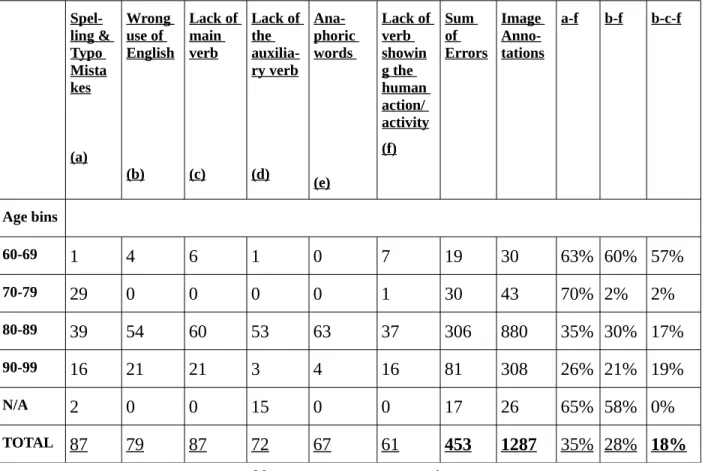
Table 1: Errors per category in absolute numbers and in percentages. Table 2: Errors in respect to age bins.
Table 3: Semantic Relations in WordNet. Retrieved from: [147]
Table 4: Classification Accuracy for different numbers of retrieved images. Table 5: Confusion matrix & measures for the class "playing the guitar". Table 6: Confusion matrix & measures for the class "riding a bike". Table 7: Confusion matrix & measures for the class "walking the dog". Table 8: Confusion matrix & measures for the class "riding a horse".
Table 9: BLEU score Distribution for the modified descriptions as training and testing set. Table 10: BLEU score Distribution for the original descriptions as training and testing set. Table 11: Intra-annotator Agreement.
Table 12: Kappa Q3, Q4, Q6.
Table 13: The distribution of the overall system evaluation per assessor. Table 14: The distribution of the human activity recognition per assessor. Table 15: The distribution of subject and object recognition per assessor. Table 16: The distribution of the language fluency per assessor.
Table 17: The distribution of grammatical error evaluation per assessor. Table 18: The distribution of lexical error evaluation per assessor. Table 19: The distribution of sentence completeness per assessor. Table 20: The distribution of sentence clarity per assessor.
Figure 1: System Overview.
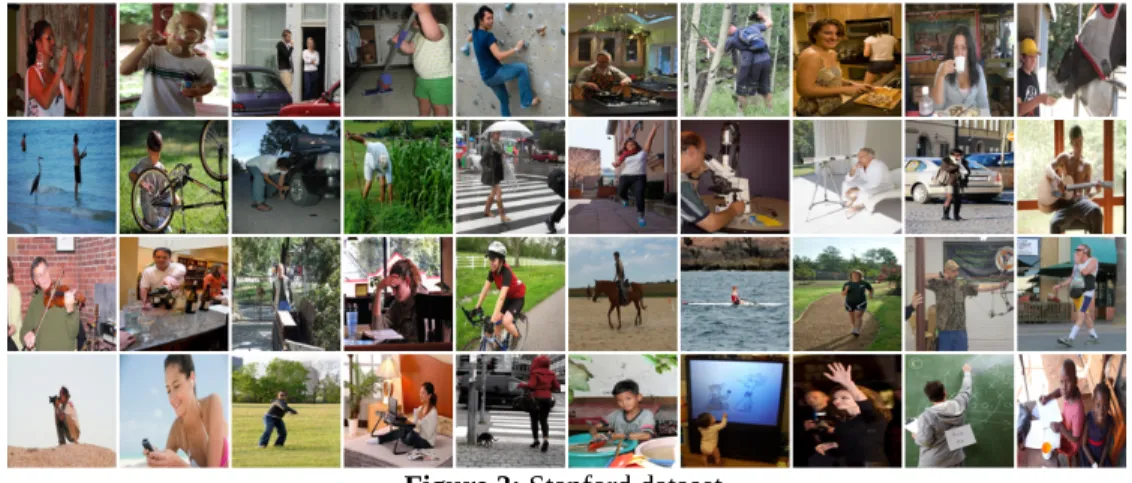
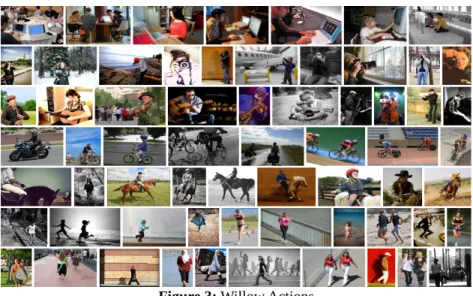
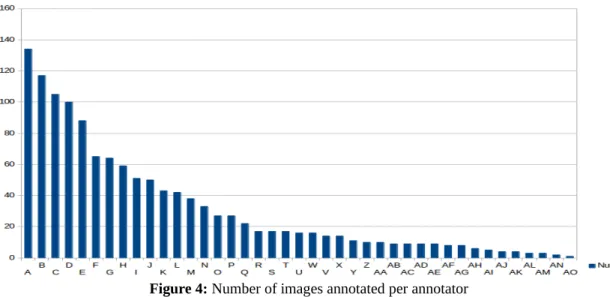
Figure 2: Stanford dataset. Retrieved from: http://vision.stanford.edu/Datasets/40actions.html Figure 3: Willow Actions. Retrieved from: http://www.di.ens.fr/willow/research/stillactions/ Figure 4: Number of images annotated per annotator.
Figure 5: Distribution of annotators in respect to their age.
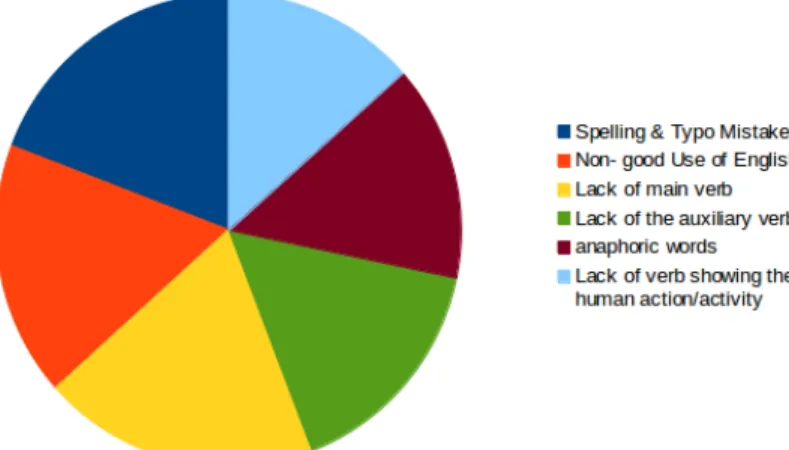
Figure 6: Distribution of each error category in relation to the total amount of errors. Figure 7: Thresholding segmentation. Retrieved from:
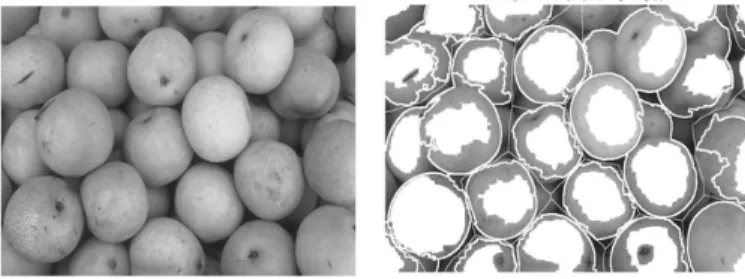
http://docs.opencv.org/doc/tutorials/imgproc/threshold/threshold.html Figure 8: Segementation with k-means. Retrieved from: http://ij-plugins.sourceforge.net/plugins/segmentation/k-means.html Figure 9: Compression-based methods. Retrieved from: [34] Figure 10: Watershed Transformation. 10(a): Retrieved from:
http://www.mathworks.com/help/images/examples/marker-controlled-watershed-segmentation.html 10(b): Retrieved from: [194] 10(c): Retrieved from: [59] Figure 11: Watershed segmentation with markers. Retrieved from:
http://www.mathworks.com/help/images/examples/marker-controlled-watershed-segmentation.html
Figure 12: Canny Edge Detector. Retrieved from: http://www-scf.usc.edu/~boqinggo/Canny.htm Figure 13: Region Growing Segmentation. Retrieved from:
http://en.wikipedia.org/wiki/Region_growing Figure 14: Splitting and merging. Retrieved from:
http://homepages.inf.ed.ac.uk/rbf/CVonline/LOCAL_COPIES/MARBLE/medium/segment/split. htm
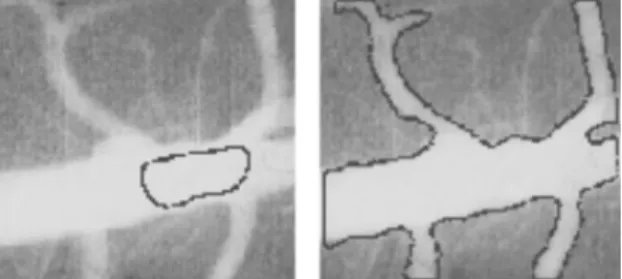
Figure 15: Segmentation using snakes. Retrieved from: http://en.wikipedia.org/wiki/Active_contour_model Figure 16: Level Set Segmentation. Retrieved from: [195]
Figure 17: left IKONOS imagery, right SOM segmentation. Retrieved from: [196]
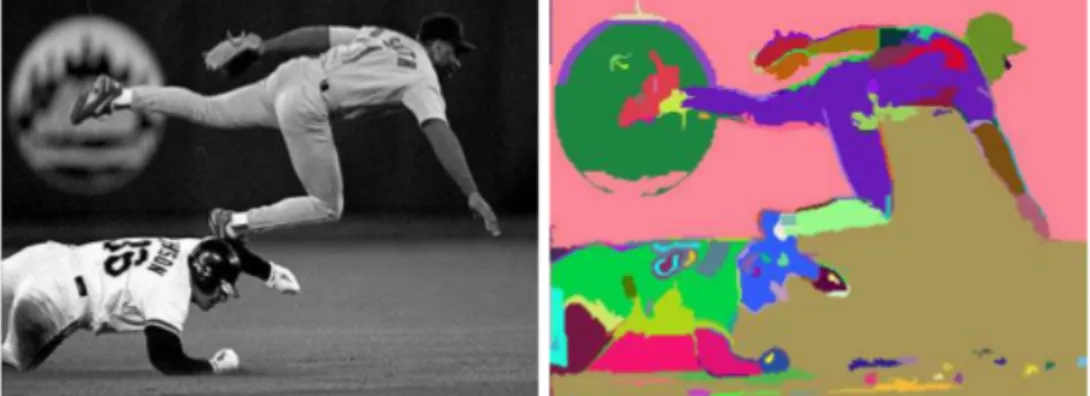
Figure 18: Segmentation with Felzenszwalb and Huttenlocher approach. Retrieved from: [49] Figure 19: Colour Layout Descriptors.
Retrieved from: http://en.wikipedia.org/wiki/Colour_layout_descriptor
Figure 20: An overview of shape description techniques Retrieved from:[46 p.258] Figure 21: left: Manhattan, right: distance Euclidean distance.
Figure 22: Cosine similarity:(a) Similar scores, (b) Unrelated scores, (c) Opposite scores. Figure 23: Example of k-neighbours classification; 3 training instances vote for a query instance. Retrieved from: http://horicky.blogspot.pt/2012/06/predictive-analytics-neuralnet-bayesian.html
Figure 24: Overview of the Content-based Image Retrieval system. Figure 25: Language Production versus Language Comprehension.
Figure 26: The stages of processing in analysis in Natural Language Processing.[87] Figure 27: Representation corresponding to constituency grammar. Retrieved from: [93] Figure 28: Representation corresponding to Dependency Analysis. Retrieved from [93]
http://nlp.stanford.edu/software/stanford-dependencies.shtml
Figure 30: Stanford dependencies. Retrieved from: http://nlp.stanford.edu/software/stanford-dependencies.shtml
Figure 31: A taxonomy of animals. Retrieved from: http://www0.cs.ucl.ac.uk/staff/a.hunter/tradepress/tax.html
Figure 32: Thesaurus representation; Relations between concepts. Retrieved from: https://grips.semantic-web.at/display/public/POOLDOKU/Thesaurus+Basics
Figure 33: An excerpt of the WordNet semantic network. Retrieved from: [130],graph page 10:9 Figure 34: Dependency Representation of all the texts corresponding to the similar retrieved images to the query image on the left.
Figure 35: Cut of the merged graph from which the optimal path is extracted. Figure 36: Confusion matrix. Retrieved from:
http://uberpython.wordpress.com/2012/01/01/precision-recall-sensitivity-and-specificity/ Figure 37: Segmentation Results for the class "walking the dog".
Figure 38: Segmentation Results for the class "riding a horse". Figure 39: Segmentation Results for the class "riding a bike". Figure 40: Segmentation Results for the class "playing the guitar". Figure 41: BLEU score Distribution for the original descriptions. Figure 42: BLEU score Distribution for the modified descriptions. Figure 43: The distribution of the overall system evaluation per assessor. Figure 44: The distribution of the human activity recognition per assessor. Figure 45: The distribution of subject and object recognition per assessor. Figure 46: The distribution of the language fluency per assessor.
Figure 47: The distribution of grammatical error evaluation per assessor. Figure 48: The distribution of lexical error evaluation per assessor. Figure 49: The distribution of sentence completeness per assessor. Figure 50: The distribution of sentence clarity per assessor.
1 Introduction
1.1 Topic
The current dissertation deals with the topic of Image Summarisation and more specifically with the description of human actions depicted in an image in form of text. A concrete definition of the term Image Summarisation is necessary before we go into detail about the approaches and
methods used for the implementation of this project.
In the literature, the Image Summarisation systems can be used for several purposes. Their main feature is the fact that they are meant to summarise visually an image or a video. In other words, such a system gets as input either an image or a set of images or even an image sequence and produces as output a visual summary, which means that the output is also in the form of an image or several images[1][2]. Moreover, the term can be also found in the context of image data compression[3]. However, in the current research project, the summarisation of the image is addressed as the problem of the semantic interpretation of the image content in the form of text. For this reason, in order to avoid any eventual confusion between those research areas, the terms Image Textual Summarisation, Image Summarisation and Image Description are interchangeable and they all imply given a previously unseen image to the system a short summary in form of text is produced, describing the semantic content of it.
In the narrow sense, the current project deals with the summarisation of images depicting human actions. Therefore, the term of human action has to be clarified. According to some famous dictionaries and among the definitions of the word action, is defined as a physical
movement(Cambridge dictionaries[191]) or as a gesture or movement(Oxford dictionaries[50]). Therefore, we can conclude that an action is a physical movement or gesture. This implies a change in the posture of the human body evolving in the time. As a consequence if we want to identify a human action we need a sequence of images that capture those changes in the body posture. However, this project is motivated by the fact that humans tend to recognise human actions and activities from static images and attempts to simulate this human highly cognitive task.
1.2 Aims
The main aim of this thesis is to develop a system that produces image descriptions of higher semantics. More specifically, descriptions that capture the main actions between the prominent objects(with the term objects both animate and inanimate image contents are meant e.g. any object, as well as any animal or humans) in an image. Given a query image as input to the system, the output has to be a textual summarisation of this specific input image.
search for visually similar images in an existing database and based on some annotated text that each of this images is accompanied, produce a short human understandable description about the content of the query image.
Therefore, among the purposes of this dissertation is the creation of a manually annotated image dataset, with the form of annotation being short descriptions about the content of the image. Since the goal of this dissertation is to simulate a higher cognitive task, a training set on actual data on how humans perceive images has to be collected.
Finally, this work also aims on a proper evaluation of the system with automatic as well as manual means. During the evaluation process, humans should be given the opportunity to judge whether a system like that fulfils its goals, in order to find out its weaknesses and strengths.
1.3 Research questions
The main research question of this project is How do humans extract actions from static images and how can this highly cognitive task can be simulated by a machine?. Thereupon:
• How can an image be automatically described without the use of a visual object database, that represents human knowledge?
• When are two images similar and how can we automatically achieve this task? • How can we automatically extract the main objects in an image?
• How can we extract from the descriptions of similar images the common knowledge? • How can we form a proper text for the query image?
• How can we properly evaluate such a system?
1.4 Rationale
A successful implementation of the Image Summarisation system in the broad sense can be useful in several research fields and for the development of several commercial applications. An
eventual and very promising application in bioinformatics field could be the Automatic Description of Medical Images. In this case, of course, the system should be trained with the respective image data set. Automatic Diagnosis from MRI (Magnetic Resonance Imaging) could be an interesting and very useful application. More specifically, the system would retrieve MR images from similar cases and analyse the text diagnosis which follows each of them in order to produce a diagnosis of the query MR image. This could be a very powerful field of application since the text written by the doctors, describes those images without including any noisy
information, in contrast to an application where the training picture dataset is described by higher semantic interpretations and personal experiences of the user, which may not correspond to the content of the picture. The system could be considered as a very helpful tool for doctors that saves them time during the diagnosis process.
In addition, the system could be a great tool for blind people or people with other visual disabilities. While surfing the web, those users do still face difficulties in the interpretation of images, since not all of them are followed by meta-data or descriptions that can clearly convey the meaning of the picture to the user. What is more, the Image Summarisation system in
combination with an Optical Character Recognition system and a Speech Synthesis System could be a very useful tool for the complete interpretation of scanned documents containing pictures. Furthermore, nowadays, it is very easy and cheap to capture photographs. It is very common that people owe big disorganised collections of photographs in digital form. Images can be a great source of information. Consequently, such a system could be a tool for better organisation of the image set and therefore their retrieval based on text queries.
Last but not least, as an extension of the previous application, an Image Summarisation system could be used in image retrieval indexing by search engines in the World Wide Web for the better performance of the image retrieval with the use of text queries.
1.5 Thesis Outline
As already mentioned before, the task of this project is the automatic description of images depicting human actions. This task has some major limitations since the actions are to be
identified from still images and not from image sequences. As a consequence the action must be inferred as a result of the objects involved in the image and the relations of their poses. The main idea to deal with this demanding task, is the use of captioned data, describing the main
interpretation of the scene emphasising on the main action.
So that the system output is closer to that a human would produce while describing a picture the training dataset will be annotated by several humans. Moreover, the system has to be flexible, which means that no visual ontology or predefined categories will be used to name the detected objects and actions. The system has to to learn the visual content from the training images of the existing dataset.
This dissertation is organised in three big sections. In section 2, an overview of the related work is presenting, examining approached generating text output given an image, varying from simple words to proper descriptions. Section 3 presents the proposed method, while providing an
overview of the state-of-the-art techniques out of which the selected ones where chosen for the completion of this project. The evaluation methods and the results of the system implementation are presented in Section 4.
2 Related work
The purpose of this section is to present the related work to the broad sense of Image Description and Image Summarisation in the sense those terms were defined in the previous section. Since these tasks are very complicated and difficult, requiring a combination of two different research fields those of Image Processing and Natural Language Processing, not so much attention has been paid by the research community, in terms of treating the topic as an integration of those both research areas equally until the recent years. In the following sections the existing literature will be presented, the work done in the fields of Image Annotation and Image Description. Both notions of Image Annotation and Description have the same goal; given a digital picture as an input to the system, the output is a set of words. Of course, the descriptions differ in terms of more precise expression of the image content.
The first approaches gathering a lot of interest in the past is the group of methods that aim to convert an image to a set of unrelated words. As will be demonstrated in the next sections the output of these systems are words which may describe the image content pretty well but do not capture the semantic or spatial relationships of the image content. For example, considering the image of "a black bag on the table ", such a system produces as output the set of words {bag, black, table}. The words are isolated without expressing the semantic relationships between them. In this specific example, we can suppose from the output that there is a black bag on or under the table or a bag is under or next to or on a black table.
The problem of ambiguity in the interpretation of the output of such systems has been tried to solved in the more recent literature by enhancing the output so that it reveals those kind of spatial and semantic relationships. This approaches will be described in the section 2.2. Finally, in section 2.3 some other interesting approaches for Video Description systems will be briefly introduced. In the subsection 2.3.1 a category of methodologies for the description of image sequences, which depends on the concept of incrementally combining the image content and the language output. The proposed systems even if they are quite old, they deal with the simultaneous description of videos in a realistic time.
2.1 Image Annotation - From Image to Words
Plenty of work has been already done in Image Annotation and Image Captioning where specific regions of a given picture are associated to a specific word. Extensions to Image Annotation include Object Recognition in the picture and description of the spatial relationships between the recognised objects. Other approaches attempt not only to extract the objects but also their
modifiers such as colour. Firstly, some of the approaches are presented in chronological order and then a sort discussion on them follows.
corresponding to the whole image can be inherited to sub-parts of it. In other words, the image is divided into equally rectangular parts, while each part is followed by all words tagged to the original image. From each of the sub-images a feature vector describing each specific segment is extracted carrying RGB colour histograms and histograms of intensity extracted after Sobel filtering. The extracted feature vectors are clustered by incremental vector quantisation. Thereafter, likelihoods for each word and each cluster centroid are estimated by accumulating their frequency. The system output for an unknown query image follows the previously described steps up to the mapping of each feature vector related to a specific sub-image to the closest centroid in the before-mentioned feature space. Thereafter, the average of the likelihoods of the nearest centroids are calculated and those words that have the highest likelihood values are combined to output the most plausible image caption.
Lavrenko et al.[24] in 2003, proposed a probabilistic model of learning the semantics of images that influenced many models proposed later on by the research community. This approach is based on the assumptions that the surrounding context often simplifies the interpretation of regions as a specific object and the association of different regions provides context while the association of words with image regions provides meaning. The formalism that models the generation of annotated images is a statistical generative model called Continuous-space Relevance Model. The proposed model computes a joint probability over different regions of some and the words in its annotation. Every image is divided into regions, each described by a continuous-valued feature vector reflecting the position of an object region, its relative size, a crude reflection of its shape, as well as predominant colours and textures. Given a training set of images with annotations, a joint probabilistic model of image features and words for the
prediction of the probability of generating a word given the image regions is computed. The model proposed here directly associates continuous features with words.
P. Duygulu et al.[18] in 2004 proposed another clustering approach for image annotation. Given a training set of captioned images, the correlations between image features and keywords are trying to be discovered. The association between image regions and words is learnt from manually annotated images. An image region is represented by a vector of features regarding its colour, texture, shape, size and position. These feature vectors are clustered into clusters using the k-means algorithm while the number of clusters is adaptively defined using the G-k-means algorithm and each region is assigned the label of the closest cluster centre. These labels are called blob-tokens. The main idea is to give higher weight to terms/blob-tokens which are more "unique" in the training set, and low weights to noisy, common terms/blob-tokens. For the image captioning, several methods can be applied on a weighted translation table(to translate from the set of keywords of an image to the set of blobs forming the image), whose elements express the probability a term is captioned given a blob-token. The first proposed method is Corr, a
correlation based method that measures the association between a term and a blob-token by the co-occurrence counts. The second method is called Cos and calculates instead a cosine-similarity translation table. Two last methods are also proposed the SvdCorr and SvdCos that generate the correlation translation table following the Singular Value Decomposition procedure instead of starting with the weighted data matrix.
Jiwoon Jeon and R. Manmatha[26] proposed in 2004 the use of the Maximum Entropy approach for the task of automatic image annotation. Given a set of labelled training data, Maximum Entropy is a statistical technique which allows to predict the probability of a label for a query. The query image is represented using a language of visual terms and then predict the probability of seeing an English word given the set of visual terms forming the image. Maximum Entropy computes the probability and in addition allows for the relationships between visual terms to be incorporated.
In 2006, Youakim Badr and Richard Chbeir[22] approached the image captioning problem, in other words the problem going from image to text but from another perspective, this of an image already surrounded by text, during the annotation process of which, the relevant information is extracted from the text in order to label the image. They introduced an expressiveness and extendible XML-based model for Image Management, which is able to capture the meta-data and content-based features of images followed by text. The images in this case as already said, are surrounded by text and the goal is to create the appropriate meta-data to tag them from the text and from low-level visual features. The authors proposed an information extraction approach to provide automatic description of image content using the related meta-data. Their approach automatically generates XML instances, which mark up meta-data and salient objects matched by extraction patterns. For the specific example of image diagnosis meaningful data can be processed efficiently by regular expressions. The notation of regular expressions is extended by providing meta-words and a multilayer approach to define a high specification language for extraction patterns. The extraction patterns are mainly based on different meta-data permutations, expression disjunction and on the context to identify salient objects.
Sean Moran in 2009, in his dissertation[20] with the aim of developing more precise annotations, reimplemented the before-mentioned probabilistic model, the Continuous Relevance Model[24] proposed by Lavrenko, by extra considering the dependencies between keywords in order to eliminate the noisy ones. His main findings reveal that under certain conditions an effective method to increase annotation accuracy is obtained by enhancing the original Continuous Relevance Model the combination of keyword correlation with an beam search to examine over sets of tags. Moran’s proposed system starts with a pre-processing stage by forming a visual feature vector extracting colour, texture, shape and position information for every Normalised Cut segmented image region for every image in the training and test data sets. After the visual features have been extracted they are further processed to extract word frequency counts, standardise image features, compute all combinations of 2, 3 and 4 word queries and re-arrange the image features into data structures that allow fast processing within the model. The output of the feature pre-processing module is then fed into the Continuous Relevance Model which constructs a probability distribution to link the provided words and features and allow the actual automated image tagging and ranked retrieval. The initial tags assigned to the images can then be further refined by an optional beam search tag refinement module that seeks to find a near to optimal set of tags with high mutual correlation. The output number of words for every picture is predefined(e.g. predefined to 5 words).
Finally, in 2009, Luo Jie et al.[16] present an approach for the joint modelling of faces and poses in images and their association to names and action verbs in accompanying text captions. Given a corpus of news items consisting of images accompanied by text captions, the aim is to find out "who is doing what", as the authors state. In other words, names and action verbs in the captions are associated to the face and body pose of the people in the images. This joint model for
simultaneously solving the image-caption correspondences and learning visual appearance models for the face and pose classes occurring in the corpus provides models that can then be used to recognise people and actions in novel images without captions. The connections between the subject and verb in a caption are found by language analysis techniques. Considering the subject-verb language construct, the "who is in the picture" and "who is doing what". The
observed variables of this introduced generative model are names and verbs in the caption as well as detected persons in the image. The image-caption correspondences are carried by latent
variables, while the visual appearance of face and pose classes corresponding to different names and verbs are model parameters. During learning, simultaneously the correspondence is solved and the appearance models are learnt. In this joint model, the correspondence ambiguity is reduced because the face and pose information help each other.
To conclude, this paragraph has presented some approaches on Image Annotation and Image Captioning. According to the organisation of this chapter, they are both techniques falling into the category From Image to Words. Both techniques produce text given an unseen image, however, Image Captioning requires as an input an image plus its surrounding text[22][16]. The words produced as the output of the system come from the surrounding text. However, Image Annotation does not require any textual input to the system that follows the input image. According to a trained model, such those introduced above, clustering[19][18], maximum entropy[19] or joint probability[20][24] a previously unseen image is labelled with some words produced by the system. The approaches may differ not only in the training models but also in the way they treat the image representation, such as division in rectangles[19] or meaningful
segmentation[24].
2.2 Image Descriptions - From Image to Text
In this section, the approaches of generating coherent text out of images is presented. As the reader may notice below, this field has started very recently attracting the interest of the researchers. This section is also organised in chronological order and short discussion follows after the methods are presented.
Patrick Hède et al.[8] in 2004, proposed an image description system, which detects and recognises objects from a dictionary of objects indexed according to their visual
characteristics(texture and colour) creating an image signature of its visual characteristics. The relative and absolute positions between the objects are also defined. The signatures of the detected objects are used to retrieve the keywords of the existing indexed objects in the visual dictionary. The description consists of the objects in the image, their attributes like colour,
brightness and the spatial relationships between the detected objects. For the final natural language generation part they use Named Entity Recognition and deep syntactical parsers. Ali Farhadi et al.[4] in 2010 introduced a system that can compute a score linking an image to a sentence. This score can be used to attach a descriptive sentence to a given image, or to obtain images that illustrate a given sentence. The score is obtained by comparing an estimate of meaning obtained from the image to one obtained from the sentence. Each estimate of meaning comes from a discriminative procedure that is learned using data. The model assumes that there is a space of "Meanings" that comes between the space of "Sentences" and the space of "Images". First the similarity between a sentence and an image is evaluated by mapping each to the meaning space and then comparing the results. The mapping is learned from images to meaning and respectively from sentences to meaning discriminatingly from pairs of images and assigned meaning representations and sentences respectively. The "Meaning" space consists of triplets - object, action scene - and as a consequence the sentences have to get linguistically parsed in this form so that their visual features correspond to this triplet. For a query image, a matching procedure of it to the semantic space begins. If an image and a sentence predict very similar triplets, they should be projections of nearby points in the meaning space, and so they should have a high matching score. A natural noise resistant score of the similarity of sentence triplets and image triples is the sum of ranks of sentence meaning and image meaning. The pair with the smallest value of this sum is both predicted by the image and predicted by the sentence.
Benjamin Z. Yao et al.[11] in 2010 propose the I2T framework which generates text descriptions of image and video content based on image understanding. This framework is implemented in three steps. First, input images or video frames are decomposed into their constituent visual patterns by an image parsing engine. Afterwards, the image parsing results are converted into a semantic representation in the form of Web Ontology Language(OWL). Finally, a text generation engine converts the results from previous steps into semantically meaningful, human readable and query-able text reports. The core piece of the I2T framework is an And-Or Graph visual knowledge representation, which provides a graphical representation serving as prior knowledge for representing diverse visual patterns and provides top-down hypotheses during the image parsing. The And-Or Graph embodies vocabularies of visual elements including primitives, parts, objects, scenes as well as a stochastic image grammar that specifies syntactic relations and semantic relations between these visual elements. Therefore, the And-Or Graph is a unified model of both categorical and symbolic representation of visual knowledge.
Yansong Feng in his PhD thesis submitted in 2011 [25][10] focuses on the task of automatically generating captions for news images in a learning-from-data fashion, as called by him. This very interesting work differs from the previous approaches in terms of the content of the textual representation of an image. The output of this method is not a description of all the objects depicted in the picture but may be an event or a place or even a named person. Given a news image and its associated news document, a natural language caption is created that captures the main content of the image given the associated document. The most important finding of this
adapted to the news dataset, which consists of BBC news articles, images and their captions. The image content is extracted by building a probabilistic image annotation model which exploits the synergy between visual and textual modalities and whose output is then used to generate captions with the help of the news documents accompanying the image. The final caption generation given an image can be done either by implementing extractive models and thus selecting a sentence from the accompanying document as the image caption, or by using abstractive models that create a new sentence from scratch.
Siming Li et al.[17] in 2011 proposed an approach to automatically compose image descriptions given computer vision based inputs and using scale n-grams. The approach is based on web-scale n-gram, also known as Google Web 1T data, which provides the frequency count of each possible n-gram sequence from one up to five-grams. The method composes sentences entirely from scratch. Image recognition techniques are used to extract visual content information on an image given as an input into the system. Its visual content is encoded as a set of triples out from which the natural language descriptions are generated. The visual information encoded in the triples is recognised objects and their attributes(e.g. colour) and the spatial relationship between the recognised objects. The language generation takes part in two steps. The first step is the candidate phrase selection by first defining three sets of phrases for each given triplet. Each candidate phrase is extended by the top three predicted modifiers for each detected object and some of the synonymous words of these modifiers. The n-gram phrases for each candidate phrase are then found from the Google Web 1T. The second step is the phrase fusion which finds the optimal compatible set of phrases using dynamic programming to compose a new and more complex phrase that describes the image.
Kulkarni et al. in 2011 in their paper Baby Talk: Understanding and Generating Image
Descriptions[9] present their approach, which detects candidate objects-things and stuff as their two broad categories are called, and then each of them are processed by a set of attribute
classifiers. Furthermore, pairs of the candidate objects are examined by prepositional relationship functions and a Conditional Random Field is used to incorporate the previously detected unary image potentials, with higher order text-based potentials computed from large text corpora. As a result a labelling of the graph is predicted and sentences are generated based on the labelling. The final sentence generation depends on the CRF labelling while at the same time some gluing words are added using n-gram language models.
Amir Sadovnik et al.[7] in 2012 presented an approach to rank the importance of the items to be described in an image. Their research is based on the fact that when describing an image, people tend to mention the unexpected. Focusing on the task of discriminating one image from a group of others they investigate the factors that contribute to the most efficient description. Moreover, they suggest a quantitative method to measure the description quality for this specific task using data from human subjects. They describe images in such a way that the main feature that makes them stand out of a collection of pictures is selected. From the detected objects those ones are used for the natural language description of the picture that make them unique in the dataset. Their approach to building a discriminating description, given a target image and a set of distractors, is the initial building of a graph for each of the images with three different types of
nodes: objects, relationships and colours. Then, using the graphs from all the images, they rank the different items in the target image. This ranking is based on two main criteria:
discriminability and salience. Finally, depending on the length of description it is required, they use the top n items and submit them to a natural language generator to create the final
description.
Polina Kuznetsova et al.[23] presented in 2012 a holistic data-driven approach to image
description generation, exploiting the vast amount of parallel image data and associated natural language descriptions available on the web. Given a query image, existing human-composed phrases are retrieved from a visually similar image. Thereupon, those phrases are selectively combined to generate a novel description for the query image. The generation process is
concerned as constraint optimisation problems, collectively incorporating multiple interconnected aspects of language composition for content planning, surface realisation and discourse structure. For a query image, candidate descriptive phrases are firstly retrieved from a large image-caption database using measures of visual similarity. The visual similarity for several kinds of image content is used to compare the query image to images from the database, including:object detections for 89 common object categories, scene classifications for 26 common scene
categories , and region based detections for studied categories. As a result four different types of information are extracted; noun phrases, verbs, prepositions and scene information. From this assortment of phrases, a subset of the objects based on saliency and semantically compatibility is selected, glued together and ordered based on their content relations, to compose a complete sentence that is linguistically plausible and semantically truthful to the content of the image. The coherent description is generated from these candidates using Integer Linear Programming formulations for content planning and surface realisation.
M. Mitchell et al.[6] introduced Midge in 2012, a system that approaches Image Description as a Language Generation task. It extends the work of Kulkarni et al.[21], detecting objects and stuff and uses large-scale text corpora to estimate likely words around object detections. In addition to that, Midge automatically decides what the subject and objects of the description will be,
leverages the collected word co-occurrence statistics to filter possible incorrect detections, and offers the flexibility to be as descriptive or as terse as possible, specified by the user at run-time. In order to train Midge, 700,000 images were used with associated descriptions from the dataset in Ordonez et al.[28]. Then the text is normalised and parsed using the Berkeley parser. Once parsed, syntactic information is extracted for individual word-tag pairs. The probabilities for different pre-nominal modifiers and determiners given a head noun in a noun phrase are calculated. The probabilities are conditioned only on open-class words, specifically, nouns and verbs. Following Penn Treebank parsing guidelines, the kinds of relationships between two head nouns in a sentence are identified. Vision detections are associated to a tag-word pair, and the model fleshes out the tree details around head noun anchors by utilising syntactic dependencies between words learned from the Flickr. Midge uses detections run on Flickr images,
incorporating action or pose detections for verbs and object detections for nouns. It also uses a knowledge base that stores models for different tasks during generation. A three-tiered generation
construct full syntactic trees around the noun clusters. Finally, a surface realisation is used to order selected modifiers, realise them as post-nominal or pre-nominal, and select final outputs. The system follows an over-generate and select approach, which allows different final trees to be selected with different settings.
In this paragraph, more organised approaches in terms of generating text where the semantic relations between the concepts and the words were examined. Most of approaches make use of visual dictionaries(e.g.[23][8][9][6]), and according to the objects detected, some of them extracting the salient ones[7] they generate coherent language output. The information that is going to be rendered into language is mostly determined by the dictionary entries. The language generation part in those approaches is more sophisticated, making use of parsers, linear
programming, dynamic programming or n-grams. Finally, Farhadi[4] computes matching scores between images and pre-existing sentences projected in a meaning space.
2.3 Other Description Systems
This section aims to demonstrate other applications of language description systems, not just for static image content, though. The research in those areas is pretty old and the purpose of this section is mostly to demonstrate the importance of the development of description systems and the extent of the applications of those methods.
2.3.1 Systems Incrementally Describing Image Sequences
Some of the first to realise the need to bridge the gap between Computer Vision and Language Processing were Elisabeth André , Gerd Herzog and Thomas Rist[14]. Already in 1988 their research tried not only to deal with the topic of image description but also to move towards simultaneous natural language description out of image sequences. They introduced the idea of the application of an incremental event recognition strategy for the adequate coordination of event recognition and language production. In order to enable free interaction between these processes, they implemented them in parallel. One of the first application of this concept is the system Soccer, which generates a description of the game which it is watching and which the listener cannot see.
In 1994[13], the same authors introduced another system called VIS that takes camera recorded image sequences as input and uses incremental strategies for the recognition of higher-level concepts such as spatial relations, motion events and intentions, and relies on a plan-based approach to communicate recognised occurrences with multiple presentation media. The core modules are scene interpretation, presentation planner, text generator and allow the automatic generation of textual descriptions for short image sequences. The knowledge-base of the system consists of about 100 concept definitions for spatial relations, motion events, plans, and plan interaction schemata. Since the system output is not just text a graphics generation component is needed, but in order to generate presentation examples, interfacing between some components still had to be done manually.
Some years later, in 1998, Dirk Voelz, Elisabeth André, Gerd Herzog and Thomas Rist[12] implemented an automatic commentator for the robot soccer games also know as "RoboCup" games. Their system is called Rocco and can generate TV-style live reports for arbitrary matches of the "RoboCup" simulator league. The systems consists of an event recognition subsystem and a report planner. They try to convey emotions and use a discourse planner. This approach like the previous one is not just refined to textual representation but a multimedia generation system. Further work of Gerd Herzog with Karl Rohr[5] in 1995 is the implementation of a system for automatic simultaneous description of human movements in real world image sequences. The system combines VITRA, a natural language access system with a vision system. A model-based approach is used for recognising human movements and it is implemented in two stages, the initialisation stage and the incremental estimation. During initialisation the image regions corresponding to moving persons are detected, the movements states are estimated and the starting values for the Kalman filter are determined. At the incremental estimation stage the Kalman filter is applied to each image, predicting the movement state, then by measuring the actual movement state the Kalman filter is updated. The geometrical scene description is considered necessary in order to translate the low-level vision processes to natural language description and since the process takes place incrementally it is also necessary to identify future intentions in the visual representation, while being able to render it into language. The
incremental high-level scene analysis continuously provides information as the image sequence progresses. Simultaneously, natural language utterances have to be generated in order to provide a running report of the time-varying scene. In VITRA, this comprises the selection of currently relevant propositions, their ordering into a linear text structure, and the successive encoding of the selected propositions. In the process of transforming symbolic event descriptions into natural language utterances, first a verb is selected and the case-roles associated with it are instantiated. The lexical choice relies on a rule-based conceptual lexicon, which constitutes the connection between non-linguistic and linguistic concepts. Considering the contents of the text memory and the partner model additional selection processes decide which information concerning the case-role fillers should be conveyed. The chosen information is then translated into natural-language expressions referring to objects, locations, and time. Internal object identifiers are transformed into noun phrases by the selection of attributes that enable the listener to uniquely identify the intended referent. Anaphoric expressions are generated if the referent is in focus and no
ambiguity is possible. Spatial prepositions and appropriate objects of reference are selected time is indicated by the verb tense and by temporal adverbs.
2.3.2 Video Descriptions
A. Gupta et al.[15] in 2009 present an approach to learn a visually grounded storyline model of videos directly from weakly labelled data. The storyline model is represented as an And-Or graph, a structure that can compactly encode storyline variation across videos. The edges in the And-Or graph correspond to causal relationships which are represented in terms of spatio-temporal constraints. An Integer Programming framework is formulated for action recognition
actions. This Representation of storyline model as an And-Or graph allows for compact encoding of substantial storyline variation across training videos. Moreover, the storyline models are learned from weakly annotated videos. The linear integer program permits one-to-many matching of actions to video tracks, addressing the problem of fragmented bottom-up segmentation.
Harnessing the structure of videos helps in better assignment of tracks to action during training. Coupling of actions into a structured model provides a richer contextual model significantly outperforms methods based on co-occurrence and relationships words.
2.4 Discussion & Conclusions
In the previous sections, a literature overview in the Computer Vision and Natural Language Processing Integration for the scope of automatic Image Description was presented. The approaches have been divided into two main categories: the ones that produce as descriptions a set words out of images and those that produce text that maintains the relations between the depicted objects. Another category is also devoted to the first attempts into bringing together the two aforementioned research fields which, however do not only produce descriptions out of a still image but from a sequence of images.
The most of the automatic annotation and captioning systems depend on joint probabilities between regions of images and words. This approach has a main drawback which is the random way of segmenting the original picture into sub-picture regions.
The majority of the approaches of the second class of methods From image to Text identify visual elements belonging to predefined categories of either objects or actions or scenes or a
combination between all of them in the images and they treat the language generation as a
translation model between visual features and words. Those translation models are either direct or indirect using a meaning space to match visual content to words. Some approaches use frequent n-grams for the final language description, or pre-existing sentences or rule-based systems or syntactical parsers. The most advanced methods try to integrate characteristics of the human neurological comprehension and interpretation of an image trying to identify the salient content of an image.
However, the approaches discussed above, that output a whole image description and not just a set of words have the following limitations. For example even if Farhadi’s method[4] is definitely one of the first attempts at scene description it is limited in that it can only select a description from a given database of sentences. Furthermore, Yao et al.[11] with their Image parsing even if they can produce a lot more flexible descriptions, they describe every element that is identified in the picture and as a result long descriptions with redundant information are formed. Moreover, in the Conditional Random Field approach[9], which encourages the detection of commonly used combinations of objects, their relationships and their attributes, a certain item may be encouraged regardless of the specific image being described, since all images use the same description
database. To conclude, those approaches need a knowledge base of predetermined categories of visual objects and actions lacking flexibility to identify unseen categories of objects or actions.
3 Methodology
3.1 Overview
The current project motivated by the unsupervised nature of the From Image to Words approaches and the more sophisticated approaches of Natural Language Generation of the From Image to Sentence approaches, as those discussed in Chapter 2, will explore the issue of Image
Summarisation as already mentioned in Chapter 1 as the integration of a Content-based Image Retrieval System and a Natural Language Processing System that extracts the common
knowledge of the descriptions attached to the retrieved images and renders it to proper text. The system has therefore to be trained on manually annotated images with short
summaries/descriptions of the desired output form. Each image has to be segmented into
meaningful regions, in a way similar to which human eyes process in low-level any visual input. It is assumed that those areas in most cases correspond to objects or part of meaningful objects. Subsequently, the segmented regions need to converted to an easily comparable form, that represents them accurately by the so called image descriptors.
Every time a query image is given to the system, it has to be segmented in the same way as the training images are segmented and from each of its regions the same image descriptors have to be extracted and form the query feature vector.
The query feature vector has to be compared to the feature of the training images and the images with the highest score will be retrieved.