Implementation of business simulation games as learning tool: An example from University of Algarve
Authors: Tatiana Kikot, Silvia Fernandes, Rui Magalhães, Gonçalo Costa
Abstract
Game-based learning environments in education are a valuable asset, as well as their potential benefits are unquestionable (Guillén-Nieto & Aleson-Carbonell, 2012). Yet, recent studies concerning academic achievement have reported contradictory or ambiguous findings. It is also interesting that empirical studies devoted to Management courses are not abundant and focus on: single unit courses (e.g., Edelheim & Ueda, 2007), units with low levels of interdisciplinarity (e.g., Pasin & Giroux, 2011), non-longitudinal studies (e.g., Sørensen, 2011) or games usability (e.g., Blažič et al., 2012). Therefore, the leading Author produced the following research query: can GBL (Cesim Global Challenge) be a useful and productive tool to support Management students for effective learning towards complex contexts while enhances engagement? A case study approach will be used (University of Algarve)
Keywords: Simulation games, integrative learning, case study, University of Algarve
Introduction
Today, when Europe is in a profound crisis, in order to people, groups or organizations survive in a changing environment (inner and outer conditions) is essential to adapt. Rules of the world of work are changing.
To adapt to the challenges of professional life today, we need invest in ourselves, build strong relationships and take risks, to discover new knowledge and use them to forge new sorts of career. Whether you are a lawyer or teacher or engineer, business owner, government agent or doctor, today you need to think of yourself, of your career (Hoffman & Casnocha, 2013), (Aldrich, 2009). Therefore, learning provided to people is a key feature for an active response to the environment since individual learning “implies acquiring knowledge, skills and competencies to cope successfully with different circumstances” (Kriz, 2003, pp. 495). Hitherto, literature has focused mostly on how digital games support education (Kardynal, 2009), since simulation games represent dynamic models of real situations (a reconstruction of a situation or reality that itself is a social construction). The main goal of simulation games is to ensure that the player denotes the consequences of his potential decision
within the “social systems” (McClarty, 2012). When attempting to teach certain skills through such games, a reflection stage is crucial to evaluate the experiences gathered during the simulation and promote knowledge appliance by participants into the real world (e.g., work) (Siewiorek et al., 2012). Concluding, gaming due to its multiple scientific contributions and overlaps maybe a valid solution to engage and prepare learners understand real and complex contexts (e.g. Findling, 2008). So during next twenty years with the skills built through simulations and serious games will challenge universities to help improving people their quality of life (Aldrich, 2009).
ICT and education: Trends
Technology had constantly influenced and shaped society, although ICT is a driven force never witnessed by society (e.g., Castells, 2006; Tofler, 1984). Thus the impacts on education (teaching and learning) are extensive, as for instance:
“new mobile devices (e.g. smartphones and tablets) raise student engagement in both indoor and outdoor activities with applications such as augmented reality. Social networks and web 2.0 tools give students a more active role in their own education, allowing them to be educational “prosumers” (e.g., both producers and consumers) (Martin et al., 2011, pp. 1893).
The analysis conducted by Martin et al. (2011), the Horizon report, advocates that not all forecasted technologies will have similar impacts on education. Presently, social web and mobile devices are the keen technologies for a near future in education according to HR experts, while games impact will be more long term and not so extended. Other promising technologies, such as augmented reality and learning objects do not have enough maturity in education (initial stages of development).
ICT trends: Evolution
In discussing ICT trends in education it’s almost impossible not to mention reach of the internet and its service like WWW. The services provided by web were largely content and information center. In fact, one of the features of WWW was an information overload, which enables the development of search services lead to discover information more quickly and easily. The examples of search services include Google and Live (Search), Yahoo, Dogpile (meta-search), Spock (people). They provide information almost on every topic and, with the right skills, relevant, authoritative and accurate information can be gained.
In reviewing trends 2003-2008 in ICT in education we can address to the report prepared by British Education and Communications Agency (BECTa), and the US Consortium of School Networks (CoSN) as well as EDUCAUSE and the New Media Consortium (NMC) in the US and Horizons reports. CoSN, BECTa reported on devices to access the internet and services , what include: personal digital devices or devices such as mobile phones, MP3 players, laptop computers, tablet PCs, games devices, scanners, interactive whiteboards, digital cameras and videos, RFID and digital TVs. In addition, there have been a number of education applications released on the market that have influenced ICT in education: learning and content management systems, web conferencing, slide sharing, student report cards, eportfolios, virtual classrooms, plagiarism detection, virtual worlds and online collaborative work spaces. The trends 2008-2012 that will have an impact on education and training in future include are: open source software and social networking, collaboration, sharing, open content and mobile technologies, new scholarship and peer to peer technologies (White, 2008).
The six technologies are considered to be the major ones for teaching, learning and creative inquiry in period 2013-2018 (Johnson et al., 2013). The report assumes the probability of enter into the higher education in 3 periods: within the next 12 months; the mid- term horizon, within two to three years; and the far-term, within four to five years.
In the near term period (within 12 months) are massively open online courses (MOOCs) and tablet computing. MOOCs as Coursera, edX, and Udacity, became very popular for learning and counts hungered of thousands of participants. In the second period (within two to three years) we are going to see adoption of two growing technologies: games and gamification, and learning analytics. And on the far term horizon (within four and five years) are 3D printing and wearable
technology.
Digital games. A concept overview
Games and their outcomes have been analyzed through multiple dimensions which entail different categories, although it is essential to develop a framework for understanding their future development (de Freitas, 2006). Games primary function is helpful to draw categories, i.e. if whether the game is developed for entertainment, learning or serious learning (T.M. Connolly et at., 2012). Digital commercial games (DCG) enable primarily entertainment and recreation, while the aim of games-based learning (GBL) and serious games (SG) are learning and behavioral change. The terms SG and GBL or simulation game are sometimes used synonymously (Corti, 2009), despite SG broader purposes (training and behavioral change in business, industry, healthcare as well as in education) (Connolly et al., 2012).
Until now, literature has been neglecting if simulations are effective means of acquiring skills and competences to understand complex business contexts when compared with traditional or even blended learning environments. Because growing complexity in the business environment is an opportunity and simultaneously a challenge for simulations, it is important to develop specific games and understand how these react to curricular areas (Golding, 2009; Strull, 2006).
Commercial and learning issues
COTS games are the most readily available video games to consumers. In some instances these games may be used for educational purposes, however, they are primarily targeted towards the entertainment industry. As Van Eck (2006) identify the use of commercial games as the most suitable approach for digital game- based learning.
Nowadays exist many definitions and ways of classifying educational games, serious games and their relationship to virtual worlds and simulations. Some view them as a continuum (Aldrich, 2009), while others distinguish them all as different categories of the same thing (Sawyer & Smith 2008).
Simulators
“Many simulations do not fall neatly into just one category but are a synthesis of more than one type” (Alessi & Trollip, 2001). In a game context a simulation is a digital recreation of something real that has game characteristics such as competition, rules, winning and losing.
Feinstein and Parks (2002) differ four models of simulation according to the design and application. According to the design simulation categories into iconic and symbolic. Iconic simulation represents visual, auditory and kinesthetic real system. Basically this iconic model use for training purposes. The example can be football and flight simulator.
Symbolic model attempts to imitate through the use of probability distributions, mathematics, or simple object representation.
In terms of application there are Analytical simulation and instructional simulation (Edelheim & Ueda.) Analytical simulations replicate a certain phenomenon and allow the user to carefully review it to support decision-making. On the other hand instructional simulations
are used for education and training purposes.
GBL
According to Connolly et al. (2007), GBL can be defined as “the use of a computer game-based approach to deliver, support, and enhance teaching, learning, assessment, and evaluation”.
The most effective learning takes place through hands on experience; this "Learning by doing" and "active learning" concepts are important constructivist principles which underlie GBL (Yang, 2012). Kebritchi and Hirumi (2008)proposed the following five reasons for defining GBL as an effective tool for education: 1) GBL uses action instead of explanation; 2) GBL creates personal motivation and satisfaction; 3) GBL accommodates multiple learning styles and skills; 4) GBL reinforces mastery of skills; and 5) GBL provides an interactive, dynamic and decision-making context.
The use of mobile devices continues to spring, and with the platform for GBL they offer new options for providing better learning experiences. M-learning is the new approach that exploits the use of mobile devices in education (Horizon Report??). The use of portable gaming platforms among young people makes mobile GBL truly relevant because they can use every free moment for learning (Virvou & Alepis, 2005).
Serious Games
“Serious games are generally defined as games whose primary intent is training or learning with definable learning goals, instead of being primarily intended for entertainment” (White, 2008). Educational games often use synonymously to serious games, whereas educational video games traditionally addressed to the primary and secondary educational system, serious games are elaborated for a wide array of audiences requiring high-order thinking skills.
It can be easily seen that the definition of serious games and simulation not strictly separated and can overlapping. The distinguish can be found in the Narayanasamy et.al (2006) work: there is the presence of goals in the serious games, while simulators make use of objectives.
Johnston & Whitehead, (2006) propose classify serious games and simulation via intention: “the primary goal is education; it may be classified as a serious game. If the serious game closely resembles the player’s reality, it is then a training simulation".
Research context
Macro
The use of simulation games for learning business within Portuguese universities can be characterized as minimum (e.g. Bastos, Sánchez-Cantón & Costas, 2012; Pretto & Fillardi, 2008). However, the existing studies indicate that lecturers and learners expectations regarding such games are often not achieved due to a gap between those parties. The reasons for this gap are multiple: aims/objectives for using simulation games, each group perception and even skills/competences in using them. Thus, this
research project aims to identify the benefits and difficulties acknowledged by each group (lecturers and learners) and derive critical success factors for achieving better learning outcomes.
Micro
The University of Algarve (UAlg) is a young (thirty years old) higher education public institution located in the southern region of Portugal with four distributed campuses- three in Faro and one in Portimão. UAlg has around 750 permanent lecturers and 450 researchers with a growing commitment towards R&D and innovation. Research and undergraduate and postgraduate courses vary from Earth/Marine Sciences and Health to Engineering and Technology, Tourism and Social Sciences/Humanities (including Management).
Presently, the university campuses are a key piece within the region and are important centers of cultural, scientific and technological development due to strong regional, national and international ties that offer learners the opportunity to explore various careers and interdisciplinary skills and competences. The University also comprises a knowledge transfer office (CRIA) and a unit for industrial property promotion (GAPI).
Research Statement of the problem
Corti (2006) argues that game-based learning environments in education are a valuable asset, as well as their potential benefits are unquestionable (complement traditional learning) (Guillén-Nieto & Aleson-Carbonell, 2012). Yet, recent studies concerning digital games for academic achievement have reported contradictory or ambiguous findings namely about learning effective support and learners engagement (Yang, 2012; Papastergiou, 2009). It is also interesting that empirical studies devoted to Management courses are not abundant and focus mostly on: single unit courses (absence of comparison with non-using units) (e.g., Edelheim & Ueda, 2007), units with low levels of interdisciplinary (e.g., Pasin & Giroux, 2011), non-longitudinal studies (e.g., Sørensen, 2011) or games usability (e.g., Blažič et al., 2012).
In the recently published meta-analysis by Connolly et al. (2012), based on study of 129 papers, the authors denote that more papers identified positive outcomes of entertainment games than games for learning, and the evidence that game leads to more effective learning was no strong. It still little consensus on the game features providing learning effectiveness, the process by which the simulation and serious games engage the learns and the types of learning outcomes that can be achieved through play (Guillen-Nieto & Aleson-Carbonell, 2012).
Given this scenario, the leading author produced the following research query: can GBL (Cesim Global Challenge) be a useful and productive tool to support Management students for effective learning towards complex contexts while enhances engagement?
Research objectives
The University of Algarve (UAlg) is a young (thirty years old) higher education public institution located in the southern region of Portugal with four distributed campuses- three in Faro and one in Portimão. UAlg has around 750 permanent lecturers and 450 researchers with a growing commitment towards R&D and innovation. Research and undergraduate and postgraduate courses vary from Earth/Marine Sciences and Health to Engineering and Technology, Tourism and Social Sciences/Humanities (including Management).
Presently, the university campuses are a key piece within the region and are important centers of cultural, scientific and technological development due to strong regional, national and international ties that offer learners the opportunity to explore various careers and interdisciplinary skills and competences. The University also comprises a knowledge transfer office (CRIA) and a unit for industrial property promotion (GAPI).
Research design
Methodologically, the research is framed as a qualitative case study because “qualitative researchers aim not to limit a phenomenon- make it neat, tidy, and comfortable- but to break it (...) so that a description of the phenomenon, in all of its contradictions, messiness, and depth, is (re)presented” (Mayan, 2009, pp. 11).The interpretive philosophy aims to understand events rather figures or percentages which why and how queries clearly reflect (in-depth analysis) (Walsham, 2011). Patton, (2002) define cases as a “specific, unique, bounded system. [in which researchers] gather comprehensive, systematic, and in-depth information” (p. 447). A single case study methodology is particularly valuable when the researcher has little control over events, and can establish cause and effect due to real context observation and recognition (Cohen et al., 2000). Connolly et al., (2012), Fletcher & Tobias, (2006), Bourgonjon et al. (2013) denote the lack of studies based on longitudinal approach or qualitative researches on learns' engagement, learning’s' outcomes and teachers with game-based learning experience so recommendation of these reviews were to investigate understanding and contributions of games in more details applying qualitative study .
Individual interviews and questionnaires were considered as appropriate strategies for data collection and researching, as their responders can provide an active data for the research. For both the focus group and individual interviews, semi-structured questions will be used. We also consider that utilization of focus groups will "allow participants to state feelings, perceptions, and beliefs that they would not express if interview individually" (Gall et al., 2003).
Patton (2002) described focus group interviews as “an interview with a small group [usually 6 to 10 people] on a specific topic”. The research team conducts the focus group interviews with groups of students according to the team size in the game from 4 to 5 participants.
Also informal observation was engage to collect as much information as possible on participants’ engagement, attention, involvement, enjoyment, difficulties, and the time need to complete the game.
Diagnosis
The initial results denote interesting results, as for instance: Research aim 1
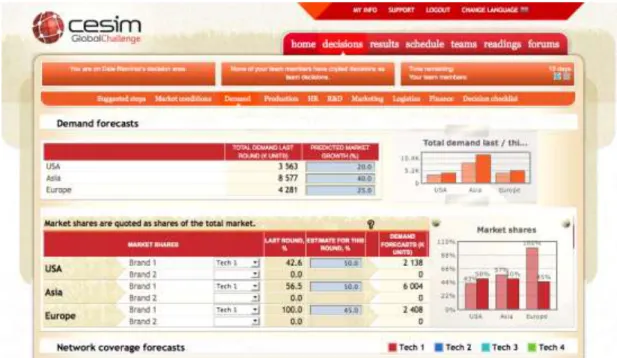
Cesim Global Challenge enables learners understanding basic management concepts, as well as complex problems that require interdisciplinary knowledge. The reasons that support such argument are:
• create a technological company located in different continents and that operates globally; • through that hypothesis learners have to draw their project finance (e.g. taxes and rates- economic and legal assumptions; capital; investment, human resources allocation, etc.), as well as marketing and strategic behavior (e.g. product characteristics, marketing policy, production strategies, etc.);
• understand their decisions into management key indicators (e.g. operational and financial, market share, shareholders return, etc.);
• the “snowball effect” of their decisions throughout corporate indicators.
These empirical results are consistent with Cesim (2012) website information.
Concluding, the technical features of Cesim Global Challenge enable a realistic context to learners understand the critical dimensions of a complex and uncertain business environment, namely when integrated with the SME, marketing and general (finance) modules. This assumption is based on the prior research aim results; and authors understanding.
The authors’ understanding acknowledges their academic (namely the lecturer for Entrepreneur Games and first supervisor) and professional experience (second supervisor):
• SME are the “giants” from corporate world since these represent 98% of the European economy, as well as 67% of employment. In Portugal these factsheets rise until 99,8% and 78,3% respectively (European Commission, 2012a; 2012b);
• Marketing and its consistency are key factors for surviving in a chaotic and uncertain business environment (Faingezicht, 2012)
• General allows learners to interact with all inner activities of an organization and how the environment shapes them (personal experience).
Research aim 2
The main conclusion is that all units within a Management course may explore serious games for learning, since these may act as complement or develop new ways of thinking or approaching complex problems/decisions.
Mainly, there are three components required to run a simulation: briefing in start of the session; the actual implementation of the simulation; and the feedback part (Edelheim & Ueda.).
At the stag briefing learning goals and evaluation should be connecting with the previous lectures. Also administrator (usually it is a professor of the discipline) should explain any concerns about the reality of the simulation that participants not confused by unrealistic decisions made for the unreal situation. How it is in our simulation: it is much easier earn money in simulation than in real life (Yang, 2012). Another detail that should be highlighted is the importance of familiarizing participants with the mechanism of simulation and helping them to understand how it works. Understanding the mechanics is also important in order to avoid potential technical failure.
The stage of implementation is the major part of the simulation course. Participants should play the simulation themselves, so the experimental learning takes place. The role of administrator needs to be passive.
And finally feedback is a stage where decisions are automatically and continuously given to the participants as the simulation proceeds, thus the purpose of having feedback sessions is mainly to facilitate participants’ conceptualization of the simulated environment and strengthening of the
learning experience. Like in our case where participants are competing against each other, their performances may be compared to stimulate their interest and motivation.
To explore this question the teacher of Cesim Global Challenge simulation will be interviewed separately about his experience adopting and using the game.
Questions for the teacher were also planned to focus on how and why he adopted the game as well as how his use of the game had changed and why he continued to use it.
Watson et el., (2011) state and our initial results confirm: that for game involvement needs to be aspects that should be resolved. Primary to involve game into the subject curriculum, teacher must find a game that somehow fits the prescribed syllabus. After, the university must pay for the game and provide hard and soft ware to implement it. And finally, the teacher needs completely figure out what is game is used for, why is it appropriate for the classroom use.
Doing so, traditional learning obtain learner-centered, interactive and dynamic classroom, where the students don’t stay unaware and asleep.
Research aim 3
Here we aim at contributing to the understanding of teachers’ decision-making processes to adopt GBL. To attain this goal, a careful research design is set up: questionnaire which explains, understand and predict change in teachers’ behavior with regard to integrate GBL to their curriculum.
There is a large body of study devoted to the investigation of integration ICT in the syllabus. The integration of game-based learning depend largely on the acceptance by classroom teachers
(Bourgonjon et al., 2013), where an important fact is teacher’ attitude and perception about the educational use of new technologies (Usluel et al., 2008. The most popular theory is the technology acceptance model (Davis, 1989), which explains that teachers will consider a technology to be more useful when it is easier to operate. Schifter (2008), also denote that teachers will not use the technology in the classroom, unless they understand how it will enhance their job performance. In questionnaire we explore the willingness of the teachers to try out games and the different factors contributing to the acceptance or rejection of GBL (Pastore & Falvo, 2010). Ketelhut and Schifter (2011) look more specifically at how teachers are familiar with the games and is it affects to their perception and attitude in further integration of GBL. One more factor, what affects is the both teaching genre and experience (Baek, 2008).
After analyzing the course structure the authors acknowledged that only one course unit explores Cesim Global Challenge, i.e., a 3rd year (2sd semester) unit called “Jogos da Empresa” (Entrepreneur Games) which is optional. The lecturer is permanent within UAlg and a co-author of this publication, since it is using the collected data to improve the lecturing experience. During last academic year were enrolled 29 learners and the simulation scenario was a company devoted to selling mobile phones.
Initial and exploratory contacts with lecturers regarding GBL usage into the learning environment denoted the following reasons: personal choice, the need to change or adapt their lecturing style, unawareness about GBL or lack of skills/competences, non-political enforcement (UAlg strategy), etc.
Research aim 4
The purpose of this question is to understand student experience with and perspectives of an in -class use of an educational simulation Cesim Global Challenge.
The research team previously determined areas of questioning for the focus group interviews, including student perception of the use of the video game in their class, their past experiences with both commercial games and educational video games, and their thoughts on the use of video games for educational purposes.
According to observation of the students, we can already denote that they are really enthusiastic, motivated and fully involved in the game. For many of them this is the first time in their lives they are playing a simulation, and a vast majority had never had any training in international business before. While participants are engaged and active during our observation, remarks made during a couple of sessions denote that at least some students are dipped into the experience and feel to discuss and elaborate strategies outside of classroom. Participants trying not only to discuss, but build a collective strategy to win the session (Watson et al., 2011).
At the beginning of the game teacher announce that the student would have grades that are based on their in-game goals that they should finalize. This helps, them to be more concentrated on what is happening in the game, or otherwise they just bankrupt their firms and stop playing. So, It is important to emphasize that they are not just playing, they are learning. After finishing play training round, the class had a brief discussion, member of each team presented strategy and explain tactic and results of the training sessions. This helped to understand different policy in business simulation and understand what results can be achieved.
Consequently, they are already improving their management skills, especially understanding of the complexity of global business operations in a dynamic, competitive environment, which were why Cesim Glabal Challenge was created.
In one group session, students mentioned that they enjoy the visual part of the game; they can see results, rather than just hearing how it can be. Participants consider this game very entertainment and enjoyable, but also denote that this is a challenge. They meet outside the class and ask professor to clarify some concepts and situation in forum of the simulation, such concepts as: ''price/earnings per share", Cash-Flow, Wage effect, HR Efficiency Multiplier and others in terms understandable for the student. From one’s part, teacher use information from previous lectures in University and push his students towards the learning outcomes.
Discovered advantage during the observation is that this simulation propose a solution for developing leadership skill by providing students with the practical experience through the use of strategic simulation played in small teams (4-5), competed against each other. Students developed goals, discussed problems and tracked progress in order to win the game. The leading author is not familiar with the leadership skills characteristic but, as the leader haven't been predefined we can distinguish different styles, for example: in one team dependence on a single leader resulted in effective team performance, in another is shared leadership (Siewiorek, et al., 2012). So in the future work it can be interesting to evaluate the effect of two levels of DGBL: single player and multi-player on students' learning process and outcomes.
This game emphasizes collaboration and active learning, so the only one disadvantage that can distinguish now is that some students are more introverted and prefer to learn independently. So in the future work it can be interesting to evaluate the effect of two levels of DGBL: single player and multi-player on students' learning process and outcomes.
Research aim 5
The aim of this comparison is to demonstrate that the new method is at least as good as the one already in use. Results showed that the use of the video game resulted in a shift from a traditional teacher centered learning environment to a student-centered environment where the students were much more active and engaged. Also, the teacher had evolved implementation strategies based on his past experiences using the game to maximize the focus on learning (Watson et el., 2011).
The core of the activity in the classroom largely consistent of a single student sitting directly in front of the computer interacting with the simulation while the others team' participants (4-5 students) sitting in their chairs around the computer and discuss strategy with providing suggestions.
The atmosphere of the classroom when the game is played is radically different than that of the traditional classroom: the students are discussing the policy and strategy and speak about what is going on in the game. As the teams are competing with each other’s, they don't speak with the rivals and afraid of being spied. This is an active environment, were the teacher removed from being the center of attention and information, resulted in a more engaging experience.
Future work
Despite the interesting empirical data the authors strive to deal with some limitations, as for instance: the existence of single course unit that explores GBL (inhibiting research aim #3); its optional character (constraining research aims #2, #3, #4 and #5); the learners present and future sample size
(undermining research aims #3 and #4); and, the need for more in-depth data concerning context- university, Management course and course units (hindering research aims #3 and #5). This is consistent with Mayan (2009) argument: that a research project is an evolving process.
As a result, the authors are considering valid solutions for minimizing such limitations: • a longitudinal analysis with multiple case studies;
• understand if Cesim Global Challenge is explored within the other case studies (universities). If not, understand which serious games are utilized and their characteristics;
• interviews to learners, non-using lecturers and the course Director; • focus groups with learners;
• a questionnaire to non-using lecturers about their usage denial.
While this study also provides a perception of teachers to involve games into their curriculum, future research need to evaluate how games reshape teachers’ professions and education in general (Bourgonjon et al., 2013).
We discuss here aspects of engagement and learning that are relevant to students, and there are other outcomes which are important for students. So, we believe that more research should be done to show how simulators, serious games can work on challenges in learning process.
Conclusion
This research aims to understand GBL advantages and disadvantages within Management courses, namely the business simulator Cesim Global Challenge. Of course, similar to any PhD research project, is an ongoing process constrained by the researcher development (personal, professional and academic) and understanding (research topic analysis), so the leading author expectations for CEPE is to receive valuable comments and suggestions about existing and future research decisions.
From the observation, the most visible conclusion is how active the classroom was when playing the simulation; teacher always answering the questions and point out important issues. The students highlighted their enjoyment and the teacher also denotes their activity within the classroom. In the light of the study is a possibility to visualize the process in a different way that would be impossible in a traditional learning. The simulation process also provides participants with the visual communication and offering new models of interactions and lead to collaboration. This can help participants, who prefer to work individually, to engage in more collaborative activities. It was denoted that the groups with more collaborative abilities used more time in the simulation process and their firms reach higher positions.
Involvement simulation into a subject curriculum altered the teacher-centric classroom into the learner-centric, where the participants are collaborate with each other, make decisions and solve the problems. These changes also transform the teacher, who starting to be a coach and a guide in the
classroom (Watson et al., 2011). Allowing students to make experiments help encourage high-level thinking to hypothesize what might happen with their firm in different circumstances: increase/decrease short-term debt, pay the dividends or issue the shares and etc.
In these research aims we explore the factors what clarify the idea of integration of simulation and serious games into the learning curriculum. But meanwhile, out initial results identify the barriers to involve: firstly the limited budgets of university, lack of supportive material, inflexibility of the curriculum and unprepared students (Bourgonjon et al., 2013).
References.
Aldrich, C. (2009). The Complete Guide to Simulations and Serious Games: How the Most Valuable Content Will be Created in the Age Beyond Gutenberg to Google. San Francisco: Pfeiffer.
Alessi, S., & Trollip, S. (2001). Multimedia for learning. Needham Heights, MA: Allyn and Bacon. Baek, Y. (2008). What hinders teachers in using computer and video games in the classroom? Cyberpsychology & Behavior, 11(6), 665-671.
Bastos, N., Sánchez-Cantón, B., & Costas, I. (2012). ENTRExplorer: a Serious Game for Immersive Entrepreneurs. Atas do Encontro sobre Jogos e Mobile Learning., 231-238.
Blažič, A. J., Ribeiro, C., Fernandes, J., Pereira, J., & Arh, T. (2012). Analysing the Required Properties of Business Simulation Games to Be Used in E-Learning and Education. Intelligent Information Management, 4, 348-356.
Bourgonjon, J., De Grove, F., De Smet, C., Van Looy, J., Soetaert, R., & Valcke, M. (2013). Acceptance of Game-Based Learning by secondary School Teachers. Elsevier, 1-24.
Castells, M., Fernandez-Ardevol, M., Qiu, J., & Sey, A. (n.d.). Mobile Communication and Society: A Global perspective. Cambridge.: MA: MIT Press.
Cohen, L., Manion, L., & Morrison, K. (2000). Research mehtods in education. New York: RoutledgeFalmer.
Corti, K. (2009, November 29). Game-based learning: a serious buisness applicaton. Retrieved from PIXELearning Limited: htt://www.pixeleaning.com/docs/games_based learning-pixelearning.pdf Davis, F. D. (1989). Perceived usefulness, perceived ease of use, and user acceptance of information technology. MIS Quarterly, 319-340.
Eck, R. C. (2006). Digital Game-Based Learning:It's Not Just the Digital Natives Who Are Restless. EDUCAUSE Review, 41(2), 16–30.
Edelheim, J., & Ueda., D. (n.d.). Effective use of simulations in hospitality-management education – a case study. Journal of Hospitality, Leisure, Sport, and Tourism Education, 6(1), 10-25.
European Commission. (2012 a). EU SMEs in 2012: at the crossroads Annual report on small and medium-sized enterprises in the EU. Rotterdam.
European Commission. (2012 b). Enterprise and Industry SBA Fact Sheet 2012 PORTUGAL. Feinstein, A. H., & Parks, S. (2002). SIMULATION RESEARCH IN THE HOSPITALITY INDUSTRY. Developments in Business Simulation and Experiential Learning, 29, 45-57.
Findling, J. C. (2008). Integration of Game-Based Learning into a social studies curriculum model to improve student performance in the Ohio social studies standarts. Graduate College of Bowling Green State University.
Freitas, S. (2006). Learning in Immersive worlds. A review of game-based learning. London: JISC. Gall, M., Gall, J., & Borg, W. (2003). Educational research an introduction . Boston: Allyn and Bacon.
Golding, C. (2009). Integrating the disciplines: Successful interdisciplinary subjects. Melbourne: The Universirty of Melbourne.
Guillén-Nieto, V., & Aleson-Carbonell, M. (2012). Serious games and learning effectiveness: The case of It’s a Deal! Computers & Education, 58(1), 435–448.
Hoffman, R., & Casnocha, B. (2013). The Start-up of You: Adapt to the Future, Invest in Yourself, and Transform Your Caree. New York : Crown Business.
Johnson, L. L., & Smith, R. (2007). The 2007 horizon report. Austin,Texas: The New Media Consortium.
Johnson, L. L., & Smith, R. (2008). The 2008 horizon report. Austin, Texas: The New Media Consortium.
Johnson, L. L., & Smith, R. (2009). The 2009 horizon report. Austin, Texas: The New Media Consortium.].
Johnson, L. L., & Stone, S. (2010). The 2010 horizon report. Austin, Texas: The New Media Consortium. Austin, Texas: The New Media Consortium.
Johnson, L., AdamsBecker, S., Cummins, M., Estrada, V., Freeman, A., & Ludgate, H. (2013). The NMC Horizon Report: 2013 Higher Education Edition. Austin,Texas: TheNew MediaConsortium. Johnson, L., Laurence, F., Levine, A., Smith, R., & Stone, S. (2011). The 2011 Horizon Report. Austin, Texas: The new media consortrium.
Johnson, L., Laurence, F., Levine, A., Smith, R., & Stone, S. (2012). The 2012 Horizon report. Austin:Texas: The new media consortrium.
Johnston, .., & Whitehead, A. (2006). Distinguishing Games, Serious Games, and Training Simulators on the Basis of Intent. Ontario, Canada: School of Information Technology Carleton University. Kardynal, J. (2009). The potential of serious games for teaching construction technologies : a case study. (U. o. Dissertations, Ed.) Retrieved from http://library.usask.ca/theses/available/etd-04082009-194817/.
Kebritchi, M., & Hirumi, A. (2008). Examining the pedagogical foundations of modern educational computer games. Computer & Education, 55(2), 427-443.
Ketelhut, D., & Schifter, C. (2011). Teachers and Game-Based Learning:Improving understanding of how to increase efficiacy of adoption. Computer and Education, 56(2), 539-546.
Kriz, W. C. (2003). Creating Effective Learning Environments and Learning Organizations through Gaming Simulation Design. Simulation & Gaming, 34(4), 495-511.
Martin, S., Diaz, G., Sancristobal, E., Gil, R., Castro, M., & Peire, J. (2011). New technology trends in education: Seven years of forecast and convergence. Computers & Education(57), 1893-1906.
McClarty, K. L., Orr, A., Frey, P. M., Dolan, R., Vassileva, V., & McVay, A. (2012). A Literature Review of Gaming in Education. Pearson.
Narayanasamy, V., Wong, K. W., Fung, C. C., & Rai, S. (2006). Distinguishing games and simulation games from simulators. Computers in Entertainment., 4(2), 9.
Pastore, R., & Falvo, D. (2010). Video games in the classroom.Pre- and in-service teachers' perceptions of games in the K-12 games in the classroom. International Journal of Instructional Technology and Distance Learning, 7(12), 49-57.
Patton, M. (2002). Qualitative research and evaluation methods. Thousands Oaks, CA: Sage.
Schifter, C. (2008). Infusing computers into classrooms: Continuous practice improvement. Hershey: PA: IGI Global.
Siewiorek, A., Saarinen, E., Lainema, T., & Lehtinen, E. (2012). Learning leadership skills in a simulated business environment. Computers & Education, 58(1), 121-135.
Usluel, Y., Askar, P., & Bas, T. (2008). A structural equation model for ICT usage in higher education. Educational Technology & Society, 11(2), 262-273.
Virvou, M., & Alepis, E. (2005). Mobile educational features in authoring tools for personalised tutoring. Computers & Education, 44, 53–68.
Watson, W., Mong, C., & Harris, A. (2011). A case study of the in-class use of a video game for teaching hight school history. Computer & Education, 56, 466-474.
White, G. (2008). ICT Trends in Education. Australian Council for Educational Research. Yang, Y.-T. C. (2012). Building virtual cities, inspiring intelligent citizens: Digital games for developing. Computers & Education, 59, 365–377.