Review Article Caputo et al.
Rev Bras Ativ Fís Saúde 2016;21(6):517-524
DOI: 10.12820/rbafs.v.21n6p517-524 RBAFSSOCIEDADE BRASILEIRA DE ATIVIDADE FÍSICA E SAÚDE
Brazilian Journal of Physical Activity and Health
RBAFS
Revista Brasileira de Atividade Física & Saúde
SOCIEDADE BRASILEIRA DE ATIVIDADE FÍSICA E SAÚDE Brazilian Journal of Physical Activity and Health
RBAFS
Revista Brasileira de Atividade Física & Saúde SOCIEDADE BRASILEIRA DE ATIVIDADE FÍSICA E SAÚDE
Brazilian Journal of Physical Activity and Health
Brazilian Journal of Physical Activity and Health
Sociedade BraSileira de atividade FíSica & Saúde
1 Universidade Federal de Pelotas, escola Superior de educação Física. Pelotas, rS. Brasil.
Abstract
The process of urbanization observed in recent decades has brought with it some consequences for the quality of life and change in the profile of diseases, which are related to high-er rates of physical inactivity. The lack of sufficient physical activity (PA) is currently being considered as a risk factor for diseases and comorbidities, especially in adult populations. Thus, the aim of the present study was to systematically re-view the scientific findings in the literature on the practice of physical activity among adults and its relation to the percep-tion of safety in urban centers, published between 2005 and 2014. The search process was conducted using the PubMed, MedLine and LILACS databases, and the reference lists of se-lected articles used the following key words: “physical activ-ity”, “violence” and “safety”. Initially, 303 articles related to the subject under study were found. However, after analyses and the establishment of inclusion criteria, 13 articles were included in this review. It was concluded that the reduction in crime and improvement in traffic and in the environment for walking are key factors to perceive safety in a district. Despite the evidence showing that traffic safety, adequate lighting and improvements in the aesthetics of districts contribute to the perception of safety, the results are yet inconclusive.
Keywords
Motor Activity; Violence; Safety.
Resumo
O processo de urbanização observado nas últimas décadas trou-xe consigo algumas consequências em relação a qualidade de vida emodificação do perfil das doenças, os quais estão relacionados à maiores índices de inatividade física. Aausência de prática suficien-te de atividade física (AF), atualmensuficien-te, vem sendo considerada como fator de risco para doenças e comorbidades, especialmente nas populações adultas. Sendo assim, o objetivo do presente estudo foi analisar sistematicamente os achados científicos na literatura, publicados entre os anos de 2005 e 2014, sobre a prática de ativida-de física entre adultos e sua relação com a percepção ativida-de segurança nos centros urbanos. O processo de busca foi realizado utilizando-se as bautilizando-ses de dados PubMed, MedLine e LILACS, e nas listas de referências dos artigos selecionados, sendo utilizados os seguintes descritores em inglês: “physical activity”, “violence” e “safety”. Ini-cialmente, foram encontrados 303 artigos que apresentavam rela-ção com o tema em estudo; porém, após análises e estabelecimento dos critérios de inclusão, 13 artigos foram incluídos na presente revisão.Através da análise dos artigos foi possível concluir que a redução de crimes, a melhora no tráfego e o ambiente para cami-nhar são fatores fundamentais para perceber-se seguro no bairro. Apesar das evidências demonstrarem que segurança no trânsito, iluminação adequada e melhora na estética do bairro auxiliam na percepção de segurança, os resultados ainda não são conclusivos.
Palavras-chave
Atividade motora; Violência; Segurança.
Perception of safety and physical activity in
adults: a systematic review
Percepção de segurança e prática de atividade física em adultos: uma
revisão sistemática
Eduardo Lucia Caputo1; Airton José Rombaldi1; Tanísia Hipólito1; Marcelo Cozzensa da Silva1
Introduction
The regular practice of physical activity (PA) contri-butes to positive changes in physical, psychological, cognitive and social aspects of human health1.
Mo-reover, the need to reduce the levels of morbidity and mortality worldwide shows the importance of public health actions aimed at enabling inactive individuals
to become active, thus decreasing the load of chronic diseases2.
Despite the abundant evidence on the positive effects of PA practice on health, the majority of the population have not met the minimum recommen-dations yet3-5. According to the ecological perspective
proposed by Sallis et al.6, PA practice and the
adop-tion of a healthy lifestyle are complex acadop-tions that depend on the characteristics of the environment in which individuals are included. Environmental
deter-minants have become the focus of research in recent years, in view of its interrela-tion with individual factors7,8.
In the perspective of the environment where individuals are included, safety can be a determining factor for PA practice. Like water, air and food, safety can be considered as one of the needs of individuals. When this fails to happen and such need is not met, the practice of PA can be compromised9.
Variables such as crime rate and traffic and pedestrian safety can affect indi-viduals’ availability to practice PA in their district10,11. The literature indicates that
the relationship between these variables can be more complex than their simple direct relationship12.
In this sense, the socioeconomic inequality experienced by low-income popu-lations, for example, directly and indirectly influences the lifestyle of this sector/ segment of society13. As these individuals have lower conditions to pay for services
related to health promotion, safe public locations for leisure physical activity are required in the districts where they live14.
In addition, the present study aimed to systematically analyze the scientific findings in the literature associated with PA practice among adults and its rela-tionship with the perception of safety in urban centers.
Methods
Studies that established a relationship between PA practice during leisure time and perception of safety in adults were selected. Theses, dissertations and review articles were excluded.
References that met the inclusion criteria were assessed, regardless of the peri-odical. The selection of descriptors used throughout the review process was per-formed with the Medical Subject Headings (MeSH).
The search process was conducted considering the period between 2005 and 2014, using the PubMed, MedLine and LILACS databases and the lists of refer-ences of selected articles. The following descriptors were used: “physical activity”, “violence” and “safety”. Aiming to combine descriptors and terms used in this search, the “AND” and “OR” logical operators were used.
Initially, a total of 303 articles related to the theme in question were found. Next, studies that met the following criteria were selected: a) the study population was comprised of adults; b) a population-based study; and c) a study performed with urban populations.
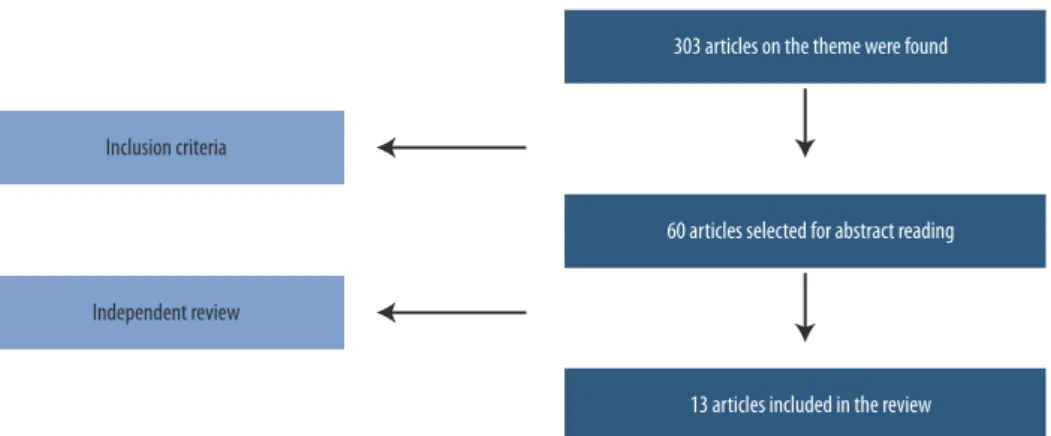
After the initial analysis, which simply consisted in title reading, 60 articles were selected for the second stage of review, abstract reading. Subsequently, the full ar-ticles from studies that had met the inclusion criteria were read. Finally, 13 arar-ticles were included in the present review, as observed in Figure 1. During the entire search process in the literature, the review was performed independently by two researchers. The articles selected were assessed and scored in terms of quality using an adapted Downs & Black scale15. Of all 27 original items, 16 were assessed, only
those that could be applied to observational cross-sectional studies, when the maximum score possible was 17 points (item 5 can have a maximum score of two points). The items assessed were as follows: (1) quality of the description of hy-potheses/objectives; (2) quality of the description of the outcome to be studied; (3) characterization of the sample included; (4) quality of the description of the exposures of interest; (5) discussion about the main confounding factors; (6) qual-ity of the description of the main study outcomes; (7) provision of estimates of random variability of the main findings; (10) presentation of the real probability
found; (11) selection and (12) inclusion of the representative sample; (16) analysis of the main results; (18) adaptation of the statistical tests used to measure the main outcomes; (19) exposures without classification errors; (20) accuracy of the instruments used for the main outcomes; (25) adequacy of the adjustment for the main confounding factors; (27) adequacy of the statistical power to detect an important effect, with a significance level of 5%.
Initially, the score that each study had in each item selected according to the Downs & Black’s instrument15 will be shown. Next, the individual data of each
study will be shown: location, sample, instrument used and main results.
Results
Of all 13 articles selected, six were performed in Europe (four in Holland16-19, one
in Germany20 and one in the whole Europe21), six in the Americas (three in the
Uni-ted States21-23 and three in Brazil13,24,25) an one in Africa (Nigeria26). In the studies
performed by Europeans and Americans, the majority of the sample was compri-sed of females and the most prevalent age group was adults and elderly individuals aged more than 60 years. In contrast, in the study performed by Maiduguri26, the
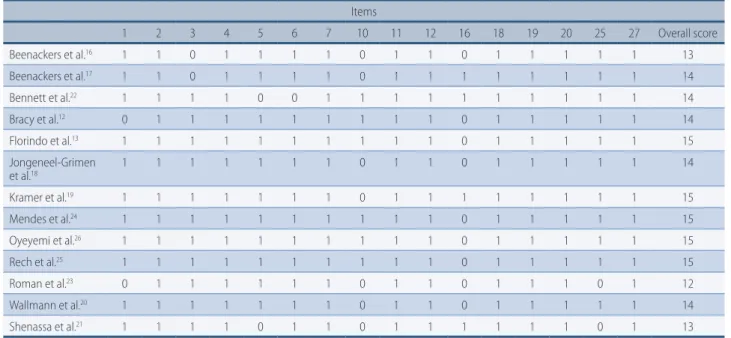
majority of participants were males (60.7%) with a mean age of 34.9 ± 8.8 years. With regard to the scale of quality of articles, the mean scores achieved in the present review study was 14.1 ± 1.0, thus showing good quality. Of all 17 points possible, certain studies13,19, 24-26 achieved a higher score (15 points) and the study
by Roman et al.23 obtained the lowest score, 12 points. The score of each item and
the total score obtained in each study are shown on Table 1.
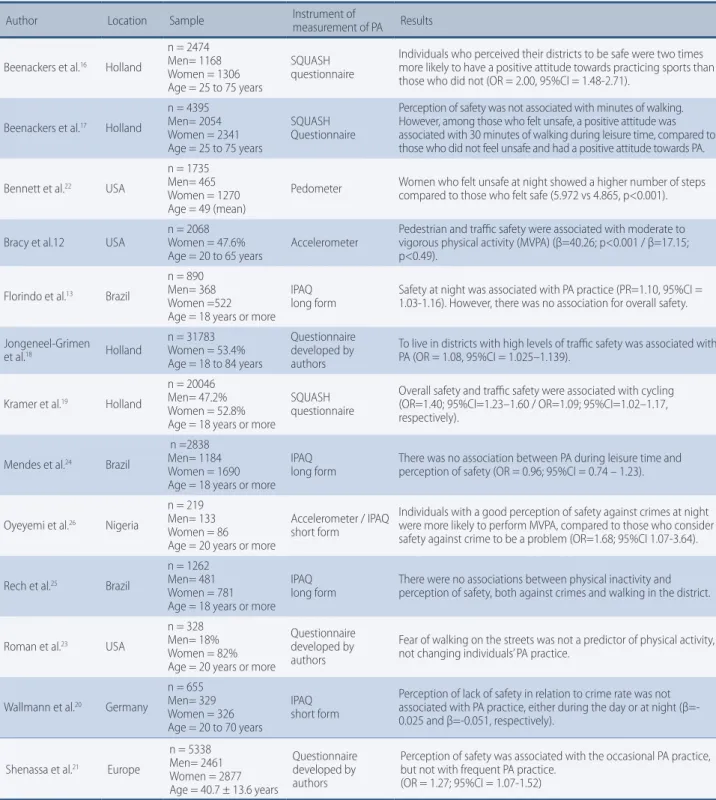
Table 2 shows the number of participants in the sample from each of the 13 studies selected, apart from the place of study, location, instruments used and main results. In order to measure the PA levels, the instruments used varied between ques-tionnaires (IPAQ short or long form or SQUASH), pedometers and accelerometers, associated with the application of the questionnaires mentioned or not.
Regarding the results, eight studies found an association12, 13, 16, 18, 19, 21, 22, 26
be-tween perception of safety and PA practice, all indicating a direct association. Nonetheless, five studies did not show an association between these variables17, 20,
23-25. Perception of safety varied among the following: overall perception of safety12,
13, 19, 20-22, 25, safety against crimes23, 24, fear of staying at home or leaving home
dur-ing the day or night16,17, traffic safety18 and safety against crimes and in traffic26.
Discussion
The present study aimed to systematically review the scientific findings from the literature on PA practice among adults and its relationship with perception of
fety in urban centers. Our review selected 13 studies that met the inclusion criteria used. The distribution of places of study, taking continents into consideration, shows that almost all studies were performed in South America13, 24, 25, North
Ame-rica12, 22, 23 and Europe16-21.
Regarding the scores obtained through the Downs & Black’s scale15, of all five
studies that obtained the highest score, three13, 19, 26 showed direct association
be-tween perception of safety and PA practice, whereas the other two24, 25 did not.
Fol-lowing the increasing order of scores of the next best ranked group of articles in the scale, three12,18,22 of them were directly associated with the outcome, while the
remaining ones17,20 were not associated at all. In the sequence, both articles16, 21 had
a direct association with the outcome. Finally, the article with the lowest score23 was
not associated. These results indicate good data reliability.
Of all 13 studies selected, eight found an association between perception of safety and practice of PA during leisure time12, 13, 16, 18, 19, 21, 22, 26 and five did not
re-veal such association17, 20, 23-25. Of all studies that found an association, six were
performed in Europe and two in the United States, indicating that the perception of safety in developed countries and its association with PA practice during leisure time is higher than that of developing countries such as Brazil and Nigeria.
Only one study performed in Europe17 did not find an association between PA
during leisure time and perception of safety. However, in a different study16, there was
a strong association between sports practice and perception of safety in the district, regardless of whether such activity was performed there or not, showing that individ-uals felt safe to go to the place of their practice even when it was out of their district.
On the other hand, of all three studies performed in Brazil, only one of them13
found a positive association between perception of safety and PA practice. However, the same study revealed this association in terms of perception of safety at night, al-though this effect was not found in the association with overall perception of safety.
Overall perception of safety includes the occurrence of crimes, safe traffic, green areas, and good physical and social environment in a certain district. A total of seven studies analyzed the overall perception of safety of individuals12, 13, 19, 20-22, 25; two
analyz-ed safety against crimes23, 24; two, the fear of staying home or leaving home during the
Table 1 – Scores obtained for each item of the adapted Downs & Black scale, based on the articles included in this systematic literature review. Items 1 2 3 4 5 6 7 10 11 12 16 18 19 20 25 27 Overall score Beenackers et al.16 1 1 0 1 1 1 1 0 1 1 0 1 1 1 1 1 13 Beenackers et al.17 1 1 0 1 1 1 1 0 1 1 1 1 1 1 1 1 14 Bennett et al.22 1 1 1 1 0 0 1 1 1 1 1 1 1 1 1 1 14 Bracy et al.12 0 1 1 1 1 1 1 1 1 1 0 1 1 1 1 1 14 Florindo et al.13 1 1 1 1 1 1 1 1 1 1 0 1 1 1 1 1 15 Jongeneel-Grimen et al.18 1 1 1 1 1 1 1 0 1 1 0 1 1 1 1 1 14 Kramer et al.19 1 1 1 1 1 1 1 0 1 1 1 1 1 1 1 1 15 Mendes et al.24 1 1 1 1 1 1 1 1 1 1 0 1 1 1 1 1 15 Oyeyemi et al.26 1 1 1 1 1 1 1 1 1 1 0 1 1 1 1 1 15 Rech et al.25 1 1 1 1 1 1 1 1 1 1 0 1 1 1 1 1 15 Roman et al.23 0 1 1 1 1 1 1 0 1 1 0 1 1 1 0 1 12 Wallmann et al.20 1 1 1 1 1 1 1 0 1 1 0 1 1 1 1 1 14 Shenassa et al.21 1 1 1 1 0 1 1 0 1 1 1 1 1 1 0 1 13
day or at night16, 17; one, only traffic safety18; and one, crime and traffic safety26.
The fact that individuals do not perceive their district to be safe is an indication that they will not become active, as they can be active anywhere. However, living in an environment perceived as unsafe can become an obstacle for such practice, as they are afraid of leaving their home16, 17. Brazil has high rates of violence and as an
example, 10% of homicides committed worldwide occur in our country27, steadily
decreasing the perception of safety.
Table 2 – Overall characteristics of the studies selected for this systematic literature review. Author Location Sample Instrument of measurement of PA Results
Beenackers et al.16 Holland
n = 2474 Men= 1168 Women = 1306 Age = 25 to 75 years SQUASH questionnaire
Individuals who perceived their districts to be safe were two times more likely to have a positive attitude towards practicing sports than those who did not (OR = 2.00, 95%CI = 1.48-2.71).
Beenackers et al.17 Holland
n = 4395 Men= 2054 Women = 2341 Age = 25 to 75 years SQUASH Questionnaire
Perception of safety was not associated with minutes of walking. However, among those who felt unsafe, a positive attitude was associated with 30 minutes of walking during leisure time, compared to those who did not feel unsafe and had a positive attitude towards PA. Bennett et al.22 USA
n = 1735 Men= 465 Women = 1270 Age = 49 (mean)
Pedometer Women who felt unsafe at night showed a higher number of steps compared to those who felt safe (5.972 vs 4.865, p<0.001).
Bracy et al.12 USA n = 2068Women = 47.6%
Age = 20 to 65 years Accelerometer
Pedestrian and traffic safety were associated with moderate to vigorous physical activity (MVPA) (β=40.26; p<0.001 / β=17.15; p<0.49).
Florindo et al.13 Brazil
n = 890 Men= 368 Women =522 Age = 18 years or more
IPAQ
long form Safety at night was associated with PA practice (PR=1.10, 95%CI = 1.03-1.16). However, there was no association for overall safety. Jongeneel-Grimen et al.18 Holland n = 31783 Women = 53.4% Age = 18 to 84 years Questionnaire developed by authors
To live in districts with high levels of traffic safety was associated with PA (OR = 1.08, 95%CI = 1.025–1.139).
Kramer et al.19 Holland
n = 20046 Men= 47.2% Women = 52.8% Age = 18 years or more
SQUASH questionnaire
Overall safety and traffic safety were associated with cycling (OR=1.40; 95%CI=1.23–1.60 / OR=1.09; 95%CI=1.02–1.17, respectively).
Mendes et al.24 Brazil
n =2838 Men= 1184 Women = 1690 Age = 18 years or more
IPAQ
long form There was no association between PA during leisure time and perception of safety (OR = 0.96; 95%CI = 0.74 – 1.23).
Oyeyemi et al.26 Nigeria
n = 219 Men= 133 Women = 86 Age = 20 years or more
Accelerometer / IPAQ short form
Individuals with a good perception of safety against crimes at night were more likely to perform MVPA, compared to those who consider safety against crime to be a problem (OR=1.68; 95%CI 1.07-3.64). Rech et al.25 Brazil
n = 1262 Men= 481 Women = 781 Age = 18 years or more
IPAQ
long form There were no associations between physical inactivity and perception of safety, both against crimes and walking in the district.
Roman et al.23 USA
n = 328 Men= 18% Women = 82% Age = 20 years or more
Questionnaire developed by authors
Fear of walking on the streets was not a predictor of physical activity, not changing individuals’ PA practice.
Wallmann et al.20 Germany
n = 655 Men= 329 Women = 326 Age = 20 to 70 years IPAQ short form
Perception of lack of safety in relation to crime rate was not associated with PA practice, either during the day or at night (β=-0.025 and β=-0.051, respectively).
Shenassa et al.21 Europe
n = 5338 Men= 2461 Women = 2877 Age = 40.7 ± 13.6 years Questionnaire developed by authors
Perception of safety was associated with the occasional PA practice, but not with frequent PA practice.
(OR = 1.27; 95%CI = 1.07-1.52)
Bracy et al.12 reported that pedestrian safety can be the most important factor
for individuals to practice PA. However, Kramer et al.19 stated that individuals are
more influenced by the social aspects of safety, such as crimes and social disorder. Crime-reducing strategies can increase PA practice, as they promote walks in one’s environment28. The structural question in the districts is also important, as
its improvement and maintenance enable an increase in social networks, better social control and increase in residents’ perception of safety29.
The study by Oyeyemi et al.26, the only one performed in the African
conti-nent, revealed that traffic control was a potential factor for PA promotion and intervention in their country. According to the authors, based on the increasing development of Africa, the trend is towards greater use of cars, causing this aspect to become relevant.
Due to the structural and social differences and diversity of developed and de-veloping countries, the way individuals perceive safety in their environment and the most important factor to improve it can differ. However, regardless of this, individuals prefer to practice PA outdoors, close to their home, using the facilities that are available for free30.
PA practice was measured with a questionnaire in ten studies13,16-21,23-25, in an
objective way in two studies12, 22, and in a combined way in only one26. The use of
questionnaires makes it more difficult to obtain a good measurement, in view of the problems with estimate errors and subjective assessment. In contrast, the use of accelerometers and pedometers has a high financial cost, although it is more ac-curate. Taking into consideration the advantages and disadvantages of each type of instrument, whether it is direct or indirect, their combination can provide more accurate and reliable data31.
Although direct measurements are more consistent, questionnaires enable the PA domain to be assessed, which can provide a better association with environ-mental perception32. However, the way in which PA was measured did not
influ-ence the results found apparently, as the association between PA and perception of safety occurred independently from the measurement method used by the au-thors. The measurement of perception of safety was found to be less accurate. The definition of such perception is still subjective and it can encompass several fac-tors. Thus, it cannot be analyzed through an isolated factor. Instead, it will need to be analyzed in both subjective and objective ways in future studies.
Finally, it can be concluded that the evidence found, although moderate, indi-cate that individuals’ perception of factors associated with safety in their district influence PA practice. It is important that future studies specify which safety fac-tors are being analyzed, aiming to facilitate their relationship with PA practice.
Author contributions
Eduardo Lucia Caputo participated in the conception, literature review, writing and final article version. Tanísia Hipólito participated in the conception, litera-ture review, writing and final article version. Airton José Rombaldi contributed to the conception and critical review of the article. Marcelo Cozzensa da Silva contri-buted to the conception and critical review of the article.
References
1. Cimarras OC, Calderón AL, Poblador BP, González FR, Gimeno LAF, Arjol JLS, et al.
Association between physical activity, multimorbidity, self-rated health and functional limitation in the Spanish population. BMC Public Health. 2014;14(1): 1.
2. Young DR, Coleman KL, Ngor E, Reynolds K, Sidell M, Sallis RE. Associations Between Physical Activity and Cardiometabolic Risk Factors Assessed in a Southern California Health Care System, 2010–2012.Prev Chronic Dis. 2014;219(11): 1-8.
3. Bauman AE, Reis RS, Sallis JF, Wells JC, Loos RJ, Martin BW et al. Correlates of
physical activity: why are some people physically active and others not? The Lancet. 2012;380(9838): 258-71.
4. Lee IM, Shiroma EJ, Lobelo F, Puska P, Blair SN, Katzmarzyk PT, et al. Effect of physical inactivity on major non-communicable diseases worldwide: an analysis of burden of disease and life expectancy. The Lancet. 2012;380(9838): 219-29.
5. Hallal PC, Andersen LB, Bull FC, Guthold R, Haskell W, Ekelund U, et al. Global physical activity levels: surveillance progress, pitfalls, and prospects. The Lancet. 2012;380(9838): 247-57.
6. Sallis JF, Cervero RB, Ascher W, Henderson KA, Kraft MK, Kerr J. An ecological approach to creating active living communities. Annu Rev Public Health. 2006;27: 297-322.
7. Brug J, van Lenthe FJ, Kremers SPJ. Revisiting Kurt Lewin: how to gain insight into
environmental correlates of obesogenic behaviors. Am J Prev Med.2006;31(6): 525-9.
8. Spence JC, Lee RE. Toward a comprehensive model of physical activity. Psychol Sport
Exerc. 2003;4(1):7-24.
9. Maslow AH. Toward a psychology of being. New York: Van Nostrand Company, 1968.
10. Diguiseppi C, Roberts L, Li L, Allen D. Determinants of car travel on daily journeys to school: cross sectional survey of primary school children. Br Med J. 1998;316(7142): 1426–8.
11. Holman CD, Donovan RJ, Corti GB. Factors influencing the use of physical activity
facilities: results from qualitative research. Health Promot J Austr. 1996;6(1):16–21.
12. Bracy NL, Millstein RA, Carlson JA, Conway TL, Sallis JF, Saelens BE, et al. Is the
relationship between the built environment and physical activity moderated by perceptions of crime and safety? Int J Behav Nutr Phys Act. 2014;11(24): 1-13.
13. Florindo AA, Salvador EP, Reis RS, Guimarães VV. Perception of the environment and
physical activity practice in adults living in an impoverished area. Rev Saúde Pública. 2011;45(2): 302-10.
14. Salvador EP, Florindo AA, Reis RS, Costa EF. Perception of the environment and leisure-time physical activity in the elderly. Rev Saúde Pública. 2009;43(6): 972-80.
15. Downs SH, Black N. The feasibility of creating a checklist for the assessment of the methodological quality both of randomised and non-randomised studies of health care interventions. J Epidemiol Community Health. 1998;52(6): 377-84.
16. Beenackers MA, Kamphuis CB, Burdof A, Mackenbach JP, van Lenthe FJ. Sports
participation, perceived neighborhood safety, and individual cognitions: how do they interact? International Int J Behav Nutr Phys Act. 2011;8(76): 2-8.
17. Beenackers MA, Kamphuis CB, Burdof A, Mackenbach JP, van Lenthe FJ. Why some walk
and others don’t: exploring interactions of perceived safety and social neighborhood factors with psychosocial cognitions. Health Educ Res. 2013;28(2): 220-33.
18. Jongeneel BG, Busschers W, Droomers M, van Oers HAM, Stronks K, Kunst AE. Change
in neighborhood traffic safety: does it matter in terms of physical activity? PLOS Med. 2013;8(5): 2-12.
19. Kramer D, Maas J, Wingen M, Kunst AE. Neighborhood safety and leisure-time physical
activity among Dutch adults: a multilevel perspective. Int J Behav Nutr Phys Act. 2013;10(11): 1-10.
20. Wallmann B, Bucksch J, Froboese I. The association between physical activity and
perceived environment in German adults. Eur J Public Health. 2011;22(4): 502-8.
21. Shenassa ED, Liebhaber A, Ezeamama A. Perceived Safety of Area of Residence and
Exercise: A Pan-European Study. Am J Epidemiol. 2006;163(11):1012–7.
22. Bennett GG, McNeill LH, Wolin KY, Duncan DT, Puleo E, Emmons KM. Safe to walk?
Neighborhood safety and physical activity among public housing residents. PLOS Med. 2007;4(10): 1599-1607.
23. Roman CG, Knight CR, Chalfin A, Popkin SJ. The relation of the perceived environment to fear, physical activity, and health in public housing developments: evidence from Chicago. J Public Health Policy. 2009;30(1): 286-308.
24. Mendes MA, da Silva ICM, Hallal PC, Tomasi E. Physical activity and perceived insecurity from crime in adults: a population-based study. PLOS Med. 2014;9(9): 1-7.
Corresponding Author
eduardo lucia capuTo [email protected]
REcEivEd 04/05/2016
REvisEd 14/08/2016
AppRovEd 17/08/2016
Rua Luiz de Camões, 625 – Bairro Tablada
Pelotas, RS, Brazil 96055-630
Contact: +55 53 3273-2752
25. Rech CR, Reis RS, Hino AAF, Añez CRR, Fermino RC, Gonçalves PB, et al. Neighborhood safety and physical inactivity in adults from Curitiba, Brazil. Int J Behav Nutr Phys Act. 2012;9(72): 1-7.
26. Oyeyemi AL, Adegoke BO, Sallis JF, Oyeyemi AY, de Bourdeaudhuij I. Perceived crime
and traffic safety is related to physical activity among adults in Nigeria. BMC Public Health. 2012;12(294):1-11.
27. Cerqueira D, Ferreira H, Lima RSD, Bueno S, Hanashiro O, Batista F, Nicolato P. 2016 Atlas of Violence.
28. Evenson KR, Block R, Roux AVD, McGinn AP, Wen F, Rodríguez DA. Associations of
adult physical activity with perceived safety and police-recorded crime: the Multi-ethnic Study of Atherosclerosis. Int J Behav Nutr Phys Act. 2012;9(146): 1-12.
29. Wood L, Shannon T, Bulsara M, Pikora T, McCcormack G, Corti GB. The anatomy of the
safe and social suburb: an exploratory study of the built environment, social capital and residents’ perceptions of safety. Health Place. 2008;14(1):15-31.
30. Corti GB, Donovan RJ. The relative influence of individual, social and physical
environment determinants of physical activity. Soc Sci Med. 2002;54(12): 1793–812.
31. Silva SPS, Yokoo EM, Costa RS. Demographic factors and life habits associated with
physical inactivity during leisure time between genders. Rev Nutr. 2013;26(6): 633-45. 32. Ding D, Sallis JF, Kerr J, Lee S, Rosenberg DE. Neighborhood environment and physical