AbbreviAtions.-OJPS = polysaccharide extracted from Ophiopogon japonicus; E-C3bRR = erythrocyte-C3b receptor rosette rate; E-ICRR = erythrocyte-C3b immune complex rosette rate; ND = Newcastle disease; NDV = Newcastle disease virus; DMSO = dimethyl sulfoxide;CMF = calcium and magnesium-free; PBS = phosphate-buffered saline; HI = hemagglutination inhibition; MTT = 3-(4,5-dimethylthia-zol-2-yl)-2,5-diphenyltetrazolium bromide; ConA = conca-navalin A.
introDUCtion
Newcastle disease (ND) resulting from infection with vi-rulent Newcastle disease viruses (NDV) is one of the most important infectious diseases of poultry, and cause enor-mous economic loss and social disruption because of its worldwide distribution and high flock mortality (Miller et al. 2010, Ravindra et al. 2009). At present, there were no effective drugs to treat this disease and the main method to control ND was vaccination. Moreover, new strains of virus resistant to chemotherapy continue to emerge, so does the need for a safe and effective vaccine (Chen et al. 2010). The immune adjuvant can make vaccine generate a strong im -mune response providing long-term protection against in-fection (Chen et al. 2010). However, the benefits of adjuvant incorporation into a vaccine need to be balanced against the risk of adverse side effects, therefore, minimizing toxi -city remains as one of the major challenges in adjuvant re-search (Chen et al. 2010). Polysaccharides as adjuvant are paving its way as a safe alternative.
Previous research found that polysaccharides could im-prove the immune response to ND vaccine in chicken, such
effects of polysaccharide from Ophiopogon japonicus on
immune response to newcastle disease vaccine in chicken
1Xu Song2, Mei Cao3, Zhongqiong Yin2*, Renyong Jia2,4, Yuanfeng Zou2, Lixia Li2, Guizhou Yue5, Xiaoxia Liang2, Lizi Yin2 and Changliang He2
AbstrACt.- Song X., Cao M., Yin Z., Jia R., Zou Y., Li L., Yue G., Liang X., Yin L. & He C. 2016. effects of polysaccharide from Ophiopogon japonicus on immune response to new-castle disease vaccine in chicken. Pesquisa Veterinária Brasileira 36(12):1155-1159. Na-tural Medicine Research Center, College of Veterinary Medicine, Sichuan AgriculNa-tural Uni-versity, Chengdu, 611130, China. E-mail: [email protected]
In order to investigate the immune enhancement effects of Ophiopogon japonicus poly-saccharide Ophiopogon japonicus (OJPS) on Newcastle disease (ND) live vaccine, chickens vaccinated against ND live vaccine was orally administered with the OJPS at high, me-dium and low concentrations respectively. In negative control group, chickens were given orally equal volume of physiological saline. On day 14, 21 and 28, the serum antibody titer, erythrocyte-C3b receptor rosette rate (E-C3bRR), erythrocyte-C3b immune complex ro-sette rate (E-ICRR) and peripheral lymphocyte proliferation were measured. The results showed that at most time points, the antibody titer, peripheral lymphocyte proliferation, E--C3bRR and elimination rate of immune complex of three OJPS administrating groups were significantly higher (P<0.05) than those in negative control group. It indicated that OJPS could significantly improve the immune efficacy of Newcastle disease live vaccine, Ophio-pogon japonicus polysaccharide possessed synergistical immunoenhancement.
INDEX TERMS: Ophiopogon japonicus polysaccharide, antibody titer, peripheral lymphocyte prolife-ration, erythrocyte immunity, ND vaccine
1 Received on October 9, 2015.
Accepted for publication on June 25, 2016.
Xu Song, Mei Cao and Zhongqiong Yin contributed equally to this pa-per and should be considered as the first author.
2 Natural Medicine Research Center, College of Veterinary Medicine,
Si-chuan Agricultural University, Chengdu, 611130, China. *Corresponding author: [email protected]
3 Core Laboratory, Sichuan Provincial People’s Hospital, Chengdu
610072, China.
4 Key Laboratory of Animal Disease and Human Health of Sichuan
Pro-vince, Sichuan Agricultural University, Chengdu, 611130, China.
as epimedium polysaccharides, astragalus polysaccharides, isatis root polysaccharides and so on (Chen et al. 2010, Fan et al. 2010, Kong et al. 2004).
Ophiopogon japonicus is a kind of traditional Chinese medicinal herb that is always used as a lung-moistening medicine. OJPS is the main active constituents of Ophiopo-gon japonicus, composed of (1→4)-linked-α-D-glucose (She & Shi 2003). It has been shown that OJPS possess anti-oxi-dative (Wang & Luo 2008a; 2008b), immunomodulatory (Yu et al. 1991), anti-hypoxia (Xu & Chen 1996), hypoglyce-mic (Qiu & Li 2008), anti-myocardial ischemia(Zheng et al. 2007) activity.
In this study, the effects of Ophiopogon japonicus poly-saccharide (OJPS) on serum antibody titer, peripheral lym-phocyte proliferation, erythrocyte-C3b receptor rosette rate (E-C3bRR) and erythrocyte-C3b immune complex rosette rate (E-ICRR) were tested in chicken vaccinated with Newcastle disease (ND) vaccine taking the physiolo -gical saline as control. The purpose of this research was to observe whether Ophiopogon japonicus polysaccharide possessed synergistical immunoenhancement, and offer the theoretical evidence for developing potential new-type adjuvant.
MAteriALs AnD MetHoDs
Extraction and purification of polysaccharides. The
poly-saccharide, OJPS, was prepared in our laboratory. Briefly, Ophio-pogon japonicus was decocted 3 times with distilled water, the combined decoction was concentrated. Then total polysaccha-ride was extracted by ethanol precipitation (v/v, 1:3). The total
polysaccharides was deproteinized with sevag’s reagent, filtra -ted by chromatography on macroporous adsorption resins D101 and dialyzed against distilled water for 3 days in turn to remove pigment and other impurity. The content of polysaccharides was 86.82% measured by the phenol-sulfuric acid method (Li et al. 2009).
Material and reagent. RPMI-1640(Gibco) medium supple-mented with benzylpenicillin 100 IU/mL, streptomycin 100 IU/ mL and 10% Fetal bovine serum (Gibco) was used for washing, resuspending and culturing lymphocyte. ConA (Sigma), as T-lym-phocyte mitogen, was dissolved into 0.1mg/mL with RPMI-1640. The 3-(4, 5-dimethylthiazol-2-yl)-2,5-diphenyltetrazolium bromi-de (MTT, Amresco) and Sodium heparin was dissolved into 5mg/ mL with phosphate buffered saline (PBS, pH 7.4). Lymphocytes separation medium (No. LTS1090) was bought from Haoyang Bio-logical manufac-ture co., LTD, Tianjin, China.
vaccine and virus. ND live vaccine (La Sota strain, No.100608) was offered by Liyuan Bio co., LTD, Guangxi, China. ND virus (La Sota strain) was supplied by Key laboratory of Animal Disease and Human Health of Sichuan Province, Sichuan Agricultural Uni-versity, Ya’an, China.
Chickens and experimental design. Two hundred and
three--yellow chickens at one day of age, purchased from Wens Co., Ltd
Guangzhou, China, were randomly divided into four groups and reared in separated pens at 37℃ with 24h light during the first
week, then gradually declined to 25℃ and illumination time was
reduced to 12h per day. The chickens were fed with commercial chick starter and sufficient water.
On 7 days old, the average maternal serum hemaglutination inhibition (HI) antibody titer was less than 3log2, all chickens of each group (the average body weight (BW) was 120g) were vac-cinated with ND live vaccine through nasal drip and eye-drop. At
the same time, the chickens in three OJPS groups (high, medium
and low doses of OJPS, OJPSH, OJPSM and OJPSL) were orally
ad-ministered with 0.5mL of OJPS at concentrations of 100mg/kg BW, 50mg/kg BW, 25mg/kg BW respectively, once a day for five
successive day, in negative control group (NC), with 0.5mL of
phy-siological saline, once a day for five successive day. On day 14, 21 and 28, six chickens were randomly selected from each group for
determination of serum antibody titer by HI test; Another four
chickens were randomly selected from each group for examina -tion of E-C3bRR, E-ICRR by red cell yeast rosette forma-tion test and peripheral lymphocyte proliferation by MTT method.
serum Hi antibody titer assay. Blood sample (1mL per
chi-ck) from jugular vein was collected and the serum was separated
by centrifugation. After inactivated at 56℃ for 30 min, twofold serial dilution of serum, ranged from 1:2 to 1:2048, was added in
a 96-well, V-shaped bottom microtiter plate containing 50μL of CMF-PBS in each well and then 50μL of NDV antigen (4 HA units)
was added into all wells except for the last row served as the con-trols. The antigen–serum mixture was incubated at 37℃ for 10
min. Then, 50μL of 1% chicken erythrocytes suspension was ad -ded into each well and re-incubated for 30 min. The condition of agglutination was monitored and recorded. The highest dilution of serum causing complete inhibition was considered the end-point. The geometric mean titer was expressed as reciprocal log2 values of the highest dilution that displayed HI (Ma et al. 2010).
Peripheral lymphocyte proliferation assay. The peripheral lymphocyte, separated by lymphocyte separation medium from heart blood, was suspended with RPMI 1640 media (containing 10% fetal bovine serum) at a concentration of 5×10⁶ cell/mL. 80μL of cell suspension and 20μL of Con A was added into each
well of a 96-well microtiter plates, each sample seeded 4 wells. The plates were incubated at 39.5 ℃ with a humidified 5% CO2.
After incubation for 44h, 20μL of MTT was added into each well,
and the plates were re-incubated for another 4 h. Then the pla-tes were centrifuged at 1000rpm for 10 min to remove the
su-pernatant carefully and 100μL of Dimethyl Sulfoxide were added
into each well to dissolve the formazan crystal. The OD570nm was measured by an ELISA reader (Model 680, Bio-Rad Instruments) as the index of peripheral lymphocytes proliferation(Hung et al. 2010).
e-C3brr and e-iCrr assay. Heparinized blood sample (1mL
per chick) from jugular vein was centrifuged at 2000 rpm for
5min and erythrocytes were collected. After washed 3 times with
Hanks’ buffer (PH7.2), the erythrocytes were re-suspended with Hanks’ buffer at a concentration of 1.25×10⁷ cell/mL. 1% yeast
suspension was prepared and boiled in thermostat water bath for
20 min. After filtration, part of the yeast suspension was adjusted
to 1×10⁸ cell/mL and to be served as unsensitized yeast. The rest
of yeast suspension was opsonized with an equal volume of fresh rat serum at 37°C with water bath for 20 min and then washed
with Hank’s buffer. The yeast was re-suspended in Hank’s buffer
at a concentration of 1×10⁸ cell/mL and to be served as sensiti-zed yeast. 50μL erythrocytes suspension were incubated with 50 μL yeast suspension(sensitized yeast was used for measuring
E-C3bRR, unsensitized yeast for measuring E-ICRR) at 37°C for
30 min by shaking periodically, then 100 μL Hank’s buffer and 25 μL 0.25% glutaraldehyde were added and shaken gently and continually. 5 min later, three smears were prepared. After fixed
statistical analyses. Data are shown as means ±SD and provi-ded to Statistical analyse using SPSS 17.0. Duncan’s multiple ran-ge tests was used to evaluate the difference. Differences between
means were considered significant at p<0.05.
resULts the dynamic changes of antibody titer
The dynamic changes of serum HI antibody titer were listed in Table.1. On day 14, the antibody titers in all OJPS groups were significantly higher than that in negative con -trol group (P<0.05), and the antibody titer in medium dose of OJPS group was significantly higher than that in low dose of OJPS group. On day 28, no significant differences were observed in all groups. On day 28, the antibody titers in high and medium dose of OJPS groups were significantly higher than those in negative control group and low dose of OJPS group (P<0.05).
the dynamic changes of peripheral lymphocyte proli-feration
The dynamic changes of optical density in each group were shown in Table.2. On day 14, peripheral lymphocyte proliferation in all OJPS groups was significantly higher (P<0.05) than that in negative control group, and in high dose of OJPSgroup, the peripheral lymphocyte prolifera-tion was significantly higher than those in medium and low dose of OJPS groups (P<0.05). On day 21, the peri -pheral lymphocyte proliferation in all OJPS groups was significantly higher (P<0.05) than that in the negative control group; the high and medium dose of OJPS groups had higher effect on peripheral lymphocyte proliferation (P<0.05) in comparison with low dose of OJPS group. On day 28, no significant differences were detected in the four experimental groups.
the dynamic changes of e-C3brr
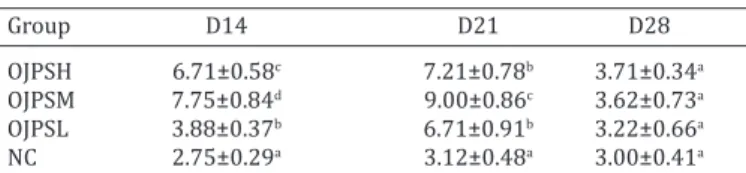
The dynamic changes of E-C3bRR value in each group was listed in Table.3. On day 14, the E-C3bRR values in all OJPS groups were significantly higher (P<0.05) than that in negative control group; significant differences were obser -ved in the three OJPS groups, and the medium dose of OJPS group had best effect on E-C3bRR. On day 21, the E-C3bRR values in all CVPS groups were significantly higher than that in the negative control group, and in medium dose of OJPS group, the E-C3bRR value was significant higher (P<0.05) than that in high and low dose of OJPS groups. On day 28, no significant differences were detected in the four experimental groups.
the dynamic changes of e-iCrr
The dynamic changes of E-ICRR value in each group was listed in Table.4. On day 14 and 28, the E-ICRR values in all OJPS groups were significantly lower (P<0.05) than that in the negative control group, and in high dose of OJPS group, the E-ICRR value was significantly lower (P<0.05) than tho -se in medium and low do-se of OJPSgroups. On day 28, the E-ICRR values in all OJPS groups were significantly lower (P<0.05) than that in negative control group, but no signi -ficant differences were observed in the three OJPS groups.
DisCUssion
The changes of serum antibody titer in poultry reflected the state of humoral immunity (Fan et al. 2010). Antibody usu-ally appears within 6-10 days after infection in blood and local tissues (Rauw et al. 2009). The higher level of antibo-dy titer has always been associated with better protection against ND (Huang et al. 2008). In the present study, the se-rum antibody titer in three OJPS groups was almost higher at the three experimental time points in comparison with negative control group, the high and medium dosage of OJPS group possessed better activity in three OJPS groups. Treated with high and medium dosage of OJPS could induce the antibody titer rapidly rising to a high level in the ear-liest period and retain in the longest time. It indicated that the OJPS could accelerate the antibody production and im-prove the humoral immunity.
Both humoral immunity and cellular immunity play an important role in defense against NDV. In chickens, Cell-me -diated immune responses play an important role to decrea-se the excretion and disdecrea-semination of the NDV (Rauw et al.
table 4. the changes of e-iCrr in each group
Group D14 D21 D28
OJPSH 10.62±0.93c 4.96±0.52c 3.58±0.69b
OJPSM 12.46±1.10b 7.52±0.59b 3.00±0.49b
OJPSL 13.38±0.98b 6.75±0.65b 2.92±0.55b
NC 15.12±1.07a 10.12±0.96a 6.74±0.50a
The superscripts within a column with different letters (a-c) differ signi-ficantly (P<0.05).
table 1. the dynamic changes of serum Hi antibody titer in each group (log2)
Group D14 D21 D28
OJPSH 4.17±0.41bc 4.50±0.55a 4.50±0.55b
OJPSM 4.67±0.52c 4.67±0.81a 4.67±0.52b
OJPSL 3.83±0.75b 4.67±0.52a 3.83±0.41a
NC 3.17±0.41a 4.33±0.52a 3.33±0.52a
The superscripts within a column with different letters (a-c) differ signi-ficantly (P<0.05).
table 2. the changes of peripheral lymphocyte proliferation in each group (oD570 value)
Group D14 D21 D28
OJPSH 0.181±0.016c 0.283±0.030c 0.241±0.027a
OJPSM 0.163±0.012bc 0.276±0.023c 0.233±0.016a
OJPSL 0.144±0.012b 0.218±0.024b 0.229±0.022a
NC 0.106±0.019a 0.162±0.018a 0.223±0.021a
The superscripts within a column with different letters (a-c) differ significantly(P<0.05).
table 3. the dynamic changes of e-C3brr in each group
Group D14 D21 D28
OJPSH 6.71±0.58c 7.21±0.78b 3.71±0.34a
OJPSM 7.75±0.84d 9.00±0.86c 3.62±0.73a
OJPSL 3.88±0.37b 6.71±0.91b 3.22±0.66a
NC 2.75±0.29a 3.12±0.48a 3.00±0.41a
2010). Lymphocytes proliferation is an important indicator reflecting the state of cellular immunity (Guo et al. 2009). In the present study, mitogen-induced lymphocyte prolife-ration in responses to the T-lymphocyte mitogen conA was significantly augmented in three OJPS groups with a dose --dependent manner in comparison with the control group on days 14 and 21. These results suggested that OJPS could promote the cellular immunity and the effect was streng-thened gradually with the increase of dosage. The higher peripheral cellular immunity induced by OJPS might be involved in a greater proportion of specific T-lymphocytes (Guo et al. 2009). Similar results had been observed in as-tragalus polysaccharide that orally administration for three days could enhance the NDV antibody levels in chickens (Chen et al. 2010).
The immune function of erythrocytes play the major car-riers of immune complexes(IC) in the circulation via their complement receptor(E-C3b, CR1), these erythrocytes bind C3b bearing immune complexes and transport them to the organs of the monocyte phagocytic system and reticuloen-dothelial system where the IC were eliminated, including the liver and spleen (Zhou et al. 2010, Gershon 1997). De-fect of E-C3b could lead to tissue injury by IC which esca-ped from the red cell immune system (Jiang et al. 2010). In this study, the E-C3bRR of chickens treated with OJPS was always higher than that of negative control group on days 14 and 21, and the medium dosage of OJPS group posses-sed better activity on E-C3bRR in three OJPS groups, thus it suggested that OJPS could increase the activity of CR1, and enhance the expression of E-C3b (Gershon 1997).
After vaccinated against ND vaccine, ND-specific an -tibodies were abundantly produced by chick immune or -gans and many circulating immune complexes (CIC) were formed in blood circulation. The CIC were adhered by erythrocytes via CR1 causing the E-ICRR rising, then qui-ckly carried to be cleaned up (Li et al. 2007, Yoshida et al. 1986). In our research, the E-ICRR in all four experimental groups was reached a higher level after vaccination, and then it went down gradually. On day 14, the E-ICRR in high dosage of OJPS group was significantly lower than that in negative control group, and it was turned to normal level on day 21, while the medium and low dosage of OJPS groups were recovered on day 28. At the same time, the negative control group was still higher on days 21 and 28 than the three OJPS groups. These results demonstrated the OJPS could accelerate clearing the CIC in a dose dependent way. This was agreement with the studies in Selenium, Sodium Selenite and epimedium polysaccharides (Deng et al. 1999, Luo et al. 2009, Yang et al. 2000, 2001).
The correlation of immunoenhancement efficacy with the dosage of OJPS was also investigated in this resear-ch. Our observations shown that different dosage of OJPS possessed a dose-dependent relationship in peripheral lymphocyte proliferation and E-ICRR, however this rela-tionship did not exist in serum antibody titer and E-C3bRR. Similar effects of some Chinese herbal medicinal ingre-dients on serum antibody titer and epimedium polysaccha-rides on E-C3bRR in chickens immunized with ND vaccine has been reported(Luo et al. 2009, Wang et al. 2005).
ConCLUsions
The OJPS not only improved the E-C3bRR and accele-rated the elimination rate of CIC, but also induced higher antibody titer and peripheral lymphocyte proliferation in chickens vaccinated against ND live vaccine.
These results confirmed that OJPS could enhance the immune response of ND vaccine in chicken, and it would be expected as a candidate of new-type immunologic ad-juvant.
Acknowledgements.- This study was supported by the Foundation for the Author of Excellent Doctoral Dissertation of Sichuan Agricultural Uni-versity (YB2014003), the International cooperation projects of Sichuan Province (2014HH0058, 2013HH0042), the Sichuan Youth Science and Technology Innovation Research Team for waterfowl disease prevention and control (2013TD0015) and the National Natural Science Foundation of China (Grant no.31372477).
Contribution of the authors.- Conceived and designed the experiments: Xu Song, Mei Cao, Zhongqiong Yin, Renyong Jia. Performed the experi-ments: Xu Song, Mei Cao, Yuanfeng Zou. Analyzed the data: Yuanfeng Zou , Lixia Li, Lizi Yin, Changliang He. Contributed reagents/materials/analysis tools: Lixia Li, Xiaoxia Liang, Guhou Yue. Wrote the paper: Xu Song.
reFerenCes
Chen Y.K., Wang D.Y., Hu Y.L., Guo Z.H., Wang J.M., Zhao X., Fan Y.P., Guo L.W., Yang S.J., Sai F.D. & Xing Y.J. 2010. Astragalus polysaccharide and oxy-matrine can synergistically improve the immune efficacy of Newcastle disease vaccine in chicken. Int. J. Biol. Macromol. 46:425-428.
Deng H., Yang H., Liu Y.Q. & He Y.M. 1999. Effect of sodium selenite on the humoral immunity and erythrocyte immune function of chick vaccinated against NDV by adding to drink water. Chinese J. Vet. Sci. Technol. 7:21-22. Fan Y.P., Hu Y.L., Wang D.Y., Guo Z.H., Zhao X.N., Guo L.W., Zhao B., Zhang J. & Wang Y.L. 2010. The Luong Nguyen epimedium polysaccharide and propolis flavone can synergistically stimulate lymphocyte proliferation in vitro and enhance the immune responses to ND vaccine in chickens. Int. J. Biol. Macromol. 47:87-92.
Gershon H. 1997. The anti-inflammatory role of the erythrocyte: impair -ment in the elderly. Arch. Gerontol. Geriatr. 24:157-165.
Guo Z.H., Hu Y.L., Wang D.Y., Ma X., Zhao X.N., Zhao B.K., Wang J.M. & Liu P. 2009. Sulfated modification can enhance the adjuvanticity of lentinan and improve the immune effect of ND vaccine.Vaccine 27:660-665. Huang X.Y., Hu Y.L., Zhao X.N., Lu Y., Wang J.M., Zhang F. & Sun J.L. 2008.
Sulfated modification can enhance the adjuvant activity of astragalus polysaccharide for ND vaccine. Carbohydr. Polym. 73:303-308. Hung C., Yeh C., Chen H., Lai C., Kuo M., Yeh M., Lin W., Tu M., Cheng H. &
Chen C. 2010. Porcine lactoferrin administration enhances peripheral lymphocyte proliferation and assists infectious bursal disease vaccina-tion in native chickens. Vaccine 28:2895-2902.
Jiang J.B., Wu C.H., Gao H., Song J.D. & Li H.Q. 2010. Effects of Astragalus polysaccharides on immunologic function of erythrocyte in chickens in -fected with infectious bursa disease virus. Vaccine 28:5614-5616. Kong X.F., Hu Y.L., Rui R., Wang D.Y. & Li X.R. 2004. Effects of Chinese herbal
medicinal ingredients on peripheral lymphocyte proliferation and se-rum antibody titer after vaccination in chicken. Int. Immunopharmacol. 4:975-982.
Li F., Yuan Q.P. & Rashid F. 2009. Isolation, purification and immunobio -logical activity of a new water-soluble bee pollen polysaccharide from
Crataegus pinnatifida Bge. Carbohydr. Polym. 78:80-88.
Li H., Lloyd R. & Wang J. 2007. Effect of Astragalus polysaccharides on erythrocyte immune adherence of chickens inoculated with infectious bursa1 disease virus. Agricult. Sci. China 11:1402-1408.
Ma X., Guo Z.H., Wang D.Y., Hu Y.L. & Shen Z.Q. 2010. Effects of sulfated polysaccharides and their prescriptions on immune response of ND vac-cine in chicken. Carbohydr. Polym. 82:9-13.
Miller P.J., Decanini E.L. & Afonso C.L. 2010. Newcastle disease: evolution of genotypes and the related diagnostic challenges. Infect. Genet. Evol. 10:26-35.
Qiu B.H. & Li R.M. 2008. Effects of polysaccharide in Ophiopogon japonicus on blood glucose in gestational diabetic rats. J. Jinan Univ. (Med. Ed.) 4:367-369.
Rauw F., Gardin Y., Palya V., Anbari S., Lemaire S., Boschmans M., Berg T. & Lambrecht B. 2010. Improved vaccination against Newcastle disease by an in ovo recombinant HVT-ND combined with an adjuvanted live vaccine at day-old. Vaccine 28:823-833.
Rauw F., Gardin Y., Palya V., Borm S., Gonze M., Lemaire S., Berg T. & Lam-brecht B. 2009. Humoral, cell-mediated and mucosal immunity indu-ced by oculo-nasal vaccination of one-day-old SPF and conventional layer chicks with two different live Newcastle disease vaccines. Vaccine 27:3631-3642.
Ravindra P.V., Tiwari A.K., Ratta B., Baisa M.V., Chaturvedi U., Palia S.K., Bhaskar S. & Chauhan R.S. 2009. Time course of Newcastle disease vi -rus-induced apoptotic pathways. Virus Res. 144:350-354.
She G.M. & Shi J.P. 2003. Study on structural features of two neutral poly-saccharides Md-1 and Md-2 from Ophiopogon japonicus. Northwest Pharmaceut. J. 2:58-59.
Wang D.Y., Hu Y.L., Sun J.L., Kong X.F., Zhang B.K. & Liu J.G. 2005. Compa-rative study on adjuvanticity of compound Chinese herbal medicinal in-gredients. Vaccine 23:3704-3708.
Wang Z.J. & Luo D.H. 2008a. Isolation, purification and antioxidant activity study of Radix ophiopogonis water-soluble polysaccharide OPA. Modern Traditional Chinese Medicine 5:77-79.
Wang Z.J. & Luo D.H. 2008b. Isolation, purification and antioxidant activity study of Radix ophiopogonis water-soluble polyaccharide OPB. J. Chang-chun Univ. Traditional Chinese Medicine 3, 254-255.
Xu Y.P. & Chen Q. 1996. Ophiopogon japonicus polysaccharide protection against cerebrum ischaemia. J. Zhenjiang Medical College 3:217-218. Yang H., Deng H., Liu Y.Q. & He Y.M. 2000. Effect of Selenium on the
erythrocyte immune function of chick. J. Foshan Univ. (Nat. Sci. Ed.) 4:65-68.
Yang H., Deng H., Liu Y.Q. & He Y.M. 2001. Effect of Selenium on the erythrocyte immune Adherence and body weight of chick vaccinated against NDV. Chinese J. Vet. Drug 4:18-20.
Yoshida K., Yukiyama Y. & Miyamoto T. 1986. Interaction between immune complexes and C3b receptors on erythrocytes. Clin. Immunol. Immuno-pathol. 39:213-221.
Yu B.Y., Yin X. & Zhang C.H. 1991. The immune activity of Ophiopogon japo-nicus polysaccharides. J. China Pharmaceut. Univ. 5:286-288.
Zheng Q., Feng Y., De D.S. & Chen Y.Z. 2007. Protective effect of Ophio-pogonis polysaccharide MDG-1 on experimental myocardial ischemic rats. Chinese J. Integrated Traditional and Western Medicine 12:1116-1120.