Poliane Meire Dias de Freitas(1), Gleidson Giordano Pinto de Carvalho(1), Edson Mauro Santos(2), Gherman Garcia Leal Araújo(3), Juliana Silva de Oliveira(2), Aureliano José Vieira Pires(4), Camila Maida de Albuquerque Maranhão(5), Thomaz Cyro Guimarães de Carvalho Rodrigues(1)
and Luís Fernando Batista Pinto(1)
(1)Universidade Federal da Bahia, Departamento de Zootecnia, Avenida Ademar de Barros, no 500, Ondina, CEP 40170110 Salvador, BA,
Brazil. E-mail: [email protected], [email protected], [email protected], [email protected]
(2)Universidade Federal da Paraíba, Centro de Ciências Agrárias, Departamento de Zootecnia, Campus II, CEP 58397-000 Areia, PB,
Brazil. E-mail: [email protected], [email protected] (3)Embrapa Semiárido, BR-428, Km 152, Caixa Postal 23,
CEP 56302-970 Petrolina, PE, Brazil. E-mail: [email protected] (4)Universidade Estadual do Sudoeste da Bahia, Departamento
de Tecnologia Rural e Animal, Laboratório de Forragicultura e Pastagens, Praça Primavera, no 40, CEP 45700-000 Itapetinga, BA, Brazil.
E-mail: [email protected] (5)Universidade Estadual de Montes Claros, Departamento de Zootecnia, Avenida Reinaldo Viana,
no 2.630, Bico da Pedra, Caixa Postal 91, CEP 39440-000 Janaúba, MG, Brazil. E-mail: [email protected]
Abstract – The objective of this work was to evaluate the effects of urea ammoniation of pearl millet silage, at
different compaction densities, on chemical composition, losses in the ensilage process, fermentation profile,
microbial population count, and aerobic stability. The experimental design was completely randomized, in a 2×4 factorial arrangement, with two compaction densities (600 and 800 kg m-³) and four urea levels (0, 2, 4, and 6% on a dry matter basis), with five replicates. For the aerobic stability assay, the experimental design was
completely randomized, in a 2×4 factorial arrangement, with two times (0 and 72 hours) and four urea levels
(0, 2, 4, and 6%, on dry matter basis), with five replicates. The urea levels interacted significantly with density
as to the contents of organic matter, crude protein, neutral detergent insoluble protein, and as to dry matter
recovery; and with exposure hours as to the contents of acid detergent fiber and lignin. Molds and yeasts were
not observed in the ammoniated silages. The 800 kg m-³ density reduced losses in the fermentation process of pearl millet silage, and promoted better nutritive value than the compaction at 600 kg m-³. The use of urea does not reduce losses and does not improve the aerobic stability of silages; however, it controls mold growth after silage exposure to air.
Index terms: Pennisetum glaucum, ADR500, ammoniation, fermentation losses, microbial populations.
Parâmetros qualitativos da silagem de milheto amonizada
com ureia, a diferentes densidades de compactação
Resumo – O objetivo deste trabalho foi avaliar a amonização com ureia em silagens de milheto com diferentes densidades de compactação, quanto aos seus efeitos sobre a composição químico-bromatológica, as perdas
no processo de ensilagem, o perfil fermentativo, a contagem de populações microbianas e a estabilidade
aeróbia. Utilizou-se o delineamento inteiramente casualizado, em arranjo fatorial 2×4, com duas densidades de compactação (600 e 800 kg m-³) e quatro níveis de ureia (0, 2, 4 e 6% com base na matéria seca), com cinco repetições. Na avaliação da estabilidade aeróbia, utilizou-se o delineamento experimental inteiramente
casualizado, em arranjo fatorial 2×4, com dois tempos (0 e 72 horas) e quatro níveis de ureia (0, 2, 4 e 6%, com
base na matéria seca), com cinco repetições. Os níveis de ureia interagiram significativamente com a densidade,
quanto aos teores de matéria orgânica, proteína bruta, proteína insolúvel em detergente neutro e quanto à
recuperação de matéria seca; e com o tempo de exposição, quanto aos teores de fibra em detergente ácido e de lignina. Não se observaram mofos e leveduras nas silagens amonizadas. A densidade de compactação de 800
kg m-³ reduziu as perdas no processo de ensilagem do milheto e proporcionou silagem de maior valor nutritivo do que a compactação a 600 kg m-³. O uso de ureia não reduz as perdas e não melhora a estabilidade aeróbia das silagens; no entanto, controla o crescimento de mofos após a exposição da silagem ao ar.
Termos para indexação: Pennisetum glaucum, ADR500, amonização, perdas por fermentação, populações microbianas.
Introduction
Ensiling is a forage-preservation technique based on the fermentation of lactic acid under anaerobic
conditions. Forage plants are considered suitable for
values able to mitigate secondary fermentation losses (Trevisoli, 2014). The proper compaction of the ensiled material, coupled with the plant characteristics, allows of the adequate fermentation and minimum nutritional losses during ensiling and after silo opening.
The pearl millet [Pennisetum glaucum (L.) R. Br.] cultivation has shown promising results in regions with adverse climates, mainly in semiarid regions
(Amodu et al., 2008). Moreover, unlike other forage species, pearl millet is flexible for the harvest period,
as it maintains good nutritional value even with the advance in its maturity (Brunette et al., 2016).
However, despite its nutritional value, when ensiled pearl millet may display undesirable characteristics such as reduced dry matter content and low palatability (Kamali et al., 2012). The excess soluble carbohydrates in pearl millet lead to a pH decline to values below optimum, which stimulates secondary fermentations, culminating in losses of ensiled material in the form of
gases and effluents (Pinho et al., 2014).
Thus, the use of chemical additives like urea should be considered in the ensiling of this forage plant, in an attempt to reduce undesirable fermentation losses. Urea addition to the pearl millet silage can control the alcoholic fermentation by increasing pH
to the ideal range, which is 3.8 to 4.2 (McDonald
et al., 1991). Through the urease enzyme, urea is partially transformed into ammonia during the silage fermentation (Santos et al., 2010). Ammonia has an antimicrobial power, inhibiting molds and yeasts which are responsible for the production of ethanol (Schmidt et al., 2007).
Urea addition during the ensiling of pearl millet can thus increase the aerobic stability of the silage by inhibiting the development of yeasts, which use lactic acid and residual soluble carbohydrates after the silo is opened (Schmidt et al., 2014) and prevent the aerobic stability of the silages. In this way, urea might increase aerobic stability by controlling the development of these microorganisms. The use of urea, associated with a compaction density that enables the maintenance of anaerobiosis in the silo, will allow of the production of silages with lower fermentation losses and elevated aerobic stability.
The objective of this work was to evaluate the effects of urea ammoniation of pearl millet silage, at different compaction densities, on the chemical composition,
losses in the ensilage process, fermentation profile,
microbial populations count, and aerobic stability.
Materials and Methods
The experiment was carried out at the Bebedouro
experimental field, of Embrapa Semiárido, in
Petrolina, PE, Brazil, from April to August 2013. The aerobic stability trial was conducted at the forage
cropping unit, at the Centro de Ciências Agrárias of Universidade Federal da Paraíba, in August
2013. Analyses for the chemical composition of the samples at different density and air-exposure times
were performed at the Laboratório de Forragicultura
e Pastagens of Universidade Estadual do Sudoeste da Bahia, in Itapetinga, BA, Brazil, from April to September 2014.
Pearl millet, Pennisetum glaucum (L.) R. Br. cultivar ADR500 was used as forage; grains were sown on April 04, 2014. The soil analysis performed prior to the experiment showed the following attributes: pH 6.78; P, 39 mg dm-3; K, 77 mg dm-3; 65% base saturation; and
5.33 g kg-1 organic matter. Based on the soil analysis, no
liming or initial fertilization was necessary, except for the nitrogen fertilization, which was applied at 15 days
after seeding, using 50 kg N in the form of ammonium
sulfate. Pearl millet was harvested at 72 days, when grains had a doughy/farinaceous consistency. Samples were collected at pearl millet ensiling, on June 15, 2013, to determine the chemical composition of the ensiled material before the fermentation process (Table 1). Whole plants were harvested mechanically, and chopped to particles of approximately 3 cm in a forage shredder coupled to the tractor.
The experimental design adopted to evaluate the different densities was completely randomized, in a 2×4 factorial arrangement consisting of two compaction densities (600 and 800 kg m-3) and four
urea levels (0, 2, 4, and 6%, on a dry matter basis), with
five replicates. In the evaluation of aerobic stability, a
completely randomized design was also used, in a 2×4 factorial arrangement corresponding to two evaluation times (0 hour and 72 hours) and four urea levels (0, 2,
4, and 6%, on a dry matter basis), with five replicates. Forty experimental PVC silos (10 cm diameter
× 37.5 cm height) were produced as follows: 20 at 600 kg m-3 compaction density, and 20 at 800 kg m-3
contained 1,760 kg fresh forage, while the silos of 800 kg m-3 contained 2,350 kg fresh forage. In the
chopped material, regardless of density, 2, 4, and 6% urea were added manually on the basis of the total ensiled dry matter. The material was homogenized without dilution in water because pearl millet had
over 70% moisture, which is sufficient to promote
ammoniation. Each silo received previously 1.5 kg of
sand at its bottom for the capture of effluents, which
was covered by a plastic canvas to prevent the mixture of the ensiled material and sand. Silos were closed with a lid, which was coupled to a rubber hose with a longitudinal section that formed a Bunsen valve, for the escape of gases produced during the fermentation process.
The experimental silos were opened on August 26, 2013, one hundred and twenty days after ensiling, when all fermentation processes had already occurred, and the ensiled material was stable and preserved in the form of silage. After the opening of the silos, 250 g of silage samples were taken from the treatments with different compaction densities and were pre-dried.
In the silos, losses in the form of gases and effluents
and the dry matter recovery were estimated according to the equations described by Zanine et al. (2010).
For the evaluation of aerobic stability in the surface
layer of the silos (silo panel), the 20 silos at 600 kg m-3
density were exposed to air from 0 to 72 hours. To better characterize the deterioration of the silages, the
following variables were considered: pH, temperature, ammoniacal nitrogen, and microbial populations.
Immediately after the opening of the silos, the surface temperature and the silage mass were measured; the temperature was monitored at two-hour intervals for a period of 12 hours. The silo surface temperature was measured with a nontouch digital thermometer, whereas the temperature of the mass was measured with a digital immersion thermometer which was inserted 10 cm into the center of the silage. The room temperature was controlled with an air-suspended thermometer. Aerobic stability was determined by the method of Taylor & Kung Jr. (2002), according to which we measured the time taken for the silage to show a 2ºC increase in relation to room temperature. The aerobic stability analysis simulated the conditions
encountered in the field.
The pH and ammoniacal N analyses in the silages
were undertaken according to the methodology of Bolsen et al. (1992), by using a portion of each collected sample for analysis of organic acids, for which 10 g of samples were diluted in 90 mL distilled water and
filtered through Whatman paper (Kung Jr. & Ranjit,
2001). Subsequently, the samples were centrifuged and the organic acids were analyzed in a Shimadzu high-performance liquid chromatograph (American Laboratory Trading, East Lyme, Connecticut, USA)
with a SPD-10A VP detector (American Laboratory
Trading, East Lyme, Connecticut, USA) coupled to an ultraviolet detector, at 210 nm wavelength.
For the microbiological evaluation, 25 g of fresh
sample of silage were collected at 0, 24, 48, 60, and 72 hours; to each sample, 225 mL distilled water were added, and then, the samples were processed in a blender
for approximately 1 min. From the mixture, 1 mL was
removed, and 9 mL distilled water were added to it in order to obtain a 10:1 ratio dilution. Subsequently, serial dilutions were performed to obtain ratios of 10:1 to 10:6. Plating was performed in duplicate for each growth medium. The microorganism populations were determined by the selection technique of cultures in anaerobic medium, using the following media: Rogosa agar, for the count of lactobacilli; PDA (potato dextrose
agar) acidified with 1% tartaric acid, for the count of
molds and yeasts; and brilliant green bile broth, for the count of enterobacteria. Plaques with values between
30 and 300 CFU (colony forming units) were counted
on each Petri dish.
Table 1. Chemical composition of pearl millet (Pennisetum glaucum)'ADR500' before ensiling(1).
Item Pearl millet
Dry matter (DM) 28.00
Organic matter (% DM) 90.96
Mineral matter (% DM) 9.04
Crude protein (% DM) 10.86
Ether extract (% DM) 2.1
Neutral detergent indigestible protein (% CP) 47.89 Acid detergent indigestible protein (% CP) 14.61
Neutral detergent fiber ap 63.62
Acid detergent fiber 34.77
Lignin 4.16
Cellulose 30.61
Hemicellulose 32.29
Nonfibrous carbohydrates ap 14.38 In vitro dry matter digestibility 69.90
Ground samples through 1 mm sieves were used
for determinations of dry matter (DM), organic matter (OM), ether extract (EE), mineral matter (MM), lignin, crude protein (CP), and in vitro DM digestibility (IVDMD), which were performed according to Silva & Queiroz (2002). In all samples, the neutral (NDF) and acid (ADF) detergent fiber contents were obtained following Van Soest et al. (1991), and the neutral (NDIP) and acid (ADIP) detergent insoluble protein
levels were determined according to Licitra et al.
(1996). Neutral detergent fiber corrected for ash and protein was obtained as described by Mertens (2003), and the nonfibrous carbohydrates, corrected for ash and protein (NFCap), were calculated as proposed by
Hall (2000).
A study was performed on the assumptions of analysis of variance that showed that lactic and propionic acids, as well as crude protein, did not meet all assumptions. Therefore, lactic acid and protein were transformed into base 10 logarithmic scale, whereas propionic acid was transformed into its inverse. The remaining variables met the assumptions of the analysis of variance and were analyzed on their original scale.
For the variables that were measured more than once
over time, an analysis of variance was performed with repeated measures over time, in order to evaluate the effects of urea levels, of time, and of the interaction
between these factors. For the variables that were
assessed only once in each experimental unit, an analysis of variance was run to evaluate the effect of urea levels, of density, and of the interaction between
these factors. For those variables in which the two main factors were significant, a multiple regression analysis
was performed including the two factors in the model. In the cases in which only one of the two factors was
significant, a simple regression analysis was used,
and tests were applied with the linear and quadratic
models. For the comparison of these two models, we used the coefficient of determination and the t test for
evaluation of the regression parameters. In all tests, 5%
was adopted as the significance level, using the SAS statistical package (SAS Institute, Cary, NC, USA).
Results and Discussion
As to the chemical composition of the silage, there was an interaction effect between compaction density
and urea levels on OM, MM, CP, and NDIP contents
(Table 2). There was no effect of urea levels on cellulose,
hemicellulose, or on IVDMD. There was effect of the compaction densities on the following variables: OM, MM, NDFap, ADF, lignin, and IVDMD. The higher
compaction density (800 kg m-3) provided a better
fermentation of the ensiled mass, with lower contents
of ADF and lignin, and higher NDF levels. Higher
compaction densities allow of the expulsion of air, eliminate oxygen, promote the growth of lactic acid bacteria (Tavares et al., 2009), and preserve the ensiled material more quickly, which prevents nutrient losses.
The urea levels caused the DM and EE contents to decrease linearly, while NDFap, ADF, and lignin
increased linearly. The use of urea in the ammoniation
of pearl millet did not lead to a reduction of the fibrous fraction of the silages, as observed in other scientific
studies (Keskin et al., 2005; Rong et al., 2013).
Martins et al. (2015) also found an increase in ADF and lignin contents in sugarcane silages treated
with urea. These authors attributed this effect to the nonsolubilization of these cell wall components. The
higher concentration of nonfibrous carbohydrates may
be derived from the effect caused by the reduction of cell wall components, such as soluble carbohydrates,
hemicellulose, ADIP, and NDIP.
The urea levels had a quadratic effect on the ADIP
and NFC contents; the former variable showed a
minimum value of 3.79% for the CP level of 2.62%.
These findings may be explained by the addition of
urea, which can be incorporated into the cell wall
structure, and the NFC loss via effluents. For the NFC
content, a minimum of 11.58% was estimated at 5.11% CP level.
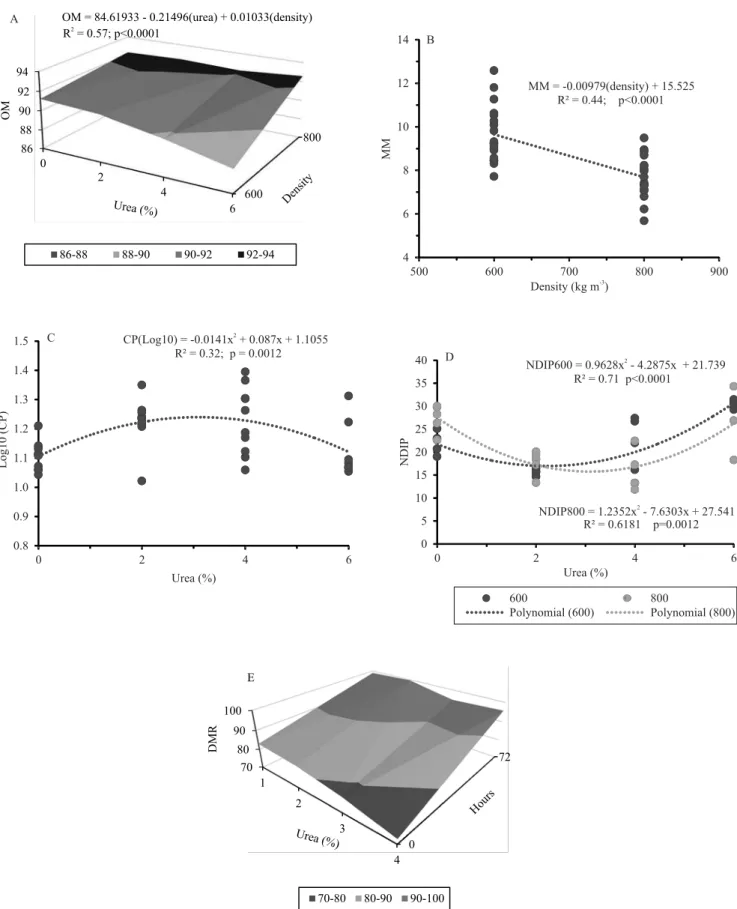
In the decomposition of the interactions between
compaction densities and urea levels, different OM and MM means were obtained between both densities for the urea levels of 4 and 6% (Figure 1). Urea concentration at 2% was not sufficient to elicit changes
in the chemical composition of the silage, irrespective of the compaction density. By contrast, the compaction density interfered with the chemical composition of the pearl millet silage.
In the decomposition of the interactions, the CP content was similar at the urea levels of 0, 2, and 4% for the both densities (600 and 800 kg m-3). However, there
occurrence of proteolysis and losses in the silage with
6% urea at the lower density (Figure 1).
When the compaction density adopted was 800 kg m-3, the CP content increased linearly, by
approximately 9.45%, with every percentage unit of urea added to the ensiled mass. At 600 kg m-3 density,
CP showed a quadratic effect, in which the highest content was observed with the addition of 2.68% urea to the ensiled material.
The urea hydrolysis may originate the ammonium hydroxide, which promotes a pH increase of the ensiled
mass. Vieira et al. (2004) observed a pH increase after
enriching the silages with 0.5% urea. Silages with a very high pH may favor the growth of enterobacteria (Pinho et al., 2016). These microorganisms can decarboxylate and deaminate proteins, as well as
they can use N constituents (McDonald et al., 1991). Moreover, enterobacteria are facultative anaerobic.
The compaction density of 600 kg m-3 might have
allowed of higher-oxygen contents in the ensiled material than at 800 kg m-3, which, associated with the
high-urea contents (4 and 6%), promoted the growth of these microorganisms over lactic bacteria.
There was an interaction effect between compaction
densities and urea levels for NDIP (Figure 1). A
difference was detected in NDIP contents between
the densities of 600 and 800 kg m-3, at the 6% urea.
The highest value was observed at 600 kg m-3 density
of. This difference can be explained by the loss of
nonprotein N as effluent at the lower density.
Regarding fermentation losses (Table 2), there was an interaction effect between density and urea for dry
matter recovery (DMR) and of densities on effluent
losses. However, the urea levels affected the gas losses. The 600 kg m-3 compaction density led to 69%
more losses than the 800 kg m-3 density. This result
explains the lower DMR values obtained at 600 kg m-3
compaction density.
Results for losses and DMR of the silage at the
800 kg m-3 density can be explained by the lack of
air and by the lower effluent loss in the fermentation
at higher compaction densities (Loures et al., 2003). At the 600 kg m-3 compaction density, there might
have been losses of N compounds by the action of
undesirable microorganisms which cause greater
effluent production in the silage. Fermentation losses
account for the largest percentage of losses occurring in the silage, and they may generate water, gas,
effluents, and heat (Pinho et al., 2016).
Table 2. Chemical composition, fermentation losses through effluents and gases, and dry matter recovery of pearl millet
(Pennisetum glaucum) silages at two compaction densities and treated with urea levels.
Item Density (kg m-3) Urea level (%) SEM p-value
600 800 0 2 4 6 Density Urea Density × urea
Dry matter (DM) 25.23 25.52 26.35 26.03 24.91 24.22 0.160 0.373 <0.001(1) 0.322
Organic matter(% DM) 89.77 92.30 91.67 91.69 90.95 89.82 0.273 <0.001 0.014 0.019
Mineral matter(% DM) 10.22 7.69 8.32 8.30 9.04 10.17 0.273 <0.001 0.014 0.019
Crude protein (% DM) 14.56 16.18 12.36 17.16 16.49 15.47 0.472 0.096 0.005 0.009 Ether extract(% DM) 3.01 2.68 3.11 3.20 2.64 2.41 0.090 0.076 0.002(2) 0.640
NDIP (% CP) 22.41 22.72 25.41 17.51 21.52 25.82 0.903 0.868 0.003 0.035
ADIP (% CP) 6.26 6.26 6.72 5.14 3.74 9.44 0.512 1.000 0.001(4) 0.983
Neutral detergent fiber ap(3) 57.69 59.90 57.34 58.52 58.83 60.50 0.396 0.009 0.008(5) 0.552
Acid detergent fiber 55.63 41.19 46.78 46.66 49.65 50.54 0.598 <0.001 0.011(6) 0.292
Lignin 6.66 5.22 5.64 5.37 6.50 6.24 0.150 <0.001 0.039(7) 0.368
Cellulose 35.33 32.56 34.17 33.4 31.84 36.37 0.701 0.060 0.148 0.737
Hemicellulose 21.95 22.24 24.64 23.49 18.54 21.71 0.865 0.868 0.076 0.526
Nonfibrous carbohydrates ap 14.50 13.53 18.84 12.80 12.97 11.44 0.314 0.136 0.002(8) 0.874
In vitro DM digestibility 70.39 68.18 68.62 69.34 70.24 68.95 0.469 0.024 0.630 0.108
Effluents (%) 24.07 7.46 16.61 15.70 15.41 15.33 0.339 <0.001 0.551 0.509
Gases (%) 0.93 0.84 0.40 0.72 1.03 1.40 0.069 0.541 <0.001(9) 0.269
Dry matter recovery(%) 78.79 97.17 90.81 90.65 86.35 84.11 0.425 <0.001 <0.001 0.016
(1)Ŷ = 26.482 – 0.371x (R² = 0.97); (2)Ŷ = 3.224 – 0.129x (R² = 0.84); NDIP, neutral detergent indigestible protein; ADIP, acid detergent indigestible pro
Figure 1. Mean values of the interaction between compaction density and urea levels for: A, organic matter (OM); B, mineral
matter (MM); C, crude protein (CP); D, neutral detergent insoluble protein (NDIP); and E, dry matter recovery (DMR). 600
800 86
88 90 92 94
0
2
4
6 Density
OM
Urea (%)
86-88 88-90 90-92 92-94
OM = 84.61933 - 0.21496(urea) + 0.01033(density)
R = 0.57; p<0.00012
MM = -0.00979(density) + 15.525 R² = 0.44; p<0.0001
4 6 8 10 12 14
500 600 700 800 900
MM
Density (kg m )-3
CP(Log10) = -0.0141x + 0.087x + 1.10552 R² = 0.32; p = 0.0012
0.8 0.9 1.0 1.1 1.2 1.3 1.4 1.5
0 2 4 6
Log10 (CP)
Urea (%)
NDIP600 = 0.9628x - 4.2875x + 21.7392 R² = 0.71 p<0.0001
NDIP800 = 1.2352x - 7.6303x + 27.5412 R² = 0.6181 p=0.0012
0 5 10 15 20 25 30 35 40
0 2 4 6
NDIP
Urea (%)
600 800
Polynomial (600) Polynomial (800)
0
72 70
80 90 100
1
2
3
4
Hours
DMR
Urea (%)
70-80 80-90 90-100
B A
C
D
The highest-gas losses were observed in the silages with higher-urea levels. There was a linear increase of 0.397% with every percentage of added urea (Table 2), which may be related to the ammonia volatilization resulting from the higher-urea content in the silages, and to the fermentation of the ensiled material by undesirable microorganisms. Dry matter recovery decreased linearly by 1.23 percentage units with the increasing urea levels; therefore, for fermentation
losses, urea addition was not efficient.
The interaction between densities and urea levels
showed a linear decreasing effect on DMR. This
decrease is directly related to the losses through
effluents, in which the lower density led to the largest
loss, in addition to increased gas production (CO2 and
NH3), as urea was added (Figure 1).
For aerobic stability, there was an interaction effect
between time of exposure and urea levels on the
variables ADF and lignin, but no effect was observed on OM, MM, CP, NDIP, cellulose, and hemicellulose.
Urea levels did not influence cellulose or hemicellulose
(Table 3).
At the opening of mini-silos (zero time), higher ADIP
and NDFap contents were observed, in comparison
to to time 72 hours, possibly as a consequence of the
ammonolysis reactions, that is, part of the N originating
from the added urea was bound to the lignin and cell wall components. At 72 hours of exposure of the
silages, the DM, EE, and NFC contents were higher
(Table 3). Silo opening and exposure to air generate losses associated with the metabolism of sugars and organic acids caused by yeasts and bacteria, which may result in losses of dry matter (Gimenes et al., 2006).
The CP, EE, NDIP, ADIP, NDFap, and NFCap
contents responded quadratically to the urea levels. The lowest concentrations of these variables were obtained with 1.0, 2.2, 2.2, 2.7, 1.1, and 5.7% urea, respectively.
Urea did not prevent losses of these nutrients. Martins et al. (2015) also observed a lower NFC content in
sugarcane silage with 1% urea, and suggest that
Table 3. Chemical composition and fermentation profile of pearl millet silages, at 600 kgm-3 compaction density, treated with urea levels at two evaluation times – opening (0 hour) and exposure to air (72 hours).
Item Time (hours) Urea level (%) SEM p-value
0 72 0 2 4 6 Time Urea Time × urea
Dry matter (DM) 25.23 29.38 28.60 28.03 26.99 25.23 0.187 <0.001 <0.001(1) 0.987
Organic matter(% DM) 89.77 90.43 91.33 91.33 89.64 88.12 0.263 0.222 <0.001(2) 0.418
Mineral matter(% DM) 10.22 9.54 8.66 8.67 10.35 11.87 0.262 0.222 <0.001(3) 0.418
Crude protein (% DM) 14.56 13.93 12.49 17.49 14.94 12.05 0.319 0.326 <0.001(4) 0.845
Ether extract(% DM) 3.01 3.48 3.79 3.19 2.78 3.01 0.056 <0.001 <0.001(5) 0.214
NDIP (% CP) 22.41 23.41 22.78 16.09 22.90 29.87 0.617 0.432 <0.001(6) 0.951
ADIP (% CP) 6.26 3.93 5.69 3.67 3.54 7.46 0.369 0.004 <0.001(7) 0.191
Neutral detergent fiber ap(8) 57.69 55.77 55.22 54.18 57.37 60.16 0.386 0.019 0.024(9) 0.196
Acid detergent fiber 55.63 46.68 52.22 52.39 48.80 51.22 0.544 <0.001 0.093 <0.001
Lignin 6.66 5.44 6.11 5.93 6.10 6.66 0.116 <0.001 0.929 0.012
Cellulose 35.33 33.69 34.26 34.08 33.6 36.11 0.442 0.076 0.212 0.544
Hemicellulose 21.95 22.81 25.16 19.83 21.8 22.73 0.998 0.675 0.362 0.112
Nonfibrous carbohydrates 14.50 17.24 20.39 15.84 14.12 13.12 0.353 <0.001 0.019(10) 0.252
N-NH3/N in the DM 11.15 9.89 1.97 5.74 11.69 22.67 0.829 0.456 <0.001(11) 0.514
Lactic acid (g kg-1 DM) 8.6 7.4 9.3 10.9 7.4 4.5 0.032 0.074 0.001 0.006
Acetic acid (g kg-1 DM) 6.7 4.6 3.8 6.0 5.7 7.2 0.026 <0.001 <0.001(12) 0.079
Propionic acid (g kg-1 DM) 6.8 7.3 1.0 0.6 0.5 0.6 0.005 0.616 0.005 0.009
Butyric acid (g kg-1 DM) 0.1 0.1 0.1 0.1 0.09 0.1 0.000 0.211 0.001 <0.001
Lactic acid / Total acids (%) 53.44 55.09 64.99 63.73 53.79 34.55 0.656 0.224 <0.001 <0.001
(1)Ŷ = 28.792 – 0.497x (R² = 0.97); (2)Ŷ = 91.744 – 0.558x (R² = 0.90); (3)Ŷ = 82.552 + 0.558x (R² = 0.90); (4)Ŷ = 12.823 + 2.684x – 0.477x² (R² = 0.86); (5)Ŷ = 3.269 + 2.630x – 0.590x² (R² = 0.81); NDIP, neutral detergent indigestible protein; (6)Ŷ = 22.189 – 3.574x + 0.825x² (R² = 0.91); ADIP, acid deter
ammonia, produced by the action of urease on urea, was not able to inhibit yeasts.
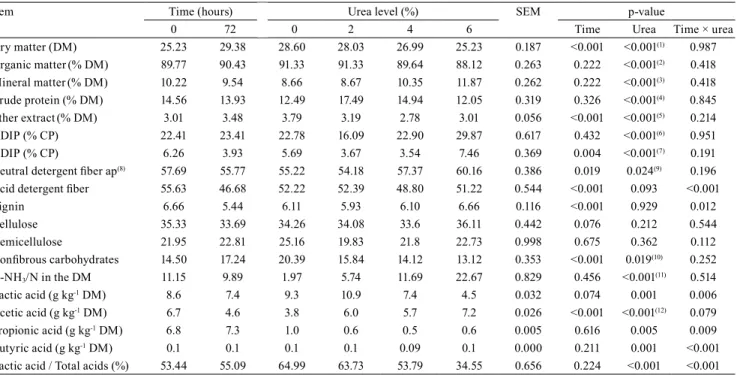
In the decomposition of the interactions between
urea levels and exposure time for ADF and lignin,
a difference was detected between contents of these fractions at 0 and 72 hours for the urea levels of 4 and 6%. This result can be explained by the occurrence
of ammonolysis, which makes the link between N and lignin. After the exposure to air (72 hours), N
is released; at the same time, alkaline swelling of the cellulose may occur, facilitating the use of part of the available cellulose by the microorganisms. According
to Fadel et al. (2003), the ammonolysis between
ammonia and ester-like bonds between hemicellulose or lignin results in the formation of one amide. These
reactions might have reduced the ADF and lignin
values of the silages at 72 hours of exposure of the
ensiled mass (Figure 2). In this way, the addition of
4 or 6% urea to the pearl millet silage can increase
the digestibility of fibrous carbohydrates from the silage, considering that the ADF components have low
digestibility, or, like lignin, are indigestible (Berchielli et al., 2006).
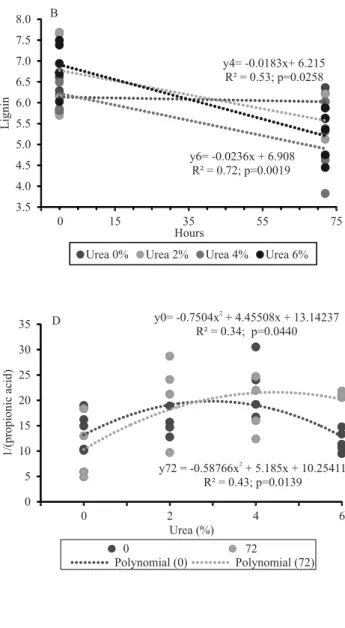
The pH increased linearly as the urea levels were increased, as a consequence of the use of an
alkalinizing additive (Figure 3). Filamentous fungi
and yeasts were observed in the silage with pH below 3.8 (silage with 0% urea), which indicates the occurrence of aerobic instability of the ensiled mass (Table 4). Lopes & Evangelista (2010) also reported inhibition of pH decline in sugarcane silages with 1.5% urea. In the present study, the inclusion of 2% urea resulted in a pH 4.0, which is above the range for ideal yeast growth.
An interaction effect between urea levels and exposure period was observed for lactic, propionic, and butyric acids (g kg-1 DM) and for lactic acid: total
acids ratio (Table 3).
The concentration of ammoniacal N per total N in the
DM (N-NH3/N in the DM) and acetic acid production
increased linearly with the urea levels. The increase
in N-NH3 was 3.71% for each percentage unit of urea.
However, the high ammoniacal N values in the present
study can not be attributed to the microorganism proteolysis of the genus Clostridium, because the silos were produced over canvas, without any contact with the soil or animal feces, and the silages had low presence of enterobacteria (Table 4).
In the present study, lactic acid ranged from 4.5 to 10.9 g kg-1 DM in the pearl millet silages enriched
with urea. This result is similar to those reported by Pinho et al. (2014), who evaluated silage of different
pearl millet genotypes subjected to N fertilization. The
maximum value for the percentage of butyric acid was
2.1% (Figure 2).
In the decomposition of the interaction, a decreasing linear effect on lactic acid at zero time was observed as a function of urea levels, as well as differences between the means at the urea levels 0 and 6% for the exposure
times (0 and 72 hours) (Figure 2). The inclusion
of 6% urea in the pearl millet ensiling reduced the concentration of lactic acid at the times 0 and 72 hours.
Butyric acid showed a quadratic effect as a function of urea levels. The reduced butyric acid values, observed in the silages at 0 and 72 hours, indicate that there was no contamination by microorganisms of the genus Clostridium.
In general, by the decompositions of the interactions for organic acids, we can infer both their higher values in the silages with 0% urea at 72 hours of exposure, in relation to the opening time (zero time), and the action of aerobic microorganisms on the deterioration of the ensiled mass exposed to air. The silage exposure to air transforms the anaerobic medium (responsible for the preservation of forage) into aerobic one, which promotes the growth of aerobic microorganisms and alters the nutritional value of the silage (Pinho et al., 2016).
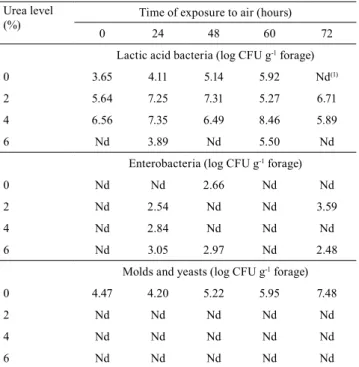
After the silos were opened, no action of filamentous
fungi or yeast was observed in the silages ammoniated with 4 and 6% urea. However, in the silage without urea (0%), the presence of molds was observed in
some parts of the material. These visual findings can be confirmed by the count of microbial populations
(Table 4).
The urea addition of 2, 4, and 6% showed a
fungicide action on the silage, no significant presence of filamentous fungi and yeasts was observed in
these. This is an important result, as silages with mold occurrence should be discarded, since their presence is associated with contamination by mycotoxins.
Yitbarek & Tamir (2014) confirmed that urea elevates
the crude protein content and improves the aerobic stability of silages when silos are unloaded.
Figure 2. Mean values of the interaction between time and urea levels for: A, acid detergent fiber (ADF); B, lignin; C, lactic
acid; D, propionic acid; E, butyric acid; and F, lactic acid / total acid ratio. y2 = -0.0911x + 55.972
R² = 0.6058; p=0.0229
y4 = -0.1937x + 55.343 R² = 0.7864; p=0.0006
y6 = -0.2063x + 58.196 R² = 0.7662; p=0.0009
35 40 45 50 55 60 65
0 15 35 55 75
ADF
Hours
Urea 0% Urea 2% Urea 4% Urea 6%
y4=-0.0183x+ 6.215 R² = 0.53; p=0.0258
y6=-0.0236x + 6.908 R² = 0.72; p=0.0019
3.5 4.0 4.5 5.0 5.5 6.0 6.5 7.0 7.5 8.0
0 15 35 55 75
Lignin
Hours
Urea 0% Urea 2% Urea 4% Urea 6%
0
72
-0.5 0.0 0.5 1.0 1.5
0
2
4
6
Hours
Log10(lactic acid)
Urea (%)
-0.5-0.0 0.0-0.5 0.5-1.0 1.0-1.5
y0= -0.7504x + 4.45508x + 13.142372 R² = 0.34; p=0.0440
y72 = -0.58766x + 5.185x + 10.254112 R² = 0.43; p=0.0139
0 5 10 15 20 25 30 35
0 2 4 6
1/(propionic acid
)
Urea (%)
0 72
Polynomial (0) Polynomial (72)
y = 0.00068694x - 0.00326x + 0.011582 R² = 0.65; p=0.0004
0.000 0.005 0.010 0.015 0.020 0.025
0 2 4 6
Butyric acid
Urea (%)
0 hour 72 hours 0 hour
y0 = -3.46327x + 63.55646 R² = 0.77; p<0.0001 y72 = -6.39431y + 74.23911
R² = 0.79; p<0.0001
0 10 20 30 40 50 60 70 80
0 2 4 6
Lactic acid/total acid ratio
Urea (%)
0 hour 72 hours
A
B
C D
E
inhibited the growth of lactic acid and stimulated the growth of enterobacteria after the opening of the silos and their exposure to air, which resulted in nutrient losses and nonmaintenance of aerobic stability. Although the addition of 2 and 4% urea had increased CP and ADIP
concentrations in the silage, losses were not reduced.
Nevertheless, the control of mold appearance after
exposure to air can justify the use of urea as an additive, as it would prevent the discard of silages.
Conclusions
1. The compaction density of 800 kg m-3 reduces
losses in the ensiling of pearl millet and provides silage with greater nutritional value, in comparison with the 600 kg m-3 compaction density.
2. Urea does not reduce losses or improve the aerobic stability of the silages; however, it controls the development of molds in silage exposed to air.
Acknowledgments
To Conselho Nacional de Desenvolvimento Científico e Tecnológico (CNPq), for financial support.
References
AMODU, J.T.; KALLAH, M.S.; ADEYINKA, I.A.; ALAWA, J.P.; LAKPINI, C.A.M. The nutritive value of silages made form
mixtures of pearl millet (Pennisetum americanum) and lablab
(Lablab purpureus) as feed for Yankasa rams. Asian Journal
of Animal and Veterinary Advances, v.3, p.78-84, 2008. DOI:
10.3923/ajava.2008.78.84.
BERCHIELLI, T.T.; PIRES, A.V.; OLIVEIRA, S.G. de. Nutrição
de ruminantes.Jaboticabal: Funep, 2006. 583p.
BOLSEN, K.K.; LIN, C.; BRENT, B.E.; FEYERHERM, A.M.; URBAN, J.E.; AIMUTIS, W.R. Effect of silage additives on the
microbial succession and fermentation process of alfalfa and corn silages. JournalofDairyScience, v.75, p.3066-3083, 1992. DOI: 10.3168/jds.S0022-0302(92)78070-9.
BRUNETTE, T.; BAURHOO, B.; MUSTAFA, A.F. Effects of
replacing grass silage with forage pearl millet silage on milk yield, nutrient digestion, and ruminal fermentation of lactating dairy cows. Journal of Dairy Science, v.99, p.269-279, 2016. DOI: 10.3168/jds.2015-9619.
FADEL, R.; ROSA, B.; OLIVEIRA, I.P. de; OLIVEIRA, J.D. de S. Avaliação de diferentes proporções de água e de uréia sobre
a composição bromatológica da palha de arroz. Ciência Animal
Brasileira, v.4, p.101-107, 2003.
GIMENES, A.L. de G.; MIZUBUTI, I.Y.; MOREIRA, F.B.; PEREIRA, E.S.; RIBEIRO, E.L. de A.; MORI, R.M. Composição
química e estabilidade aeróbia em silagens de milho preparadas
com inoculantes bacteriano e/ou enzimático. Acta Scientiarum.
Animal Sciences, v.28, p.153-158, 2006. DOI: 10.4025/
actascianimsci.v28i2.640.
HALL, M.B. Neutral detergent-soluble carbohydrates:
nutritional relevance and analysis. Gainesville: University of
Florida, 2000. 76p. (Bulletin, 339).
0 24
36 48
60 72
3 5 7 9
0
2
4
6
Hours
pH
Urea level
3-5 5-7 7-9
Figure 3. Mean pH values of pearl millet (Pennisetum
glaucum) silages enriched with urea as a function of time of exposure to air.
Table 4. Microbial population counts in pearl millet
(Pennisetum glaucum) silages ammoniated with urea as a function of time of exposure to air.
Urea level (%)
Time of exposure to air (hours)
0 24 48 60 72
Lactic acid bacteria (log CFU g-1 forage)
0 3.65 4.11 5.14 5.92 Nd(1)
2 5.64 7.25 7.31 5.27 6.71
4 6.56 7.35 6.49 8.46 5.89
6 Nd 3.89 Nd 5.50 Nd
Enterobacteria (log CFU g-1 forage)
0 Nd Nd 2.66 Nd Nd
2 Nd 2.54 Nd Nd 3.59
4 Nd 2.84 Nd Nd Nd
6 Nd 3.05 2.97 Nd 2.48
Molds and yeasts (log CFU g-1 forage)
0 4.47 4.20 5.22 5.95 7.48
2 Nd Nd Nd Nd Nd
4 Nd Nd Nd Nd Nd
6 Nd Nd Nd Nd Nd
KAMALI, R.; TOGHDORY, A.; MOHAJER, M.; MIRHADI, S.A.; GHOLAMI, H. Investigation of quality characteristics of
pearl millet silage. International Research Journal of Applied
and Basic Sciences, v.3, p.1854-1858, 2012.
KESKİN, B.; YILMAZ, İ.H.; KARSLI, M.A.; NURSOY, H.
Effects of urea or urea plus molasses supplementation to silages with different sorghum varieties harvested at the milk stage on the quality and in vitro dry matter digestibility of silages. Turkish
Journal of Veterinary and Animal Sciences, v.29, p.1143-1147,
2005.
KUNG JR., L.; RANJIT, N.K. The effect of Lactobacillus
buchneri and other additives on the fermentation and aerobic
stability of barley silage. Journal of Dairy Science, v.84, p.1149-1155, 2001. DOI: 10.3168/jds.S0022-0302(01)74575-4.
LICITRA, G.; HERNANDEZ, T.M.; VAN SOEST, P.J.
Standartization of procedures for nitrogen fractionation of ruminant feeds. Animal Feed Science and Technology, v.57, p.347-358, 1996. DOI: 10.1016/0377-8401(95)00837-3.
LOPES, J.; EVANGELISTA, A.R. Características bromatológicas,
fermentativas e população de leveduras de silagens de cana-de-açúcar acrescidas de ureia e aditivos absorventes de umidade.
Revista Brasileira de Zootecnia, v.39, p.984-991, 2010. DOI:
10.1590/S1516-35982010000500007.
LOURES, D.R.S.; GARCIA, R.; PEREIRA, O.G.; CECON, P.R.; SOUZA, A.L. de. Características do efluente e composição
químico-bromatológica da silagem de capim-elefante sob diferentes níveis de compactação. Revista Brasileira de
Zootecnia, v.32, p.1851-1858, 2003. DOI:
10.1590/S1516-35982003000800007.
MARTINS, S.C. dos S.G.; CARVALHO, G.G.P.; PIRES, A.J.V.; SILVA, R.R.; LEITE, L.C.; PEREIRA, F.M.; MOTA, A.D.S.; NICORY, I.M.C.; CRUZ, C.H. da. Parâmetros qualitativos de silagens de cana-de-açúcar tratadas com ureia e óxido de cálcio.
Semina: Ciências Agrárias, v.36, p.1135-1144, 2015. DOI:
10.5433/1679-0359.2015v36n2p1135.
MCDONALD, P.; HENDERSON, A.R.; HERON, S.J.E. The
biochemistry of silage. 2nd ed. Marlow: Chalcombe, 1991. 340p.
MERTENS, D.R. Challenges in measuring insoluble dietary
fiber. Journal of Animal Science, v.81, p.3233-3249, 2003. DOI:
10.2527/2003.81123233x.
PINHO, R.M.A.; SANTOS, E.M.; CAMPOS, F.S.; RAMOS, J.P. de F.; MACEDO, C.H.O.; BEZERRA, H.F.C.; PERAZZO, A.F. Silagens de milheto submetidas à adubação nitrogenada.
Ciência Rural, v.44, p.918-924, 2014. DOI:
10.1590/S0103-84782014000500025.
PINHO, R.M.A.; SANTOS, E.M.; SILVA, T.C.; PERAZZO, A.F.; PEREIRA, O.G.; MACEDO, A.J. da. Microbiologia e o processo de ensilagem. In: SANTOS, E.M.; PARENTE, H.N.; OLIVEIRA,
J.S.; PARENTE, M.O.M. (Ed.). Ensilagem de plantas forrageiras
para o Semiárido. São Luís: Ed. da UFMA, 2016. p.87-146.
RONG, H.; CHENG-QUN, Y.; ZHI-HUA, L.; SHIMOJO, M.;
TAO, S. Evaluation of fermentation dynamics and structural
carbohydrate degradation of Napiergrass ensiled with additives
of urea and molasses. Pakistan Veterinary Journal, v.33, 374-377, 2013.
SANTOS, M.V.F.; GÓMEZ CASTRO, A.G.; PEREA, J.M.; GARCÍA, A.; GUIM, A.; PÉREZ HERNÁNDEZ, M. Fatores
que afetam o valor nutritivo da silagens de forrageiras tropicais.
Archivos de Zootecnia, v.59, p.25-43, 2010.
SCHMIDT, P.; MARI, L.J.; NUSSIO, L.G.; PEDROSO, A. de F.; PAZIANI, S. de F.; WECHSLER, F.S. Aditivos químicos
e biológicos na ensilagem de cana-de-açúcar. 1. Composição química das silagens, ingestão, digestibilidade e comportamento ingestivo. Revista Brasileira de Zootecnia, v.36, p.1666-1675, 2007. DOI: 10.1590/S1516-35982007000700027.
SCHMIDT, P.; NUSSIO, L.G.; QUEIROZ, O.C.M.; SANTOS, M.C.; ZOPOLLATTO, M.; TOLEDO FILHO, S.G.; DANIEL,
J.L.P. Effects of Lactobacillus buchneri on the nutritive value
of sugarcane silage for finishing beef bulls. Revista Brasileira
de Zootecnia, v.43, p.8-13, 2014. DOI:
10.1590/S1516-35982014000100002.
SILVA, D.J.; QUEIROZ, A.C. de. Análise de alimentos: métodos
químicos e biológicos. 3.ed. Viçosa: Ed. da UFV, 2002. 235p. TAVARES, V.B.; PINTO, J.C.; EVANGELISTA, A.R.; FIGUEIREDO, H.C.P.; ÁVILA, C.L. da S.; LIMA, R.F. de.
Efeitos da compactação, da inclusão de aditivo absorvente e do emurchecimento na composição bromatológica de silagens de capim-tanzânia. Revista Brasileira de Zootecnia, v.38, p.40-49, 2009. DOI: 10.1590/S1516-35982009000100006.
TAYLOR, C.C.; KUNG JR., L. The effect of Lactobacillus
buchnneri 40788 on the fermentation and aerobic stability of high
moisture corn in laboratory silos. Journal of Dairy Science, v.85, p.1526-1532, 2002. DOI: 10.3168/jds.S0022-0302(02)74222-7.
TREVISOLI, F.C.A. Características fermentativas e
composição bromatológica da silagem de cultivares de milheto
com inclusão de casca de soja. 2014. 90p. Tese (Doutorado) –
Universidade Federal de Góias, Goiânia.
VAN SOEST, P.J.; ROBERTSON, J.B.; LEWIS, B.A. Methods for dietary fiber, neutral detergent fiber, and nonstarch polysaccharides
in relation to animal nutrition. Journal of Dairy Science, v.74, p.3583-3597, 1991. DOI: 10.3168/jds.S0022-0302(91)78551-2.
VIEIRA, F.A.P.; BORGES, I.; STEHLING, C.A.V.; GONÇALVES, L.C.; COELHO, S.G.; FERREIRA, M.I.C.; RODRIGUES, J.A.S.
Qualidade de silagens de sorgo com aditivos. Arquivo Brasileiro
de Medicina Veterinária e Zootecnia, v.56, p.764-772, 2004.
DOI: 10.1590/S0102-09352004000600011.
YITBAREK, M.B.; TAMIR, B. Silage additives: review. Open
Journal of Applied Sciences,v.4, p.258-274, 2014. DOI: 10.4236/
ojapps.2014.45026.
ZANINE, A. de M.; SANTOS, E.M. dos; DÓREA, J.R.R.; DANTAS, P.A. de S.; SILVA, T.C. da; PEREIRA, O.G. Evaluation
of elephant grass silage with the addition of cassava scrapings.
Revista Brasileira de Zootecnia, v.39, p.2611-2616, 2010. DOI:
10.1590/S1516-35982010001200008.