Baroreflex dysfunction in rats submitted to protein restriction
Igor de O. Loss
a, Luciano G. Fernandes
a, Carlito D.D. Martins
a, Leonardo M. Cardoso
a,
Marcelo E. Silva
b, Valdo J. Dias-da-Silva
c, Márcio F.D. Moraes
d, Deoclécio A. Chianca Jr.
a,⁎
aDepartment of Biological Sciences, DECBI-NUPEB, Federal University of Ouro Preto, 35400-000, Ouro Preto, MG, Brazil bLaboratory of Experimental Nutrition, ENUT, Federal University of Ouro Preto, 35400-000, Ouro Preto, MG, Brazil
cDepartment of Biological Sciences, Federal University of the Triangulo Mineiro, 38015-050, Uberaba, MG, Brazil d
Department of Physiology and Biophysics, Federal University of Minas Gerais, 31270-901, Belo Horizonte, MG, Brazil
Received 25 April 2007; accepted 3 August 2007
Abstract
Earlier studies from the authors' laboratory showed that malnourishment induces alterations in the cardiovascular homeostasis increasing the basal mean arterial pressure and heart rate. In this study, the authors evaluated whether the sympathetic and parasympathetic efferent activities contribute to changes in the cardiovascular homeostasis through altered modulation of the arterial baroreflex of malnourished rats. After weaning, male Fischer rats were given 15% (Normal Protein—NP) or 6% (Low Protein—LP) protein diet for 35 d. The baroreflex gain and latency were evaluated before and after selective autonomic blockades in control and malnourished rats. It was observed that malnourishment affected the baroreflex gain in response to activation and deactivation of the arterial baroreflex. Moreover, malnourished rats showed increased baroreflex latency as compared to that of control rats. Regarding the autonomic efferent activity directed to the heart, the data showed increased sympathetic and decreased parasympathetic efferent activities in malnourished rats, and such alterations could be related to the observed changes in the arterial baroreflex gain as well as in the basal mean arterial pressure and heart rate.
© 2007 Elsevier Inc. All rights reserved.
Keywords:Autonomic dysfunction; Malnourishment; Baroreflex gain; Baroreflex latency; Methyl-atropine; Metoprolol
Introduction
Although the right to food and nutrition has been enshrined in the Universal Human Rights Declaration more than 50 years ago, malnourishment continues to be one of the most difficult pro-blems of public health in developing countries (de Onis et al., 2000; Sawaya et al., 2003). Several studies suggest that low protein intake leads to biochemical, physiological, and cardio-vascular alterations (Barker et al., 1989, 1990, 1993; Benabe et al., 1993a,b; Benabe and Martinez-Maldonado, 1993, 1998; Brawley et al., 2003; Mi et al., 2000). Blood pressure is under tonic autonomic control through sympathetic and parasympa-thetic branches of the autonomic nervous system whose efferent
activities are adjusted every moment by integrating several neural cardiovascular reflexes to maintain the blood pressure within a narrow range of variation (Loewy, 1990). Among the cardiovas-cular neural mechanisms, the arterial baroreceptor reflex repre-sents a homeostatic cardiovascular mechanism that maintains the mean arterial pressure within normal levels by coupling the cardiac output with the tissue demand (Machado et al., 1997; Machado, 2001). Baroreflex activation produces parasympathoexcitation and sympathoinhibition to “buffer” alterations produced by an increase in the arterial pressure (Machado et al., 1997; Machado, 2001). The sympathetic and parasympathetic contributions to the changes in the heart rate subsequent to baroreflex activation have distinct characteristics related to central pathways, latencies and abilities to increase or reduce the heart rate (Loewy, 1990). While the tachycardia observed in response to baroreflex deactivation seems to be determined by changes in both autonomic branches, including inhibition of parasympathetic activity and sympathetic activation (mainly), bradycardic responses during baroreflex acti-vation seem to be dependent on rapid vagal discharges directed to ⁎ Corresponding author. Tel.: +55 31 3559 1721; fax: +55 31 3559 1680.
E-mail address:[email protected](D.A. Chianca).
URL's:http://www.nupeb.ufop.br/lfc(I.O. Loss),
http://www.nupeb.ufop.br/lfc(L.G. Fernandes),http://www.nupeb.ufop.br/lfc
(C.D.D. Martins),http://www.nupeb.ufop.br/lfc(L.M. Cardoso),
http://www.nupeb.ufop.br/lfc(D.A. Chianca).
the heart, because the sympathetic activity is slower to respond to sudden changes in mean arterial pressure (MAP) (Head and McCarty, 1987).
In earlier laboratory studies, the authors evidenced increased basal mean arterial pressure and heart rate (Oliveira et al., 2004), as well as increased baroreflex gain in rats subjected to a low protein diet (Tropia et al., 2001). The sympathetic vasomotor tonus in the experimental model also seems to have increased (Tropia et al., 2001). To further elucidate the cardiovascular autonomic changes associated with malnourishment, the present work was aimed at evaluating the involvement of the sympathetic and parasympathetic efferent activity directed to the heart in the modulation of the baroreflex function of malnourished animals.
Materials and methods
Animals
Male Fischer rats from the Experimental Nutrition Laboratory of the School of Nutrition at Federal University of Ouro Preto were used in this study. After birth, the offspring were randomly picked up and eight puppies were kept with each dam. The dams continued to receive commercial food (normal protein content) and waterad libitumand the pups were weaned after 28 d. After weaning, the male rats were divided into two groups: control group, receiving diet containing 15% protein (Normal Protein Diet—NP) and experimental malnourished group, receiving diet containing 6% protein (Low Protein Diet—LP) for the next 35 d. Thereafter, during the next 7 d, the rats underwent expe-rimental protocols and continued receiving expeexpe-rimental rat chow (normal or low protein diet according to the experimental group). During all experimental protocols, the rats remained in controlled laboratory conditions (12/12 h light/darkness cycle, temperature: 23–25 °C).
Arterial blood pressure and heart rate recordings
Under tribromoethanol anesthesia (250 mg/kg, ip; Aldrich Chemical Company, Inc., Milwaukee, WI, USA), a polyethylene catheter (PE-10 connected to PE-50; Clay Adams, Parsippany, NJ, USA), filled with heparinized PBS (125 U/ml), was inserted into the abdominal aorta through the left femoral artery for mea-surement of pulsatile arterial pressure (PAP). Another catheter was inserted into the inferior vena cava through the left femoral vein for systemic administration of drugs. The free endings of both the catheters were tunneled subcutaneously and exteriorized through the back of the neck. The next day, at the time of cardiovascular recordings, the arterial catheters were connected to pressure transducer (Model MLT0699; ADInstruments Pty Ltd., Castle Hill, NSW Australia). The data acquisition was made through an analog-to-digital data acquisition system (Model PowerLab 400; ADInstruments Pty Ltd., Castle Hill, NSW Aus-tralia). The data were sampled at 12 bits using a 200-Hz sampling rate. Heart rate (HR) and mean arterial pressure (MAP) were derived off-line from PAP using the Chart for Windows software, version 4.1.2 (ADInstruments Pty Ltd., Castle Hill, NSW Aus-tralia). The baseline cardiovascular variables, MAP and HR, were recorded during the 15 min before each experimental trial. All trials were performed on conscious and unrestrained rats.
The baroreceptor reflex evaluation
Changes in MAP and HR were elicited by bolus injections of phenylephrine (0.25 to 4.0 μg/kg, i.v., Sigma, St. Louis, MO, USA) or sodium nitroprusside (0.7 to 10.0μg/kg, i.v., Sigma, St. Louis, MO, USA). The difference between the baseline just before baroreflex activation or deactivation and the peak of the changes in the MAP and HR produced by baroreflex activation or deactivation were measured asΔMAP andΔHR, respectively.
The baroreflex gain was evaluated through dividing the maximum
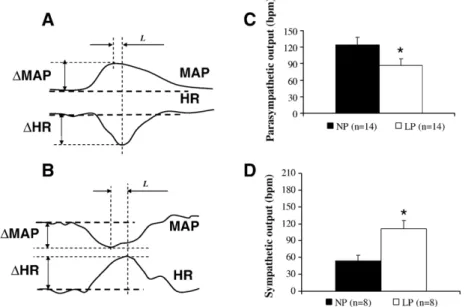
ΔHR alteration by the maximumΔMAP produced by pressor or depressor drugs. The indexΔHR/ΔMAP of each drug injection was calculated for all the groups in different conditions of autonomic blockades, that is, sympathetic and/or parasympathetic antagonism (using metoprolol or methyl-atropine, respectively). The latency of the baroreflex was accepted as the time (expressed in seconds) between the peak of the pressure response and the peak of its respective chronotropic (bradycardic or tachycardic) response (Fig. 1A and B, respectively).
Autonomic cardiac antagonisms
To perform vagal blockade in this study, atropine methyl-sulfate (4 mg/kg, i.v., in bolus, Sigma Chemical Co., St. Louis, MO, USA) was used.β1-adrenergic blockade was performed by theβ1-adrenergic receptors antagonist metoprolol (10 mg/kg, i.v. in bolus, Sigma Chemical Co., St. Louis, MO, USA). The para-sympathetic tonus to the heart was calculated by the difference between the maximum HR after systemic administration of atropine and the basal level of HR. The sympathetic tonus to the heart was obtained by calculating the difference between the basal
HR and the minimum HR after the systemic administration of metoprolol.
Statistical analysis
All the data were expressed as mean ± S.E.M. Unpaired or paired Studentt-tests were used when comparing two groups. Significance level was fixed atPb0.05.
Results
Protein restriction, during the 35 d of experimental protocol, induced in the animals significant reduction in body weight of the LP group as compared to that of the NP group (67 ± 1 gvs.207 ± 2 g, respectively), and significant increase in both basal MAP and HR (124 ± 3 mmHg and 435 ± 9 bpm;n= 26vs.114 ± 2 mmHg and 388 ± 6 bpm, respectively).
Brief note regarding the animals' health
But for the low weight gain, none of the malnourished animals used in this study presented any signs of sickness of any kind. The
evaluation of the autonomic tonus directed to the heart, illustrated inFig. 1C, shows that the parasympathetic tonus, observed after administering atropine, diminished in LP rats as compared to that in NP animals (+87 ± 11vs.+124 ± 14 bpm, respectively), while Fig. 1D shows that sympathetic efferent activity increased in the LP group as compared to that of the NP group (+111 ± 15
vs.+54 ± 11 bpm, respectively).
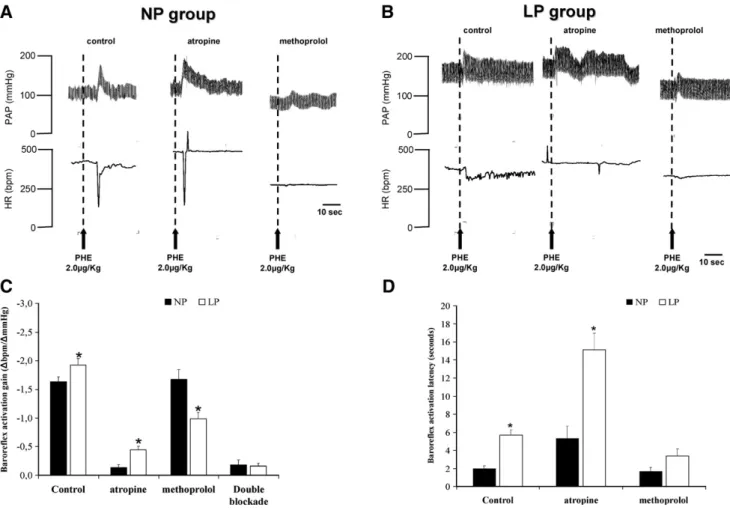
Fig. 2, showing representative tracings from representative rats of the groups, illustrates the cardiovascular changes observed in the MAP and HR subsequent to baroreceptor acti-vation of NP (2A) and LP (2B) groups. In the panel C ofFig. 2 are depicted the data concerning the baroreflex gain in control (NP) and malnourished rats (LP) before and after systemic administration of atropine and/or metoprolol. The LP group showed more baroreflex gain in response to phenylephrine bolus injection, before (control) (−1.93 ± 0.11 bpm/mmHgvs.−1.64 ± 0.08 bpm/mmHg) and after atropine administration (−0.44 ± 0.07
vs.−0.14 ± 0.05 bpm/mmHg, respectively) than that shown by NP animals. Afterβ1-adrenergic blockade, the baroreflex gain was higher in NP rats than in LP rats (−1.68 ± 0.17 bpm/mmHg
vs.−0.99 ± 0.11 bpm/mmHg, respectively) and after the double blockade (atropine + metoprolol), no difference was found in baroreflex gain between LP and NP groups (−0.31 ± 0.41 vs.
−0.33 ± 0.17 bpm/mmHg, respectively). Also, the latency of the baroreflex response (Fig. 2D) to phenylephrine injection increa-sed in LP group before (5.70 ± 0.58vs.1.99 ± 0.29 s, respectively) and after systemic administration of atropine (15.13 ± 1.81 vs.
5.31 ± 1.37 s, respectively). No significant differences were found between LP and NP animals after the systemic administration of metoprolol (5.08 ± 2vs.3.14 ± 3.57 , respectively).
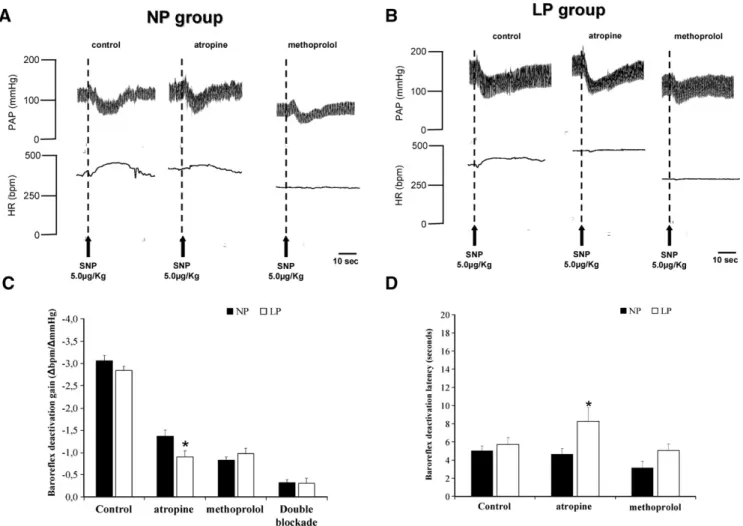
Fig. 3A and B depict tracings of representative rats from NP and LP groups (respectively) showing the changes in the baseline MAP and HR in response to baroreflex deactivation. Also,Fig. 3 shows the changes in the gain of the tachycardic response to baroreflex deactivation (3C) and latency (3D) through sodium nitroprusside bolus injection, before and after systemic administration of atropine and/or metoprolol in LP and NP animals. Before autonomic blockade (control), the barore-flex gain in LP rats was not different from that observed in NP rats (−2.84 ± 0.10 bpm/mmHg vs. −3.06 ± 0.12 bpm/mmHg,
respectively). On the other hand, atropine significantly reduced the baroreflex gain in LP rats as compared to that in NP rats, (−0.90 ± 0.13 vs. −1.37 ± 0.13 bpm/mmHg, respectively). No differences were found after β1-adrenergic (−0.98 ± 0.56
vs.−0.83 ± 0.33 bpm/mmHg, respectively) or double autonomic blockade (−0.31 ± 0.41 vs. −0.33 ± 0.17 bpm/mmHg, respec-tively). Similar results were obtained for the latency of the tachycardic response to baroreflex deactivation (Fig. 3D): In the control condition (before autonomic blockades), the latency of tachycardic baroreflex responses in LP rats was not different from that of the NP group (5.70 ± 0.76 vs. 5.02 ± 0.53 s, res-pectively) and no significant changes were found after meto-prolol (5.08 ± 3.35 vs. 3.14 ± 3.57 s, respectively). After cholinergic antagonism, however, the latency of the baroreflex response seems to have increased in LP rats in comparison to that in NP rats (8.25 ± 6.81vs.4.64 ± 2.84 s, respectively).
Discussion
Reduced nutrient intake is a serious problem of public health in underdeveloped countries (de Onis et al., 2000). Malnourishment often produces marked impacts leading to multiple organ lesions, including cardiovascular disturbances (Fernandez-Repollet et al., 1987, 1989; Hawkins et al., 2000; Oliveira et al., 2004). It also produces disturbances in the baroreflex sensitivity (Tropia et al., 2001).
Reduced protein intake was used in this study and in others (Agarwal et al., 1981; Benabe et al., 1993a,b; Benabe and Martinez-Maldonado, 1993, 1998; Ferreira et al., 2003; Tropia et al., 2001) as a model of malnourishment. In this study, it was demonstrated that in the rats, subjected to protein restriction, the mean body weight loss was approximately one-third of the mean body weight of their respective controls. In the literature, the deficit in body weight was considered as an index of protein restriction and malnourishment in distinct experimental protocols (Kim et al., 1994; Oliveira et al., 2004; Zucoloto et al., 1975).
The present study comprised experiments regarding the auto-nomic modulation of the baroreflex chronotropic responses. Ini-tially, the evaluation of the autonomic tonus to the basal HR in malnourished rats showed an increased basal sympathetic efferent activity and a reduced parasympathetic activity. The chronic sympathetic activation of the heart leads to the development and/ or maintenance of heart failure status, thereby increasing the risk of sudden death both in rats and humans (Fletcher, 2001; Judy et al., 1976; Schultz et al., 2007; Schultz and Li, 2007). Moreover, several researchers related the development of cardiovascular dysfunction to malnourishment in individuals (Sawaya et al., 2003; Young et al., 1985), thereby underscoring the importance of studies concerning the genesis of autonomic imbalance in indi-viduals subjected to chronic low protein diet.
Regarding baroreflex activation, it was observed that the increase in baroreflex gain, following baroreflex activation in the control period and after methyl-atropine systemic adminis-tration, was higher in LP rats than in NP rats. This suggests an increase in the sympathoinhibition in LP animals, which is probably related to an increased basal sympathetic activity. The baroreflex activation after metoprolol i.v. injection showed a
decreased baroreflex gain, suggesting a decreased parasym-pathoexcitation. Moreover, the latency to baroreflex activation appears to have increased in LP animals, especially after cho-linergic blockade, pointing to an impaired sympathoinhibitory pathway. The gain and latency related to baroreflex deactivation decreased in LP animals only after cholinergic blockade, suggesting an impaired modulation of the sympathetic activity. Taken together, the data suggest that protein restriction disrupts cardiovascular homeostasis. These alterations in the modulation of the efferent autonomic activity might be responsible for the increased levels of baseline MAP and HR in LP rats. These observations are in tune with the findings of earlier workers on rats (Kim et al., 1994; Langley-Evans et al., 1996a,b, 2003; Tropia et al., 2001; Young et al., 1985; Zucoloto et al., 1975) and in humans (Cruz Angeles and Ortiz-Hernandez, 2006; Fernandes et al., 2003; Florencio et al., 2004; Franco et al., 2006; Sawaya et al., 2003, 2005; Sesso et al., 2004; Tropia et al., 2001).
concerning these pathophysiological mechanisms could provide crucial information for improving the treatment of homeostatic disturbances in people subjected to low protein intake. It also helps the governments of underdeveloped countries in adopting suitable policies for public health management. Moreover, this kind of study could be helpful in unraveling the cross-talk between the cardiovascular and the energetic homeostasis, and in improving the knowledge regarding autonomic modulation of the cardiovascular system.
In summary, the study showed that malnourished male Fischer rats present autonomic disturbances (e.g. increased sympathetic and decreased parasympathetic outflows) directed to their heart and blood vessels, and this accounts for the cardiovascular disturbances observed in them.
Acknowledgments
This research received financial support from Fundação de Amparo à Pesquisa do Estado de Minas Gerais—FAPEMIG and Conselho Nacional de Desenvolvimento Científico e Tecnoló-gico—CNPq.
References
Agarwal, K.N., Prasad, C., Taneja, V., 1981. Protein deprivation and the brain: effect on enzymes and free amino acids related to glutamate metabolism in rats. Annals of Nutrition and Metabolism 25, 228–233.
Barker, D.J., Winter, P.D., Osmond, C., Margetts, B., Simmonds, S.J., 1989. Weight in infancy and death from ischaemic heart disease. Lancet 2, 577–580. Barker, D.J., Bull, A.R., Osmond, C., Simmonds, S.J., 1990. Fetal and placental size and risk of hypertension in adult life. British Medical Journal 301, 259–262. Barker, D.J., Gluckman, P.D., Godfrey, K.M., Harding, J.E., Owens, J.A.,
Robinson, J.S., 1993. Fetal nutrition and cardiovascular disease in adult life. Lancet 341, 938–941.
Begum, N., Song, Y., Rienzie, J., Ragolia, L., 1998. Vascular smooth muscle cell growth and insulin regulation of mitogen-activated protein kinase in hypertension. American Journal of Physiology 275, C42–C49.
Bell, J.M., Slotkin, T.A., 1988. Postnatal nutritional status influences development of cardiac adrenergic receptor binding sites. Brain Research Bulletin 21, 893–896.
Benabe, J.E., Martinez-Maldonado, M., 1993. Dietary modification of the renin angiotensin system. Seminars in Nephrology 13, 567–572.
Benabe, J.E., Martinez-Maldonado, M., 1998. The impact of malnutrition on kidney function. Mineral and Electrolyte Metabolism 24, 20–26. Benabe, J.E., Fernandez-Repollet, E., Tapia, E., Luo, C., Martinez-Maldonado, M.,
1993a. Angiotensin II and catecholamines interaction in short-term low protein feeding. Kidney International 44, 285–293.
Benabe, J.E., Wang, S., Wilcox, J.N., Martinez-Maldonado, M., 1993b. Modulation of ANG II receptor and its mRNA in normal rat by low-protein feeding. American Journal of Physiology 265, F660–F669.
Brawley, L., Itoh, S., Torrens, C., Barker, A., Bertram, C., Poston, L., Hanson, M., 2003. Dietary protein restriction in pregnancy induces hypertension and vascular defects in rat male offspring. Pediatric Research 54, 83–90. Conchillo, M., Prieto, J., Quiroga, J., 2007. Insulin-like growth factor I (IGF-I) and
liver cirrhosis. Revista Española de Enfermedades Digestivas 99, 156–164. Cruz Angeles, L.I., Ortiz-Hernandez, L., 2006. Blood pressure was associated
with body mass but no with pre- and postnatal growth in Mexican school-children. Archivos de Cardiología de México 76, 185–196.
Cruzado, M.C., Risler, N.R., Miatello, R.M., Yao, G., Schiffrin, E.L., Touyz, R.M., 2005. Vascular smooth muscle cell NAD(P)H oxidase activity during the development of hypertension: effect of angiotensin II and role of insulin like growth factor-1 receptor transactivation. American Journal of Hypertension 18, 81–87.
de Onis, M., Frongillo, E.A., Blossner, M., 2000. Is malnutrition declining? An analysis of changes in levels of child malnutrition since 1980. Bulletin of the World Health Organization 78, 1222–1233.
Fernandez-Repollet, E., Tapia, E., Martinez-Maldonado, M., 1987. Effects of angiotensin-converting enzyme inhibition on altered renal hemodynamics induced by low protein diet in the rat. Journal of Clinical Investigation 80, 1045–1049.
Fernandez-Repollet, E., Van Loon, P., Martinez-Maldonado, M., 1989. Renal and systemic effects of short-term high protein feeding in normal rats. American Journal of the Medical Sciences 297, 348–354.
Fernandes, M.T., Sesso, R., Martins, P.A., Sawaya, A.L., 2003. Increased blood pressure in adolescents of low socioeconomic status with short stature. Pediatric Nephrology 18, 435–439.
Ferreira, F., Filiputti, E., Arantes, V.C., Stoppiglia, L.F., Araujo, E.P., Delghingaro-Augusto, V., Latorraca, M.Q., Toyama, M.H., Boschero, A.C., Carneiro, E.M., 2003. Decreased cholinergic stimulation of insulin secretion by islets from rats fed a low protein diet is associated with reduced protein kinase calpha expression. Journal of Nutrition 133, 695–699.
Fletcher, E.C., 2001. Invited review: physiological consequences of intermittent hypoxia: systemic blood pressure. Journal of Applied Physiology 90, 1600–1605.
Florencio, T.T., Ferreira, H.S., Cavalcante, J.C., Sawaya, A.L., 2004. Short stature, obesity and arterial hypertension in a very low income population in North-eastern Brazil. Nutrition Metabolism and Cardiovascular Diseases 14, 26–33.
Franco, M.C., Christofalo, D.M., Sawaya, A.L., Ajzen, S.A., Sesso, R., 2006. Effects of low birth weight in 8- to 13-year-old children: implications in endothelial function and uric acid levels. Hypertension 48, 45–50. Hawkins, P., Steyn, C., McGarrigle, H.H., Saito, T., Ozaki, T., Stratford, L.L.,
Noakes, D.E., Hanson, M.A., 2000. Effect of maternal nutrient restriction in early gestation on responses of the hypothalamic-pituitary-adrenal axis to acute isocapnic hypoxaemia in late gestation fetal sheep. Experimental Physiology 85, 85–96.
Head, G.A., McCarty, R., 1987. Vagal and sympathetic components of the heart rate range and gain of the baroreceptor-heart rate reflex in conscious rats. Journal of Autonomic Nervous System 21, 203–213.
Judy, W.V., Watanabe, A.M., Henry, D.P., Besch Jr., H.R., Murphy, W.R., Hockel, G.M., 1976. Sympathetic nerve activity: role in regulation of blood pressure in the spontaenously hypertensive rat. Circulation Research 38, 21–29. Kim, S.W., Yu, B.P., Sanderford, M., Herlihy, J.T., 1994. Dietary restriction
modulates the norepinephrine content and uptake of the heart and cardiac synaptosomes. Proceedings of the Society for Experimental Biology and Medicine 207, 43–47.
Langley-Evans, S.C., Phillips, G.J., Benediktsson, R., Gardner, D.S., Edwards, C.R., Jackson, A.A., Seckl, J.R., 1996a. Protein intake in pregnancy, placental glucocorticoid metabolism and the programming of hypertension in the rat. Placenta 17, 169–172.
Langley-Evans, S.C., Welham, S.J., Sherman, R.C., Jackson, A.A., 1996b. Weanling rats exposed to maternal low-protein diets during discrete periods of gestation exhibit differing severity of hypertension. Clinical Science (Lond) 91, 607–615.
Langley-Evans, S.C., Langley-Evans, A.J., Marchand, M.C., 2003. Nutritional programming of blood pressure and renal morphology. Archives of Physiology and Biochemistry 111, 8–16.
Lauterio, T.J., Scanes, C.G., 1987. Time course of changes in plasma con-centrations of the growth related hormones during protein restriction in the domestic fowl (Gallus domesticus). Proceedings of the Society for Expe-rimental Biology and Medicine 185, 420–426.
Loewy, A.D., 1990. Central Autonomic Pathways. In: Loewy, A.D., Spyer, K.M. (Eds.), Central Regulation of Autonomic Functions. Oxford university Press, New York, pp. 88–103.
Machado, B.H., 2001. Neurotransmission of the cardiovascular reflexes in the nucleus tractus solitarii of awake rats. Annals of the New York Academy of Sciences 940, 179–196.
Mi, J., Law, C., Zhang, K.L., Osmond, C., Stein, C., Barker, D., 2000. Effects of infant birthweight and maternal body mass index in pregnancy on components of the insulin resistance syndrome in China. Annals of Internal Medicine 132, 253–260.
Nguyen, T.T., Cao, N., Short, J.L., White, P.J., 2006. Intravenous insulin-like growth factor-I receptor antisense treatment reduces angiotensin receptor expression and function in spontaneously hypertensive rats. Journal of Pharmacology and Experimental Therapeutics 318, 1171–1177.
Oliveira, E.L., Cardoso, L.M., Pedrosa, M.L., Silva, M.E., Dun, N.J., Colombari, E., Moraes, M.F., Chianca Jr., D.A., 2004. A low protein diet causes an increase in the basal levels and variability of mean arterial pressure and heart rate in Fisher rats. Nutritional Neuroscience 7, 201–205. Plagemann, A., Harder, T., Rake, A., Melchior, K., Rohde, W., Dorner, G., 2000.
Hypothalamic nuclei are malformed in weanling offspring of low protein malnourished rat dams. Journal of Nutrition 130, 2582–2589.
Sawaya, A.L., Martins, P., Hoffman, D., Roberts, S.B., 2003. The link between childhood undernutrition and risk of chronic diseases in adulthood: a case study of Brazil. Nutrition Reviews 61, 168–175.
Sawaya, A.L., Sesso, R., Florencio, T.M., Fernandes, M.T., Martins, P.A., 2005. Association between chronic undernutrition and hypertension. Maternal and Child Nutrition 1, 155–163.
Schultz, H.D., Li, Y.L., 2007. Carotid body function in heart failure. Respiratory Physiology & Neurobiology 157, 171–185.
Schultz, H.D., Li, Y.L., Ding, Y., 2007. Arterial Chemoreceptors and Sympathetic Nerve Activity. Implications for Hypertension and Heart Failure. Hypertension 50 (1), 6–13.
Sesso, R., Barreto, G.P., Neves, J., Sawaya, A.L., 2004. Malnutrition is associated with increased blood pressure in childhood. Nephron Clinical Practice 97, c61–c66.
Talman, W.T., Perrone, M.H., Reis, D.J., 1980. Evidence forL-glutamate as the neurotransmitter of baroreceptor afferent nerve fibers. Science 209, 813–815.
Tropia, F.C., Cardoso, L.M., Pedrosa, M.L., Silva, M.E., Haibara, A.S., Moraes, M.F., Chianca Jr., D.A., 2001. Effects of low-protein diet on the baroreflex and Bezold–Jarisch reflex in conscious rats. Nutritional Neuroscience 4, 99–107.
Vickers, M.H., Ikenasio, B.A., Breier, B.H., 2001. IGF-I treatment reduces hyperphagia, obesity, and hypertension in metabolic disorders induced by fetal programming. Endocrinology 142, 3964–3973.
Young, J.B., Kaufman, L.N., Saville, M.E., Landsberg, L., 1985. Increased sympathetic nervous system activity in rats fed a low-protein diet. American Journal of Physiology 248, R627–R637.