GASTROENTEROLOGIA EXPERIMENT
AL / EXPERIMENT
AL GASTROENTEROLOGY
PROTECTION OF ESTROGEN IN
PORTAL HYPERTENSION GASTROPATHY –
an experimental model
Maria Isabel
MORGAN-MARTINS
1, 2, Simone Iahnig
JACQUES
1, 2, Renata Minuzzo
HARTMANN
1, 2,
Camila Moraes
MARQUES
1, 2, Cláudio Augusto
MARRONI
3and Norma Possa
MARRONI
1, 2ABSTRACT – Context - Portal hypertension is a complication secondary to cirrhosis that is characterized by increased blood low and/or vascular resistance in the portal system, causing the appearance of a hyperdynamic collateral circulation. Partial portal vein ligation is an experimental model used in rats to study the pathophysiological mechanisms involved in pre-hepatic portal hypertension. Estrogen E2 is an antioxidant molecule with various physiological actions. Objectives - To evaluate the antioxidant activity of endogenous estrogen in an experimental model of partial portal vein ligation by comparing intact with castrated rats. Methods - Twenty Wistar rats, weighing on average 250 g were used and divided into four groups: sham-operated (SO); intact (I) with partial portal vein ligation (I + PPVL), castrated (C) and castrated with partial ligation of the vein (C + PPVL). Day 1: castration or sham-operation; day 7, PPVL surgery; on day 15 post-PPVL, portal pressure in the mesenteric vein of rats was measured on polygraph Letica. Lipid peroxidation in the stomach was assessed using the technique of thiobarbituric acid reactive substances and activity of antioxidant enzymes superoxide dismutase, catalase and glutathione peroxidase. Statistical analysis was done with ANOVA - Student-Newman-Keuls (mean ± SE), and P<0.05 was considered as signiicant. Results - Portal pressure was signiicantly increased in C + PPVL as compared to the other groups. There was no signiicant difference in the group of intact rats. TBARS showed signiicant damage in C and C + PPVL in relation to others. Antioxidant enzymes were signiicantly increased in the castrated rats with subsequent PPVL as compared to the other groups. Conclusion - We suggest that estrogen E2 plays a protective role in intact compared with castrated rats because it presents hydrophenolic radicals in its molecule, thus acting as an antioxidant in this experimental model.
HEADINGS - Stomach diseases. Hypertension, portal. Estrogens. Rats.
INTRODUCTION
Portal hypertension (PH) is a complication of cirrhosis characterized by dilatation of the mesenteric vessels with an increase in portal pressure (PP) and development of collateral circulation which diverts blood from the portal to the systemic circulation, bypassing the liver and leading to the formation of gastroesophageal varices and dilatation of the gastric submucosa, a situation that characterizes portal hypertensive gastropathy (PHG)(6, 23).
PH results from an obstruction of the blood low in vessels caused by different disorders that may occur in pre-, intra- or post-hepatic anatomical locations, respectively, portal thrombosis, cirrhosis and Budd-Chiari syndrome(10, 11).
The attempt to decompress the portal system causes the communication between the portal and systemic circulation vessels to become dilated and tortuous, and one of the most common locations is the submucosa of the stomach and esophagus.
1 Lutheran University of Brazil, Canoas, RS; 2 Porto Alegre Clinical Hospital, Porto Alegre, RS; 3 Federal University of Health Sciences of Porto Alegre, RS, Brazil.
Correspondence: Dr. Maria Isabel Morgan Martins - Rua Nações Unidas, 756 – 92110-340 – Canoas, RS, Brazil. E-mail: [email protected]
The largest component of gastroesophageal varices is formed as a result of anastomosis between the left gastric vein, part of the portal system, and the azygos vein, which drains into the superior vena cava. There may be anastomosis between perisplenic vessels (components of the portal system) and short gastric veins draining into the superior vena cava, constituting the main source for varicose veins of the submucosal plexus of the stomach and for PHG(22).
PHG is characterized by vascular changes occurring predominantly in the gastric submucosa, including red spots or “gastric petechiae”, marked vascular ectasia, and absence of inlammation(23, 30).
The changes in blood low cause the release of vasoactive substances produced by the endothelium as vasodilators (prostacyclin and nitric oxide) and vasoconstrictors (endothelins and prostanoids) that act in paracrine fashion in smooth muscles(22).
partial portal vein ligation (PPVL) is performed, thus increasing the portal venous low without compromising the liver function, as it is a pre-hepatic model. This model allows to evaluate different stages of PH, the interaction between low and resistance of the portal system, the relationship between the development of hyperdynamic circulatory state and the elevation of the portal venous low, and to assess the actions of different drugs that alter the degree of PP(33).
Hemodynamic changes involved in PH lead to increased reactive oxygen species (ROS) in the gastric mucosa, which trigger oxidative stress (OS)(26). Both the hemodynamic changes and the OS affect men and women differently, as described in different randomized studies indicating that the incidence of coronary heart disease is lower in pre-menopausal women than in men the same age, and pointing to an increase of cardiovascular diseases in menopause(32). According to Borras et al.(4) the mitochondria are responsible for differences in longevity between genders, concluding that mitochondrial oxidant production is higher in males than in females. In another study, Borras et al.(5) found that these effects are due to the action of estrogen (E2), which self-regulates the expression of nuclear genes of antioxidant enzymes acting directly on the mitochondria. Thus, E2, with its action as a hormone and its antioxidant activity, contributes to the protective effect in females.
Ovariectomy (castration) is the surgical removal of the ovaries to induce menopause (absence of estrogen). Thus, after the process of castration there is a decrease in serum E2 as well as a reduction of the weight of uterine horns(36).
In cells, E2 can inhibit apoptosis of endothelial cells and promotes angiogenic activity in vitro(15). Estrogens are thus considered vasoprotective agents(20, 41). They act on different intracellular mechanisms due to their antioxidant activity by having a hydrophenolic group in their molecule, which grants them action as scavenger of free radicals, decreasing the formation of ROS(28).
Given that PH leads to the development of a hyperdynamic circulation and oxidative stress, the aim of this study was to investigate the action of E2 in the stomach of female Wistar rats subjected to castration and PPVL.
METHODS
Animals
Twenty female Wistar rats weighing 250 g were used. The animals were obtained from the State Foundation for Production and Research in Health (FEPPS), Porto Alegre, RS, Brazil. They were kept at the vivarium of the Lutheran University of Brazil in plastic boxes measuring 47 cm x 34 cm x 18 cm lined with wood chips, in a 12-hours dark/ light cycle (light from 7 a.m. to 7 p.m.) at a temperature of 22°C ± 4°C. They were fed 16 g per animal/day on rat chow (Purina-Nutripal, Porto Alegre, RS, Brazil) and had water ad libitum.
This experiment complied with the norms of the ethics committee on animal research of the Lutheran University of Brazil, Canoas, RS, Brazil. (Protocol # 55-2010).
Experimental design
The rats were divided into four groups (n = 5): SO (sham-operated), which underwent simulation of both ovariectomy and partial portal vein ligation; intact (I) + PPVL, which were submitted to PPVL but sham ovariectomy; C (castrated), submitted to ovariectomy but sham PPVL; and C + PPVL, submitted to both ovariectomy and PPVL.
Ovariectomy
The procedures for castration (groups C and C + PPVL) and simulation (groups SO and I + PPVL) were performed on the 1st day of the experiment. The rats were anesthetized with ketamine (ketamine chloride, Parke-Davis, São Paulo, SP, Brazil) in a dose of 100 mg/kg and xylazine (Xylazine chloride - LAB) 50 mg/kg IP and surgery was performed bilaterally according to the model of Baker et al.(1).
Partial portal hypertension induction
The animals were anesthetized with ketamine hydrochloride (100 mg/kg) and xylazine hydrochloride (50 mg/kg) IP. After a medium incision in the abdomen, the bowels were gently withdrawn on humidiied gauze with saline and the portal vein was isolated. A 20 g needle was placed into the portal vein and both were tied up using a 3.0 silk yarn, the needle being gently withdrawn after ligation. Subsequently, we ensured that portal vein thrombosis did not occur by manipulating the spot(34).
The SO and C groups underwent the same procedures but their portal veins was not submitted to partial portal vein ligation.
Portal pressure measurement
Portal pressure was measured in mm Hg on polygraph 2006 (Leticia Scientiic Instruments, Barcelona, Spain) by cannulation of the mesenteric vein with a catheter.
Death of animals
The animals were killed after the recording of portal pressure by exsanguination under deep anesthesia. The stomach was removed and weighed, a small fragment was separated and immersed in buffered formalin for histological analysis, and the remainder was homogenized and frozen at -80°C for subsequent biochemical evaluations.
The uterine horn of rats was removed and immediately weighed (wet weight), and then placed in an oven for 24 hours for subsequent measurement of dry weight.
Stomach homogenates
10 minutes at 4,000 rpm (2150,4 x g) (SORVALL RC-5B Refrigerated Superspeed Centrifuge). The supernatant was pipetted into Eppendorf lasks, and the precipitate was discarded. The samples were stored again at –80°C for posterior analyses(21).
Protein
We used the Bradford(8) method to quantify protein, with bovine albumin as the standard (SIGMA®). The samples were measured spectrophotometrically at 595 nm, and values expressed in mg/mL were used to calculate values of TBARS (thiobarbituric acid–reactive substances) and antioxidant enzymes.
Stomach lipoperoxidation
The amount of aldehydes generated by lipid peroxidation is measured by the TBARS method, which measures the amount of substances reacting with thiobarbituric acid. The samples were incubated at 100°C for 30 minutes after addition of 500 μL of 0.37% thiobarbituric acid in 15% trichloroacetic acid and centrifuged at 3,000 rpm (1612.8 x g) for 10 minutes at 4°C. Absorbance was determined spectrophotometrically at 535 nm(9).
Antioxidants enzyme analyses
The analysis of superoxide dismutase (SOD) is based on the inhibition of the reaction of the superoxide radical with adrenaline, values expressed in U/mg prot(24). The analysis of catalase (CAT) activity is based on measuring the decrease in hydrogen peroxide, values expressed in pmol/ mg prot(7, 37). The activity of glutathione peroxidase (GPx) is based on the consumption of NADPH in the reduction of oxidized glutathione(39), values expressed in mmoles/ min/mg prot(14).
Histology
For histological evaluation, part of the stomach was preserved in 10% formalin for 24 hours, embedded in parafin and cut into 3 µm sections with a microtome. The sections were stained with hematoxylin-eosin (100x).
Statistical analysis
All data are presented as means ± SE. Statistical signiicance was calculated using Graphpad Instat, version 3.0 for Windows. We used variance analysis (ANOVA) and Student-Newman-Keuls for multiple analysis, adopting a signiicant level of 5% (P<0.05).
RESULTS
Efficacy of castration
To evaluate the eficacy of surgical castration, the difference between wet and dry weight of uterine horns was calculated. The uterine horns of groups C and C + PPVL had signiicantly lower values (P<0.05) than those of groups I and SO + PPVL for both wet and dry weights (Figure 1).
PP
The analysis of the results of PP in the different experimental groups showed a signiicant increase in C + PPVL as compared to the other groups (P<0.05). It should be highlighted that there was no increase in PP in I + PPVL compared with SO and C, despite PPVL (Figure 2).
0 0,1 0,2 0,3 0,4 0,5 0,6 0,7 0,8 0,9 1
Wet Weight Dry Weight
Weight Dry-Wet (g tissue)
SO I+PPVL C C+PPVL
Mean ± standard error of mean (n = 5)
Signiicant difference (P<0.05) between C and C + PPVL compared with SO and I + PPVL,
for both wet and dry weight of uterine horns
SO – sham-operated, I + PPVL - intact with partial ligation of the portal vein, C - castrated, C+PPVL - castrated with partial portal vein ligation
FIGURE 1. Wet and dry weights of uterine horns of rats subjected to surgical castration and intact rats
40 35 30
25 20 15 10
5 0
SO I+PPVL C C+PPVL
Groups
Portal pressure (mmHg)
* Presents signiicant difference at P<0.05 C + PPVL compared to other groups
SO – sham-operated, I + PPVL - intact with partial ligation of the portal vein, C - castrated, C + PPVL - castrated with partial portal vein ligation
FIGURE 2. Average values of portal pressure (mm Hg) across the different
groups. Mean ± standard error of mean (n = 5)
Lipoperoxidation (LPO)
Antioxidant enzyme activity
The activities of antioxidant enzymes SOD, CAT and GPx were evaluated in homogenized stomach. The data are shown in Table 1. The antioxidant enzymes did not show any significant differences in groups I and SO + PPVL, while groups C and C PPVL showed a different profile.
DISCUSSION
Castration (ovariectomy) induces surgical “menopause”, and 7 days after surgery ovariectomized animals have no detectable levels of estrogen(27). Torrezan et al.(36) demonstrated that ovariectomy decreases the weight of uterine horns, a fact that was conirmed in our study, comparing the eficacy of surgery as well as evidencing the absence of circulating estrogen (Figure 1).
Borekci et al.(18) demonstrated the protection of estrogen in the gastric mucosa, as other authors have demonstrated the greatest protection in the cardiovascular system in women of reproductive age compared with men the same age, for their hormonal and antioxidant activity(3, 12, 13, 17, 27).
Intact or castrated female rats were subjected to PPVL (pre-hepatic model) and then analyzed regarding the inluence of castration (absence of estrogen) in PH-related changes, mainly to PHG.
A previous work by our group(26) and other authors(6, 34, 38, 40) showed that on day 15 post-PPVL there is a signiicant increase in PP in all animals. In the present study with female rats subjected to PPVL, the intact rats showed no signiicant increase in PP, but in the castrated rats PP was signiicantly increased (P<0.05) (Figure 2). Intact rats with PPVL and castrated rats without PPVL were found to have the same proile of greater portal pressure as compared to SO animals, a inding that was not signiicant but may be considered as an effect of the absence of estrogen by castration. The absence of estrogen and PPVL potentiate the actions causing PP increase. We note that in intact rats, therefore with estrogen, PPVL appears not to cause the usual increase in PP, which seems to indicate a degree of protection by estrogen preventing that signiicant increase. This protection could possibly be related Mean ± standard error of mean (n = 5)
# Presents signiicant difference (P<0.05) in group C + PPVL and C compared to the other
groups
SO – sham-operated; I + PPVL - intact with partial ligation of the portal vein; C - castrated, C + PPVL - castrated with partial portal vein ligation
6
5
4
3
2
1
0
TB
ARS (n moles/mg prot.)
Groups
SO I+PPVL C C+PPVL
FIGURE 3. Average TBARS values in different groups
# *Signiicant increase (P<0.05) of SOD and CAT in groups C and C + PPVL compared to
the other groups
* Signiicant increase (P<0.05) in GPx compared to the other groups
Mean ± standard error of mean (n = 5). SO – sham-operated, I + PPVL - intact with partial liga-tion of the portal vein, C - castrated, C + PPVL - castrated with partial portal vein ligaliga-tion
SO I+PPVL C C+PPVL
SOD (USOD/mg prot) 26.33 ± 5 24.17 ± 1,6 80.73 ± 8.5* 112.64 ± 9.8# CAT (pmoles/mg de prot) 0.14 ± 0.02 0.16 ± 0.01 0.24 ± 0.005* 0.35 ± 0.06# GPx (nmoles/min/mg prot) 0.67 ± 0.28 0.51 ± 0.18 2.9 ± 0.05* 0.57 ± 0.02
TABLE 1. Values of SOD, CAT and GPx activities
Group C showed a signiicant increase (P<0.05) of SOD and CAT activities in relation to groups I and SO + PPVL, while group C + PPVL showed a signiicant increase (P<0.05) of these enzymatic activities in relation to all groups.
Concerning GPx activity, there was a signiicant increase (P<0.05) in group C compared to the other groups, and group C + PPVL showed a signiicantly decreased GPx activity compared to group C.
Histology
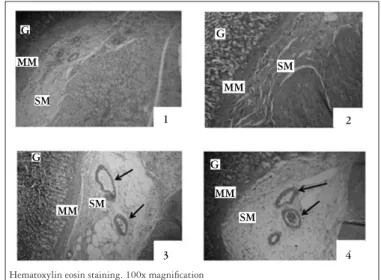
The histological analysis of stomach tissues showed edema, congestion, and vessel proliferation in the gastric mucosa of animals of groups I + PPVL and C + PPVL (Figure 4 (3 and 4)), in contrast to groups SO and C, which were not submitted to PPVL (Figure 4 (1 and 2)).
Hematoxylin eosin staining. 100x magniication
FIGURE 4. Micrograph of gastric tissue of an animal in SO (1), animal in group C (2), animal in group I + PPVL (3), and animal in group C + PPVL (4) G: glandular tissue; MM: muscularis mucosae; SM: submucosa Edema, congestion and proliferation of blood vessels can be seen in images C and D. The arrows in images C and D show the dilated vessels in the animals of groups I + PPVL and C + PPVL, respectively
!
2 1
SM
SM
SM
SM MM
MM
MM
MM G
G
G G
to the action of E2 on the endothelial function by modulating the generation of NO, thereby contributing to vasodilation as shown by a number of authors(16, 19, 25, 41).
Oxidative stress measured by lipid peroxidation through TBARS is increased in rats subjected to PPVL. In Figure 3 one sees that intact rats showed no signiicant increase in TBARS, which were similar to those of SO. In castrated rats with and without PPVL there was a marked increase in TBARS (P<0.05). The absence of estrogen shows a signiicant increase in TBARS and thus in LPO, with more cellular damage.
Estrogen, seemingly protecting against LPO, could be exerting its potential antioxidant preventing oxidative damage and oxidative stress, as previously demonstrated(2, 5, 18, 28), through its hydrophenolic radicals(27).
Regarding antioxidant enzymes, SOD and CAT showed similar activity across the groups. In SO and I + PPVL there was no signiicant difference (P<0.05) of SOD and CAT, as we found no difference in the LPO (Figure 3). Since in the I + PPVL the ovaries were kept, we suggest that E2 is conferring this protective action.
Römer et al.(31) reported that several estrogen metabolites inhibit the production of superoxide radical anion in vitro and inluence in the iron redox cycle, leading to less free radical formation. Likewise, Borras et al.(4) found that mitochondria of females have a higher expression of antioxidant enzymes than males. In our study, we observed in group I + PPVL that estrogen granted protection, as there was an increase in LPO in this group, explaining the SOD values found.
In groups C and C + PPVL a signiicant increase in the activity of these enzymes was observed as compared to the other groups (Table 1). We suggest that this increase may have occurred to compensate for the absence of circulating E2, promoted by castration, but even then it was not effective in reducing LPO as shown in Table 1. Other authors have
reported that castration increases LPO by increased production of hydrogen peroxide(35), corroborating our indings, as well as studies such as Ozgonul et al.(29), in which castrated female Sprague-Dawley rats have increased CAT activity in liver and estrogen replacement reverses this effect, returning to the values of the control animals.
Hernández et al.(17) demonstrated that castration caused a decrease in thiol groups (-SH) and total antioxidant capacity in plasma as well as an increase in plasma lipoperoxides, relecting an imbalance in favor of oxidative processes.
In our experimental model as well as in Hernández et al.(17), castration triggered a signiicant increase in LPO (Figure 3). We suggest that castration may have reduced the thiol groups, consistent with the signiicant decrease in GPx activity in C + PPVL, favoring the damage, which was evidenced by the increased LPO in this group as compared to the others. In contrast, group C showed a signiicant increase in GPx as compared to the others, in an attempt to compensate for the lack of circulating estrogen.
Analyzing the micrographs of the different experimental groups, we noticed that in groups C and SO there was no vasodilation (Figure 4 (1 and 2)) while in groups I + PPVL and C + PPVL there was vasodilation, congestion and edema in the sub-mucosa (Figure 4 (3 and 4)), characteristic of this model that leads to PHG(22, 23, 26). Although the group I+PPVL did not show changes in PP and LPO, histology already showed damages resulting from PPVL.
CONCLUSION
We suggest that E2, by presenting hydrophenolic radicals in its molecule and acting as a scavenger of free radicals, may have protected the intact rats from the hemodynamic changes and LPO, in the comparison of castrated and intact Wistar rats in this experimental model.
Morgan-Martins MI, Jacques SI, Hartmann RM, Marques CM, Marroni CA, Marroni NP. Proteção do estrogênio na gastropatia da hipertensão portal – um modelo experimental. Arq Gastroenterol. 2011;48(3):211-6.
RESUMO – Contexto - A hipertensão portal é uma complicação secundária à cirrose que tem como característica aumento do luxo sanguíneo e/ou
resistência vascular no sistema porta, causando o surgimento de uma circulação colateral hiperdinâmica. A ligadura parcial de veia porta é o modelo experimental utilizado em ratos para estudar os mecanismos isiopatológicos envolvidos na hipertensão portal pré-hepática. O estrogênio E2 é uma molécula antioxidante com diferentes ações isiológicas. Objetivos - Veriicar a ação antioxidante do estrogênio endógeno em modelo experimental de ligadura parcial de veia porta comparando ratas intactas com ratas castradas. Métodos - Foram utilizadas 20 ratas Wistar, pesando em média 250 g, divididas em quatro grupos: “sham-operated” (SO); intactas com ligadura parcial da veia porta (I + LPVP); castradas (C) e castradas com ligadura parcial da veia porta (C + LPVP). No 1º dia: castração ou “sham-operated”; no 7º dia cirurgia de LPVP; no 15° dia após a LPVP, foi veriicada a pressão portal na veia mesentérica das ratas, no polígrafo Letica. A lipoperoxidação no estômago foi avaliada através da técnica das substâncias reativas ao acido tiobarbitúrico e a atividade das enzimas antioxidantes superóxido dismutase, catalase e glutationa peroxidase. A análise estatística utilizada foi ANOVA - Student-Newmann-Keuls, (Média ± EP) e foi considerado signiicativo para P<0.05. Resultados - A pressão portal mostrou aumento signiicativo no grupo C + LPVP em relação aos demais, não houve diferença signiicativa no grupo das ratas intactas. O TBARS mostrou dano estatisticamente signiicativo no grupo C e C + LPVP em relação aos demais. Quanto às enzimas antioxidantes, as ratas castradas e com posterior ligadura parcial de veia porta tiveram aumento signiicativo em relação às demais. Conclusão – Sugere-se que o estrogênio E2, por apresentar radicais hidrofenólicos em sua molécula, desempenha um papel protetor nas ratas intactas em comparação com as castradas, agindo assim, como antioxidante, neste modelo experimental.
REFERENCES
1. Baker HJ, Lindsey JR, Weisbroth SH, editors. The laboratory rat. V.I. Biology
and diseases. New York: Academic Press; 1979.
2. Bednarek-Tupikowska G, Bohdanowicz-Pawlak A, Bidzinska B, Milewicz A,
Antonowicz-Juchniewicz J, Andrzejak R. Serum lipid peroxide levels and erythrocyte glutathione peroxidase and superoxide dismutase activity in premenopausal and postmenopausal women. Gynecol Endocrinol. 2001;15:298-303.
3. Borekci B, Kumtepe Y, Karaca M, Halici Z, Cadirci E, Albayrak F, Polat B,
Suleyman H. Role of alpha-2 adrenergic receptors in anti-ulcer effect mechanism of estrogen and luteinising hormone on rats. Gynecol Endocrinol. 2009;25:264-8.
4. Borrás C, Sastre J, García-Sala D, Lloret A, Pallardó FV, Viña J. Mitochondria
from females exhibit higher antioxidant gene expression and lower oxidative damage than males. Free Radic Biol Med. 2003;34:546-52.
5. Borrás C, Gambini J, López-Grueso R, Pallardó FV, Viña J. Direct antioxidant
and protective effect of estradiol on isolated mitochondria. Biochim Biophys Acta. 2010;1802:205-11.
6. Bosch J, Berzigotti A, Garcia-Pagan JC, Abraldes JG. The management of portal
hypertension: rational basis, available treatments and future options. J Hepatol. 2008;48(Suppl 1):s68-92.
7. Boveris A, Chance B. The mitochondrial generation of hydrogen peroxide. General
properties and effect of hyperbaric oxygen. Biochem J. 1973;134:707-16.
8. Bradford MM. A rapid and sensitive method for the quantitation of microgram
quantities of protein utilizing the principle of protein-dye binding. Anal Biochem. 1976;72:248-54.
9. Buege JA, Aust SD. Microsomal lipid peroxidation. Methods Enzymol.
1978;52:302-10.
10. Cameron JL, Herlong HF, Sanfey H, Boitnott J, Kaufman SL, Gott VL, Maddrey WC. The Budd-Chiari syndrome. Treatment by mesenteric-systemic venous shunts. Ann Surg. 1983;198:335-46.
11. Cichoz-Lach H, Celinski K, Slomka M, Kasztelan-Szczerbinska B. Pathophysiology of portal hypertension. J Physiol Pharmacol. 2008;59:231-8.
12. Dantas APV, Carvalho MHC. Efecto protector de los estrógenos en el sistema cardiovascular. Antioxid Calid Vida. 2000;7(28):6-11.
13. Fernandes CE, Baracat EC, Lima GR, editors. Climateric: a handbook. São Paulo: Ponto; 2004. 372p.
14. Flohé L, Günzler WA. Assays of glutathione peroxidase. Methods Enzymol. 1984;105:114-21.
15. Gruber CJ, Tschugguel W, Schneeberger C, Huber JC. Production and actions of estrogens. N Engl J Med. 2002;346:340-52.
16. Hayashi T, Fukuto JM, Ignarro LJ, Chaudhuri G. Basal release of nitric oxide from aortic rings is greater in female rabbits than in male rabbits: implications for atherosclerosis. Proc Natl Acad Sci USA. 1992;89:11259-63.
17. Hernández I, Delgado JL, Díaz J, Quesada T, Teruel MJ, Llanos MC, Carbonell LF. 17beta-estradiol prevents oxidative stress and decreases blood pressure in ovariectomized rats. Am J Physiol Regul Integr Comp Physiol. 2000;279:R1599-R605.
18. Kumtepe Y, Borekci B, Karaca M, Salman S, Alp HH, Suleyman H. Effect of acute and chronic administration of progesterone, estrogen, FSH and LH on oxidant and antioxidant parameters in rat gastric tissue. Chem Biol Interact. 2009;182:1-6.
19. Levin ER. Cellular functions of plasma membrane estrogen receptors. Steroids. 2002;67:471-5.
20. Levin ER. Estrogen receptor-beta and the cardiovascular system. Trends Endocrinol Metab. 2002;13:184-5.
21. Llesuy SF, Milei J, Molina H, Boveris A, Milei S. Comparison of lipid peroxidation and myocardial damage induced by adriamycin and 4’-epiadriamycin in mice. Tumori. 1985;71:241-9.
22. Martinelli ALC. Portal hypertension. Medicina (Ribeirão Preto). 2004; 37: 253-61.
23. McCormack TT, Sims J, Eyre-Brook I, Kennedy H, Goepel J, Johnson AG, Triger DR. Gastric lesions in portal hypertension: inlammatory gastritis or congestive gastropathy? Gut. 1985;26:1226-32.
24. Misra HP, Fridovich I. The role of superoxide anion in the autoxidation of epinephrine and a simple assay for superoxide dismutase. J Biol Chem. 1972;247:3170-5. 25. Moncada S, Palmer RM, Higgs EA. Nitric oxide: physiology, pathophysiology,
and pharmacology. Pharmacol Rev. 1991;43:109-42.
26. Moreira AJ, Fraga C, Alonso M, Collado PS, Zetller C, Marroni C, Marroni N, González-Gallego J. Quercetin prevents oxidative stress and NF-kappaB activation in gastric mucosa of portal hypertensive rats. Biochem Pharmacol. 2004;68:1939-46.
27. Morgan-Martins MI. Replacement estrogen decreases oxidative damage, increase the activity of antioxidant enzymes and improves cardiac function in rats [thesis]. Porto Alegre: Federal University of Rio Grande do Sul; 2003.
28. Niki E, Nakano M. Estrogens as antioxidants. Methods Enzymol. 1990;186:330-3.
29. Ozgönül M, Oge A, Sezer ED, Bayraktar F, Sözmen EY. The effects of estrogen and raloxifene treatment on antioxidant enzymes in brain and liver of ovarectomized female rats. Endocr Res. 2003;29:183-9.
30. Primignani M, Carpinelli L, Preatoni P, Battaglia G, Carta A, Prada A, Cestari R, Angeli P, Gatta A, Rossi A, Spinzi G, De Franchis R. Natural history of portal hypertensive gastropathy in patients with liver cirrhosis. The New Italian Endoscopic Club for the study and treatment of esophageal varices (NIEC). Gastroenterology. 2000;119:181-7.
31. Römer W, Oettel M, Menzenbach B, Droescher P, Schwarz S. Novel estrogens and their radical scavenging effects, iron-chelating, and total antioxidative activities: 17 alpha-substituted analogs of delta 9(11)-dehydro-17 beta-estradiol. Steroids. 1997;62:688-94.
32. Saleh TM, Connell BJ, Saleh MC. Acute injection of 17beta-estradiol enhances cardiovascular relexes and autonomic tone in ovariectomized female rats. Auton Neurosci. 2000;84:78-88.
33. Sikuler E, Groszmann RJ. Hemodynamic studies in a parabiotic model of portal hypertension. Experientia. 1985;41:1323-4.
34. Sikuler E, Kravetz D, Groszmann RJ. Evolution of portal hypertension and mechanisms involved in its maintenance in a rat model. Am J Physiol. 1985;248:G618-G25.
35. Strehlow K, Rotter S, Wassmann S, Adam O, Grohé C, Laufs K, Böhm M, Nickenig G. Modulation of antioxidant enzyme expression and function by estrogen. Circ Res. 2003;93:170-7.
36. Torrezan R, Gomes RM, Ferrarese ML, de Melo FB, Ramos AM, Mathias PC, Scomparin DX. [Treatment with isolavones replaces estradiol effect on the tissue fat accumulation from ovariectomized rats]. Arq Bras Endocrinol Metabol. 2008;52:1489-96.
37. Webster NR, Nunn JF. Molecular structure of free radicals and their importance in biological reactions. Br J Anaesth. 1988;60:98-108.
38. Wen Z, Zhang JZ, Xia HM, Yang CX, Chen YJ. Stability of a rat model of prehepatic portal hypertension caused by partial ligation of the portal vein. World J Gastroenterol. 2009;15:4049-54.
39. Wendel A. Glutathione peroxidase. Methods Enzymol. 1981;77:10-5. 40. Yokoyama Y, Baveja R, Sonin N, Clemens MG, Zhang JX. Hepatic neovascularization
after partial portal vein ligation: novel mechanism of chronic regulation of blood low. Am J Physiol Gastrointest Liver Physiol. 2001;280:G21-31.
41. Zhu BT, Conney AH. Functional role of estrogen metabolism in target cells: review and perspectives. Carcinogenesis. 1998 Jan;19:1-27.