Printed version ISSN 0001-3765 / Online version ISSN 1678-2690 http://dx.doi.org/10.1590/0001-3765201820170250
www.scielo.br/aabc | www.fb.com/aabcjournal
Optimization of RT-PCR reactions in studies with genes of
lignin biosynthetic route in
Saccharum spontaneum
JUAN P.P. LLERENA1
, PEDRO ARAÚJO2
and PAULO MAZZAFERA1,3
1
Universidade Estadual de Campinas, Laboratório de Fisiologia Molecular das Plantas, Departamento de Biologia Vegetal, Instituto de Biologia, Rua Monteiro Lobato, 255, Caixa Postal 6109, 13083-862 Campinas, SP, Brazil 2
Universidade Estadual de Campinas, Laboratório de Genoma Funcional, Departamento de Genética, Evolução e Bioagentes, Instituto de Biologia, Rua Monteiro Lobato, 255, 13083-862 Campinas, SP, Brazil
3
Universidade de São Paulo,Escola Superior de Agricultura Luiz de Queiroz, Departamento de Produção Vegetal, Av. Pádua Dias, 11, Caixa Postal 9, 34294-100 Piracicaba, SP, Brazil
Manuscript received on March 31, 2017; accepted for publication on May 19, 2017
ABSTRACT
Saccharum spontaneum has been used for the development of energy cane a crop aimed to be used for the production of second-generation ethanol, or lignocellulosic ethanol. Lignin is a main challenge in the conversion of cell wall sugars into ethanol. In our studies to isolate the genes the lignin biosynthesis in S. spontaneum we have had great difficulty in RT-PCR reactions. Thus, we evaluated the effectiveness of different additives in the amplification of these genes. While COMT and CCoAOMT genes did not need any additives for other genes there was no amplification (HCT, F5H, 4CL and CCR) or the yield was very low (CAD and C4H). The application of supplementary cDNA was enough to overcome the non-specificity and low yield for C4H and C3H, while the addition of 0.04% BSA + 2% formamide was effective to amplify 4CL, CCR, F5H and CCR. HCT was amplified only by addition of 0.04% BSA + 2% formamide + 0.1 M trehalose and amplification of PAL was possible with addition of 2% of DMSO. Besides optimization of expression assays, the results show that additives can act independently or synergistically.
Key words: biomass, cell wall, energy cane, lignin, lignocellulosic ethanol, sugarcane.
Correspondence to: Paulo Mazzafera E-mail: [email protected]
INTRODUCTION
Due to the increasing demand for clean energy,
there has been a growing interest in biofuels
obtained from biomass. In the production of the
second-generation ethanol (E2G) or lignocellulosic
ethanol the cell wall polymeric sugars cellulose
and hemicellulose are hydrolyzed to simpler units
which become fermentable (Ruth and Thomas
2003, Aden and Foust 2009, Huang et al. 2009).
Lignin is a bottleneck for E2G production in
several plants. This phenolic polymer chemically
binds to cellulose and hemicellulose in a systematic arrangement, increasing the recalcitrance of the
biomass (Boerjan et al. 2003, Vanholme et al. 2010). As a consequence, gene manipulation has been tried
aiming to decrease or change lignin composition
reduction or modification of lignin depends on the
position of the enzyme in the biosynthetic pathway and the pattern of expression (Vanholme et al. 2012, Poovaiah et al. 2014). Change in the expression of genes encoding enzymes operating in the earlier part of the route usually changes the total lignin content (Bonawitz and Chapple 2010), while genes positioned later lead to changes in the lignin type (Li et al. 2003, Ralph et al. 2006, Chen and Dixon 2007).
Sugarcane bagasse is promising lignocellulosic material for E2G production. It is composed primarily of cellulose (39%), hemicellulose (25%) and lignin (23%) (Carroll and Somerville 2009, Rezende et al. 2011, Szczerbowski et al. 2014). Few studies were conducted with lignin biosynthesis in sugarcane (Cesarino et al. 2012a, b, 2013, Bottcher et al. 2013, Santos et al. 2015a, b, Vicentini et al. 2015, Ferreira et al. 2016) but transgenic plants were already produced (Jung et al. 2012, Bewg et al. 2016, Jung and Altpeter 2016).
Recently, breeders are transferring and increasing the number of Saccharum spontaneum alleles in commercial sugarcane hybrids, aiming to increase fiber content in the bagasse and, consequently, the potential for E2G generation (Carvalho-Netto et al. 2014). S. spontaneum culms are rich in lignin and other polyphenolic compounds (Devi and Muthu 2014) which can negatively
interfere in RT-PCR reactions during analysis of
gene expression. Additionally, the genomes of the Saccharum genus are polyploid, redundant,
and present a high GC content as verified in other
grasses (Šmarda et al. 2014), which often leads to
the observation of non-specific bands or smears in the agarose gel as a result of RT-PCR analysis. In our case, the difficulty to amplify cDNA of genes
of the lignin biosynthesis route in S. spontaneum internodes, using good quality (non-degraded)
RNA, led us to test different additives in RT-PCR
reactions.
RT-PCR is an essential technique in gene
expression and other biotechnological studies (Farell and Alexandre 2012) but it is prone to several problems caused by inhibitors in the samples (Samarakoon et al. 2013). Additionally, some nucleotide regions in primers with high melting
temperature (Tm) or with high GC content (>60%)
can form secondary structures “interrupting” the reaction (Zeng et al. 2006, Mamedov et al. 2008, Farell and Alexandre 2012). Several alternatives have been proposed to minimize these problems, such as the addition of substances of varied
molecular nature (Simonović et al. 2012) that can
act synergistically (Ralser et al. 2006, Farell and Alexandre 2012) or independently (Chakrabarti and
Schutt 2001) in increasing the amplification process
and the specificity of the reaction. Formamide (Sarkar et al. 1990, Chakrabarti and Schutt 2001),
dimethyl sulfoxide – DMSO (Winship 1989,
Varadaraj and Skinner 1994, Chakrabarti and Schutt 2002), non-ionic detergents (Demeke and Adams
1992), betaine (Baskaran et al. 1996, Weissensteiner
and Lanchbury 1996, Henke et al. 1997), trehalose (Spiess et al. 2004, Samarakoon et al. 2013) and other compatible solutes have been used to solve the problems of formation of secondary structures in the template of cDNA (Ralser et al. 2006, Farell and Alexandre 2012). BSA (bovine serum albumin) has a high content of lysine which binds to phenolic compounds (Katcher and Schwartz 1994) and polysaccharides (Demeke and Adams 1992), avoiding polymerase inactivation (Kreader
1996). The beneficial effects of these additives on PCR reactions are often specific to the type of
cDNA template and primer and they have to be
empirically determined (Simonović et al. 2012).
Commercially available ready-to-use solutions, containing additives, have led to good results, but they possess the disadvantage of having unknown
composition and the lack of flexibility to adjust the
RNA EXTRACTION AND CONSTRUCTION OF THE FIRST cDNA STRAND
RNA extraction was made with Trizol (Reagent Tri-Phasis - Bio Agency). Approximately 1/3 of the volume of an Eppendorf of 2 mL was filled with a
mixture 1/1 (v/v) of young (2°+3°) and mature (8°) internode powders (in order to identify as many isoforms possible) from the five replicates and
1.5 mL of Tri-Phasis reagent was added. Further
on the extraction followed the manufacturer
recommendations. The quantification of total RNA was made in Nanodrop spectrophotometer (Thermo Scientific) at 260 nm and the purity evaluated by 260 nm/280 nm ratio. The RNA quality was checked by
1% agarose electrophoresis with ethidium bromide and further visualization under UV light (Gel Doc 2000, BioRad). RNA samples were treated
with DNAse (Turbo DNAse-free kit, Ambion)
and submitted to reverse transcription using the RevertedAid First Strand cDNA Synthesis kit,
according to manufacturer’s instructions (Thermo Scientific).
In silico ANALYSIS OF DATABASE AND DESIGN OF
PRIMERS
The sequences of the genes coding for the
enzymes: 4-hydroxicinnamoyl CoA: ligase (4CL), cinnamoyl CoA reductase (CCR), ferulate
5-hydroxylase (F5H), caffeate O-methyltransferase (COMT) cinnamyl alcohol dehydrogenase
(CAD), L- phenylalanine ammonia- lyase (PAL), caffeoyl CoA 3-O-methyltransferase
( C C o A O M T ) , p - c o u m a r o y l s h i k i m a t e
3’-hydroxylase (C3’H), cinnamate 4- hydroxylase (C4H), hydroxycinnamoyl-CoA: shikimate/
quinate p-hydroxycinnamoyl-transferase (HCT)
were carried out in the NCBI, Gene Index and Phytozome databases. Glyceraldehyde 3-phosphate
dehydrogenase (GAPDH) = positive control. We
used as bait the sequences more expressed in
hybrid sugarcane tissues identified by Bottcher et
Aiming to isolate genes of the lignin
biosynthesis in S. spontaneum for further studies on
gene expression and sugarcane transformation, we
used formamide, BSA, trehalose, betaine, DMSO
and PEG-8000 as additives in RT-PCR reactions. We were able to amplify all genes of the lignin
biosynthesis route.
MATERIALS AND METHODS
PLANT MATERIAL
The plants used in the study were clones obtained
from tissue culture material provided by the
Agronomic Institute of Campinas (IAC), Ribeirão
Preto, São Paulo-Brazil. Culms were cut in
segments containing two nodes and were planted
in plastic trays containing vermiculite and kept in
the greenhouse, with daily irrigation. After 40 days,
the seedlings obtained were transplanted to plastic
vessels of 50 L (3 plants per vessel) containing
organic substrate (nitrogen= 0.5%, moisture = 50%,
organic carbon = 15%, pH = 6, C/N = 130 mmol/
Kg, CIC/C ratio= 8%, Genefertil-Genesol) and kept
in the greenhouse under sprinkler irrigation (30
minutes, twice a day) for a period of approximately
one year. After this period, the vessels were
transferred to full sun, out of the greenhouse and
plants were left to grow for another four months,
under sprinkler irrigation (30 minutes, three times
a day). Plant material was harvested in June 2014,
with 5 replicates (5 plants). Healthy culms were
collected from internodes 2nd+3rd (young) and 8th
(mature), not including the node. With the aid of a
blade the culms were cut into small pieces, frozen
in liquid nitrogen and freeze-dried. The lyophilized
material was ground to a powder in sterile mortars
and cooled with liquid nitrogen and then stored in
al. (2013). Among the sequences returned from the databases we selected those from sorghum (Sorghum bicolor), rice (Oryza sativa), corn (Zea mays), wheat (Triticum aestivum), rye grass (Lolium perenne) and Arabidopsis thaliana. Only sequences
with full CDS, low e-value (10-6) and verified by BLASTx were used (Altschul et al. 1997). These sequences were aligned in the BioEDIT software
(Hall 1999) and from the alignment, primers were designed in conserved regions with Primer 3 (Rozen and Skaletsky 2000), using as parameters
Tm in the range of 57°C - 60°C, 2°C of maximum difference between forward and reverse primers and % GC between 55 and 60. When this was not possible, degenerate primers were designed. The
avoid formation of secondary internal structures and dimers the primers were verified by the
OligoAnalizer 3.1 software. The primer sequences,
GC content and the expected size of the amplicon
are in Table I.
RT-PCR REACTIONS
RT-PCR reactions were carried out in a thermal cycler Veriti 96-Well Thermal Cycler (AB Applied Biosystems). The standard conditions for
RT-PCR were 40 cycles, each cycle consisting of a
denaturing step at 94°C for 30 s, ringing at 57°C for 1 min, extension at 72°C for 2 min, with an initial denaturation step of 94°C for 5 min and
a final extension of 72°C for 5 min. The final concentrations of 25 µL reactions were: 200 μM of each dNTP (dNTP mix Quiagen - 10 mM of each dNTP), 1.5 mM of MgCl2, 1 U of Taq-polymerase (Phoneutria 500 U) in buffer 1x Qiagen
(Tris-Cl, K(Tris-Cl, (NH4)2SO4, 15 mM MgCl2; pH 8.7),
0.4 μM of each primer, 1 µL of a cDNA solution
(corresponding to 3.5 ng of total RNA) and nuclease-free water. Additives were added independently or
mixed in at the following final concentrations in 25 µL of RT-PCR reaction: 1 M betaine (Sigma),
2% formamide (Pharmacia Biotech, 99%), 2% DMSO (Merck, max. 0.03% H2O), 0.1 M trehalose [D-(+)-trehalose dehydrate, Sigma], 8% PEG-8000 (Affymetrix) and 0.04% BSA (Sigma). Betaine, trehalose and PEG-8000 were initially prepared as 5X concentrated stock solutions and BSA 25X. DMSO and formamide were considered as 100%
stocks. The amplified bands were separated in
1% agarose gel containing ethidium bromide and displayed in photo-documenter-Gel Doc 2000 BioRad.
TABLE I
Primers used in the RT-PCR reactions, expected amplicon size (base pairs) and % of G+C in the amplicon. Non-specific
bases (degenerate primers) are indicated in parenthesis.
Gene Forward 5’-->3’ Reverse 5’-->3’ Amplicon (bp)
and %GC
4CL AGCT(G/T)CCGGACATCGA(G/C)ATC CTTGTAGAA(A/C)ACCACCTCCTT(G/T)G 1340 (65%)
CAD TACTG(C/T)GG(G/C)ATATGCCAC CGA(C/T)GTCGATGACGAAGC 973 (65%)
C3H AACCTGCGCCAGATCAAG GTGCCCATGAA(G/C)GTGACG 1343 (58%)
C4H GTTCGGCGACATCTTCCTC CTTCTCCGTGGTGTCGATCT 1281 (63%)
CCoAOMT CTCAAGAGCGAAG(A/C)CCT(G/C)TAC GAGCTGGCAGA(C/T)CTCGAC 649 (63%)
CCR G(G/C)CTCGTGG(G/C)TCGTCAAG GGTT(G/C)GAGAACTTGTACGGCT 823 (68%)
COMT GTCCATCCTGCCCATGAC CAGTCGTGGAGGATCCACTT 756 (66%)
HCT GGGGTCGGAGATGGTGTA CGGAACTTCTCCATGTGCTC 1317 (72%)
F5H CG(A/T)TGATGGACCAGCTGAC TGCTCGTCGATGATCTTGTC 625 (68%)
PAL CCACCT(G/C)GA(G/C)GAGGTGAAG GT(C/T)CCACTCCTTGAGGCACT 2033 (67%)
---RESULTS AND DISCUSSION
Preliminarily, RT-PCR reactions were carried out
without additives (Figure 1). Eight of the 10 genes
analyzed did not have good amplification or they did not amplify. The amplicons were nonspecific to PAL and C3H; they were not observed with HCT,
F5H, 4CL and CCR, or showed low yield with CAD and C4H.
Only COMT and CCoAOMT genes presented good amplification without additives, observing
intense and specific bands at the expected size of 756 and 649 bp, respectively. C4H and C3H
reactions produced bands with the expected size of 1281 and 1343 bp, respectively, but with low
specificity and low yield. The genes coding for these
two enzymes could be simply and satisfactorily
Figure 1- RT-PCR amplification of lignin biosynthesis genes using standard reaction conditions as described in the text. cDNA was
produced from a pool of young (2°+3°) and mature (8°) internodes from S. spontaneum. The numbers indicate the base pairs of the
expected amplicon and arrows indicate weak bands. bp = base pairs (DNA 1 kb ladder New England Biolabs). GAPDH = positive control. Negative control reactions (template omitted) did not amplify any bands (not shown).
Figure 2- RT-PCR amplification of C4H (a) and C3H (b) using standard reaction conditions as described in the text but 1 or 2 µl of cDNA were included in the reaction mixture. cDNA was produced from a pool of young (2°+3°) and mature (8°) internodes from S. spontaneum. The numbers indicate the base pairs of the expected amplicon and arrows indicate weak bands. bp = base pairs
amplified when 2 µL of cDNA was used in the RT-PCR reactions, increasing yield and specificity of
the bands (Figures 2a and 2b).
For CAD gene amplification, all PCR reactions were initially set up with 1 µL of cDNA and, preliminarily, additives were tested solely and at fixed concentrations, according to the
literature (Lorenz 2011, Simonović et al. 2012).
Only treatments 0.04% BSA and 0.04% BSA + 2%
formamide allowed CAD gene amplification, and
the combination of both additives showed better
results in relation to the standard reaction, without
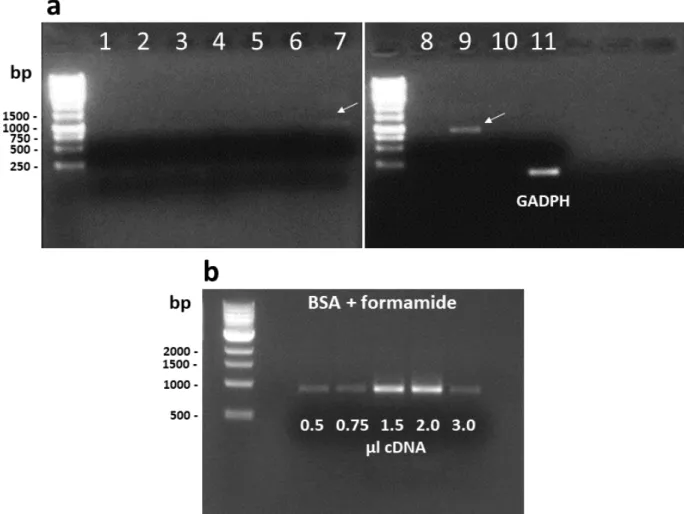
additives (see Figure 1), generating a specific band with 943 bp, as expected (Figure 3a). The low efficiency with BSA may be due to its sensitivity to high temperatures used in the RT-PCR reaction,
suggesting that its role would be more like a co-additive in the amplification of “templates” containing high GC % and PCR inhibitors (Farell
and Alexandre 2012). The combination of BSA with
formamide seemed to proportionate a synergistic
effect, stabilizing Taq polymerase by inhibitors
Figure 3 - RT-PCR amplification of CAD (a) using different adjuvants at varied concentrations and with BSA + formamide and
varied amount of cDNA in the reaction mixture (b). cDNA was produced from a pool of young (2°+3°) and mature (8°) internodes from S. spontaneum. Expected CAD amplicon was 979 bp. 1 = 2% formamide, 2 = 4% DMSO, 3 = 2% formamide + 2% DMSO, 4 = 2% DMSO + 1 M betaine, 5 = 1 M betaine, 6 = 1 M betaine + 2% formamide, 7 = 0.04% BSA, 8 = 0.04% BSA + 4% DMSO, 9 = 2% formamide + 0.04% BSA, 10 = 0.04% BSA + 1 M betaine, 11 = GAPDH (positive control). Arrows indicate weak bands.
bp = base pairs [DNA 1 kb ladder from Thermo Scientific (a) and from New England Biolabs(b)]. Reactions in B were carried out
with 0.04% BSA + 2% formamide and different cDNA volumes were included. Negative control reactions (template omitted) did
binding (mainly phenols) to BSA (Woide et al.
2010, Samarakoon et al. 2013), and formamide-caused destabilization of GC rich regions, thereby
decreasing Tm and facilitating the extension step
in the reaction. In other reactions using BSA and formamide, but varying template amount, 1.5µL or
2 µL of cDNA proved most efficient for CAD gene amplification (Figure 3b).
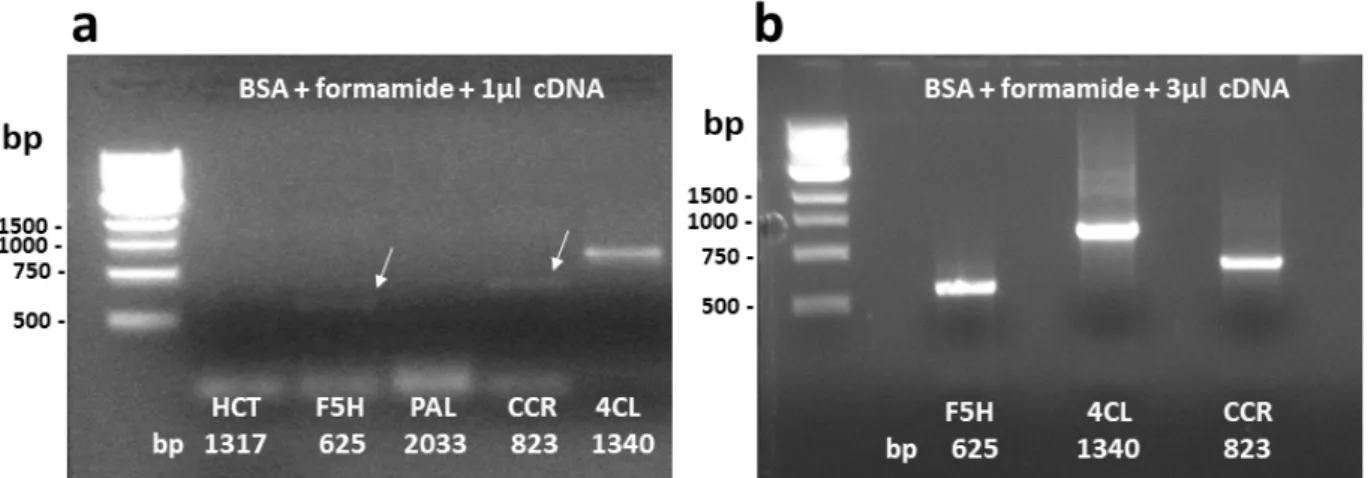
No amplification products were observed for F5H, 4CL, HCT and CCR genes without additives (see Figure 1). Taking as reference the results with
CAD, reactions were carried out using 0.04% BSA
+ 2% formamide (Figure 4a). Although specific
bands were observed for F5H, CCR, and 4CL genes (625, 823 and 1340 bp, respectively), the
yield was low. When more cDNA was added to the
reactions the combination 3 µl of cDNA + 0.04% BSA + 2% formamide gave good results for these genes (Figure 4b).
The need to employ additives in reactions
with CAD, F5H, CCR, and 4CL may be related
to the fact that we used degenerate primers. Thus,
the primers would be in fact a “pool” of oligomers and could be leading to the formation of secondary structures, “hairpin loops” or dimers, which
would be competing with the annealing process
in the RT-PCR reaction, decreasing amplification.
(Singh et al. 2000, Linhart and Shamir 2002,
Strien et al. 2013). Formamide decreases the Tm
of cDNA template and consequently optimizes
the annealing process of the primer (Simonović
et al. 2012). Formamide is much more efficient as an additive when used at a concentrations up
to 5%, its effectiveness being abolished at 10%
(Chakrabarti and Schutt 2010), due to inhibition
of Taq polymerase activity (Varadaraj and Skinner
1994). For this reason, we used an intermediate concentration (2%), but the yield was improved in the reactions of CAD, CCR, 4CL and F5H genes only with cDNA supplementation (Figure 4b).
BSA + formamide combination was not
effective for amplification of HCT gene, which
has the highest % GC among genes herein studied
(Table I). No amplification band was observed in
the expected size of 1317 bp (Figure 4a). Others additives with unknown or not well established function are being successfully tested in various
experiments of gene amplification by RT-PCR
(Nordstrom et al. 2006, Spink et al. 2007).
Trehalose (0.1 M) and 8% PEG-8000 were chosen
Figure 4 - RT-PCR amplification of HCT, F5H, PAL, CCR and 4CL using 0.04% BSA + 2% formamide and 1 µl cDNA in the reaction mixture (a) and F5H, 4CL and CCR using BSA and formamide but 3 µl cDNA in the reaction mixture (b). cDNA was produced from a pool of young (2°+3°) and mature (8°) internodes from S. spontaneum. The numbers indicate the base pairs of
as additives to overcome the amplification problem of HCT in reactions containing 0.04% BSA + 2%
formamide. BSA + formamide + trehalose allowed
the amplification of HCT, resulting in a band with
1317 bp, as expected (Figure 5). PEG-8000 did not generate positive results. Additional cDNA was not
needed to obtain a good yield and specificity.
It has been reported that besides decreasing
the Tm of cDNA, trehalose also has a thermal stabilizer effect of Taq polymerase. (Weissensteiner
and Lanchbury 1996, Carninci et al. 1998, Spiess
et al. 2004, Samarakoon et al. 2013). The fact that
trehalose is an innocuous chemical compound
and does not inhibit Taq polymerase suggests that in the reactions with HCT it would be acting
in synergism with formamide in the annealing process, resulting in minimal competition between the annealing process and the formation of hairpin-loops or dimers in the pool of primers used in this experiment.
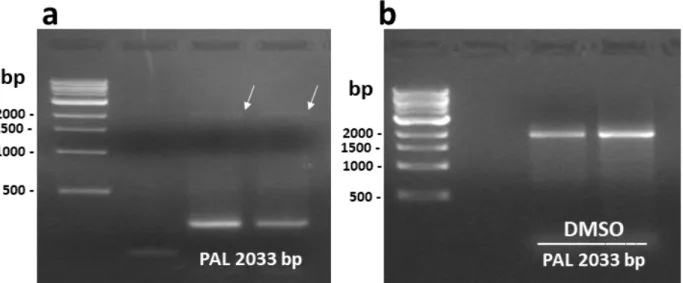
Little success was observed in the amplification of PAL gene using the basic conditions of RT-PCR
(see Figure 1), with 3 diffuse and non-specific
bands, below the expected size of 2033 bp. The
addition of BSA and formamide also did not result
in success (Figure 4a). PAL was amplified with
the addition of 2% DMSO, presenting intense bands on expected 2033 bp position (Figures 6a
Figure 5 - RT-PCR amplification of HCT and C4H using 0.04% BSA + 2% formamide and 1 µl cDNA in the reaction mixture, supplemented either with 8% PEG-8000 or 0.1 M trehalose. GAPDH was used as a control with PEG-8000 and
trehalose. The expected amplicons of HCT and C4H were 1317 and 1281 base pairs. cDNA was produced from a pool of young (2°+3°) and mature (8°) internodes from S. spontaneum. bp = base pairs (DNA 1 kb ladder from New England Biolabs). Negative control reactions (template omitted) did not amplify any bands (not shown).
and 6b). DMSO can stimulate RT-PCR reactions within the final concentration range of 1% to 10% (Jung et al. 2001, Kitade et al. 2003, Simonović et
al. 2012). However, other studies have shown that above 2% this solvent can inhibit the activity of
Taq polymerase (Lorenz 2011), which defined the
concentration used in our study.
Taken together, our data shows that the
appropriate use of single or combined additives
in RT-PCR reaction mixtures can significantly improve the expression effectiveness of genes of lignin biosynthesis in sugarcane. The guidelines for optimizing amplification may be applied to other
recalcitrant plant genes.
ACKNOWLEDGMENTS
JPPL thanks Coordenação de Aperfeiçoamento de Pessoal de Nível Superior (CAPES) and Fundação de Amparo à Pesquisa do estado de São Paulo (FAPESP, grant 2014/25994-1) for MSc fellowships; PM thanks Conselho Nacional de
Desenvolvimento Científico e Tecnológico (CNPq)
for a research fellowship and FAPESP
(2008/58035-6) for grant support. The authors thank Dr. Silvana
Creste of Centro de Cana - Instituto Agronômico de Campinas (IAC) for providing the S. spontaneum clones.
REFERENCES
ADEN A AND FOUST T. 2009. Technoeconomic analysis of
the dilute sulfuric acid and enzymatic hydrolysis process for the conversion of corn stover to ethanol. Cellulose 16: 535-545.
ALTSCHUL SF, MADDEN TL, SCHÄFFER AA, ZHANG J, ZHANG Z, MILLER W AND LIPMAN DJ. 1997. Gapped BLAST and PSI-BLAST: a new generation of protein
database search programs. Nucleic Acids Res 25: 3389-3402.
BASKARAN N, KANDPAL RP, BHARGAVA AK, GLYNN MW, BALE A AND WEISSMAN SM. 1996. Uniform
amplification of a mixture of deoxyribonucleic acids with varying GC content. Genome Res 6: 633-638.
BEWG WP, POOVAIAH C, LAN W, RALPH J AND
COLEMAN HD. 2016. RNAi downregulation of three key
lignin genes in sugarcane improves glucose release without reduction in sugar production. Biotechnol Biofuels 9: 270.
BOERJAN W, RALPH J AND BAUCHER M. 2003. Lignin
biosynthesis. Annu Rev Plant Biol 54: 519-546.
BONAWITZ ND AND CHAPPLE C. 2010. The genetics of
lignin biosynthesis: connecting genotype to phenotype. Annu Rev Genet 44: 337-363.
BOTTCHER A ET AL. 2013. Lignification in sugarcane: biochemical characterization, gene discovery, and expression analysis in two genotypes contrasting for lignin content. Plant Physiol 163: 1539-1557.
CARNINCI P, NISHIYAMA Y, WESTOVER A, ITOH M, NAGAOKA S, SASAKI N, OKAZAKI Y, MURAMATSU M AND HAYASHIZAKI Y. 1998. Thermostabilization
and thermoactivation of thermolabile enzymes by trehalose and its application for the synthesis of full length cDNA. Proc Natl Acad Sci 95: 520-524.
CARROLL A AND SOMERVILLE C. 2009. Cellulosic Biofuels. Annu Rev Plant Biol 60: 165-182.
CARVALHO-NETTO CV, BRESSIANI JA, SORIANO HL, FIORI CS, SANTOS JM, BARBOSA GVS, XAVIER MA, LANDELL MGA AND PEREIRA GAG. 2014. The
potential of the energy cane as the main biomass crop for
the cellulosic industry. Chem Biol Technol Agric 1: 1-8.
CESARINO I, ARAÚJO P, DOMINGUES JÚNIOR AP AND MAZZAFERA P. 2012a. An overview of lignin metabolism and its effect on biomass recalcitrance. Brazilian J Bot 35: 303-311.
CESARINO I, ARAÚJO P, LEME AFP, CRESTE S AND
MAZZAFERA P. 2013. Suspension cell culture as a tool for the characterization of class III peroxidases in sugarcane. Plant Physiol Biochem 62: 1-10.
CESARINO I, ARAÚJO P, MAYER JLS, LEME AFP
AND MAZZAFERA P. 2012b. Enzymatic activity and proteomic profile of class III peroxidases during sugarcane stem development. Plant Physiol Biochem 55: 66-76
CHAKRABARTI R AND SCHUTT C. 2010. Chemical PCR:
Compositions for enhancing polynucleotide amplification reactions. U.S. Patent No. 7,772,383. Aug 10, 2010.
CHAKRABARTI R AND SCHUTT CE. 2001. The
enhancement of PCR amplification by low molecular-weight sulfones. Gene 274: 293-298.
CHAKRABARTI R AND SCHUTT CE. 2002. Novel
sulfoxides facilitate GC-rich template amplification. Biotechniques 32: 866-875.
CHAPPLE C AND CARPITA N. 1998. Plant cell walls as
targets for biotechnology. Curr Opin Plant Biol 1: 179-185. CHEN F AND DIXON RA. 2007. Lignin modification
improves fermentable sugar yields for biofuel production. Nat Biotechnol 25: 759-761.
DEMEKE T AND ADAMS RP. 1992. The effects of
DEVI JAI AND MUTHU AK. 2014. Evaluation of in vitro
free Radical Scavenging Potential of Whole Plant of S. spontaneum (Linn). Evaluation 6: 1436-1440.
FARELL EM AND ALEXANDRE G. 2012. Bovine serum albumin further enhances the effects of organic solvents on increased yield of polymerase chain reaction of GC-rich templates. BMC Res Notes 5: 1.
FERREIRA SS, HOTTA CT, DE CARLI POELKING VG, LEITE DCC, BUCKERIDGE MS, LOUREIRO ME,
BARBOSA MHP, CARNEIRO MS AND SOUZA GM. 2016. Co-expression network analysis reveals transcription factors associated to cell wall biosynthesis in sugarcane. Plant Mol Biol 91: 15-35.
HALL TA. 1999. BioEdit: a user-friendly biological sequence alignment editor and analysis program for Windows 95/98/ NT. Nucleic Acids Symp Ser 41: 95-98.
HENKE W, HERDEL K, JUNG K, SCHNORR D AND
LOENING SA. 1997. Betaine improves the PCR amplification of GC-rich DNA sequences. Nucleic Acids Res 25: 3957-3958.
HUANG HJ, RAMASWAMY S, AL-DAJANI W, TSCHIRNER U AND CAIRNCROSS RA. 2009. Effect
of biomass species and plant size on cellulosic ethanol: A comparative process and economic analysis. Biomass and Bioenergy 33: 234-246.
JUNG JH AND ALTPETER F. 2016. TALEN mediated targeted
mutagenesis of the caffeic acid O-methyltransferase in highly polyploid sugarcane improves cell wall composition for production of bioethanol. Plant Mol Biol 92: 131-142.
JUNG JH, FOUAD WM, VERMERRIS W, GALLO M AND ALTPETER F. 2012. RNAi suppression of lignin
biosynthesis in sugarcane reduces recalcitrance for biofuel production from lignocellulosic biomass. Plant Biotechnol J 10: 1067-1076.
JUNG M, MUCHE JM, LUKOWSKY A, JUNG K AND
LOENING SA. 2001. Dimethyl sulfoxide as additive in ready-to-use reaction mixtures for real-time polymerase
chain reaction analysis with SYBR Green I dye. Anal
Biochem 289: 292-295.
KATCHER HL AND SCHWARTZ I. 1994. A distinctive property of Tth DNA polymerase: enzymatic amplification
in the presence of phenol. Biotechniques 16: 84-92.
KITADE Y, OOTSUKA S, IITSUKA O AND SAGA N.
2003. Effect of DMSO on PCR of Porphyra yezoensis
(Rhodophyta) gene. J Appl Phycol 15: 555-557.
KREADER CA. 1996. Relief of amplification inhibition in
PCR with bovine serum albumin or T4 gene 32 protein.
Appl Environ Microbiol 62: 1102-1106.
LI Y, KAJITA S, KAWAI S, KATAYAMA Y AND
MOROHOSHI N. 2003. Down-regulation of an anionic peroxidase in transgenic aspen and its effect on lignin characteristics. J Plant Res 116: 175-182.
LINHART C AND SHAMIR R. 2002. The degenerate primer
design problem. Bioinformatics 18: S172-S181.
LORENZ TC. 2011. Polymerase chain reaction: basic protocol
plus troubleshooting and optimization strategies. J Vis Exp JoVE 63: e3998.
MAMEDOV TG, PIENAAR E, WHITNEY SE, TERMAAT JR, CARVILL G, GOLIATH R, SUBRAMANIAN A
AND VILJOEN HJ. 2008. A fundamental study of the PCR amplification of GC-rich DNA templates. Comput Biol Chem 32: 452-457.
NORDSTROM LJ, CLARK CA, ANDERSEN B, CHAMPLIN SM AND SCHWINEFUS JJ. 2006. Effect of
ethylene glycol, urea, and N-methylated glycines on DNA thermal stability: the role of DNA base pair composition and hydration. Biochemistry 45: 9604-9614.
POOVAIAH CR, NAGESWARA-RAO M, SONEJI JR, BAXTER HL AND STEWART CN. 2014. Altered
lignin biosynthesis using biotechnology to improve lignocellulosic biofuel feedstocks. Plant Biotechnol J 12: 1163-1173.
RALPH J, AKIYAMA T, KIM H, LU F, SCHATZ PF, MARITA JM, RALPH SA, REDDY MSS, CHEN F AND
DIXON RA. 2006. Effects of coumarate 3-hydroxylase down-regulation on lignin structure. J Biol Chem 281: 8843-8853.
RALSER M, QUERFURTH R, WARNATZ HJ, LEHRACH H, YASPO ML AND KROBITSCH S. 2006. An efficient
and economic enhancer mix for PCR. Biochem Biophys Res Commun 347: 747-751.
REZENDE CA, DE LIMA MA, MAZIERO P, RIBEIRO
DE AZEVEDO E, GARCIA W AND POLIKARPOV I.
2011. Chemical and morphological characterization of sugarcane bagasse submitted to a delignification process for enhanced enzymatic digestibility. Biotechnol Biofuels 4: 54.
ROZEN S AND SKALETSKY H. 1999. Primer3 on the WWW for general users and for biologist programmers.
Bioinforma methods Protoc: 365-386.
RUTH MF AND THOMAS SR. 2003. Effect of Corn Stover
Composition on Ethanol Process Economics. 25th Symp. Biotechnol. Fuels Chem NREL Publications, Breckenridge, Colorado, p. 22.
SAMARAKOON T, WANG SY AND ALFORD MH. 2013.
Enhancing PCR amplification of DNA from recalcitrant plant specimens using a trehalose-based additive. Appl Plant Sci 1: 1200236.
SANTOS AB, BOTTCHER A, KIYOTA E, MAYER JLS, VICENTINI R, SANTOS BRITO M, CRESTE S, LANDELL MGA AND MAZZAFERA P. 2015. Water
SANTOS AB, BOTTCHER A, VICENTINI R, MAYER JLS, KIYOTA E, LANDELL MGA, CRESTE S AND
MAZZAFERA P. 2015. Lignin biosynthesis in sugarcane is affected by low temperature. Environ Exp Bot 120: 31-42.
SARKAR G, KAPELNER S AND SOMMER SS. 1990. Formamide can dramatically improve the specificity of PCR. Nucleic Acids Res 18: 7465.
SIMONOVIĆ A, TRIFUNOVIC M, RASPOR M, CINGEL A, BOGDANOVIC M, DRAGICEVIC M AND SUBOTIC
A. 2012. Dimethyl sulfoxide improves sensitivity and
specificity of RT-PCR and QRT-PCR amplification of
low-expressed transgenes. Arch Biol Sci 64: 865-876.
SINGH VK, GOVINDARAJAN R, NAIK S AND KUMAR A.
2000. The effect of hairpin structure on PCR amplification efficiency. Mol Biol Today 1: 67-69.
ŠMARDA P, BUREŠ P, HOROVÁ L, LEITCH IJ,
MUCINA L, PACINI E, TICHÝ L, GRULICH V AND
ROTREKLOVÁ O. 2014. Ecological and evolutionary
significance of genomic GC content diversity in monocots. Proc Natl Acad Sci 111: E4096-E4102.
SPIESS AN, MUELLER N AND IVELL R. 2004. Trehalose
is a potent PCR enhancer: lowering of DNA melting
temperature and thermal stabilization of Taq polymerase
by the disaccharide trehalose. Clin Chem 50: 1256-1259.
SPINK CH, GARBETT N AND CHAIRES JB. 2007.
Enthalpies of DNA melting in the presence of osmolytes. Biophys Chem 126: 176-185.
STRIEN J, SANFT J AND MALL G. 2013. Enhancement of
PCR amplification of moderate GC-containing and highly GC-rich DNA sequences. Mol Biotechnol 54: 1048-1054.
SZCZERBOWSKI D, PITARELO AP, ZANDONÁ FILHO
A AND RAMOS LP. 2014. Sugarcane biomass for biorefineries: comparative composition of carbohydrate
and non-carbohydrate components of bagasse and straw. Carbohydr Polym 114: 95-101.
VANHOLME R ET AL. 2010. Engineering traditional monolignols out of lignin by concomitant up-regulation
of F5H1 and down-regulation of COMT in Arabidopsis.
Plant J 64: 885-897.
VANHOLME R, STORME V, VANHOLME B, SUNDIN L, CHRISTENSEN JH, GOEMINNE G, HALPIN C, ROHDE A, MORREEL K AND BOERJAN W. 2012. A
systems biology view of responses to lignin biosynthesis perturbations in Arabidopsis. Plant Cell 24: 3506-3529. VARADARAJ K AND SKINNER DM. 1994. Denaturants or
cosolvents improve the specificity of PCR amplification of a G+C-rich DNA using genetically engineered DNA polymerases. Gene 140: 1-5.
VICENTINI R, BOTTCHER A, SANTOS BRITO M, SANTOS AB, CRESTE S, DE ANDRADE LANDELL
MG, CESARINO I AND MAZZAFERA P. 2015. Large-scale transcriptome analysis of two sugarcane genotypes contrasting for lignin content. PLoS ONE 10: e0134909.
WEISSENSTEINER T AND LANCHBURY JS. 1996.
Strategy for controlling preferential amplification and avoiding false negatives in PCR typing. Biotechniques 21: 1102-1109.
WINSHIP PR. 1989. An improved method for directly
sequencing PCR amplified material using dimethyl sulphoxide. Nucleic Acids Res 17: 1266.
WOIDE D, ZINK A AND THALHAMMER S. 2010. Technical
note: PCR analysis of minimum target amount of ancient DNA. Am J Phys Anthropol 142: 321-327.
ZENG ZS, YAN HT, ZHENG XD, HU GZ, CHEN Y AND