Genes encoding enzymes of the lignin biosynthesis pathway in
Eucalyptus
Ricardo Harakava
Instituto Biológico, Laboratório de Bioquímica Fitopatológica, São Paulo, SP, Brazil
Abstract
Eucalyptus ESTs libraries were screened for genes involved in lignin biosynthesis. This search was performed under the perspective of recent revisions on the monolignols biosynthetic pathway.Eucalyptus orthologues of all genes of the phenylpropanoid pathway leading to lignin biosynthesis reported in other plant species were identified. A library made with mRNAs extracted from wood was enriched for genes involved in lignin biosynthesis and allowed to infer the isoforms of each gene family that play a major role in wood lignin formation. Analysis of the wood library suggests that, besides the enzymes of the phenylpropanoids pathway, chitinases, laccases, and dirigent proteins are also important for lignification. Colocalization of several enzymes on the endoplasmic reticulum membrane, as predicted by amino acid sequence analysis, supports the existence of metabolic channeling in the phenylpropanoid pathway. This study establishes a framework for future investigations on gene expression level, protein expression and enzymatic assays, sequence polymorphisms, and genetic engineering.
Key words: Eucalyptus, lignin, expressed sequenced tag, phenylpropanoids pathway, monolignols.
Accepted: May 31, 2004; Received: March 17, 2005.
Introduction
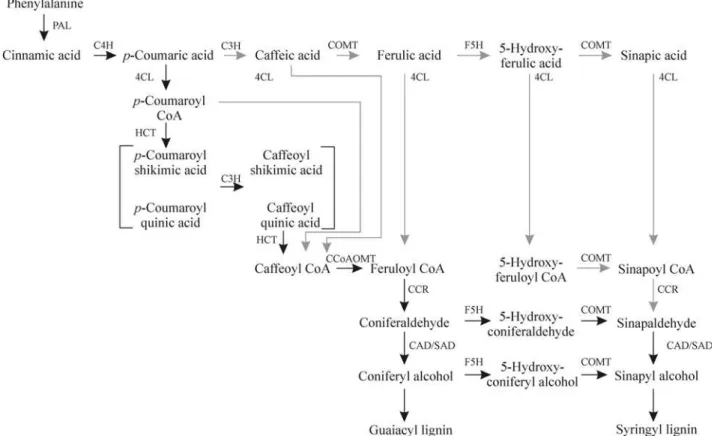
Lignin, after cellulose, is the second most abundant terrestrial organic polymer, accounting for up to 30% of all vascular plant tissue. Deposition of lignins reinforces plant cell walls, providing rigidity, impermeability to water, and protection against pathogens. Lignins are complex racemic aromatic heteropolymers that, in Gymnosperms, derive mainly from coniferyl alcohol and a small proportion of p-coumaryl alcohol, and in Angiosperms, from approxi-mately equal parts of coniferyl and sinapyl alcohols. These monolignols are products of the phenylpropanoid metabo-lism, which is initiated by deamination of phenylalanine by the enzyme phenylalanine ammonia-lyase (PAL). A series of hydroxylation andO-methylation reactions, and conver-sion of side-chain carboxyl to an alcohol results in the building blocks of lignins (Figure 1; Humphreys and Chap-ple, 2002). In the traditional view, this series of reactions occurred at the level of free hydroxycinnamic acids, but re-cent discoveries led to a reformulation of the pathway where hydroxycinnamic acid esters play a central role (Humphreys and Chapple, 2002; Boerjanet al., 2003).
Removal of lignin for cellulose production requires large amounts of chemical and energy input, resulting in fi-nancial and ecological costs. Efforts are being made world-wide towards the development of tree varieties with less
and/or modified lignin which would enhance wood-pulp production efficiency. Transgenic trees with enhanced or reduced expression of different gene encoding enzymes of the phenylpropanoid metabolism show that it is possible to develop varieties with less and/or more easily extractable lignin (Pilateet al., 2002; Li et al., 2003; Baucheret al., 2003).
In Brazil,Eucalyptusis the main source of cellulose for the paper industry. Breeding programs resulted in fast growing and high-yield varieties and is one of the reasons Brazil is a world leader in cellulose and paper production fromEucalyptus. Further improvements will require better understanding of the factors that control wood properties and the recently completed ESTs sequencing project (FOR-ESTs) is a invaluable tool to achieving this goal.
Material and Methods
FifteenEucalyptus grandis ESTs libraries from dif-ferent tissues, developmental stages, and growth conditions were mined for genes encoding enzymes of the phenyl-propanoid metabolism or involved in lignin biosynthesis. Four libraries made from dark grown seedlings of E. globulus,E. saligna,E. urophylla, andE. camaldulensis were also included. These libraries contained altogether 123,889 reads that produced 33,080 clusters (17,286 singlets + 15,794 clusters). Protein sequences of enzymes already described forArabidopsis thaliana,Populusspp., Eucalyptusspp,Nicotiana tabacum, and a few other plant
www.sbg.org.br
Send correspondence to Ricardo Harakava. Av. Conselheiro Rodri-gues Alves 1252, Vila Mariana, 04014-002 São Paulo, SP, Brazil. E-mail: [email protected].
species were used to query the ESTs clusters database using T-Blast-n (Altschulet al., 1997). Sequences alignment and comparisons were made using Clustal-X (Thompsonet al., 1997) and BioEdit (Hall, 1999). Cell compartment local-ization of the encoded protein was determined using PSORT (Nakai and Kanehisa, 1992). Special attention was given to the WD2 library (10,224 reads, 1346 singlets + 4164 clusters), produced with mRNA extracted from wood, which could be enriched for genes encoding enzymes in-volved in lignin biosynthesis. For each cluster mentioned in the text, total number of reads followed by number of reads from WD2 library are provided.
Results and Discussion
Phenylalanine ammonia-lyase - PAL
PAL is the first enzyme of the phenylpropanoid path-way and catalyzes the deamination of phenylalanine to pro-duce trans-cinnamic acid. Twelve clusters with high similarities to PAL genes were found. None of them com-prehended a full-length gene. This can be explained by the fact that PAL enzymes are large proteins (> 70 kDa), en-coded by genes of more than 2 kbp, and most of the ESTs corresponding to either the 5’ or 3’ ends did not reach each other. Four clusters comprehended only one read each and
may contain sequencing errors. Of the eight clusters remaining, six contained several reads (7 to 66) and were considered robust. When the amino acid sequences en-coded by these six clusters were aligned with known PAL protein sequences fromA. thaliana,Populusspp., and Eu-calyptus globulus, three pairs of clusters, each correspond-ing to the N- and C-termini of the protein, could be formed. The pair EGEQRT3100H09.b (66 reads, 23 in WD2)-EGBMRT3131H09.g (18 reads, 12 in WD2), correspond-ing to the N- and C-termini respectively, is the more in-tensely expressed PAL gene. The high number of reads from the WD2 library suggests that it is the main PAL en-zyme involved in wood lignin biosynthesis. This pair is also the most closely related (~97.7 % amino acid sequence identity) to anE. globuluspartial PAL sequence available in the GenBank (AF167487). The pair EGUTRT3109B 10.g (11 reads, 4 in WD2)-EGMCRT3145G11.g (17 reads, 6 in WD2) is the second most expressed PAL gene. The pair EGABLV 2284G08.g (7 reads, 3 in WD2)-EGEZFB 1045G07.g (8 reads, 0 in WD2) corresponds to the least ex-pressed PAL gene. Analysis of the N-terminus of each PAL protein using PSORT indicated that all are directed to the endoplasmic reticulum (ER).
isoenzymes were identified in parsley (Petroselinum crispum),Populus kitakamiensis, andA. thaliana(Appert et al., 1994; Osakabeet al., 1995; Cochraneet al., 2004). The existence of multiple isoforms of PAL allows regula-tory flexibility where each member is preferentially ex-pressed in response to developmental, environmental, or metabolic needs (Kumar and Ellis, 2001; Kaoet al., 2002; Costaet al., 2003, Raeset al., 2003).
Cinnamate 4-hydroxylase - C4H
C4H belongs to the CYP73A group of cytochrome P450-dependent monooxygenases protein family. It hydro-xylates cinnamic acid to generatep-coumaric acid. Two clusters encoding C4H enzymes were found inEucalyptus. Both EGEQRT3101D09.b (72 reads, 36 in WD2) and EGJ MCL1327G07.g (15 reads, 11 in WD2) contained full-length genes encoding proteins that share amino acid se-quence identity of 59.8 %. PSORT predicts the former to be localized to the ER and the latter to the plasma membrane. Accordingly, a C4H protein from hybrid poplar (Populus balsamifera subsp. trichocarpa x Populus deltoides; AAG50231), highly similar to the protein encoded by clus-ter EGEQRT3101D09.b (90.8 % identical), has been dem-onstrated to be localized to the ER (Ro et al., 2001). EGEQRT3101D09.b encoded protein belongs to class I C4Hs while EGJMCL1327G07.g groups with class II C4Hs (Raeset al., 2003). In citrus and French bean, class II C4Hs are induced by elicitor treatment (Nedelkinaet al., 1999; Betzet al., 2001). InEucalyptus, besides WD2 li-brary, class II C4H reads were found only in CL1 and CL2 libraries, made from callus tissue grown under dark and light, respectively, while class I C4H reads were more widely distributed among the different libraries. This sug-gests that, resembling other plant species,Eucalyptusclass II C4H is particularly involved in stress responses but it is also involved in wood lignin biosynthesis and class I is con-stitutively expressed in any tissue requiring phenyl-propanoid metabolites.
4-Hydroxycinnamoyl CoA ligase - 4CL
4CL is responsible for the CoA esterification of p-coumaric acid, caffeic acid, ferulic acid, 5-hydroxyferulic acid, and sinapic acid. InEucalyptus, 3 clusters encoding 4CLs were found. EGEQRT3001E07.b (46 reads, 22 in WD2), appears to be the main isoenzyme involved in lignin biosynthesis and encodes a class I 4CL (Raeset al., 2003). The encoded protein is predicted to be targeted to the ER. Clusters EGSBRT3310C08.g (2 reads, 0 in WD2) and EGJMCL1315H12.g (1 read, 0 in WD2) encode N- and C-termini, respectively, of a class II 4 CL. At least other 7 clusters encode 4CL-like proteins, among which cluster EGBFFB1044B05.b (13 reads, 3 in WD2) is the only one that contains reads from WD2 library and may have a role in lignin biosynthesis.
Hydroxycinnamoyl-CoA:shikimate/quinate hydroxycinnamoyltransferase - HCT
The first HCT was recently purified and the corre-sponding gene cloned from tobacco (Hoffmann et al., 2003). This enzyme converts p-coumaroyl-CoA and caffeoyl-CoA to their corresponding shikimate or quinate esters and catalyzes the reverse reaction as well. Shikimate and quinate esters ofp-coumaroyl-CoA have been shown to be preferred substrates forp-coumarate 3-hydroxylase (C3H), which converts them into their corresponding caffeoyl esters (Schochet al., 2001). Six clusters encoding HCT proteins were found in Eucalyptus. Among these, only EGBMRT3128A11.g (6 reads, 2 in WD2) corre-sponded to a full-length gene while cluster EGABRT3012D12.g (19 reads, 10 in WD2), encoding 342 amino acids of the protein N-terminus, seems to be the main HCT isoenzyme involved in wood lignin formation. Se-quence comparison shows that the protein encoded by EGBMRT3128A11.g has a slightly higher level of identity, 77.8%, to the functionally characterized tobacco HCT, than the one encoded by EGABRT 3012D12.g, which shows 72.3% identity. Hoffmanet al.(2003) have shown that to-bacco HCT has a pronounced preference for shikimic acid versus quinic acid as acyl acceptors, thus it would be inter-esting to investigate whether the more divergent Eucalyp-tus HCT has an opposite preference. Cluster EGEQRT3101E12.b (9 reads, 1 in WD2) may correspond to the C-terminus of EGABRT3012D12.g. The three clus-ters remaining have few reads each and may contain either sequencing or assembling errors.
p-Coumarate 3-hydroxylase - C3H
C3H belongs to the CYP98A3 group of cytochrome P450-dependent monooxygenases family. Although its name indicatesp-coumaric acid as substrate, as commented before, the shikimate and quinate esters of this acid are the substrates instead (Schoch et al., 2001). Two bona fide clusters encoding C3H proteins were found. EGSBRT3314B10.g (30 reads, 17 in WD2) is a full-length gene and EGEQCL2001E08.g (11 reads, 8 in WD2) en-codes 253 N-terminal amino acids of the protein. The pro-tein encoded by cluster EGSBRT3314B10.g shows 77.2% sequence identity to the functionally characterized A. thalianaC3H (Schochet al., 2001; Frankeet al., 2002; Nair et al., 2002), while the peptide encoded by EGEQCL2001E08.g shows an identity of 70.7%. PSORT indicates ER localization for both proteins. Since both shikimate and quinate esters ofp-coumaric acid are sub-strates for C3Hs in the lignin biosynthetic pathway, it is tempting to speculate that the twoEucalyptusisoenzymes have differential specificity towards these compounds.
Caffeoyl CoAO-methyltransferase - CCoAOMT
proteins were found inEucalyptus. EGBMRT3129H01.g (37 reads, 13 in WD2) and EGEQST2200H08.g (24 reads, 11 in WD2) are full-length genes and apparently are the main CCoAOMT genes in wood lignin formation. The en-coded proteins share 88.2% amino acid sequence identity, and PSORT predicts a cytoplasmic localization for both. Both Eucalyptus CCoAOMT isoenzymes have high se-quence identity (> 87%) to the experimentally character-ized one from poplar (O65862; Meyermanset al., 2000). EGB MRT3129H01.g is orthologous to Eucalyptus globulus CCoAOMT-2 (GenBank AAD50443, 99.1% identical) and EGEQST2200H08.g is orthologous to E. globulusCCo AOMT-1 (AAC26191, 99.5% identical) and E. gunnii CCo AOMT (CAA72911, 98.5% identical). Cluster EGRFST 6280E09.g (2 reads, 0 in WD2) shows a 99 nucleotide internal deletion when compared to EGEQST2200H08.g but are otherwise identical. Cluster EGRFRT3333F04.g (2 reads, 0 in WD2) encodes 143 N-terminal amino acids of a protein that is 52% identical to both EGBMRT3129H01.g and EGEQST2200H08.g.
Cinnamoyl CoA reductase - CCR
CCR converts hydroxycinnamoyl CoA esters to their corresponding aldehydes. Cluster EGEQRT5001C10.g (14 reads, 0 in WD2) encodes a protein 74.7% identical toA. thalianaCCR1 (AAG46037), which plays a major role in lignification (Jones et al., 2001; Raes et al., 2003). EGEQRT5001C10.g is orthologous to previously cloned CCRs from E. gunnii (CAA56103, 98.8% identical), E. saligna (AAG16242, 99.1% identical), and E. globulus (AAM34502, 98.5% identical). Cluster EGBMRT6276 A06.g (7 reads, 0 in WD2) encodes a CCR-like protein 40.4% identical to EGEQRT5001C10.g. It is noteworthy that no CCR encoding reads were found in the WD2 library but given the homology of EGEQRT5001C10.g to the pre-viously cloned CCR gene fromE. gunnii, which has been functionally characterized (Lacombe et al., 1997), this cluster is likely to encode the main or exclusive CCR in-volved in lignin biosynthesis. Most of the CCR-encoding reads were from a root cDNA library (7 out of 14).
Ferulate 5-hydroxylase - F5H
F5H is a cytochrome P450-dependent monooxy-genase of the CYP84 group that converts ferulic acid to 5-hydroxyferulic acid but in vitro studies using recombi-nant F5Hs fromA. thalianaand sweetgum (Liquidambar styraciflua) have shown that it preferentially converted coniferaldehyde and/or coniferyl alcohol to synapaldehyde and/or sinapyl alcohol, respectively (Humphreys et al., 1999; Osakabeet al., 1999). For this reason F5H is also designated coniferaldehyde 5-hydroxylase (CAld5H). Three clusters encoding F5H isoenzymes were found in Eucalyptus: EGBFFB1040D04.g (67 reads, 54 in WD2); EGE QRT3200F07.g (27 reads, 0 in WD2); and EGCCRT6008 B11.g (7 reads, 0 in WD2). The elevated
number of reads from the WD2 library in cluster EGBFFB1040D04.g indicates the importance of this isoenzyme for lignin biosynthesis. The encoded protein has sequence identity of 76.5% and 75.0% to functionally char-acterized F5Hs from sweetgum (AAD48912) and A. thaliana(Q42600) respectively. PSORT predicts ER local-ization for the protein encoded by EGBFFB1040D04.g.
Caffeic acidO-methyltransferase - COMT
COMT was previously thought to be a bi-functional enzyme, methylating caffeic and 5-hydroxyferulic acids. More recently, in vitro studies using recombinant alfalfa (Medicago sativa) and sweetgum COMTs have shown that preferential substrates are 5-hydroxyconiferaldehyde and/ or 5-hydroxyconiferyl alcohol, resulting in sinapaldehyde and/or sinapyl alcohol, respectively (Osakabeet al., 1999; Parvathi et al., 2001). Cluster EGEQRT3104D08.g (127 reads, 69 in WD2) encodes a protein with high identity to functionally characterized COMTs from alfalfa (P28002 -80.8%) and sweetgum (AAD48913 - 78.2%). Among clus-ters encoding lignin biosynthetic pathway enzymes, COMT has the highest number of reads from the WD2 li-brary. It is orthologous (99.1% amino acid sequence iden-tity) to the previously cloned COMT from E. gunnii (Poeydomengeet al., 1994). At least 14 other clusters en-coding COMT-like proteins were found inEucalyptusbut only EGRFST7274F09.g (8 reads, 4 in WD2) and EGSBRT6210D12.g (3 reads, 1 in WD2) contained reads from the WD2 library.
Cinnamyl alcohol dehydrogenase - CAD
of CAD proteins. Another 3 clusters appeared to be full-length genes: EGBFRT3114B12.g (9 reads, 0 in WD2); EGEQLV1201D07.g (13 reads, 0 in WD2); and EGEQST2002A03.g (20 reads, 0 in WD2). These 3 pro-teins show below 55% sequence identity to previously de-scribed Eucalyptus CADs. Cluster EGEQLV1201D07.g encodes a protein with the highest identity level (70.8%), among Eucalyptus CADs, to a sinapyl alcohol dehydrogenase (SAD) fromPopulus tremuloides(Liet al., 2001). The encoded enzyme may show preference for sinapaldehyde, making it an S-branch specific enzyme, but the absence of reads from the WD2 library in this cluster ar-gues against this hypothesis. Supporting the latter, Kimet al.(2004) did not detect any specific substrate preference among all A. thaliana CADs and genes with closest homology to P. tremuloides SAD displayed the poorest ability to use any of the 5 aldehyde substrates tested. At least another 13 clusters encoded CAD-like proteins in Eu-calyptusbut were not full-length and since none contained reads from the WD2 library, these are probably not in-volved in wood lignin biosynthesis.
Other enzymes related to lignin biosynthesis and wood formation
Chitinase- The cluster with highest number of reads from the WD2 library, EGEQRT3301F08.g, encodes a class I chitinase. Apparently this gene is highly and specifi-cally expressed in wood since among all reads enconding this enzyme (110 reads), 93 were from the WD2 library. Zhonget al.(2002) have shown that a mutation in a class I chitinase gene (elp1) inA. thalianacauses ectopic deposi-tion of lignin and aberrant shapes of cells with incomplete cell walls in the pith of inflorescence stems. The protein en-coded by cluster EGEQRT3301F08.g is 70.3% identical to the ELP1 protein. Although plants are not known to pro-duce chitin, it is likely that the substrates or products of the class I chitinases-mediated reaction are necessary for nor-mal plant growth and development (Zhonget al., 2002).
Laccase- Laccases can promote polymerization of monolignols in the absence of H2O2, resulting in either
lignans or lignins. Multiple clusters encoding putative laccase proteins were found inEucalyptus, most of them were not full-length. Among the five clusters encoding complete proteins, only EGEQRT3101C03.b (19 reads, 17 in WD2), EGEZRT3005B09.g (15 reads, 9 in WD2), and EGCCRT6011G09.g (11 reads, 1 in WD2) contained reads from the WD2 library. PSORT predicts that the proteins en-coded by EGEQRT3101C03.b and EGCCRT6011G09.g are secreted while the one encoded by EGEZRT3005B09.g is localized to the ER membrane. An extracellular localiza-tion is in accordance to the proposed role of laccases as polymerization catalysts of monolignols. Interestingly, cluster EGEZRT3005B09.g encodes a laccase protein 67.2% identical to that encoded by the poplar lac3 gene, which, when silenced, causes alterations in phenolics
me-tabolism and cell wall structure (Ranochaet al., 2002). It is interesting to note that a large number of reads encoding peroxidase enzymes was found in allEucalyptusESTs li-braries except WD2, which had only 3 reads encoding such enzymes. InEucalyptus, apparently, laccases rather than peroxidases play a more important role in lignification. This is in agreement to what has been observed in develop-ing xylem ESTs libraries from poplar (Sterkyet al., 1998) andPinus taeda(Allonaet al., 1998).
Dirigent protein - Dirigent proteins can promote stereoselective coupling of monolignols and their role in the formation of (+)-pinoresinol lignan inForsythiasp and western red cedar (Thuja plicata) has been well established (Davinet al., 1997; Ganget al., 1999; Kimet al., 2002). Al-though their importance for polymerization of lignins re-mains to be demonstrated, their mode of action may provide clues on how plants control composition and struc-ture of lignins. Five clusters encoding full-length dirigent-like proteins were found. Among these, cluster EGBFST 7259E05.g (7 reads, 5 in WD2) contained the highest num-ber of reads from the WD2 library. The encoded protein has an identity level between 22.5% and 25.5% when com-pared to previously characterized dirigent proteins from Forsythiasp. and western red cedar (Ganget al., 1999; Kim et al., 2002). PSORT indicates that the protein is secreted, in accordance to its proposed role either as a lignan or lignin polymerization agent. Cluster EGBGWD2291B02.g (1 read, 1 in WD2) encodes a dirigent-like protein with the highest identity to those fromForsythiaandThuja, ranging from 50.5% to 60.7%. It is possible that these dirigent-like proteins are involved in lignans formation only, but even if it is the case, the importance of lignans as wood extractives that interfere with pulping makes investigation of those proteins worthwhile.
Metabolic channeling
(Achnine et al., 2004). It was also shown that PAL1 isoform has a higher affinity for its membrane localization than PAL2 (Achnine et al., 2004). Association between PAL and C4H might reduce the cinnamate pool within the cell and, thereby, reduce feedback inhibition of PAL (Blountet al., 2000). Although there is evidence that sup-ports the existence of metabolic channeling at the entry point into the phenylpropanoid pathway, Ro and Douglas (2004) could not demonstrate this mechanism in yeast cells expressing poplar PAL and C4H.
Transgenic approaches to improve wood quality, by increasing or reducing expression of specific enzyme iso-forms, may affect their subcellular localization and lead to unexpected results. Therefore, detailed studies of enzyme isoforms localization and whether or not they form multi-enzyme complexes are extremely important. The availabil-ity of sequences of all genes encoding phenylpropanoid pathway enzymes fromEucalyptuswill facilitate studies on this subject.
Conclusions
Clusters encoding enzymes of all steps in lignin bio-synthesis could be found in theEucalyptusEST libraries. Comparison of the number of reads of each cluster hints at the expression level of the different genes and in many cases points at the isoform(s) most likely to play a role in wood lignin biosynthesis. Several potential targets for gene silencing aiming reduction and/or modification of lignin through plant transformation were identified. All genes found in this study are good candidates for detailed investi-gation of single nucleotide polymorphisms (SNPs) and comparison of expression levels betweenEucalyptus lin-eages varying in lignin quantity and quality.
References
Achnine L, Blancaflor EB, Rasmussen S and Dixon RA (2004) Colocalization of L-phenylalanine ammonia-lyase and cinnamate 4-hydroxylase for metabolic channeling in phenylpropanoid pathway. Plant Cell 16:309-3109. Allona I, Quinn M, Shoop E, Swope K, St Cyr S, Carlis J, Riedl J,
Retzel E, Campbell MM, Sederoff R and Whetten RW (1998) Analysis of xylem formation in pine by cDNA se-quencing. Proc Natl Acad Sci USA 95:9693-9698. Altschul SF, Madden TL, Schaffer AA, Zhang J, Zhang Z, Miller
W and Lipman DJ (1997) Gapped BLAST and PSI-BLAST: A new generation of protein database search programs. Nucl Acids Res 25:3389-3402.
Appert C, Logemann E, Hahlbrock K, Schmid J and Armhein N (1994). Structural and catalytic properties of the four phenylalanine ammonia-lyase isoenzymes from parsley (Petroselinum crispumNym.) Eur J Biochem 225:491-499. Baucher M, Halpin C, Petit-Conil M and Boerjan W (2003) Lignin: Genetic engineering and impact on pulping. Crit Rev Biochem Mol Biol 38:305-350.
Betz C, McCollum TG and Mayer RT (2001) Differential expres-sion of two cinnamate 4-hydroxylase genes in ‘Valencia’ or-ange (Citrus sinensisOsbeck). Plant Mol Biol 46:741-748.
Blount JW, Korth KL, Masoud SA, Rasmussen S, Lamb C and Dixon RA (2000) Altering expression of cinnamic acid 4-hydroxylase in transgenic plants provides evidence for a feedback loop at the entry point into the phenylpropanoid pathway. Plant Physiol 122:107-116.
Boerjan W, Ralph J and Baucher M (2003) Lignin biosynthesis. Annu Rev Plant Biol 54:519-546.
Cochrane FC, Davin LB and Lewis NG (2004) TheArabidopsis phenylalanine ammonia lyase gene family: Kinetic charac-terization of the four PAL isoforms. Phytochem 65:1557-1564.
Costa MA, Collins RE, Anterola AM, Cochrane FC, Davin LB and Lewis NG (2003) An in silico assessment of gene func-tion and organizafunc-tion of the phenylpropanoid pathway meta-bolic networks in Arabidopsis thaliana and limitations thereof. Phytochem 64:1097-1112.
Davin LB, Wang HB, Crowell AL, Bedgar DL, Martin DM, Sarkanen S and Lewis NG (1997) Stereoselective bimolecu-lar phenoxy radical coupling by an auxiliary (dirigent) pro-tein without an active center. Science 275:362-366. De Melis LE, Whiteman PH and Stevenson TW (1999) Isolation
and characterization of a cDNA clone encoding cinnamyl al-cohol dehydrogenase inEucalyptus globulusLabill. Plant Sci 143:173-182.
Endt DV, Costa P, Zago MK, Zanettini MHB and Pasquali G (2000) Genes de lignificação: Em busca do eucalipto trans-gênico com reduzidos teores de ligninas. Biotecnolog Cienc Desenvolv 15:152-159.
Feuillet C, Lauvergeat V, Deswarte C, Pilate G, Boudet A and Grima-Pettenati J (1995) Tissue- and cell-specific expres-sion of a cinnamyl alcohol dehydrogenase promoter in trans-genic poplar plants. Plant Mol Biol 27:651-667.
Franke R, Humphreys JM, Hemm MR, Denault JW, Ruegger MO, Cusumano JC and Chapple C (2002) TheArabidopsis REF8 gene encodes the 3-hydroxylase of phenylpropanoid metabolism. Plant J 30:33-45.
Gang DR, Costa MA, Fujita M, Dinkova-Kostova AT, Wang HB, Burlat V, Martin W, Sarkanen S, Davin LB and Lewis NG (1999) Regiochemical control of monolignol radical cou-pling: A new paradigm for lignin and lignan biosynthesis. Chem Biol 6:143-151.
Grima-Pettenati J, Feuillet C, Goffner D, Borderies G and Boudet AM (1993) Molecular cloning and expression of a Eucalyp-tus gunnii cDNA clone encoding cinnamyl alcohol dehydrogenase. Plant Mol Biol 21:1085-1095.
Hall TA (1999) BioEdit: A user-friendly biological sequence alignment editor and analysis program for Windows 95/98/NT. Nucl Acids Symp Ser 41:95-98.
Hibino T, Chen JQ, Shibata D and Higuchi T (1994) Nucleotide sequence of a Eucalyptus botryoides gene encoding cinnamyl alcohol dehydrogenase. Plant Physiol 104:305-306.
Hoffmann L, Maury S, Martz F, Geoffroy P and Legrand M (2003) Purification, cloning, and properties of an acyl-transferase controlling shikimate and quinate ester interme-diates in phenylpropanoid metabolism. J Biol Chem 278:95-103.
Hrazdina G and Wagner G (1985) Metabolic pathways as enzyme complexes: Evidence for the synthesis of phenylpropanoids and flavonoids on membrane-associated enzyme com-plexes. Arch Biochem Biophys 237:88-100.
cytochrome P450-dependent monooxygenase. Proc Natl Acad Sci USA 96:10045-10050.
Humphreys JM and Chapple C (2002) Rewriting the lignin roadmap. Curr Opin Plant Biol 5:224-229.
Jones L, Ennos AR and Turner SR (2001) Cloning and character-ization of irregular xylem4 (irx4): A severely lignin-deficient mutant ofArabidopsis. Plant J 26:205-216. Kao YY, Harding SA and Tsai CJ (2002) Differential expression
of two distinct phenylalanine ammonia-lyase genes in con-densed tannin-accumulating and lignifying cells of quaking aspen. Plant Physiol 130:796-807.
Kim MK, Jeon JH, Fujita M, Davin LB and Lewis NG (2002) The western red cedar (Thuja plicata) 8-8’ dirigent family dis-plays diverse expression patterns and conserved monolignol coupling specificity. Plant Mol Biol 49:199-214.
Kim SJ, Kim MR, Bedgar DL, Moinuddin SG, Cardenas CL, Davin LB, Kang C and Lewis NG (2004) Functional reclas-sification of the putative cinnamyl alcohol dehydrogenase multigene family inArabidopsis. Proc Natl Acad Sci USA 101:1455-1460.
Kumar A and Ellis BE (2001) The phenylalanine ammonia-lyase gene family in raspberry. Structure, expression, and evolu-tion. Plant Physiol 127:230-239.
Lacombe E, Hawkins S, Van Doorsselaere J, Piquemal J, Goffner D, Poeydomenge O, Boudet AM and Grima-Pettenati J (1997) Cinnamoyl CoA reductase, the first committed en-zyme of the lignin branch biosynthetic pathway: Cloning, expression and phylogenetic relationships. Plant J 11:429-441.
Li L, Cheng XF, Leshkevich J, Umezawa T, Harding SA and Chiang VL (2001) The last step of syringyl monolignol biosynthesis in angiosperms is regulated by a novel gene en-coding sinapyl alcohol dehydrogenase. Plant Cell 13:1567-1586.
Li L, Zhou Y, Cheng X, Sun J, Marita JM, Ralph J and Chiang VL (2003) Combinatorial modification of multiple lignin traits in trees through multigene cotransformation. Proc Natl Acad Sci USA 100:4939-4944.
Meyermans H, Morreel K, Lapierre C, Pollet B, De Bruyn A, Busson R, Herdewijn P, Devreese B, Van Beeumen J, Marita JM, Ralph J, Chen C, Burggraeve B, Van Montagu M, Messens E and Boerjan W (2000) Modifications in lignin and accumulation of phenolic glucosides in poplar xylem upon down-regulation of caffeoyl-coenzyme AO -methyl-transferase, an enzyme involved in lignin biosynthesis. J Biol Chem 275:36899-36909.
Nair RB, Xia Q, Kartha CJ, Kurylo E, Hirji RN, Datla R and Selvaraj G (2002) ArabidopsisCYP98A3 mediating aro-matic 3-hydroxylation. Developmental regulation of the gene, and expression in yeast. Plant Physiol 130:210-220. Nakai K and Kanehisa M (1992) A knowledge base for predicting
protein localization sites in eukaryotic cells. Genomics 14:897-911.
Nedelkina S, Jupe SC, Blee KA, Schalk M, Werck-Reichhart D and Bolwell GP (1999) Novel characteristics and regulation of a divergent cinnamate 4-hydroxylase (CYP73A15) from French bean: engineering expression in yeast. Plant Mol Biol 39:1079-1090.
Osakabe Y, Osakabe K, Kawai S, Katayama Y and Morohoshi N (1995) Characterization of the structure and determination of mRNA levels of the phenylalanine ammonia-lyase gene family from Populus kitakamiensis. Plant Mol Biol 28:1133-1141.
Osakabe K, Tsao CC, Li L, Popko JL, Umezawa T, Carraway DT, Smeltzer RH, Joshi CP and Chiang VL (1999) Coniferyl al-dehyde 5-hydroxylation and methylation direct syringyl lignin biosynthesis in angiosperms. Proc Natl Acad Sci USA 96:8955-8960.
Parvathi K, Chen F, Guo D, Blount JW and Dixon RA (2001) Sub-strate preferences ofO-methyltransferases in alfalfa suggest new pathways for 3-O-methylation of monolignols. Plant J 25:193-202.
Pilate G, Guiney E, Holt K, Petit-Conil M, Lapierre C, Leple JC, Pollet B, Mila I, Webster EA, Marstorp HG, Hopkins DW, Jouanin L, Boerjan W, Schuch W, Cornu D and Halpin C (2002) Field and pulping performances of transgenic trees with altered lignification. Nat Biotechnol 20:607-612. Poeydomenge O, Boudet AM and Grima-Pettenati J (1994) A
cDNA encoding S-adenosyl-L-methionine:caffeic acid 3-O-methyltransferase from Eucalyptus. Plant Physiol 105:749-750.
Raes J, Rohde A, Christensen JH, Van de Peer Y and Boerjan W (2003) Genome-wide characterization of the lignification toolbox inArabidopsis. Plant Physiol 133:1051-1071. Ranocha P, Chabannes M, Chamayou S, Danoun S, Jauneau A,
Boudet AM and Goffner D (2002) Laccase down-regulation causes alterations in phenolic metabolism and cell wall structure in poplar. Plant Physiol 129:145-155.
Rasmussen S and Dixon RA (1999) Transgene-mediated and elicitor-induced perturbation of metabolic channeling at the entry point into the phenylpropanoid pathway. Plant Cell 11:1537-1551.
Ro DK and Douglas CJ (2004) Reconstitution of the entry point of plant phenylpropanoid metabolism in yeast (Saccharomyces cerevisiae): Implications for control of metabolic flux into the phenylpropanoid pathway. J Biol Chem 279:2600-2607. Ro DK, Mah N, Ellis BE and Douglas CJ (2001) Functional
char-acterization and subcellular localization of poplar (Populus trichocarpaxPopulus deltoides) cinnamate 4-hydroxylase. Plant Physiol 126:317-329.
Schoch G, Goepfert S, Morant M, Hehn A, Meyer D, Ullmann P and Werck-Reichhart D (2001) CYP98A3 fromArabidopsis thalianais a 3’-hydroxylase of phenolic esters, a missing link in the phenylpropanoid pathway. J Biol Chem 276:36566-36574.
Sterky F, Regan S, Karlsson J, Hertzberg M, Rohde A, Holmberg A, Amini B, Bhalerao R, Larsson M, Villarroel R, Van Montagu M, Sandberg G, Olsson O, Teeri TT, Boerjan W, Gustafsson P, Uhlén M, Sundberg B and Lundeberg J (1998) Gene discovery in the wood-forming tissues of poplar: Analysis of 5,692 expressed sequence tags. Proc Natl Acad Sci USA 95:13330-13335.
Thompson JD, Gibson TJ, Plewniak F, Jeanmougin F and Higgins DG (1997) The ClustalX windows interface: Flexible strate-gies for multiple sequence alignment aided by quality analy-sis tools. Nucl Acids Res 25:4876-4882.
Walter MH, Grima-Pettenati J, Grand C, Boudet AM and Lamb CJ (1988) Cinnamyl-alcohol dehydrogenase, a molecular marker specific for lignin synthesis: cDNA cloning and mRNA induction by fungal elicitor. Proc Natl Acad Sci USA 85:5546-5550.
Winkel BSJ (2004) Metabolic channeling in plants. Annu Rev Plant Biol 55:85-107.
Zhong R, Kays SJ, Schroeder BP and Ye ZH (2002) Mutation of a chitinase-like gene causes ectopic deposition of lignin, aber-rant cell shapes, and overproduction of ethylene. Plant Cell 14:165-179.