Master in Business Administration - Major in Marketing
Online Grocery Shopping:
An exploratory study of consumer decision making processes
JOANA MARGARIDA CALDAS DA SILVA PENIM
ADVISOR: ANA ISABEL DE ALMEIDA COSTA
Dissertation submitted in partial fulfillment of the requirements for the degree of MSc in Business Administration at Católica Lisbon School of Business & Economics
1
ACKNOLEDGEMENTS
First and foremost, I would like to thank all of those who collaborated in the data collection phase, either by helping in reaching possible participants and/or actively serving as study subjects. Without them, this dissertation would not have been possible. Secondly, I would like to thank my academic supervisor Doutora Ana Isabel Costa, as her expertise helped contribute to the final quality of this project.
Last, but most definitely, not least, I would like to show my gratitude to all my friends and family, for all the love and support they have given me during this period. Particularly, I would like to thank my parents for all the effort and support they have given towards my academic and professional success, and to whom I would like to dedicate this dissertation.
2
ABSTRACT
Online Grocery Shopping:
An exploratory study of consumer decision making processes
Joana Penim
Online shopping has been known as a rapidly growing business, and although online grocery shopping has not followed these same growth patterns in the past, it is now being recognized for its potential. As such, the focus of previous online shopping research has seldom encompassed this specific retail market, with the existing studies focusing essentially on consumers’ motivations and attitudes, rather than how consumers actually shop for groceries online. Therefore, this dissertation has the objective of uncovering some of the details of consumer decision making processes for this specific online retail market, details which can help further both academic research and managerial knowledge.
The general consumer decision making process is characterized by a pre-decisional, a decisional and a post-decisional phase. All of which were addressed in an exploratory fashion, through a mixed methods strategy which combined both quantitative and qualitative methods of data collection. One of the main results obtained through this study is the complementarity of retail channels - as it was found that online grocery shopping serves essentially for major shopping trips, being complemented with smaller trips to traditional stores. Moreover, some resistance to online grocery shopping, specifically the shopping of fresh produce, was also still found among the Portuguese population. Additionally, based on two of the main consumer shopping orientations which shape online grocery shopping, price-sensitivity and convenience, this study uncovered consumer groups which presented distinguishable shopping strategies. These strategies are in general very focused and rational, and vary essentially based on the shopper’s more prominent shopping orientation. Moreover, all consumer types were found to have general negative responses to online stimuli present during shopping. Thus, this dissertation contributed to the knowledge of consumer decision making processes for online grocery shopping, making wave for new and further researches in this field and contributing to managerial knowledge.
3
SUMÁRIO
Compras de Supermercado Online:
Um estudo exploratório sobre processos de decisão do consumidor
Joana Penim
A compra online é conhecida como um negócio de rápido crescimento, e embora as compras de supermercado online não tenham no passado seguido este mesmo padrão de crescimento, estão agora a ver o seu potencial reconhecido. Desta forma, a investigação relativa a compras online não tem tido por foco esta categoria específica de produtos, já que os poucos estudos existentes se centraram essencialmente nas motivações e atitudes dos consumidores e não na forma como estes realmente efectuam as suas compras. Desta forma, esta tese tem por objectivo estudar os detalhes dos processos de decisão dos consumidores relativamente à compra de supermercado online. Detalhes estes que podem ser de relevante importância no avanço, tanto da pesquisa académica, como do conhecimento empresarial.
Em geral, o processo de decisão do consumidor é caracterizado por três fases, uma fase antes da compra, a fase durante a compra e uma última fase após a compra. Tendo as três fases referidas sido abordadas de uma forma exploratória, através de uma estratégia de métodos mistos que combina métodos de recolha de dados quantitativos e qualitativos. Um dos principais resultados obtidos com este estudo, depreende-se pela complementaridade de canais de distribuição. Tendo sido descoberto que a compra de supermercado online serve essencialmente para uma compra maior (por exemplo, a compra do mês), sendo complementada com compras de menor dimensão em lojas tradicionais (por exemplo, a compra da semana ou diária). Adicionalmente, foi ainda encontrada alguma resistência a este tipo de compra online entre a população Portuguesa, especificamente no que toca a compra de produtos frescos. Para além destes resultados, e com base em duas das orientações de compra que guiam a compra de supermercado online mais importantes (sensibilidade ao preço e conveniência), este projecto permitiu ainda encontrar grupos de consumidores com estratégias de compra distintas. Estas estratégias são em geral focadas e racionais, mas variam com base na orientação de compra do consumidor mais proeminente. Todos os tipos de consumidores encontrados mostraram ainda respostas, em geral, negativas quanto aos estímulos online presentes durante a compra. Assim, é possível constatar que esta tese de mestrado contribuiu para o conhecimento dos processos de decisão do consumidor para compras de supermercado online, abrindo vaga para novas e futuras pesquisas académicas na área, assim como contribuindo para o conhecimento desta actividade comercial.
4
Table of Contents
CHAPTER 1: INTRODUCTION ... 6
1.1. Background and problem statement ... 6
1.2. Aims and scope ... 7
1.3. Methodology ... 8
1.4. Relevance and implications ... 9
1.5. Dissertation outline ... 10
CHAPTER 2: LITERATURE REVIEW AND CONCEPTUAL FRAMEWORK... 11
2.1. The purchase decision making process in traditional retail environments ... 11
2.2. The purchase decision making process in online retail environments ... 12
2.3. Grocery shopping in traditional stores ... 13
2.3.1. Pre-decisional stages ... 14
2.3.2. In-store buying decisions ... 16
2.4. Grocery shopping in online stores ... 17
2.4.1. Adoption and buying motivations ... 18
2.4.2. Buying, browsing and search patterns ... 20
2.5. Main conclusions & conceptual framework ... 21
CHAPTER 3: METHODOLOGY ... 24
3.1. Research purpose and approach ... 24
3.2. Research strategy and design ... 24
3.3. Population and sampling ... 26
3.4. Data collection ... 27
Web-based questionnaire ... 27
Semi-structured interviews and accompanied shopping visits ... 28
3.5. Data analysis ... 30
Web-based questionnaire ... 30
Semi-structured interviews and accompanied shopping visits ... 31
CHAPTER 4: RESULTS’ ANALYSIS & DISCUSSION ... 32
4.1. Results of the web-based questionnaire ... 32
4.2. Results from the semi-structured interviews and accompanied shopping visits.. 36
4.2.1. Pre-decisional phase... 37
5
Inter- & Intra-Purchase Cycles ... 38
4.2.2. Decisional phase ... 39
Buying and browsing strategies ... 39
Response to Stimuli ... 42
4.2.3. Post-decisional phase ... 43
4.3. Resulting propositions ... 44
CHAPTER 5: CONCLUSIONS ... 46
5.1. Conclusions & Suggestions ... 46
Managerial suggestions ... 48
5.2. Limitations ... 49
5.3. Future Research ... 50
REFERENCES ... 51
ANNEX 1 – Web-based questionnaire for online grocery shopping ... 56
ANNEX 2 – Script for the semi-structured interviews and observation of shopping trip ... 57
ANNEX 3 – Continente Online Store Layout ... 60
ANNEX 4 – Tesco’s Store Layout with ‘multisearch’ tool... 60
LIST OF FIGURES Figure 2.1. – Conceptual Framework ………...…. 21
LIST OF TABLES Table 4.1 – Demographic Characteristics (n=55) ……….………....……... 32
Table 4.2 – Planning Patterns (n=49) ……….…... 35
6
CHAPTER 1: INTRODUCTION
1.1. Background and problem statement
As pointed out by previous studies, (e.g. Lim, Widdows & Hooker, 2009; Ramus & Nielsen, 2005), the online retail market has grown tremendously over the last decades, with sales and consumer adoption increasing every year. However, this growth has been highly heterogeneous across retail segments. The online grocery business, in particular, has witnessed a difficult start in Europe and the U.S., with the online operations of established retailers and click-only grocery stores struggling to survive (e.g. Peapod, Webvan, Homegrocer, Shoplink) (e.g., Delaney-Klinger, Boyer & Frohlich, 2003; Lim, Widdows & Hooker, 2009; Ramus & Nielsen, 2005). Consequently, the scope of previous academic research related to online shopping and consumer behaviour has seldom addressed the grocery retail market, with the few existing studies focusing only on consumers’ adoption and general attitudes and motivations towards online grocery shopping (e.g. Ramachandran, Karthick & Kumar, 2011; Morganosky & Cude, 2000; Hansen, 2005; Verhoef & Langerak, 2001). As a result, not much is known about how exactly consumers shop online for groceries. In this contemporary society, bounded by the search of constant technological advances and innovations, consumers are becoming less and less loyal to any specific brand or retail format and increasingly focus on the satisfaction of immediate goals and needs (Deloitte & Harrison Group, 2010). Consequently, online shopping has become a highly profitable retail format, achieving high sales values across much of the developed world (e.g. Lim, Widdows & Hooker, 2009; Hand, Riley, Harris, Singh & Rettie, 2009). Although yet far from reaching its full potential in several markets, the current percentage of online grocery sales is certainly something to follow closely (e.g. Lim, Widdows & Hooker, 2009). As traditional and click-only grocery retailers begin to learn from past errors and learn to take better advantage of the technological innovations developed for the digital world, more companies are venturing into this segment with improved business models and service levels (Delaney-Klinger, Boyer & Frohlich, 2003). Concurrently, Western consumers are experiencing increasing time and budget constraints, both of which are impacting considerably their shopping behaviour (Morganosky & Cude 2000; POPAI, 2011; Deloitte & Harrison Group, 2010). Namely, they are becoming more value-conscious due to the current economic crisis, which
7 together with the time scarcity felt, leads to an increasing demand for lower search costs, higher shopping convenience, better price deals and more rewarding purchase experiences (e.g., Morganosky & Cude 2000; POPAI, 2011; Deloitte & Harrison Group, 2010). Such trends are likely to motivate a renewed interest in online grocery shopping in the coming years.
Although several studies have looked at online grocery shopping at various levels, such as adoption (e.g., Hansen, 2005), profiling of consumer segments (e.g., Rohm and Swaminathan’s, 2004) or relationship with situational variables (e.g., Robinson, Riley, Reetie & Rolls-Willson, 2007), very few have investigated the actual purchase decision making processes of online grocery shoppers. Since grocery shopping involves purchase decisions that are markedly different from those in other product categories (Verhoef & Langerak, 2001), such as apparel or technology for instance, it is crucial for retailers to learn how their customers shop online for groceries if they want to tap into this market’s potential and thrive in the highly competitive online environment (Ramachandran, Karthick & Kumar, 2011). It becomes, therefore, necessary for retailers and managers to better understand not only what motivates their consumers to shop for groceries online in the first place, but also how online consumers go about making buying decisions in a digital environment (Hand, Riley, Harris, Singh & Rettie, 2009; Ramachandran, Karthick & Kumar, 2011).
This dissertation intends to contribute to the growing body of knowledge of the consumer decision making processes in online grocery shopping environments. Namely, it will seek to explore, in as much detail as possible, how consumers purchase supermarket products in online retail stores and uncover the main features of the buying decision processes involved in this type of consumer behaviour.
1.2. Aims and scope
The general aim of this dissertation is to portray a complete and detailed picture of the overall purchase decision making process of consumers shopping online for groceries, including pre- and post-decisional stages. Although providing a broad description of the overall decisional process, the intent is to focus on the actual purchasing stage, shedding some light onto two details of this process – the in-store buying and browsing strategies used by online grocery shoppers and their reaction to in-store stimuli. Specifically, this dissertation attempts to answer the following research questions:
8
What are the consumers’ buying, search and browsing strategies while looking for offers in online grocery stores?
How do consumers respond to in-store stimuli in an online grocery store environment?
For practical reasons, the scope of this dissertation’s data collection is limited to the buying behaviour of Portuguese grocery shoppers, particularly of those living in the broad Lisbon area. Portuguese consumers have a marked preference for buying groceries in large, traditional store formats, such as hypermarkets and supermarkets, a segment in which the company Sonae MC is the current market leader (GAIN Report, 2003; APED Report, 2009). To date, there are only two hypermarkets and one supermarket brand selling groceries online in Portugal, with Sonae MC also leading this segment with its brand Continente Online (GAIN Report, 2003; APED Report, 2009; Acepi, 2012). Consequently, the scope of this dissertation is limited to shopping trips conducted in the Continente Online’s website, which is also the only Portuguese online grocery store with a website up to par with current e-commerce technology.
1.3. Methodology
In order to answer the research questions proposed, and given that there are no specific articles on in-store decision making processes for online grocery shopping, as indicated previously, two studies were conducted and approached in an exploratory fashion. A mixed methods strategy was chosen, more specifically a convergent parallel research design. Such a design is characterized by the concurrent, but independent collection and analysis of quantitative and qualitative data, with the aim of combining findings to obtain meaningful answers to the underlying research questions (Bryman, 2012; Creswell & Plano Clark, 2011; Tashakkori & Teddlie, 2003). The first study elaborated consisted of an online questionnaire directed towards Portuguese online grocery shoppers of Continente Online (n=55), focusing on the collection of quantitative data, essentially on the pre-decisional phase of the consumer decision making process. The second study, on the other hand, consisted on the collection of qualitative data on the consumer’s behaviour inside the online store, through in-depth interviews and behavioural observation. The subjects (n=9) for the second study were recruited through the online questionnaire performed before hand, targeting Portuguese consumers
9 shopping at Continente Online and that corresponded to the desired characteristics (i.e. constituting an overall balanced sample). It is important to acknowledge that the qualitative aspect of this methodology encompasses a higher weight of the overall analysis, compared with the contrasting quantitative feature, given that the qualitative facet focuses essentially on the decisional phase of the online grocery shopper decision making process – the focal point of the research questions defined. The methods described were based on the Shopping with Consumers observational method used in in-store traditional retailing (Lowrey, Otnes & McGrath, 2005). This method, although usually used in in-store retailing, was adapted for this dissertation due to the proximity with the informant, which provides a better understanding of consumers’ behaviour in-store, being more advantageous for the study proposed. Moreover, the combination of both quantitative and qualitative methods, allows for a more complete and in-depth approach of the research questions defined. As the response to in-store stimuli, occurring exactly at the point of sale, is better acknowledged through consumer’s observations, as well as the search and browsing strategies used, although being the last also determined by pre-decisional factors. Thus, the combination of both methods was deemed the most appropriate.
1.4. Relevance and implications
The findings and conclusions presented by this dissertation have both academic and practical relevance. On one hand, they support the establishment of future research studies related to online grocery shopping, uncovering new insights about consumer online behaviour within this retail category. Namely, the different strategies consumers use while shopping online for groceries and their respective response to the presented stimuli. On the other hand, these new insights and information about online grocery shoppers are also important for the success of retailers’ strategies and respective online platforms. By better understanding the buying process of online grocery shopping - from the plans consumers elaborate before shopping, to the actual buying process and finally to the post-shopping evaluation – as well as some of the implications on sales of this retail channel versus a more traditional one, this study is expected to contribute to the practical knowledge of retailers, retail managers and marketers, allowing them to better adapt their online stores to the expectations and behaviour of consumers. Moreover, allowing retailers and managers to better understand how to engage
10 consumers in the different retail channels available, increase possible sales and position over competitors, and how to offer consumers the best suitable service possible given their specific consumer characteristics and preferences.
1.5. Dissertation outline
Chapter 2 presents the results of the literature review performed, which focused on current knowledge about traditional and online grocery shopping behaviour. This chapter also provides details of the conceptual framework that guided the development of the dissertation. Chapter 3 details the research methodology employed to seek answers to the proposed research questions, namely the design and performance of empirical studies with online grocery shoppers, while Chapter 4 describes and analyses the results obtained from these studies. Chapter 5 summarizes the relevant conclusions and implications that can be derived from the findings of this dissertation, addresses its main limitations and proposes avenues for further research in the area of online grocery shopping.
11
CHAPTER 2:
LITERATURE REVIEW AND CONCEPTUAL
FRAMEWORK
This chapter presents a review of the articles and business reports related to consumers’ grocery shopping decision making process, in both offline and online retail channels. The intent was to acquire a general overview of grocery shopping, in what pertains to this dissertation and subsequent research questions, and as such the focus relies mostly on the decisional phase and influencing pre-decisional phase of the grocery shopper decision making process. Based on the outcome of the literature review performed, a conceptual framework that guided the design and performance of the empirical studies, aiming at providing answers to the proposed research questions, is also presented.
2.1. The purchase decision making process in traditional retail environments
A consumer purchase is typically a response to a problem or need, and once a consumer realizes this, he or she undergoes a series of steps until his or her need is satisfied (Solomon, Bamossy, Askegaard, & Hogg, 2006). This is a reflection of the consumer decision making process, which main stages are generally defined in the Consumer Behaviour and Marketing literature as: (1) Problem identification; (2) Information search; (3) Evaluation of alternatives; (4) Purchasing decision; (5) Post-purchase behaviour (e.g. Kotler & Keller, 2008; Solomon, Bamossy, Askegaard, & Hogg, 2006). However, not all decision making processes are exactly consistent with this model, as several external factors (such as consumer characteristics, motivations, socio-economic environment, etc.) may influence how consumers progress from one stage to the next (Solomon, Bamossy, Askegaard, & Hogg, 2006). In the context of the models of consumer decision making described by Solomom, Banossy, Askegaard, & Hogg (2006), grocery shopping can be best categorized as a habitual decision making process. As the decisions associated to most supermarket purchases typically demand only a low level of involvement from most consumers, being strongly related to the experience of past shopping trips and automated buying routines (Solomon, Bamossy, Askegaard, & Hogg, 2006). Nevertheless, supermarket product offers and grocery store environments are usually far more complex, information-rich and heterogeneous than those characterizing other types of purchases, encompassing a very large set of cues and stimuli designed to influence consumers’ decision making at the point of purchase. As
12 Inman, Ferraro & Winer (2004) established in their model for in-store decision making, customers are firstly exposed to product categories and in-store displays as they shop, with the intensity of exposure being highly influenced by several contextual factors, like shopping trip type, display type/location, number of aisles shopped and purchase involvement. Then, shoppers must be motivated to process the in-store stimuli to which they are exposed, a motivation which is in turn influenced by factors such as deal proneness, age and need for cognition. Next, the recognition of a need for the product category (if the consumer has not planned to purchase such category beforehand) must be acknowledged, something which again may be influenced by several factors, like compulsiveness, shopping party size, gender, household size, age and income. And finally, the actual decision execution must occur for each category purchase, independently of whether the purchase was planned beforehand or decided only inside the store.
2.2. The purchase decision making process in online retail environments
When analysing the particular case of online shopping, factors other than those already reviewed come into play and should therefore be taken into account. Chen & Chang (2003) highlight three key quality dimensions that impact consumers’ satisfaction with online shopping activities and subsequent purchase: interactivity (e.g., the quality of broadband connection and the design of the website), transaction (e.g., shopping value, convenience, assurance, entertainment and evaluation) and fulfillment (e.g., order processing, delivery and post-sales service). Interactivity is closely linked to overall store satisfaction, as it can by itself demote or promote the consumer to continue browsing/searching/purchasing on a specific website. Meanwhile, the quality of the transaction process also plays a crucial role, as convenience, value and security are essential online consumer requirements. Finally, the level of fulfillment determines the confidence and trust consumers have in online transactions, and may also help to provide greater convenience and value to e-shoppers (Chen & Chang, 2003).
Additionally, Constantinides (2004) reinforced the claim that, just as in traditional markets, the interaction of uncontrollable (consumer characteristics and environmental influences) and controllable factors (product/service characteristics, medium characteristics, merchant/intermediary characteristics) is also at play in the online shopping environment. Consequently, the controllable traditional marketing tactics,
13 which are essential to attract and engage consumers, are paired with the online shopping experience controllable elements as to provide a satisfactory consumer online experience (Constantinides, 2004). As such, online shopping experiences are viewed as being the outcome of website functionality, user characteristics, online cues and stimuli, information provisioning and product and service offers (Constantinides, 2004). All these factors will hence serve as input for buying decisions, alongside the traditional consumer decision making variables associated to offline purchasing.
Finally, in their review of previous research, Darley, Blankson & Luethge (2010) present an online decision making process model, which further segregates the external influential factors into individual differences or characteristics (i.e., motives, values, lifestyle, and personality), socio-cultural factors (i.e., culture, social class, reference groups, and family), situational and economic factors, and online atmospherics or environmental aspects (i.e., website quality, interface, user satisfaction and user experience). This model is based on the central role occupied by traditional decision making processes in the online shopping environment, recognizing the existence of particular moderating and interacting effects. Furthermore, the authors highlight the satisfaction of human needs rather than emphasizing the specifics of the underlying technology, and emphasize online consumer behaviour as a complex phenomenon, with several links and interactions that are still unexplored and offer ground for further research.
2.3. Grocery shopping in traditional stores
As several studies indicate (e.g. Deloitte & Harrison Group, 2010; POPAI, 2011), grocery shoppers have begun to find ways to spend less and reduce risk in the mist of the current economic and financial crisis. They have learned new tactics to save money on supermarket purchases and manage their household pantry, while shopping trips have also become more careful and focused (Deloitte & Harrison Group, 2010). Consumers’ grocery shopping routine now regularly includes strategic and tactical features like clarifying wants versus needs, delaying gratification, lowering quality requirements, frequent channel, store and brand switching, an intense use of coupons, loyalty cards, shopping lists and other promotional offers, stockpiling and increasing purchase of private label products, among others (Deloitte & Harrison Group, 2010; POPAI, 2011). Furthermore, consumers are becoming increasingly less loyal to national
14 brands and also less likely to engage in impulse buying or new product trial, as the new aim for grocery shopping is household gratification while maintaining quality but minimizing expenditure (Deloitte & Harrison Group, 2010). Consumers are no longer afraid or ashamed to be seen shopping for a bargain, often viewing price as the single most important factor in choosing among retail brands and also a motive to patronize multiple stores, formats and retail brands (POPAI, 2011). Shoppers are also increasingly synergizing between the off- and on-line channels, in order to maximize the value of their purchases (POPAI, 2011; Deloitte & Harrison Group, 2010). To the same end, they are also becoming more receptive to new electronic shopping tools and savvier as to which fit better their purchase needs and plans, increasingly seeking all sorts of information resources available to gain more control over their shopping experience (POPAI, 2011). And while these new approaches and strategies are mostly based on cutting down expenditure, most consumers still do not feel like they are sacrificing much, and thus show no intention of returning to old shopping habits when the economy recovers (POPAI, 2011; Deloitte & Harrison Group, 2010). According to A.C. Nielsen’s annual report on consumer confidence (2010), Portuguese consumers are no exception to this scenario. As fellow shoppers worldwide, they are also changing their spending habits – e.g., eating out less, buying less garments and more private labels, being more concerned about energy and gas spending –, and show no intention of returning to old shopping habits.
2.3.1. Pre-decisional stages
How purchases are actually decided upon during shopping trips is greatly influenced not only by the purchase environment, but also by several pre-decisional factors. Namely, buying decisions are heavily conditioned by the goals consumers pursue within a specific purchase, which can be as diverse as satisfaction of general needs, acquisition of essential items, emotional gratification or mere entertainment (Santos, 2009). This reflects different shopping motivations, which shape shoppers’ decision making processes, and which can be generally distinguished as being of an utilitarian or hedonic perspective (Babin, Darden & Griffin, 1994; Cardoso & Pinto, 2010). Utilitarian shoppers are problem-solving, task-oriented consumers, who make mainly rational decisions. While, on the other hand, the hedonic shopper is often looking for enjoyment, emotional and/or sensory stimulation and the satisfaction of desires while carrying out
15 their shopping activities (Babin, Darden & Griffin, 1994; Cardoso & Pinto, 2010). In the context of grocery shopping, this activity can be, for some consumers, a highly stressful chore and nothing more than a hassle, rather than pleasant and enjoyable (Santos, 2009). In this sense, and given the habitual or routine characteristic of this type of purchase, which mostly focuses on the acquisition of essential items (Santos, 2009; Solomon, Bamossy, Askegaard, & Hogg, 2006), grocery shopping is mostly considered an activity with an underlying utilitarian motivation (Babin, Darden & Griffin, 1994; Cardoso & Pinto, 2010; Santos, 2009). Concurrently, the establishment and achievement of such shopping goals implies a series of pre-decisional steps, such as when to conduct a particular shopping trip, which stores to visit or which products to choose from (Santos, 2009). As Santos (2009) states, the timing of shopping trips is defined not only by the availability of the consumer, but also by the periods when the shopper believes to be more appropriate to visit the selected stores. While the decision of which stores to visit and which products to purchase is deeply influenced by the shopper’s expectations of which alternatives will better satisfy his or hers existing needs (Santos, 2009). Additionally, other pre-shopping decisional factors such as the use or not of a shopping list or shopping alone or accompanied, for example, are also likely to influence consumers’ behaviour and shopping outcomes (Santos, 2009; POPAI, 2011; Thomas & Garland, 2004). The use of a written shopping list, for instance, can act as an important shopping tool for goal achievement. As, for some, shopping lists yield the benefits of ensuring that needed products are acquired and hence minor fill-in shopping trips are avoided. While, for others, shopping lists mean fewer hassles, as the shopping process and budget expenditure are kept under control (Thomas & Garland, 2004; Santos, 2009). Furthermore, according to a study by the POPAI Institute (2011), unaccompanied shoppers are less likely to use written shopping lists and more likely to deviate more from their spending goals. While, accompanied shoppers tend to navigate more throughout the store, but see companions as having little influence on their purchases (POPAI, 2011). Indeed, grocery shopping patterns are heavily determined by consumer demand and subsequent shopping plans, and this has an important effect on the time and budget spent at the store (Santos, 2009).
16
2.3.2. In-store buying decisions
According to POPAI’s report on grocery shopper engagement (2012), the rate of overall in-store decision making (i.e., generally planned, unplanned and substitute purchases) has climbed to 76% in 2012, with most of this rise coming down to the increase of in-store marketing activities. An increasingly important part of the marketing mix is, thus, the use of point-of-sales materials and devices to stimulate sales, given that the decision making process of shoppers is often triggered just at the sight of the product category displays or related in-store stimuli (e.g., POPAI, 2012; Inman, Winer & Ferraro, 2009; Park, Iyer & Smith, 1989). Therefore, planned purchases can be defined as purchase decisions completely established before entering the store, while unplanned or impulse purchases can be defined as made specifically inside the store, and thus dependent on the existing marketing activities (e.g., Inman, Winer & Ferraro, 2009). Consequently, positive affective reactions to in-store stimuli increase the likelihood of unplanned purchases, or, in other cases, prompt consumers to consider or remember that there is a need for a certain product category which was not considered at the time when the shopping plans were made (Inman, Winer & Ferraro, 2009). Concurrently with the interaction of the shopper and the shopping environment, consumer’s proneness to unplanned purchases has also been shown to vary with out-of-store stimuli, such as overall shopping goals (Bell, Corsten & Knox, 2011). In this sense, research has shown that on major shopping trips there is a higher incidence of unplanned purchases rather than on fill-in trips, given that in-store stimuli are likely to have a higher impact on more broadly-defined purchase intentions (Kollat & Willett, 1967; Bell, Corsten & Knox, 2011). Also, consumers on major shopping trips are likely to spend more time inside the grocery store and therefore become more exposed to in-store stimuli (Kollat & Willett, 1967; Bell, Corsten & Knox, 2011). Moreover, Park, Iyer & Smith (1989) have found that time restrictions and high store familiarity limit the extent to which shoppers process in-store information, and as such, shoppers make more unplanned purchases under no time pressure and in unfamiliar stores. Additionally, Bell, Corsten & Knox, (2011) have found that on trips in which the household chooses the store based on its low prices there is more unplanned buying, as the consumer may feel its extra purchases to be justifiable. Moreover, the authors suggest that on trips in which the household chooses the store as part of a multi-store shopping strategy there are less unplanned purchases, as this reflects a strategy of more specifically-defined goals. Another important aspect of unplanned purchases was stated by Stilley, Inman &
17 Wakefield (2010), which argue that consumers anticipate the occurrence of unplanned purchases because they realize they have neither the time nor the resources to fully plan, and/or because they want to be able to make spontaneous decisions while in-store. Therefore, these authors defend that consumers establish a mental budget to spend on a specific grocery shopping trip and that this budget includes room for impulse purchases. Additionally, even when a budget is not explicitly defined, consumers will know by experience the average amount to spend due to the routinized nature of grocery shopping, and will take this into account (Stilley, Inman & Wakefield, 2010).
2.4. Grocery shopping in online stores
Online grocery stores were amongst the first Internet start-ups to be launched in the late 1990’s. Nevertheless, it was only very late that this type of business was able to gain enough traction amongst North-American and European consumers, currently accounting for only a small portion of total online retail sales in many countries (KPMG International, 2012; Lim, Widdows & Hooker, 2009; Ramus & Nielsen, 2005). Nevertheless, after books, clothing and other product categories, grocery shopping is emerging as the next fastest growing category in online retailing (KPMG International, 2012). As such, the strong predicted growth of the online grocery channel in Western countries presents good business opportunities for brand manufacturers and retailers alike (Lim, Widdows & Hooker, 2009). A study by KPMG International (2012) has encountered that, in such developed countries, the largest segment of online grocery shoppers is mainly composed of highly educated (graduates or above) females, aged 25–55 years old, with a full or a part-time job and with children under their care. Due to the current economic conditions, however, this study found that more consumers from all income levels are beginning to buy groceries online, looking to benefit from the variety of promotional offers that tend to be exclusive to this retail format. Additionally, the KPMG International (2012) study uncovered that consumers are gradually shifting from personal computers to mobile phone and tablets as the preferred device for online shopping. Consequently, the continued development of mobile applications and its increased convenience of use and associated services should help increase even more the occurrence of online grocery shopping (KPMG International, 2012). Moreover, the referred study defends that online grocery stores offer the contemporary, time and money tight customers a way to conveniently search and acquire products, alongside
18 with the opportunity to more easily control their budget and closely monitor their cart contents (KPMG International, 2012). Thus, the aspect that seems to be, at least, one of the main drivers for online shoppers is the need for convenient shopping activities (e.g., Rohm and Swaminathan’s, 2004; Morganosky & Cude, 2000; Ramus & Nielsen, 2005; Verhoef & Langerak, 2001; Robinson, Riley, Reetie & Rolls-Willson, 2007). The study performed by Rohm & Swaminatham (2004), for instance, confirms this result arguing that convenience, paired with variety seeking, are the main underlying motivations in the online channel, while time savings and recreational shopping orientations appear to be more significant drivers in the offline store format. Although convenience remains important in both retail channels, one possible explanation the authors found for the differentiating drivers between store formats may be that, while there is time saved in shopping online, there is also a higher time gap between purchase and actual acquisition of the goods purchased, due to the delivery waiting periods.
2.4.1. Adoption and buying motivations
“Digital retailing is playing an increasingly pivotal role in the way consumers shop, having changed their expectations and preferences considerably” (KPMG International, 2012). This development also applies to the online grocery store business, as a study undertaken by Hansen (2005) indicates that, on average, consumers are now well familiar with online grocery stores and do not associate a particularly higher risk of shopping online for grocery products, when compared to other product categories. Yet, there are still some strong barriers to widespread online grocery shopping adoption, namely consumer skepticism and uncertainty, the payment of delivery fees, the occurrence of delayed and/or wrong deliveries, a lack of/lower level of online promotional activities, a higher task complexity and insufficiently user-friendly websites (Robinson, Riley, Reetie & Rolls-Willson, 2007; KPMG International, 2012). These perceived drawbacks lower the trust of potential customers on online transactions, decrease conversion rates from browsers to shoppers, reduce basket sizes and limit the number of returning customers (KPMG International, 2012). Additionally, it is suspected that consumers continue to shop for groceries offline out of habit, or due to a lack of awareness and actual availability of online options (Nielsen, 2009). These are unfortunate circumstances, as more consumers increasingly appreciate the opportunity to shop day and night for groceries and avoid the unpleasant experiences
19 that can accompany shopping in traditional stores, such as crowds or traffic (Nielsen, 2009; Robinson, Riley, Reetie & Rolls-Willson, 2007; Morganosky & Cude, 2000). Furthermore, online grocery shopping allows consumers to buy in bulk and stock up without having to lug around heavy packages (Nielsen, 2009; Robinson, Riley, Reetie & Rolls-Willson, 2007). Finally, it helps time-restricted consumers to save time and money, and can become a less stressful way of shopping, one in which consumers exercise greater control over their purchases and better compare products and offers (KPMG International, 2012; Nielsen, 2009; Verhoef & Langerak, 2001). As such, more evidence is provided which denotes shopping convenience as one of the main drivers for online grocery shopping (e.g., Nielsen, 2009; Verhoef & Langerak, 2001). Accordingly, Robinson, Riley, Reetie & Rolls-Willson (2007), supporting earlier findings by Morganosky & Cude (2000), noted that convenience seems particularly relevant when some situational constraints - such as ill health, changing homes or jobs, breaking a limb, having a baby, working late, children leaving home, working from home, aging, etc. – come into play. In addition, the authors argue that the disappearance of such situational constraints is also often the primary reason for stopping or diminishing the frequency of online grocery shopping. In this sense, online grocery shopping has been found to be, by several studies, highly discretionary (Hand, Riley, Harris, Singh & Rettie, 2009; Robinson, Riley, Reetie & Rolls-Willson, 2007; Morganosky & Cude, 2000), as it may be forsaken when a specific trigger disappears or when, for some reason, consumers become unhappy with the level of service. This indicates that even the high demand for convenience that often drives the adoption of online grocery shopping may be highly contingent upon particular individual circumstances (Hand, Riley, Harris, Singh & Rettie, 2009). This leads to the frequent re-evaluation of the decision to conduct grocery shopping in online formats. Consequently, post-adoption evaluations become particularly crucial to the decision of whether or not to continue using an online grocery store (Hand, Riley, Harris, Singh & Rettie, 2009). Taken together, past findings suggest that online grocery shopping is complementary to, rather than a substitute of, traditional grocery shopping (Hand, Riley, Harris, Singh & Rettie, 2009; Robinson, Riley, Reetie & Rolls-Willson, 2007; Morganosky & Cude, 2000). As evidence has been found that most consumers shop personally, at least, for perishables and/or special products (i.e., items shopped with an uncommon purpose, as for example a dinner party) (Robinson, Riley, Reetie & Rolls-Willson, 2007; Morganosky & Cude, 2000).
20
2.4.2. Buying, browsing and search patterns
Some studies have investigated consumers’ search and browsing patterns for several product categories, within the online environment (e.g. Moe, 2003; Wolfinbarger & Gilly, 2001). In a research by Moe (2003), for example, a distinction between goal-directed search and exploratory search is made. On one hand, exploratory search is less deliberate and focused on a particular purchase occasion. It tends to be more undirected and stimulus-driven than goal-driven, hence being often referred to as browsing or
ongoing search, and in many instances derives from consumers’ poor familiarity with
product categories. Goal-directed search, on the other hand, refers to situations in which online consumers browse the web with a specific or planned purchase in mind. In this case, search patterns are very focused and driven towards goal achievement. As a result, goal-directed searches are highly task-oriented, rational, efficient and deliberate (Moe, 2003; Wolfinbarger & Gilly, 2001). Furthermore, goal-oriented consumers reach control, freedom and lack of commitment in the online channel, as they encounter little pressure to purchase before they are completely ready, and are thus found to be less impulsive (Wolfinbarger & Gilly, 2001). Additionally, and as previously mentioned, online grocery shopping, as offline grocery shopping, is considered by most consumers as a chore, an activity which is performed mainly by utilitarian, rather than hedonic, shopping motivations (Robinson, Riley, Reetie & Rolls-Willson, 2007; Verhoef & Langerak, 2001), and which is highly directed towards goal achievement (POPAI, 2012). Thus, online grocery store visits should be considered as directed-buying internet visits, which are more likely to result in immediate purchases (Moe, 2003). A typical characteristic of such directed-buying visits is the consumer’s tendency to present focused search patterns, which represent the shopper’s goal-driven motivation (Moe, 2003). This, however, does not totally exclude the possibility of exploratory search behaviours at the category, product or even brand level and hence does not necessarily preclude the incidence of in-store decision-making, depending also on the extent and nature of the encountered stimuli (Moe, 2003). In regards to online stimuli, a study conducted by Parsons & Conroy (2006) suggests that grocery websites provide examples of the middle ground concerning the relationship between stimuli and the browsing experience. Given that online grocery stores are more likely to have frequent repeat visits, consumers should be more pervious to familiar stimuli and would not want to become over-stimulated, relatively to what happens in traditional stores (Parsons & Conroy, 2006). In addition, the referred study uncovered that, online grocery shoppers
21 have a preference for fast tempo, low volume music and average pitch, and that the matching of these requirements would likely increase the time spent browsing the store. Finally, regarding visual stimuli, there is an indication that colours and brightness were likely to improve the shoppers’ perception of the products’ quality, possibly leading to increased browsing. However, too many animations, videos or fonts are likely to have an adverse effect on browsing and store perceptions (Parsons & Conroy, 2006).
2.5. Main conclusions & conceptual framework
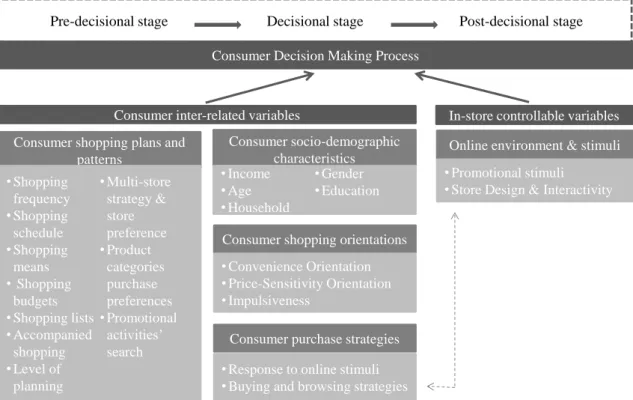
The literature reviewed allowed for the understanding of the main characteristics of both offline and online grocery shopping, setting a framework of the most important factors influencing the consumer’s online decision making process. While establishing a baseline for online grocery shopping, as to support this dissertation in its quality of exploratory study and in what relates to the problem statement and research questions defined. Figure 2.2, shows the conceptual framework designed to guide the elaboration of the field study.
Figure 2.1. – Conceptual Framework.
According to several studies (e.g. POPAI, 2011), consumers are changing their shopping habits and show no signs of returning to old patterns. Shoppers are becoming
Pre-decisional stage Decisional stage Post-decisional stage Consumer Decision Making Process
Consumer socio-demographic characteristics • Income • Age • Household • Gender • Education Consumer shopping plans and
patterns • Shopping frequency • Shopping schedule • Shopping means • Shopping budgets • Shopping lists • Accompanied shopping • Level of planning • Multi-store strategy & store preference • Product categories purchase preferences • Promotional activities’ search
Consumer shopping orientations • Convenience Orientation • Price-Sensitivity Orientation • Impulsiveness
Consumer purchase strategies • Response to online stimuli • Buying and browsing strategies Consumer inter-related variables
Online environment & stimuli • Promotional stimuli
• Store Design & Interactivity In-store controllable variables
22 savvier and more concerned with money and time savings, which helps to explain the increase of online grocery shopping and its tendency for growth. Although this growth is shown across consumers of most income levels, the largest consumer segment is composed of highly educated employed females, aged 25 to 55 years old, with children (KPMG International, 2012). Additionally, the literature review revealed that convenience is one of the main orientations towards online grocery shopping (e.g. Morganosky & Cude, 2000; Ramus & Nielsen, 2005; Verhoef & Langerak, 2001; Chen & Chang, 2003) and price one of the main factors taken into consideration, both on- and off-line (e.g. POPAI, 2011; Santos, 2009). However, it was also shown that online grocery shopping is complementary to traditional grocery shopping, being preferred for non-perishable products, evidencing the still existence of some drawbacks on the adoption of this retail channel for grocery shopping (Hand, Riley, Harris, Singh & Rettie, 2009; Robinson, Riley, Reetie & Rolls-Willson, 2007). Coexisting with offline shopping, online grocery shopping is viewed in the same light, not much as a pleasure but more as a utilitarian oriented activity (Robinson, Riley, Reetie & Rolls-Willson, 2007; Verhoef & Langerak, 2001). As such, consumers are more motivated to complete the task quickly and efficiently (Robinson, Riley, Reetie & Rolls-Willson, 2007), which lead online grocery shopping trips to be considered as directed-buying store visits exhibiting goal-oriented browsing strategies (Moe, 2003). Therefore, and as suggested throughout this chapter, the consumer decision making process is influenced by consumer’s demand and pre-shopping plans and goals defined (Santos, 2009). In addition, given the precision and rationality of their purchases and their task-oriented strategies, there’s evidence that such goal-directed shoppers are less prone to impulse behaviours and deviations from plans (Moe, 2003; Wolfinbarger & Gilly, 2001). Furthermore, the relation with these shoppers and online stimuli is fickle, as the main goal is task-completion, making exploratory browsing more specifically dependent on store design (Parsons & Conroy, 2006). The relation with in-store stimuli, independently of the retail channel, was found mostly dependent on affective reactions and emotions. Moreover, on offline shopping, a lower incidence of in-store decisions was evidenced on shopping trips with more specific goals and that are part of a multi-store strategy, plus evidence was found that shoppers anticipate and account for unplanned purchases in their plans (Bell, Corsten & Knox, 2011; Stilley, Inman & Wakefield, 2010; Kollat & Willett, 1967). Such results cannot, however, be extrapolated for the online retail channel so far. The full-length of these results, paired
23 with the understanding of the consumer decision making process, allowed for the elaboration of the framework depicted in Figure 2.2. This framework complements the traditional decision making process with the key factors present in the online retail channel. The emphasizes is in how pre-shopping decisions and other consumer related variables are inter-related with the buying and browsing patterns of consumers, as well as their response to stimuli, and how these interconnected and moderating factors affect online grocery consumers’ decision making processes overall. Thus, focusing on the most important aspects uncovered through this chapter, an overall view of the online grocery shopper decision making process is depicted in the conceptual framework established.
The next chapter presents the methodology developed for this dissertation, followed by the analysis of the results in Chapter 4 and the conclusion’s presentation in Chapter 5.
24
CHAPTER 3: METHODOLOGY
In order to address the research questions established in Chapter 1 and formulate conceptually relevant propositions on online grocery shoppers’ decision making processes, an empirical study was conducted. The following chapter describes in detail the methodological approach underlying the study’s design, implementation and subsequent analysis of results.
3.1. Research purpose and approach
As stated in Chapter 1, the general aim of this dissertation is to develop, as accurately as possible, an overall image of the consumers’ decision making process for online grocery shopping. The objective is to provide a broad description of the overall process, from the pre-decisional to the post-decisional phase, however being the intent to then focus on the actual decisional stage. Within the decisional phase, two details take particular consideration – the buying/browsing strategies used by online grocery shoppers and their reaction to in-store stimuli. However, as indicated in the preceding chapters, the body of research on online grocery shopping is not particularly extensive, with the majority of studies tending to focus on the drivers of adoption of such consumption behaviour, rather than on the actual in-store decision making process of shoppers – with a few exceptions, however mostly for generalized online shopping (Moe, 2003; Demangeot and Broderick, 2006; Wolfinbarger & Gilly, 2001). As such, the appropriate method to empirically investigate the research questions established is an exploratory research approach, given that this approach is the most commonly used when there’s a need to increase or clarify the understanding of a problem. Furthermore, and as in the case of this dissertation, this type of approach is particularly useful when existing theories are insufficient or contradictory, when important concepts and its interrelationships are hard to establish and/or when an area of investigation is hard to differentiate from others (Saunders, Lewis and Thornhill, 2007).
3.2. Research strategy and design
In light of the research purpose and approach underlying the development of this dissertation, a mixed methods strategy, namely a convergent parallel research design, was selected (Bryman, 2012; Creswell & Plano Clark, 2011; Tashakkori & Teddlie,
25 2003). Convergent designs are characterized by the concurrent, but independent collection and analysis of quantitative and qualitative data, with the aim of combining findings to obtain meaningful answers to the underlying research questions (Creswell & Plano Clark 2011; Bryman, 2012). For combining both qualitative and quantitative methods in several different possible ways, a mixed strategy offers many positive prospects, although not being as institutionalized as single quantitative or qualitative strategies (Bryman, 2012; Tashakkori & Teddlie, 2003). Namely, by being able to combine both elements of research, it helps to fill-in the gaps when relying solely on either one of the two methods is not optimal. As in the present study, in which neither quantitative not qualitative methods on their own would be sufficient to portray a complete and detailed picture of the overall purchase decision making process of consumers shopping online for groceries (Bryman, 2012; Tashakkori & Teddlie, 2003; Creswell & Plano Clark, 2011). Furthermore, as Bryman (2012) adds, there are several ways in which qualitative research may be helpful in guiding quantitative research, and vice-versa. For example, one of the forms in which quantitative research can possibly form ground for further qualitative research is through the selection of subjects to be interviewed or observed. At the same time, not everything a researcher needs to inquire is possible via subjects’ observation, in such case a multi-strategy approach might be undertaken as to collect the necessary information (e.g. social class backgrounds, demographic characteristics, experiences prior to the observation). In this multi-strategy design, and although is not typical (Creswell & Plano Clark, 2011), a priority is given to the qualitative collection of data and consequent analysis given that this strand better matches the requirements of the research questions defined, being the quantitative methods essentially used as in the example above (Creswell & Plano Clark, 2011; Tashakkori & Teddlie, 2003). As such, this multi-strategy approach entails a single cross-sectional web-based survey (quantitative method) - from which participants were selected, identified and profiled within the target population of online grocery shoppers, their grocery shopping and purchase patterns and their level of planning established; and semi-structured interviews paired with online grocery purchase observations and a self-administered questionnaire (qualitative methods) – as to uncover important pre-decisional drivers of online grocery shopping behaviour, particularly in-store buying/browsing strategies and responses to in-store stimuli, as well as relevant post-decisional outcomes of online shopping trips. All these steps will be further described in the following sections of this chapter.
26
3.3. Population and sampling
Similar with the Shopping with Consumers method (Lowrey, Otnes & McGrath, 2005), and as mentioned in the previous section, shoppers were recruited via a web-based survey in which they were asked to participate in the remaining part of the study. The population of interest for the first part of the study (quantitative method of data collection) was defined as Portuguese adult online grocery shoppers (i.e. 18 years-old or older), who purchase their groceries from Continente Online and reside within the country’s geographical limits. This represents a population of approximately 80.0001
individuals (estimation based on reported data for 2010, from LINI (2010) and Dionísio, Pereira & Cardoso (2012), as no concrete data is available from the retailer in question). A convenience sampling method and snowballing technique were employed in the distribution of the survey, which was conducted via a social network and email contacts. Given the integration of social media in the survey distribution, it becomes extremely difficult to exactly determine how many people the link to the web-based questionnaire reached. Nonetheless, a rough estimated can be made, including both means of web-distribution, accounting for at least 255 individuals reached, approximately. From these, only 65 individuals started filling the survey, all of whom have completed it and were therefore valid. This corresponds to a response rate of approximately 25.5%, which is consistent with Bryman’s (2012) indication of low response rates for online surveys, which the author argues are also less significant for convenience samples. In addition, information on social media distributed surveys response rates is not yet available, which might help to explain such a low rate. After filtering the answers that fall outside of the scope of the population defined, the questionnaire contributed with a final convenience sample of 55 shoppers, which thus constituted the final sample for the quantitative study. The final sample was analysed contrasting the shopping behaviour of consumers residing within and outside the Grand Lisbon area. As the results showed no disparities, and being unpractical to conduct observations outside the city’s limits given the thesis constraints, the selection of the participants for the second part of the study was conducted based on the 38 shopper sample of Continente Online consumers residing within the Lisbon area. That is, the population of interest for the qualitative study was defined as adult online grocery shoppers (i.e., 18 years-old or above), Portuguese naturals and residents of the Lisbon area, conducting an online shopping trip
1 The approximate population is based on a 44.6% of Internet users, from which 35% purchase goods and services online, resulting in an average of 9% more frequent purchase of online groceries (LINI, 2010; Dionísio, Pereira & Cardoso, 2012), for which 55.6% of consumers show a preference for Continente Online (Dionísio, Pereira & Cardoso, 2012).
27 for their household at the retailer Continente Online. Given this and assuring that these consumers met the study requirements and only participated in the study once, from the population defined, a sample of 10 willing participants was purposefully sampled and recruited to take part in semi-structured interviews and accompanied online shopping trips. The sample for the second study was determined as to guarantee a balanced and heterogeneous sample (e.g. diversity and balance in gender, age, income, shopping frequency, etc.), which profile matched the one found on the first study’s sample. Furthermore, as stated previously, individuals conducting their shopping trips in other retailers were excluded, given that the market leader was chosen as to guarantee an ease of results’ analysis and consumer grouping and comparison, as mentioned in Chapter 1. Additionally, consumers aiming at purchasing items directed at people out-side the house, re-sale or special situations (e.g., birthday party) were also excluded, as these situations did not fit the scope of the study. In the analysis of the qualitative study sample, one of the participants was not included, given incongruences with the study purpose and the individuals understanding of it and subsequent non-relying results, leaving the second study with a final sample of 9 participants. Further information on the participants’ profile is presented in the next chapter (Table 4.3).
3.4. Data collection
The data collection techniques employed were based on the Shopping with Consumers method (Otnes, McGrath & Lowrey, 1995), particularly by its prior applications to the study of shopping behaviour (Demangeout and Broderick, 2006; Xia, 2010), and previous studies by the POPAI Institute (2011 and 2012), combining the advantages of previous techniques used in the study of grocery shopping behaviour. Firstly, participants were recruited and selected via a web-based survey; a pre-shopping interview, actual purchasing trip observation and post-shopping interview followed as the next three stages; the final stage entailed a self-administered questionnaire to assess psychographic characteristics not assessed so far.
Web-based questionnaire
As mentioned above, the first method of data collection was an online questionnaire (depicted in Annex 1), administered via a social network and personally sent e-mails, with the aid of the Qualtrics Software during October and November 2012. This survey was elaborated according to the research questions and conceptual framework defined
28 for the study, and based on survey construction literature (Bryman, 2012; Malhotra & Birks, 2007). Its contents were divided into 4 blocks of questions about (1) online grocery shopping habits; (2) patterns of online grocery store visits and category purchases; (3) out-of-store information search and planning of online grocery store visits and (4) socio-demographic characteristics. At the end of the questionnaire, shoppers were asked if they would like to be part of the remaining part of the study, with an associated reward of a 10€ gift card. In case of an affirmative answer, the software prompted them to register an active e-mail address for further contact Consumers were only vaguely informed about the nature of the second study – “a study on the consumer’s behaviour towards online grocery shopping” – as to keep further observations with the minimum interference possible. After the elaboration of the questionnaire, a pre-test was conducted as to confirm the survey’s clarity and ease of comprehension and completion, only after which the web-based survey was launched.
Semi-structured interviews and accompanied shopping visits
As mentioned, the second part of the study was comprised of 4 stages: a pre-shopping interview, accompanied shopping trip to Continente Online, a post-shopping interview and a brief self-administered questionnaire (Annex 2 depicts the script purposefully developed to guide the data collection). The items and scales present in the script were developed according to the research questions and conceptual framework and relevant literature established (Bryman, 2012; Malhotra & Birks, 2007). Moreover, the elaboration of the script of the qualitative study entailed a crucial previous analysis of the online store, as to understand the environment in which the consumer shops and how he or she might navigate the store and perform its inherent activities (Annex 3 illustrates one of the main windows of the online store in which the shopper navigates). As with the quantitative method of this study, after the interview & observation script elaboration, a pre-test was performed to insure that clarity, comprehension, ease of execution and correlation with the intended results was obtained. The qualitative study was administered according to each participant’s environment (i.e., home, office) and timing of choice (i.e., weekday vs. weekend and morning vs. afternoon vs. night) - within the possibilities, this method was employed as to remain as truthful as possible to each consumer’s shopping trip planning and purchase, without interfering. Data collection took place between in the second half of November 2012, with the time expected to collect each participant’s data being the time each participant takes in their
29 purchasing experience plus an average of 20 to 30 minutes to complete the remaining steps – on average, each participant was engaged for 90 minutes in the study. The interview was performed immediately before the shopper logged-in to the retailer’s website (www.continente.pt). First, shoppers were inquired about their purchase intentions and goals for that particular store visit. Questions related to shopping intentions were carefully designed and asked, as to influence consumers’ answers the least as possible, and they were free to respond in any kind of segregation level (i.e. category, brand or product). Participants were then asked about their on- and off-line store and category purchases patterns, resources committed to that store visit and their general out-of-store planning and information search habits. Finally, consumers were asked to log-in into the website, and the observation phase was ready to begin. In this stage, there was no further interaction between the interviewer and the participant, as data was collected only through behavioural observation, being the task of the interviewer to observe without interference while taking notes of the participants’ actions. Therefore the pre-shopping interview was crucial to eliminate any possible discomfort and/or psychological barriers between both parties that could compromise the quality of the data collection. Particular attention in this stage was given to the buying/browsing strategies consumers used while shopping online for groceries, and their possible response to the stimuli present in such environment. Regarding in-store stimuli, a special single form (Annex 2 – B1) was filled at the beginning of the store visit, in case the shopper visualized any of the store’s applications and/or special promotional banners. For the remaining part of the store visit, each visit to each of the retailer’s broad categories present in the store (groceries, beverages, fresh produce, dairy, frozen foods, baby, hygiene, cleaning, home, pets, leisure, promotions, campaigns, and novelties) was recorded in a separate form (Annex 2 – B2), registering in each form the products within that category placed in the basket for each category visit. Once participants completed their online shopping trips, paid their bill and logged-out of store’s shopping page, a post-shopping interview took place to assess their overall satisfaction with the shopping trip and the online store. Prior to this, participants were also asked to provide self-reported measures of shopping trip fulfillment, unplanned buying behaviour and browsing activities. All scales (browsing activities, shopping trip satisfaction and overall store satisfaction) were scored on a 1- to 7-point
strongly disagree to strongly agree scale, elaborated as a combination of previously