AMazING – Advance Mobile wireless playGrouNd
João Paulo Barraca, Diogo Gomes, Rui L. AguiarInstituto de Telecomunicações – Polo de Aveiro {jpbarraca,dgomes,ruilaa}@av.it.pt
Abstract. We describe a wireless testbed composed of 24 wireless nodes that
can be used to perform a broad range of studies in the area of next generation networks. This paper addresses the difficulties and constrains faced by the authors throughout the deployment process of such testbed. Flexibility and controllability were key concerns driving the testbed design. The testbed can be remotely managed through a series of remotely accessible web services performing low level management. Validation results are presented, showing the interference levels of the testbed as well as its maximum throughput capabilities.
Keywords: testbeds, wireless network, outdoor systems
1
Introduction
Wireless Networks, and especially mobile networks, have been a hot-topic on the research community in the past years. Most of the associated research work has been carried out through simulations due to difficulties associated with conducting real experiments. Such difficulties include (but are not limited to) cost of equipment, complexity of scenarios, availability of a lab with the required conditions, human resources required to conduct the experiment and reproducibility difficulties in wireless environments.
Simulation tools have therefore been used to conduct such studies in a controlled manner with far less effort. However, with increasingly complex systems, the research community has questioned in recent years the accuracy of such simulations, based on models of the wireless reality. This led to an increased interest in deploying testbeds were wireless studies could be conducted under more realistic – but still controllable - conditions. Such testbeds constitute an intermediate step between simulations/emulations and a full-scale prototype. The objective of such testbeds is to provide the means for the research community to validate their concepts and theories in an environment that better matches a real scenario.
Several testbeds exist around the world, with different strengths and weaknesses. In this paper, we discuss a new testbed deployed for supporting research on next generation networks (NGN), which intends to differentiate itself from the existing ones by increased controllability (for the experimenter) and high reproducibility of the tests. The AMazING testbed is an an outdoor system, Operating System agnostic,
which the authors have designed and deployed in the rooftop of Instituto de Telecomunicações in Aveiro, Portugal with a reasonably low deployment cost.
In section 2 we review previous work in wireless testbeds and identify some of the problems associated with such testbeds. In section 3 we establish the requirements we had for our testbed and describe the solutions developed both in terms of Hardware and Management Platform. We present the results of a brief performance evaluation on the throughput of the deployed testbed in section 4 and conclude the paper in section 5 with an assessment of the most important features of the testbed and draw some guidelines for future work.
2
Wireless Testbeds
Much research effort was put and is increasingly being put into the development of wireless solutions. Over the time this created optimized solutions for multiple scenarios such as metropolitan area, campus, industry, our homes, or even our personal space. Despite all the effort spent in developing new solutions and evaluating new scenarios, there are still doubts about the limits and applications that wireless can support. This is in part due to the fact that the wireless medium is much less reliable, unpredictable, and hard to evaluate than wired mediums.
Typically, solutions for wireless networks are first validated in a discrete simulation environment. After this initial validation by simulation, it is emulated with a real world prototype and then implemented in a final product (if useful). There are many such simulation platforms, with NS-2 [1], dominating the academia world. These simulation tools are vital to the advance of the state-of-the-art in most networking areas, because they allow protocol evaluation to be performed in a reasonably controlled platform, unaffected by external variables and thus enabling some controlled repeatability. All simulators implement simplified representations of the real world models, which need to be validated [2]. Due to their inherent limitations, these simplified models constrain the quality of the results obtained. With current models and the complexity of existing systems, practice shows that simulation results should be increasingly taken with a grain of salt, in particular because minor (unseen) details may result in misleading or incorrect answers. The amount of synthetic validation through simulation increased in many cases without a clear increase in the quality of the results presented [3].
Fast deployment in a more real environment can rapidly exclude untrustable results. Thus in recent years there has been a major rise in the interest around wireless testbeds. With decreasing equipment prices, it became easier to evaluate solutions in scenarios closer to the real world. With testbeds appearing as a reasonably efficient tool, increased effort in testing, stressing, observing, tuning and validating solutions became normal. For high profile scientific work, simulations alone are no longer sufficient to support the results. Several research institutes, enterprises and universities have built testbeds aiming to create a reproducible evaluation environment. These initiatives usually have in their core either multi-purpose experimental platforms or simply custom proof-of-concept platforms. The first aim to provide an environment able to evaluate a multitude of solutions and scenarios while
proof-of-concept platforms target advancing a particular research objective and exist until the solution reaches market or is abandoned.
The recent history of multi-purpose experimental wireless testbeds starts in the late 90s. Ad-hoc networks were on the rise and the MONARCH [3] project was created. It consisted of 2 fixed nodes at CMU premises, and 5 mobile nodes installed in rented cars circulating in a nearby road. While a little crude and with low repeatability, this early effort had a major impact. in many networking areas related to mobility and wireless communications, such as MobileIPv6 and Dynamic Source Routing. At UCLA the NRL [4], aimed at developing ad-hoc solutions, comprised 20 laptops and 60 PDAs using 802.11b cards. It spans the entire campus and was integrated with a simulation platform able to evaluate hybrid scenarios. MIT Roofnet [5] consists of an experimental 802.11b/g network of 20 off-the-shelf nodes providing connectivity to users in Cambridge. As another example, the University of California created a wireless testbed aimed at low-level radio research, with more than 100 nodes, with very different capabilities and access technologies. ORBIT [6], that includes over 400 nodes in a 20x20 meter area, is currently one of the most complex wireless testbeds. On a different scale, but also relevant there is OneLab [7] add-ons to PlanetLab, that has extensions to support evaluation of wireless solutions over its general-purpose network infrastructure. In most of the existing wireless testbeds nodes are placed very close to each other. In such testbeds it is very difficult to create scenarios in which sets of nodes are hidden from each other. Such scenarios are only possible in such testbed through the use of MAC filtering mechanisms that can severely interfere with the experiment results.
There are many other examples of wireless testbeds around the world. This diversity is now leading to efforts of federation of these testbeds, trying to reuse as much as possible common tools and data representation.
All the testbeds mentioned have inherent flaws and limitations. Most rely on MAC filtering techniques, which is unable to discard radio interference effects. Often they are only able to support static scenarios, and the few that have mobile nodes are not able to provide reasonable repeatability of the experiments, impairing the study of mobile phenomena. NRT aims at supporting integration with a simulator but it is unknown when this will be fully functional.
3
The AMazING testbed
In the past the authors have experienced with custom purpose testbeds for next generation networks, such as the ones used for project IST-Daidalos [8]. This experience provided valuable knowledge about the requirements for multiple purpose test systems able to evaluate new NGN concepts through prototypes. It became apparent the need for a new testbed, that could be used by multiple NGN research projects without ever limiting the complexity of the experiments through artificial management rules and hardware constrains.
In particular it was clear from our previous experience that a NGN wireless testbed should abide to two key requirements:
- Provide administrative privileges for users: Most of the existing testbeds
are either private, and therefore fully accessible by their owners, or are public accessible but provide a limited set of functionalities to users. A limited set of functionalities ultimately means that only a limited set of experiments can be conducted, which is worrisome for NGN research. To restrict access to foreign users is usually an administrative decision, based on the need to setup a monitoring and management infrastructure, capable of controlling the testbed usage. We have made a requirement of our testbed to fully disclose access to the nodes, making it possible to foreign users accessing all the functionalities made available by the hardware platform deployed.
- Provide a reproducible environment – A NGN testbed, albeit not
completely isolated, has to be very predictable, with small variance in the tests. This could only be obtained in an open environment in which no objects would flow through the node and where radio interference would be set to a very low level (bellow what could be considered interference). Most testbeds exist in laboratory environments, and are affected by normal people movement, regular electromagnetic interference, and interference from multiple experiences.
Besides these key requirements, several other issues must be taken in considerations:
- x86 compatible nodes: Of the several existing computer architectures the
most popular amongst developers is the x86 architecture. This fact is easily realized by the sheer amount of publicly available software implementations in the area of networking, and most NGN research uses network nodes based on x86. By making it a requirement, we are guaranteeing that a broader set of testbed users can easily deploy existing software.
- Support for Multiple Radio interfaces: The focus of the testbed is in
creating a wireless testbed for NGN, thus potentially covering several wireless technologies, existing and future. Each node must therefore be flexible enough to support different radios. Ultimately this must be translated into mainboards with multiple hardware interfaces, in which the radios can be connected to. - Access to low-level radio interfaces: In addition to the existence of multiple
radios, it is also required that each of the chosen radio interfaces provides programmatic access to low-level aspects such as the MAC, an common research issue. Ultimately the desirable radio interface should be a fully software-defined radio, but this is not simple to support currently.
- Extendable: the nodes processing capabilities must be extendable, and easily
linkable to current and future core network solutions. This implies that a smooth interface for the testbed nodes should exist, and that the wireless interfaces of the nodes should be easily accessible from core machines. - Reduced Radio Interference: An obvious corollary for the reproducibility
requirement. The amount of interference a wireless testbed is usually subject to, can lead to important variations in the results obtained. It is necessary that the nodes receive as few interference as possible, and that they cause as little interference on their neighbours as possible.
- Low Power and Cost: The amount of nodes immediately leads to concerns
as less power as possible. To this end, there is a strong concern on the amount of power supplies involved, as well as on the power requirements of the computers and radio interfaces used. Furthermore, it is expected that the testbed should be deployed with low cost CoTS devices.
Based on these requirements several hardware-based solutions were evaluated, and a management platform was specified. In the next sections the chosen hardware platform and management platform solutions are detailed, together with the reasons behind each of the choices.
3.1 Hardware and deployment aspects
The key design decision is related with the need to have a clean, predictable environment, with an easy access location. The solution found was to place the testbed outdoors in the rootop of a building, reasonably insulated from common interference sources, and isolated from human movement interference. This also had the advantage of providing a reasonable large area for the testbed deployment.
3.2 Hardware deployed
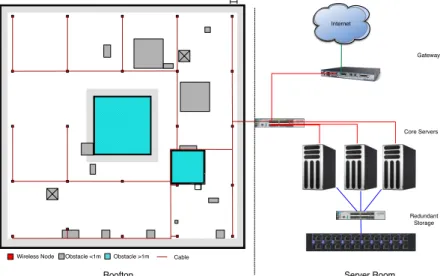
This key decision led to the AMazING (Advanced Mobile wIreless Network playGround) testbed, which consists of 24 fixed nodes located at Instituto de Telecomunicaçoes (IT) - Aveiro rooftop, as depicted in Figure 1. The testbed spans over 1200m2, and nodes are distributed across the area forming a grid with
approximately 8m between each neighbor.
Figure 1 - Architecture of the AMazING testbed with detail over the spatial deployment on the rooftop
Wireless Node Obstacle <1m Obstacle >1m Cable
Internet
Redundant Storage Core Servers
Gateway
Rooftop Server Room
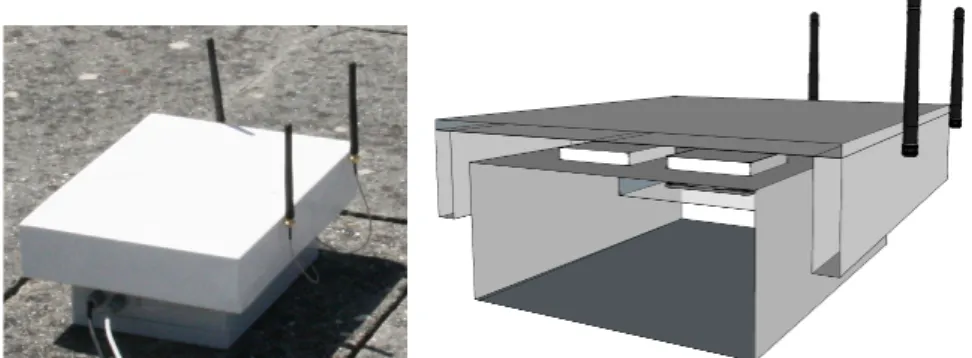
The system is exposed to the weather conditions of a south European coastal region (frequent sun and average humidity of 85%) and it is therefore required the use of watertight, and UV resistent enclosures (IP65). Polycarbonate enclosures have a very low heat transfer coefficient (~0.21 W/(m2K)), which is insufficient for the heat
produced by the systems. Heat generated by the electronics (in particular the CPU) keeps the board always above dew point. Solar Heat Gain was also taken in consideration, especially because temperature in this region can reach 40ºC during summer time. The solution we found (see Error! Reference source not found.) was to use one fan and two openings, protected with particle filters. In order to reduce dangerous water condensation, the main board was placed in an inverted position and near the top of the enclosure. The final solution involved developing a protective cap made of waterproof plywood, to reduce solar load, and allow air heat exchange with the environment. Figure 3 depicts the temperature differential between outside environment and the interior of a node during three days. As it can be seen, the difference remains stable with inside temperature only varying by less than 10ºC.
Figure 2 - Node structure with side cut and actual node in the testbed
Figure 3 Temperature variation over 3 days period
At the core of the testbed, there are several support servers and a redundant storage device that serves all files in the testbed. Servers provide processing power to analyze results and extend the testbed by integrating simulators such as NS3. Also, they
configure nodes according to the experiment trough the Control Module and provide a common time source [9]. Additionally they can be used to run Virtual Machines configured by testbed users in order to support specific experiments. The redundant storage device provides a 4TB NAS in a RAID5 configuration, connected to the servers and nodes using Gigabit Ethernet. This device provides storage support to store OS images, experiment configuration, the results obtained and the virtual machines.
Nodes have at its core a Commell LE-365 board, with a VIA EDEN 1Ghz CPU and 1GB of RAM. These are powered by a single 120A, 8-16V power supply shared by all nodes. Power is distributed point to point from the power supply to each of the nodes. The LE-365 board provides a high number of expansion possibilities such as 8 USB ports, a RS-232 port, a 2 ports SATA controller, 2 miniPCI slots and 1 CF interface. This myriad of interfaces makes it possible to easily expand the node interfaces, which is perfect for a multi-radio testbed, as in the future new network interfaces can be added to the available ports/interfaces. A Gigabit Ethernet is also available and is used solely for the purpose of managing the nodes and collecting statistics. The availability of a Gigabit Ethernet control network is important due to several aspects: it reduces command delay, it supports raw packet collection from multiple node and provides support for NFS with low delay. This interface can also be used for extending the testbed nodes capabilities.
Currently the CF interface is occupied by a 4GB CF card while two 802.11 cards occupy the miniPCI interfaces. One of the cards is a Compex WLM54SuperAG, which has an Atheros AR5414 processor at its core. This card can output 20dbm and supports channel bonding both in the 2.4Ghz (802.11bg) and 5Ghz (802.11a) ranges. The additional card (Compex WLM200NX) is also Atheros based (AR9220) but besides supporting 802.11a,b,g,i,e,h,j, high sensitivity (Extended Range), Power Control, and Channel Bonding (40Mhz) like the previous card, it also adds support for 802.11n in a 2x2 MIMO spatial multiplexing configuration. The open-source ath5/9k drivers control both cards and provide high flexibility due to almost direct access to the networking ASIC.
Electromagnetic interference is reduced due to the high insulation of the roof pavement materials, location of the building (in the edge of the university campus), and the characteristics of the external users wireless usage (there are no residential or industrial neighbors). Radio interference is at its highest values during office times (9-18h) on weekdays in the 2.4Ghz band, but is always very low. Even the signal of the Access Points located in the top floor of IT-Aveiro, which operates in the spectrum range of the testbed cards, reaches the rooftop with a power usually lower than -92dBm (notice that wireless cards only report signal until -110dBm). During the remaining time, as well as in the 5Ghz band, no radio measurable radio interference occurs.
3.3 Management
Given the fact that the testbed nodes are enclosed inside the protecting cases in an outdoor environment, it was necessary to carefully plan how the nodes were to be
managed without the need to direct intervention in the node. Additionally, one of the requirements we set for our testbed was the need to support administrative access to the nodes.
Based on these two requirements, the management framework of our testbed was built with a mixture of hardware and software based management mechanisms. The former provide a basic control of the nodes that is independent of the operating system, and can override users access, while the later are required to be installed in the operating system currently active in the node. The two types of mechanisms are nonetheless undissociable, with the hardware based mechanism only taking action if the software based mechanisms have failed, based on a centralized management infrastructure that monitors all the testbed.
The operation concept of the testbed is a “leased-time” model. Experiments take continuously hold of the testbed for a given period of time, deploying their own operating system and tools. Access to the testbed is provided to registered users, which have gone through a screening process in order to check the purposes and requirements of their experiments. After registration, users are provided a user account in the management platform in which they can upload their custom build Operating System image or choose from one of the existing ones. Access to the testbed is based on a timesharing scheduling mechanism and in accordance to the requirements set by the users.
The node operating system is remotely loaded, based on well-known tools such as PXE [10]. A powered up node operating system image is loaded to the node using PXE and a mixture of various file sharing protocols such as TFTP, NFS, iSCSI and SMB depending on the image being loaded. Testbed users are supposed to be able to setup their own operation images with any Linux distribution or even Microsoft Windows. A central Linux based server is made available for distribution of the images using the aforementioned protocols, and additionally core machines can be setup by the testbed user to host any additional tools required for the deployment of the Operating System Images and experiment tools, as well as any other type of core infrastructure required to support a NGN experiment. This approach intends to give Testbed users maximum flexibility in terms of choice of Operating System and experiments. But it creates an important challenge for reducing the risks associated to this full access. The testbed hardware must be monitored in order to avoid damage such as CPU overheating, or for violations on the time used for conducting a given experiment.
The most basic control mechanism we have setup is a power control web-service that controls several relays in the power distribution network. Through this very simple mechanism it is possible to remotely power-cycle the machines regardless of their status (running, freezed, booting, etc). The web-service is available not only to the testbed administrator, but also to the testbed user. In this case it will only control over the leased nodes for the experiment, during the experiment time. . Experiments that overdue their reservations periods can be shutdown selectively using this power control mechanisms. Since users are encouraged to run their tools and data collection mechanisms over the network, it is not expected serious loss of results from the cold poweroff solution. A remote poweroff command will only came as a last resort.
A spectrum analyzer placed centrally on the testbed monitors the spectrum. The information collected by such spectrum analyzer is used in the management platform
to identify violations of spectrum usage that can be stopped by shutting down the offending nodes
One of the requirements we placed for our nodes was the availability of hardware watchdogs in the mainboard. This is required in order to easily (and automatically) recover from crashes and bad booting processes. Our objective is that once the system boots, a hardware watchdog will reboot the system after 4 minutes if no watchdog driver is meanwhile loaded. The mainboard we choose, the Commell LE-365 board, uses a Winbond W83697HF watchdog. This watchdog has drivers both for Linux and Windows operating systems that were set as our primary operating systems.
In addition to providing these drivers to the testbed users, prebuilt images (Debian based) are available for customization or for direct use by users . These prebuilt images, besides the control watchdog, have several other monitoring and management modules and automatically mount a NFS share where tools and data can be placed, using the Ethernet interface. Such functionality makes it possible for non computer-oriented users to have a simple access to the testbed through the use of the standard images provided by us, but still being able to use custom software deployed over the NFS share. This comes without any kind of need by the user to setup operating system images. In the future, we plan to extend the prebuilt image concept to the Windows operating system.
Another important driver (available on the Linux image) is the so called FlyingInterfaces, what allow direct access (from the core) to the wireless interfaces. This allows hosts in the support servers to use the network interfaces of the wireless nodes. Because testbed nodes are multiradio, maximum testbed capacity is actually doubled (2x24), as a different server can access a different interface. Each testbed equipment runs a low complexity daemon, which exports network device IOCTL access [13] over the network. Remote equipments run a different module providing a virtual interface, which mimics all functions of the testbed equipment wireless interface. Tools like Linux’s iwconfig or iwpriv (used in linux to control and monitor wireless devices) report exactly the same results when running both in remote equipments (using virtual devices) and in testbed nodes (using the real device).
The AMazING Control component (see Figure 4) is thus comprised by both a server (running in the support servers) and a client (running at each node). Its tasks include: monitor and management operations, node configuration, and trigger based execution of a given experiment. Its design is simple so that the impact on the node operation is minimal, thus not introducing artificial glitches in the experiment results.
The Monitoring function of the component provides basic statistics about the operation of the node, such as CPU load, memory consumption, temperature, and fan speed. While irrelevant for most experiments, operational metrics are vital to the proper maintenance of the system, mostly to avoid and early detect hardware failures. Values for each of the monitored metrics are reported periodically while the node is operating, and independently of the testbed utilization.
The Scheduling function is an event driven processing module, which triggers actions (command or script executions) at specific time events. Lists of events are specified upon the creation of the experiment and distributed to all nodes upon initialization. After the list of tasks is finished, the Scheduling function will periodically try to get new event definitions. Nodes are synchronized with the support servers within a few milliseconds using NTP [9], allowing for coordinated quasi-simultaneous events across the entire testbed.
4
Validation
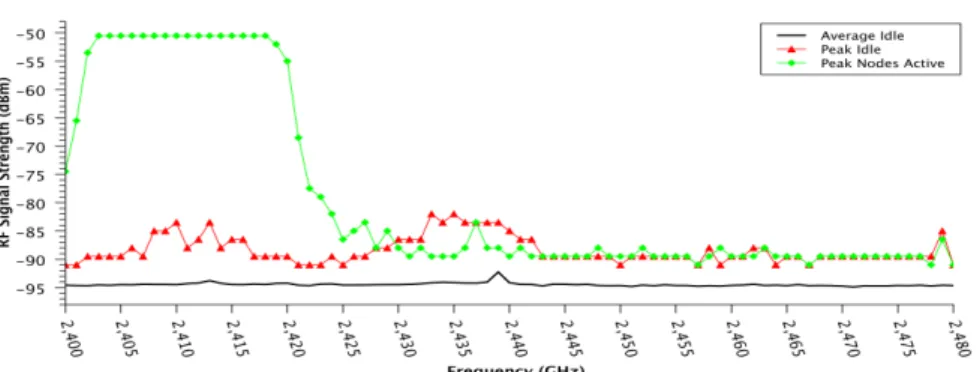
As a preliminary validation of our testbed and surrounding environment, we demonstrate some simple experiments obtained with the described setup. In the first case we deployed a WiSpy dongle near one of the nodes and monitored the radio levels over the 2.4Ghz band. This dongle is an easy to use spectrum analyzer, which while not comparable with laboratory equipments (which are also tens of times more expensive), allows for some basic measurements in the range of -6.3 to -100dBm. The model we used has a resolution of 373KHz and sweeps the radio band in the range of 2.400 to 2.483 Ghz. Then we plot signal strength as a function of time and frequency and assess interference level at a particular location. Figure 5 depicts the signal strength near Node 1, when no node is active and when Node 1 is acting as an Access Point in channel 1. As it is depicted, average signal level on the testbed area is below -92dBm. Peak signal value measured when nodes are active, but idle, is a little higher, reaching -80dBm. If compared with the situation of nodes transmitting in channel 1 (2.412 Ghz) it can seen the different between the signal power of the nodes (at 20dBm) and the environment peak noise values.
While Node 1 is configured as an Access Point in channel 1, we conducted an experiment to determine how radio signal and throughput varies along one of the sides of the testbed. For this, we sent TCP flows from Nodes 2, 3, 4 and 5 towards Node 1 during 1 minute and observed the throughput at intervals of 10s. All these nodes are located in the right side of the building, actually forming a line, each node distancing 8m from the previous. Node 5 is 32m from Node 1. As depicted in Figure 6, neighbor nodes are able to sustain a throughput of up to 23Mbps when using 802.11g. This value decreases, as expected, with the distance as the receiving power also decreases. The farthest node (Node 5) is able to reach Node 1 and exchange data at less than 4Mbits/s. Interestingly, when considering 802.11b, rates drop to less than 6Mbps, but values do not seem to decrease with distance. Node 5 is able to exchange data with Node 1 with 6Mbits when using 802.11b, which is higher than when using 802.11g. According to the specification of the Atheros chip, 20dBm of SNR are required for a link rate of 11Mbps, indicating that noise level at this node is indeed very low.
Figure 6 - Throughput (802.11b/g) and SNR as a function of distance from the AP node
SNR measured at the receiving node drops rapidly as the distance increases. At 8m, Node 2 indicates a receiving power of -55dBm while at 32 meters, Node 5 indicates that the signal generated by Node 1 is received with -86dBm. Considering free space propagation [12] of an omnidirectional antenna, at 32 meters the receiving power should be higher than it is, which suggests additional attenuation. In this case attenuation is intentional and is provoked mainly by the occlusion of the Fresnel zones, which we achieved by placing antennas very near the floor at about 25cm high.
Considering the radius of the Fresnel zone as given by
€
F =
n
λ
d
2
where n is number of the Fresnel zone, d is the distance between end-points and λ the wavelength of the signal. The maximum radius of the 1st Fresnel zone, has the
values present in Table 1.
Table 1
8 m 16 m 24 m 32 m
2.400 Ghz 0.5 0.71 0.87 1.00
5.000 Ghz 0.35 0.49 0.60 0.69
As depicted, even at close range (8m) and for the 5Ghz band, the 1st Fresnel zone
intercepts the rooftop at a large extent. The minimum occlusion will be of 29% for the node at 8m when using the 5Ghz band, while the maximum occlusion is of 85% for nodes at 32m when using the 2.4Ghz band. The resulting effect is additional radio attenuation, which helps in creating custom topologies where nodes have no, or only minimized, direct radio reachability.
5
Conclusions
Testing NGN has led us to the development of a general-purpose testbed. This testbed is characterized by its extreme flexibility and the large reproducibility of the experiments.
We have developed a usage model where users have full access to the nodes devices, and can even expand its capabilities by locating in the core functions that eventually access the wireless interfaces of the nodes. The outside nature of the testbed had posed specific deployment challenges, but the advantages achieved in terms of reduced noise and interference are well-worth these added constrains. The management infrastructure developed allows for a coarse hardware control of the testbed, while fine control can be performed by software modules.
Confronting with previous custom-built NGN testbeds, this testbed seems to provide a much faster deployment and evaluation process, thus simplifying the complex evaluation process of such research.
In the future we intend to expand the testbed to other buildings in the campus and explore the use of robots as mobile nodes.
Acknowledgments.
We would like to thank Alexandre Brito and André Raínho for the help developing the testbed and its components.
References
1. DARPA/NSF. The network simulator - ns-2. http://www.isi.edu/nsnam/ns/. 2. S Ivanov, A Herms, G Lukas, Experimental validation of the ns-2 wireless model
using simulation, emulation, and real network, Proceedings of the 4th Workshop on Mobile Ad-Hoc Networks, 2007
3. Kurkowski, S., Camp, T., and Colagrosso, M. 2005. MANET simulation studies: the incredibles. SIGMOBILE Mob. Comput. Commun. Rev. 9, 4 (Oct. 2005), 50-6 4. A. Maltz et al. Experiences designing and building a multi-hop wireless ad hoc
network testbed. CMU-CS-99-116, CMU, School of Computer Science, 1999. 5. Aguayo D., et al, MIT Roofnet: Construction of a Production Quality Ad-Hoc
Network, in Proc of MOBICOM 2003.
6. Raychaudhuri, D., Ott, M., and Secker, I. ORBIT Radio Grid Tested for Evaluation of Next-Generation Wireless Network Protocols. In Proc. of the First international Conference on Testbeds and Research infrastructures For the Development of Networks and Communities, 2005
7. OneLab1 D4D.1 OneLab wireless mesh multi-hop network, 2007
8. D Gomes, A Matos, E Fonseca, R L Aguiar, "Deploying and testing a NGN testbed", Proc. 2009 TridentCom, Washington D.C., Apr 2009
9. Mills, D. 1992 Network Time Protocol (Version 3) Specification, Implementation. RFC 1305. IETF.
10.Intel corporation. Preboot execution environment (PXE) specification. 2002. 11.Peterson L. et al, “PlanetLab architecture: An overview”, Technical Report
PDN-06-031, PlanetLab Consortium, 2006
12.Simon R. Saunders , Saunders R Simon, Antennas and Propagation for Wireless Communication Systems, John Wiley & Sons, Inc., New York, NY, 1999