Carotenoid Profile in Grapes Related to Aromatic
Compounds in Wines from Douro Region
CARLA OLIVEIRA, ANTONINA BARBOSA, A. C. SILVA FERREIRA, JOAQUIM GUERRA, AND PAULA GUEDESDE PINHO
ABSTRACT: The aim of this work was to characterize 8 representative grape varieties of the Douro Region using the carotenoid profile as it relates to aromatic compounds in the respective wines. Some other analyses, such as the determination of sugar, probable alcohol, pH, and total acidity, were also performed in an attempt to understand in which way the evaluated characteristics influenced by grape variety could contribute to the wine aroma. For the 3 y of the study, grape varieties with higher concentrations of carotenoids (Touriga Fêmea, Tinta Amarela, and Tinta Barroca) have lower values of free norisoprenoids, even with exceptions (Touriga Fêmea). Conversely, grape variet-ies with lower concentrations of carotenoids (Touriga Nacional, Sousão, and Tinto Cão) appear to have higher contents of free norisoprenoids, namely b-ionone for Touriga Nacional and vitispirane and 1,1,6-trimethyl-1,2-dihydronaphthalene (TDN) for Sousão and Tinto Cão. Touriga Nacional, followed by Touriga Fêmea, was the wine variety with the highest values of total free terpenols (linalol, a-terpineol, nerol, and geraniol), the presence of which is responsible for the floral aroma.
Keywords: Vitis vinifera, carotenoids, cultivars, wine aroma
Introduction
I
n grape berries, the presence of carotenoids is well recognized. b-carotene and some xanthophylls (neoxanthin, flavoxanthin, and lutein) are abundant before veraison, and subsequently de-crease dramatically (Razungles and others 1987, 1988, 1996). Three other xanthophylls, namely, violaxanthin, luteoxanthin, and 5,6-epoxylutein, appear after veraison. Cultivar, viticultural region, exposure to sunlight, and ripening stage all affect carotenoid con-centrations in grapes (Marais and others 19991; Bureau and others 1998; Razungles and others 1998).In previous work, a relationship has been shown between caro-tenoid contents in grapevine berries and plant water status (Olivei-ra and others 2003). The effect of some viticultu(Olivei-ral pa(Olivei-rameters on the grape carotenoid profile was also reported (Oliveira and others 2004). Grape cultivars, ripeness stage, sunlight and shade expo-sure, altitude, and vegetative height were investigated. In the Douro Valley, high-elevation terraces, which presented a lower tem-perature and higher humidity, appeared to produce grapes with higher carotenoid values. Furthermore, grapes grown with higher vegetative height seems to have higher carotenoid levels (Oliveira and others 2004).
It was reported that norisoprenoids could come from the direct degradation of carotenoid molecules such as b-carotene, lutein, neoxanthin, and violaxanthin (Mordi and others 1991; Winterhal-ter 1992; Di Stefano and others 1998) and also from the hydrolysis of glycoside molecules (Skouroumounis and others 1992; Di Ste-fano and others 1998). Some norisoprenoids have been identified in wine, such as, b-damascenone, b-ionone, 1,1,6-trimethyl-1,2-dihydronaphthalene (TDN), and vitispirane. Recently, the 2,2,6-trimethylcyclohexenone, another non-megastigmane noriso-prenoid, was reported in wines (Freitas and others 1999). All these
molecules have an important sensorial impact on wine aroma as they have very low olfactory perception thresholds.
As suggested by several authors, terpenoid compounds are closely associated with the sensory expression of the wine bouquet contributing for flowery odors, which are used for variety character-ization (Marais and others 1986; Bayonove 1991; Sabon and others 2002). The relationship between grape flavor content and wine quality is dependent on terpene content for most of the variety aroma (Marais and others 1986; Bayonove 1991; Sabon and others 2002). The monoterpenes can exist in 2 forms: free and glycosidical-ly conjugated forms (Williams and others 1981). The free aroma compounds are volatile substances, which have an olfactive impact and are for the most part related to wine quality. In addition to the free form of monoterpenes, there are the glycosidically bound monoterpenes, which are quantitatively the most important forms (Bayonove 1991), although they do not have a direct contribution to wine aroma.
The aim of this work was to characterize 8 representative grape varieties of the Douro Region, considering that some of them (Touriga Nacional, Tinta Roriz, and Touriga Franca) are also planted in other viticultural regions. Physical and chemical evaluation, car-otenoid profile and aroma compounds, in the respective grapes and wines, were investigated. Although C13-norisoprenoid and monoterpene glycosides are precursors of volatiles in wine, only the determination of C13-norisoprenoid glycosides was performed, for the single 2002 year of study in the 8 grape varieties. Finally, at-tempts were made to understand in which way the evaluated char-acteristics are influenced by grape variety as well as their contribu-tion to the wine aroma.
Materials and Methods
Plant materialThe effect of grape cultivars on physical and chemical properties, carotenoid contents, and their respective wine volatile compounds were studied in varieties of Vitis Vinifera from 1 grape growing sub-region of the Douro, Cima Corgo (CC), on a experimental vineyard
MS 20050317 Submitted 5/25/05, Revised 7/5/05, Accepted 9/21/05. Authors Oliveira, Barbosa, Ferreira, Guedes de Pinho are with Escola Superior de Biotecnologia, Univ. Católica Portuguesa, R. Dr. António Bernardino de Almeida 4200-072 Porto, Portugal. Author Guerra is with Direcção Regional de Agricultura de Trás-os-Montes, Mirandela, Portugal. Direct inquiries to author Guedes de Pinho (E-mail: [email protected]).
(Sta. Bárbara) in 8 different grape varieties: Touriga Fêmea (TFê) named before Touriga Brasileira, Tinta Barroca (TB), Tinta Amarela (TA), also named Trincadeira, Sousão (S), Touriga Franca (TF), Touriga Nacional (TN), Tinta Roriz (TR), also named Aragonês and Tinto Cão (TC). The study was conducted in 3 consecutive years, 2001, 2002, and 2003. Grape samples were analyzed at harvest date. Vines were spaced 1.1 m in rows 2.2 m apart with a NNW orientation, trained to a bilateral cordon. The grapes were frozen at –20 °C imme-diately after harvest for further analysis.
Winemaking
Grapes were manually harvested, mechanically destemmed and crushed, and then put in 30-L stainless-steel tanks for microvinifi-cation. Musts were added with SO2 at 50 mg/L, without inoculation. Fermentation and maceration were carried out during 8 d to10 d at 23 °C to 25 °C. The used fermentation tanks had a pumping over system. At the end of fermentation, wines were transferred to a 10-L glass demijohn to initiate malolactic fermentation, between No-vember and December. For the 2003 year of study, a lactic acid bac-teria (Lalvin-Leuconostoc Oenos EQ 54 MBR) was used. After malolactic fermentation, wines were decanted to a 5-L glass dem-ijohn and added with SO2 at 25 mg/L to 30 mg/L. Wines were stored in these vessels until the end of January and then bottled. Wines were analyzed in March, after 5 to 6 mo of harvest date.
Extraction and determination of carotenoids
Grape material. Approximately 50 g of fresh berries, without
seeds, were homogenized using a “Turrax” homogenizer at 9500/ min for 15 min. This procedure provided 40 g of sample that was spiked with 200 mL of internal standard, 170 mg/L of beta-apo-89-carotenal (Fluka, Porto, Portugal, ref. 10810), and diluted with 40 mL of water (18.3 MV/cm). Extraction was carried out with 40 mL of ether/hexane (1:1, v/v), high-performance liquid chromatography (HPLC)-grade (Merck, Lisbon, Portugal), agitated for 30 min. The extraction was repeated 2 more times with 20 mL of ether/hexane (30 min each). The final combined extract was concentrated to dry-ness (rotavapor) and resuspended in 1 mL of acetone/hexane (1:1, v/v) for HPLC determination. Each sample was injected in dupli-cate. If the area of internal standard was not inside of the analytical values previously determined, the sample was re-extracted. Light exposure was minimized during sample preparations to avoid pho-toisomerization (Oliveira and others 2003, 2004).
HPLC
A Beckman (Barcelona, Spain) Model 126 quaternary solvent sys-tem, equipped with System 32 Karat software and a 168 rapid-scan-ning, UV-visible photodiode array detector, was used. The absorp-tion spectra were recorded between 270 nm and 550 nm.
(1) Stationary phase HPLC was performed on a Nova-Pack C18 60 Å 4-mm particles (300 mm × 3.9 mm), Waters (Barcelona, Spain). (2) Mobile phase HPLC was performed with solvent A, ethyl ace-tate (Merck pure-grade); solvent B, acetonitrile/water (9:1 v/v) (Mer-ck pure grade and pure water), flow rate = 1 mL/min. The following gradient was used: 0 to 31 min (0% to 60% A); 31 to 46 min (60% A); 46 to 51 min (60% to 100% A); 51 to 55 min (100% A); 55 to 60 min (100% to 0% A); 60 to 65 min (0% A). Retention time values: neoxanthin (5.5 min); violaxanthin (6.0 min); luteoxanthin (6.2 min); lutein (13.6 min); chlorophyll (30.2 min) and b-carotene (32.4 min) (Guedes de Pinho and others 2001; Mendes Pinto and others 2004).
Identification. Carotenoids were identified by comparison with
commercially available standards, b-carotene (Sigma 95%, syn-thetic, Porto, Portugal) (C-9750), lutein (Sigma 70%, from alfalfa) (X-6250), neoxanthin (0234.1) and violaxanthin (0259) from
(Carote-Nature GmbH from Switzerland) and chlorophyll a (Aldrich, from spinach, Porto, Portugal) (25,825-3). Luteoxanthin was identified by comparison of relative retention time, and UV-visible photo-diode array spectra.
Extraction and determination of volatiles and its glycoside precursors.
Wine material. Volatiles. 20 mL of sample was placed in a vial of
40 mL capacity with a small stir magnet, at 1300 r.p.m., spiked with an internal standard (20 mL of methanolic solution of 3-octanol, 47.2 mg/L) and immersed in a water-bath at 35 °C. A Solid Phase Mi-croextraction (SPME) for volatile compound analysis was used to extract the volatiles. The fiber used was a divinylbenzene/carbox-en/polydimethylsiloxane (DVB/CAR/PDMS), 50/30 mm (Supelco, Bellefonte, Pa., U.S.A.). The SPME needle was pierced the septum and the fiber was extended through the needle to place the station-ary phase in contact with the headspace of the sample during 90 min. Finally, it was removed from the vial and inserted into the in-jection port of the gas chromatograph for 10 min. The extracted chemicals were thermally desorbed, at 220 °C, and transferred di-rectly to the analytical column. Fibers were cleaned before each microextraction process to prevent contamination, inserting the fiber in the auxiliary injection port at 220 °C for 30 min (Silva Ferrei-ra and others 2003). Each analyze was performed in duplicate. Gas chromatography analysis mass spectrometry
Samples were analyzed using a Varian CP-3800 gas chromato-graph (Walnut Crick, Calif., U.S.A.) equipped with a Varian Saturn 2000 mass selective detector and Saturn GC/MS workstation soft-ware version 5.51. The column used was a STABILWAX-DA (60 m × 0.25 mm, 0.25 mm) fused silica (Restek, Bellefonte, Pa., U.S.A.). The injector port was heated to 220 °C. The split vent was opened after 30 s. The oven temperature was 40 °C (for 1 min), then increased at 2 °C/ min to 220 °C and held for 30 min. The carrier gas was Helium C-60 (Gasin, Portugal), at 1 mL/min, constant flow. All mass spectra were acquired in the electron impact (EI) mode with the Ion Trap detector set as follows: transfer line, manifold and trap temperatures 230 °C, 45 °C, and 170 °C, respectively. The mass range was 33 m/z to 350 m/ z, with a scan rate of 6 scan/s, and without solvent delay. The emis-sion current was 50 mA, and the electron multiplier was set to the auto-tune procedure. The maximum ionization time was 25000 ms with an ionization storage level of 35 m/z. The analysis was per-formed in Full Scan mode (Silva Ferreira and others 1998). Quantita-tive analysis was preformed by selected ion current mode. Ions se-lected were respectively for 3-octanol, m/z = 83; linalol, m/z = 93; a-terpineol, m/z = 121; nerol, m/z = 69; geraniol, m/z = 69; a and ionone, m/z = 177; 2,2,6-trimethylcyclohexenone (TCH), m/z = 82; b-damascenone, m/z = 121; vitispirane, m/z = 177; TDN, m/z = 157. Glycoside precursors
About 200 g of frozen berries was used from each sampling point. After seed removal berries were homogenized (3 min, 13500 rpm) (Ultra Turrax, T 25, Janke & Kunkel IKA-Labortechnik), centrifuged (8000/min, 10 min) and the supernatant filtered. To achieve the best column performance ultra pure water (18.3 MV/cm) was added to 20 mL of supernatant filtered samples, to make up to 50 mL total volume. Before sample addition, the column containing 5 g of resin (Amberlite XAD-2 resin [Supelco, Portugal]) with a portion of washed glass wool was activated by passing through successively 50 mL of methanol, 50 mL of diethyl ether, and 50 mL of ultra-pure water (18.3 MV/cm). The flow rate was maintained close to 1.5 mL/ min, using a Visiprep System (Supelco), at 2.0 kPa (–15 torr) con-stant vacuum. The extraction of the bound fraction was adapted
from previous studies (Gunta and others 1985), treated samples being passed through the column (flow rate: 1.5 mL/min). The col-umn was then washed with 50 mL of ultra-pure water (18.3 MV/cm) and with 50 mL of Pentane-Dichroromethane (2:1, v/v), and the bound fraction eluted with 50 mL of ethyl acetate. Flow rate was maintained close to 1.5 mL/min. The eluted ethyl acetate fractions being frozen at –20 °C until analysis. After defrosting, the ethyl acetate dissolved sample was dried over anhydrous sodium sul-phate (Merck) and concentrated to dryness in a vacuum, over a 20 °C water bath. These dried samples were re-suspended in 2 mL of ethyl acetate and then evaporated under a nitrogen stream flow (30 mL/min). These final dried extracts were dissolved in 20 mL of citrate-phosphate buffer (pH = 5, 100 mmol/L), containing 46.7 mg/mL of pectolytic enzyme, Lallzyme Beta (Lallemand) (activities: 595 mPG/g, 5 mPL/g, 180 mPE/g) and incubated at 40 °C for 14 h. The sample obtained was submitted to SPME extraction and ana-lyzed by gas chromatography-mass spectrometry (GC-MS). Extrac-tion of free fracExtrac-tion. After preparaExtrac-tion of supernatant filtered sam-ples, 20 mL of each sample was stirred in a vial and spiked with 20 mL of methanolic solution of 3-octanol (47.2 mg/L) as internal stan-dard. The resultant preparation was submitted to SPME extraction and analyzed by GC-MS.
Identification. Aromatic molecules were identified by
compari-son with mass spectra obtained from the sample with those from pure commercially available standards injected using the same conditions or by comparing the Kovats indices and the mass spectra present in the NIST 98 Miss. library. Pure standards were pur-chased from SigmAldrich (Portugal): linalol (L-5255) (95%), a-terpineol (T-3407) (95%), nerol (N-7761) (98%), geraniol (G-5135) (98%), a-ionone (W25, 940-3) (100%), b-ionone (I-1, 260-3) (96%), and TCH (T7, 573-6) (98%). The b-damascenone was kindly sup-plied by Firmenich (Switzerland). Vitispirane was identified by Kovats index and mass spectrum according to the literature (Van Den Dool and others 1963) and TDN was synthesized according to (Schneider and others 2001). The degree of purity obtained was <30% due to the presence of 1,1,6-trimethyl-1,2,3,4-tetrahy-dronaphthalene (TTN) sufficient to use for GC-MS identification. Sugar and probable alcohol were measured using a refractometer LEICA-model 7530. Total acidity was determined by titration with NaOH (0.1 M) (Iland and others 1993).
Statistical analysis
Principal component analysis (PCA) was carried out using a XL-STAT-Pro version 6.1.8. An analysis of variance (ANOVA) using Ex-celTM software from Windows 98 v 7.0 was applied to the experi-mental data; the results were considered significant if the associated P value was <0.05.
Results and Discussion
1. Characterization of Douro grape berries: Physical and chemical evaluationCarotenoid profile. The characterization of Douro grape berries
from Cima Corgo (CC) Douro subregion, at harvest date, is shown in Table 1. The study was conducted in 3 consecutive years, 2001, 2002, and 2003, and in 8 different grape varieties: Touriga Fêmea (TFê), Tinta Barroca (TB), Tinta Amarela (TA), Sousão (S), Touriga Franca (TF), Touriga Nacional (TN), Tinta Roriz (TR), and Tinto Cão (TC). Sousão was the grape variety with the highest total acidity in all 3 y of study. Furthermore, this cultivar had the lowest pH values. Along with this grape variety, TN also had higher total acidity and lower pH values. The concentration of carotenoids in the different cultivars is shown in Table 1. Results from 2001 and 2002 were previously
pub-lished (Oliveira and others 2004). Differences between cultivars can be observed (Table 1). Chlorophyll determination was performed as it serves as an indicator of maturity. TFê clearly produced a higher concentration of carotenoids in all 3 y of study. Along with this grape variety, TA also had higher carotenoid levels in 2001 and 2002, and TB in 2001. Sousão and Tinto Cão, followed by Touriga Nacional variety, had the lowest levels of these compounds.
Considering that carotenoids are precursors of norisoprenoids, the knowledge of the biogenetic pathway for the formation of these compounds may be a useful tool for the prediction of potential volatiles in wine.
In grapes, b-carotene and lutein are converted into neoxanthin, violaxanthin, and luteoxanthin, following that, these compounds are degraded into smaller molecules, norisoprenoids, which are then glycosylated. The biogenetic pathway proposed in literature for the formation of norisoprenoids has 3 main steps: 1st, the cleav-age of carotenoid molecules into C13-norisoprenoid carbonyl com-pounds possessing the oxidized structure of their carotenoid par-ent; 2nd, these resulting compounds are hydroxylated; and finally, these norisoprenoids with hydroxyl groups are glycosylated (Enzell 1985; Baumes and others 2002).
2. Relationship between carotenoid molecules and free and glycosilated norisoprenoids in grapes
The determination of C13-norisoprenoid glycosides was made only for the 2002 year of study and was performed according to the method of Gunta and others (1985). Free norisoprenoids of grapes from 2002 vintage were also analyzed. Table 2 shows the concen-tration of free and bound norisoprenoids in the different cultivars found in the 8 grape varieties, from the 2002 vintage, whereas the relationship between carotenoid molecules and free and glycosilat-ed norisoprenoids, in the respective grapes, is shown in Figure 1. It was observed that Sousão (Table 2) have the higher levels of free and bound b-damascenone and TDN and is the only grape variety with free vitispirane (Table 2). The respective bound noriso-prenoids are also higher in Sousão. In fact, for the 3 y of study, wines made from this variety are richer in b-damascenone, TDN, and vitispirane. Touriga Nacional is the grape variety with higher levels of bound a- and b-ionone (Table 2). Grapes from TN have higher levels of a- and b-ionone. TA has higher content of xantho-phylls: neoxanthin, violaxanthin, luteoxanthin, and lutein (Table 1). TN and Sousão have the lowest levels of carotenoid compounds (Table 1) and the highest contents of C13-norisoprenoid glycosides, respectively, of 75% and 100% higher than the average of the values for all analyzed varieties (Table 2). This fact confirmed the report-ed observation that grapes with lower concentration of carotenoids had higher values of C13-norisoprenoid glycosides (Baumes and others 2002). A relationship between b-carotene and a-ionone was observed, r = –0.780 and r = –0.691, respectively, for free and bound a-ionone in the analyzed grape varieties (Table 1 and Table 2). 3. Aromatic compounds found in the
wines produced by the 8 grape varieties
Norisoprenoids. The concentration of norisoprenoids in the
dif-ferent wines is shown in Table 3. For the 3 y of study, the major norisoprenoids found in the analyzed wines were b-ionone, b-dam-ascenone, 2,2,6-trimethylcyclohexenone (TCH), vitispirane, and TDN. Levels of b-ionone are higher in wines from TN variety. Aver-age values from the 3 y of the study are 3.1 mg/L whereas levels from the other wines vary between 0.9 for TA and 2.2 mg/L for Tfê. Con-versely, for b-damascenone and TCH, no differences were ob-served for the different cultivars. Nevertheless, wines from Souzão are richer in TCH than the other wines. For TDN (Figure 2), it can be
seen that Souzão and Tinto Cão clearly produced higher concentra-tions of this compound. For vitispirane, the same was results were found. Vitispirane and TDN were well correlated (r = 0.900). S and TC cultivars produced higher levels of TDN, along with vitispirane. These results are in agreement with the previous observations that TDN and vitispirane have similar formation conditions (Williams
and others 1983; Rapp and Mandery 1986; Strauss and others 1986; Winterhalter 1991). It has been demonstrated that TDN can be formed by direct degradation of b-carotene (Murray and others 1972). Other authors suggested a megastigmane precursor (me-gastigmane-4,7-dien-3,6,9-triol) linked to a sugar molecule for both TDN and vitispirane (Strauss and others 1986; Winterhalter 1991).
Table 1—Carotenoid concentration, sugar concentration, probable alcohol, pH, and total acidity of 8 different culti-vars of Douro grape berries from Cima Corgo (CC) Douro subregion at harvest datea,b
Grape variety Neox Viol Luteox Lutein Chlor Carotene Sum of car. Sugar Alc. pH TA
2001 Tfê 21 31 47 702 166 769 1570 232 13.3 3.7 4.1 TB 7 51 35 993 157 795 1881 214 12.2 3.5 5.4 TA 8 98 4 654 172 910 1674 208 11.9 3.5 5.3 S 10 74 18 458 117 456 1016 232 13.3 3.2 7.2 TF 10 71 5 511 120 606 1202 228 13,0 3.5 4.7 TN 10 44 9 383 91 463 908 209 11.9 3.3 5.6 TR 8 19 8 386 105 750 1170 195 11.2 3.6 4.9 TC 13 65 5 423 116 549 1055 195 11.2 3.6 5.6 Average 11 57 16 564 131 662 1310 214 12.25 3.5 5.35 SD 4 26 16 210 30 167 353 15 0.86 0.16 0.9 2002 Tfê 47 9 2 386 51 537 981 219 12.5 3.3 4.1 TB 31 5 4 279 43 495 814 244 14,0 3.6 3.9 TA 44 14 6 410 65 621 1095 228 13.4 3.6 5.1 S 20 3 2 231 65 495 751 229 13.1 3.1 7.1 TF 35 4 2 297 54 530 867 188 11.3 3.4 4.3 TN 51 10 5 365 57 402 833 204 11.7 3.1 5.9 TR 40 7 4 259 49 567 877 212 12.1 3.5 3.8 TC 19 3 3 218 67 617 860 231 13.2 3.4 5.1 Average 36 7 3 306 56 533 885 219 12.7 3.4 5.0 SD 12 4 2 73 9 72 107 18 0.92 0.20 1.14 2003 Tfê 101 26 14 1044 143 335 1520 211 12.1 3.7 3.9 TB 66 14 6 567 83 184 838 211 12.1 3.5 5,0 TA 80 22 8 568 88 209 887 223 12.8 3.7 5.9 S 72 20 9 488 86 201 791 217 12.4 3.1 6.7 TF 47 25 6 572 80 250 900 231 13.2 4.0 4.1 TN 76 37 8 681 101 238 1040 241 13.8 3.2 5.3 TR 55 18 3 499 44 270 845 212 12.1 3.9 3.7 TC 34 17 5 295 69 168 520 252 14.4 3.7 5.2 Average 66 23 7 589 87 232 918 225 12.9 3.6 5.0 SD 21 7 3 214 28 54 284 15 0.87 0.32 1.04
aAlc= probable alcohol, expressed in % (v/v); Chlor = chlorophyll; Luteox = luteoxanthin; Neox = neoxanthin; Viol = violaxanthin; Sum of car.= sum of
carotenoids = neoxanthin + violaxanthin + luteoxanthin + lutein + b-carotene. expressed in mg/Kg of berry; TA = total acidity, expressed in g/L as tartaric acid.
bSugar is expressed in g/L.
Table 2—Concentration of free and bound norisoprenoids in the different cultivars found in the 8 grape varieties from the 2002 vintagea 2002 Tfê TB TA S TF TN TR TC Free norisoprenoids (mg/L) Vitispiranea nd nd nd 0.06 nd nd nd nd b-Damascenone 0.02 0.11 0.12 1.84 0.11 0.17 0.05 0.07 a-Ionone 0.22 0.50 0.12 0.19 0.48 0.64 0.20 0.24 b-Ionone 0.24 0.95 0.56 0.34 0.47 0.29 0.39 0.16 TCH 0.08 0.18 0.15 0.21 nd 0.04 0.05 0.10 TDNa 0.01 0.02 0.03 0.05 0.05 0.04 0.03 0.04 Total 0.6 1.8 1.0 2.7 1.1 1.2 0.7 0.6 Bound norisoprenoids (mg/L) Vitispiranea 0.02 0.02 nd 0.05 0.01 0.01 0.01 0.01 b-Damascenone 0.02 0.02 nd 0.26 nd 0.03 0.01 0.01 a-Ionone 0.05 0.04 nd 0.08 0.03 0.24 0.17 nd b-Ionone 0.21 0.28 0.32 0.29 0.14 0.32 0.20 0.12 TCH 0.02 0.09 nd 0.02 nd 0.01 0.01 0.02 TDNa 0.31 0.32 0.32 0.46 0.21 0.18 0.06 0.11 Total 0.6 0.8 0.6 1.2 0.4 0.8 0.5 0.3
aConcentration is expressed in mg/L of equivalents of b-damascenone. nd = not detected lower than the quantification limit, which is 0.01 mg/L for vitispirane, 0.01 mg/L for 2,2,6-trimethylcyclohexenone (TCH), and 0.01 mg/L for b-damascenone; TDN = 1,1,6-trimethyl-1,2-dihydronaphthalene.
Although TDN is not commercially available and no sensorial test could be done to evaluate its impact on aroma, it may be considered as an important contributor to the aroma of S and TC varieties be-cause of the high amounts of this molecule found in wines from these cultivars.
TN is the grape variety with the highest concentration of b-ion-one that can participate in wine aroma with a very low perception threshold of 90 ng/L (in a model base wine) (Kotseridis and others 1999). Its descriptor is “violet.” b-ionone can be formed by b-caro-tene degradation (Kanasawud and others 1990) or by its sugar pre-cursor hydrolysis (Kotseridis and others 1999). In fact, levels of bound a- and b-ionone are much higher in TN grapes from 2002 vintage. For this reason and the fact that it occurred well above its threshold value, b-ionone may be considered as a contributor for TN wine aroma. Some other norisoprenoids have been identified by mass spectroscopy; however, their quantification was not possi-ble because of the lack of availapossi-ble commercial standards. On the other hand, they were identified by negligible chromatographic peaks and no reference of sensorial impact have been recognized for such compounds.
Monoterpenes. The concentration of monoterpenes in the
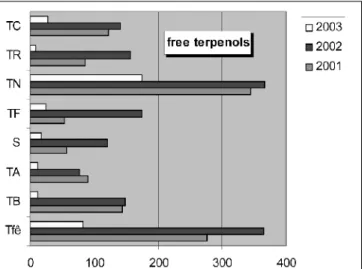
differ-ent wines is shown in Figure 2. For the 3 y of the study, the major free terpenols found in the analyzed wines were linalol, a-terpineol, ner-ol, and geraniol. Figure 2 shows differences between cultivars al-though a significant variation was found between the 3 y of the study. Touriga Nacional is the analyzed wine variety with the highest val-ues of total free terpenols, followed by Touriga Fêmea. Knowing that the limits of perception of the analyzed free terpenols are, respective-ly, 100 mg/L for linalol, 130 mg/L for nerol and geraniol, and 500 mg/L for a-terpineol (Etievant and others 1991), it may be considered that linalol (205 and 153 mg/L, average of the 3 years, respectively, for Touriga Nacional and Touriga Fêmea) is significant within its limit of perception (100 mg/L) and would have an impact on aroma. 4. Relationship between carotenoid profile in grapes and aromatic compounds in wines
Figure 1 gives the factor score (factor score plot 1-2 accounting for 57.98% of total variance) from the principal components study. Vari-ables correspond to the compounds analyzed; observations referred to grape variety analyzed. From a detailed observation of this figure,
3 different groups can be seen: (1) a 1st group that includes all the analyzed 3 y of study from Touriga Nacional and Touriga Fêmea. TN and TFê are the wine varieties with the highest values of total free terpenols (linalol, a-terpineol, nerol, and geraniol) and b-ionone. Such molecules are responsible for floral and “violet” aromas, respec-tively. (2) A 2nd group is formed by Sousão (2001 and 2002). This cultivar had higher contents in vitispirane and TDN (Figure 1), as it was expected considering the higher levels of bound vitispirane and TDN found in this grape variety for the 2002 vintage. These mole-cules are found to be responsible for “eucalyptus”/“camphor” and “kerosene” flavors, respectively (Simpson and others 1977; Rapp and others 1986). (3) A last group, different from the others, is formed by all varieties that do not include TN and TFê.
Although TFê clearly produced a higher concentration of caro-tenoids in all 3 y of study, along with TA in 2001 and 2002, and TB in 2001 (Figure 1 and Table 1) these cultivars have not necessarily produced the most aromatic wines. TN is the analyzed wine variety
Figure 2—Concentration of free terpenols in the different wines for the 3 y of study. Concentration is expressed in mg/L. Free terpenols = linalol + a-terpineol + nerol + geraniol.
Figure 1— PC plot 1-2 for 57.98% of total variance of the aromatic compounds found in the wines and the total carotenoids in the 8 grape varieties in the 3 y of the study. _01, _02, _03 correspond to the vintage: 2001, 2002, and 2003, respec-tively.
with the highest values of total free terpenols and b-ionone, as demonstrated previously, followed by TFê (Figure 2 and Table 3). Sousão and Tinto Cão had the lowest levels of carotenoids. Con-versely, these cultivars had produced higher concentrations of vitispirane and TDN (Table 1, Table 2, and Table 3).
For the 3 y of the study, and generally, grape varieties with higher concentrations of carotenoids (TFê, TA, TB) have lower values of free norisoprenoids, although there are exceptions (TFê). Con-versely, grape varieties with lower concentrations of carotenoids (TN, S, TC) appear to have higher contents of free norisoprenoids. This fact could be related to the reported observation that grapes with lower concentration of carotenoids had higher values of bound norisoprenoids (Bayonove 1991; Baumes and others 2002).
Conclusions
L
evels of carotenoids are very different among the 8 grape vari-eties studied. Grape varivari-eties with higher concentrations of car-otenoids are Touriga Fêmea, Tinta Amarela, and Tinta Barroca. Wines produced from these grapes have the lowest concentrations of free nor-isoprenoid compounds. In contrast, grape varieties with low contents in carotenoid molecules (TN, Souzão, and TC) cor-respond to wines with higher levels in volatiles, namely b-ionone, TDN, and vitispirane. TN wines have higher contents in terpenols and b-ionone, which in part explains the floral and violet aroma characteristic of these wines. Souzão wines have the highest con-centration in TDN and vitispirane compounds, for the 3 y of the study.More results are needed to better understand the biosynthetic mechanism (concerning carotenoids, glucosylated molecules, and volatiles) that are involved in the formation of norisoprenoids.
Acknowledgments
This work was supported by the Portuguese Ministry of Agriculture through the AGRO program (project 313). Carla Oliveira is in receipt of a Research Grant from the Ministry of Agriculture (AGRO 313). We also thank the program AGRO and the project 820 for the financial support.
References
Baumes R, Wirth J, Bureau S, Gunata Y, Razungles A. 2002. Biogeneration of C13-norisoprenoid compounds: experiments supportive for an apo-carotenoid pathway in grapevines. Anal Chim Acta 458:3–14.
Bayonove C. 1991. Les composes terpéniques. In: TEC&DOC Les acquisitions récentes en chromatographie du vin. Paris, France: Applications à l´analyze sensorielle des vins. p 99–118.
Bureau S, Razungles A, Baumes R, Bayonove C. 1998. Effect of vine or bunch shading on the carotenoid composition in Vitis Vinifera L. berries. I. Syrah grapes. Vitic Enol Sci 53(2):64–71.
Di Stefano R, Bottero S, Pigello R, Borsa D, Bezzo G, Corino L. 1998. Glycosylated aroma precursors in red winemaking grape cv. L´Enotecnico. 3:63–74. Enzell C. 1985. Biodegradation of carotenoids—an important route to aroma
compounds. Pure Appl Chem 57(5):696–700.
Etievant P. 1997. Wine. In: Maarse H, editor. Volatile compounds in foods and beverages. Zeist, The Netherlands: TNO-CIVO, Food Analysis Inst. p 483–545. Freitas V, Ramalho P, Azevedo Z, Macedo A. 1999. Identification of some volatile descriptors on the rock-rose-like aroma of fortified red wines from Douro Demarcated Region. J Agric Food Chem 47:4327–331.
Guedes de Pinho P, Ferreira AC, Mendes Pinto M, Gomez Benitez J, Hogg T. 2001. Determination of carotenoid profiles in grapes, musts and fortified wines from Douro varieties of Vitis vinifera. J Agric Food Chem 49(11):5484–8. Gunata YZ, Bayonove CL, Baumes RL, Cordonnier RE. 1985. The aroma of grapes.
I. Extraction and determination of free and glycosidically bound fractions of some grape aroma components. J Chromatogr 331:83–90.
Iland P, Ewart A, Sitters J. 1993. Techniques for chemical analysis and stability testes of grape juice and wine. South Africa: Kitchener Press Pty. p 120-5. Kanasawud P, Crouzet JC. 1990. Mechanism of formation of volatile compounds
by thermal degradation of carotenoids in aqueous medium. 1. b-carotene deg-radation. J Agric Food Chem 38:237–43.
Kotseridis Y. 1999. Etude de l’arome des vins de Merlot et Cabernet-sauvignon de la région Bordelaise [DPhil thesis]. Bordeaux, France: Univ. Victor Segalen Bordeaux II. 652 p.
Kotseridis Y, Baumes RL, Bertrand A, Skouroumounis GK. 1999. Quantitative determination of b-ionone in red wines and grapes of Bordeaux using a stable isotope dilution assay. J Chromatogr A 848:317–25.
Marais J, van Wyk CJ. 1986. Effect of grape maturity and juice treatments on terpene concentrations and wine quality of Vitis vinifera L. cv. Weisser Riesling and Bukettraube. S Afr J Enol Vitic 7(1):19–30.
Marais J, van Wyk C, Rapp A. 1991. Carotenoid levels in maturing grapes as affected by climatic regions, sunlight and shade. S Afr J Enol Vitic 12(2):64–9. Mendes Pinto MM, Silva Ferreira AC, Oliveira MBPP, Guedes de Pinho P. 2004. Evaluation of major carotenoids in grapes by liquid chromatography with re-versed and normal phase—a qualitative analysis. J Agric Food Chem 52(10):3182–8.
Mordi CR, Walton JC, Burton GW, Hughes L, Ingold KU, Lindsay DA. 1991. Explor-atory study of b-carotene auto-oxidation. Tetrahedron Lett 32:4203–6. Murray KE, Shipton JE, Whitfield FB. 1972. The chemistry of food flavor. I. Volatile
constituents of passion fruit Passiflora edulis. Aust J Chem 25:1921–33. Oliveira C, Silva Ferreira AC, Costa P, Guerra J, Guedes de Pinho P. 2004. Effect of
some viticultural parameters on the grape carotenoids profile. J Agric Food Chem 52(13):4178–84.
Oliveira C, Silva Ferreira AC, Hogg T, Alves F, Mendes Minto M, Guedes de Pinho P. 2003. Carotenoid compounds in grapes and their relationship to plant water status. J Agric Food Chem 51(20):5967–71.
Rapp A, Mandery H. 1986. Wine aroma. Experientia 42:873–84.
Razungles A, Babic I, Sapis J, Bayonove C. 1996. Particular behavior of epoxy xanthophylls during veraison and maturation of grape. J Agric Food Chem 44:3821–5.
Razungles A, Bayonove C, Cordonnier R, Baumes R. 1987. Etude des caroténoides du raisin à maturité. Vitis 26:183–91.
Razungles A, Bayonove C, Cordonnier R, Sapis J. 1988. Grape carotenoids: chang-Table 3—Concentration of free TCH, damascenone, b-ionone, TDN, and vitispirane in wines produced by the 8 grape varietiesa,b,c
Grape b-Damas- Vitis- b
-variety TCH c e n o n e TDN pirane ionone
Tfê_2001 nd 1.4 21 28 1.5 Tfê_2002 1.8 0.3 4 7 2.6 Tfê_2003 0.8 1.0 8 5 2.6 Average nd 0.9 11 13 2.2 SD nd 0.4 8 13 0.6 TB_2001 1.6 1.3 38 32 1.6 TB_2002 nd 0.9 9 9 1.2 TB_2003 nd 0.3 3 2 0.3 Average nd 0.8 17 15 1.0 SD nd 0.4 19 15 0.7 TA_2001 nd 0.8 13 5 1.5 TA_2002 1.2 0.2 13 4 0.6 TA_2003 0.3 1.1 7 2 0.7 Average nd 0.7 11 4 0.9 SD nd 0.4 4 1 0.5 S_2001 2.4 2.5 148 278 2.6 S_2002 1.9 nd 48 186 2.7 S_2003 0.5 0.6 12 42 0.7 Average 1.6 1.0 69 169 2.0 SD 1.0 1.0 71 119 1.0 TF_2001 nd 1.7 4 4 1.5 TF_2002 1.8 0.2 16 15 1.9 TF_2003 2.0 0.6 4 2 0.8 Average nd 0.8 8 7 1.4 SD nd 0.6 7 7 0.6 TN_2001 nd 2.2 20 23 2.8 TN_2002 0.9 0.3 3 3 4.1 TN_2003 1.0 0.7 8 0 2.3 Average nd 1.0 10 9 3.1 SD nd 0.8 9 12 0.8 TR_2001 nd 3.6 5 10 2.0 TR_2002 0.4 0.3 16 39 1.9 TR_2003 0.2 0.2 4 3 0.9 Average nd 1.4 8 17 1.6 SD nd 1.6 6 19 0.6 TC_2001 nd 2.7 67 70 1.9 TC_2002 1.8 0.3 44 25 1.4 TC_2003 1.1 1.3 15 11 1.9 Average nd 1.4 4 3 1.8 SD nd 1.0 21 13 0.2 aConcentration is expressed in mg/L. bTCH = 2.2.6-trimethylcyclohexenone; TDN =
1.1.6-trimethyl-1.2-dihydronaphthalene. Concentration of TDN and vitispirane expressed in mg/L of equivalents of b-damascenone.
cnd = not detected lower than the quantification limit, which is 0.02 mg/L for
es during the maturation period and localization in mature berries. Am J Enol Vitic 39(1):44–8.
Razungles A, Bureau S, Bayonove C, Baumes R. 1998. Effect de l’ensoleillement sur les teneurs en precurseurs d’arômes des baies de Syrah. 23rd Congrès Mondial de la Vigne et du Vin; Lisbon, Portugal; 1988 June 22–27. Ser. II, p 382–8. Rocha S, Coutinho P, Barros A, Coimbra MA, Delgadilho I, Dias Cardoso A. 2000. Aroma potential of two Bairrada white grape varieties: Maria Gomes and Bi-cal. J Agric Food Chem 48:4802–7.
Sabon I, Revel G, Kotseridis Y, Bertrand A. 2002. Determination of volatile com-pounds in Grenache wines in relation with different Terroirs in the Rhone Valley. J Agric Food Chem 50(22):6341–5.
Schneider R, Razungles A, Augier C, Baumes R. 2001. Monoterpenic and noriso-prenoidic glycoconjugates of Vitis vinifera L., cv Melon B. as precursors of odorants in Muscadet wines. J Chromatogr A 936:145–57.
Silva Ferreira AC, Guedes de Pinho P. 2003. Analytical method for determination of some aroma compounds on white wines by solid phase microextraction and gas chromatography. J Food Sci 68(9):2817–20.
Simpson RF, Strauss CR, Williams PJ. 1977. Vitispirane: a C13 spiro-ether in the aroma volatiles of grapes juice, wines and distilled grape spirits. Chem Indus-tr 6:633–64.
Siva Ferreira AC. 1998. Caractérisation du vieillissement du vin de porto. ap-proche chimique te statistique. role aromatique du sotolon [DPhil thesis]. Univ.
Victor Segalen Bordeaux II, France. p 593.
Skouroumounis GK, Massy-Westropp RA, Sefton MA, Williams PJ. 1992. Precur-sors of damascenone in fruit juices. Tetrahedron Lett 33:3533–6.
Strauss CR, Dimitriadis E, Wilson B, Williams PJ. 1986. Studies on the hydrolysis of two megastigma-3,6,9-triols rationalizing the origins of some volatile C13 norisoprenoids of Vitis vinifera grapes. J Agric Food Chem 34:145–9. Van Den Dool H, Kratz PD. 1963. A generalization of the retention index system
including linear temperature programmed gas-liquid partition chromatog-raphy. J Chromatogr 11:463–71.
Williams AA, Lewis MJ, May HV. 1983. The volatile flavor components of com-mercial port wines. J Sci Food Agric 343:311–9.
Williams PJ, Strauss CR, Wilson B. 1981. Classification of the monoterpenoid composition of Muscat grapes. Am J Enol Vitic 32(3):230–5.
Winterhalter P. 1991. 1,1,6-trimethyl-1,2-dihydronaphthalene (TDN) formation in wine. 1. Studies on the hydrolysis of 2,6,10,10-tetramethyl-1-oxaspiro [4.5] dec-6-ene-2,8-diol rationalizing the origin of TDN and related C13 noriso-prenoids in Riesling wine. J Agric Food Chem 39:1825–9.
Winterhalter P. 1992. Oxygenated C13-norisoprenoids—important flavor
pre-cursors. In: Winterhalter P, Teranishi R, Takeoka G, Guntert M, editors. Flavour precursors—thermal and enzymatic conversion. Washington, D.C.: ACS Sym-posium Series. 490. p 98–115.