486
The moderating role of age and gender
differences in the relation between
subjective well-being, psychopathology and
substance use in Uruguayan adolescents*
1O papel moderador das diferenças de
idade e gênero na relação entre
bem-estar subjetivo, psicopatologia e uso de
substâncias em adolescentes uruguaios
Maria Eugenia Fernandez*2, Lore Van Damme*3, Sarah De Pauw*4,
Daniel Costa-Ball*5, Lilian Daset*6, Wouter Vanderplasschen*7
Rev. Latinoam. Psicopat. Fund., São Paulo, 21(3), 486-510, set. 2018
http://dx.doi.org/10.1590/1415-4714.2018v21n3p486.5
The aim of this study is to explore the Subjective well-being (SWB) of school-going adolescents in Uruguay (N= 325; Mage= 14.67; SD= 1.62). We investigate age- and gender-specific relationships between psychopathology and substance use on the one hand, and subjective well-being on the other hand.
Multivariate linear regression analyses, indicated five significant predictors of SWB: three psychopathology factors (depression-anxiety, social anxiety and dissocial behaviour), and age displayed a negative association, while one psycho-pathology factor (resilience) showed a positive association. When extending the multivariate linear regression analysis with interaction effects, significant interac-tions appeared regarding gender and resilience and age and substance use.
Our study focuses on the necessity to have evidence-based results in order to plan appropriate preventive interventions with adolescents.
Key words: Subjective well-being, psychopathology, adolescence, substance use
*1 This article is included as one chapter of the Doctoral Thesis “Enhancing quality
of life and mental health in substance using adolescents”. Maria Eugenia Fernandez. Defended the 8th December 2017 at the Universidad Catolica del Uruguay
.
*2, 5, 6 Universidad Católica del Uruguay (Montevideo, Uruguai).
487
IntroductionAdolescent development
Adolescence is a key period in human development, characterized by various transitions and changes. Biological changes during this period of transition impact adolescents’ social, sexual, and emotional development (Costello, Copeland & Angold, 2011). This period is often referred to as a period of storm and stress (Steinberg, 2001), with both mental health problems and experimenting behaviour being relatively normal phenomena. Often, the onset of mental health problems occurs in early adoles-cence. Moreover, incidence of psychopathology increases substantially during this period. Also, the timing of puberty has been considered a risk factor for the development of mental health problems (especially depres-sion and behavioural problems) (Costello, 2016). The study by Costello, Copeland and Angold (2011) claims that one in ! ve adolescents has some kind of psychiatric problems. The most prevalent mental health problems among youth are: depression, panic disorder, agoraphobia and substance use. Increased rates of antisocial behaviour have been observed in adoles-cence (Belloch & Alvarez, 2002). Mental health problems are likely to impact the subjective well-being of adolescents (Huebner et al., 2004).
Due to the fact that experimenting behaviour is common among adolescents, they are at the peak developmental period for substance use (JND, 2014). In Uruguay, among students between 13 to 17 years old, the prevalence of last year use of alcohol is 60% and marihuana 17% (JND, 2014). Previous studies have highlighted the impact of substance misuse in adolescence, leading to problems in mental health, academic performance and social relations in later life (Fergusson, Boden & Horwood, 2013; Hemphill et al., 2014; Liang & Chikritzhs, 2015). The longitudinal study by Bogart and colleagues (2007) demonstrated that the use of alcohol and marihuana had a lasting effect on the decrease in subjective well-being.
Relevance of studying subjective well-being
488
concept which is of high relevance in this particular developmental period (Casas, 2011; Montserrat et al., 2015; Brann et al., 2017). Two contrasting constructs of well-being should be distinguished: the hedonic perspective, which emphasizes satisfaction in relation to happiness and pleasure, and the eudemonic perspective, which stresses the importance of the development of persons’ potential and achieving a meaningful life (Broekaert et al., 2017). Diener et al. (2006) de! nes subjective well-being as a general evaluation by the person of his/her life. This construct implies three domains: positive affect(e.g. enthusiasm, joy, excitement, curiosity), negative affect (e.g. anger, distress, sadness, lethargy) that should be reduced in order to have a high level of SWB, and lastly a global positive judgment of one’s life. Life satis-faction is part of this third domain, the global self-judgment, and refers to the cognitive aspect of SWB (Park, 2004).
The ‘homeostasis theory’ of SWB states that there is a neurological inherit tendency in each person that maintains the level of SWB around set points (Cummins, 2010). These set points range between 70 and 90, re" ecting the adequate range of SWB (Tomyn, Weinberg & Cummins, 2015). This theory of SWB states that under unchanging life circumstances, the person’s sense of global well-being is maintained by this homeostatic system. However, the system could collapse under life challenges (Tomyn, Weinberg & Cummins, 2015). Cummins’ homeostatic theory implies that
SWB is sensitive to modi! cations. The SWB homeostatic system may vary through life disturbances or regulatory adjustment processes, which may be particularly prevalent during the turbulent developmental phase of adoles-cence (Cummins, et al., 2014).
Positive development in adolescence has been shown to be related to high levels of SWB in teenagers. Park (2004) considers SWB as a key factor in the healthy development of adolescents. For example, the social support adolescents have (from family, friends, and school) and core affects they experience (e.g. feeling happy) are positively associated with
SWB (Gonzalez-Carrasco et al., 2017). Also, prosocial factors, personality factors, high self-perception of control, high self-esteem, and optimism were identi! ed as positive correlates of SWB (Cummins, 2010). Finally, good physical and mental health, positive interpersonal relationships, and high academic performance are related to high levels of SWB (Park, 2004).
489
problems, such as depressive symptoms, dissocial behaviour, suicidal intent and suicidal ideation, low self-esteem, and family and peer relationship problems (Alfaro et al., 2016; Suldo & Huebner 2004; Zullig et al., 2001). In addition, low levels of SWB in adolescents have been found to be related to risky behaviour such as drug or alcohol abuse and antisocial behaviour like aggression to others and sexual harassment (Proctor et al., 2009).
Age, gender and subjective well-being
Earlier studies have reported age and gender differences in SWB among adolescents (Gonzalez et al., 2017; Casas et al., 2007). Previous studies reported a progressive decline in the levels of SWB during adolescence (Gonzalez et al., 2017; Castella-Sarriera et al., 2012; Tomyn & Cummins, 2011; Casas et al., 2007). A possible explanation given by these authors is that older adolescents might be challenged by developmental factors which result in a decrease in SWB. However, the majority of these studies are cross-sectional, which hampers a sound evaluation of causal and developmental effects.
Noteworthy, the above-mentioned age differences regarding SWB
seemingly differ according to gender. The most pronounced decline in SWB
levels during adolescence was reported among girls (Brann et al., 2017). The study by Brann and colleagues (2017) compared two birth cohorts in Sweden (n=4362 and n=5151) and found signi! cant differences in the levels of SWB per gender. At the age of 18 years, girls reported much lower levels of well-being for all SWB dimensions. This study could not make ! rm conclusions on the cause of these gender differences, although it offered some plausible explanations. Girls’
SWB levels could be affected by more social pressure, socialization aspects, gender identity and stereotypes, and hormonal changes (Brann et al., 2017).
Studies on adolescents’ subjective well-being from Latin America
490
tobacco, but not for other substances (Palacios & Cañas, 2010). The study of Contini and colleagues (2003) in Argentina showed that positive coping stra-tegies (e.g. looking for social support, focus on positive aspects) in adoles-cents are associated with high levels of SWB. To the best of our knowledge,
SWB has not being studied previously in Uruguay in adolescents in relation to psychopathology and substance use.
The study by Noble and McGrath (2014) claims that in order to provide solid educational interventions; governments should base their programmes on evidence-based de! nitions of the construct of well-being in students. Casas (2011) claimed that research and systematic data-collection about subjec-tive social indicators of child and adolescent well-being worldwide, is still very scarce, and that policy makers should consider these in order to make decisions and evaluate social interventions. Therefore, further studies on SWB
in adolescents are important, in particular in the context of Latin-American countries like Uruguay. Prior research showed that depending on the culture, there are different constructs of what well-being implies (Garcia et al., 2017), which goes hand in hand with the dissimilar emphasis given to interventions to promote it (Ryff, et al. 2014).
This study
Based on the evidence from the research exposed above, SWB has been shown to be a key factor for healthy and positive development among adoles-cents. Studies in Latin America about SWB in adolescents are still in an early stage. Especially in Uruguay, there are no previous studies that assessed the
SWB of adolescents in relation to psychopathology and substance use. This study was designed to ! ll this gap by studying SWB in school-going adoles-cents in Montevideo. More speci! cally, we investigate age- and gender-speci! c relationships between psychopathology and substance use on the one hand, and subjective well-being on the other hand. We expect that high levels of psycho-pathology and substance use will be related to low levels of SWB (Huebner et al., 2004). In addition, we expect to ! nd age and gender differences regarding
SWB and its relationship with the other concepts of interest (Brann et al., 2017; Gonzalez-Carrasco et al., 2017). Our hypothesis, based on the available litera-ture, is that the girls in our sample will present lower level of SWB in comparison with boys. Our second hypothesis in relation to age in SWB is that the levels of
491
MethodsSample
A non-probabilistic sample was recruited between May and June 2016 in a school located in the metropolitan area of Montevideo, the capital city of Uruguay. The school is a private and traditional catholic school. We choose this school as it has a good gender and age balance. Many private schools have few pupils over 15 years old. In Uruguay since 2008, secondary school is compulsory until the age of 18 years, before this date, school was compul-sory until 15 years old. The total sample consisted of 390 students. Since some students (n=65) and/or their parents did not approve to participate or were not at school at the moment of data collection, this resulted in a ! nal sample of 325 adolescents. The sample consisted of 172 girls (53.2%) and 153 boys (46.8%) from 12 to 18 years old (Mage= 14.67; SD=1.62). The socioe-conomic status of 8 (3%) adolescents’ families was low, medium for 156 students (48%) and high for 49% (n=159) of the sample.
Procedure
Before starting data collection, a verbal explanation was given to students about the content of the study and ethical issues regarding their parti-cipation. Active informed consent was signed by the head of the institution, parents or guardian, and the students. The self-report scales (all in electronic version) were administered in Spanish in the school computer labs during the class period. On average, the administration of the questionnaires took around one hour to complete. An IT teacher was present during the administration for assistance on any problems with the computers or software used. Moreover, the ! rst author as well as a research assistant were present during adminis-tration, in case students had any further questions. The current study was approved by the Ethical committee of the Uruguayan Catholic University.
Instruments
492
‘socio-economic status’ (SES), subdivided into low, medium and high. SES is calculated by classifying households according to their consumption or expen-diture capacity and consisted of questions regarding individual, family, school and environment characteristics. We also included gender and age, with the latter being dichotomised into younger (12-14 years) and older (15-18 years) adolescents.
Psychopathology. The Adolescent Self-report (ADA) (Daset et al., 2015) was used to assess psychopathology. This instrument consists of 82 items and is scored using a 5-point Likert scale (0-4). Psychopathological symptoms refer to emotional, behavioural and thought related problems (e.g. “I feel sad and fed-up most of the time”). The instrument also includes some items referring to positive development, including strengths, life planning, coping skills, and social desirability (e.g.”I have self-con! dence”). Cronbach’s alpha’s for the ADA domains range from .70 to .90 (Daset, et. al. 2015). The ADA screening is based on the empirical taxonomies and studies of Achenbach and Edelbrock (1978), Lemos and colleagues (1992) and López-Soler and contributors (1998). The ADA consists of 6 cluster dimensions: Factor1 ‘Depression-anxiety’, Factor 2 ‘Dissocial behaviour, substance use and negative emotionality’, Factor 3 ‘Disrupted and dysregulated behaviour’, Factor 4 ‘Social anxiety’, Factor 5 ‘Resilience and pro-sociality’ and Factor 6 ‘Obsessive- compulsive symptoms’. In the current study, Cronbach’s alpha was .94 for F1, .84 for F2,.94 for F3, .92 for F4, .93 for F5, and.87 for F6.
Alcohol use. To assess adolescents’ alcohol use, an existing question-naire (JND, 2011) was used. The questionnaire assessed (i) the lifetime preva-lence of alcohol use (yes/no), (ii) the prevapreva-lence of alcohol use during the last 12 months (yes/no); (iii) the prevalence of alcohol use during the last 30 days (yes/no); and (iv) the age of ! rst alcohol use in school-going adolescents from 12 to 18 years old.
493
to have more cases that were ever exposed and to be able to include these variables in the model.
Subjective Well-being. Cummins and Lau (2003) developed the Personal Well-being Index (PWI) to measure subjective well-being across 50 countries and different age groups (12 to 65 years old) and cultures. The instrument showed good psychometric properties and cultural stability (The International Well-Being Group, 2013). We used the Personal Well-Being index (PWI) (Cummins et al., 2003) in its Spanish version, validated for Chile (Alfaro et al., 2016). The scale is unidimensional and consists of 7 items that evaluate following domains: ‘standard of living’, ‘health’, ‘achievements’, ‘relationships with others’ (peers and family), ‘safety’, ‘community-connec-tedness’, and ‘future security’. The items asses the perceived satisfaction with these life domains. It is measured using a Likert scale ranging from0 (completely dissatis! ed) to 10 (completely satis! ed). The index is calcu-lated by summing up all the items and transforming the scores into a 0-100 scale. Cronbach’s alpha of the original instrument in international studies vary between .70 and .85. The version we used had an internal reliability of .77 and was validated for teenagers (Cummins et al., 2003). In the current study, the Cronbach’s alpha of the PWI was .87.
Statistical analyses
First, descriptive statistics were calculated regarding psychopathology, substance use and SWB for gender, age and SES groups. Second, gender, age and SES differences regarding psychopathology, substance use and SWB were examined using (a) independent t-tests and ANOVAs for continuous variables and (b) chi-square tests for categorical variables. Third, a multivariate linear regression analysis was performed to examine the relationship between psychopathology and substance use on the one hand (i.e., the independent variables), and SWB on the other hand (i.e., the dependent variable). To maximize the statistical power, we decided to only include those sociodemo-graphic variables that were signi! cantly (p-value 0.05) related with psychopa-thology, substance use and/or SWB (i.e., gender and age, and SES).
494
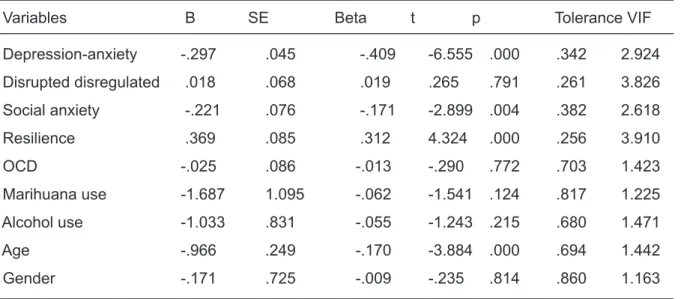
out (same coef! cient of opposite sign); we decided to perfom separate linear regresion analysis including each variable (disocial behaviour and social anxiety) separate. In the annexes of this article we included the table of the correlation analysis between all variables. The variance in" ation factor (VIF) indicates whether a predictor has a strong linear relationship with the other predictor (s). Although there are no hard and fast rules about what value of the VIF should cause concern, Myers (1990) (in Field, 2009), suggests that a value below 10 is adequate. What’s more, if the average VIF is greater than 1, then multicollinearity may be biasing the regression model (Bowerman & O’Connell, 1990, in Field, 2009). Related to the VIF is the tolerance statistic, which is its reciprocal (1/VIF). As such, values below 0.1 indicate serious problems although Menard (1995) (in Field, 2009), suggests that values below 0.2 are worthy of concern. Table 3 (a & b) presents both linear regression models including the VIF and tolerance statistic. In our model VIF is bellow 5 and the tolerance above 0.2, therefore showing that no collinearity problems are found in both regressions.
Fourth, the multivariate linear regression analysis was extended with the interaction effects between psychopathology and substance use on the one hand, and gender and age on the other hand. Before creating the interaction variables, all continuous variables were standardized. Subsequently, the interaction variables were constructed by multiplying psychopathology and substance use variables with age and gender.The R and R² are stated for each model. A p-value of 0.05 was used in all analyses as the standard for statistical signi! cance.
Results
The mean score of global SWB of the total sample was 84.00 (SD
495
Pearson Correlation ADA FactorsDepression Dissocial Disrupted Social Resilience OCD
anxiety behaviour disregulated anxiety
Depression- 1 0.721 0.081 0.754 -0.26 0.377
anxiety
Dissocial 1 0.162 0.904 -0.122 0.744
behaviour
Disrupted 1 0.033 0.772 0.345
disregulated
Social 1 -0.234 0.413
anxiety
Resilience 1 0.175
OCD 1
Table 1. Subjective well-being, psychopathology and substance use: distribution and gender differences
Variables Boys Girls Boys vs girls
N= 152 N= 173
M SD M SD t (df)
SWB 59.67 7.80 57.22 10.15 -2.456 (317)•
Depression-anxiety 11.17 9.54 17.73 14.22 4.934 (302)*
Dissocial behaviour 15.74 8.39 18.69 9.94 2.899 (320)*
Disrupted disregulated 46.23 9.95 46.03 9.36 -189(323)
Social anxiety 7.75 6.25 10.63 7.58 3.756 (321)*
Resilience 40.63 7.80 41.23 7.77 .685 (323)
OCD 11.50 4.45 11.89 4.82 .754 (323)
N (%) N (%) x2(df)
Alcohol use 105 (60,7) 91 (59.9) .023 (1)*
Marihuana use 22 (12.7) 21 (13.9) .099 (1)
496
In table 2, we describe the distribution of SWB, psychopathology and substance use for younger versus older adolescents. Compared to younger students (12 to 14), older students (15 to 18) had signi! cantly lower levels of SWB, signi! cantly higher scores for Factor 3 ‘Disrupted dysregulated behaviour’, and signi! cantly higher prevalence rates for lifetime alcohol and marihuana use.
Table 2. Subjective well-being, psychopathology and substance use: distribution and age differences
Variables Younger (12-14) Older (15-18) Younger vs Older
N= 155 N= 169
M SD M SD t (df)
SWB 60.50 9.14 56.45 8.85 4.040 (317)•
Depression-anxiety 13.61 12.17 15.60 13.11 -1.412 (322)
Dissocial behaviour 16.52 9.75 17.97 8.94 -1.388 (322)
Disrupted disregulated 44.27 9.51 47.88 9.44 -3.424 (319)*
Social anxiety 8.80 7.44 9.69 6.83 -1.125 (322)
Resilience 40.58 8.77 41.31 6.76 -845 (322)
OCD 11.29 4.75 12.05 4.53 -1.489 (322)
N (%) N (%) x2 (df)
Alcohol use 53 (34.2) 143 (84.6) 86.007 (1)*
Marihuana use 6 (3.9) 36 (22) 23.020 (1)*
*p<0.05
497
Factor 5 ‘Resilience and pro-sociality’ (p=.000). Also, age had a signi! cant negative association with SWB (p=.002).
Table 3a. Multivariate linear regression analysis predicting SWB (excluding Social anxiety)
Variables B SE Beta t p Tolerance VIF
Depression-anxiety -.321 .045 -.442 -7.111 .000 .348 2.870
Dissocial behaviour -.168 .080 -.170 -2.085 .038 .202 4.958
Disrupted disregulated .020 .069 .020 .285 .776 .261 3.835
Resilience .366 .086 .310 4.230 .000 .252 3.972
OCD .111 .125 .056 .894 .372 .339 2.949
Marihuana use -1.529 1.099 -.056 -1.391 .165 .820 1.219
Alcohol use -.910 .836 -.048 -1.089 .277 .681 1.469
Age -1.007 .250 -.177 -4.037 .000 .698 1.432
Gender -.151 .730 -.008 -.207 .836 .860 1.163
N=325, R2= 0.582.
In table 3b. we present the multivariate regression model predic-ting the global score of SWB, including psychopathology, substance use and the selected socio-demographic variables, excluding the variable dissocial behavior. We identi! ed depression-anxiety (p= .000), social anxiety (p=.004), and age negatively related to SWB and resilience with a positive association (p= .000).
498
Regarding the interactions with substance use, age*alcohol use (t(df) = 2.064 (24); p = .040), age*marihuana use (t(df) = 1.927 (24); p = .055) appeared as signi! cant. This model explained 62.2% of the variance.
Table 3b. Multivariate linear regression analysis predicting SWB (excluding Dissocial behavior)
Variables B SE Beta t p Tolerance VIF
Depression-anxiety -.297 .045 -.409 -6.555 .000 .342 2.924
Disrupted disregulated .018 .068 .019 .265 .791 .261 3.826
Social anxiety -.221 .076 -.171 -2.899 .004 .382 2.618
Resilience .369 .085 .312 4.324 .000 .256 3.910
OCD -.025 .086 -.013 -.290 .772 .703 1.423
Marihuana use -1.687 1.095 -.062 -1.541 .124 .817 1.225
Alcohol use -1.033 .831 -.055 -1.243 .215 .680 1.471
Age -.966 .249 -.170 -3.884 .000 .694 1.442
Gender -.171 .725 -.009 -.235 .814 .860 1.163
N=325, R2= 0.582.
Discussion
In this study, we aimed to assess the global level of subjective well-being of a sample of school-going adolescents from Uruguay, exploring the moderating role of age and gender in the relation between psychopathology and substance use on the one hand, and subjective well-being on the other hand. The Well-being International Group (2013) suggests a normative range between a minimum of 73.8 and a maximum of 90.4 (Well-being International Group, 2013). The total score of SWB in our sample (i.e. M=84.00, SD=4.16) falls within this stipulated normative range which illustrates that overall, school-going adolescents from this speci! c sample are relatively satis! ed with their life.
499
had a negative association with SWB. In line with prior studies (Huebner et al., 2004; Park, 2004), these results suggest that negative development (e.g. psychological problems) is associated with lower levels of SWB in teenagers. It is likely that adolescents who display high levels of dissocial behaviour lack empathy to others and lack insight about their own behaviour and its conse-quences (Aalsma, Lapsley, & Flannery, 2006; Berk, 2006; Seagrave & Grisso, 2002). More research is needed to gain more insight regarding the construct of this particular ADA factor, as well as regarding plausible variables that could mediate the association between SWB and dissocial behaviour, such as peer relationships, bonds with the family, and patterns of problems behaviour since childhood (Costello, 2016; Keyes, 2006).
Also in line with prior studies (Casas et al., 2012), the factor resilience showed a positive association, providing support for the idea that positive development is associated with higher levels of SWB during the develop-mental period of adolescence. Resilience is de! ned as healthy development in the face of adversity, and refers to contextual challenges.
Regarding age, both the bivariate analysis indicated that, compared to older adolescents, younger adolescents reported higher levels of SWB. This is in line with previous studies (Brann et al., 2017), showing a negative asso-ciation between age and global level of SWB. This also accords with prior work in other Latin-American countries. For example, the study of Castella and colleagues (2012) compared the SWB of 12 to 16 year old adolescents from Brazil and Argentina. In both countries, the level of SWB decreased with age. In addition, our study results revealed some interesting interac-tion effects; alcohol and marihuana use displayed a signi! cant interacinterac-tion effect with age. The positive coef! cient of the interaction between age and substance use (alcohol and marihuana), implies that as the individuals grow up the negative impact of the use of these substances over the global SWB is reduced. Similarly, the study by Van Ouytsel and colleagues (2017) found that Belgian adolescents that use alcohol and marihuana at a young age are more vulnerable or prone to engage in risk behavior such as dating violence, and more vulnerability to have depression and low self-esteem.
500
and Argentina. A possible explanation for this ! nding is the strong existing connection between SWB and psychopathology, where there is a higher preva-lence of Psychopathology in female adolescents (Costelo, 2016; Lopez-Soler et al., 1998; Belloch & Alvarez, 2002). Noteworthy, these gender differences did not appear in our multivariate regression model. However, a signi! cant gender interaction effect was found: gender and resilience had a signi! cant positive interaction effect for girls only.
Our study has several contributions. In the ! rst place, this is the ! rst study in Uruguay that relates SWB in adolescents to psychopathology and substance use, thereby contributing to the scant research on the topic in Latin America (Castella-Sarriera et al., 2012). Our study focuses on the necessity to have evidence-based results in order to plan appropriate preventive interventions with adolescents to avoid negative development and promote positive deve-lopment (Montserrat et al., 2015). In relation to age and gender, our results suggest that when planning interventions aimed at increasing the level of SWB
in adolescents, educators, teachers, psychologists and youth workers should consider gender and age differences. Additionally, interventions aimed at stimulating the level of SWB should be speci! c, based on the main signi! cant factors that are related to SWB in teenagers (Casas et al., 2015). Our results also suggest that it is important to invest efforts in detecting and preventing depression-anxiety, social anxiety and dissocial behaviour in school settings.
Based on the current study, it is therefore suggested to not only adopt a problem-oriented approach (i.e., striving to reduce depressive, anxious and compulsive symptoms), but to also apply strength-based principles (i.e., striving to enhance resilience), in particular among girls given the interaction effect.
Research limitations and recommendations
The study ! ndings, however, need to be considered in the light of some limitations. First, the cross-sectional nature of the study does not allow any causal conclusions. Of note, while we considered the effects of psychopatho-logy and substance use on SWB, other studies suggested an inverse impact (Alfaro et al., 2016; Huebner et al., 2004). Longitudinal studies are needed to reveal more insight in the bi-directionality of this relationship, which is clearly needed in future research on this topic in Uruguay and Latin-America.
501
characteristics (i.c. a catholic school, located in the city centre of a small city near the capital). For future research, it is recommended to collect data at national level and to design the study including a probabilistic sample.
Third, it is advisable to assess SWB on various groups of adolescents, including clinical samples, to assess whether the current age- and gender-s-peci! c relationships can also be revealed in at risk adolescents or adolescents with pre-existing health and/or mental health problems. Also, pre-adolescents, from 10 years old, should be included in future longitudinal studies in order to observe whether any pattern of change in SWB can be observed in the transi-tion from primary school to high school (Gonzalez-Carrasco et al., 2017).
Finally, we suggest further research to add a qualitative assessment of
SWB, in order to gain a deeper understanding of individuals’ interpretation of different dimensions of SWB, as well as about the importance they attach to it (Casas, 2011).
References
Aalsma, M. C., Lapsley, D. K., & Flannery, D. J. (2006). Personal fables, narcissism, and adolescent adjustment. Psychology in the Schools, 43(4), 481-491. doi: 10.1002/pits.20162.
Achenbach, T. M., & Edelbrock, C. (1978). The classification of child psychopathology: a review and analysis of empirical efforts. Psychological Bulletin, 85(6), 1275-301.
Alfaro, J., Guzmán, J., García, C., Sirlopú, D., Reyes, F., & Varela, J. (2016). Psychometric Properties of the Spanish Version of the Personal Wellbeing Index-School Children (PWI-SC) in Chilean School Children. Child Indicators Research, 9, 731-742.
Belloch, A., & Álvarez, H. (2002). Trastornos de la personalidad. Madrid, Espanha: Editorial Síntesis.
Berk, L. E. (2006). Development Through the Lifespan. (4th ed.). Illinois, USA:
Pearson.
Brann, E., Chaplin, J., Agelii, M., Sjoberg, A., Nikalsson, A., Albertsoon-Wikland, K., & Lissner, L. (2017). Declining well-being in young Swedes born in 1990 versus 1974. Journal of Adolescent Health, 60, 306-312.
Casas, F., Rosich, M., & Alsinet, C. (2000). El bienestar psicológico de los pre-adolescentes. Anuario de Psicología, 31(2),73-86.
502
well-being of 12 to 16 years old adolescents and their parents from 1999 to 2003 Spanish samples. Social Indicators Research, 83, pp. 87-115.
Casas, F. (2011). Subjective Social indicators and child and adolescent well-being.
Child Indicators Research, 4, pp. 555-575.
Casas, F., Castella, J., Abs, D., Coenders, G., Alfaro, J., Saforcada, E., & Tonon, G. (2012). Subjective indicators of personal well-being among adolescents. Performance and results for different scales in Latin-language speaking countries: a contribution to the international debate. Child IndicatorsResearch, 5, 1-28. Castella-Sarriera, J., Saforcada, E., Tonon, G., Rodríguez de la Vega, R., Mozobancyk,
S., & Bedin, L. (2012). Bienestar Subjetivo de los Adolescentes: un estudio comparativo entre Argentina y Brasil. Psychosocial Intervention, 21(3), 273-280. Cerda, M., Bordelois, P., Keyes, K., Galea, S., Koenen, K., Pardini, S. (2013).
Cumulative and recent psychiatric symptoms as predictors of substance use onset: does timing matter? Addiction, 108(12), doi: 10.1111/add.12323.
Ciairano, S., Rabaglietti, Roggero, A., Bonino, S., & Beyers, W. (2007). Patterns of adolescent friendships, psychological adjustment and antisocial behaviour: The moderating role of family stress and friendship reciprocity. International Journal of Behaviour Development, 31(6), 539-548.
Contini, N., Coronel, P., Levin, M., & Estévez, A. (2003). Estrategias de afrontamiento y bienestar psicológico en adolescentes escolarizados de Tucumán.
Revista de Psicología de la PUCP, XXI(1), 180-199.
Costello, E. J. (2016). Early detection and prevention of mental health problems: developmental epidemiology and systems of support. Journal of Clinical Child and Adolescent Psychology, 45(6), 710-717.
Costello, E. J., Copeland, W., & Angold, A. (2011). Trends in psychopathology across the adolescent years: what changes when children become adolescents, and when adolescents become adults? The Journal of Child Psychology and Psychiatry, 52(10), 1015-1025. Crawford, L., & Novak, K. (2008). Parent-child relations and peer associations as
mediators of the family structure-substance use relationship. Journal of Family Issues, 29(2), 155-184. doi: 10.1177/0192513x07304461.
Cummins, R. A., Eckersley, R., Pallant, J., Van Vugt, J., & Misajon, R. (2003). Developing a national index of subjective wellbeing: The Australian unity well-being Index. Social Indicators Research, 64, 159-190.
Cummins, R. A. (2010). Subjective well-being, homeostatically protected mood and depression: a synthesis. Journal of Happiness Studies, 11, 1-17. doi 10.1007. Cummins, R., Li, N., Wooden, M., & Stokes, M. (2014). A demonstration of
set-points for subjective well-being. Journal of Happiness Studies, 15, 183-206. Daset, L., Fernández-Pintos, M. E., Costa-Ball, D., López-Soler, C., &
503
adolescentes (ADA). Ciencias Psicológicas, 9(1), 85-104.Diener, E., Lucas, R., & Scollon, C. (2006). Beyond the hedonic treadmill. Revising the adaptation theory of well-being. American Psychological Association, 61(4), 305-314. Estévez-López, E., Musiti Ochoa, G., & Herrero Olaizola, J. (2005). El rol de la
comunicación familiar y del ajuste escolar en la salud mental del adolescente.
Salud Mental, 28(4), 81-89.
Fava, A., & Ruini, C. (Eds).(2014). Increasing Psychological Well-being in Clinical and Educational settings. Interventions and Cultural Contexts. Cross-Cultural Advancements in Positive Psychology, 8. New York.
Fergusson, D. M., Boden, J. M., & Horwood, L. I. (2013). Alcohol misuse and psychosocial outcomes in young adulthood: results from a longitudinal birth cohort studied to age 30. Drug and Alcohol Dependence, 133(2), 513-519.
Fernández, M. E., Van Damme, L., Daset, L., & Vanderplasschen, W. (2017). Domain speci! c determinants of Subjective well-being among school-going adolescents in Uruguay. A multidimensional approach. Submitted.
Field, A. (2009). Discovering statistics using SPSS. (3th ed.). London, UK: Sage.
Fischer, J., Clavarino, A., Plotnikova, M., & Najman, J. (2015). Cannabis use and quality of life of adolescents and youth adults: Findings from an Australian birth cohort. Journal of Psychoactive Drugs, 47(2), 107-116.
Garcia, D., Sagone, E., De Caroli, M., & Nima, A. (2017). Italian and Swedish adolescents: differences and associations in subjective well-being and psychological well-being. Peer J 5 e:26868: doi 10.7717.
Gaspar, T., & Balancho, L. (2017). Fatores pessoais e sociais que in" uenciam o bem- -estar subjetivo: diferenças ligadas estatuto socioeconómico. Ciencia & Saude Coletiva, (4), 13-80.
Gómez Bustamante, E., & Cogollo, Z. (2010). Factores predictores relacionados con el bienestar general en adolescentes estudiantes de Cartagena, Colombia. Rev. Salud Pública, 12(1), 61-70.
González Barón, R., Montoya Castilla, I., Casullo, M., Bernabéu Verdu, J. (2002). Relación entre estilos y estrategias de afrontamiento y bienestar psicológico en adolescentes. Psicothema, 14(2), 363-368.
Gonzalez-Carrasco, M., Casas, F., Vinas, F., Malo, S., Gras, M., & Bedin, L. (2017). What leads subjective well-being to change throughout adolescence? An exploration of potential factors. Child Indicators Research, 10, 33-56.
González-Carrasco M., Casas, Malo, S., Vinas, F., & Dinisman, T. (2017). Changes with age in subjective well-being through adolescent years: differences by gender.
Journal of Happiness Studies, 18, 63-88.
504
Federation of Psychological Associations, 6, 53-63.
Handren, L. M., Donaldson, D. C., & Crano, W. D. (2016). Adolescent alcohol use: Protective and predictive parent, peer, and self-related factors. Society for Prevention Research, 17, 862-871, doi: 10.1007/s11121-016-0695-7.
Hasking, P., Lyvers, M., & Carlopio, C. (2011). The relationship between coping strategies, alcohol expectancies, drinking motives and drinking behaviour.
Addictive Behaviours, 36, 479-487.
Hemphill, S., Heerde, J., Scholes-Balog, K., Herrenkohl, T., Toumbourou, J., & Catalano, R. (2014). Effects of early adolescent alcohol use on mid-adolescent school performance and connection: A longitudinal study of students in Victoria, Australia and Washington state, United States. Journal of School Health, 84 (11). Huebner, S., Suldo, S., Smith, L., & McKnigth, C. (2004). Psychology in the Schools,
41(1), 81-93.
Junta Nacional de Drogas (JND) (2014). Sexta encuesta nacional sobre consumo de drogas en estudiantes de enseñanza media, Uruguay.
Junta Nacional de Drogas (JND). Observatorio Uruguayo de drogas (OUD) (2011).
Sobre ruidos y nueces. Consumo de drogas legales e ilegales en la adolescencia.
Junta Nacional de Drogas, Observatorio Uruguayo de Drogas, Montevideo. Keyes, C. (2006). Mental Health in adolescence: is America’s youth ! ourishing?
American Journal of Orthopsychiatry, 76(3), 395-402.
Lai, L., Cummins, R., Lau, A. (2013). Cross cultural difference in subjective well-being: cultural response bias as an explanation. Soc Indic Res, 114, 607-619. Legleye, S., Piontek, D., Kraus, L., Morand, E., & Falissard, B. (2013). A validation
of the cannabis abuse screening test (CAST) using a latent class analysis of the DSM-IV among adolescents. International Journal of Methods of Psychiatric Research, 22(1), 16-26.
Liang, W., & Chikritzhs, T. (2015). Age at " rst use of alcohol predicts the risk of heavy alcohol use in early adulthood: a longitudinal study in the United States. International Journal of Drug Policy, 26,131-134.
López-Soler, C., García Montalvo, C., Pérez López, J., Brito, A., Tejerína, M. Y., & Fernández-Ros, E. (1998). Psicopatología en la adolescencia: Taxonomías empíricas, rasgos de personalidad y estrés. Programa Séneca, Plan Regional de Investigación, Desarrollo Tecnológico y del Conocimiento, Murcia.
Mason, A (2001). Slef-esteem and deliquency revisited (again): A test of Kaplan’s self-drogation latent growth curve modleing. Journal of Youth and Adolescence,
30(1), 83-102.
505
Navarro, D., Montserrat, C., Malo, S., Gonzalez, M., Casas, F., Crous, G. (2017).Subjective well-being: what do adolescents say? Child & Family Social Work, 22, 175-184.
Noble, T., & McGrath, H. (2014). Well-being and resilience in school settings. In Fava & Ruini (eds.). Increasing Psychological well-being in Clinical and Educational Settings. Interventions and Cultural Contexts (Chapter 9, pp. 135-152).
Orcasita Pineda, L., & Uribe Rodríguez, A. (2010). La importancia del apoyo social en el Bienestar de los Adolescentes. Psicologia: Avances de la Disciplina, 4(2), 69-82. Ormel, J., Oerlemans, A., Raven, D., Laceulle, O., Hartman, C., Veenstra, R., Verhulst,
F., Vollebergh, W., Rosmalen, J., Reijneveld, S., & Oldehinkel, J. (2017). Functional outcomes of child and adolescent mental disorders. Current disorder most important but psychiatric history matters as well. Psychological Medicine, 47, 1271-1282. Palacios Delgado, J., & Canas Martínez, J. (2010). Características psicosociales
asociadas al consumo de alcohol, tabaco y drogas en adolescentes de Chiapas.
Psicología Iberoamericana, 18(2), 27-36.
Park, N. (2004). The Role of Subjective well-Being in Positive Youth Development.
ANNALS, 591.
Piko, F. B., & Kovács, E. (2009). Do parents and school matter? Protective factors for adolescent substance use. Addictive Behaviours, 35, 53-56.
Proctor, C., & Linley, A. (2014). Life satisfaction in youth. In Fava & Ruini (eds.). Increasing Psychological well-being in Clinical and Educational Settings.
Interventions and Cultural Contexts (Chapter 13, pp. 199-215).
Proctor, C., Linley, P., & Maltby, J. (2009) Youth life satisfaction: A review of the literature. Journal of Happiness Studies, 10, 583-630.
Ryan, S. M., Jorm, A. F., & Lubman, D. I. (2010). Parenting factors associated with reduced adolescent alcohol use: A systematic review of longitudinal studies.
Australian and New Zeeland Journal of Psychiatry, 44, 774-783.
Ryff, C., Love, G., Miyamoto, Y., Markus, H., Curhan, K., Kitayama, S., Park, J., Kwakami, N., Kan, C., & Karasawa, M. (2014). Culture and the promotion of well-being in East and West: Understanding varieties of attunement to the surrounding context. In Fava & Ruini (eds.). Increasing Psychological well-being in Clinical and
Educational Settings. Interventions and Cultural Contexts (Chapter 1, pp. 1-19).
Rodríguez-Fernández, A. (2009). Auto concepto físico y bienestar/malestar psicológico en la adolescencia. Revista de Psicodidactica, 14(1), 155-158.
Sánchez-López, M., Parra Martínez, J., Rosa Alcázar, A. (2003). El bienestar subjetivo, su relación con la salud e incidencias en la Educación. Revista de Investigacion
Educativa, 21(2), 387-401.
506
of juvenile psychopathy. Law and Human Behavior, 26(2), 219-239. doi: 10.1023/A:1014696110850
Scholes-Balog, K., Hemphill, S., Patton, G., & Toumbourou, J. (2015). Relationships between substance use and depressive symptoms: A longitudinal study of Australian adolescents. Journal of Early Adolescence, 35, 538-561.
Siegel, J. T., Tan, C. N., Navarro, M. A., Alvaro, E. M., & Crano, W. D. (2015). Th e power of the proposition: Frequency of marijuana off ers, parental knowledge, and adolescent marijuana use. Drug and Alcohol Dependence, 148, 34-39.
Steinberg, L. (2001) We know same things: Parent-adolescent relashionships in retrospect and prospect. Journal of Research Adolescence, 11(1), 1-19.
Suldo, S., & Huebner, S. (2004). Does life satisfaction moderate the rff ects of stressful life events on psychopathological behaviour during adolescence? School Psychology Quarterly, 19(2), 93-105.
Tagliabue, S., Lanz, M., & Beyers, W. (2014). Th e transition to adulthood around the Mediterranean: contributions of the special issue. Journal of Adolescence, 1-6. doi 10.1016.
Tian, L., Zhang, L., Huebner, E., Zheng, X., & Liu, W. (2016).The longitudinal relationship between school belonging and subjective well-being in school among elementary school students. Applied research quality life, 11, 1269-1285.
Th e International Well-Being Group (2013). Personal Well-Being Index, English Manual
(5th Ed.). Th e Australian Centre on Quality of Life, Deakin University.
Tomyn, A., Weinber, M., & Cummins, R. (2015). Intervention effi cacy among “at risk” adolescents: A test of subjective well-being homeostasis theory. Social Indicators
Research, 120, 883-895.
Van Damme, L., Colins, O., & Vanderplasschen, W. (2014). Gender diff erences in psychiatric disorders and clusters of self-esteem among detained adolescents.
Psychiatry Research, 220, 991-997.
Van Ouytsel, J., Ponnet, K., & Walrave, M. (2017). Th e associations of adolescent’s dating violence victimization, well-being and engagement in risk behaviours.
Journal of Adolescence, 55, 66-71.
Wong, M., & Chui, W. (2017). Economic development and subjective well-being: A comparative study of adolescents in Hong Kong. Child Indicators Research, 10,
247-265.
Zullig, K., Valois, R., Huebner, S., Oeltmann, J., & Drane, W. (2001). Relationship Between Perceived Life Satisfaction and Adolescents’ Substance Abuse. Journal of
507
Resumos(O papel moderador das diferenças de idade e gênero na relação entre bem-estar subjetivo, psicopatologia e uso de substâncias em adolescentes uruguaios)
O objetivo deste estudo é explorar o bem-estar subjetivo (BES) de adolescentes que frequentam o ensino médio no Uruguai (N = 325; M idade = 14,67; DP = 1,62). Pesquisamos as relações específicas de idade e sexo entre psicopatologia e uso de substâncias, por um lado, e bem-estar subjetivo, por outro.
Análises de regressão linear multivariada indicaram cinco preditores significativos de BES: três fatores psicopatológicos (depressão-ansiedade, ansiedade social e comportamento dissocial) e idade apresentaram associação negativa, ao passo que um fator psicopatológico (resiliência) apresentou associação positiva. Ao estender a análise de regressão linear multivariada com efeitos de interação, surgiram interações significativas em relação a gênero e resiliência e idade e uso de substâncias.
Este estudo está centrado da necessidade de obter resultados baseados em evidências para planejar intervenções preventivas adequadas com adolescentes. Palavras-chave: Bem-estar psicológico subjetivo, psicopatologia, adolescência, uso
de substâncias
(Le rôle modérateur des différences d’âge et de sexe dans le rappot entre le bien-être subjectif, la psychopathologie et la consommation de substances chez les adolescents Uruguayens)
Le but de cette recherche est d’explorer le bien-être subjectif (BES) des adolescents étudiants du secondaire en Uruguay (N = 325, M être = 14,67, SD = 1,62). Nous étudions les rapports spécifiques entre l’âge et le sexe entre la psychopathologie et l’usage de substances, d’une part, et le bien-être subjectif, d’autre part.
Les analyses de régression linéaire multivariée ont indiqué cinq prédicteurs significatifs de BES: trois facteurs psychopathologiques (dépression-anxiété, anxiété sociale et comportement anti social) et l’âge ont montré une association négative, tandis qu’un facteur psychopathologique (résilience) présentait une association positive. Après extension de l’analyse de régression linéaire multivariée avec des effets d’interaction, des interactions significatives sont apparues concernant le genre et la résilience et l’âge et la consommation de substances.
Notre recherche met l’accent sur la nécessité d’obtenir des résultats fondés sur des données appuyés empiriquement afin de planifier des interventions préventives appropriées auprès des adolescents.
508
(El papel moderador de las diferencias de edad y género en la relación entre bienestar psicológico subjetivo, psicopatología y consumo de sustancias entre adolescentes uruguayos)
El objetivo de este estudio es explorar el bienestar psicológico subjetivo (BPS) de adolescentes uruguayos que van al colegio (N = 325, M edad = 14,67, SD = 1,62). Por un lado, investigamos las relaciones específicas, por edad y género, entre la psicopatología y el uso de sustancias, y por otro lado, el bienestar psicológico subjetivo. Los análisis de regresión lineal multivariante indicaron cinco predictores significativos de BS: tres factores psicopatológicos (depresión-ansiedad, ansiedad social y comportamiento disocial) y la edad, mostraron una asociación negativa, mientras que un factor psicopatológico (resiliencia) mostró una asociación positiva. Al extender el análisis de regresión lineal multivariante con efectos de interacción, aparecieron interacciones significativas con respecto al género, la resiliencia, la edad y el uso de sustancias.
Este estudio se enfoca en la necesidad de lograr resultados basados en evidencias para planificar intervenciones preventivas apropiadas para adolescentes.
Palabras clave: Bienestar psicológico subjetivo, psicopatología, adolescencia, uso de sustancias
(Die moderierende Rolle von Alters- und Geschlechtsunterschieden im Verhältnis zwischen subjektivem Wohlbefinden, Psychopathologie und Substanzkonsum in uruguayischen Jugendlichen)
Ziel dieser Studie ist es, das subjektive Wohlbefinden (SWB) schulpflichtiger Jugendlicher in Uruguay zu untersuchen (N = 325; Mage = 14,67; SD = 1,62). Wir untersuchen alters- und geschlechtsspezifische Zusammenhänge zwischen Psychopathologie und Substanzgebrauch einerseits und subjektivem Wohlbefinden andererseits.
Multivariate lineare Regressionsanalysen ergaben fünf signifikante SWB Prädiktoren: drei psychopathologische Faktoren (Depressionsangst, soziale Angst und dissoziales Verhalten) und Alter ergaben eine negative Assoziation und nur ein psychopathologischer Faktor (Resilienz) ergab eine positive Assoziation. Bei der Erweiterung der multivariaten linearen Regressionsanalyse mit Interaktionseffekte ergaben sich signifikante Wechselwirkungen hinsichtlich Geschlechtes und Resilienz sowie Alter und Substanzkonsum.
Unsere Studie konzentriert sich auf die Notwendigkeit evidenzbasierter Ergebnisse um geeignete präventive Maßnahmen für Jugendliche zu planen.
509
Citação/Citation: Fernandez, M. E., Van Damme, L., De Pauw, S., Costa-Ball, D., Daset,L., & Vanderplasschen, W. (2018, setembro). The moderating role of age and gender diffe-rences in the relation between subjective well-being, psychopathology and substance use in Uruguayan adolescents. Revista Latinoamericana de Psicopatologia Fundamental, 21(3), 486-508. http://dx.doi.org/10.1590/1415-4714.2018v21n3p486.5.
Editores do artigo/Editors: Profa. Dra. Ana Maria Rudge e Profa. Dra. Sonia Leite.
Recebido/Received: 25.2.2018/ 2.25.2017 Aceito/Accepted: 13.6.2018 / 6.13.2018
Copyright: © 2009 Associação Universitária de Pesquisa em Psicopatologia Fundamental/ University Association for Research in Fundamental Psychopathology. Este é um artigo de livre acesso, que permite uso irrestrito, distribuição e reprodução em qualquer meio, desde que o autor e a fonte sejam citados / This is an open-access article, which permits unrestricted use, distribution, and reproduction in any medium, provided the original authors and sources are credited.
Financiamento/Funding: Os autores declaram não terem sido ! nanciados ou apoiados / The authors have no support or funding to report.
Con! ito de interesses/Con! ict of interest: Os autores declaram que não há con" ito de interesses / The authors have no con" ict of interest to declare.
MARIA EUGENIA FERNANDEZ
Universidad Católica del Uruguay.
Edificio Mullin | Facultad de Psicología, Departamento de Psicologia Clinica y Salud. Comandante Braga 2715, Piso 2 sala 10
Montevideo, CP 11600 Uruguay
LORE VAN DAMME
Ghent University. Faculty of Psychology and Educational Sciences Department of Special Needs Education
Henri Dunantlaan 2, 9000, Gent, Belgium [email protected]
SARAH DE PAUW
Ghent University. Faculty of Psychology and Educational Sciences Department of Special Needs Education
510
This is an open-access article, which permits unrestricted use, distribution, and reproduction in any medium for non-commercial purposes provided the original authors and sources are credited.
DANIEL COSTA-BALL
Universidad Católica del Uruguay Departamento de Neurocognición Montevideo, CP 11600
Uruguay
LILIAN DASET
Universidad Católica del Uruguay.
Edificio Mullin | Facultad de Psicología, Departamento de Psicologia Clinica y Salud. Comandante Braga 2715, Piso 2 sala 10.
Montevideo, CP 11600 Uruguay
WOUTER VANDERPLASSCHEN
Ghent University. Faculty of Psychology and Educational Sciences Department of Special Needs Education.