J. res.: fundam. care. online 2015. jan./mar. 7(1):1820-1831
1820
RESEARCH
Assédio moral: estudo com enfermeiros da estratégia saúde da família
Moral harassment: a study with nurses of the family health strategy Asediomoral: un estudio con enfermeras de la estrategia de salud de la familia
Alana Franco da Silva 1 , Solange Fátima Geraldo da Costa 2 , Patrícia Serpa de Souza Batista 3 , Ana
Aline Lacet Zaccara 4 , Isabelle Cristinne Pinto Costa 5 , Marcella Costa Souto Duarte 6
Objective: Investigating the occurrence of the practice of moral harassment in the workplace of nurses of
the Family Health Strategy; ascertaining who are the harassers; identifying the characteristics of aggressors; verifying the consequences of the moral harassment practice for the health of the professional.
Method: this is an exploratory research, with quantitative approach, developed at Family Health Units, of
the city of João Pessoa, with 30 nurses, with the application of a questionnaire. The data were analyzed by frequency and percentage. Results: from the 30 nurses of the research, ten (33,3%) suffered moral harassment, and in 46,1% of the cases, the aggressors were supporters. Regarding health problems as a consequence of the harassment, stands out the stress (92,3%). Conclusion: The study evidenced that a significantly number of nurses were victims of moral harassment in their workplaces, in a repetitive and systematically way, which causes health problems for the worker. Descriptors: Violence, Nurses, Moral injury.
Objetivo: Investigar a ocorrência da prática do assédio moral no ambiente de trabalho de enfermeiros da
Estratégia Saúde da Família; averiguar quem são os assediadores; identificar as características dos agressores; verificar as consequências da prática do assédio moral para a saúde do profissional. Método: Trata-se de uma pesquisa exploratória, com abordagem quantitativa, desenvolvida em Unidades de Saúde da Família, do município de João Pessoa, com 30 enfermeiros, com a aplicação de um questionário. Os dados foram analisados por meio de frequência e percentual. Resultados: Dos trinta enfermeiros da pesquisa, dez (33,3%) sofreram assédio moral, e em 46,1% dos casos, os agressores eram apoiadores. No que tange a problemas de saúde em consequência do assédio, destaca-se o estresse (92,3%). Conclusão: O estudo evidenciou que um número significativo de enfermeiros foram vítimas de assédio moral em seu ambiente de trabalho, de forma repetitiva e sistemática, o que acarreta problemas de saúde para o trabalhador. Descritores: Violência, Enfermeiros, Dano moral.
Objetivo: Investigar la ocurrencia de acoso en el lugar de trabajo de enfermeros de la Estrategia de Salud
de la Familia; determinar quién son los acosadores, identificar las características de los agresores; verificar las consecuencias de la práctica de intimidación para la salud del profesional. Método: Esta es una investigación exploratoria, enfoque cuantitativo, desarrollada en Unidades Salud de la Familia, del municipio de João Pessoa, con 30 enfermeras, con la aplicación de un cuestionario. Los datos se analizaron mediante el uso de frecuencia y porcentaje. Resultados: De las treinta enfermeras de la investigación, diez (33,3%) sufrieron acoso moral, y en el 46,1% de los casos, los agresores eran partidarios. Con respecto a los problemas de salud como consecuencia del acoso, se destacan eles trés (92,3%). Conclusión: el estudio mostró que un número considerable de enfermeras fueron víctimas de acoso moral en el lugar de trabajo, de forma repetitiva y sistemática, lo que causa problemas de salud a los trabajadores.
Descriptores: Violencia, Enfermeras, Daño moral.
1Nurse. Researcher at the Center for Studies and Research in Bioethics – CCS - UFPB. Email: [email protected]. 2Nurse. PhD in Nursing from the College of Nursing of Ribeirão Preto-USP. Faculty of Graduate and Postgraduate Nursing UFPB.
Coordinator of Studies and Research in Bioethics - CCS - UFPB. Email: [email protected]. 3Nurse. PhD in Education from
UFPB. Docent at the Faculty of Graduate and Postgraduate Nursing UFPB. Researcher at the Center for Studies and Research in Bioethics - CCS UFPB. Brazil. Email: [email protected]. 4Nurse. Master's Student, Program Postgraduate of Nursing UFPB.
Researcher at the Center for Studies and Research in Bioethics UFPB. Email: [email protected]. 5Nurse. Speech
Therapist. Doctoral Student in Nursing UFPB. Docent of the Faculty of Medical Sciences of Paraíba. Member of the Center for Studies and Research in Bioethics - CCS / UFPB. Email: [email protected]. 6Nurse. Doctoral Student of Nursing from the
Federal University of Paraíba - UFPB. Docent, University Center of João Pessoa. Member of the Center for Studies and Research in Bioethics - CCS / UFPB. Email: [email protected].
ABSTRACT
RESUMEN RESUMO
J. res.: fundam. care. online 2015. jan./mar. 7(1):1820-1831
1821
T
he term moral or moral violence harassment is the exposure ofworkers to situations of embarrassment and humiliation during the exercise of their function. It is characterized by any conduct that takes place by means of words, gestures and attitudes that cause damage to the personality, dignity, physical and mental integrity of someone, which could constitute a socio-psychic pathology.1
Violence to be considered bullying, must submit information detailing an agreed definition, standardizing its meaning, especially in the field of labor.2 Conceptualizations
about bullying have in common humiliation and degradation, which aim to reach moral and integrity physical and psychic employee in the workplace.3 Moreover, being a psychological
phenomenon, bullying is not an isolated or sporadic act and considers as main characteristic the repetition of acts.4
In the health field, most professionals are still unaware of the practice of bullying. As an obscure phenomenon, workers cannot distinguish the defining characteristics of this humiliating practice or associate any symptoms reported psychological violence experienced in their work every day.2 However, despite being more difficult to be detected due to their
nature "invisible", this practice has had the attention of health professionals and society in general, because of the severe psychological damage it can cause to the health of the worker.5
In the context of nursing, research shows that professionals in this area are vulnerable to bullying at the work process, as they work in multidisciplinary teams, under constant stress, not only because of the patients, but also for interpersonal relationships, the management of conflicts, among others experienced in health team.6 Moreover, some
caregivers and family members of patients harass the worker of Nursing, in whom discharge, among other things, the dissatisfaction with the reality of health care, with moral violence through interference of various assistance provided by these professionals.6
It is known that the work of nursing is usually represented by stressful long hours- night shifts, weekends and public holidays, the risks of accidents and occupational diseases; multiplicity and accumulation functions, the separation between intellectual work and manual; poor working conditions, among other related labor organization that represents peculiar characteristics that may favor the occurrence of workplace bullying.7
In a study on workplace of nursing bullying, the main forms of harassment were identified: humiliation in public and behind closed doors with threats; depreciation of professional image, rumors and malicious rumors; absurd charges by the managers; delegation of tasks that do not can be carried out, among other.5
Given this situation, one can assume that in the Brazilian scenario, bullying in the work of nursing professionals is high. However, no data on the quantum of the practice work
INTRODUCTION
J. res.: fundam. care. online 2015. jan./mar. 7(1):1820-1831
1822
METHOD
in this occupational category were identified and are incipient research related to it. Therefore, further studies about bullying, which can contribute to the social visibility of this issue that affects so frequent, irreversibly, worker health, in particular, nursing professionals are needed.
Thus, considering the problem of bullying in the work of professional nursing environment, this research was to thread the following objectives: To investigate the occurrence of the practice of bullying in the work environment of nurses of the Family Health Strategy; find out who are stalkers, identifying the characteristics of offenders; verify the consequences of the practice of bullying for health professional.
This is an exploratory study with a quantitative approach. This type of research is a systematic method, characterized by the use of quantification both in terms of gathering information regarding the processing of data obtained.8
The research was done in units of the Family Health District III, belonging to the city of João Pessoa. The study population consisted of nurses inserted in the selected district. To select the sample, the following criteria were adopted: be exerting activities referenced in the health district at the time of data collection; present at least six months of professional experience; accepting participate. Considering the above criteria, the sample was composed of 30 professional nurses.
It is worth noting that the sampling procedure in this study was non-probabilistic, and the sample was chosen for accessibility. This mode does not require much statistical rigor and can be suitable for exploratory studies and quantitative.8It should be noted that
the researcher complied with the ethical aspects of research involving humans, recommended by the Resolution nº 196/96 of the National Health Council, especially the ethical principle of autonomy of the participants, especially with regard to informed consent. The survey was submitted to the Science Center UFPB Health Research Ethics Committee and approved under paragraph CAAE n. 12389713.3.0000.5188.
To enable the collection of the empirical material, a form containing objective and subjective, relevant to the purpose of the research questions was used. The proposed form was based on the data collection instrument used by Cahú2 and Leite7, whose studies have
addressed the phenomenon of bullying. The analysis of the empirical material was carried out on a quantitative approach, and the data processed by frequency and percentage and presented by means of graphical representations.
J. res.: fundam. care. online 2015. jan./mar. 7(1):1820-1831
1823
RESULTS E DISCUSSION
30 nurses from the Family Health Strategy participated in the survey, in the city of João Pessoa, crowded in the Sanitary District III. Of these, 27 (90%) were female, and three (10%) male. Regarding the age, it was observed that 13 nurses (43,3 %) were aged between 30 and 39 years old, nine (30%) between 40 and 49 years old, eight (26,6%) between 50 and 59 years old. As for length of service in the FHS, 17 ( 56,5% ) worked for more than seven years, seven (23,2%) work between five and seven years, five (18,3%), between three and five years, and two (3,3%) between six months and one year. When asked about the salary range, 27 (90 %) said earning between two and six times the minimum wage, and three (10%) between six and ten times the minimum wage.
This study also sought to investigate the quantitative Nursing professionals already conceded the practice of bullying within the ESF and 10 nurses who examined the study participants assured having been victims of bullying at work, as shown in Figure 1 below:
Figure 1: The question: “Have you ever suffered from bullying?”.João Pessoa, 2013.
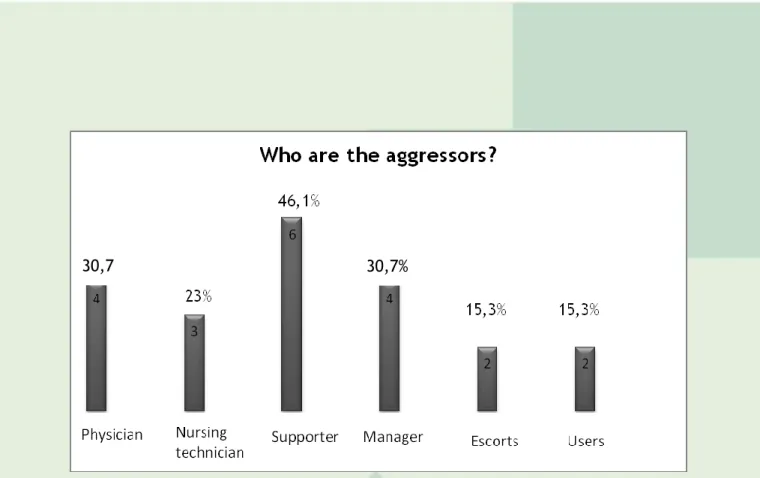
In Figure 2, the research participants told who were the aggressors in bullying situation.
J. res.: fundam. care. online 2015. jan./mar. 7(1):1820-1831
1824
Figure 2: Who are the aggressors? João Pessoa, Brazil, 2013.In Table 1 below, they cite the characteristics of offenders who drew the most attention and that can be decisive to justify the realization of moral harassment.
Table 1: Characteristics of the aggressors. João Pessoa, 2013.
CHARACTERISTICS OF THE OFFENDER. N° %
Person overly stressed 10 100
Is the one who's always right 08 80
Insecure 07 70
Give conflicting orders 06 60
Envious 06 60
Selfish 06 60
Lives counting advantages and does not admit that his colleagues know more than him
05 50
Jaundiced 05 50
Humiliates the subordinates for pleasure 04 40
Requires public to feel respected 04 40
He is always ready to receive compliments, however, if he is criticized, puts the blame on subordinates.
04 40
In Table 2 are indicated actions that offenders committed to the study participants who reported having been victims of bullying.
30,7% 30,7
J. res.: fundam. care. online 2015. jan./mar. 7(1):1820-1831
1825
Tabela 2: Aggressionssufferedin work environment. João Pessoa, 2013.SUFFERED AGGRESSIONS N° %
Criticizes his work unfairly and exaggerated 10 100
Stops when you talk 09 90
Speak with you screaming 08 80
Challenges systematically all your decisions 07 70
Gives confusing and inaccurate statements 07 70
Criticizes you in public 04 40
Does not convey more useful information for performing tasks 03 30
Removes the work normally up to you 03 30
Presses to vindicate their rights (holidays, timetables, awards) 03 30
Assigns tasks below your powers 02 20
Induces you to error 02 20
Circulates mischiefs and slanders about you 02 20
Deprives you of access to phone, fax, computer 01 10
Does not assigns tasks to you 01 10
Ignore your presence 01 10
Regarding the factors those serve as motivation for the practice of bullying has been directed to the harasser, participants highlighted: stress at work - 10 (100%), shortage of human resources - seven (70%), not bend authoritarianism - six (60%), lack of material resources - five (50%), be devoted to work - four (40%), being more competent than the aggressor - three (30%), for which the offender is jealous of you - two (20%).
Regarding the main consequences of bullying, nurses study participants, victims of bullying, noted: stress (92,3%), irritability (84,6%), anxiety (76,9%), fatigue (38,4%), low self-esteem (30,7%) and insomnia (23%).
Bullying is an intentional, sustained and repeated time employment situation in which a person is subject to negative acts, characterized by asymmetry of the relationship and the relative power difference between the victim and no apparent sequelae, except the psychological deterioration of the victim.9 It should be noted that there are international
and national evidence of high rates of prevalence of this phenomenon against nurses. 10-11-12-13-14-15Studies16-17-18point out that such workers are the most vulnerable to situations of
professional bullying in the workplace, due to the development work in isolation of insufficient staffing and inadequate training.19
These considerations are in line with the findings of this study, it was found that ten (33%) nurses reported having experienced such violence. This phenomenon arises from something harmless and progresses insidiously. Initially, people battered lead quarrels and ill-treatment in jest. However, episodes of attacks will multiply and make victims feel cornered, inferiorized and subjected to degrading and hostile actions.20
Regarding the analysis of the frequency and the time that the victims were exposed to these aggressions, five participants (50%) stated that the actions occurred twice a week, and six (60%) pointed out that the episodes lasted between one and two years. Therefore, it
J. res.: fundam. care. online 2015. jan./mar. 7(1):1820-1831
1826
appears that the practice of bullying tends to last a long time , from months to years, and carries significant impacts on the quality of life of the victim , who has just sickening. The study21 highlights that the criterion used as a parameter to define the occurrence of bullying
is at least weekly and at least for six months. However, it is known that the frequency and duration of bullying are very variable and depend on numerous factors.
Regarding the aggressor, according to the chart, the research investigated the assailants nurses were supportive of the Family Health Unit (FHU) (46,1%), the unit physician (30,7%), people municipal health management (30,7%), nursing technician (23%), community health workers (15,3%) and users and their companions (15,3%).
These findings express, emphatically, that the prevalent type of bullying in the study was horizontal. It is worth mentioning that such a practice can be of three types: ascending, when a person of a higher level is attacked by one or more subordinates; horizontal, when an employee is harassed by a colleague of the same rank, and descending type, location more frequent when the person holding the power harasses his subordinate with false accusations and insults, reaching its psychological sphere and thereby maintains its hierarchical position.5 Another study22 adds the mixed type, related to the presence of
vertical stalker, horizontal stalker and the victim.
It is worth noting that hierarchy SUS happens only in bureaucratic level, without, in the workplace, managers or subordination process. It is observed in practice, the overvaluation of a professional rather than others, or excessive charging in professional activities that are outside of its jurisdiction. In this case, bullying is characterized as a false downward, since no subordination, but the abuser insists find that the victim owed him allegiance. This form of violence is often tied to authoritarian labor relations, in which the failure predominates. In such cases transpires distortion of the power of teamwork and collective aggressor, who, afraid of losing control, or the need to demean others to magnify, abuses his right of inspection and review, disrupting the environment work.23
In this light, it is observed that the attackers have different characteristics. According to Table 1, the main characteristics of the offender, in the opinion of the nurses participating in the study were as follows: a person excessively stressed (20%) that is always right (11%), unsafe (10%); envious (9%), biased (7%); humiliates subordinates for pleasure (6%).
The study23 shows that the typical characteristics of the stalker are related to
personality; threats of loss of power and control, leadership and the negative actions as typical - intimidating, frightening, and consuming, emotionally and intellectually, the victim, among others.
It is importantly that the perpetrators are persons who have narcissistic and destructive, unsafe features as their professional competence with paranoid personality, and not admit critical. Act with excessive distrust and suspicion regarding the behavior of others and do not tolerate the success of another.24 This narcissistic abuser wants to
encourage themselves at the expense of the other is a guy who has a grandiose sense of self-importance, believe that it is natural and therefore needs to be admired by colleagues. Thus, it seeks to exploit others in interpersonal relationships, reflecting attitudes and behaviors arrogant.20
J. res.: fundam. care. online 2015. jan./mar. 7(1):1820-1831
1827
The offender is also an intolerant and grumpy person who discharges his colleagues in anxiety and has little ability to cope with everyday diversity; added to it, the fact that you have a wrong idea about yourself and not always overestimate the existing qualities. Excessively employs the envy in their daily activities because you think others are luckier than him, which triggers violence against any victim. Thus, feels morally unspeakable pleasure in destroying the victim and attacks by simple desire to humiliate, because he feels happy to enslave another.25
According to Table 2, the most practiced actions, from the point of view of the nurses participating in the study were critical of the work of unfair and exaggerated (17%); interrupts the victim when he speaks (10%); talks the victim screaming (8%); gives confusing and inaccurate instructions (7%); criticizes the victim in public (4%): remove work that normally is for the victim (3%).
The attacker, whose mind is perverse, incessantly prepares traps for their prey, organizing strategies to destroy it without any shred of morality or blame. Most often, this violence develops sneak in quietly, silently, and disguised way, and most victims of bullying are affected psychologically as they cannot see the damage.1
The study1 points out other modes of practice of this phenomenon, such as:
humiliation, persecution declared or not, embrittlement, refusal to direct communication, isolation, speech impediment, plus more explicit aspects that highlight the problem - exaggerated criticism, determination of time unnecessarily scarce, public ridicule, manipulation of information so as not to be passed in due time, comments in bad taste and spread rumors in the workplace.
Ten nurses enrolled in the study (100%) reported that channeled most attacks from the stress at work, seven (70%) mentioned the shortage of human resources, and six (60%) did not bow to authoritarianism. These findings suggest that the situations experienced bullying betray a lack of respect for nurses, caused often by trivial and personal reasons, which lead to the assumption of administrative and organizational absence.
The research20 highlights that victims of bullying are not people without their own
opinion; are those that lead the offender to feel threatened, whether in office or position within the group. Individuals are usually endowed with responsibility, with a higher level of knowledge to others, with good self-esteem and believe and trust in the people that surround them. It should be noted that these people stand out as productive, which resist authority, who questions and do not conforms to injustices. By having higher skills and qualifications, become easy targets of bullying. These qualities lead the attacker to use all legal means or not, in order to reduce self-esteem and sense of justice, which results in their professional and psychological destruction.26 Success can also turn someone into a
victim, since arouses jealousy, envy, and slander.
With regard to the most common health problems caused by bullying, nurses stressed: stress (92,3%), irritability (84,6%), anxiety (76,9%), fatigue (38,4%); low self-esteem (30,7%) and insomnia (23%). It is noteworthy that many disorders can be caused in the individual victim of bullying and can be psychopathological character - anxiety, depression, cyclothymia and dysthymia. Psychosomatic disorders include physical symptoms - they have a psychic origin or genesis - hypertension, asthma attacks, stomach ulcers,
J. res.: fundam. care. online 2015. jan./mar. 7(1):1820-1831
1828
CONCLUSION
migraine, sprains, lumbago, alopecia, muscle and/or joint pain tensional origin, and stress, among others. Behavioral symptoms translate into aggressive reactions (self or other people's social life) - eating disorders, increased consumption of alcohol and/or drugs, smoking and sexual dysfunction and social isolation.27
In a research conducted with workers victims of bullying there were verified the following consequences: changes in sleep, periods of depression and anxiety, pneumonia, bronchitis crises, crises column, hypothyroidism, low self-esteem, crying spells and lack of interest in life.28In a study in the footwear sector, it was observed that the victims suffered
from depression, loss of appetite, difficulty sleeping, discouragement, disappointment, sorrow, anguish and hopelessness - a set of feelings and symptoms that revealed a traumatic experience of pressure and humiliation.29
It should be stated that there is still not a statistical estimate of how many victims of harassment suffered some kind of consequence on your health. This depends on the duration and intensity of the aggressors' stimuli and idiosyncratic capabilities of each individual, called "predispositions" or "intrinsic factors".27
The consequences of bullying can also be reflected in the organization, with increasing rates of absenteeism, decreased productivity and competitiveness, as well as damage to the company image, as well as economic damages as a result of a court action. It should not forget the damage that is caused in society as a whole by reducing the quality of life, family crises, illness and costs for unemployment.
The data collected in this research lead us to infer that bullying is currently a poorly discussed topic, though it happens a great deal. Nurses, victims of bullying, communicate knowledge of the situation, only to close people or for those who can help them mitigate the conflict or even psychological distress as a result of embarrassing situations caused by the harasser. In this sense, it is emphasized that bullying is not a recent phenomenon, but its occurrence and consequent increased marketing have led scholars to worry about studying the subject.30
Studies on different aspects of bullying represent a growing theme of particular interest to practitioners, particularly those in the field of Nursing. The research in question enabled highlight the presence of the practice of bullying experienced by nurses working in Basic Health Units in the city of João Pessoa, Paraíba, find out who are the Stalkers, identify its characteristics and to verify the consequences of the practice of bullying for that worker health, contributing to further examine factors related to this practice.
Considering the findings of the study, it was observed that a significant number of nurses that referenced were the victim of bullying in the workplace, repetitive and
J. res.: fundam. care. online 2015. jan./mar. 7(1):1820-1831
1829
REFERENCES
systematic way. It was found also that most stalkers consist of supporters, people management and medical staff's own health.
In this sense, it is worth noting the importance of disseminating information about the existence and occurrence of bullying and the drastic consequences that may suffer the victims of this type of psychological distress. Thus, it is essential to have an institutional awareness and individual workers and to promote actions aimed at extinguishing the phenomenon, in order to improve interpersonal relationships in the professional environment.
Nevertheless, particularly in the local scenario, you must perform further investigations to further understand the factors involved in the occurrence of such violence. Thus, it should be noted that this study has limitations, since there is still much to be explored within the theme. However, such gaps may be filled by other research, the results of which may be associated with them.
Given the above, it is expected that this research can support further research about bullying in order to disseminate knowledge on the subject and that knowledge can be used to curb this phenomenon in the workplace of professionals in health, especially in field of nursing.
1. Posener HC. O assédio moral no âmbito acadêmico e suas implicações legais.
WebArtigos[periódico online] 2009; [Citado24 mar 2013] Disponível em:
http://www.webartigos.com/articles/15345/1/Oassedio-moral-no-ambitoacademic
o-e-suas-implicacoes-legais/pagina1.html
2. Cahú GPR. Situações de assédio moral vivenciados por enfermeiros no ambiente de trabalho. [Dissertação] João Pessoa (PB): Programa de Pós-graduação em Enfermagem, Universidade Federal da Paraíba; 2012.
3. Silva MALF. Assédio moral nas relações trabalhistas sob a ótica civil-trabalhista-constitucional. [Dissertação] Campos (RJ): Faculdade de Direito de Campos; 2007.
4. Barros RCLG. A disciplina jurídica do assédio moral na relação de emprego: aspectos configurativos e de reparação deste fenômeno social. [Dissertação] Salvador (BA): Universidade Federal da Bahia; 2009.
5. Thofehrn MB, Amestoy SC, Carvalho KK, Andrade FP, Milbrath VM. Assédio moral no trabalho da enfermagem. RevCogitareEnferm. 2008; 13(4):587-601.
6. Dias HHZR. O “des”cuidado em saúde: a violência visível e invisível no trabalho da enfermagem. [Dissertação] Florianópolis (SC): Universidade Federal de Santa Catarina; 2002.
7. Leite AIT. Assédio moral no âmbito hospitalar: estudo com profissionais de Enfermagem. [Dissertação] João Pessoa (PB): Universidade Federal da Paraíba; 2012.
J. res.: fundam. care. online 2015. jan./mar. 7(1):1820-1831
1830
8. Richardson RJ. Pesquisa social: métodos e técnicas. 1th ed. São Paulo: Atlas; 2008.
9. Topa G, Depolo M, Morales JF. Acoso laboral: metaanálisis y modelo integrador de sus antecedentes y consecuencias. Psicothema. 2007;19(1):88-94.
10. Amnistía Internacional. El Cuidado de losDerechos humanos: Oportunidades y desafíos para elpersonal de enfermería y partería. Madrid (España): Amnistía Internacional; 2006. 11. Kwok R, Law Y, Li K, Ng Y, Cheung M, Fung, V, et al. Prevalence of workplace violence against nurses in Hong Kong. Hong Kong Med J. 2006;12(1):6-9.
12. Woelfle C, McCaffrey R. Nurse on Nurse. NursForum. 2007;42(3):123-31.
13. Oliveira SEM,Mizuguchi SE, Tanji S. O universo desleal na relação entre líder e liderados: perspectiva para o assédio moral. RevNursing. 2007; 10(113):454-9.
14. Barbosa R, Labronici LM, Sarquis LMM, Mantovani MF. Violência psicológica na prática profissional da enfermeira. RevescenfermUSP.2011; 45(1): 26-32.
15. Fontesi KB, Pelloso SM, Carvalho MDB. Tendência dos estudos sobre assédio moral e trabalhadores de enfermagem. RevGaúchaEnferm. 2011; 32 (4): 815-22.
16. Di Martino V. Workplaceviolence in thehealth sector: country case studies (Brazil, Bulgaria, Lebanon, Portugal, South Africa, Thailand, andanadditionalAustralianstudy): synthesis report. Geneva (Suiça): OIT/OMS/CIE/ISP; 2002.
17. Fornés-Vives J. Dos de cada diezenfermeros y enfermeras de lasIslas Baleares se perciben como víctimas de hostigamiento laboral. Baleares: UIB; 2003. [Citado 14 abr
2013]. Disponível em:
http://www.opas.org.br/gentequefazsaude/bvsde/bvsacd/cd49/mobbingcast.pdf
18. Klijn TP, Suazo SV, Moreno MB. Violenciapercibida por trabajadores de atención primaria de salud. CiêncEnferm. 2004; 10(2): 53-65.
19. Costa ALRC. da. As múltiplas formas de violência no trabalho de enfermagem: o cotidiano de trabalho no setor de emergência e urgência clínica em um hospital público [tese].Ribeirão Preto (SP): Escola de Enfermagem de Ribeirão Preto da Universidade de São Paulo; 2005.
20. Campos CJG. Método de análise de conteúdo: ferramenta para analise de dados qualitativos no campo da saúde. RevBrasEnferm. 2004; 57(5):611-4.
21.LeymannH.The
contentanddevelopmentofmobbingatwork.EuropeanJournalofWorkandOrganizationalPsychol ogy. 1996; 5 (2): 165-84.
22. Guedes MN. Terror psicológico no trabalho. São Paulo: LTr, 2003.
23. Hirigoyen MF. Assédio moral: a violência perversa no cotidiano. 12ªed. Rio de Janeiro: Bertrand Brasil; 2008.
24. Marcondes ALN, Dias R. Características do bulliyng como um tipo de assedio moral nas organizações. Rev Pensamento Contemporâneo em Administração. 2011; 11:114-26.
25. Peres RM. A visão do enfermeiro gestor sobre assédio moral no trabalho: uma reflexão bioética. [Dissertação]. Ipiranga (SP): Centro Universitário São Camilo; 2009.
26. Ramos LHD, Grigoletto MVD. Gestão de serviços de saúde. Especialização em Saúde da Família. UNA-SUS [periódico online]. 2010. [Citado 18 mar 2013]. Disponivelem: <http://www.unasus.unifesp.br>.
J. res.: fundam. care. online 2015. jan./mar. 7(1):1820-1831
1831
28. Mikos NRC, Baracat EM. Assédio moral:características e prevenção. Rev Âmbito jurídco[periódico online]. 2011 [Citado 16 jan 2013]. Disponivel em: <http://www.ambito-juridico.com.br/site/index.php?n_link=revista_artigos_leitura&artigo_id=9791>
29. Fortini BW. Assédio moral: o impacto dos valores organizacionais. [Dissertação]. Goiania (GO): Universidade Católica de Goiás; 2009.
30. Rouquayrol MZ. Epidemiologia e Saúde. 4ª ed. Rio de Janeiro: Medsi; 2003.
Received on: 09/01/2014 Required for review: No Approved on: 15/01/2014 Published on: 01/01/2015
Contact of the corresponding author: Alana Franco da Silva Programa de Pós-Graduação em Enfermagem, Centro de Ciências da Saúde, Universidade Federal da Paraíba, Campus Universitário I, Cidade Universitária, João Pessoa (PB), Brasil, 58059.900