J. res.: fundam. care. online 2016. jan./mar. 8(1):3609-3623
3609
A teoria das representações sociais e a qualidade de vida\hiv\aids: revisão integrativa deliteratura
The theory of social representations and quality of life\hiv\aids: Integrative literature review
La teoría de las representaciones sociales y la calidad de vida\vih\sida: revisión integradora de la literatura
Rodrigo Leite Hipolito 1, Denize Cristina de Oliveira 2, Antônio Marcos Tosoli Gomes 3,Tadeu Lessa da
Costa 4
Objective: to draw the profile of scientific productions developed with the theory of social representations
that address the quality of life in the context of people living with HIV/ aids. Method: integrative literature review in 2014 in virtual portals of Capes, Bireme, Bdenf, USP, UFRJ and UERJ. Results: three publications were found available in full online, a summary of a monograph and a thesis in print form and area studies was the predominance of social psychology. Conclusion: it is concluded that the bio-psychosocial consequences leads us to consider the influence of aids on the quality of life and its power of social representation will be built in a newer representation anchored in pre-existing representation of aids.
Descriptors: Quality of life, Aids, Nursing.
Objetivo: delinear o perfil das produções científicas desenvolvidas com a teoria das representações sociais
que contemplam a qualidade de vida no contexto das pessoas que vivem com HIV/Aids. Método: revisão integrativa de literatura, realizada em 2014, nos portais virtuais da Capes, Bireme, Bdenf, USP, UFRJ e UERJ. Resultados: foram encontradas três publicações disponíveis na íntegra online e um resumo de monografia e uma tese na forma impressa. A área de predominância dos estudos foi a da Psicologia Social.
Conclusão: conclui-se que as consequências biopsicossociais deixam evidentes a influência da Aids na
qualidade de vida e a sua representação social poderia constituir-se em uma representação mais nova ancorada na representação pré-existente da Aids. Descritores: Qualidade de vida, Aids, Enfermagem.
Objetivo: definir el perfil de las producciones científicos desarrollados con la teoría de las representaciones
sociales que se ocupan de la calidad de vida en el contexto de las personas que viven con el VIH/sida.
Método: revisión integradora de la literatura en el año 2014 en los portales virtuales de la Capes, Bireme,
Bdenf, USP, UFRJ y UERJ. Resultados: se encontraron tres publicaciones disponibles en su totalidad en línea, un resumen de una monografía y una tesis en forma impresa y los estudios de la zona era el predominio de la psicología social. Conclusión: se concluye que las consecuencias biopsicosociales nos llevan a considerar la influencia del sida en la calidad de vida y su poder de representación social va a estar en una representación más joven anclado en representación preexistente de sida. Descriptores: Calidad de vida, Sida, Enfermería.
1 PhD in Nursing, Nursing School of the University of RJ State ( FENF / UERJ ) ; Adjunct professor of the Nursing College of Universidade Federal Fluminense ( UFF / EEAAC ) Niterói , Rio de Janeiro , Brazil . 2 PhD in Public Health; Teacher of Nursing School of the State University of Rio de Janeiro (UERJ). Professor of Graduate Programs in Nursing and Social Psychology of UERJ - Rio de Janeiro , Brazil. 3 PhD in Nursing; Professor of Nursing School of the State University of Rio de Janeiro (UERJ). Professor of the Graduate Program in Nursing of UERJ - Rio de Janeiro, Brazil. 4 PhD in Social Psychology - IP / UERJ; Adjunct Professor of Nursing and Midwifery Course of the Federal University of Rio de Janeiro (UFRJ), campus Macaé - Rio de Janeiro, Brazil.
J. res.: fundam. care. online 2016. jan./mar. 8(1):3609-3623
3610
he theme involving issues related to aids, due to its current character and expressiveness in the world, remains in the field of studies conducted by researchers from several areas of science and, among them, the nurses and social psychologists. It is known that the infection affects different aspects of quality of life (QOL) of people living in this condition, influencing the biological, physical, psycho-social areas, level of independence, personal beliefs and also economical.1The bio-psychosocial area deserves attention because in many cases, the development of the infection have a moral connotation leading to religious discrimination, stigmatization, abandonment, and rejection by the family. Mental health is affected by the negative reactions on the diagnosis, such as anxiety, fear, sadness, anger, frustration, hopelessness, helplessness, guilt, suicidal and obsessive, stigma, rejection, discrimination and abandonment by family and friends.2
The pandemic in faced with significant numbers in the range of approximately 34 million people living with the virus on the planet being most adults, with 15.7 million women and 2.1 million being under 15 years old.1 In Brazil, it is estimated at 718 thousand individuals with HIV/aids, representing a prevalence rate of 0.4% in the general population observing micro-epidemics as reflections of the cultural plurality and its territorial size.3
The HIV virus is classified as belonging to the retroviridae family (consisting of ARN) and the lentivirinae gender, comprising two serotypes: HIV-1 and HIV-2. The lentiviruses are associated with long periods of incubation and, therefore, they are called as slow virus. They have the ability to infect primarily immune system cells, T CD4+ lymphocytes (also called auxiliaries) and macrophages, and preferentially attacking the immune system and the central nervous system. Given this, the molecule CD4+ acts as a cell invasion, since it acts as a receptor for the virus.4
To study and analyze the QOL in the context of HIV/Aids have been one of the goals of the World Health Organization (WHO). The character of chronicity of Aids, assigned as a result of scientific advances of the last decade, prolonged survival and reduced the mortality of people and since then, the impacts on quality of life of this group are goals of long-term studies aimed at understanding their needs and what can be done to contribute positively in their lives.5
In this perspective, the quality of life construct comes raising great interest, consonant with the new paradigms that have guided health practices.6
Although there is no consensus on the definition of QOL, the World Health Organization group (WHO) that study about quality of life, conceptualized it broadly as “the individuals´
J. res.: fundam. care. online 2016. jan./mar. 8(1):3609-3623
3611
perception of their position in life in the context of culture and value system in which they live in relation to their goals, expectations, standards and concerns.”7:1403The TSR have been the focus of interest of researchers in the health field since the 90s with the impulse of psychosocial oriented investigations addressing the problem of HIV/Aids and this fact demonstrates recognition of the contribution of theory at the unveiling of the constituent elements of social thought.8
Understanding the social representation of QOL for people living with the aids virus means to contribute while theoretical-methodological set, in understanding how groups absorb and mold their subjective world in social relations.9
According to Jodelet,10 the Social Representation (SR), is a form of social knowledge that generalizes as common sense, which form a general and functional knowledge to people, serving to the mental activity of groups and individuals can relate to situations, events, objects and communications that concern them. The mediation which causes this to happen is through the concrete context in which these people and groups live, and also acquired culture throughout history, in addition to the values, codes and their ideas of a particular social group. The symbolic change attributed to aids object has been transformed over the past three decades and what once was associated with the idea of “fear and death” already points out in recent studies that such representation is more positive in people who have the virus with a tendency towards replacement of this idea by the word “life”.11-12 The study object of this work refers to productions (Dissertations/Theses/articles) published in virtual portals of Capes, using as a theoretical approach to the theory of social representations in the area of quality of life of people living with HIV/Aids.
It is increasingly necessary for a greater number of researchers to guide their works searching for models and methods that allow understanding the human behavior, in their complexity, understanding about their cognitive, emotional, symbolic and imaginary dimensions.13
Bringing together articles and material of dissertations and theses in the timeframe of 2000 to 2013, this study aims at drawing the profile of scientific productions developed with the theory of social representations (TSR) covering the quality of life (QOL) in the context of people living with HIV/Aids (PLWHA).
J. res.: fundam. care. online 2016. jan./mar. 8(1):3609-3623
3612
The integrative literature review was used (ILR), since it enables decision-making and quality for clinical practice, considering the research synthesis of results about a particular subject, systematically and orderly, contributing to a greater depth of knowledge of the topic investigated and even having as a characteristic the search exhaust of studies with the inclusion of material published and unpublished material.14The integrative literature review is also one of the search methods used in Practice Based on Evidence (PBE) which allows the incorporation of evidence into clinical practice. This method aims to gather and synthesize research findings about a bounded topic or issue, systematically and orderly, contributing to the deepening knowledge of the topic investigated.15
The first step included the choice of the guiding question: what are the relevant records in scientific publications on the quality of life of people living with HIV/Aids in the area of the Theory of Social Representations. In the second step, the inclusion criteria used were the simultaneous presentation of words “Aids” and social representation/social representations and quality of life or their synonyms in Spanish (quality of life, la calidad de vida, aids, sida, representación social, representaciones sociales) in the contents of their abstracts, given the absence of all standardized terms in the vocabulary Health Sciences descriptors (DeCS), which reflects the interest in this review. In this process, and with the objective of the study, publications that did not possess full text or abstract available were excluded. The data were collected during the months of November 2013 to January 2014 in virtual portals of the Coordenação de aperfeiçoamento de pessoal de nível superior (Capes), in the Latin American and Caribbean Center on health sciences information (Bireme), in the database of nursing (Bdenf), in the library of theses and dissertations of the University of São Paulo (USP), as well as, in the libraries of the Fluminense Federal University (UFRJ) and the State University of Rio de Janeiro (UERJ), in published works in the timeframe of 2000 and 2013.
In the third step, the information to be extracted from selected works were defined. The data were collected through a form produced by the authors, with the objective of guaranteeing the review development with methodological rigor. The information extracted from studies included content related to: identify the dissertation and/or thesis (title, year of defense, place, and keywords); identification of researchers (profession, area of expertise and entitling) and identification of research (research techniques for data production, subject, objectives, results and conclusions).
The fourth step was about the assessment of studies included in the IRL. This step is equivalent to the data analysis performed on a conventional research. In the case of IRL, analytical reading was initially applied ordering the sources information, allowing for obtaining answers to the problem, followed by interpretative reading related to what the
J. res.: fundam. care. online 2016. jan./mar. 8(1):3609-3623
3613
author states as possible solutions. The material was organized by similarity of content. In the fifth step the interpretation of results was held. To the discussion step of the results obtained in the research, a comparison to theoretical knowledge about the subject was performed. The results were discussed based on the authors, whose production was shown relevant to the analysis of the object of study in screen. In this IRL, the identification of the evidence level of the selected articles was considered in all of them, the use of the Theory of Social Representation, a qualitative approach, which implies the level of evidence four, according to Agency for Healthcare Research and Quality (AHRQ).16 Thus, it was sought to point out the following levels of evidence: level 1 - evidence resulting from meta-analysis of multiple randomized controlled studies; level 2 - evidence of individual studies with experimental design; level 3 – evidence of almost-experimental studies, time series or case-control; level 4 – evidence from descriptive studies (non-experimental or qualitative approach); level 5 - evidence case reports or experience; level 6 - evidence based on opinions of expert committees, including interpretations of information based on research, regulatory or legal opinions.Finally, the sixth step was the presentation of the review/knowledge synthesis, consisting in the grouping of the main results highlighted in the analysis of the studies involved.
After searching articles indexed in the bases of the Coordenação de aperfeiçoamento de pessoal de nível superior (Capes) portal and abstracts available online, every national and Latin American publications whose title or abstract made reference to “quality of life, social representation/social representations and HIV/Aids” were selected. After the location of these works readings for analysis of content found were done.
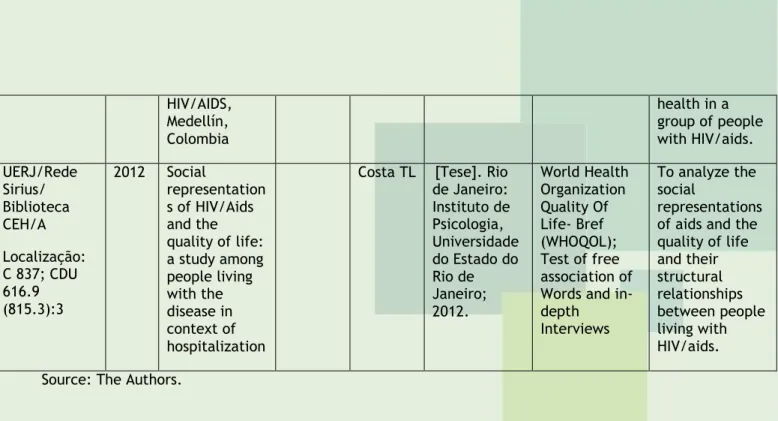
Based on these criteria, the search obtained results little quantitative when compared to clinical studies based on evidences and experimental nature in the field of HIV/Aids published in the last decade. The search revealed that only five studies were produced in the last decade (Table 1). After reading the interpretive works selected, data were analyzed according to the following variables: knowledge area, country of publication, type of study, field of study, study subjects, collection data instrument used. The processing and presentation of data was decoded in a text and discussed in a critical-reflexive way, articulating the thought with the authors of expression in the areas of knowledge, whose production demonstrated relevance for the interpretation of the themes highlighted.
The low number of articles found can encourage researchers and professionals in the field, to investigate more about the subject, or publish their actions in relation to this theme.
J. res.: fundam. care. online 2016. jan./mar. 8(1):3609-3623
3614
The low scientific production “hinders the dissemination of successful experiences, which could be repeated or at least subsidize new strategies in other places.”17:98Three publications available in full on-line in databases and periodicals of the Coordenação de Aperfeiçoamento de Pessoal de Nível Superior (CAPES) and in the Public Domain (Library, archive staff), a monograph abstract (not published) and a thesis in printed form were found. The area of study was the predominance of social psychology with three works, followed by an article in public health and other medical sciences. Figure 1 analysis revealed two articles on the base of Lilacs and Scielo having been published in the following magazines: Brazilian Journal of sexually transmitted diseases, Studies of psychology and, finally, the magazine of public health of Bogotá.
Figure 1 – Methodological characteristics of the studies about quality of life in the field of the theory of social representations in Graduate programs and in databases/CAPES, Rio de Janeiro, 2014
Origin Year publication Title of Authors Journal collection Data Instrument Objectives Index Psi - Teses (Brasil) ID: 31820 \ Biblioteca responsável: BR85.1 - Localização: BR8.1; 316.6(043), C346q 2005 Quality of life in the context of seropositivity for hiv: a study of social representations Castanha
AR João Pessoa: [Dissertação] Universidade Federal da Paraíba; 2005. (não publicada) World Health Organization Quality Of Life- Bref (WHOQOL); Test of free association of Words and in-depth Interviews. To assess the QOL of people with HIV; to identify the influence of socio-demographic and clinical variables in QOL and to understand the SR about aids and quality of life. Lilacs 2006 Bio-Psychosocial consequences of Aids on quality of life of people with HIV Castanha AR, Coutinho MPL, Saldanha AAW, Oliveira JSC DST J bras doenças sex transm. 2006;18(2):1 00-7 Semi-structure interview To evaluate the biopsychosocial consequences of aids in quality of life anchored in the theory of social representations. Scielo 2007 Evaluation of quality of life in people with HIV Castanha AR, Coutinho MPL, Saldanha AAW, Ribeiro C G Estud psicol. 2007 jan-mar. 24(1): 23-31 Test of free Association of Words. Evaluate the perception of Acquired Immunodeficien cy Syndrome and the quality of life for HIV positive for the Human Immunodeficien cy Virus. Lilacs 2010 Social representation s of quality of life related to health in people with Cardona -Arias JA Rev Salud Publica. 2010 oct; 12(5): 765-76 Semi-structured interviews. To understand the social representations about the quality of life related to
J. res.: fundam. care. online 2016. jan./mar. 8(1):3609-3623
3615
HIV/AIDS, Medellín, Colombia health in a group of people with HIV/aids. UERJ/Rede Sirius/ Biblioteca CEH/A Localização: C 837; CDU 616.9 (815.3):3 2012 Social representation s of HIV/Aids and the quality of life: a study among people living with the disease in context of hospitalizationCosta TL [Tese]. Rio de Janeiro: Instituto de Psicologia, Universidade do Estado do Rio de Janeiro; 2012. World Health Organization Quality Of Life- Bref (WHOQOL); Test of free association of Words and in-depth Interviews
To analyze the social
representations of aids and the quality of life and their structural relationships between people living with HIV/aids. Source: The Authors.
As regards the timeframe, there were publications in 2006, 2007 and 2010. Among Graduate Programs (GP) selected, there is the psychology highlighted with a monograph in 2005 by the Federal University of Paraíba (UFPB) and a thesis in 2012 by the State University of Rio de Janeiro (UERJ). Four studies were found in Brazil and one in Colombia. They were classified as exploratory and descriptive research and the research field of studies showed a predominance in the services specialize in aids treatment, but however it was also evidenced the hospital and one of the studies was developed in a non-governmental organization. The subjects of the studies were selected by random sampling in the adult age range above 18 years old and have accused as higher percentage amount the category referring to male.
On the methodological aspect there was a predominance of the use of semi-structured interviews as a technique for data collection, but the methodology of the WHOQOL-HIV-Bref used together with the technique of free evocations. The WHOQOL-HIV-Bref questionnaire is a specific instrument to evaluate aspects of people´s lives who live with the virus. This instrument, scientifically substantiated, avoids an assessment based only on criteria associated with the clinical components of HIV infection, valuing also the psychosocial dimensions, central to infected people's lives.18
In the calculation of the data using the thematic analysis of Bardin, followed by the use of some software, SPSS 17.0 (statistical analysis), Tri-Deux-Mots, as well as, the EVOC 2005 and ALCESTE 4.7, all are programs that allow quantitative analysis of data from the lexicographic study.
From Figure 2 it is possible to check how the researchers analyzed reports about the quality of life, the consequences in several segments of their lives coming of their current condition and their social representations. It was proceeded to the classification of the level of evidence as already mentioned in classification methods16.
J. res.: fundam. care. online 2016. jan./mar. 8(1):3609-3623
3616
Research title Content synthesis Level of evidence
Bio-Psychosocial consequences of Aids on quality of life of people with HIV
It evaluated 26 HIV-positive
individuals and it concluded that the bio-psychosocial consequences of aids on quality of life are diverse,
including physical-organic, the psycho-affective and the behavioral.
4 C
Evaluation of quality of life in
people with HIV It assessed the social representation of Acquired Immunodeficiency Syndrome in 91 subject as being a disease that can bring psychosocial consequences, professionals and organic. The quality of life was represented in subjective elements and objectives covering domains present in the concept of QOL of the WHO.
4 A
Social representations of quality of life related to health in people with HIV/AIDS, Medellín, Colombia
It aimed to understand the social representations about the quality of life related to health in a group of 19 people with HIV/aids. For the
subjects of the study the therapy with the use of ART is decisive in QOL, as well as, the maintenance of a healthy lifestyle, including good health practices, have good food, avoiding drug use, avoiding stressful situations like the fear of the future and of death. The SR of QOL was perceived as multidimensional and such knowledge is crucial in improving disease prevention and strategies for health education programs.
4 C
Source: The Authors.
The bio-psychosocial consequences show the influence of aids on quality of life of people with HIV, revealing, in this way, the importance of their analysis in the context of life of this group. The most prevalent upon the publications found are19-21: physical-organic consequences; the psycho-affective as prejudice, depression, self-esteem and self-perception and behavioral consequences as insulation and aspects of sexuality.
In research on the National territory, quality of life was also represented19-21 objectively and subjectively, respectively. The group of men was associated with the work and support from the friendship, while in the women´s group, was associated to love, happiness and the figure of God, from the belief of religiosity. In other studies by the same authors, besides the aspects described above, there is also the relationship between self-esteem and depression. It should be noted that this data established a nexus with the concept of QOL of PLWHA created by the World Health Organization.
The only study found on the international scenario was held in the city of Medellín-Colombia. For the investigation participants,22 therapy with the use of antiretroviral drugs (ART) is crucial in QOL, as well as the maintenance of a healthy lifestyle. In the biological field, there is an important number of participants considered symptomatic antiretroviral therapy as a determinant of QOL while asymptomatic pointed out that the use of drugs affects their QOL depending on the secondary side effects and also by leaving them in a situation of
J. res.: fundam. care. online 2016. jan./mar. 8(1):3609-3623
3617
possible exposure before the social cycle and at work. In the psychological domain, the initial impact with the discovery of seropositive is evident on the verbalization of feelings of hopelessness and disappointment with the priorities of their life projects affected by the ideas of death and the consequent fear of the future. With the passage of time, there is an adaptation to this new reality by taking a more optimistic stance. In the social domain, the SR are in the family and friends with the persistence of discriminatory as the symbolic systems that relate to the practice of sex infection among HSH, drug users and sex workers.22To accept the new reality and in an attempt to give meaning to the life project, the author22 highlights the need for a good level of information, because he removes the myth that aids is synonymous with death, improving medical recommendations, rethinking stigmata, concepts and prejudices that exist around imaginary of the infection. In short, for the author, the SR of QOL was perceived as multidimensional and such knowledge is crucial in improving disease prevention and strategies for health education programs.
From the studies20.23 that used the WHOQOL-HIV-bref methodology in its shortened version, the thesis of Costa23 is highlighted for being a pioneer in investigations of this nature in more remote regions geographically within the State of Rio de Janeiro. It is worth noting that in an attempt to correct the distortions in the QOL ratings in the world, the WHO strives in the construction of specific instruments and WHOQOL and possess their onw evaluation syntax.24 The results of this research identified intermediaries multidimensional levels, with worse perception about the domain environment and statistical differences in social, economic and clinic variables. The other study selected25 showed that, in general, the quantitative evaluation of QOL was regarded as being positive, with highest score in Psychological and Social domains, and lowest in Physical and Environmental domains.
As regards the structural configuration of the social representation of the quality of life of people living with HIV/aids, the author23 observed in his studies the presence of no likely central core, initially, of themes about family, treatment, medications, good diet and work, having in the peripheral system, the first periphery, the cognition prejudice. However, the analysis of similarity by the maximum tree allowed considering the latter as an equal and probably central.
Thus, a constitution was obtained so that the central system of the SR of aids and the quality of life was crossed by the same topics, except for good nutrition for cognition and work, in the case of this last one. This empirical characterization might be evidenced, also, through the statistical test among the corpora of analysis for both representational objects concerned.23 This finding showed as adherent to the theoretical assumptions of authors in the field of structural approach of TSR, regarding the possibility that the second social object on the screen can maintain a relationship with the first coordinate type in conjunction, more specifically, the embedded type, configuring, in other words, a dependency interaction or non-autonomy SR of the QOL.
Such characterization according to the conclusions of the study23 allowed considering that the SR of the QOL could be in a newer representation in the context of the group analyzed. In this way, developed from the anchoring in the SR pre-existing of aids, possible process as the discovery of the possibility of co-existence with the infection in a healthy way,
J. res.: fundam. care. online 2016. jan./mar. 8(1):3609-3623
3618
as evidenced by the fact that most subjects do not have considered sick and perceive asymptomatic with the disease.The approach of the quality of life in academic studies with carriers of the disease becomes more evident shortly after the introduction of the drug therapy, especially of Active Antiretroviral Therapy (AART) in 1996. From then on, in Brazil, it was not only possible the increased survival of these people, but also resulted in changes to the symbolic plan related. It began a progressive displacement of the idea of death and fatal disease as a central aspect and organizer of social representations about aids and the insertion of cognitions associated with the possibility of co-existence with it, as the treatment.17
Access to policies, the changes in society, advances in pharmacological therapies and studies of the bio-psychosocial field are bringing benefits to this population. Representational changes are happening slowly, but it is already a reality in the topic of HIV\aids.11
The evidence found in the five selected studies validated researchers and subjects that the individual characteristics of the infection process, converge on necessity and increasingly widespread, to evaluate the quality of life. This importance is due mainly to the nature of their own situation, characterized by unpredictability and by multiple recurrences,25 beyond the need to monitor the effects of the treatments on the welfare of individuals infected.26
The studies highlighted that such a condition could lead to demonstrations in various fields and that interfere with the quality of life of these people and, sometimes, the presence of a simple physical fatigue affect day-to-day activities. Besides the physiological field demonstrations, there is also the psychological and social difficulties of living with HIV/aids, as has already been presented and that seems to be the most influential factor in the opinion of those people. This difficulty is expressed by the perceptions of prejudice that appear in the attitudes of other people, generating a discomfort that happens to be feeling and sometimes generated by the closest people, as children and relatives.19.27
The representations related to prejudice deserves emphasis because those people are often isolated from living with others despite the extensive knowledge that currently has about the forms of transmission of the disease, which is quite alarming, since the social conviviality is essential for the configuration of supporting.19-21 It can say that the element of bias is one of the main triggers of depressive symptoms in the context of aids since it implies abandonment, segregation, stigmatization and rupture in personal relationships when the support becomes invaluable.
In one of the studies selected, aids was anchored in psycho-affective diseases, particularly on depression, which confirms the high rate of prevalence of depressive symptomatology found in these groups.20 Thus, social representations seized on studies which cover biological and psychosocial aspects are very important for the authors of this IRL, revealing a similarity with scientific knowledge as regards the themes of aids and depression. It is noticed that there is a strong connection between them through the emergence of the next elements such as elements of desperation, fear, distress, disease and death.
Some data suggest that the diagnosis of aids help the people to define what is important for themselves. The reflection on the meaning of life and the good use of the time
J. res.: fundam. care. online 2016. jan./mar. 8(1):3609-3623
3619
favors the subjective experience of QOL of patients is better than before the disease, when only the physical and social functions were prioritized.28With regard to incidence and corroborating with the data found in selected studies, currently in Brazil, there are still more cases of the disease among men. Considering the accumulated data from 1980 to June 2013, a total of 445,197 (64.9%) being male and 241,223 (35.1%) female were notified in the Information System of Reportable diseases (SINAN), declared in the Mortality Information System (SIM) and registered in the Control System of Laboratory Tests/Logistic Control System of Medicines (SISCEL/SICLON).29 In 2010, the ratio of genders reached 1.7 cases in men for every 1 in women and in 2012 this same ratio was 1.4. The age range in which aids is more incident, in both genders is 25 to 49 years old.29
Despite the search does not have identified subjects as children, adolescents and the group of HIV-positive people with more than 60 years old, it is important to correlate that studies in these age ranges are justified on the basis of the change in the epidemiological profile. The Pediatric Aids brought a new rendition of Pathology due to insertion of a new seropositive client in its context, since there is a reduction in the process of guilt in the wearer.30 Between 1998 and 2013, we also observed an increase in the incidence rate of aids cases in the age group of 05 to 12 years old; from 50 to 59 and 60 years old or more.3.29 It is highlighted that in the group of adolescents is common to have representations that do not match with their practices, it is believed that the distances of the teaching models and the way in which relevant information are passed on to society require constant usages in their languages. Thus, it is up to the researchers to think how much this disarticulation between representations and practices can influence the perception of quality of life.
Another dimension that deserves to be placed in discussion is the world trend of studies to investigate the spirituality as positive predictive factor and influencer of the QOL-related aspects. The spirituality31 has close relationship with the improvement of the quality of life of patients with chronic diseases. Another author32 pointed to the significant correlation between the domains of quality of life and spiritual well-being. There are already published reports demonstrating that the use of new therapies with the antiretroviral drugs alone, will not impact on QOL in the psychosocial field.19.21
This IRL brings up questions concerning the feminization of aids in Brazil, because, it was noticed that the participation of women in the research was expressive and through this the authors highlighted that in Brazil this process was faster compared to any other party in the world bringing profound implications for the lives of women in the various stages of their life cycle.33
When it comes to investigate representations of the quality of life of people living with HIV/aids, it is important in improve the processes by which the subjects appropriate to build their SR.34 These processes can be cognitive, emotional nature, and relying on a life experience.35
The vast field of Social Representations Theory despite not having been exploited in all its approaches in selected studies, additionally, from the latest inferences authors of the structural approach of social representations, became tangible cogitate on the hypothesis that older social representation, in this case, the aids can influence in the selection process and decontextualization of available information about object characterized as newer, the
J. res.: fundam. care. online 2016. jan./mar. 8(1):3609-3623
3620
quality of life. It would be this aspect, therefore, a modulation in objectification or setting of the iconic dimension of social representation.23Finally, considering the approach of pertinent realities being still little explored in the research area, the authors of this IRL agrees with one of the researchers23 that when discussing the anchoring process based on Vala,36 he notes that by supporting a new object in a previous scheme, the incorporation of the first cognitive occurs more easily, but there are also implications for the second with possible transformations and in the midst of all these issues is reasonable thinking on the ability of interaction between these social representations which can generate possible changes probably more positive about modes of building socially prepared and shared of aids and vice versa.
It was possible to achieve the objective proposed in this IRL, checking from the analysis of the studies that quality of life suffers the influence of various aspects of everyday life. Thus, characteristics of each individual, as the cultural and social support, may influence the way they are perceived and internalized the events.
The measurement of QOL is essential for the evaluation of treatment strategies and cost/benefit, becoming important tool to direct the distribution of resources and the implementation of programs that can favor not only the physical aspects of the clients, but also those related to psychological and social dimensions.37
It is important to understand the meaning of the SR of QOL because it represents a significant step in the changes of social practices, to the extent that the speech, representation and practice are mutually generated.11
It is concluded before the exposed that in Brazil with a care policy to the carrier of the virus is understood as a model for several other nations in the world should be considered the permanence of investment in research in general and more specifically in studies on how the quality of life is configured among people living with HIV/aids using for that reflections not only in the field of structural approach but also in others like the processual10, by worrying centrally with the construction of the representation, its genesis and its processes of elaboration.
J. res.: fundam. care. online 2016. jan./mar. 8(1):3609-3623
3621
1. Joint United Nations Programme on HIV/AIDS (UNAIDS) A. Dados do Relatório Global sobre a epidemia de Aids no mundo. Brasília(DF). [acesso em 2014 jan 01]. Disponível em: http://www.unaids.org.br/ 2012.2. Arrivillaga M, Correa D, Salazar I. Psicología de la salud: abordaje integral de la enfermedad crónica. Bogotá: Manual Moderno; 2007.
3. Ministério da Saúde (Br). Secretaria de Vigilância em Saúde - Departamento de DST, Aids e Hepatites Virais. Boletim Epidemiológico - Aids e DST Ano II - nº 1 - até semana epidemiológica 26ª - dezembro de 2013 Brasília(DF): MS; 2013.
4. Cunico W, Gomes CR, Velasco Junior WT. HIV: recentes avanços na pesquisa de fármacos. Quim Nova. 2008; 31(8): 2111-7.
5. Reis RK, Santos CB, Dantas RAS, Gir E. Qualidade de vida, aspectos sociodemográficos e de sexualidade de pessoas vivendo com HIV/AIDS. Texto Contexto Enferm. 2011; 20(3): 565-75. 6. Seidl EMF, Zannon C, Tróccoli BT. Pessoas vivendo com HIV/AIDS: enfrentamento, suporte social e qualidade de vida. Psicol reflex crit. 2005; 18(2): 188-95.
7. The WHOQOL Group 1995. The World Health Organization quality of life assessment (WHOQOL): position paper from the World Health Organization. Social Science and Medicine. 1995; 10(1): 1403-09.
8. Oliveira DC, Costa TL, Gomes AMT, Acioli S, Formozo GA, Heringer A, et al. A produção de conhecimento sobre HIV/AIDS no campo da teoria de representações sociais em 25 anos da epidemia. Rev eletrônica enferm. 2009; 9:3.
9. Ferreira SRS, Brum JLR. As representações sociais e suas contribuições no campo da saúde. Rev gaúch Enferm. 2000; 21(n. esp.): 5-14.
10. Jodelet D. Representações sociais: um domínio em expansão. In: Jodelet D, organizador. As representações sociais. Rio de Janeiro: EDUERJ; 2001. p. 17-44.
11. Oltramari L. Um esboço sobre as representações sociais da aids nos estudos produzidos no Brasil. Cad pesq interdiscip ciênc hum. 2008 june [acesso em 2014 jan 10]; 4(45): 2-17. Disponível em: http://www.journal.ufsc.br/index.php/cadernosdepesquisa/article/view/1948.
12. Gomes AMT, Silva EMP, De Oliveira DC. Representações sociais da AIDS para pessoas que vivem com HIV e suas interfaces cotidianas. Rev latino-am enferm. 2011; 19(3): 485-92.
13. Jodelet D, Madeira M. Aids e representações sociais: à busca de sentidos. Natal: EdUFRN; 1998. p. 121-54.
14. Santos I, Silva LA. Vulnerability of hiv/aids in patients with mental disorders: an integrative review. Online braz j nurs [Internet]. 2013 June [acesso em 2013 dez 20]; 12 (2): 393-410. Disponível em: http://www.objnursing.uff.br/index.php/nursing/article/view/3868.
15. Roman AR, Friedlander MR. Revisão integrativa de pesquisa aplicada à enfermagem. Cogitare Enferm. 1998 Jul-Dez; 3(2):109-12.
16. Oliveira LMAC, Munari DB, Medeiros M, Brasil VV. Análise da produção científica brasileira sobre intervenções de enfermagem com a família de pacientes. Acta sci Health sci [periódico na
J. res.: fundam. care. online 2016. jan./mar. 8(1):3609-3623
3622
Internet]. 2005 [acesso em 2014 dez 08]; 27(2):[aproximadamente 9 p.]. Disponível em http://www.periodicos.uem.br/ojs/index.php/ActaSciHealthSci/article/view/1373/78317. Organização Mundial da Saúde. Departamento de Saúde Mental e Dependência Química.
WHOQOL-HIV BREF: versão em Português. Genebra; 2002.
18. Mendes KDS, Silveira RCdCP, Galvão CM. Integrative literature review: a research method to incorporate evidence in health care and nursing. Texto e contexto Enferm [Internet] 2008
[acesso em 2014 jan 05]; 17(4): 758-64. Disponível em:
http://www.scielo.br/pdf/tce/v17n4/18.pdf.
19. Castanha AR, Coutinho MPL, Saldanha AAW, Oliveira JSC. Consequências biopsicossociais da Aids na qualidade de vida de pessoas soropositivas para o HIV. DST J bras doenças sex transm. 2006; 18(2): 100-7.
20. Castanha AR. A qualidade de vida no contexto da soropositividade para o HIV: um estudo das representações sociais [dissertação].João Pessoa(PB): Universidade Federal da Paraíba; 2005. 21. Castanha AR, Coutinho MPL, Saldanha AAW, Ribeiro CG. Life quality evaluation in HIV serum-positive individuals. Estud Psicol. 2007; 24(1): 23-31.
22. Cardona-Arias JA. Representaciones sociales de calidad de vida relacionada con la salud en personas con VIH/SIDA, Medellín, Colombia. Rev Salud Publica. 2010 [acesso em 2013 dez 20]; 12(5): 765-76. Disponível em: http://www.scielosp.org/scielo.php?script=sci_arttext&pid=S0124-00642010000500007.
23. Costa TLD. Representações sociais do HIV/Aids e da qualidade de vida: um estudo entre pessoas que vivem com o agravo em contexto de interiorização [tese]. Rio de Janeiro (RJ): Instituto de Psicologia, Universidade do Estado do Rio de Janeiro; 2012.
24. Zimpel R, Fleck MPA. Quality of life in HIV-positive Brazilians: application and validation of the WHOQOL-HIV, Brazilian version. AIDS care. 2007; 19: 923-30.
25. Remple VP, Hilton BA, Ratner PA, Burdge DR. Psychometric assessment of the Multidimensional Quality of Life Questionnaire for Persons with HIV/AIDS (MQOL- HIV) in a sample of HIV-infected women. Qual life res. 2004; 13: 947-57.
26. Bing EG, Hays RD, Jacobson LP, Chen B, Gange SJ, Kass NE, et al. (2000). Health- related quality of life among people with HIV disease: results from the Multicenter AIDS Cohort Study. Qual life res. 9: 55-63.
27. Meirelles BHS, Silva DMG, Vieira FMA, Souza SS, Coelho IZ, Batista R. Percepções da qualidade de vida de pessoas com HIV/Aids. Rev Rene. 2010; 11(3): 68-76.
28. Holzemer WL, Gygax Spicer J, Skodol Wilson H, Kemppainen JK, Coleman C. Validation of the quality of life scale: living with HIV. J adv nurs. 2001; 28(3): 622-30.
29. Ministério da Saúde (Br). Secretaria de Vigilância em Saúde. Departamento de DST, Aids e Hepatites Virais. Boletim Epidemiológico - Aids e DST Ano II - nº 1 - até semana epidemiológica 26ª - dezembro de 2013 Brasília(DF); 2013.
30. Félix FO, Barvosa BFS, Gomes AMT, Oliveira DC, Oliveira CC. As representações sociais da criança soropositiva: uma análise do pensamento social de enfermeiros hospitalares. R pesq: cuid fundam online 2010 out-dez. 2(Ed. Supl.): 797-800.
31. Volcan SMA, Sousa PLR, Mari JJ, Horta BL. Relação entre bem-estar espiritual e transtornos psiquiátricos menores: estudo transversal. Rev saúde pública. 2003; 37(4): 440-5.
32. Calvetti PU, Muller MC, Nunes MLT. Qualidade de vida e bem-estar espiritual em pessoas vivendo com hiv/aids. Psicol estud. 2008; 13(3): 523-30.
J. res.: fundam. care. online 2016. jan./mar. 8(1):3609-3623
3623
33. Oliveira DC, Costa TL, Gomes AMT, Acioli S, Formozo GA, Heringer A, et al. Análise da produção de conhecimento sobre o HIV/AIDS em resumos de artigos em periódicos brasileiros de enfermagem, no período de 1980 a 2005. Texto Contexto Enferm. 2006; 15(4): 654-62.34. Jodelet D. O movimento de retorno ao sujeito e a abordagem das representações sociais. Sociedade e estado. 2009; 24(3): 679-712.
35. Jodelet DV. Place de l’expérience vécue dans les processus de formation des représentations sociales. In: Haas V. Les savoirs du quotidien. France: PUR; 2006.
36. Vala J. Representações sociais e psicologia social do conhecimento do quotidiano. In: Vala J, Monteiro M, editores. Psicologia Social. Lisboa: Fundação Calouste Gulbenkian; 2002. p.457-502.
37. Martins JT, Garanhani ML, Robazzi MLC, Santos WC. Significados de qualidade de vida para mulheres convivendo com AIDS. Rev gaúch enferm. 2008; 29(4): 619-25.
Received on: 01/03/2014 Required for review: No Approved on: 01/09/2014 Published on: 07/01/2016
Contact of the corresponding author: Rodrigo Leite Hipolito R. Dr. Celestino, 74, Niterói – RJ CEP: 24020-091,Telefone:(21) 2629-9484