R
R
R
E
E
E
V
V
V
I
I
I
S
S
S
Ã
Ã
Ã
O
O
O
R. pes.: cuid. fundam. online 2013. dec., 5(5):111-21
111
The systematization of nursing care for children who are victims of bullying A sistematização da assistência de enfermagem em crianças vítimas de bullying
La sistematización de los cuidados de enfermería para los niños que son víctimas de acoso escolar
Kisna Yasmin Andrade Alves1, Pétala Tuani Candido de Oliveira Salvador2, Cilene Nunes Dantas3, Rodrigo Assis Neves Dantas4
Objective: the objective is to characterize the profile of child victims / targets of bullying, as well as perform the same SAE, using both the Diagnostics and Nursing Intervention CIPESC® resulting from the experience of Curitiba. Method: This is a reflective study, funded by research in databases BDENF, LILACS, SciELO and MEDLINE and other sources. We used the descriptors bullying; nursing process, public health nursing, professional practice and primary health care. Results: Were defined four diagnoses and thirty-eight interventions, all guided by the recommendations of this International Classification of Nursing Practice in Collective Health. Conclusion: it is understood that the SAE, articulated the CIPESC® is an invaluable tool for the professional nurse since strengthened its autonomy, nursing as a science and, above all, allows the consolidation of resolutive shares. Descriptors: Bullying, Nursing process, Public health nursing, Professional practice, Primary health care.
Objetivo: objetiva-se caracterizar o perfil das crianças vítimas/alvos de bullying, bem como realizar a SAE das mesmas, utilizando para tanto os Diagnósticos e Intervenções de Enfermagem da CIPESC® resultantes da
experiência de Curitiba. Método: trata-se de um estudo reflexivo, subsidiado pela pesquisa nas bases de dados BDENF, LILACS, SciELO e MEDLINE, bem como outras fontes. Utilizou-se os descritores bullying; processos de enfermagem; enfermagem em saúde pública; prática profissional; e atenção primária à saúde. Resultados: definiram-se quatro diagnósticos e trinta e oito intervenções, todas pautadas nas recomendações dessa Classificação Internacional de Práticas de Enfermagem em Saúde Coletiva. Conclusão: compreende-se que a SAE, articulada a CIPESC® constitui uma ferramenta de grande valia para o profissional enfermeiro, já que reforça a sua autonomia, a Enfermagem como ciência e, acima de tudo, permite a consolidação de ações resolutivas. Descritores: Bullying, Processos de enfermagem, Enfermagem em saúde pública, Prática profissional, Atenção primária à saúde.
Objetivo: el objetivo es caracterizar el perfil de los niños víctimas / objetivos de intimidación, así como realizar el mismo SAE, utilizando tanto los diagnósticos y las intervenciones de enfermería CIPESC® resultante de la experiencia de Curitiba. Método: Se realizó un estudio reflexivo, financiado por la investigación en bases de datos BDENF, LILACS, SciELO y MEDLINE y otras fuentes. Se utilizaron los descriptores de intimidación; proceso de enfermería, enfermería de salud pública, la práctica profesional y la atención primaria de salud. Resultados: Fueran definidos cuatro diagnósticos y treinta y ocho discursos, todos guiados por las recomendaciones de la Clasificación Internacional de la Práctica de Enfermería en Salud Colectiva. Conclusión: se entiende que el SAE, articuló la CIPESC ® es una herramienta muy valiosa para el profesional de enfermería ya que refuerza su autonomía, la enfermería como ciencia y, sobre todo, permite la consolidación de acciones resolutivas. Descriptores: la intimidación, Proceso de enfermería, Enfermería de salud pública, Práctica profesional, Atención primaria de salud.
1Nurse, Mastering in Nursing and a member of the research group research laboratory of care, safety and technologies in
health and nursing (LABTEC) Federal University of Rio Grande do Norte, Natal, Rio Grande do Norte, Brazil. E-mail: [email protected]. 2Nurse, Mastering in Nursing and a member of the research group research laboratory of care,
safety and technologies in health and nursing (LABTEC) Federal University of Rio Grande do Norte, Natal, Rio Grande do Norte, Brazil. E-mail: [email protected] 3Nurse, doing PhD in Nursing at the University of Rio Grande do Norte, Natal, Rio
Grande do Norte, Brazil. Professor of the Nursing Course FACEX / Rio Grande do Norte. E-mail: [email protected]
4Assistant Professor I of the Department of Nursing/UFRN, PhD student at the Post-graduation Program in Health
Sciences/UFRN, Master in Nursing by the Program of Post-graduation in Nursing / UFRN, Urgent and Emergency Specialist by FIP / Natal / Rio Grande do Norte, Interventional Nurse of Metropolitan SAMU of Rio Grande do Norte, GPIPE member. E-mail: [email protected]. A AABBBSSSTTTRRRAAACCCTTT R RREEESSSUUUMMMOOO R RREEESSSUUUMMMEEEMMM
R. pesq.: cuid. fundam. online 2013. dec., 5(5):111-21
112
School violence is a phenomenon of multiple topographies and that, today, gone from sporadic to a constant, bringing various physical and psychological harm to the various subjects involved,1 constituting a major cause of morbidity and mortality in the age group, as explained by the Surveillance Survey of Violence and Injuries, conducted by the Ministry of Health between 2006 and 2007.2
This presents a public health problem as its hallmark strong growth in all spheres of society and can be avoided,3 minimized and appropriate processing of your triggers.4
From this perspective, violence in school relates to the behaviors of aggression, damage to assets, conflicts between people and attitudes anti-social.4-5 It doesn’t come to something new, like public opinion and educators can find, but a phenomenon from the twentieth century, specifically the 80s, it was found their evolution through the records of homicides, rapes and violence with firearms.5
Inserted into this category, there is bullying, also called victimization, which comes from English bully, who does not have a proper translation into Portuguese and can be considered as a bully, tough.2
A study conducted by the Institution of Geography and Statistics (IBGE) in partnership with the Ministry of Health in public and private schools in all states of Brazil, from March to June 2009 revealed that the bullying is more frequent in older adolescents, and aged 15. Moreover, the most affected sex was male, which is explained by the model reproduced in schools and macho breeds were the most frequently abused brown and black.2
Due to many capital cities with the highest rate, three stand out, in descending order, are Palmas / TO (73, 8%), Belém / PA (73, 3%) and Natal / RN (73, 3%). There was no difference between public and private schools, except in Aracaju, in which private schools have that kind of violence than the public.2
In what regards involved, we can say that there are children considered the target or victim, subjects who suffer violence; offenders or offenders who practice the actions of violence, witnesses often are helpers, supporters and advocates target, and the target / aggressor, victim / perpetrator or target / author, children who have a combination of low self-esteem and levels of aggression, making hand the humiliation of other colleagues as a tool to camouflage their limitations.4
Consideration will be given to child target, which is one that is exposed to bullying. Frequently, people with low self-esteem, with few friends and social life, it is unfortunate to suffer the shame, fear, depression and anxiety.4
At this juncture, it emphasizes the role of multidisciplinary teams of primary care, since they have a better understanding of the realities experienced in the community, especially when it comes to a health care facility that has as strategy guiding the Family Health Strategy - ESF, created in 1996 by breaking the vertical concept that the word "program" denotes.6
Integrating the FHS team, there is a professional nurse who provides comprehensive care (ensuring the promotion, protection and recovery of health, and the right to free access to levels of health care) or in the clinic or at other institutions social; plan, manage, coordinate and evaluate the actions developed by Community Health Workers, by nursing staff and participate in the management of USF7 'activities with the purpose of ensuring efficient, ie that for realization have the human and material resources necessary.
I
R. pesq.: cuid. fundam. online 2013. dec., 5(5):111-21
113
Thus, this work has become an essential tool for their care activities / user assistance integral, quality and resolute, and reaffirms that, while its autonomous status within the team. It is therefore of nurse consultations, which is characterized activity as a private nurse, as spelled out in the Law of Professional Nursing, Law 7498 of June 25, 2006.9
To subsidize this practice arises through Resolution No. 272 of 2002 Care System Nursing - SAE and recast by Resolution No. 358, dated October 2009, which regulates the systematic and deliberate the Nursing Process in all public places or Private, being a prerogative of the professional nurse.10
The SAE is organized into five stages interrelated, interdependent and applicants, namely: Data Collection Nursing (Nursing or historical); Nursing Diagnosis, Planning Nursing; Implementation, Evaluation of Nursing.10
Meanwhile, for the consolidation of this systematization, it is essential to standardize the language used. To learn these needs have been created since 1919, scoring models, most of the employee classification of nursing diagnoses, commanded by Group North American Classification of Nursing Diagnoses, which then became nicknamed Association North American Nursing Diagnosis (North American Nursing Diagnosis Association - NANDA), and from 2002 called NANDA International.10
From this perspective, the International Commission of Nursing (CIE) showed that the classification systems were focused on hospital activities, leading the World Health Organization to an international project forwarding directed to the extra-hospital, by drafting in 1996 System International Classification for Nursing practice - ICNP®.10-11
Thus arises, as the Brazilian contribution CIPESC®, the International Classification of Nursing Practice in Public Health, created by the Brazilian Association of Nursing (ABEn) in 1996 and under the financial support from the Kellogg Foundation. The municipality of Curitiba held our first experience with this classification system by operating system deployment.11
Its basic principles are in agreement with the Health System and they are: the definition of pair collaboration mechanisms for classification of nursing practice in public health in the country; inspect nursing practices in public health in the country, and promote an information system of nursing practices in public health permitting their classification, experience sharing and dialogue on national and international levels.11
The severity of bullying in the sphere of public health reveals the importance of adequate attention and health actions, especially those of Nursing. However, initially, it should be understood that this problem is routine, which is a cause of suffering physical, mental, emotional and biological several children and inevitably culminates the development of a vicious cycle of violence, since the child victimized can becomes the aggressor later time. Thus, disseminate knowledge, to demonstrate that you can perform using the SAE and the present classification systems makes careful and resolute minimizer of personal and collective suffering.
Thus, given the importance of the public health problem of bullying above, and the potential tool of nurse consultations that the nurse has to develop prevention activities complications social, psychological, physical and school children, and strengthen their autonomy, aims to characterize the profile of child victims / targets of bullying, as well as perform the same SAE, using both the Diagnostics and Nursing Intervention CIPESC® resulting from the experience of Curitiba.
R. pesq.: cuid. fundam. online 2013. dec., 5(5):111-21
114
It is a work about the reflective nature of SAE, hinged to the diagnoses and nursing interventions of CIPESC ® from Curitiba experience of child victims / targets of bullying. Therefore, as the purpose of aiding in the construction of the text were developed researches on Virtual Health Library (VHL), BDENF in databases (Database of Nursing), LILACS (the Latin American and Caribbean Center on Health Sciences), SciELO (Scientific Electronic Library Online) and MEDLINE (Medical Literature Analysis and Retrieval System Online). Other sources such as books were used in order to contribute to the findings.
There were chosen descriptors controlled bullying; nursing process; Public Health Nursing; professional practice and primary health care. It was necessary to combine some of them, namely: nursing process and primary health care, nursing process and public health nursing, and professional practice and public health nursing.
The productions were selected through consistency with availability requirements in full text and written in Portuguese.
Thus, the analysis of the production took place in a systematic way, following the path methodological following: select descriptors of the site DeCS (Descriptors in Health Sciences), the literature in databases; reading exploratory studies that determined validation for the construction of these literary review-reflective screen, making it possible to read selective preference for studies that help in drafting a text reflective, analytical reading in order to make critical study of the information disclosed; interpretative reading, enabling integrate knowledge of the studies analyzed, and the construction of the final text summarizing the results of the literature review, as well as encouraging reflection and through these experiential moments.
Thus, this methodological approach has allowed some considerations about the SAE, articulated the Diagnosis and Nursing Intervention according to CIPESC ® of child victims / targets of bullying. In this way, the work will include a section that will characterize the profile of this subject as well as the consequences that bullying can cause. Then develops the SAE, encompassing Diagnostics and Nursing Interventions, which will cover the "Human Needs", "The Need", the "Nursing Diagnosis", the "Nursing Interventions" and "responsible" for these.
Psychological and social characteristics of a child victim / target of bullying
In Brazil, several terminologies were created as a synonym for Bullying, such as: make fun of someone (zoar - Portuguese), threaten, humiliate, defame, intimity, etc., however the real concept was inserted recently, leading as a consequence of misinformation and ignorance on the part of Brazilians, which creates an obstacle to the promotion of prevention activities.2
In general, this phenomenon comprises all types of violence ranging from annoyances to the facts with verbal or non-aggressive attitudes. Violence are repeated, have an intention, but no reasons are clear and caused by one or more students. Define, in the school environment, the asymmetric
R
R
R
E
E
E
S
S
S
U
U
U
L
L
L
T
T
T
S
S
S
A
A
A
N
N
N
D
D
D
D
D
D
I
I
I
S
S
S
C
C
C
U
U
U
S
S
S
S
S
S
I
I
I
O
O
O
N
N
N
M
R. pesq.: cuid. fundam. online 2013. dec., 5(5):111-21
115
power relations, causing pain, distress, mental suffering, and isolation, loss of learning and low self-esteem.1-2,13
However, it is worth noting that the violence called bullying, is also experienced in other environments such as at work, between family members, the military, prisons, clubs, nursing homes and residential condominiums, among other spaces.14-15
With the computer age, a new form of bullying is taking space. It's cyberbullying, consisting of attacks of violence in the media and communication e-mails, cell phone, digital photos, and websites, among others.4,14-15
In this way, bullying can be categorized as the type of aggression and the participation of the subjects before the phenomenon.
With regard to violence, we can define two classifications: 1) direct or physical, which is related to the nicknames, threats, robberies, assaults, verbal abuse, situations that trigger discomfort to the targets, and 2) indirect includes illusion of the person's way of living, slander, gossip, attitudes of indifference and can manipulate the victim's life.4,15
As regard to the subjects participants can be classified four categories experiencing this violence, they are: the target or victim, the guy who suffers violence, the abuser or perpetrator, the actions of those who practice violence, witnesses, many times are helpers, supporters and defenders of the target, and the target / aggressor, victim / perpetrator or target / author, children who have a combination of low self-esteem and levels of aggression, making hand the humiliation of other colleagues as a tool for camouflage their limitations.4
There are several hazards that cause school violence in individuals abusers / perpetrators, the victims / targets, the witnesses, the aggressors / targets, in society and in the health service. Given this premise, it is essential to understand it as a public health problem and not ignore it or devalue it, as some parents and teachers do because they see how natural situations and inevitable.3-4
This work will develop a reflective activity relating to children targets / victims of bullying, since the mental and physical suffering experienced by inexorable damage they bring to health, and endanger their future professional and personal with possible retaliatory measures and exclusion social.
Therefore, the victims are those exposed to negative situations and repeated intentional, causing a nuisance and suffering and can be practiced by a person or group of these. They may be passive or provocative. These have explosive tempers and counter the provocations of the aggressors. The former, subjects are shy, low self-esteem, do not defend themselves as provocations and responses to violence suffered isolate themselves.
Generally, these children have little friendship, low self-esteem that is aggravated by the criticism, is unhappy, ashamed, afraid, suffer from depression and anxiety have decreased school performance. The fact that a poor self-esteem believe they deserve the mistreatment, being at the mercy of bullies.
Added to this, studies show a possible trend to thoughts of suicide or those that stimulate the adoption of drastic measures such as revenge, violence and acquisition of firearms and situations of extreme cruelty, like the murder of several individuals.
As summing factor this reality, the fear of having retaliations and disbelief in attitudes on the part of schools, makes these children do not reveal who suffer bullying, opting thus for silence, which is broken when they feel respected, valued and heard, 4 hence the importance of qualified hearing professionals in education and health should develop along with the students.
R. pesq.: cuid. fundam. online 2013. dec., 5(5):111-21
116
Other consequences that affect many organ systems are reported. Research shows that victims / targets of bullying suffer three times more likely to feel headache, abdominal pain, five times more than having insomnia and two and a half times to experience bedwetting.
In addition to these complaints, may present fainting, vomiting, pain in extremities, paralysis, hyperventilation, visual disturbances, irritable bowel syndrome, anorexia, bulimia, irritability, aggression, memory loss, panic, hysteria, resistance to going to school, sadness, and self-harm, which may influence the future condition of target / perpetrator of bullying, since it is believed that low self-esteem interferes with communication of thoughts and feelings of children.14
Given this, there is the importance of fostering a new look at children who have this profile.
The Systematization of Nursing Assistance and CIPESC®
A systematic assistance is directed to the basic human needs that compromise the health / disease process and aims to contribute to the growth of harmony by "promoting awareness, self-healing, self-control, self-respect and have an understanding of the significance of the events they are doing part of his life."16:460
Articulated systematization, as the CIPESC® enables powerful instrument care nurses working in primary health care, which promotes the viability of a process evaluation of the results, benefits and impacts on nursing actions.17
As such, this tool allows knowing the working diagnoses and nursing interventions derived care, integrating perfectly with the performance of public health in society.18
From this perspective, CIPESC ® brings some peculiarities regarding the standardization of the use of Diagnosis and Nursing Interventions, which emphasizes that for each query used up at least one and up to four diagnoses, and for each diagnosis is attributed to a fifteen nursing interventions, an aspect that will follow in the steps of preparing reflective SAE "Nursing Diagnosis" and Nursing Interventions. " Added to this, the diagnoses are grouped by human needs, a categorization formed by three groups: psychobiological, psychosocial and psychospiritual.
Thus, understanding the main consequences that bullying can cause and the interface between them that has, we define human needs that are in disharmony and selected four diagnoses according to CIPESC®. They are: 1) self-esteem, 2) interpersonal compromised; 3) sadness, and 4) inadequate sleep. Subsequently, we established some nursing interventions, emphasizing the responsibility for its development as a hallmark of this classification is the autonomy of professional and user, as shown below.
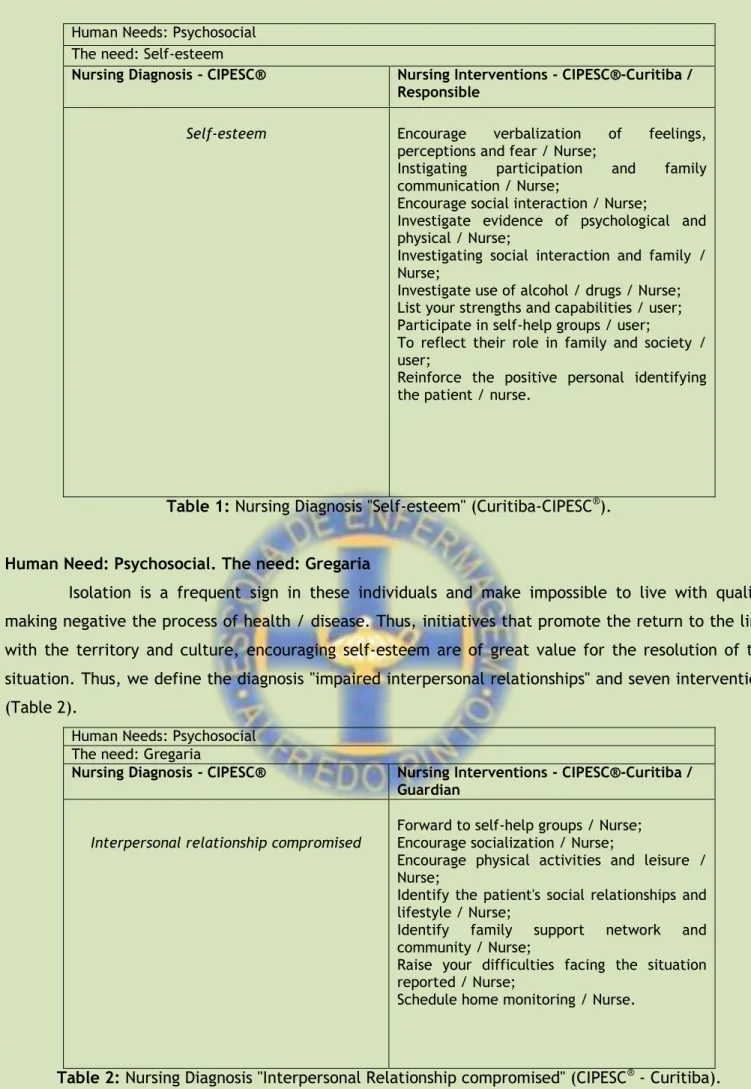
Human Need: Psychosocial. The need: Self-esteem
Low self-esteem is one of the main signs shown in children who suffer from bullying. It is closely related to mental health and psychological well-being, presenting as basilar point evaluative character. Just like that, the individual can elect goals, plan, accept himself14 and search for their dreams. Therefore, we selected the diagnosis "self-esteem", with ten interventions (Table 1).
R. pesq.: cuid. fundam. online 2013. dec., 5(5):111-21
117
Human Needs: PsychosocialThe need: Self-esteem
Nursing Diagnosis - CIPESC® Nursing Interventions - CIPESC®-Curitiba / Responsible
Self-esteem 1. Encourage verbalization of feelings, perceptions and fear / Nurse;
2. Instigating participation and family communication / Nurse;
3. Encourage social interaction / Nurse;
4. Investigate evidence of psychological and physical / Nurse;
5. Investigating social interaction and family / Nurse;
6. Investigate use of alcohol / drugs / Nurse; 7. List your strengths and capabilities / user; 8. Participate in self-help groups / user;
9. To reflect their role in family and society / user;
10. Reinforce the positive personal identifying the patient / nurse.
Table 1: Nursing Diagnosis "Self-esteem" (Curitiba-CIPESC®).
Human Need: Psychosocial. The need: Gregaria
Isolation is a frequent sign in these individuals and make impossible to live with quality, making negative the process of health / disease. Thus, initiatives that promote the return to the links with the territory and culture, encouraging self-esteem are of great value for the resolution of this situation. Thus, we define the diagnosis "impaired interpersonal relationships" and seven interventions (Table 2).
Human Needs: Psychosocial The need: Gregaria
Nursing Diagnosis - CIPESC® Nursing Interventions - CIPESC®-Curitiba / Guardian
Interpersonal relationship compromised
1. Forward to self-help groups / Nurse; 2. Encourage socialization / Nurse;
3. Encourage physical activities and leisure / Nurse;
4. Identify the patient's social relationships and lifestyle / Nurse;
5. Identify family support network and community / Nurse;
6. Raise your difficulties facing the situation reported / Nurse;
7. Schedule home monitoring / Nurse.
Table 2: Nursing Diagnosis "Interpersonal Relationship compromised" (CIPESC® - Curitiba).
Human Need: psychobiological. The need: Sleep and rest
For biological signals, specifically, insomnia, we defined the diagnosis "inadequate sleep", added to and ten interventions (Table 3).
R. pesq.: cuid. fundam. online 2013. dec., 5(5):111-21
118
Human Needs: psychobiologicalThe need: Sleep and rest
Nursing Diagnosis - CIPESC® Nursing Interventions - CIPESC®-Curitiba / Guardian
Inadequate sleep 1. Assist the identify the determinants of inadequate sleep / Nurse;
2. Search calm ambiente and timetabling to sleep / User;
3. Relate the hours of sleep and rest with the child's age / Nurse;
4. Bathing the child before bed / User;
5. Encourage standardization schedules for daily activities and physical activity / Nurse; 6. Massaging the child after bath / User;
7. Guide the search for peaceful sleeping environment / Nurse;
8. Advise parent / caregiver in the child bathe before bedtime, demonstrating the massage to be performed after bath / Nurse;
9. Guide the provision of herb tea - lemon balm, chamomile and other / Nurse;
10. Dress in comfortable clothes and appropriate temperature, User.
Table 3: Nursing Diagnosis "Inadequate sleep" (Curitiba-CIPESC®). Human Need: Psychosocial. The need: Safety
From the intensity that children experience bullying and the difficulty of expressing such violence, she may experience sadness, which requires the attention of parents and professionals in education and health, to prevent further damage. Therefore, we chose the diagnosis "sadness" and 11 interventions (Table 4).
Human Needs: Psychosocial The need: Safety
Nursing Diagnosis - CIPESC® Nursing Interventions - CIPESC®-Curitiba / Guardian
Sadness 1. Welcoming the user according to their needs / Nurse;
2. Supporting the patient needs / Nurse; 3. Forward to group self - help / Nurse; 4. Forward to educational groups / Nurse; 5. Encourage verbalization, feelings,
perceptions and fears / Nurse;
6. Involve family / significant person in care / nurse;
7. Establish trust with the patient / nurse; 8. Establish links with the patient / nurse; 9. Encourage self-esteem of the patient / nurse; 10. Foster confidence in caregiving / Nurse; 11. Identify network of family and community
support / Nurse.
R. pesq.: cuid. fundam. online 2013. dec., 5(5):111-21
119
The study aims, and reflect on the SAE articulated CIPESC® for a child characterized as a target or victim of bullying, to alert the academia, the categorical professionals and other members of the society on the importance of epidemiological public health problem currently .
Unfortunately, interest in the topic is not equivalent with regard to the magnitude of the problem, as evidenced by this study, during the literature search, his sparse approach in scientific circles. Often this reality is linked to ignorance or erroneous knowledge of thematic aspects applicable to the bullying problem, which is seen as a normal condition without damage to the individual and are not necessary interventions.
Added to these assumptions, we understand that the SAE articulated CIPESC® constitutes an invaluable tool for the professional nurse since strengthened its autonomy and Nursing as a science and, above all, allows the consolidation of actions that emphasize and space for the user role.
Moreover, we confirmed the relevance of work of professionals in primary care, particularly nursing units with FHS by social bonding and community knowledge of reality. It is the responsibility of the family health team to identify problems such as bullying in the territories and health promotion from intervening to protect health.
1. Zaine I, Reis MJD, Padovani RC. Comportamentos de bullying e conflito com a lei. Estud. Psicol. [periódico on line] 2011; [citado 16 jul 2011]; 27(3): [aprox. 8 telas]. Disponível em: http://www.scielo.br/pdf/estpsi/v27n3/09.pdf.
2. Malta DC, Silva MAI, Mello FCM, Monteiro RA, Sardinha LMV, Crespo C, et al. Bullying nas escolas brasileiras: resultados da Pesquisa Nacional de Saúde do Escolar (PenNSE), 2009. Ciênc. saúde coletiva [periódico on line] 2010; [citado 16 jul 2011]; 15 (Supl.1): [aprox. 12 telas]. Disponível em: http://www.scielo.br/pdf/csc/v15s2/a11v15s2.pdf.
3. Francisco MV, Liborio RMC. Um estudo sobre bullying entre escolares do ensino fundamental. Psicol. Reflex. Crit. [periódico on line] 2009; [citado 18 jul 2011]; 22 (2): [aprox. 7 telas]. Disponível em: http://www.scielo.br/pdf/prc/v22n2/a05v22n2.pdf.
4. Neto AAL. Bullying: comportamento agressivo entre estudantes. J. Pediatr. [periódico on line] 2005; [citado 16 jul 2011]; 81(5): [aprox. 9 telas]. Disponível em: http://www.scielo.br/pdf/jped/v81n5s0/v81n5Sa06.pdf.
5. Pinheiro FMF, Williams LCA. Violência intrafamiliar e intimidação entre colegas no Ensino Fundamental. Caderno de Pesquisa [periódico on line] 2009; [citado 16 jul 2011]; 39(138): [aprox. 9 telas]. Disponível em: http://www.scielo.br/pdf/cp/v39n138/v39n138a15.pdf.
R
R
R
E
E
E
F
F
F
E
E
E
R
R
R
E
E
E
N
N
N
C
C
C
E
E
E
S
S
S
C
R. pesq.: cuid. fundam. online 2013. dec., 5(5):111-21
120
6. Corbo AD, Morosini MVGC, Pontes ALM. Saúde da Família: construção de uma estratégia de atenção à saúde. In: Morosini, MVGC, organizador. Modelos de atenção à Saúde da Família. Rio de Janeiro (RJ): EPSJV / Fiocruz; 2007. p. 69-103.
7. Brasil. Portaria N° 648/GM, de 28 de março de 2006. Aprova a Política Nacional de Atenção Básica, estabelecendo a revisão de diretrizes e normas para a organização da Atenção Básica para o Programa Saúde da Família (PSF) e o Programa Agentes Comunitários de Saúde (PACS). Ministério da Saúde 2006; 28 Set.
8. Gomes AMT, Oliveira DC. A representação social da autonomia profissional do enfermeiro na Saúde Pública. Rev. Bras. Enferm. [preiódico on line] 2005; [citado 16 jul 2011]; 58(4): [aprox. 6 telas]. Disponível em: http://www.scielo.br/pdf/reben/v58n4/a03v58n4.pdf.
9. Brasil. Resolução COFEN n° 358 de 15 de outubro de 2009. Dispõe sobre a Sistematização da Assistência de Enfermagem e a implementação do Processo de Enfermagem em ambientes, públicos ou privados, em que ocorre o cuidado profissional de Enfermagem, e dá outras providências. COFEN 2009; 15 Out.
10. Santos SMJ, Nóbrega MML. Ações de enfermagem identificadas no Projeto CIPESC® e utilizadas no cuidado de pacientes com AIDS*. Rev Esc Enferm USP [periódico on line] 2004; [citado 17 jul 2011]; 38(4): [aprox. 10 telas]. Disponível em: http://www.scielo.br/pdf/reeusp/v38n4/02.pdf.
11. Cubas MR, Egry EY. Práticas inovadoras em saúde coletiva: ferramenta re-leitora do processo saúde-doença. Rev. Esc. Enferm. USP [periódico on line] 2007; [citado 16 jul 2011]; 41(spe): [aprox. 6 telas]. Disponível em: www.scielo.br/pdf/reeusp/v41nspe/v41nspea07.pdf.
12. Gil A.C. Como elaborar projetos de pesquisa. 4a. ed. São Paulo(SP): Atlas; 2007.
13. Moura DR, Cruz ACN, Quevedo LA. Prevalência e características de escolares vítimas de bullying. J. Pediatr. [periódico on line] 2011; [citado 16 jul 2011]; 87(1): [aprox. 5 telas]. Disponível em: http://www.scielo.br/pdf/prc/v22n2/a05v22n2.pdf.
14. Bandeira CM, Hutz CS. As implicações do bullying na auto-estima de adolescentes. Psicol. Esc. Educ. [periódico on line]. 2010; [citado 13 jul 2011]; 14(1): [aprox. 8 telas]. Disponível em: http://www.scielo.br/pdf/pee/v14n1/v14n1a14.pdf. DOI: 10.1590/S1413-85572010000100014.
15. Antunes DC, Zuin AAS. Do bullying ao preconceito: os desafios da barbárie à educação. Psicol. Soc. [periódico on line] 2008 jul; [citado 13 jul 2011]; 20(1):[aprox. 9 telas]. Disponível em: http://www.scielo.br/pdf/psoc/v20n1/a04v20n1.pdf.
16. Gonçalves LRR, Nogueira LT, Nery IS, Bonfim EG. O desafio de implantar a sistematização da assistência de enfermagem sob a ótica de discentes. Esc. Anna Nery [periódico on line] 2007; [citado 19 jul 2011]; 11(3):[aprox. 7 telas]. Disponível em: www.scielo.br/pdf/ean/v11n3/v11n3a10.pdf. 17. Cubas MR, Egry EY. Classificação Internacional de Práticas de Enfermagem em Saúde Coletiva – CIPESC. Rev Esc Enferm USP [periódico on line] 2008; [citado 16 jul 2011]; 42(1): [aprox. 6 telas]. Disponível em: www.scielo.br/pdf/reeusp/v42n1/24.pdf.
18. Egry EY. Cipescando rumo à equidade: reflexões acerca da Classificação Internacional de Práticas de Enfermagem em Saúde Coletiva. Rev. bras. enferm. [periódico on line] 2009; [citado 17 jul 2011]; 62(1): [aprox. 4 telas]. Disponível em: www.scielo.br/pdf/reben/v62n5/20.pdf.
19. Albuquerque LM, Cubas MR, organizadores. Cipescando em Curitiba: construção e implementação da Nomenclatura de Diagnóstico e Intervenção de Enfermagem na Rede Básica de Saúde. Curitiba(PR): Curitiba; 2005.
R. pesq.: cuid. fundam. online 2013. dec., 5(5):111-21