AZOREAN BRYOPHYTES:
A PRELIMINARY REVIEW OF RARITY PATTERNS
Rosalina Gabriel1, Nídia Homem1, Adalberto Couto1, Silvia Calvo
Aranda1,2 & Paulo A.V. Borges1
1Azorean Biodiversity Group – CITA-A, Dep. Ciências Agrárias, Universidade dos
Açores, 9700-042 Angra do Heroísmo, Portugal e-mail: [email protected]
2Dep. Biodiversidad y Biología Evolutiva, Museo Nacional de Ciencias Naturales (CSIC).
C/ José Gutiérrez Abascal, 2. 28006, Madrid, Spain ABSTRACT
Bryophytes are not exempt of rarity and threat, although their small size, mute colours and difficult field identification may mask their true conservation status. Actually, it is known that a quarter of all European bryophytes are under actual or potential threat. The first Red Data Book for European Bryophytes was produced in 1995, largely based on national red lists and on the work of a vast team of bryologists who assessed the conservation status of each European species. The red listing of bryophytes has undoubtedly contributed to increase the awareness of planners to this group of organisms, and several efforts have been made, through Europe, to preserve sites based on their bryological interest. Accordingly, a specific Red List for the Azorean Bryophytes may help regional managers to identify particularly endangered species, thus allowing for the creation of measures to improve their preservation. In this paper we have used an adaptation of the works of Deborah Rabinowitz (1981), who created a typology to access different forms of rarity, using three variables: Geographical Distribution, Abundance and Habitat Specificity. All the 480 species and subspecies known to occur in the Azores were surveyed; of these, 215 species lacked sufficient data to be analyzed (data deficient), 121 were not considered rare and 144 (1 hornworts, 56 liverworts and 87 mosses) were considered rare, at least in one of the three parameters considered. The benefits and limitations of the methodology are briefly discussed. Several practical suggestions are proposed in order to enhance the conservation of selected bryophyte species.
Paginação_21.indd 149
RESUMO
Os briófi tos podem ser tão raros e estar tão ameaçados como os demais organismos do planeta, apesar de o seu pequeno tamanho, cores discretas e difícil identifi cação no campo poderem mascarar o seu verdadeiro estatuto de conservação. De facto, é reconhecido que cerca de um quarto de todos os briófi tos da Europa estão efectiva ou potencialmente ameaçados. O primeiro “Livro Vermelho dos Briófi tos da Europa” foi produzido em 1995, amplamente baseado em listas vermelhas nacionais e no trabalho de uma vasta equipa de briólogos que avaliaram o estatuto de conservação para as espécies Europeias. A classifi cação de briófi tos em listas vermelhas tem contribuído para aumentar a sensibilidade dos gestores para este grupo de organismos e alguns esforços têm sido desenvolvidos na Europa, para preservar locais tendo como característica o seu interesse briológico. Consequentemente, uma lista vermelha para os briófi tos dos Açores pode auxiliar os gestores regionais a identifi car espécies particularmente ameaçadas, tornando-se o primeiro passo para assegurar a sua protecção. Neste artigo usamos uma adaptação dos trabalhos de Deborah Rabinowitz (1981), que criou uma tipologia para desocultar e avaliar várias formas de raridade, utilizando três variáveis: Distribuição Geográfi ca, Abundância e Especifi cidade do Habitat. Todas as 480 espécies e subespécies dos Açores foram investigadas: 215 taxa não tinham informação suficiente para ser analisados (deficientes em dados), 121 não foram consideradas raros e 144 briófitos (1 antocerota, 56 hepáticas e 87 musgos) foram considerados raros pelo menos num dos parâmetros considerados. Os benefícios e limitações desta metodologia são brevemente discutidos. São propostas algumas sugestões práticas para melhorar a estratégia de conservação dos briófitos seleccionados.
INTRODUCTION
O
ne of the most interestingcharacteristics of the Azores is their extraordinary wealth of bryophytes (480 species and subspecies, Gabriel et al., 2010), comparable to the diversity pre-sent in other Macaronesian
ar-chipelagos (González-Mancebo
et al., 2008; Sérgio et al., 2008),
a feature unparalleled in other groups of Azorean organisms (Izquierdo et al., 2004; Borges
et al., 2008, 2010a). In addition,
Azorean islands host a high pro-portion of European bryophyte species (Homem & Gabriel,
Paginação_21.indd 150
2008) and also many endemic species of vascular plants, mol-luscs and arthropods (Borges et
al., 2010b), many of which are in
danger as a consequence of his-torical human occupation and land-use changes (Borges et al., 2000, 2009; Cardoso et al., 2010; Martín et al., 2010; Triantis et
al., 2010). In fact, the
conserva-tion of island biota was always considered a true priority since most of the recorded extinctions have occurred in islands (Sax & Gaines, 2008).
In spite of more than four centuries of Human occupa-tion, the Azores and other Macaronesian archipelagos, still possess natural habitats (Borges et al., 2009; Gaspar et
al., 2011), and these islands are
some of the very few places in Europe where the ‘biodiversity crisis’ is particularly critical and a proper conservation strategy may effectively contribute to preserve unique pristine com-munities. Presently, about a fifth of the Azorean islands area is under some legal protection status (Monteiro & Furtado, 2010), and a few remnants of native forests have persisted since the Portuguese occupa-tion in the early 15th century, although grasslands and exotic
plantation forests dominate the islands these days (Borges et al., 2009).
Most ecological studies in is-lands, and in particular in the Azores, are limited in their time span and a detailed understand-ing of the long-term responses of island bryophyte communi-ties to global change drivers is not known. Bryophytes have long been considered indicator groups for habitat change, as their lack of roots makes them totally dependent on the at-mospheric (or aquatic) inputs of nutrients (eg. Frego, 2007; Gignac, 2010). Besides, bryo-phytes are a characteristic part of the Azorean native forests, covering all kinds of substrata, including leaves of vascular species, with luxuriant com-munities (Homem & Gabriel, 2008), and are generally con-sidered remnants of the sub-tropical flora that endured the Quaternary glaciations (but see Aigoin et al., 2009, who recently questioned the relictual origin of Macaronesian bryophytes). Thus, assessing the conserva-tion status for bryophytes may couple with policies for native habitats protection.
A red list ranks taxa accord-ing to their threat level and
Paginação_21.indd 151
extinction risk, and assess-ments for the red list compile current knowledge of conser-vation status and threats to in-dividual species (ex. Knapp & Monterrosa Salomón, 2010). Few vascular plants and even fewer bryophytes (only 101 of the ca. 18000 species!) have been formally assessed using the IUCN system (IUCN, 2010). However, one of the targets of the Global Strategy for Plant Conservation is “a preliminary assessment of the conservation status of all known plant spe-cies, at national, regional and international levels” (UNEP, 2002). There are various ap-proaches to achieve this goal, including the use of expert’s opinions (ex. Sérgio et al., 1992; Schumacker, 2001; Sjögren, 1995), the use of herbarium la-bels information (ex. Krupnick
et al., 2008), the creation of
specific software to create red lists accommodating the IUCN criteria (ex. RAMAS, 2007), but lately it has been advised that a thorough use of all available in-formation, including georefer-enced herbarium specimens and other parameters such as popu-lation size and local abundance, would be a good way forward to stimulate conservation (ex.
Brummitt et al., 2008). In prac-tice, not many species have been studied in any of these ways and the information necessary to do so is impressive. Nevertheless, the need to better understand the rarity of species is pressing and simple methods of ranking should at least be essayed for all groups of organisms.
The pioneer work of Deborah Rabinowitz (1981, 1986) has en-lightened the rarity concept, ac-knowledging that
“There are many ways in which
a species can become rare and this path has profound evolution-ary and ecological consequences”
(Rabinowitz, 1981: 205). To define rarity, she used a three dimensional system including distribution, abundance and habitat specificity. Each one of these dimensions was further subdivided into two qualita-tive categories (wide or nar-row, large or small, generalist or specialist, respectively), re-sulting in an eight cells table, from which, only one cell in-cludes common species, those with wide distributions, large populations and generalist. All other combinations suffer from at least one form of rar-ity. Knowing the rarity status of species is critical to evaluate
Paginação_21.indd 152
both their extinction proneness and their roles in the ecosys-tems (Gaston, 1994, 2010).
One of the most useful re-sources to study biodiversity in the Azores is the regional species database, ATLANTIS, where grid-based spatial inci-dence information, allied to tem-poral data, has been gathered for several groups of organisms (lichens, bryophytes, vascular plants, marine invertebrates, terrestrial molluscs, arthro-pods and vertebrates) (Borges
et al., 2010c; Martín et al., 2010).
Parallel to this work, the bio-logical and ecobio-logical features of bryophytes have also been noted by RG and co-workers. The information thus gathered may therefore serve as a start-ing point for an assessment of the rarity of bryophytes, using Rabinowitz’ approach (consider-ing range, abundance and dis-tribution). Such a characteriza-tion has been applied to vascular plant species (ex. Rabinowitz et
al., 1986; McIntyre, 1992),
verte-brates (ex. Kattan, 1992; Goerck, 1997), insects (ex. Fattorini, 2011) and was essayed for European liverworts (Weibull & Söderström, 1995).
In this study we used all the information available to
Azorean bryophytes, as in- serted in ATLANTIS database, supplemented with literature and herbaria ecological fea-tures, to analyze the rarity pat-terns of the species and provide a preliminary conservation as-sessment, at the regional lev-el, of this important indicator group. It is expected that it may be the basis of an Azorean Red List for Azorean bryophytes.
METHODS
Study Area
The nine islands composing the archipelago of the Azores, are situated in the North Atlantic Ocean, extending along a west-northwest to east-southeast ori-entation (between 36° 30’ - 40° North latitudes and 24° 30’ - 31° 30’ West longitudes). The joined
area of the islands is 2,323 km2
(larger island, São Miguel, 745
km2; smaller island, Corvo,
17 km2) (Forjaz, 2004). The
ar-chipelago’s highest altitude is reached in Pico Island, at 2,350 m, but the second highest is-land (São Miguel) is just 1,105 m altitude. The Azores were uninhabited when Portuguese navigators arrived in the early
15th century, and the earlier
de-scriptions of the islands
por-Paginação_21.indd 153
tray them as intensely forested (Frutuoso, 1963). Nowadays the Azorean population in-cludes about 241,800 people, at a density of 104 inhabitants per square kilometre (Forjaz, 2004). It is estimated that laurel forests occupied about 85% of the present area of Azores; un-fortunately, most of this natural habitat has been disturbed, re-maining only around 6,000 ha (Fernández-Palacios et al., 2011; Gaspar et al., 2011).
Data Sources
A tentative categorization of rarity was essayed for all the 480 bryophyte species and subspe-cies included in the most recent check-list of the Azorean Islands (Gabriel et al., 2010). The ana-lyzed data came from literature and herbarium records. The first step included a thorough analysis and interpretation of the available literature, dating back to the 19th century (167 sources; see Appendix 1); this list includes books, chapters and papers as well as some grey lit-erature such as academic thesis, letters and fieldwork reports (see Borges et al., 2010c for de-tails). Secondly, the collection of bryophytes deposited at the University of the Azores was
also examined. All informa-tion was fed to the ATLANTIS database (Borges, 2005). This database includes 29,323 spe-cies citations coming from lit-erature (most of them, ca. 80%, with recognizable locations and indication of date of collection) and 11,237 citations coming from herbarium records (most of them placed at the bryophyte collection of the University of the Azores). One of the authors (RG) has further compiled in-formation on fruiting, ecology and substrate preferences for each bryophyte record; in some occasions the habitat type was inferred from other published sources or direct knowledge of local experts. Although gaps of information are inevitable, and have indeed been demon-strated (see Aranda et al., 2010), this database is deemed to be as complete as possible and a good starting point to analyze rarity issues. A webpage, the Azorean Biodiversity Portal (http://www. azoresbioportal.angra.uac.pt/), with data on the taxonomy, de-tailed distribution of the species on the Azorean Islands (grid of 500 m x 500 m), European conservation status and some pictures and common names (whenever possible) has been
Paginação_21.indd 154
available to the general public since 2008 (Borges et al., 2010c).
Rarity dimensions
Geographical distribution
Due to the high disper-sal ability characteristic of the group (see revision in Rydin, 2008), bryophytes occurring in the Azores were considered to have a narrow geographical distribution when their pres-ence was known only from the Macaronesian Islands (i.e. Macaronesian endemic species and subspecies) and a wide dis-tribution, whenever they also occurred elsewhere. This data was obtained from the recent checklist for Azorean bryo-phytes (Gabriel et al., 2010).
Abundance
Abundance was the most dif-ficult parameter to quantify, as it refers to the size of the popula-tions, which is not immediate in bryophyte studies (Hallingbäck
et al., 1998; Hallingbäck, 2007).
Different authors have used dif-ferent approaches to estimate abundance, such as the examina-tion of museum specimens (see Fattorini, 2011 for arthropods), and others have not considered this parameter for bryophytes (ex. Söderström & Séneca, 2008;
Vanderpoorten & Hallingback, 2008). In order to reach an es-timation of abundance for bryo-phytes, we have taken advantage of a recurrent pattern in ecologi-cal communities, i.e. the posi-tive intraspecific or interspecifc relationship between mean lo-cal abundance and regional dis-tribution (Gaston, 1994, 1996), which assumes that
“Within a taxonomic
assem-blage, locally abundant species tend to be widespread and locally rare species tend to be restricted in their distribution.” (Gaston,
1996: 211).
The key issue here is the use of the small-scale distribution as a proxy of abundance. The importance of scaling, rarity and risk, has been highlighted by Hartley & Kunin (2003), working with two plant species (Dianthus armeria L. and
Silene otites (L.) Wibel) at a
distri-bution resolution of 1-km in Great Britain. Bearing this in mind, and using the ATLANTIS database, we have calculated for each species the number of geographical cells (500 m x 500 m) allocated with the high-est precision values (precision 1 – very precise locations, usually point UTM data; 2 – localities
never exceeding 25 km2) in all
Azorean Islands (see Borges et al., 2010c), and subsequently divided
Paginação_21.indd 155
that value by the total number of
500 m2 cells of the archipelago
(10044 cells), thus reaching an estimate of the area of occupan-cy (AOO) for each bryophyte. This ratio of relative area of oc-cupancy was then considered a predictor of the local abundance for each species. All the species were ranked by this index, and those which fell below the me-dian value were considered of low abundance while the others were considered as abundant.
Ecological tolerance
Habitat specificity was used as a proxy of ecological toler-ance. RG’s species database on ecological traits was categorized in 12 different habitat types (Coastal habitats, Mesic areas, Native forests, Semi-natural grasslands, Mountainous ar-eas, Aquatic habitats, Peat bogs, Urban habitats, Parks and Gardens, Intensive pastures, Exotic forest plantations and Cave entrances). Table 1 in-cludes a summary description of each of the habitats considered.
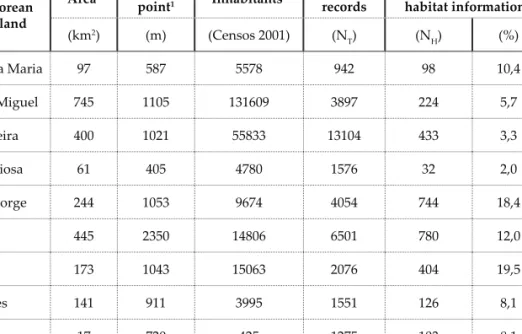
The islands survey is not eq-uitable (Table 2); for example, if
the number of records per km2 is
considered, Corvo, Terceira and Graciosa are the best inspected of the Azorean Islands while São
Miguel is the worst. Likewise, the percentage of records to which it was not possible to as-sign a habitat varied according to the islands (highest in Faial and São Jorge and lowest in Terceira and Corvo) but, in average it did not reach one tenth (9.7%) of the 34976 records considered.
To appreciate the ecological range of a species, all the re-cords where this was possible, were allocated to one of the 12 habitat types. Then, the number of records present in one habitat was divided by the total number of locations of that habitat (nor-malizing the records per habi-tat). Finally, for those species that had 12 or more described occurrences, the Lloyds Index of Patchiness (L) was applied:
L = Sx2 – x / x2 + 1 (Basset, 1999),
where Sx2 and x are respectively
the variance and mean of the samples in the 12 different habi-tat types. A specialist species in the present context is a spe-cies that showed preference for a particular habitat, the value of the index increasing for more specialized species. According to the interpretation of differ-ent authors (eg. Basset, 1999; Gabriel & Bates, 2005) those spe-cies with an L value larger or equal to three, were considered
Paginação_21.indd 156
with restricted habitat require-ments. Before proceeding to the calculus of L, the number of oc-currences in a given habitat was
normalized for the number of total occurrences in that habitat. For instance, while there were 522 locations inside native for-TABLE 1. Brief description of the habitats considered in this paper and an indication of the number of independent locations where bryophytes were collected in the Azores.
Habitat types Description Number of
locations
Coastal habitats
Coastal habitats are situated at the lowest altitudes, near the sea, mostly up to an altitude of 50 m, which may be higher, depending on the Island.
124
Mesic areas
Mesic areas occur above the coastal habitats and receive intermediate amounts of precipitation. These areas are presently dominated by fi elds (mostly corn fi elds), intensive pastures and exotic plantations.
204
Native forests
Native forests are the remnants of the former dominant ecosystem types, found by the fi rst se lers. They include evergreen tree species such as Laurus azorica, Erica azorica, Ilex perado subsp. azorica and Juniperus brevifolia.
522
Semi-natural grasslands
These are open areas, mostly located among native forest
fragments, including several herbaceous plant species. 42 Mountainous
areas
This habitat (high mountain) is restricted to Pico Island, above
1200 m altitude. 57
Aquatic habitats
This habitat includes lagoon margins, temporary and permanent rivulets, cascades and other interior waters habitats.
212
Peat bogs Large, open areas dominated by Sphagnum spp. 115 Urban habitats Habitats that may be found in cities and villages, including
buildings and other human constructions. 70 Parks and
Gardens
Areas covered with exotic species, organized to appreciate
nature. 48
Intensive pastures
Areas dominated by Holcus, Bromus or Lolium species, used by
grazing ca le. 129
Exotic plantation forests
Areas dominated by Eucalyptus spp., Cryptomeria japonica or
Pi osporum undulatum. 163
Cave entrances
Specifi c habitat, including all the rocky walls of caves (lava tubes) and volcano entrances (pits and pit caves), where light penetrates.
81
Paginação_21.indd 157
ests, there were only 163 loca-tions placed in exotic plantation forests.
Vulnerability index
Species considered rare on dis-tribution, abundance and ecologi- cal tolerance, tend to be the most prone to extinction (Ka an, 1992; Manne & Pimm, 2001). The con-sequent application of the three criteria, with their binomial mea-surements: Distribution (large/ small), Abundance (common/ rare) and Ecological tolerance (wide/narrow), led to the
follow-ing categorization: 1. Species that are not rare; 2. Scarce spe-cies (rare in abundance); 3. Species with narrow ecological tolerance; 4. Restricted spe-cies (spespe-cies rare by geographi-cal range); 5. Scarce species with narrow ecological toler-ance; 6. Scarce and restricted species; 7. Restricted species with narrow ecological range and 8. Restricted and scarce species with narrow ecological range. Similar categories may be appreciated for other groups such as vertebrates (ex. Kattan, TABLE 2. General characteristics of the Azorean Islands, including the total number of bryophyte’ records made in the archipelago and the absolute and relative
frequencies of records to which no habitat could be attributed. (1. Forjaz, 2004).
Azorean Island Area1 Highest point1 Inhabitants1 Number of records Records without habitat information (km2) (m) (Censos 2001) (N T) (NH) (%) Santa Maria 97 587 5578 942 98 10,4 São Miguel 745 1105 131609 3897 224 5,7 Terceira 400 1021 55833 13104 433 3,3 Graciosa 61 405 4780 1576 32 2,0 São Jorge 244 1053 9674 4054 744 18,4 Pico 445 2350 14806 6501 780 12,0 Faial 173 1043 15063 2076 404 19,5 Flores 141 911 3995 1551 126 8,1 Corvo 17 720 425 1275 103 8,1 Paginação_21.indd 158 Paginação_21.indd 158 19-01-2012 11:51:5219-01-2012 11:51:52
1992) and arthropods (Fattorini, 2011) and also for bryophytes Söderström (1995).
RESULTS
Of the 480 species referred to the Azores, only 265 (55.2%) could be analyzed following the combination of criteria used (Appendix 2). From the evalu-ated species, about half (121; 45.7%) were not considered rare (1. Species that are not rare) but six of the seven types of rarity proposed by Rabinowitz (1981) were found within the Azorean bryophytes’ dataset (absolute and relative frequencies of the eight categories may be seen in Figure 1). If one considers sin-gle categories of rarity by them-selves, less than half (112; 42.3%) of the evaluated species pre-sented narrow ecological tol-erance, more than one fi h (56; 21.1%) were considered scarce and only 17 evaluated species (6.8%) had restricted distributions.
The results of the Chi-square test show that the hypothesis of overall independence of the three factors may be rejected
(X2=47.36; df=2; p < 0.05),
indi-cating that these factors are not independent. Separate analysis of the 2 x 2 tables also indicated
that all measures were not inde-pendent (p<0.05).
Twenty four species, nine liv-erworts and 15 mosses, previ-ously classifi ed in the European Red List of Bryophytes (ECCB, 1995; Dierssen, 2001), four of which (Acanthocoleus aberrans,
Jamesoniella rubricaulis, Fissidens azoricus and Neckera cephalonica)
also suggested by Sjögren (1995) to become protected species in the Azores, could not be evaluat-ed in this analysis. All of these 24 species are scarce (rare by abun-dance) and none had the neces-sary number of collections to al-low a full assessment of their eco-logical tolerance. Among them there are fi ve restricted species, two Azorean endemics (Fissidens
azoricus and Trematodon persso-niorum) and three Macaronesian
endemics (Leucodon canariensis,
Neckera cephalonica and Tortula bo-gosica). Trematodon perssoniorum
which, so far, was only found in São Miguel Island seems to prefer aquatic habitats, and was collected mostly around Lagoa das Furnas and Ribeira Quente (seven records at diff erent times), while Riccia ligula was only re-corded in intensive pastures (six records) and Jamesoniella
rubri-caulis was only collected above
1000 m (five records).
Paginação_21.indd 159
DISCUSSION
Only about half (265) of all Azorean bryophytes species and subspecies (480) could be classi-fied using the three rarity cate-gories proposed by Rabinowitz (1981). In itself, this exposes a serious lack of information, regarding mostly abundance and ecological tolerance, which thwarts the design of a compre-hensive conservation policy for bryophytes. Without appropri-ate knowledge of the biology of the species, it is not possible to understand why a bryophyte is rare or threatened and it is very difficult to propose measures that would induce its recovery.
The data presented in Figure 1 and Appendix 2, shows that most of the analyzed bryophytes that may be considered rare have wide range distributions (247 species), which is not sur-prising, considering that bryo-phytes successfully disperse by spores. Actually some authors such as Medina, Draper & Lara (2011), have argued that due to their high dispersal ability, bryo-phytes would tend to ubiquity. The hypothesis “Everything is
everywhere, but the environment selects” (EiE) has generally been
accepted by microbiologists (ex.
O’Malley, 2007) and is being considered for larger organisms with microscopic dispersing stages (e.g. spores), such as ferns or bryophytes (ex. Fontaneto, 2011). An indirect evidence of this wide distribution ability is the low endemism value found among Azorean bryophytes (n=7; 1,5%), much lower those found among native vascular species or arthropods (Borges et
al., 2010b). Moreover,
accord-ing to the study of Söderström & Séneca (2008), the liverwort flora of Europe and Macaronesia con-sists of mainly widespread spe-cies, and, unlike what happens with vascular species, the rarest species occur in oceanic areas (and not in the Mediterranean region).
Eight of the 17 Macaronesian and Azorean endemic bryo-phytes evaluated, exhibited re-stricted distributions (Appendix 2, “vulnerability index 4”), while not appearing to be scarce or re-stricted in their habitat require-ments. Interestingly enough, all of these eight species have been reported to the three geo-graphical groups of islands and are presently known of six (Breutelia azorica) or more, of the nine Azorean islands (other seven species). Although the
Paginação_21.indd 160
Chi-square tests indicated a sig-nificant association among dis-tribution, rarity and abundance, endemism is not always asso-ciated with narrow ecological tolerance or with scarcity; spe-cies such as Andoa berthelotiana and Leucodon treleasei have been
abundantly collected in different types of habitats and all islands of the Azores (eg. González-Mancebo et al., 2009). If these species evolved in Macaronesia (neoendemics), or survived only in Macaronesia (paleoen-demics), they should indeed DISTRIBUTION (d)
wide range (1) restricted range (0)
ABUNDANCE (a)
dense (1)
scarce (0)
generalist (1) specialist (0) generalist (1) specialist (0)
HABITAT (h)
FIGURE 1. Distribution of rarity types within the evaluated bryophyte species (n=265) in the Azores. Numbers indicate number of species per category; dark areas of pie charts indicate the percent of the dataset each rarity type represents. 1, Species that are not rare; 2, Scarce species (rare by abundance); 3, Species with narrow ecological tolerance; 4, Restricted species (rare by range); 5, Scarce species with narrow ecological tolerance; 6, Restricted and scarce species; 7, Restricted species with narrow ecological range; 8, Restricted and scarce species with narrow ecological tolerance.
Paginação_21.indd 161
be well adapted to the Azorean ecosystems. Notwithstanding,
Echinodium renauldii, which was
recently confirmed as a true en-demic species (Stech et al., 2008), is considered vulnerable by the IUCN (BSG, 2010), on account of its decreasing population trend and occurrence in less than ten localities in fi ve islands of the Azores; this view is shared by Sjögren (1995). Fortunately, the number of places where this spe-cies has been collected is now known to be higher (more than 40 locations) and its presence was confi rmed in two more islands (Corvo and Terceira) since 1995.
Almost half (n=112; 42,3%) of all the analyzed bryophytes were considered specialists in their habitat requirements, as re-ferred by their high Lloyd index values, achieved when a high proportion of the total number of collections are grouped into one, or mostly two, habitats. Man-made habitats, such as ex-otic forests, grasslands or urban habitats do not seem to harbour specialist bryophyte species. This in itself has sobering impli-cations for conservation, because of the historical decrease and fragmentation of native habitats (Triantis et al., 2010; Gaspar et
al., 2011).
Forty liverworts and 24 mosses, more than half (!) of the special-ist bryophyte species evaluated in this study (n=112) and about a quarter of all evaluated species show preference for natural for-ests (n=64; 24.2%). This is not surprising in view of what we know about the original plant cover of the islands – a dense forest ecosystem (ex. Frutuoso, 1963) that is lavishly covered with bryophytes in all occurring substrata. In spite of its obvi-ous decrease in area (Silveira, 2007), the diversity and luxuri-ance of the communities that may be observed in the remain-ing native forest fragments (ex. Gabriel & Bates, 2005; Homem, 2005) is still staggering; thus, it is understandable, that this is the single most important habi-tat for bryophyte conservation in the Azores. Recently it was also demonstrated that Azorean native forests are a unique habi-tat for the conservation of most endemic arthropods (Triantis et
al., 2010), and a high proportion
of those species are now under threat of extinction due to its re-duction. Bryophytes depending on native fragments are prob-ably under the same pressures and would greatly benefit from an increase in the areas devoted
Paginação_21.indd 162
to natural forests and from a careful control of the quality of remaining fragments, such as the removal of invasive species.
Peat bogs are structurally very different from forests, in their openness and permanent access to water and eleven spe-cies were considered specialists from this habitat, taking ad-vantage of these special condi-tions. Obviously, Sphagnum and
Polytrichum species (the green
and brown makers of peatlands) are prone to be found in these habitats, but the persistent pres-ence of the rare Isopterygium
tenerum in Furnas do Enxofre
(Terceira Island), should also be noted.
Surprisingly, or not (see Gabriel et al., 2006; Jennings, 2009), caves (lava tube and pit caves entrances) are an equally interesting habitat for the spe-cialist group of bryophytes. Beyond Asterella africana, that has been collected specifical-ly in such habitats, two other liverworts and eight mosses find refuge in these harsh en-vironments, where competi-tion from vascular species is certainly lower. Besides the 11 species that have mostly been collected at cave entrances, some species such as Plagiochila
longispina, Cyclodictyon laete-virens, Plagiothecium nemorale, Tetrastichium virens and others,
may be found both in native forest and cave entrances. This ability to colonize cave rocks is likely to expand their altitudi-nal range, as many of the lowest altitude records were from cave entrances. It is clear that caves are acting as refugia for some of these species. Due to the particu-lar way abundance was inferred from the data, this is the least independent rarity dimension studied. The main issue is the lack of standardized data from where to take sound information (but see Gabriel & Bates, 2005 and Homem, 2005). However as showed by Couto (2010), stan-dardized data on abundance obtained for several sites, was well correlated with distribution at the scale of Terceira Island. Bearing this in mind, additional efforts to get standardized in-formation for different habitats and islands should be made. A relatively high number of the evaluated species (n=56; 21.1%), showed low abundance values, and were thus considered scarse. Scarse species include represen-tatives from the three taxonomic groups (hornworts, liverworts and mosses); some examples
in-Paginação_21.indd 163
clude species that have been col-lected in a few places and were considered specialists such as
Asterella africana (cave entrances), Leptoscyphus azoricus (native
forests) or Isopterygium tenerum (peat bogs) but also species such as Cephalozia lunulifolia, Fissidens
coacervatus or Campylopus bre-vipilus.
It is important to recog-nize that among the species that could not be evaluated are Azorean rare bryophytes seem to be found mostly in three impor-tant habitats: native forests, peat bogs and cave entrances. While a commendatory effort has been made in order to create natural parks in all islands including most native forests fragments, no such effort has been made to encompass lava tubes (Pereira et
al., 2011), which are largely
un-der private land and require ade-quate legislation to protect them, and peat bogs are presently very disturbed habitats.
About a third (n=43, 26 liv-erworts and 17 mosses; 30.1%) of all conservation dependent bryophytes (n=143) exist in five or more Island Parks. These Parks (one for each Island) have recently been created in the Azores and incorporate areas using different levels of
protec-tion, generally following IUCN criteria for protected areas (ex. Dudley, 2008). Nevertheless, there is a quarter of all conser-vation concern species (n=35 species, 22 liverworts and 13 mosses; 24.5%), including
Acrobolbus wilsonii, Adelanthus decipiens, Aphanolejeunea ma-deirensis, Leptoscyphus azoricus, Pallavicinia lyellii, Campylopus shawii or Cyclodictyon laetevirens
that exist in less than fi ve Island Parks. While some of these spe-cies have a restricted range in the archipelago, occurring also in few islands (ex. Kurzia paucifl ora,
Cheilolejeunea cedercreutzii),
oth-ers, such as Plagiochila punctata (7 Islands – 3 Island Parks), Calypogeia
azorica (6 – 3), Cyclodictyon laetevi-rens (6 – 3), Pallavicinia lyellii (6 – 2)
or Trichocolea tomentella (4 – 1) are not adequately protected by the current design of the Island Parks.
This work illustrates that even among relatively well stud-ied groups of organisms – bryo-phytes, in a very confined region – the Azores, where a continuing collection, identification and re-porting effort has been made through time, it was not pos-sible to have a clear picture of the general rarity patterns of all species, and only about half of the reported taxa (n=265; 55.2%)
Paginação_21.indd 164
could be assessed using a simple method of categorization. This hinders conservation efforts, as only a fraction of knowledge is available to managers and deci-sion makers, while enlightening the way forward. It is clear that better floristic knowledge and expertise on bryophytes is nec-essary in the Azores, if we are to preserve the wealth of species and the natural communities where they occur. As Knapp & Monterrosa Salomón have stated:
“[this] method is not a substitute for a quantitative conservation as-sessment…” (2010: 527), however
it is a way of setting priorities for further study or monitoring. Some suggestions follow:
1. The 143 species selected at least by one of Rabinowitz’s dimension of rarity should be followed and all efforts should be made to adequate-ly conserve their habitats. 2. The 24 species previously
selected by IUCN criteria (ECCB, 1995; Dierssen, 2001), that could not be evaluated in this study for lack of col-lection records, should be very carefully prospected in the field and their evolu-tion monitored, especially the four species that were
also mentioned by the ex-perts Erik Sjögren (1995) and / or René Schumacker (2001): Acanthocoleus
aber-rans, Jamesoniella rubricaulis, Fissidens azoricus and Neckera cephalonica.
3. One liverwort (Aphanolejeunea
madeirensis) and three
mosses (Fissidens
coacerva-tus, Sphagnum nitidulum, Thamnobryum rudolphianum)
have come out as restricted, scarce and with a narrow ecological tolerance, which means they were considered rare in the three dimensions considered. While it is obvi-ous that their conservation in the Azores should be care-fully planned, the taxonomic status of S. nitidulum and F.
coacervatus, should be
clari-fied.
4. Island Parks are acting as “safe areas” for a number of bryophyte species however, other conservation concern species would benefit from a reshape, sometimes quite straightforward, of those pro-tected areas.
5. Some species that are not routinely included in red lists have nonetheless come up as rare in one or two
Paginação_21.indd 165
dimensions, an aspect al-ready discussed for mosses by Sjögren (2006). This en-lightens the scale problem of conservation: it is impor-tant to acknowledge that regional, as well as global, conservation plans should be enforced.
ACKNOWLEDGEMENTS We are grateful for the careful text revision and suggestions given by Simone Fattorini. We wish to thank Eva Sousa Borges, Berta Martins for their careful feeding of the ATLANTIS data-base and Enésima Mendonça for her help throughout the project and Fernando Pereira for his help with old names of locali-ties and general information on their habitats. RG and PAVB worked on this project under the EU projects INTERREGIII B “ATLÂNTICO” (2004-2006) and BIONATURA (2006-2008). NH has a short grant from CITA-A. SCA was funded by the Azorean Fundo Regional da Ciência e Tecnologia (M311/I009A/2005). Field work was partly funded by FCT - PTDC/AMB/70801/2006 - Understanding Underground Biodiversity: Studies of Azo-rean Lava Tubes.
LITERATURE CITED
AIGOIN, D.A., N. DEVOS, S. HUTTUNEN, M.S. IGNATOV, J.M. GONZALEZ-MANCEBO & A. VANDERPOORTEN, 2009. And if Engler was not completely wrong? Evidence for multiple evo-lutionary origins in the moss fl ora of Macaronesia. Evolution, 63: 3248-3257.
ARANDA, S.C., R. GABRIEL, P.A.V. BORGES & J.M. LOBO, 2010. Assessing the completeness of bryophytes inventories: an oceanic island as a case study (Terceira, Azorean archipelago). Biodiversity
and Conservation, 19: 2469-2484.
BASSET, Y., 1999. Diversity and abun-dance of insect herbivores forag-ing on seedlforag-ings in a rainforest in Guyana. Ecological Entomology, 24: 245-259.
BORGES, P.A.V., 2005. Introduction.
In: BORGES, P.A.V., R. CUNHA,
R. GABRIEL, A.M.F. MARTINS, L. SILVA & V. VIEIRA (eds.), A list
of the terrestrial fauna (Mollusca and Arthropoda) and flora (Bryophyta, Pteridophyta and Spermatophyta) from the Azores, pp. 11-20. Direcção
Regional de Ambiente and Universidade dos Açores, Horta, Angra do Heroísmo and Ponta Delgada.
BORGES, P.A.V., A.R.M., SERRANO & J.A. QUARTAU, 2000. Ranking the
Paginação_21.indd 166
Azorean Natural Forest Reserves for conservation using their en-demic arthropods. Journal of Insect
Conservation, 4: 129-147.
BORGES, P.A.V., C. ABREU, A.M. AGUIAR, P. CARVALHO, R. JARDIM, I. MELO, P. OLIVEIRA, C. SÉRGIO, A.R.M. SERRANO & P. VIEIRA, 2008. Listagem dos fungos,
fl ora e fauna terrestres dos arquipéla-gos da Madeira e Selvagens, 1ª ed., 438
pp. Funchal: Direcção Regional do Ambiente do Governo Regional da Madeira.
BORGES, P.A.V., E.B. AZEVEDO, A. BORBA, F.O. DINIS, R. GABRIEL & E. SILVA, 2009. Ilhas Oceânicas. In: PEREIRA, H.M., T. DOMINGOS & L. VICENTE (eds.), Portugal
Millenium Ecosystem Assessment, pp.
461-508. Escolar Editora, Lisboa. BORGES, P.A.V., A. COSTA, R. CUNHA,
R. GABRIEL, V. GONÇALVES, A.M.F. MARTINS, I. MELO, M. PARENTE, P. RAPOSEIRO, R.S. SANTOS, L. SILVA, P. VIEIRA & V. VIEIRA, 2010a. Listagem dos
organis-mos terrestres e marinhos dos Açores. Biologia, 1ª ed., 432 pp. Princípia,
Cascais.
BORGES, P.A.V., A. COSTA, R. CUNHA, R. GABRIEL, V. GONÇALVES, A.M.F. MARTINS, I. MELO, M. PARENTE, P. RAPOSEIRO, P. RODRIGUES, R.S. SANTOS, L. SILVA, P. VIEIRA, V. VIEIRA, E. MENDONÇA & M. BOEIRO, 2010b.
Description of the Terrestrial and marine biodiversity of the Azores. In: BORGES,
P.A.V., A. COSTA, R. CUNHA, R. GABRIEL, V. GONÇALVES, A.M.F. MARTINS, I. MELO, M. PARENTE, P. RAPOSEIRO, P. RODRIGUES, R.S. SANTOS, L. SILVA, P. VIEIRA & V. VIEIRA (eds.), A list of the
terres-trial and marine biota from the Azores,
pp. 9-33. Princípia, Cascais.
BORGES, P.A.V., R. GABRIEL, A.M. ARROZ, A. COSTA, R.T. CUNHA, L. SILVA, E. MENDONÇA, A.M.F. MARTINS, F. REIS & P. CARDOSO, 2010c. The Azorean Biodiversity Portal: An internet database for regional biodiversity outreach.
Systematics and Biodiversity, 8:
423-434.
BRUMMITT, N., S.P. BACHMAN & J. MOAT, 2008. Applications of the IUCN Red List: towards a glob-al barometer for plant diversity.
Endangered Species Research, 6:
127-135.
BSG – Bryophyte Specialist Group 2000,2010. Echinodium renauldii.
In: IUCN 2010. IUCN Red List of
Threatened Species. Version 2010.4. <www.iucnredlist.org>. [Accessed in May 2011].
CARDOSO, P., M.A. ARNEDO, K.A. TRIANTIS & P.A.V. BORGES, 2010. Drivers of diversity in Macaronesian spiders and the role of species ex-tinctions. Journal of Biogeography, 37: 1034-1046.
Paginação_21.indd 167
COUTO, A.B., 2010. Padrões de
distribui-ção dos briófi tos dos Açores em diferentes escalas: Contributo para a conservação de espécies ameaçadas. Mestrado em
Gestão e Conservação da Natureza. Universidade dos Açores, Angra do Heroísmo.
DIERSSEN, K., 2001. Distribution,
eco-logical amplitude and phytosociologi-cal characterization of European bryo-phytes. J. Cramer, Berlin.
DUDLEY, N., (ed.) 2008. Guidelines
for applying protected area manage-ment categories. IUCN, Gland,
Switzerland.
FATTORINI, S., 2011. Insect rarity, extinction and conservation in ur-ban Rome (Italy): a 120-year-long study of tenebrionid beetles. Insect
Conservation and Diversity, 4: 307-315.
FERNÁNDEZ-PALACIOS, J.M., L. NASCIMENTO, O. RÜDIGER, J.D. DELGADO, E. GARCÍA-DEL-REY, J.R. AREVALO & R.J. WHITTAKER, 2011. A reconstruction of Palaeo-Macaronesia, with particular refer-ence to the long-term biogeography of the Atlantic island laurel forests.
Journal of Biogeography, 38: 224-246.
FONTANETO, D., (ed.) 2011.
Biogeography of microscopic organ-isms, is everything small every-where? Systematics Association
& Cambridge University Press, Cambridge, UK.
FREGO, K.A., 2007. Bryophytes as po-tential indicators of forest integrity.
Forest Ecology and Management, 242:
65-75.
FRUTUOSO, G., 1963. Livro sexto das
saudades da terra. Ponta Delgada:
Instituto Cultural de Ponta Delgada. GABRIEL, R., & J.W. BATES, 2005.
Bryophyte community composition and habitat specifi city in the natu-ral forests of Terceira, Azores. Plant
Ecology, 177: 125-144.
GABRIEL, R., F. PEREIRA, S. CÂMARA, N. HOMEM, E. SOUSA & M.I. HENRIQUES, 2006. Bryophytes of lava tubes and volcanic pits from Graciosa Island (Azores, Portugal). Proceedings of the XI International Symposium on Vulcanospeleology (Tepóztlan, Morelos, Mexico, July 2006). Association for Mexican Cave
Studies, 119: 260-263.
GABRIEL, R., E. SJÖGREN, R. SCHUMACKER, C. SÉRGIO, S.C. ARANDA, D. CLARO, N. HOMEM & B. MARTINS, 2010.
List of bryophytes (Anthocerotophyta, Marchantiophyta, Bryophyta). In:
BORGES, P.A.V., A. COSTA, R. CUNHA, R. GABRIEL, V. GONÇALVES, A.M.F. MARTINS, I. MELO, M. PARENTE, P. RAPOSEIRO, P. RODRIGUES, R.S. SANTOS, L. SILVA, P. VIEIRA & V. VIEIRA (eds.), A list of the terrestrial
and marine fungi, fl ora and fauna from the Azores, pp. 99-115. Princípia,
Cascais.
GASPAR, C., K.J. GASTON, P.A.V.
Paginação_21.indd 168
BORGES & P. CARDOSO, 2011. Selection of priority areas for ar-thropod conservation in the Azores archipelago. Journal of Insect
Conservation, 15: 671–684.
GASTON, K.J., 1994. Rarity. Chapman & Hall, London.
GASTON, K.J., 1996. The multiple forms of the interspecific abun-dance-distribution relationship.
Oikos, 76: 211-220.
GASTON, K.J., 2010. Valuing common species. Science, 327: 154-155.
GIGNAC, L.D., 2010. Bryophytes as Indicators of Climate Change. The
Bryologist, 104: 410-420.
GOERCK, J.M., 1997. Pa erns of rarity in the birds of the Atlantic Forest of Brazil. Conservation Biology, 11: 112-118.
GONZÁLEZ-MANCEBO, J.M., F. ROMAGUERA R.M. ROS, J. PATIÑO & O. WERNER, 2008.
Bryophyte fl ora of the Canary
Islands: an updated compilation of the species list with an analysis of distribution pa erns in the con-text of the Macaronesian Region.
Cryptogamie Bryologie, 29: 315–357.
GONZALEZ-MANCEBO, J., J. PATIÑO, O. WERNER, R. GABRIEL & R.M. RÓS, 2009. Distribution patterns of Leucodon species in Macaronesia, with special reference to the Canary Islands. Cryptogamie,
Bryologie, 30 : 185-197.
HALLINGBÄCK, T., 2007. Working
with Swedish cryptogam conser-vation. Biological Conservation, 135: 334-340.
HALLINGBÄCK, T., N. HOD-GETTS, G. RAEYMAEKERS, R. SCHUMACKER, C. SÉRGIO, L. SÖDERSTRÖM, N. STEWART & J. VANA, 1998. Guidelines for appli-cation of the revised IUCN threat categories to bryophytes. Lindbergia, 23: 6-12.
HARTLEY, S., & W.E. KUNIN, 2003. Scale dependency of rarity, extinc-tion risk, and conservaextinc-tion prior-ity. Conservation Biology, 17: 1559-1570.
HODGETTS, N., 2009. The Threatened Bryophyte Database. Field Bryology, 97: 35.
HOMEM, N., 2005. Biodiversidade de
bri-ófi tos nas fl orestas naturais dos Açores – Ilhas Terceira e Pico. Mestrado em
Gestão e Conservação da Natureza. Universidade dos Açores, Angra do Heroísmo.
HOMEM, N., & R. GABRIEL, 2008.
Briófi tos Raros dos Açores / Azorean Rare Bryophytes (1ª ed.), 96 pp.
Princípia Editora, Estoril.
IUCN, 2010. IUCN Red List of Threatened Species v. 2010. Version 3.1 . h p://www.iucnredlist.org/ [ac-cessed May 2011].
IZQUIERDO, I., J.L. MARTÍN, N. ZURITA & M. ARECHAVALETA, 2004. Lista de Especies Silvestres de
Canarias (Hongos, Plantas y Animales
Paginação_21.indd 169
Terrestres), (1ª ed.), 500 pp. Santa
Cruz de Tenerife: Consejería de Medio Ambiente y Ordenación Territorial del Gobierno de Canarias & Gesplan S.A.
JENNINGS, L., 2009. Azorean cave
bryo-phytes: the conservation of an under-studied group in an underprotected habi- tat. Master Degree in Biodiversity,
Conservation and Management. Centre for the Environment, University of Oxford, Oxford.
KATTAN, G.H., 1992. Rarity and vul-nerability: the birds of the Cordillera Central Colombia. Conservation
Biology, 6: 64-70.
KNAPP, S., & J. MONTERROSA SALOMÓN, 2010. A simple method for assessing preliminary conserva-tion status of plants at a naconserva-tional level: a case study using the ferns of El Salvador. Oryx, 44: 523-528. KRUPNICK, G.A., W. KRESS & W.L.
WAGNER, 2008. Using data from museum specimens to build a preliminary conservation assess-ment of species. Annual Meeting
of the International Congress for Conservation Biology, Convention
Center, Cha anooga, TN.
MARTÍN, J.L., P. CARDOSO, M. ARECHAVALETA, P.A.V. BORGES, B.F. FARIA, C. ABREU, A.F. AGUIAR, J.A. CARVALHO, A.C. COSTA, R.T. CUNHA, R. GABRIEL, R. JARDIM, C. LOBO, A.M.F. MARTINS, P. OLIVEIRA,
P. RODRIGUES, L. SILVA, D. TEIXEIRA, I.R. AMORIM, F. FERNANDES, N. HOMEM, B. MARTINS, M. MARTINS & E. MENDONÇA, 2010. Using taxo-nomically unbiased criteria to pri-oritize resource allocation for oce-anic island species conservation.
Biodiversity and Conservation, 19:
1659-1682.
MEDINA, N.G., I. DRAPER & F. LARA, 2011. Biogeography of mosses and allies: does size ma er? In: F ONTANETO, D. (ed.), Biogeography of
microscopic organisms, is everything small everywhere?. pp. 209-233. Systematics
Association & Cambridge University Press, Cambridge, UK.
McINTYRE, S., 1992. Risks associated with the se ing of conservation pri-orities from rare plant species lists.
Biological Conservation, 60: 31- 37.
MONTEIRO, R., & S. FURTADO, 2010. Situação Geográfi ca. h p://siaram. azores.gov.pt/geografia/_informa-cao-generica.html. [accessed May 2011].
O’MALLEY, M.A., 2007. The nine-teenth century roots of ‘everything is everywhere’. Nature Reviews
Microbiology, 5: 647-651.
PEREIRA, F., P.A.V. BORGES, M.P. COSTA, J.P. CONSTÂNCIA, J.C. NUNES, P. BARCELOS, T. BRAGA, R. GABRIEL & I. AMORIM, 2011.
Catálogo das cavidades vulcânicas dos Açores (grutas lávicas, algares e grutas
Paginação_21.indd 170
de erosão marinha), 286 pp. Direcção
Regional do Ambiente, Horta (in press).
RABINOWITZ, D., 1981. Seven forms of rarity. In: SYNGE, H. (ed.),
The Biological Aspects of Rare Plant Conservation, pp. 205-17. Wiley,
Chichester.
RABINOWITZ, D., S. CAIRNS & T. DILLON, 1986. Seven forms of rar-ity and their frequency in the fl ora of the British Isles. In: SOULÉ, M.E. (ed.), Conservation biology. The science
of scarcity and diversity, pp. 182–204.
Sinauer, Sunderland, Massachuse s. RAMAS, 2007. RAMAS Rapid List:
Preliminary Red List Assessment Tool. http://www.ramas.com/ RapidList.htm. [accessed May 2011]. RYDIN, H., 2008. Population and com-munity ecology of bryophytes. In: GOFFINET, B., & A.J. SHAW,
Bryophyte Biology (2nd ed.), pp. 393-444. Cambridge University Press, Cambridge.
SAX, D.F., & S.D. GAINES, 2008. Species invasions and extinctions. The future of native biodiversity on islands. Proceedings of the National
Academy of Sciences, 105, Suppl. 1:
11490-11497.
SCHUMACKER, R., 2001. The hepatic fl ora of the Azores: brief historical outline, present knowledge, en-demics and phytogeographical as-pects. Belgian Journal of Botany, 134: 51-63.
SÉRGIO, C., R. SCHUMACKER, S. FONTINHA & M. SIM-SIM, 1992. Evaluation of the status of bryophyte fl ora of Madeira with reference to endemic and threatened European species. Biological Conservation, 59: 223-231.
SÉRGIO, C., M. SIM-SIM, S. FONTINHA & R. FIGUEIRA, 2008. List of bryophytes (Bryophyta).
In: BORGES, P.A.V., C. ABREU, A.M.F. AGUIAR, P. CARVALHO, R. JARDIM, I. MELO, P. OLIVEIRA, C. SÉRGIO, A.R.M. SERRANO & E.P. VIEIRA (eds.), A list of the terrestrial
fungi, fl ora and fauna of Madeira and Selvagens archipelagos, pp. 143–156.
Direcção Regional do Ambiente da Madeira and Universidade dos Açores, Funchal and Angra do Heroísmo.
SILVEIRA, L.M.A., 2007. Aprender
com a história: interacção com a na-tureza durante a ocupação humana da ilha Terceira. Tese de Mestrado
em Educação Ambiental. Uni-versidade dos Açores, Angra do Heroísmo.
SJÖGREN, E., 1995. Report on
investiga-tions o the bryofl ora and bryovegetation in 1995 on the Azorean Islands of Faial, S. Jorge, Pico and Flores. LIFE Project.
Angra do Heroísmo: Departamento de Ciências Agrárias, Universidade dos Açores.
SJÖGREN, E., 2006. Bryophytes (musci) unexpectedly rare or absent in the
Paginação_21.indd 171
Azores. Arquipélago, Life and Marine
Sciences, 23A: 1-17.
SÖDERSTRÖM, L., 1995. Bryophyte conservation – input from popula-tion ecology and metapopulapopula-tion dynamics. Cryptogamica Helvetica, 18: 17-24.
SÖDERSTRÖM, L., & A. SÉNECA, 2008. Species richness and range restricted species of liverworts in Europe and Macaronesia. Folia
Cryptogamica Estonica, 44: 143-149.
STECH, M., M. SIM-SIM, G. ESQUÍVEL, S. FONTINHA, R. TANGNEY, C. LOBO, R. GABRIEL & D. QUANDT, 2008. Explaining the “anomalous” distribution of Echinodium Jur. (Bryopsida): independent evolution in Macaronesia and Australasia.
Organisms Diversity & Evolution, 8:
282-292.
TRIANTIS, K.A., P.A.V. BORGES, R.J. LADLE, J. HORTAL, P. CARDOSO, C. GASPAR, F. DINIS, E. MENDONÇA, L.M.A. SILVEIRA, R. GABRIEL, C. MELO, A.M.C.
SANTOS, I.R. AMORIM, S.P. RIBEIRO, A.R.M. SERRANO, J.A. QUARTAU & R.J. WHITTAKER, 2010 . Extinction debt on oceanic is-lands. Ecography, 33: 285-294.
UNEP (United Nations Environment Program), 2002. Global strategy for
plant conservation. Sixth Meeting of
the Conference of the Parties to the Convention on Biological Diversity. The Hague, 7-19 April 2002. h p:// www.cbd.int/decision/cop/?id=7183 [accessed May 2011].
VANDERPOORTEN, A., & T. HALLINGBACK, 2008. Conserva-tion biology of bryophytes. In: GOFFINET, B., & A.J. SHAW,
Bryophyte Biology (2nd ed.), pp. 487-533. Cambridge University Press, Cambridge.
WEIBULL, H., & L. SÖDERSTRÖM, 1995. Red Data Listed hepatics of Scandinavia in a regional per-spective – a preliminary study.
Cryptogamica Helvetica, 18: 57-66.
Paginação_21.indd 172
APPENDIX 1. List of references used in this bryophyte survey.
Nº Citation
1 ADE, A., & F. KOPPE, 1942. Beiträge zur Kenntnis der Moosfl ora der atlantis en Inseln und
der pyrenais en Halbinsel. Hedwigia, 81: 1-34.
2 ALLORGE, P., & V. ALLORGE, 1946. Les étages de la végétation muscinale aux îles Açores et
leurs elements. Mémoires de la Societé de Biogéographie, 8: 369-386.
3 ALLORGE, P., & V. ALLORGE, 1950. Hépatiques recoltées par P. et V. Allorge aux îles Açores
en 1937. Révue Bryologique et Lichénologique, 19: 90-118.
4 ALLORGE, P., & V. ALLORGE, 1952. Mousses recoltées par P. et V. Allorge aux îles Açores en 1937. Révue Bryologique et Lichénologique, 21: 50-95. 5 ALLORGE, P., & H. PERSSON, 1938a. Contribution à la fl ore hepaticologique des îles Açores.
Annales Bryologici, 11: 6-14.
6 ALLORGE, P., & H. PERSSON, 1938b. Mousses nouvelles pour les Açores. Le Monde des
Plantes, 39 (232): 25-26.
7 ALLORGE, V., & P. ALLORGE, 1938. Sur la répartition et l’écologie des hépatiques epiphylles
aux Açores. Boletim da Sociedade Broteriana, 2ª série, 13: 211-236.
8
ALLORGE, V., & P. ALLORGE, 1944. Le Telaranea nematodes (Go sche) Howe dans le domaine ibero-atlantique. Compte Rendu Sommaire des Séances de la Société de Biogéographie, 182-184: 58-60.
9 ALLORGE, V., & P. ALLORGE, 1948. Végétation bryologique de l’île de Flores (Açores).
Révue Bryologique et Lichénologique, 17: 126-164.
10 ALLORGE, V., & S. JOVET-AST, 1950. Aphanolejeunea teotonii nov.sp., hépatique des Açores. Révue Bryologique et Lichénologique, 19: 19-24. 11 ALLORGE, V., & S. JOVET-AST, 1955. Cololejeunea azorica V.A. et S.J.-A., Lejeunéacée nouvelle
de l´Îlle San Miguel. Mi eilungen der Thüringischen Botanischen Gesellscha , 1 (2/3): 17-22.
12 ALLORGE, V., & S. JOVET-AST, 1956. Targionia lorbeeriana K.M. dans la Péninsule Ibérique,
aux Açores et aux Canaries. Révue Bryologique et Lichénologique, 25: 134-135.
13 ALLORGE, V., 1951. Trematodon perssonorum Allorge et Theriot espèce nouvelle des Açores.
Révue Bryologique et Lichénologique, 20: 179-181.
14 ANDO, H., 1973. Révision des espèces africaines de Gollania (Hypnaceae). Révue Bryologique
et Lichénologique, 39: 529-538.
15 ARMITAGE, E., 1931. Some bryophytes of the Açores. Journal of Botany, 69: 75-76.
16 ARTS, T., 1989. Rhamphidium purpuratum Mi .: its vegetative propagation and distribution.
Lindbergia, 15: 106-108.
17 BARROS, G., 1942. Notas briológicas, II. Agronomia Lusitana, 4(1): 155-166.
18 BATES, J., 2000. Introduction to the Azores and its Bryophytes. Bulletin of the British Bryological
Society, 76: 21-23.
19
BATES, J.W., & R. GABRIEL, 1997. Sphagnum cuspidatum and S. imbricatum ssp. affi ne new to Macaronesia, and other new island records for Terceira, Azores. Journal of Bryology, 19(3): 645-648.
20 BISCHLER- CAUSSE, H., 1993. Marchantia L. The European and African taxa. Bryophytorum
Bibliotheca, 45: 1-129.
21 BISCHLER, H., 1970. Les espèces du genre Calypogeia sur le continent africain et les îles
africaines. Revue Bryologique et Lichénologique, 37: 63-134.
Paginação_21.indd 173
Nº Citation
22 BISCHLER, H., 1976. Exormotheca pustulosa Mi en. Distribution, écologie, caryotype, spores,
parois sporales, germination. Revue Bryologique et Lichénologique, 42(3): 769-783.
23 BISCHLER-CAU E, H., 1993. Mar antia L. The European and African Taxa. J. Cramer, Berlin. 24 BOUMAN, A.C., & G.M. DIRKSE, 1990. The genus Radula in Macaronesia. Lindbergia, 16:
119-127.
25 BROWN, C.E., & E.V. WATSON, 1963. A note on a small collection of bryophytes from São
Miguel, Azores. Révue Bryologique et Lichénologique, 32: 181-182.
26
BRUGGEMAN-NANNENGA, M.A., 1982. The section Pachylomidium (genus Fissidens). III. The F. crassipes-subcomplex (F. bryoides-complex), F. sublineaefolius (Pot. Varde) Brugg.- Nann. and F. fl uitans (Pot. Varde) Brugg.- Nann. Proceedings of the Koninklij ke Nederlandse Akademie
van Wetenschappen, Series C, 85(1): 59-104.
27
BRUGGEMAN-NANNENGA, M.A., 1985. The section Pachylomidium (genus Fissidens). IV. Further species from Europe, the Mediterranean and the Atlantic African islands. Proceedings
of the Koninklij ke Nederlandse Akademie van Wetenschappen, Series C, 88(2): 183-207.
28 BUCH, H., & H., PER ON, 1941. Bryophyten von den Azoren und Madeira. Societas
Scientiarum Fennica. Commentationes Biologicae, 8(7): 1-15.
29 CARDOT, J., 1897. The mosses of the Azores. Annual Report of the Missouri Botanical Garden,
8: 51-72.
30 CARDOT, J., 1905. Nouvelle contribution a la fl ore bryologique des Îles Atlantiques. Bulletin du Herbier Boissier, Série 2, 5: 201-215. 31 CASAS, C., M. BRUGUES, R.M. CROS & C. SÉRGIO, 1985. Cartografi a de Briòfi tos. Península
Ibèrica i les Illes Baleares, Canàrias, Açores i Madeira. I. Institut d’estudis Catalans, Barcelona.
32 CASAS, C., M. BRUGUES, R.M. CROS & C. SÉRGIO, 1989. Cartografi a de Briòfi tos. Península
Ibèrica i les Illes Baleares, Canàrias, Açores i Madeira. II. Institut d’estudis Catalans, Barcelona.
33 CASAS, C., M. BRUGUES, R.M. CROS & C. SÉRGIO, 1992. Cartografi a de Briòfi tos. Península Ibèrica i les Illes Baleares, Canàrias, Açores i Madeira. III. Institut d’estudis Catalans, Barcelona. 34 CASAS, C., M. BRUGUES, R.M. CROS & C. SÉRGIO, 1996. Cartografi a de Briòfi tos. Península
Ibèrica i les Illes Baleares, Canàrias, Açores i Madeira. IV. Institut d’estudis Catalans, Barcelona.
35 CHURCHILL, S.P., 1986. A revision of Echinodium Jur. (Echinodiaceae: Hypnobryales).
Journal of Bryology, 14: 117-133.
36 CHURCHILL, S.P., 1989. Transfer of Lepidopilum virens Cardot to Tetrastichium (Leucomiaceae).
Journal of Bryology, 15: 537-541.
37
CLARO, D., C. SÉRGIO & R. SCHUMACKER, 2009. Bryophytes of S. Jorge Island (Azores, Portugal). Conservation and biogeographic characterization. Portugaliae Acta Biologica, 23: 147-223.
38
CLARO, G.D., 2008. Briófi tos da Ilha de S. Jorge: Conservação e caracterização biogeográfi ca. Mestrado em Biologia da Conservação. Faculdade de Ciências da Universidade de Lisboa. Lisboa.
39 CRUNDWELL, A.C., H.C. GREVEN & R.C. STERN, 1994. Some additions to the bryophyte
fl ora of the Azores. Journal of Bryology, 18: 329-337.
40 CRUNDWELL, A.C., 1981. Reproduction in Myurium hochste eri. Journal of Bryology, 11:
715-717.
41 CUNHA, A.G., & G. BARROS, 1942. Algumas espécies de Musgos da Terceira novas para os
Açores ou para a ilha. Boletim da Sociedade Portuguesa de Ciências Naturais, 13: 156-157.
Paginação_21.indd 174
Nº Citation
42
DIAS, E., & R. GABRIEL, 1994. Distribuição das Comunidades vegetais no Algar do Carvão (Terceira, Açores). In: Actas do 3º Congresso Nacional de Espeleologia e do 1º Encontro Internacional
de Vulcanoespeleologia das Ilhas Atlânticas, 214-226 pp. (30 de Setembro a 4 de Outubro de 1992).
Angra do Heroísmo.
43 DIAS, E., & C. MENDES, 2007. Characterisation of a basin mire in the Azores archipelago.
Mires and Peat, 2: 1-11. h p://www.mires-and-peat.net/ .
44 DIAS, E., 1986. Estudo Bio-Ecológico da Bacia da Lagoa do Negro. Relatórios e Comunicações
do Departamento de Biologia, 16: 1-131. Ponta Delgada.
45 DIAS, E., 1989. Métodos de estudo e análise da vegetação. Comunidades herbáceas. M. Sc. thesis. Departamento de Ciências Agrárias, Universidade dos Açores, Angra do Heroísmo. 46 DIAS, E., 1996. Vegetação natural dos Açores. Ecologia e sintaxonomia das fl orestas naturais. Ph.D.
thesis. Departamento de Ciências Agrárias, Universidade dos Açores, Angra do Heroísmo.
47 DIAS, E., C. MENDES & A.J. SHAW, 2009. Sphagnum recurvum P. Beauv. on Terceira, Azores,
new to Macaronesia-Europe. Journal of Bryology, 31: 1999-201.
48 DIXON, H.N., 1909. Contributions to the moss fl ora of the Atlantic islands. Journal of Botany, 47: 365-374. 49 DUELL-HERMANNS, I., 1986. Taxonomy of Homalia lusitanica Schimp. and H. subrecta
(Mi .) Jaeg: is H. subrecta a species or a variety? Bryologische Beiträge, 6: 67-84.
50 EDWARDS, S.R., 1997. Key to the Fissidens species from the Azores, 6 pp. Manuscript (last edited 2 August 2002)... 51 EGGERS, J., 1982. Artenliste der Moose Makaronesiens. Cryptogamie, Bryologie et Lichénologie,
3: 283-335.
52
ENGEL, J.J., & G.L.S. MERRILL, 2004. Austral Hepaticae. 35. A Taxonomic and Phylogenetic Study of Telaranea (Lepidoziaceae), with a Monograph of the Genus in Temperate Australasia and Commentary on Extra-Australasian Taxa. Fieldiana, 44: 149-174.
53
FELDBERG, K., H. GROTH, R. WILSON, A. SCHÄFER-VERWIMP & J. HEINRICHS, 2004. Cryptic speciation in Herbertus (Herbertaceae, Jungermanniopsida): Range and morphology of Herbertus sendtneri inferred from nrITS sequences. Plant Systematics Evolution, 249: 247-261.
54
FONTINHA, S., & C. SÉRGIO, 1995. 11. Eucladium verticillatum (Brid.) B.S.G. novo musgo para briofl ora da ilha Terceira (Açores). In: Notulae Bryofl orae Macaronesicae III. Revista de
Biologia (Lisboa) “1994”, 15: 189.
55 FRAHM, J.-P., 1975. Taxonomis e Notizen zur Ga ung Campylopus. Révue Bryologique et
Lichénologique, 41(3): 321-332.
56 FRAHM, J.-P., 1982. Taxonomis e Notizen zur Ga ung Campylopus. XII. Cryptogamie,
Bryologie et Lichénologie, 3(1): 59-65.
57 FRAHM, J.-P., 2004. A Guide to Bryological Hotspots in Europe. Archive for Bryology, 3: 4-14.
58 FRAHM, J.-P., 2005. Briófi tos colhidos por Jan-Peter Frahm e colaboradores nas ilhas Terceira, Pico e Faial, em Agosto de 2004. Manuscrito. 59 FRAHM, J.-P., 2005. New or interesting records of bryophytes from the Azores. Tropical
Bryology, 26: 45-48.
60 GABRIEL, R., & J.W. BATES, 2003. Reponses of photosynthesis to irradiance in bryophytes of the Azores laurel forest. Journal of Bryology, 25: 101-105.
Paginação_21.indd 175
Nº Citation
61
GABRIEL, R., & E. DIAS, 1994. First approach to the study of the Algar do Carvão fl ora (Terceira, Azores). In: Actas do 3º Congresso Nacional de Espeleologia e do 1º Encontro Internacional
de Vulcanoespeleologia das Ilhas Atlânticas (30 de Setembro a 4 de Outubro de 1992), 206-213 pp.
Angra do Heroísmo.
62
GABRIEL, R., & C. SÉRGIO, 1991. Notas acerca dos endemismos da fl ora briológica açoreana: Sphagnum nitidulum Warnst. IX Simposio Nacional de Botánica Criptogámica, Poster. Libro de Resúmens. Salamanca.
63 GABRIEL, R., & C. SÉRGIO, 1995. Bryophyte survey for a fi rst planning of conservation areas
in Terceira (Açores). Criptogamica Helvetica, 18: 35-41.
64 GABRIEL, R., 1994a. Briófi tos de pastagem. Algumas noções de ecologia. M.Sc. thesis.
Departamento de Ciências Agrárias, Universidade dos Açores, Angra do Heroísmo.
65
GABRIEL, R., 1994b. Briófi tos da Ilha Terceira (Açores). Ecologia, distribuição e vulnerabilidade
de espécies seleccionadas. M.Sc. thesis. Departamento de Ciências Agrárias, Universidade dos
Açores, Angra do Heroísmo.
66
GAUTHIER, R., & M. BRUGUÉS, 1997. Note sur la présence de Sphagnum affi ne Ren. & Card., Sphagnum centrale C. Jens. et Sphagnum papillosum Lindb. aux Açores. Cryptogamie, Bryologie et Lichénologie, 18(2): 121-125.
67 GEHEEB, A., 1910. Bryologia atlantica - Die Laubmoose der atlantis en Inseln. E.
Schweizerbat´sche Verlagsbuchhandlung, Stu gart.
68 GIESE, M., & J.-P. FRAHM, 1985. A revision of Microcampylopus (C.Müll.) Fleisch. Lindbergia,
11: 114-124.
69
GONZÁLEZ-MANCEBO, J.M., A. LOSADA-LIMA & C.D. HÉRNANDEZ-GARCIA, 1991. A contribution to the fl oristic knowledge of caves on the Azores. Mémoires de Biospéologie, 17: 219-226.
70 GROLLE, R., & H. PER ON, 1966. Die Ga ung Tylimanthus auf den atlantis en Inseln.
Svensk Botanisk Tidskri , 60(1): 164-174.
71 GROLLE, R., & R. SCHUMACKER, 1982. Zur synonymik und vebreitung von Plagio ila spinulosa (Di s) Dum. und P. killarniensis Pears. Journal of Bryology, 12: 215-225. 72 GROLLE, R., 1962. Monographie der Lebermoosga ung Leptoscyphus Mi . Nova Acta
Leopoldina, 25(161): 1-143.
73 GROLLE, R., 1966. Dicranolejeunea auf den Atlantis en Inseln. Transactions of the British
Bryological Society, 5: 95-99.
74 GROLLE, R., 1968. Monographie der Ga ung Nowellia. Journal of the Ha ori Botanical
Laboratory, 31: 20-49.
75 GROLLE, R., 1970. Zur Kenntnis der Frullanien in Europa und Makaronesien. Wiss. Ztschr.
Friedrich-Schiller-Univ., Jena, Math.-Naturwiss. Reihe, 19 (3): 307-319.
76 GROLLE, R., 1972. Bazzania in Europa und Makaronesien. Zur Taxonomic und Verbreitung.
Lindbergia, 1: 193-204.
77 GUERKE, W.R., 1978. A monograph of the genus Jubula Dumortier. Bryophytorum Bibliotheca, 17: 1-119. 78 HE, S., 1997. A Revision of Homalia (Musci: Neckeraceae). Journal of the Ha ori Botanical
Laboratory, 81: 1-52.
79 HEDENÄS, L., 1992. Notes on Madeiran Pseudotaxiphyllum, Brachythecium and Rhynchostegiella
species (Bryopsida). Nova Hedwigia, 54(3-4): 447-457.
80 HEDENÄS, L., 2006. Bryoxiphium norvegicum in Azores.
Paginação_21.indd 176