MORAL REASONING IN E-LEARNING GENERATIONS:
FROM 1.0 TO 4.0
By Gonçalo Jorge Morais Costa, Nuno Sotero Alves Silva and
Tiago Filipe Rodrigues Fonseca
Abstract
This paper explores two hot topics in e-learning literature: moral reasoning (bond to ethical and social issues) and its generations. Future educational environments impose a dramatic shift regarding “educational actors”, since include non-human agents. These novel “educational agents” promote unforeseen ethical and moral dilemmas which e-learning literature seems to disregard. Recent e-learning empirical data (second co-author PhD) serve as analytical starting point despite potential limitations. This paper is divided into three sections: guiding concepts (moral reasoning and e-learning); ethical and social dilemmas- evaluating e-learning (authors’ argument and Stahl’s framework); and, analysis (disclosure, e-learning today and future e-learning).
Keywords
Moral reasoning, e-learning, generations, educational actors
Introduction
Moral behaviour is a sine qua non condition in education, although future educational environments enable a dramatic shift pertaining to “educational actors”. That is, education 3.0 and 4.0 will include traditional (lecturers and learners) and non-traditional (non-human agents) “educational actors” (Costa, Silva and Fonseca, 2012). These novel “learning mediators” will promote unforeseen ethical and moral dilemmas, which e-learning literature seems to disregard. Against this backdrop, the paper explores e-learning implementation in Lusíada Universities (from 1.0 to 2.0- e.g., Silva, Rogerson and Stahl, 2010) as starting point to predict such ethical and moral dilemmas.
Hence, the authors aim to: (i) understand the ethical and social dilemmas posed in each e-learning generation to “individuals”; (ii) comprehend “individuals” (lecturers, learners and non-human agents) moral behaviour, as well as effects upon the ethical and social dilemmas; (ii) and, demonstrate how e-learning technologies shape the micro (individuals) and macro levels (educational institutions). For that, the paper is divided into three sections: guiding concepts (moral reasoning and e-learning); ethical and social dilemmas- evaluating e-learning (authors’ argument and Stahl’s framework); and, analysis (disclosure, e-learning today and future e-learning).
Guiding concepts
Moral reasoning
“Moral reasoning is individual or collective practical reasoning about what, morally, one ought to do” (Richardson, 2013). Practical reasoning recognises the importance of
experience (neo-Kolberghian thesis), as well as a complex interaction among several elements to produce a moral intention (Frey, 2000). Therefore, moral reasoning unites moral intensity (moral imperative of a circumstance) and moral sensibility (cognitive process) (Jones, 1991). While moral reasoning involves a person; moral intelligence may invoke an artificial agent, which acknowledges the interaction among action, cognition, and spirituality in a non-human agent due to human-computer interaction (Panã, 2013).
E-learning Definition
Literature illustrates a wide range of e-learning definitions, as for instance:
1. online delivery of information for purposes of education, training, or knowledge management, and is different from formal education, which occurs off campus, and usually, but not always, through online resources (distance learning) (Turban et al., 2006);
2. ICT in higher education in order to engage students autonomous utilisation (Stahl, 2005);
3. Internet and other networks exploration to provide training through synchronous or asynchronous mode (Abram, 2003).
These definitions outline a formal scope of education, which enables four technological systems: Learning Management Systems (administrative tasks); Managed Learning Environment (learning and learning management procedures); Learning Content Management Systems (content management process); and, Virtual Learning Environments (educational actors interactions). However, novel and future educational mashups (e.g., Skype, social networks, PodCast, immersive learning games) challenge this paradigm in a continuum of thought (Wenmonth, 2006). Concluding, e-learning entails conceptual/physical components, formal/informal standards through a framework for co-operation amongst educational actors (authors’ definition) and thrive autonomous learning.
Generations
Crump and Costea (2003) argue that learning technologies exist on a dynamic continuum; so, while education 1.0 resumes a static and non bidirectional communication amongst lecturers and learners (a traditional perspective of e-learning) (Reis, 2011); 2.0 refers to “interlocking set of open-source applications, where learning is becoming a creative activity (podcast, wikis, blogs, etc) and that the appropriate venue is a platform rather than an application” (Downes, 2005).
And, what is the future of learning environments? In spite of semantic web early-stage of development, e-learning 3.0 is becoming a reality. These learning environments provide contextual information and text, voice or images organisation throughout workflow tools as supporting infrastructure (Teten, 2007), i.e., artificial agents explore information or other sources (voice, image, etc.). Likewise, these non-human agents can provide recommendations regarding educational content based on users’ preferences or settings, as well as in a near future deliver related content (“machine/agent” learning) and recognise anywhere (physical environment) lecturers or learners preferences (infuse in society) to promote transversal collaboration (Moravec, 2009).
Educational technologies 4.0 will have artificial intelligence in all applications (Turban et al., 2010), although literature recognises a myriad of visions:
1. blend of human and non-human brain recognition, which will “download” skills and knowledge (post-human society) (Kurzweil, 2009);
2. total ubiquitous capabilities (knowledge repository of human civilisation), i.e., an aware and cognoscenti multidimensional network (joint human and artificial intelligence due to quantum computing) from which meta-knowledge (complex decision-making) will arise in order to progress be achievable (Tow, 2010);
3. haptic devices (unlike sensations that objects and interfaces provide to individuals) will permit communication among human and non-human agents (Kambil, 2008), as well as, a continuous exchange of our behavioural profiles and activities (Nash, 2008);
4. cognoscenti multidimensional network to promote complex decision making through ubiquitous wearable and haptic devices that update users behavioural profiles and experiential preferences (Spivack, 2007).
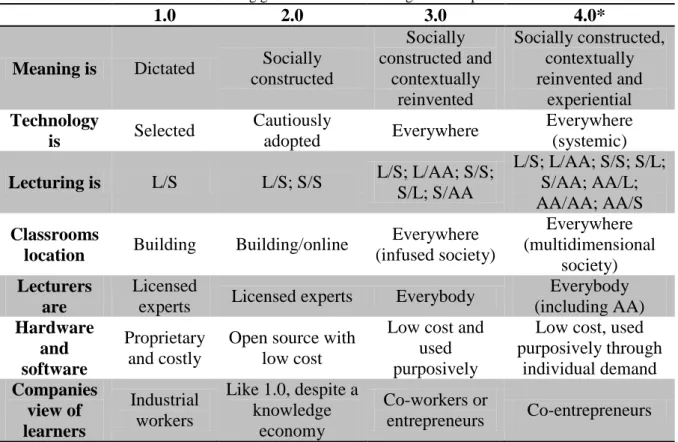
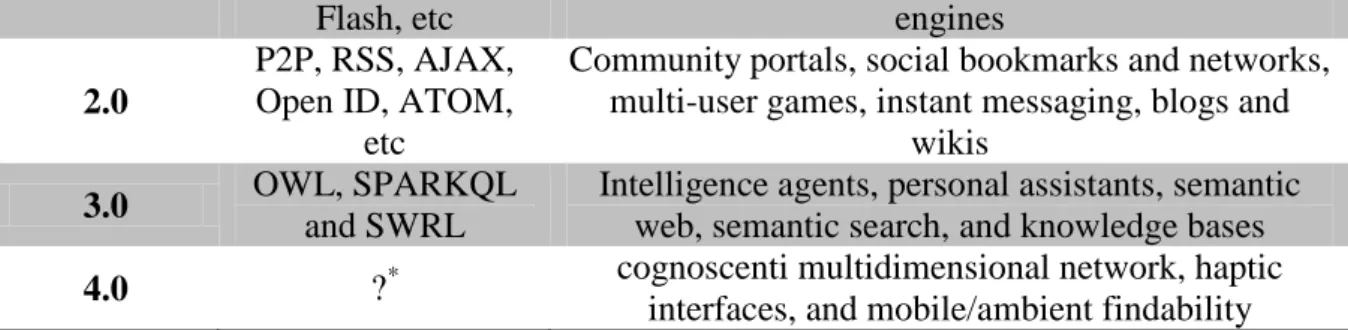
Despite the prior explanations is vital to compare each generation scheme (table 1) as well as technologies versus examples (table 2).
Table 1. E-learning generations vs. technological examples
1.0 2.0 3.0 4.0*
Meaning is Dictated Socially constructed Socially constructed and contextually reinvented Socially constructed, contextually reinvented and experiential Technology is Selected Cautiously adopted Everywhere Everywhere (systemic) Lecturing is L/S L/S; S/S L/S; L/AA; S/S; S/L; S/AA L/S; L/AA; S/S; S/L; S/AA; AA/L; AA/AA; AA/S Classrooms
location Building Building/online
Everywhere (infused society) Everywhere (multidimensional society) Lecturers are Licensed
experts Licensed experts Everybody
Everybody (including AA) Hardware and software Proprietary and costly
Open source with low cost
Low cost and used purposively
Low cost, used purposively through individual demand Companies view of learners Industrial workers Like 1.0, despite a knowledge economy Co-workers or entrepreneurs Co-entrepreneurs Legend: L- Lecturer| S- Student| AA- Artificial Agent|* authors education 4.0 vision
Source: Adapted from Moravec (2009)
Table 2. E-learning generations vs. technological examples E-learning generation Technologies (standards) Examples 1.0 HTTP, HTML, SOAP, XML, Java,
Content portals, websites, enterprise portals, databases, file servers, file sharing and search
Flash, etc engines
2.0
P2P, RSS, AJAX, Open ID, ATOM,
etc
Community portals, social bookmarks and networks, multi-user games, instant messaging, blogs and
wikis
3.0 OWL, SPARKQL
and SWRL
Intelligence agents, personal assistants, semantic web, semantic search, and knowledge bases
4.0 ?* cognoscenti multidimensional network, haptic interfaces, and mobile/ambient findability Legend: * hitherto, literature about 4.0 generation does not recognise potential standards
Source: Adapted from Turban et al., 2010
Ethical and social dilemmas: Evaluating e-learning!
Authors’ argument
E-learning assessment literature is vast and investigates topics like information systems management, organisations, “educational actors”, content, culture, ethics, communication, pedagogy and strategies. The majority of contemporary frameworks neglect a multidimensional analysis which moral reasoning and e-learning overlaps require; so, the authors acknowledge the work of Stahl (2002a).
Stahl’s framework
Stahl’s matrix exhibits three layers: micro-level (individuals); meso-level (e-learning project); macro-level (educational institutions). Yet, the author denotes that “the individual on the micro level is also part of meso level organizations, in this case of a university, and belongs to a macro level society or state” (Stahl, 2002b, pp.56).
Figure 1. E-teaching framework
Source: Stahl (2002, pp. 143)
In each layer two dimensions arise: (i) if the moral problem is theoretical or practical; and, ii) if the ethical relevant behaviour falls into a descriptive, normative or meta-ethical theory. Despite the interdependent relationship, namely between normative and descriptive ethics, Stahl (2002a) concludes that “fundamental problems of ethical research is that it always has a moral quality itself” (p. 141). Nevertheless, which ethical dilemmas require moral reasoning in digital learning environments? This
author acknowledges cheating, intellectual property, plagiarism and copyright violations, privacy versus surveillance, personal data versus identity, integrity and honesty.
Analysis
Disclosure
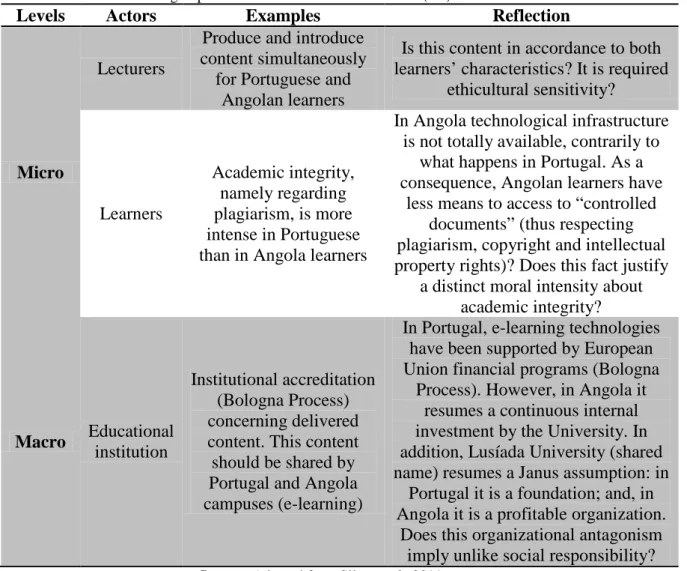
Disclosure is the act or procedure of revealing or exposing, as well as, formulating a revelation (The Free Online Dictionary, 2013). That is, e-learning technologies shape Stahl’s matrix (micro and macro levels) as Lusíada Universities empirical data demonstrate.
Table 3. E-learning implementation in Lusíada Universities (1.0) versus Stahl’s matrix
Levels Actors Examples Reflection
Micro
Lecturers
Produce and introduce content simultaneously
for Portuguese and Angolan learners
Is this content in accordance to both learners’ characteristics? It is required
ethicultural sensitivity? Learners Academic integrity, namely regarding plagiarism, is more intense in Portuguese than in Angola learners
In Angola technological infrastructure is not totally available, contrarily to
what happens in Portugal. As a consequence, Angolan learners have
less means to access to “controlled documents” (thus respecting plagiarism, copyright and intellectual property rights)? Does this fact justify
a distinct moral intensity about academic integrity? Macro Educational institution Institutional accreditation (Bologna Process) concerning delivered content. This content should be shared by Portugal and Angola campuses (e-learning)
In Portugal, e-learning technologies have been supported by European Union financial programs (Bologna
Process). However, in Angola it resumes a continuous internal investment by the University. In addition, Lusíada University (shared name) resumes a Janus assumption: in
Portugal it is a foundation; and, in Angola it is a profitable organization.
Does this organizational antagonism imply unlike social responsibility?
Source: Adapted from Silva et al., 2011
Today: E-learning at a glance
In order to debate moral reasoning in future learning environments, the authors explore Lusíada universities empirical data. The continuous utilisation of social media in Portugal and Angola denotes interesting differences as table 4 denotes. Note that in Portuguese Lusíada social media is a key component for communication and learning, contrarily to Angola.
Table 4. E-learning 2.0 implementation in Lusíada Universities
Levels Actors Examples Reflection
Micro
Lecturers
Portuguese lecturers interact with learners, although without introduce content (organisational policy), while in
Angola lecturers create Lusíada Facebook pages (absence of organisational policy) with non-authorised content (copyright and
intellectual property violation)
How to improve Angolan lecturers’ moral decision making?
Learners
In Angola is common to have false learners groups or Facebook pages (identity issues), as well as containing information that violates copyright and
intellectual property (e.g., books)
Academic integrity is more intense in Portugal. How to change the status quo and improve learners’ moral decision making?
Source: Authors
Outlook: The Future of e-learning
Future learning environments (3.0 and 4.0) comprise human (lecturers and learners) and non-human agents; so, these will reinvent the prior ethical dilemmas as the following queries denote:
1. Are the ethicultural challenges analogous in each e-learning generation? (query 1);
2. Assuming the non-human agent as knowledge creator, who belongs the intellectual property rights? (query 2);
3. Who is morally responsible for such knowledge? (query 3);
4. What is moral reasoning in these learning environments? (query 4).
Query 1: ethicultural sensitivity
Panã (in press) argues that non-human moral intelligence can provide a basis for cultural abilities, since acknowledge a compliance with norms and values. If future learning environments embrace simultaneously a physical and virtual relationship with individuals through haptic devices; then, is reasonable to claim that intelligence is distributed across the social, natural, cultural and technological environment (“glocal memory”) (Goertzel, 2008). However, is the authors’ belief that ethicultural sensitivity will continue to be a wishful thinking because if a system will learn and evolve with individuals’ utilisation, a ethicultural human user will shape a non-ethicultural agent despite memetic computing development. Memetic computing is an attempt to capture the biological-cultural combination and optimisation in non-human agents (Emergent Technologies Task Force on Memetic Computing, 2010), i.e., ethicultural sensitivity in non-human agents.
Query 2: intellectual property rights
With “fully” cognoscenti non-human agents that produce knowledge according to our behavioural profiles and activities (Nash, 2008) or emotional states (Spivack, 2007), the human perception of creativity and ownership will be tremendously reshaped. In spite this assumption is a fuzzy debate due to:
• autonomic learning- inner mechanism of self-directed learning that resumes learners’ attitudes, competences and learning strategies (Wang and Li, 2007); • autonomic non-human learning- systems that now themselves or ought to
create self-knowledge (Cofino et al., 2003).
If knowledge can be produced by a human or non-human agent what will be the outcome? Presuming autonomic human learning, how users and knowledge “owners” of these technologies will balance their contribution? In case of autonomic non-human learning, who belongs intellectual property rights? To non-humans, that assume a “pastoral care” relationship or, to the autopoietic non-human agent... This legal quandary is also challenged by devirtualisation (immersive learning environments): extensions of our “self” and knowledge that configure multiple methodological and ontological perceptions (Baofu, 2008) which is related to informational existentialism (Costa and Silva, 2010).
Query 3: moral responsibility
From the previous queries, it is possible to debate the moral responsibility. Its theoretical ground acknowledge intellectual property rights legal subjectivity (Gutwirth and Hert, 2006), since a non-human agent own actions continue to illustrate difficulties about copyright law. In fact, their polymorphic behaviour leads to unpredictable outcomes which even hurdles the legal and moral analysis (Shoyama, 2005). Hence, two arguments exclude non-human agents as “knowledge creators” (Groom, 2004): (i) technological exclusion, defined as design measures to prevent or restrain copyright or related rights; (ii) contractual exclusion, internet structure facilitates contractual interactions in a variety of ways, as for instance immediate communication regarding agreement terms and conditions.
Query 4: moral reasoning
Himma (2009) refers two conditions for moral agency: free choice (rational agent); and, the agent ought to understand the consequences of its actions. The issue of conscience within non-human agents assumes a traditional anthropocentric conception (Floridi and Sanders, 2004), despite do not possess functional consciousness (Torrance, 2008). Although these non-human agents produce moral dangers, which presume to ascribe moral reasoning through a positive retort to three queries (Sullins, 2006): (i) are non-human agents considerably autonomous?; (ii) what is the meaning of intentional behaviour in such agents?; (iii) are these morally responsible, or not? Traditionally, autonomy acknowledges a condition or state regarding self-government and self-determination; although, it remains unclear if individuals value equally autonomy (Christman, 2011). The complex interaction among both entities will produce unforeseen results in a certain context, as well as is virtually impossible to ignore that such non-human agents’ autonomy depends on external information and design constraints (Gotterbarn, 2010). From the above assumptions it is reasonable to refer that a non-human agent simply entail moral agency, since
“quasi-responsibility indicates that the speaker intends to use the idea of a social construction for the purpose of ascribing a subject to an object with the aim of attributing sanctions (the heart of responsibility) without regard to the question whether the subject fulfils the traditional conditions of responsibility” (Stahl, 2006, pp. 210).
Discussion and conclusion
E-learning evolution is a current topic within literature, although the novel dilemmas that future learning environments will pose has been neglected as this paper denotes. From the analysis is possible to argue that education 3.0 and 4.0 will produce intricate quandaries regarding moral reasoning, since old ethical issues continue and novel ones arise.
Probably the most relevant is the interaction among both entities, because it is feasible to question if an unmoral person may influence negatively the autopoietic non-human agent despite its capabilities to evolve. In case of a positive answer the ethical dilemmas will proliferate; if not, a behavioural change is possible? Hitherto the retort is blurry, although the concept of moral exemplar may provide important clues. A moral exemplar is an individual that achieve continued successful performance through ethical behaviour (Huff and Barnard, 2009), so a moral lecturer or learner may induce a positive influence over the non-human agent.
In spite of be complex and uncertain to predict learning environments features, is the authors believe that education 5.0 will reshape the following idea: “localitas (as a necessary quality of bodies), connectivitas (fusion status about multi-glocal experiences), and humanitas (capacity for self-consciousness, self-exploration, and self-determination as the Roman philosopher Cicero describes) (Silva, Alvarez and Rogerson, 2011, pp. 148)”. I.e., localitas will merge the concept of “self” and “digital self”; and, connectivitas will incorporate learners distributed experiences due to systemic and immersive environments.
Acknowledgments
For financial assistance pertaining ETHICOMP 2013, the first co-author gratefully recognises Autónoma University of Lisbon.
References
Abram, S. (2003), A primer on e-learning... The framework, the market, the players, KM World, 12, 2, online at http://www.kmworld.com/Articles/Editorial/Features/A-primer-on-e-learningThe-framework-the-market-the-players-9436.aspx, accessed 01.03.2013.
Baofu, P. (2008), The future of post-human knowledge: A preface to a new theory of methodology and ontology, Woodhead Publishing Limited, Oxford.
Christman, J. (2011), Autonomy in moral and political philosophy, Stanford University, online at http://plato.stanford.edu/entries/autonomy-moral/, accessed 05.03.2013.
Cofino, T. et al. (2003), Towards knowledge management in autonomic systems, in Nyberg, K. (ed), IEEE International Symposium on Computers and Communications 2003, IEEE, Kiris-Kemer, 789-794.
Costa, G. J. M., Silva, N. S. A. and Fonseca, T. F. R. (2012), Moral reasoning in knowledge authoring: An e-learning 4.0 analysis!, in Abramovich, S. (ed), Computers in Education- Volume 1, Nova Science Publishers, Hauppauge, NY, 135-154.
Costa, G. J. M. and Silva, N. S. A. (2010), Informational existentialism! Will
information ethics shape our existence?, International Review of information Ethics, 13, 33-41.
Crump, N. and Costea, B. (2003), Pedagogical objects in management education: A cultural historical critique, Lancaster University, online at
http://eprints.lancs.ac.uk/26287/1/Pedagogical_Objects_Lancaster_Working_Paper.pd f, accessed 02.03.2013.
Downes, S. (2005). E-learning 2.0, Elearn Magazine, online at
http://www.elearnmag.org/subpage.cfm?section=articles&article=29-1, accessed 02.03.2013.
Emergent Technologies Task Force on Memetic Computing (2010), Memetic computing, Nanyang Technical University, on line at
http://www3.ntu.edu.sg/home/asysong/ETTC/ETTC%20Task%20Force%20-%20Memetic%20Computing.htm, accessed 04.03.2013.
Floridi, L. and Sanders, J. W. (2004), On the morality of artificial agents, Mind & Machines, 14, 3, 349-379.
Frey, B. F. (2000), The impact of moral intensity on decision making in a business context, Journal of Business Ethics, 26, 3, 181-195.
Goertzel, B. (2008), Glocal memory: A new perspective on knowledge representation, neurodynamics, distributed cognition, and the nature of mind, Goertzel, online at
http://www.goertzel.org/dynapsyc/2008/glocal_memory.pdf, accessed 03.03.2013. Gotterbarn, D. (2010), Autonomous weapon’s ethical decisions; “I’am sorry Dave; I am afraid I can’t do that”, in Arias-Oliva, M. et al. (eds), ETHICOMP 2010,
University of Rovira i Virgili, Tarragona, 219-229.
Groom, J. (2004), Are “agent” exclusion clauses a legitimate application of the EU database directive? SCRIPTed- A Journal of Law, Technology & Society, 1, 1, 83-118.
Gutwirth, S. and Hert, P. D. (2006), Law and autonomic computing: Mutual transformations (GOA Proposal), Free University Brussels, Brussels.
Huff, C. and Barnard, L. (2009), Moral exemplars in the computing profession, IEEE Technology and Society Magazine, 28, 3, 47-54.
Jones, T. (1991), Ethical decision making by individuals in organizations: An issue-contingent model, Academy of Management Review, 16, 2, 366-395.
Kambil, A. (2008), What is your 5.0 web strategy? Journal of Business Strategy, 29, 6, 56-58.
Kurzweil, R. (2009). The intelligent universe, Soft Technics, online at
http://softtechnic.blogspot.com/2009/09/intelligent-universe.html, accessed 02.03.2013.
Moravec, J. (2009), Towards society 3.0- A new paradigm for XXI century education, Slide Share, online http://www.slideshare.net/moravec/toward-society-30-a-new-paradigm-for-21st-century-education-presentation, accessed 04.03.2013.
Nash, S. S. (2008), Web 3.0, web 4.0 and personal agents: Will they open or restrict choice?, E-learning Queen, online at http://elearnqueen.blogspot.com/2008/10/web-30-web-40-and-personal-agents-will.html, accessed 02.03.2013.
Panã, L. (2013, in press), Human and artificial agents with moral intelligence, in Costa, G. et al. (eds), CEPE 2013, Autónoma University of Lisbon, Lisbon, paper 51. Reis, A. (2011), From connectivism to “ethicism”, in Costa, G. J. M. (ed), Handbook of Ethical and Social Issues in Knowledge Management: Organizational Innovation, IGI Global, Hershey, PA, 113-130.
Richardson, H. S. (2013), Moral reasoning, Stanford University, online at
Shoyama, R. M. (2005), Intelligent agents: Authors, makers, and owners of computer-generated works in Canadian copyright law, Canadian Journal of Law and
Technology, 4, 2, 129-140.
Silva, N. S. A., Alvarez, I. M. S. B. and Rogerson, S. (2011), Glocality, diversity and ethics of distributed knowledge, in Costa, G. J. M. (ed), Handbook of Ethical and Social Issues in Knowledge Management: Organizational Innovation, IGI Global, Hershey, PA, 131-158.
Silva, N. S. A. et al. (2011), The evolution of E-learning Management Systems- An ethical approach, International Journal of Cyber Ethics in Education, 1, 3, 12-24. Silva, N. S. A., Rogerson, S. and Stahl, B. C. (2010), “Ethicultural” sensitivity in e-learning: Discussing Lusíada universities empirical findings, in Arias-Oliva, M. et al. (eds), ETHICOMP 2010, University of Rovira i Virgili, Tarragona, 500-511.
Spivack, N. (2007), How the webOS evolves, Nova Spivack, online at
http://novaspivack.typepad.com/nova_spivacks_weblog/2007/02/steps_towards_a.ht ml, accessed 03.03.2013.
Stahl, B. C. (2006), Responsible computers? A case for ascribing quasi-responsibility to computers independent of personhood or agency, Ethics & Information Technology, 8, 4, 205-213.
Stahl, B. C. (2005), E-voting: An example of collaborative e-teaching and e-learning, Journal of Interactive Technology & Smart Education, 2, 1, 19-30.
Stahl, B. C. (2002a), Ethical issues in e-teaching- A theoretical framework, in King, G.
et al. (eds), Proceedings of Inspire VII, Quality in Learning and Delivery Techniques,
The British Computer Society, Limerick, 135-148.
Stahl, B. C. (2002b), Ethics and e-teaching: The student’s perspective, Communications of the IIMA, 2, 3, 51-62.
Sullins, J. P. (2006), When is a robot a moral agent? International Review of Information Ethics, 12, 23-30.
Teten, D. (2007, June), Web 3.0: Where are we headed?, Paper presented at the Web 2.0 New York Conference, New York, NY.
The Free Online Dictionary (2013), Disclosure, The Free Online Dictionary, online at
http://www.thefreedictionary.com/disclosure, accessed 04.03.2013.
Torrance, S. (2008), Ethics and consciousness in artificial agents, Ethics and Information Technology, 22, 4, 495-521.
Tow, D. (2010), Future web, Future Web, online at,
http://futurewebblog.blogspot.com/2010/06/future-of-web.html, accessed 03.03.2013. Turban, E. et al. (2010), Electronic commerce 2010: A managerial perspective, 6th ed, Prentice Hall, Upper Saddle River, NJ.
Turban, E. et al. (2006), Electronic commerce 2006: A managerial perspective, 4th ed, Prentice Hall, Upper Saddle River, NJ.
Wang, J. and Li, F-z. (2007), Autonomic learning model and algorithm based on DFL, in Lin, T. Y. (ed), Granular Computing 2007, IEEE, Fremont, CA, 259-264.
Wenmoth, D. (2006), OLE scope, Core Education Ltd, online at http://blog.core-ed.org/derekarchives/archives/OLE%20Scope.pdf, accessed 02.03.2013.