UNIVERSIDADE DE LISBOA
FACULDADE DE CIÊNCIAS
DEPARTAMENTO DE BIOLOGIA ANIMAL
INFLUENCE OF ENVIRONMENTAL VARIABLES ON THE
PREDATORY SUCCESS OF THE IBERIAN WOLF IN THE
NORTH OF PORTUGAL
MESTRADO EM BIOLOGIA DA CONSERVAÇÃO
INÊS BERNARDINO DA SILVA
Dissertação Orientada por:
Prof. Dr. Francisco Petrucci-Fonseca
Acknowledgements
I must first thank Professor Francisco Fonseca and Grupo Lobo for providing me with the opportunity and means to study such a fascinating subject, it’s been a roller coaster (sometimes literally, mountain dirt roads are no joke!).
I couldn’t have done it without Barbara Domken, tireless in her help during the field work part of this thesis. Through the fog, the snow, heavy rain and scorching sun, we prevailed!
I also thank my friends (special thanks to Patrícia Jorge for helping me with my inaptitude for programming, and Teresa and Tânia for putting up with me in general) for being my pillars, my biggest support in all
circumstances, and my secondary source of hugs (first were my cats, who were hugged when they felt like it) even when they had their own research to worry about. That said I have to thank my cats Luna and Nalla for always staying with me in the long months of writing, occasionally reminding me their bellies needed petting. To researchers Gonçalo Costa and Luís Rosalino for the guidance and help, and professor Marília Antunes for always having fast and effective words of help in times of desperate need.
Last but never least, to chocolate, copious amounts of chocolate that kept me focused and in a good mood to write, and my blood sugar perilously close to hyperglycemia.
Resumo
A predação de animais domésticos por carnívoros de grande porte é fonte de conflito entre estes e as populações locais, e é particularmente problemática nos casos em que estão envolvidos predadores com estatuto protegido. O lobo ibérico (Canis lupus signatus), é um desses predadores.
O estudo do comportamento predatório do lobo e de que variáveis ambientais estão associadas ao seu sucesso, até agora pouco conhecidas, é vital para a compreensão e minimização destes conflitos, e o nosso objectivo foi identificar que variáveis teriam maior influência, positiva ou negativa, na escolha de um local de ataque. Para isso, recolhemos dados relativamente a 28 variáveis ambientais em 250 locais onde ocorreram mortes de gado causadas pelo lobo ibérico e em 250 locais aleatórios nas proximidades dos locais de ataque, de tal forma que um local aleatório se encontrasse sempre num local onde fosse( pelo menos teoricamente) possível ocorrer um ataque.
A análise dos dados permitiu-nos verificar que a distância a objectos inultrapassáveis pela presa, a existência de plantações, o declive, a distância de aproximação por um predador e a distância a povoações diminuem significativamente as odds de um ataque consoante o seu número aumenta. Por outro lado, distância à estrada, a existência de pastos e a altitude aumentam significativamente as odds de ataque consoante o seu valor aumenta.
Em estudos futuros, recomendamos a análise destes dados sazonalmente, a recolha de dados relativamente a factores como o tamanho da manada, e a construção de um mapa de risco para a área tendo em conta os mais recentes territórios das alcateias.
Palavras-chave: Canis lupus signatus, lobo, gado, predação, variáveis ambientais
Summary
Livestock depredation by large carnivores and their persecution by local communities are a major conservation concern, especially when it concerns protected species like the Iberian wolf. Understanding which environmental factors influence the wolves’ predatory success is vital for conservation efforts and reducing conflict.
To clarify the effect of environmental variables on the hunting habits of the Iberian wolf, we compared data on 28 environmental variables at 250 randomly selected sites and 250 sites where attacks by wolves on livestock had occurred using a model from which we calculated odds ratio.
Our model found that habitat type (pasture and crops), altitude, slope, and distances to village, road, insurmountable obstacle and distance of approximation by predator to be the most relevant to the occurrence of an attack.
Kills occurred in places with less visibility for the prey, with smaller distances to insurmountable obstacles that would make it harder for the prey to detect a predator and evade it. They also occurred in areas of pasture and significatively closer to villages, and at higher altitudes.
To avoid livestock depredation, a stable and significant population of wild ungulates should be maintained, as larger numbers of wild ungulates would doubtless reduce the human-predator conflict and the amount of compensation money the Portuguese government has to attribute every year. This must be coupled with the appropriate methods for livestock raising, including the use of guard dogs.
For future studies, we recommend the seasonal analysis of the data now obtained, and the collection of data regarding factors such as herd size.
Resumo alargado
A subespécie Canis lupus signatus (Cabrera 1907) tinha, até ao início do século XX, uma distribuição ampla na Península Ibérica(Petrucci-Fonseca and Álvares, 1997). Desde então, o número tanto de indivíduos como de alcateias diminuíu de forma alarmante, e a espécie foi declarada protegida em 1990. Hoje em dia, é uma subespécie cuja conservação é prioritária, e está incluída na Directiva Habitats( anexos II e IV, 92/43/CEE), na Convenção de Berna e no CITES.
Apesar disto, a construção de auto-estradas e a consequente urbanização resultou na fragmentação do habitat natural do lobo devido a um efeito de barreira e a uma maior mortlidade com várias causas, incluindo mortalidade directa devido a atropelamentos e caça furtiva(Rio Maior et al., 2003).
O lobo é frequentemente descrito como uma espécie oportunista, (Carbyn 1988, Cuesta et al., 1991, Salvador &Abad 1987, Urios 1995) mas estudos mostram que esta espécie selecciona positivamente presas selvagens sempre que estas estejam disponíveis (Ansorge et al., 2006, Barja 2009, Grazzola et al. 2005, Jedrzejewski et al., 1992, Nowak et al., 2005, Smietana 2005, Smietana and Klimek 1993, Valdmann et al., 2005). Por este motivo, os factores limitantes ao crescimento e sobrevivência do lobo ibérico em Portugal, e as razões pelas quais a espécie depende de animais domésticos para a sua sobrevivência, são tanto o número limitado de presas domésticas disponíveis e a fragmentação e destruição do seu habitat natural.
Os ataques a gado no conselho são comuns e regulares. Numa tentativa de proteger o Lobo Ibérico, o governo português desenvolveu legislação que não só proíbe que indivíduos da espécie sejam mortos, como introduziu um programa de compensação monetária direccionado a donos de gado que sofram prejuízos com os ataques (Lei 90/88 de 13 de Agosto e decreto 139/90 de 27 de Abril), e que ainda está em vigor atualmente. Este estudo foi realizado no distrito de Vila Real, no Norte de Portugal, que cobre uma área de 4.328Km2 . Uma vez que o gado pasta tradicionalmente em regime de liberdade nesta parte do país, as
características ambientais e topográficas podem ser de especial importância para a sua sobrevivência. O objectivo deste estudo foi identificar que características num determinado lugar influenciavam positiva ou negativamente a escolha de um lugar de ataque. Também procurámos descobrir se a presença de determinada característica num dado local aumentava ou dinimuía a propensão desse local para a ocorrência de um ataque e, se sim, em que medida.
Foram recolhidos dados de 500 locais (250 locais aleatórios e 250 locais onde tinham ocorrido ataques de lobo, estes últimos retirados de um conjunto maior de dados fornecidos pelo ICNF).
Os pontos aleatórios foram obtidos em ArcGIS e Excel criando uma zona tampão de um mínimo de 300m e um máximo de 2Km à volta da coordenada GPS de um local de ataque.Á chegada às coordenadas de cada um dos 500 locais, foi definida uma área com raio de 150m onde todas as medições foram feitas. Em todos os locais, as variáveis recolhidas foram:
- Tipo de habitat (bosque de carvalho, floresta de pinheiros, pastos, zona arbustiva, formações rochosas, zonas de cultivo e outras);
- Tamanho do coberto vegetal dominante ( solo nú, <30cm, 30cm-1m, >1m): - Declive e orientação da encosta;
- Rugosidade do terreno (baixo, médio ou alto);
- Posição das presas (vale, encosta ou cume) e altitude;
- Distância a área florestal mais próxima, a obstáculos intransponíveis, obstáculos retardantes e distância mínima de aproximação por um predador sem detecção:
- Distância ao estradão, à estrada, povoação e curso de àgua mais próximos.
O nosso objetivo ao analisar os dados foi encontrar diferenças significativas entre as características de locais aleatórios e as características de um local onde tinha ocorrido a morte de um animal. Para todos os testes, a hipótese nula foi definida como a inexistência de diferenças entre locais de morte e locais aleatórios.
Os dados pertencentes às 28 variáveis não tinham normalidade e foram analisados de acordo com esta limitação, tendo posteriormente sido construído um modelo parcimonioso com as variáveis mais influentes na escolha de um local de ataque. Este processo foi complexo, uma vez que sopusemos que várias das
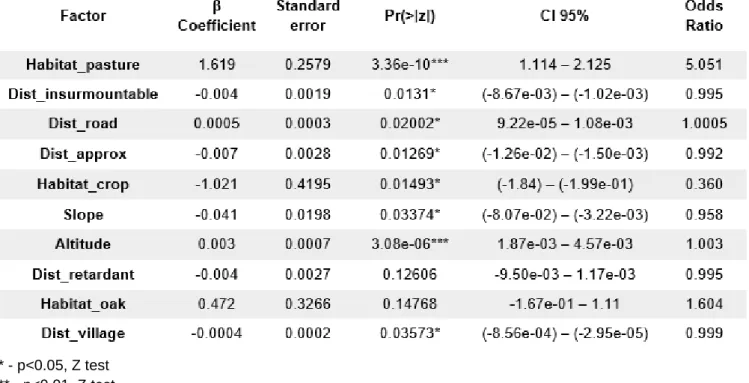
O modelo que em última instância obtivémos indicou-nos que a existência de campos agrícolas (O.R.=0.36, p<0.05), o declive(O.R.=0.95, p<0.05), a distância a obstáculos intransponíveis(O.R.=0.99, p<0,05), a distância de aproximação de um predador (O.R.=0.99, p< 0.05) e a distância a uma
povoação(0.99, p<0.05) todas reduzem significativamente a chance de ocorrência de ataque conforme o seu valor absoluto aumenta. Por outro lado, a existência de pastagens(O.R.=5.05, p<0.001), a altitude
(O.R.=1.003, p<0.001) e a distância a estradas (OR.=0.99, p<0.05) todas aumentam significativamente a chance de ataque.
A interconectividade entre os diferentes factores ambientais testados torna dificil avaliar quais destes factores são os mais influentes, e é possível que tenhamos uma ou mais variáveis de confundimento.
A nossa análise sugere que o gado é mais susceptível a ataque em locais de visibilidade mais reduzida para a presa. Distâncias mais pequenas a obstáculos intransponíveis parecem aumentar a chance de um ataque, o que pode ser explicado por permitir aos predadores aproximarem-se das presas sem serem detectados (a distância de aproximação também foi significativamente menor em locais de ataque) e, assim, evadirem os comportamentos defensivos das mesmas. A fuga nestes casos será também muito difícil, se não impossível. Maiores altitudes parecem aumentar a chance de ataque, o que pode ser explicado pelo facto de uma grande parte dos animais atacados serem cabras (302 indivíduos), que tradicionalmente pastam a maiores altitudes. A presença de pastos foi de longe o factor com maior importância na escolha de um local de ataque (O.R.=5.05). Isto pode ser simplesmente porque os animais domésticos pastam mais frequentemente em áreas de pasto, e é nestas que os predadores os encontram mais frequentemente, juntamente com o facto de os cercados na zona de estudo raramente oferecerem a protecção adequada.
Não tomámos em conta o tamanho das manadas, e este pode ser um factor com grande influência no que toca à escolha de um local de ataque (Bradley and Pletscher, 2005, Kaartinen et al. 2009), porque rebanhos maiores geralmente necessitam de pastar mais longe das aldeias e não têm cercas a protegê-los, podendo assim tornar-se alvos mais fáceis.Assumimos também que as coordenadas fornecidas pelo ICNF diziam respeito ao local exacto do ataque, apesar de isto não ser sempre necessariamente verdade, o que pode influenciar medidas como a distância à estrada ou à povoação mais próxima, e estas foram dadas como significativas pelos testes Z feitos ao nosso modelo.
O estudo de que características num dado local são importantes para a maneira como os lobos escolhem o seu local e ataque é vital para evitar conflito entre humanos e outros predadores, o que é especialmente importante no caso de espécies protegidas como o lobo ibérico. Para evitar os ataques a animais domésticos, uma população estável e significativa de presas selvagens deve ser mantida, e populações existentes de veado e corço deveriam ser reforçadas (Barja, 2009).
A cooperação com associações de caçadores seria benéfica para ambas as partes, ja que os caçadores são geralmente responsáveis pela gestão de muitas áreas onde a presa do lobo está presente. Maiores números de ungulados selvagens reduziriam sem dúvida o conflito humano-lobo e a quantia de dinheiro que o estado português gasta todos os anos. Tal estratégia tem de ser usada em conjunto com métodos apropriados de criação de gado (Meriggi and Lovari 1996), incluindo o uso de cães de gado e a redução do tamanho das manadas (Vos, 2000).
O facto de termos encontrado várias variáveis influentes na escolha de um local de ataque não significa necessariamente que estas sejam as únicas a ter esta influência. Pelo contrário, fatores como a condição física dos animais, condições climatéricas ou se os animais estavam ou não a ser vigiados na altura do ataque devem ser muito importantes no processo complexo pelo qual os lobos escolhem a altura e o local de um ataque (Kunkel and Pletcher, 2000).
De futuro, gostaríamos de proceder à recolha de dados quanto a estes aspectos, bem como à análise sazonal dos dados já recolhidos. A construção de um mapa de risco que tenha em conta tanto os resultados deste estudo para esta área (e a execução deste estudo noutros distritos do país em que ataques de lobo a gado sejam um problema) e os territórios das alcateias da área também deveria ser considerada.
Table of Contents
Page
Acknowledgements
2
Resumo
3
Summary
3
Resumo alargado
4
Abstract
7
Introduction
7
Material and Methods
9
Results
11
Discussion
12
Final Considerations
12
Influence of environmental variables on the predatory success of the Iberian Wolf in
the north of Portugal
ABSTRACT
Livestock depredation by large carnivores and their persecution by local communities are a major conservation concern, and understanding which environmental factors influence the wolves’ predatory success is vital for conservation efforts.
To clarify the effect of environmental variables on the hunting habits of the Iberian wolf, we compared data on 28 environmental variables at 250 randomly selected sites and 250 sites where attacks by wolves on livestock had occurred using a model from which we calculated beta coefficients and odds ratio.
Our model found that habitat type (pasture and crops), altitude, slope, and distances to village, road, insurmountable obstacle and distance of approximation by predator to be the most relevant to the occurrence of an attack. O.R. results indicate that existence of habitat type “crop”, slope, distance to insurmountable obstacles, distance of approximation by predator and distance to village significatively reduce the likelihood of an attack occurring with their presence (for presence/absence variables) as their value increases. On the other hand, the existence of habitat type “pasture”, altitude and distance to road, all significatively
increase the likelihood of an attack.
Kills occurred in places with less visibility for the prey, with smaller distances to insurmountable or retardant obstacles that would make it harder for the prey to detect a predator and evade it. They also occurred in areas of pasture, significatively closer to villages, and at higher altitudes.
Keywords: Canis lupus signatus, domestic ungulates, wolves, Portugal, topographic variables, livestock depredation.
Introduction
The subspecies Canis lupus signatus (Cabrera 1907) was, until the beginning of the 20th
century, widespread in the Iberian Peninsula (Petrucci-Fonseca and Álvares, 1997). Since then, the number of both wolf packs and individuals has decreased alarmingly, and the species was declared as protected in 1990. Nowadays, it is a subspecies whose conservation is prioritary, and is included in the Habitats Directive (annexes II and IV, 92/43/CEE), Bern Convention (Annex II) and CITES.
Despite this, the construction of highways and consequent urbanization has resulted in habitat fragmentation due to barrier effect and higher mortality from several causes, including direct mortality from cars and poaching (Rio Maior et al.,
In spite of having often been described as an opportunist species (Carbyn 1988, Cuesta et al., 1991, Salvador &Abad 1987, Urios 1995) studies have also shown that wolves positively select wild prey whenever those are available (Ansorge et al., 2006, Barja 2009, Grazzola et al. 2005, Jedrzejewski et al., 1992, Nowak et al., 2005, Smietana 2005, Smietana and Klimek 1993, Valdmann et al., 2005). Therefore, the limiting factors for the growth and survival of Iberian wolf populations in Portugal, and the reason why wolves rely on cattle for sustenance, are both the limited number of wild prey available and the fragmentation of their natural habitat.
The district of Vila Real, where this study was conducted, has in the last decade been heavily affected by forest fires (representing 14.6% of the total of national burned area from 2001 to 2013 with
construction and urbanization in recent years, including the construction of 3 major highways ( IP4, A24 and A7). All these factors have contributed to the fragmentation of both the Iberian wolf population and that of one of their main wild prey, the roe deer (whose distribution has otherwise been expanding) (Torres et al., 2015). There is not much information available regarding poaching on roe deer, but authorities acknowledge it to be a serious problem for the populations of both roe deer and its predator (Torres et al., 2015).
All of these factors contribute to making attacks on livestock more common and regular in this area. In an attempt to protect the Iberian wolf, the Portuguese government developed a legal framework which not only banned the killing of wolves, but introduced a compensation program for livestock owners who suffer losses from wolf attacks (Law 90/88, of August 13th and decree 139/90, of April 27th), and which is still in place today.
Although some claims for compensation may be dubious in nature (Nyhus et al., 2005, Petrucci-Fonseca and Costa, personal communication), most kills of livestock are attributed to wolf attacks. This evaluation is made by ICNF (Instituto de Conservação da Natureza e das Florestas- Institute for Nature and Forests Conservation) technicians, who provided us with the locations of kill sites. These were revisited in this study, and a series of variables were measured. Some habitat features may be invaluable for prey attempting to escape predation by helping them either detect predators before they are within killing distance, or evading attack (Elliot et al. 1977, Kunkel and Pletscher 2000, Van Orsdal 1984).
As livestock is traditionally free-ranging in this part of the country, environmental and topographic characteristics may be especially important for their survival.
The aim of this study was to identify which characteristics in a given place-if any- influenced
the choice of place for an attack, positively or negatively. We also sought to see if the presence of a given characteristic increased or decreased the odds of attack occurrence, and if so, by how much.
Understanding these aspects will
contribute towards minimizing conflict in the area by helping us understand how to better protect livestock.
Material and Methods
Study area
This study was conducted in the district of Vila Real, in the North of Portugal, which covers an area of 432.800ha.
According to the last census, human population density is 136, 88 individuals per Km2 (INE-
Instituto Nacional de Estatística- National Institute of Statistics, 2011).
The climate in the region is a mixture of Mediterranean and Atlantic influences. It is a mountainous area, with altitudes up to 1548m. Winters are long, with negative temperatures and frequent frosts and snowfall, while in the summer temperatures often reach 40º.
The main tree species are pine (Pinus
pinaster), eucalyptus (Eucalyptus globulus),
chestnut (Castanea sativa) and oak (Quercus
robur and Quercus pyrenaica) (ICNF 2013), but
shrubland comprises a large part of the existing habitats. The main wild prey species available for the wolf are wild boar (Sus scrofa) and roe deer (Capreolus capreolus). Other mammal species that exist in the area include the red fox (Vulpes
vulpes), genet (Genetta genetta) and badger
(Meles meles).
Agriculture and livestock raising have long been two of the most important economic activities for local people, often shaping the habitat, but as human density decreases in response to socio-economic changes, so have these activities decreased in recent years (Census, 1991, 2001, RGA 1989, 1999) (INE 2010). Despite this, road density and construction of infrastructures (such as wind farms) keep increasing.
Data collection
Data was collected from 500 sites (250
random sites and 250 wolf attack sites provided by the ICNF).
Of the provided data on attack occurrence, which referred to attacks that occurred from Set 2013 to June 2014, 250 were selected and visited. A buffer area was set up around each attack location such that a random point would have to be at least 300m and at maximum 2Km from it.
The minimum distance ensured random points were not in the exact same places as attack sites. Maximum distance ensured the random points were somewhere where herds grazed and, more importantly, it insured that these random points were inside the wolf distribution area.
GPS coordinates for the random points were obtained by using both the Excel RAND function and ArcGIS (version 9.3.1) and marked on an IGeoE (Army Geographic Institute- Instituto Geográfico do Exército) military chart (1: 25.000 scale). Universal Transverse Mercator (UTM) was the chosen coordinate system, as it was used on both the ICNF wolf attack reports and the Portuguese military charts used in the field.
Upon arrival to the sites, we defined an area with a center on the location of the carcass (or accurate location of random site) and radius of 150m within which all the measurements were made.
In all of the sites, the variables we collected data on were:
-Type of habitat (oak woods, pine woods, pastures, bushes, rock formations, agricultural land and other);
-Dominant cover size (naked soil, <30cm, 30cm-1m, >1m);
- Slope and slope orientation;
- Rugosity of the terrain (low, medium or high); - Position of the prey (valley, slope or summit) and altitude;
-Distance to closest forest area,
insurmountable obstacles, retardant obstacles and minimum approximation distance that a predator could reach before being detected;
- Distance to dirt road, paved road, closest village and closest water source.
All of the distances were measured using either a Bushnell Yardage Pro rangefinder (for smaller distances) or a Garmin GPS (for greater distances. Altitudes and slope orientation were also measured using this).
Slope of the terrain was obtained using ArcGIS software, and rugosity was classified as “low” (0-25 cm), “medium” (25-50cm) or “high”
(>50cm).
Data analysis
Our objective when analyzing the data was to find significative differences between random and
de facto attack locations.
The null hypothesis was defined as the inexistence of differences between attack sites and random sites, and the dependent variable was, for all tests, “occurrence of attack”.
The 28 different variables were analyzed individually to test whether or not they differed between places with and without attacks. None of the data obtained had a normal distribution, according to a Shapiro-Wilk test (Norusis 1995), so non-parametric Mann-Whitney test was used for the quantitative data.
For the categorical variables- rugosity, position of prey, slope orientation and number of habitats- a two-way contingency table and X2 test were made
with R to compare different sites (significance level of p<0,05).
For the simultaneous analysis of several variables, multiple logistic regression was used. The variables, which were categorized to enter the model, required the use of a logistic regression, with the objective of making habitat characteristics that are likely to have an influence in wolf predation stand out.
A multiple regression analysis generates an equation that describes the relationship between the independent variables and the dependent variable (occurrence of attack).
The qualitative variables were defined as factors and a complete model with all variables was defined.
AIC (Akaike’s Information Criterion) was then used to select the best model to estimate depredation risk, as we supposed several of the variables would be related because of their very nature (Burham and Anderson, 2004, Kaartinen et al 2009).
Variables were subjected to a forward, backward and bidirectional stepwise inclusion process (Kunkel & Pletscher 2000), with identical results.
VIF (Variance Inflation Factor) was calculated for the optimized model, and the two factors with VIF>10 (two sizes of dominant cover size) were removed to avoid multicollinearity, which was important as we wished to assess the importance of individual factors.
Standardized coefficients (β) were estimated from the model to show which of the independent variables influenced the occurrence of a wolf attack the most. The exponentials of the coefficients were calculated to obtain the odds-ratio (OR) (Brito et al. 1999).
*- Kill site significantly different from random site (p<0, 05, Mann-Whitney test) **- Kill site significantly different from random site (p<0, 01, Mann-Whitney test) SD- Standard Deviation
Table 1-Univariate analysis- Habitat and spatial variables associated with wolf kill sites (n=250) and random locations (n=250) in the district of Vila Real
* - p<0.05, Z test ** - p<0.01, Z test
The OR is a measure of association between the dependent and independent variables. It indicates if the presence of a given independent variable in a site raises or reduces the odds of that site being suitable for the presence of the independent variable (in this case, the occurrence of attack). An odds-ratio value of 1 indicates that a given independent variable does not significantly contribute to define the dependent variable.
Results
Our database consisted of data on 28 environmental variables collected from 250 random locations and 250 locations where wolf attacks on cattle had occurred.
During the attacks on these 250 sites (which resulted in the death of one or more individuals), 281 of the animals killed were sheep (Ovis aries), 302 were goats (Capra hircus) 58 were cows (Bos
taurus) and 38 were of other species. We chose to
analyze an equal number of random and attack places because random places are, naturally, expected to have more variability than attack places and we wanted to avoid having a biased logistic regression (Hosmer & Lemeshow, 1989).
Univariate analysis
Resorting to univariate analysis, we verified that Distance to road (M-W U=26847 p<0,01), altitude (M-W U=23008 p<0,01) and
distance to forest (M-W U=28197, p<0,05) were all significantly smaller in random sites than in kill sites, while distance to retardant obstacles (M-W U=27234 p<0,05), distance to insurmountable obstacles (M-W U=27866 p<0,05) and slope (M-W U=24329 p<0,01) were significantly higher in random sites than in attack sites.
As for the qualitative variables, X2 test determined position of prey (X2=13.3d.f.=2, p =0.001), slope orientation (X216.06,d.f.=8,p=0.041), number of habitats (X2=12.83,d.f.=2,p= 0.0016) and dominant cover size (X2=74.81,d.f.=3,p<0,001) were the most significative.
For the remaining variables, significative differences between kill sites and random sites were not found.
Multivariable analysis
The most parsimonious model found by the stepwise AIC found 11 factors (habitat types pasture, oak and crops, dominant cover size, altitude, slope, and distances to village, road, insurmountable object, retardant object and distance of approximation by predator) to be the most relevant to the occurrence of an attack. After verifying V.I.F., the factor dominant cover size was removed due to its high value to reduce multicollinearity in the model, and habitat type oak
Table 2- Beta Coefficients estimate, Standard error, confidence interval and odds ratio associated with each characteristic deemed influential by our model
and distance to retardant obstacles were proved to have no significance
O.R. results indicate that existence of habitat type “crop” (0.36, p<0.05), slope (0.95, p<0.05), distance to insurmountable obstacles (0.99, p<0.05), distance of approximation by predator (0.99, p< 0.05) and distance to village (0.99, p<0.05) significatively reduce the likelihood of an attack occurring with their presence (for presence/absence variables) as their value increases.
On the other hand, the existence of habitat type “pasture” (5.05, p<0.001) altitude (1.003, p<0.001), and distance to road (1.0005, p<0.5), all significatively increase the likelihood of an attack.
Discussion
Factors affecting the vulnerability of prey and the way wolves hunt probably occur at different scales (Kunkel & Pletscher 2000), but for this study we sought to understand the global effect of variables on sites where wolf should be present. Our null hypothesis was that there were no significative differences between the kill sites and randomly selected sites in the study area. Interconnectivity between the different environmental factors tested makes it difficult to assess which factors are the most influential, and we may have confounding factors.
Our analysis suggests that cattle was more susceptible to attack in places with reduced visibility to the prey species. Lower distances to obstacles insurmountable to the prey (these were usually fences, walls, large rocks or dense bushes) seem to increase the odds of an attack, as this enables the wolves to approach the prey without being detected and to catch them by surprise, avoiding the preys’ defensive behavior. In case the prey attempts to flee, it is too close to an obstacle to be successful
Higher altitudes also seem to increase the odds of an attack occurrence. This can be explained by the fact that a large portion of the attacked animals were goats (302 individuals), which traditionally graze at higher altitudes and in an extensive regime.
The presence of a pasture was by far the factor with the highest OR (5.051), which underlines its importance. This may be simply because livestock grazes more frequently in areas considered pasture (large areas with low
herbaceous vegetation), and that is where predators find them. Enclosures in the study area are usually inappropriately fenced, with crumbling or low walls (personal observation). Animals also graze in man-made pasture areas (generally burned areas) with no fencing at all, which may help account for this high value.
However, the amount of individuals in each herd was not taken into account, and that may be a very influential factor when it comes to wolf attack sites (Bradley and Pletscher, 2005, Kaartinen et al. 2009), because larger flocks usually need to graze farther from villages and outside of enclosures, and may for that reason be easier targets. On the other hand, Mech et al (2000) was skeptical regarding whether distance from houses increased the risk of depredation, as in the United States data indicates that attacks on cattle often happen near human houses. This may also be true for our study area, where enclosures are often very near houses, and our model indicated that smaller distance to village was a significative factor to the occurrence of an attack.
We also assumed that the GPS coordinates supplied by the ICNF were relative to the exact place of the attack, though this may not always be strictly true, which would influence factors such as distance to nearest road and distance to village, which although they had low OR (1.0005 and 0.99, respectively) were significative.
Final Considerations
Studying of what characteristics in a given place are important for wolves to succeed in their attack places plays a vital role in helping avoid human-predator conflict.
By understanding where and why wolves hunt we can assist the shepherds in changing the way their animals graze and the conditions they are kept in so as to minimize the number of attacks and reduce the negative consequences of the necessary coexistence between wolves and humans.
To avoid livestock depredation, a stable and significant population of wild ungulates should be maintained, and the existing populations of roe deer and red deer should be reinforced (Barja, 2009). Cooperation with hunter associations would be beneficial for both parties, as hunters have shown positive attitudes towards wolves (Milheiras and Hodge, 2011) and they are usually responsible for
the management of large areas where the wolves’ prey is present. Larger numbers of wild ungulates would doubtless reduce the human-predator conflict and the amount of compensation money the Portuguese government has to attribute every year. This must be coupled with the appropriate methods for raising livestock (Meriggi and Lovari 1996), including the use of shepherd dogs and the reduction of herd size (Vos, 2000).
Furthermore, we believe that taking the carcasses of the animals they kill to the forest and allowing the wolves to feed from them would greatly reduce the number of animals killed. Shepherds often arrive while the wolves are feeding (preventing them from consuming the carcass), which may force the wolves to hunt more often. Reducing the time the technicians need to go to the site and do their report would both contribute to the collection of accurate data and enable this to happen.
The fact that we found several environmental variables that are influential in the choice of a kill site does not necessarily mean those are the only variables that influence the choice of such a site by predators. In fact, factors like the physical condition of the animals, weather conditions or whether or not the animals were guarded at the time of the attack are likely to have an important role in the complex process by which wolves choose a time and place to attack (Kunkel and Pletcher, 2000).
In the future, besides gathering data on the above mentioned factors, we would like to analyze the data we already collected seasonally. The wolf is considered to be an opportunist species (Carbyn, 1988, Salvador and Abad, 1987). This would generally mean that the type of prey consumed would change seasonally, and so we believe seasonal analysis of our data would give us insight regarding how dependent on cattle wolves in the municipality are. The construction of a risk map that takes into account both the results of this study for the area (and for other districts where wolf attacks on cattle are a problem) and the most recent territories of the district’s packs should also be considered.
References
Ansorge, H., Gesa Kluth, G. & Hahne, S., 2006. Feeding ecology of wolves Canis
lupus returning to Germany. -Acta Theriologica 51(1): 99–106.
Barja, Isabel., 2009. Prey and Prey-Age Preference by the Iberian Wolf Canis Lupus Signatus in a Multiple-Prey Ecosystem Wildlife Biology 15 (2), 147-154.
Bradley EH, Pletscher DH, 2005. Assessing factors related to wolf depredation of cattle in fenced pastures in Montana and Idaho. Wildl Soc Bull 33:1256–1265.
Burnham, K.P. & Anderson, D.R., 2004. Model Selection and Multimodel Inference: A Practical Information-Theoretic Approach. Springer, New York.
Carbyn, L.N., 1988. Gray wolf and red wolf. - Journal of Wildlife Management 52: 20–31. Cuesta, L., Bárcena, F., Palacios, F. & Reig, S.. 1991. The trophic ecology of the Iberian Wolf (Canis lupus signatus Cabrera, 1907). A new analysis of stomach's data. - Mammalia 55: 239–254.
Elliot, J. P., I. McTaggart Cowan, and C. S. Holling., 1977. Prey capture by the African lion. Can. J. Zool. 55: 181 1-1828.
Gazzola, A., Bertelli, I., Avanzinelli, E., Tolosano, A., Bertotto, P. & Apollonio, M., 2005. Predation by wolves (Canis lupus) on wild and domestic ungulates of the western Alps, Italy. - Journal of Zoology (London) 266:205–216.
Hosmer, J.R. & D.W. Lemeshow, 1989. Applied Logistic Regression. John Wiley & Sons, New York, USA.
Instituto da Conservação da Natureza e das Florestas, 2013. Espécies Arbóreas Indígenas em Portugal Continental [accessed 2015 June 2]. http://www.icnf.pt/.
Instituto Nacional de Estatística, 2010. Recenseamento Agrícola 2009. [Accessed 2015 June 2]. https://www.ine.pt.
J drzejewski, W., J drzejewska, B., Okarma, H. & Ruprecht, L., 1992. Wolf predation and snow cover as mortality factors in the ungulate community of the
Białowieża National Park,
Kaartinen S., Luoto M., Kojola I., 2009. Carnivore– livestock conflicts: determinants of wolf (Canis lupus) depredation on sheep farms in Finland. Biodivers Conserv 18:3503–3517.
Kunkel, K.E. & D.H. Pletscher, 2000. Habitat factors affecting vulnerability of moose to predation by wolves in southeastern British Columbia. Canadian Journal of Zoology, 78: 150-157.
Mech L.D., Harper E.K., Meier T.J., Paul W.J., 2000. Assessing factors that may predispose Minnesota farms to wolf depredation on cattle. Wildl Soc Bull 28:623–629.
Meriggi, A. & Lovari, S., 1996. A review of wolf predation in southern Europe: does the wolf prefer wild prey to livestock? J. Appl. Ecol. 33: 1561±1571. Milheiras, S. & Hodge, I., 2011. Attitudes towards compensation for wolf damage to livestock in Viana do Castelo, north of Portugal. Innovation: The European Journal of Social Science Research24:333–351.
Nowak, S., Myslajek, R.W. & J drzejewska, B., 2005. Patterns of wolf Canis lupus predation on wild and domestic ungulates in the Estera Carpathian Mountains (S Poland). - Acta Theriologica 50(2): 263–276.
Nyhus, P.J., Osofsky, S.A., Ferraro, P., Madden, F. &Fischer, H., 2005. Bearing the costs of human-wildlifeconflict: the challenges of compensation schemes. - In:Woodroffe, R., Thirgood, S. & Rabinowitz, A.R.(Eds.);People and Wildlife. Conflict or Coexistence. CambridgeUniversity Press, New York, New York, USA, pp. 107-121.
Orsdol, K. G. V., 1984. Foraging behaviour and hunting success of lions in Queen Elizabeth National Park, Uganda. African Journal of Ecology, 22: 79–99.
Petrrucci-Fonseca, F., Álvares, F., 1997. Evolução histórica da distribuição e análise da situação actual do lobo na metade sul de Portugal, II Jornadas sobre el Lobo mediterrâneo, Sevilha, Spain, pp. 20– 21.
Ribeiro, S., Petrucci-Fonseca, F., 2004. Recovering the use of livestock guarding dogs to protect the Iberian Wolf in Portugal. Wolfprint 20, 16–18. Rio-Maior, H., Roque, S., Grilo, C., Pretucci-Fonseca, F., 2003. Monitoring roads impact on south Douro river Iberian wolf population. In: Proceedings of the International Conference on Habitat Fragmentation Due to Transportation Infrastructure, IENE, Brusseles.
Robel R.J., Datyton A.D., Henderson F.R., Meduna R.L., Spaeth C.W., 1981. Relationship between husbandry methods and sheep losses to canine predators. J Wildl Manag 45:894–911.
Salvador, A. & Abad, P.L., 1987. Food habits of a wolf population (Canis lupus) in Leon Province, Spain. - Mammalia 51: 45-52.
Smietana, W., 2005. Selectivity of wolf predation on the red deer in the Bieszczady Mountains, Poland. - Acta Theriologica 50(2): 277–288. Smietana, W. & Klimek, A., 1993. Diet of wolves in the Bieszczady Mountains, Poland. - Acta Theriologica 38:245–251.
Stahl P., Vandel J.M., Herrenschmidt V., Migot P., 2001. Predation on livestock by an expanding reintroduced lynx population: long-term trend and spatial variability. J Appl Ecol 38:674–687.
Torres, R.T., Miranda, J., Carvalho, J., Fonseca, C., 2015. Expansion and current status of roe deer (Capreolus capreolus) at the edge of its distribution in Portugal. Annales Zoologici Fennici, 51, 00-00. Urios, V., 1995. Eto-ecología de la depredación del lobo Canis lupus signatus en el NO de la Peninsula Ibérica., .M.Sc thesis, Universidad de Barcelona, Barcelona, 546 pp. (In Spanish). Valdmann, H., Andersone-Lilley, Z., Copa, O., Ozolins, J. & Bagrade, G., 2005. Winter diets of wolf Canis lupusand lynx Lynx lynx in Estonia and Latvia. - Acta Theriologica 50(4): 521–527.
Vos, J., 2000. Food habits and livestock depredation of two Iberian wolf packs (Canis lupus signatus) in the north of Portugal. Journal of Zoology, 251: 457–462