Performance, blood parameters, and carcass yield of broiler chickens
supplemented with Mexican oregano oil
Gerardo Méndez Zamora
1, Lorenzo Antonio Durán Meléndez
2, Michael E. Hume
3, Ramón Silva
Vázquez
4*1 Universidad Autónoma de Nuevo Leon, Facultad de Agronomia, Escobedo, Nuevo Leon, Mexico. 2 Universidad Autónoma de Chihuahua, Departamento de Nutrición Animal, Chihuahua, Chihuahua, Mexico.
3 U.S. Department of Agriculture, Agricultural Research Service, Southern Plains Agricultural Research Center, Food and Feed Safety Research Unit, College Station, Texas, USA.
4 Centro de Investigación para los Recursos Naturales, Salaices, Lopez, Chihuahua, Mexico.
ABSTRACT - The objective of the current study was to evaluate performance, blood parameters, and carcass yield of broilers supplemented with Mexican oregano oil. A total of 162 one-day-old broilers were randomly distributed into three dietary treatments: control diet (without oregano oil or antibiotic); control diet + 0.25 g kg–1 of oxytetracycline; and control
diet + 0.4 g kg–1 of Mexican oregano oil. Treatment with organ oil had positive effects on body weight at 35 and 42 days. Feed
intake was significantly different at 21 and at 1-42 days; control treatment presented the highest feed intake at 28 and 35 days, while treatment with oxytetracycline had the lowest feed intake from 21 to 42 days. Weekly body weight gain was different at 42 days, in which treatment with oregano oil was the highest and control the lowest. Feed efficiency rate was significantly different at 42 and at 1-42 days; treatment with oxytetracycline and treatment with oregano oil had the best values over control treatment. Blood parameters were found different among treatments, in which treatment with oregano oil was the highest in cholesterol and high-density lipoprotein at 42 days. Carcass and blood biometric variables were not different among treatments. The amount of 0.4 g kg–1 of Mexican oregano oil in diets improves high-density lipoprotein, body weight, and feed efficiency
rate of broiler chickens.
Key Words: blood profile, broilers, Mexican oregano
© 2017 Sociedade Brasileira de Zootecnia ISSN 1806-9290
www.sbz.org.br
R. Bras. Zootec., 46(6):515-520, 2017
Received: March 2, 2016
Accepted: February 4, 2017
*Corresponding author: [email protected] http://dx.doi.org/10.1590/S1806-92902017000600006
How to cite: Méndez Zamora, G.; Durán Meléndez, L. A.; Hume, M. E. and
Silva Vázquez, R. 2017. Performance, blood parameters, and carcass yield of broiler chickens supplemented with Mexican oregano oil. Revista Brasileira de Zootecnia 46(6):515-520.
Copyright © 2017 Sociedade Brasileira de Zootecnia. This is an Open Access article distributed under the terms of the Creative Commons Attribution License (http://creativecommons.org/licenses/by/4.0/), which permits unrestricted use, distribution, and reproduction in any medium, provided the original work is properly cited.
Introduction
Antibiotics have been used prophylactically and in
disease control. However, the European Union has banned
antibiotic use in animal feed production out of concerns for
bacterial resistance and hazards to public health (Hong et al.,
2012). The ban has prompted researchers to study natural
additives for growth promoter, antibiotic, and antioxidant
properties in animal production (Adil et al., 2011; Hong et al.,
2012; Cho et al., 2014; Park et al., 2014; Mohiti-Asli and
Ghanaatparast-Rashti, 2015; Hashemipour et al., 2016).
Hippenstiel et al. (2011) stated that oregano essential oil
(OEO) has antimicrobial and antioxidant properties and
stimulate the secretion of digestive enzymes. Lee et al.
(2003) and Zhang et al. (2005) described OEO as having
antifungal and antiviral properties. These researchers also
demonstrated that OEO stimulate appetite and improve
digestion and respiratory disorders. In addition, OEO is
generally recognized as safe (GRAS; Silva and Dunford,
2005).
The main active components of OEO are thymol and
carvacrol, which can improve feed digestibility, due to
positive effects on nutrient digestibility (Jamroz et al., 2005),
and induce a higher secretion of bile acids (Hashemipour
et al., 2016). Oil extracts of
Origanum vulgare
L. tested
in broiler diets improve body weight and feed intake
at 1,000 ppm (Bozkurt et al., 2009), 500 ppm
(Mohiti-Asli and Ghanaatparast-Rashti, 2015), 100 and 250 ppm
(Symeon et al., 2009), 150 and 300 ppm (Kırkpınar et al.,
2011), while 200 ppm of thymol and carvacrol (Lee et al.,
2003; Hassanpour et al., 2013; Silva Vázquez et al., 2015;
Hashemipour et al., 2016) also result in improvements in
chicken performance.
Most studies involving oregano oil extracts have used
OEO
from
Origanum vulgare
L. and some results have led
Park et al., 2014; Mohiti-Asli and Ghanaatparast-Rashti,
2015; Hashemipour et al., 2016). Moreover, little attention
has been given to Mexican oregano oil (MOO), prepared
from
Lippia berlandieri
Schauer, in broiler production, and
its use in broilers in Mexico and other countries has not
been documented extensively. Therefore, the hypothesis
is that MOO has potential in the intensive production
of broilers as supplement in diets and as a nutraceutical
additive (Gopi et al., 2014). The objective of the current
study was to evaluate performance, blood parameters,
and carcass yield of broilers supplemented with Mexican
oregano oil. The data obtained will benefit oregano and
broiler producers.
Material and Methods
Procedures used in this study were approved by the
local Care and Animal Welfare Committee in Chihuahua,
Chihuahua, Mexico. The city is located between the
28º38' N and 106º04' W parallels at an altitude of 1,440 m,
with a mean annual temperature 18 °C, annual precipitation
between 200-600 mm, and with a tempered dry climate
(INEGI, 2013). Broilers were handled according to
guidelines established in the Norma Oficial Mexicana
(NOM-062-ZOO-1999) on care and animal welfare.
A total of 162 one-day-old Ross commercial genetic
line broilers were used in this study. The birds were
not vaccinated against diseases. Feed and water were
offered
ad libitum
. Broilers were managed according the
methodology of Cho et al. (2014): room temperature began
at 33 °C from day 0 to 3 and was reduced gradually to
24 °C until the end of the experiment. Relative humidity
fluctuated by 50%, while the lighting regimen consisted of
23 h of light and 1 h of dark.
The supplied diet was isoproteic and isoenergetic
and ingredients were based according to NRC (1994).
Starter and finisher diets provided from 0 to 21 and 22
to 42 days of age (Table 1) were formulated according to
Silva Vázquez et al. (2015). Mexican oregano essential
oil, prepared by steam distillation of
Lippia berlandieri
Schauer, was purchased from Natural Solutions S.M.I.
(Jimenez, Chihuahua, Mexico). The main components
of MOO (24.63% 1,8-cineole, 10.57% p-cymene, 0.11%
γ-terpinene, 4.06% thymol, and 60.62% carvacrol) were
determined by gas chromatography (Clarus 600 and MS
Clarus SQ8 Perkin Elmer USA company) according to
Dunford and Silva (2005).
Three treatments were evaluated: the control diet with
no additives; control diet + 0.25 g kg
–1of oxytetracycline
(Bayer Pfizer Inc, New York City, USA); and control diet +
0.4 g kg
–1of Mexican oregano oil. A completely randomized
design was used for the distribution of treatments in
metabolic cages (30 × 33 × 44 cm), with two chickens in
each cage and 54 chickens in each treatment group.
The initial weight (g) of each broiler was determined
on the first day of the experiment. The productive variables
evaluated were body weight (BW; g) and feed intake (FI; g)
at 7, 14, 21, 28, 35, and 42 days. These measurements
were used to estimate the weekly body weight gain
(WBWG; (BW
current− BW
previous)/week) and feed efficiency
(FI/WBWG). Blood variables were measured (n = 10 blood
samples): cholesterol (CHOL), triglycerides, high-density
lipoproteins (HDL), low-density lipoprotein (LDL), very
low-density lipoprotein (VLDL), and blood biometrics
(erythrocytes, hemoglobin, heterophils, eosinophil mean
corpuscular volume, lymphocytes, monocytes, and mean
corpuscular hemoglobin) according to Cohn et al. (1988),
Medway et al. (1969) and Benjamin (1984). Blood samples
were obtained by puncture of the left vein of broilers at
42 days of age according to Hong et al. (2012) with
some modifications. Blood samples were immediately
centrifuged for 15 min at 1,938 ×
g
to obtain serum and
were stored in Eppendorf tubes at –20 °C until analysis.
Cholesterol and triglycerides were determined according to
Cohn et al. (1988) in serum samples and were measured in
duplicate by spectrophotometry; a commercial kit (Spinreact;
Stanbio Laboratory, Boerne, Texas, USA) was used for
this analysis. At 42 days, carcass yield was determined in
twenty chickens per treatment for slaughter weight (SW),
Table 1 - Ingredients of the starter and finisher diets for broilers
Ingredient (g kg–1)1
Diet2
Starter
(0-21 days) (22-42 days)Finisher
Corn 467.2 556.4
Soybean (48% crude protein) 392.2 312.9
Corn gluten 53.3 44.4
Vitamin and mineral premix 11.7 13.3
Calcium carbonate 14.4 21.4
Dicalcium phosphate 21.3 22.2
Sodium chloride 6.0 6.4
DL-methionine 1.9 0.8
Canola oil® 32.0 22.2
Calculated contents
Metabolizable energy (ME; kcal kg–1)3 3,200.0 3,200.0
Crude protein (%) 23.0 19.0
Lysine (%) 1.1 0.9
Methionine + cystine (%) 0.9 0.62
Calcium (%) 1.0 0.8
Available phosphorus (%) 0.5 0.3
1 Ingredients were incorporated per kg of the experimental diet (expressed on a dry matter basis).
2 Diets were formulated according to the nutrient requirements for broilers as recommended by NRC (1994).
hot carcass weight (HCW), cold carcass weight (CCW),
hot carcass yield [(HCW/SW)×100], and cold carcass yield
[(CCW/SW)×100].
The data obtained from the performance variables
were analyzed using the general lineal model (GLM) of
SAS (Statistical Analysis System, version 9.0), considering
fixed effects of treatment, and day of fattening, considering
initial weight as covariate in the statistical model (Wang and
Goonewardene, 2004). Performance of blood variables and
meat yield were analyzed through the analysis of variance
obtained with the GLM procedure of SAS, establishing
the treatments as fixed effects in the statistical model. A
significance level of P<0.05 was used to detect significant
statistical differences among treatments and when the
P-value was less than 0.05, the treatment means were
compared with the Tukey test.
Results and Discussion
Mexican oregano oil (60.62% carvacrol and 4.06%
thymol) had significant effect (P<0.01) on BW at 35 and
42 days and not at the other days tested (Table 2). The
influence of MOO was notable at 35 and 42 days, at which
times, BW in the group treated with Mexican oregano was
higher than in the antibiotic treatment group and the control
group. Similar effects were found by Cho et al. (2014)
when phytogenic additives were included in the diet of
chickens. Other studies showed improvements in BW at 21
and 42 days when the chickens were fed peppermint, thyme
leaves, and thymol with cinnamaldehyde or carvacrol
(Ocak et al., 2008; Tiihonen et al., 2010; Mohiti-Asli and
Ghanaatparast-Rashti, 2015; Hashemipour et al., 2016). In
the present study, feed intake was different at days 21 and
1-42 (P<0.01), as well as at 28 and 35 days (P<0.05), in
which the oxytetracycline treatment group consumed less
feed, followed by MOO treatment group, while control
group had the highest FI throughout the study (1-42 days)
(Table 2). Feed intake decreased in the antibiotic treatment
group. Similar results were obtained by Cabuk et al. (2006)
and Küçükyılmaz et al. (2014).
In the present study, WBWG showed significance
at 42 days, in which the MOO treatment group had the
highest and control the lowest value (P = 0.05) (Table 3).
Performance efficiency results obtained by Basmacıoğlu
et al. (2004) with oregano oil were lower than results
found in the current investigation with MOO. Silva Vázquez
et al. (2015) found improvements in productive efficiency
when evaluating 400 and 800 mg kg
–1of MOO. Karimi
et al. (2010) showed differences in composition between
Mediterranean and Mexican oregano oils, finding different
responses in performance of broiler chickens.
Feed efficiency was significantly (P<0.05) affected
at 42 and 1-42 days (Table 3). Feed efficiency values
of antibiotic and oregano oil treatment groups were
not statistically different, which were different from
control. These results coincide partially with Cho et al.
(2014), who found improved feed efficiency with the
addition of phytogenic additives (250 mg kg
–1; oregano,
cinnamaldehyde, carvacrol, yucca extract, and a herb
mix) compared with a commercial antibiotic (10 mg kg
–1of avilamycin) and the control with no additives. Hong
et al. (2012) found similar results when an essential oil
mix (125 ppm including essential oil from oregano, anise,
and citrus peel) was included in the diet. These authors
Treatment1 Day
Initial weight 7 14 21 28 35 42
Body weight (g)
T1 35.40 151.29 427.05 854.84 1,454.39 2,064.63b 2,604.31b
T2 35.04 152.92 424.70 842.37 1,431.71 2,049.84b 2,651.73b
T3 33.65 151.57 426.74 899.09 1,494.16 2,138.01a 2,763.42a
SEM 0.28 3.85 8.94 8.45 27.59 25.16 39.08
P-value 0.9496 0.9800 0.0611 0.3546 0.0123 0.0109
7 14 21 28 35 42 1-42
Feed intake (g)
T1 197.34 244.05 563.25a 996.10a 1,257.48a 1,048.45 4,287.40a
T2 180.63 240.82 528.52b 930.73b 1,176.32b 1,040.03 4,103.43b
T3 182.78 232.91 532.51b 934.47b 1,182.13b 1,043.21 4,109.41b
SEM 4.08 1.88 6.82 17.87 14.26 10.22 44.22
P-value 0.0520 0.1015 0.0005 0.0117 0.0484 0.9276 0.0082
1 T1: control diet; T2: control diet + 0.25 g kg–1 of oxytetracycline (Bayer); and T3: control diet + 0.4 g kg–1 Mexican oregano oil (4.06% thymol and 60.62% carvacrol). Means (n = 54) of body weight (g) and feed intake in the same column with different letters are significantly different (P<0.05).
SEM - standard error of the mean.
concluded that the oil mix acted as a growth promoter,
positively affecting production parameters. The current
results with Mexican oregano oil were similar to those
of Jamroz et al. (2005), Hong et al. (2012), and Silva
Vázquez et al. (2015). Mountzouris et al. (2011) indicated
that incorporating 125 and 250 mg kg
–1of a commercial
phytogenic feed additive strengthened broiler production
and improved efficiency and FI at the final stage. These
results could be due to the properties of essential oils to
enhance stimulation of digestive secretion, circulation,
antioxidant and antimicrobial properties, and the immune
status (Brenes and Roura, 2010; Sugiharto, 2014). Results
of other studies demonstrated that phytobiotics improves
the growth performance of broiler chickens (Windisch and
Kroismayr, 2007; El-Ghany and Ismail, 2013). Thereby, the
results obtained by Hong et al. (2012) and the current study
with Mexican oregano oil suggest that Mexican oregano oil
can be considered a natural growth promoter.
The effect of Mexican oregano essential oils on
lipoproteins has not been widely reported. In the current
study, at 42 days, significant statistical differences were
found in CHOL, HDL, and LDL (P<0.05) but not in
triglycerides and VLDL (P>0.05) (Table 4). The oregano
oil treatment group had the highest CHOL value, while
Treatment Day
7 14 21 28 35 42 1-42
Weekly body weight gain
T1 116.20 277.09 428.85 599.09 611.30 561.92b 437.03
T2 117.84 281.69 431.84 588.66 620.13 603.75ab 441.95
T3 116.49 269.02 477.54 594.78 640.98 698.31a 460.57
SEM 3.97 9.39 15.08 14.76 19.93 17.09 9.25
P-value 0.9496 0.4419 0.0638 0.8900 0.6112 0.0501 0.1661
Feed efficiency
T1 1.75 0.94 1.32 1.67 2.08 2.13a 2.10a
T2 1.67 0.88 1.29 1.62 1.94 1.90ab 1.85ab
T3 1.60 0.90 1.20 1.59 1.88 1.60b 1.66b
SEM 0.08 0.03 0.05 0.05 0.07 0.12 0.12
P-value 0.3894 0.2371 0.2269 0.4984 0.1072 0.0184 0.03
T1: control diet; T2: control diet + 0.25 g kg–1 of oxytetracycline (Bayer); and T3: control diet + 0.4 g kg–1 Mexican oregano oil (4.06% thymol and 60.62% carvacrol). Mean (n = 54) of weekly body weight gain [WBWG = (BWcurrent − BWprevious)/week] and feed efficiency [FE = FI/WBWG] in the same column with different letters are significantly different (P<0.05).
SEM - standard error of means.
Table 3 - Effect of Mexican oregano oil on broiler feed efficiency and weekly body weight gain
Blood parameter Treatment SEM P-value
T1 T2 T3
Lipid and lipoprotein profile (mg dL–1)
Cholesterol 121.42ab 104.16b 138.42a 8.10 0.03
Triglycerides 28.71 39.50 37.00 4.38 0.21
HDL 69.00ab 58.83b 72.14a 4.06 0.05
LDL 46.68a 37.43b 45.51ab 2.77 0.05
VLDL 5.74 7.90 7.40 0.87 0.21
Blood biometrics
Leukocytes (K µL–1) 17.96 18.24 18.59 0.49 0.65
Eosinophils (K µL–1) 1.57 2.00 1.71 0.34 0.68
Heterophile (K µL–1) 27.83 33.60 30.43 2.58 0.34
Lymphocytes (K µL–1) 12,048.55 10,745.00 11,977.71 611.96 0.29
Heterocytes (K µL–1) 4,814.64 5,887.00 5,131.60 359.12 0.13
Monocytes (%vol) 4.14 2.80 3.17 0.56 0.24
Eosinophils (%vol) 240.32 261.00 219.40 43.58 0.81
Erythrocytes (106 µL–1) 2.73 2.50 3.01 0.28 0.49
Hematocrit (%vol) 37.50 36.33 38.29 1.10 0.46
Hemoglobin (g dL–1) 12.51 12.11 12.76 0.37 0.46
MCV (fL) 127.81 118.48 113.46 9.34 0.53
MCH (pg) 47.28 47.01 44.96 5.90 0.95
T1: control diet; T2: control diet + 0.25 g kg–1 oxytetracycline (Bayer); T3: control diet + 0.4 g kg–1 Mexican oregano oil (4.06% thymol and 60.62% carvacrol).
HDL - high-density lipoprotein; LDL - low-density lipoprotein; VLDL - very low-density lipoprotein; K µL–1 - thousands per microliter; MCV - corpuscular volume; fL - femtoliters; MCH - mean corpuscular hemoglobin (pg - picogram); SEM - standard error of means.
Means in the same row with different letters are significantly different (P<0.05).
the antibiotic treatment had the lowest CHOL, HDL,
and LDL values. These results were similar to those of
Cho et al. (2014), although their results on CHOL were
lower compared with the results obtained in this study
with Mexican oregano oil, in which oregano oil treatment
increased the total CHOL (P<0.05) as well as HDL
(P<0.05). These results partially agree with Hong et al.
(2012), who found that essential oils reduced total CHOL,
decreased VLDL, and increased HDL. Contrasting results
were presented by Najafi and Torki (2010), who found no
effect on cholesterol and HDL when studying essential oils
in the diet. Results in blood biometrics were not different
among treatments at 42 days (P>0.05) (Table 4). In general,
the blood biometrics of the three treatment groups were
within normal ranges. Broilers given Mexican oregano
oil had slightly increased white blood cells, erythrocytes,
and hemoglobin. The control group had high values of
mean corpuscular volume, lymphocytes, monocytes, and
mean corpuscular hemoglobin, followed by antibiotic and
MOO treatment groups. Treatment with oxytetracycline
increased, but not significantly, the levels of heterophiles
and eosinophils.
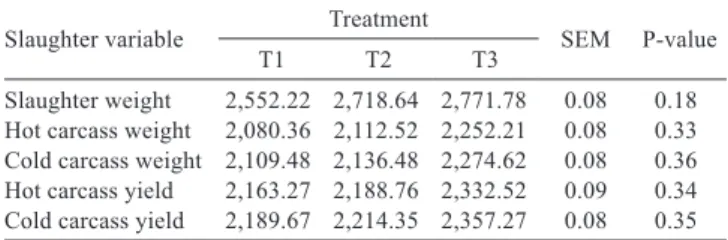
No significant statistical differences (P>0.05) were
found among treatments regarding meat production
variables. In the current study, the group treated with MOO
had high values among slaughter variables, followed by
control and oxytetracycline treatment groups (Table 5).
Similar results were observed in hot carcass weight, cold
carcass weight, hot carcass yield, and cold carcass yield by
Mendez-Zamora et al. (2015) and by Kırkpınar et al. (2014)
only on carcass yields.
Conclusions
Supplementation of 0.4 g kg
−1of Mexican oregano
oil has positive effect on body weight, feed intake, and
feed efficiency. Mexican oregano oil can be used as a
supplement in the diet of broilers to improve health and
slaughter parameters.
Acknowledgments
This study was supported by Facultad de Zootecnia
y Ecologia, Universidad Autónoma de Chihuahua, which
provided the installations and some ingredients of diets.
References
Adil, S.; Banday, T.; Ahmad Bhat, G.; Salahuddin, M.; Raquib, M. and Shanaz, S. 2011. Response of broiler chicken to dietary supplementation of organic acids. Journal of Central European Agriculture 12:498-508.
Basmacıoğlu, H.; Tokuşoğlu, Ö. and Ergül, M. 2004. The effect of oregano and rosemary essential oils or alpha-tocopheryl acetate on performance and lipid oxidation of meat enriched with n-3 PUFA’s in broilers. South African Society for Animal Science 34:197-210. Benjamin M. N. 1984. Manual de patología clínica veterinaria. 3. ed.
Limusa, Mexico. 421p.
Bozkurt, M.; Küçükyılmaz, K.; Çatlı, A. U. and Çınar, M. 2009. Effect of dietary mannan oligosaccharide with or without oregano essential oil and hop extract supplementation on the performance and slaughter characteristics of male broilers. South African Society for Animal Science 39:223-232.
Brenes, A. and Roura, E. 2010. Essential oils in poultry nutrition: mail effects and modes of action. Animal Feed Science and Technology 158:1-14.
Cabuk, M.; Bozkurt, M.; Alcicek, A.; Akbas, Y. and Kücüyilmaz, K. 2006. Effect of an herbal essential oil mixture on growth and internal organ weight of broilers from young and old breeder flocks. South African Society for Animal Science 36:135-141. Cho, J. H.; Kim, I. H. and Kim, I. J. 2014. Effects of phytogenic feed
additive on growth performance, digestibility, blood metabolites, intestinal microbiota, meat color and relative organ weight after oral challenge with clostridium perfringens in broilers. Livestock Science 160:82-88.
Cohn, J. S.; McNamara, J. R. and Schaefer, E. J. 1988. Lipoprotein cholesterol concentrations in the plasma of human subjects as measured in the fed and fasted states. Clinical Chemistry 34:2456-2459.
Dunford, N. T. and Silva, V. R. 2005. Effect of water stress on plant growth and thymol and carvacrol concentrations in Mexican oregano grown under controlled conditions. Journal of Applied Horticulture 7:20-22.
El-Ghany, W. A. A. and Ismail, M. 2013. Tackling of experimental colisepticaemia in broiler chickens using phytobiotic essential oils and antibiotic alone or in combination. Iranian Journal of Veterinary Research 15:110-115.
Gopi, M.; Karthik, K.; Manjunathachar, H. V.; Tamilmahan, P.; Kesavan, M.; Dashprakash, M.; Balaraju, B. L. and Purushothaman, M. R. 2014. Essential oils as a feed additive in poultry nutrition. Advances in Animal and Veterinary Sciences 2:1-7.
Hashemipour, H.; Khaksar, V.; Rubio, L.A.; Veldkamp, T. and van Krimpen, M. M. 2016. Effect of feed supplementation with a thymol plus carvacrol mixture, in combination or not with an NSP-degrading enzyme, on productive and physiological parameters of broilers fed on wheat-based diets. Animal Feed Science and Technology 211:117-131.
Hassanpour, H.; Moghaddam, A. K. Z.; Khosravi, M. and Mayahi, M. 2013. Effects of synbiotic on the intestinal morphology and humoral immune response in broiler chickens. Livestock Science 153:116-122.
Slaughter variable Treatment SEM P-value
T1 T2 T3
Slaughter weight 2,552.22 2,718.64 2,771.78 0.08 0.18 Hot carcass weight 2,080.36 2,112.52 2,252.21 0.08 0.33 Cold carcass weight 2,109.48 2,136.48 2,274.62 0.08 0.36 Hot carcass yield 2,163.27 2,188.76 2,332.52 0.09 0.34 Cold carcass yield 2,189.67 2,214.35 2,357.27 0.08 0.35
T1: control diet; T2: control diet + 0.25 g kg–1 oxytetracycline (Bayer); T3: control diet + 0.4 g kg–1 Mexican oregano oil (4.06% thymol and 60.62% carvacrol). SEM - standard error of means.
Hippenstiel, F.; Abdel-Wareth, A.A.A.; Kehraus, S. and Südekum, K.-H. 2011. Effects of selected herbs and essential oils, and their active components on feed intake and performance of broilers – a review. Archiv fur Geflügelkunde 75:226-234.
Hong, J. C.; Steiner, T.; Aufy, A. and Lien, T. F. 2012. Effects of supplemental essential oil on growth performance, lipid metabolites and immunity, intestinal characteristics, microbiota and carcass traits in broilers. Livestock Science 137:219-225.
INEGI - Instituto Nacional de Estadística y Geografía e Informatica. 2013. Mexico en cifras: Información Nacional por Entidad Federativa y Municipios. Available at: <www3.inegi.org.mx/ sistemas/mexicocifras/default.aspx.>. Accessed on: Dec. 14, 2013. Jamroz, D.; Orda, J.; Kamel, C.; Wiliczkiewicz, A.; Wertelecki, T.
and Skorupinska, J. 2005. The influence of phytogenic extracts on performance, nutrient digestibility, carcass characteristics and gut microbial status in broiler chickens. Journal of Animal and Feed Sciences 12:583-596.
Karimi, A.; Yan, F.; Coto, C.; Park, J. H.; Min, Y.; Lu, C.; Gidden, J. A.; Lay Jr., J. O. and Waldroup, P. W. 2010. Effect of level and source of oregano leaf in starter diets for broiler chicks. Journal of Applied Poultry Research 19:137-145.
Kırkpınar, F.; Ünlü, H. B. and Özdemir, G. 2011. Effects of oregano and garlic essential oils on performance, carcase, organ and blood characteristics and intestinal microflora of broilers. Livestock Science 137:219-225.
Kırkpınar, F.; Ünlü, H. B., Serdaroğlu, M. and Turp, G. Y. 2014. Effects of dietary oregano and garlic essential oils on carcass characteristics, meat composition, colour, pH and sensory quality of broiler meat. British Poultry Science 55:157-166.
Küçükyılmaz, K.; Bozkurt, M.; Çınar, M.; Çatlı, A. U.; Bintaş, E. and Erkek, R. 2014. The effects of an organic rearing system and dietary supplementation of an essential oil mixture on performance and meat yield of slow-growing broilers in two seasons. South African Journal of Animal Science 44:360-370.
Lee, K.; Everts, H.; Kappert, H. J.; Frehner, M.; Losa, R. and Beynen, A. C. 2003. Dietary carvacrol lowers body weight but improves feed conversion in female broiler chickens. Journal of Applied Poultry Research 12:394-399.
Medway, W.; Prier, J. E. and Wilkinson, J. S. 1969. A textbook of veterinary clinical pathology. Williams & Wilkins Co, Baltimore, Inglaterra. 522p.
Mendez-Zamora, G.; García-Macías, J. A.; Durán-Meléndez, L. A.; Herman-Lara, E.; Santellano-Estrada, E. and Silva-Vazquez, R. 2015. Aceite esencial de orégano (Lippia berlandieri Schauer) en variables de calidad de la canal de pollo. Ecosistemas y Recursos Agropecuarios 2:41-51.
Mohiti-Asli, M. and Ghanaatparast-Rashti, M. 2015. Dietary oregano essential oil alleviates experimentally induced coccidiosis in broilers. Preventive Veterinary Medicine 120:195-202.
Mountzouris, K. C.; Paraskevas, V.; Tsirtsikos, P.; Palamidi, I.; Steiner, T.; Schatzmayr, G. and Fegeros, K. 2011. Assessment of a phytogenic feed additive effect on broiler growth performance,
nutrient digestibility and caecal microflora composition. Animal Feed Science and Technology 168:223-231.
Najafi, P. and Torki, M. 2010. Performance, blood metabolites and immunocompetence of broiler chicks fed diets included essential oils of medicinal herbs. Journal of Animal and Veterinary Advances 9:1164-1168.
NOM-062-ZOO-1999. 1999. Norma Oficial Mexicana, especificaciones técnicas para la producción, cuidado y uso de animales de laboratorio. Available at: <http://www.economia-noms. gob.mx/noms/consultasAction.do>. Accessed on: Nov. 20, 2015. NRC - National Research Council. 1994. Nutritional requirements of
poultry. 9th ed. National Academy Press, Washington, DC. Ocak, N.; Erener, G.; Burak, A. K.; Sungu, F.; Altop, M. and Ozmen,
A. 2008. Performance of broilers fed diets supplemented with dry peppermint (Mentha piperita L.) or thyme (Thymus vulgaris L.) leaves as growth promoter source. Czech Journal of Animal Science 53:169-175.
Park, J. H.; Kang, S. N.; Chu, G. M. and Jin, S. K. 2014. Growth performance, blood cell profiles, and meat quality properties of broilers fed with Saposhnikovia divaricata, Lonicera japonica, and Chelidonium majus extracts. Livestock Science 165:87-94. Silva Vázquez, R; Durán Meléndez, L. A.; Santellano Estrada, E.;
Rodríguez Muela, C.; Villalobos Villalobos, G.; Méndez Zamora, G. and Hume, E. M. 2015. Performance of broiler chickens supplemented with Mexican oregano oil (Lippia berlandieri Schauer). Revista Brasileira de Zootecnia 44:283-289.
Silva, V. R. and Dunford, T. N. 2005. Bioactive components of mexican oregano oil as affected by moisture and plant maturity. Journal of Essential Oil Research 17:668-671.
Sugiharto, S. 2014. Role of nutraceuticals in gut health and growth performance of poultry. Journal of the Saudi Society of Agricultural Sciences, <http://dx.doi.org/10.1016/j.jssas.2014.06.001>. Accessed on: Nov. 25, 2015.
Symeon, G. K.; Zintilas, C.; Ayoutanti, A.; Bizelis, J. A. and Deligeorgis, S. G. 2009. Effect of dietary oregano essential oil supplementation for an extensive fattening period on growth performance and breast meat quality of female medium-growing broilers. Canadian Journal of Animal Science 89:331-334. Tiihonen, K.; Kettunen, H.; Bento, M. H.; Saarinen, M.; Lathinen, S.;
Ouwe-hand, A. C.; Sculze, H. and Rautonen, N. 2010. The effect of feeding essential oils on broiler performance and gut microbiota. British Poultry Science 51:381-392.
Wang, Z. and Goonewardene, L. A. 2004. The use of MIXED models in the analysis of animal experiments with repeated measures data. Canadian Journal of Animal Science 84:1-11.
Windisch, W. and Kroismayr, A. 2007. Natural phytobiotics for health of young piglets and poultry: mechanisms and application. Poultry Science 86(Suppl. 1):643.